


Questions
4 questionsShowing 1–4 of 4 questions
-
- (A) \(0.1\)
- (B) \(0.5\)
- (C) \(0.7\)
- (D) \(0.3\)
Show answer and solution
Correct Answer: (A)
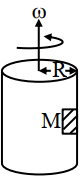
The normal force \(N\) provides the necessary centripetal force for the mass to move in a circle:
\(N = m \omega^2 R\)
For the mass to remain stuck to the wall without falling, the upward frictional force must balance the downward gravitational force:
\(f \ge mg\)
Since the maximum static friction is \(f_{max} = \mu N\), we have:
\(\mu N \ge mg\)
\(\mu (m \omega^2 R) \ge mg\)
\(\mu \ge \dfrac{g}{\omega^2 R}\)
Substituting the given values \(g = 10\) m/s\(^2\), \(\omega = 5\) rad/s, and \(R = 4\) m:
\(\mu \ge \dfrac{10}{5^2 \times 4}\)
\(\mu \ge \dfrac{10}{100}\)
\(\mu \ge 0.1\)
The minimum coefficient of friction is \(0.1\).
Answer: \(0.1\) -
- (A) \( \sqrt{\frac{\mu g}{R}} \)
- (B) \( \sqrt{\frac{2g}{\mu R}} \)
- (C) \( \sqrt{\frac{g}{2\mu R}} \)
- (D) \( \sqrt{\frac{g}{\mu R}} \)
Show answer and solution
Correct Answer: (D)
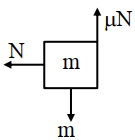
\(N = m \omega^2 r , mg =\mu N\)
\(\mu \times m \omega^2 r = mg\)
\(\omega=\sqrt{\frac{g}{\mu r}}\) -
- (A) 150
- (B) 210
- (C) 180
- (D) 250
Show answer and solution
Correct Answer: (B)
For 8 kg to move with constant velocity \(F _{\text {net }}=0\).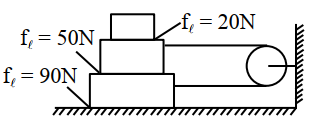
\(\therefore F =90+ T +50\) (for 8kg block)
\(T =20+50\) (for 6 kg block )
\(\therefore F =210 N\). -
- (A) \(3/4\)
- (B) \(2/3\)
- (C) \(5/9\)
- (D) \(4/9\)
Show answer and solution
Correct Answer: (C)
Let the length of the inclined plane be \(s\).
For the smooth inclined plane, the acceleration of the block is \(a_1 = g \sin \theta\).
The time taken to slide down is \(t_1 = \sqrt{\dfrac{2s}{a_1}} = \sqrt{\dfrac{2s}{g \sin \theta}}\).
For the rough inclined plane, the acceleration of the block is \(a_2 = g \sin \theta - \mu_k g \cos \theta\).
The time taken to slide down is \(t_2 = \sqrt{\dfrac{2s}{a_2}} = \sqrt{\dfrac{2s}{g (\sin \theta - \mu_k \cos \theta)}}\).
Given that \(t_2\) is \(50\%\) more than \(t_1\), we have \(t_2 = t_1 + 0.5 t_1 = \dfrac{3}{2} t_1\).
Squaring both sides gives \(t_2^2 = \dfrac{9}{4} t_1^2\).
Substituting the expressions for \(t_1^2\) and \(t_2^2\):
\(\dfrac{2s}{g (\sin \theta - \mu_k \cos \theta)} = \dfrac{9}{4} \left( \dfrac{2s}{g \sin \theta} \right)\)
\(\dfrac{1}{\sin \theta - \mu_k \cos \theta} = \dfrac{9}{4 \sin \theta}\)
\(4 \sin \theta = 9 \sin \theta - 9 \mu_k \cos \theta\)
\(9 \mu_k \cos \theta = 5 \sin \theta\)
\(\mu_k = \dfrac{5}{9} \tan \theta\)
Given \(\theta = 45^\circ\), we have \(\tan 45^\circ = 1\).
\(\mu_k = \dfrac{5}{9} \times 1 = \dfrac{5}{9}\)
Answer: \(5/9\)
No questions on this page match these filters.