


Questions
23 questionsShowing 1–23 of 23 questions
-
- (A) 429
- (B) 550
- (C) 650
- (D) 380
Show answer and solution
Correct Answer: (A)
\(y=n\frac{\lambda D}{d}\)
\(y_{1}=y_{2}\)
\(n_{1}\lambda_{1}\frac{D}{d}=n_{2}\lambda_{2}\frac{D}{d}\)
\(\frac{n_{1}}{n_{2}}=\frac{\lambda_{2}}{\lambda_{1}}=\frac{550}{650}=\frac{11}{13}\)
\(y=11\times\frac{\lambda_{1}D}{d}=\frac{11\times650\times10^{-9}\times1.2}{2\times10^{-3}}\)
\(y=429\times10^{-5}\) -
- (A) \(\dfrac{D\lambda}{a}\)
- (B) \(1.5\dfrac{D\lambda}{a}\)
- (C) \(2\dfrac{D\lambda}{a}\)
- (D) \(3\dfrac{D\lambda}{a}\)
Show answer and solution
Correct Answer: (C)
The position of the \(n^{th}\) minimum in a single slit diffraction pattern on a screen at distance \(D\) is given by \(y_n = \dfrac{n D \lambda}{a}\).
For the \(1^{st}\) minimum, \(n = 1\), so \(y_1 = \dfrac{D \lambda}{a}\).
For the \(3^{rd}\) minimum, \(n = 3\), so \(y_3 = \dfrac{3 D \lambda}{a}\).
The linear separation between the \(1^{st}\) and \(3^{rd}\) minima on the same side of the central maximum is \(\Delta y = y_3 - y_1\).
\(\Delta y = \dfrac{3 D \lambda}{a} - \dfrac{D \lambda}{a} = 2\dfrac{D \lambda}{a}\).
Answer: \(2\dfrac{D\lambda}{a}\) -
- (A) \(61\)
- (B) \(122\)
- (C) \(244\)
- (D) \(305\)
Show answer and solution
Correct Answer: (B)
The limit of resolution of a telescope is given by the formula:
\(\Delta \theta = \dfrac{1.22 \lambda}{R}\)
where \(\lambda\) is the wavelength of light and \(R\) is the diameter of the objective lens.
Given:
\(\lambda = 500 \text{ nm} = 500 \times 10^{-9} \text{ m} = 5 \times 10^{-7} \text{ m}\)
\(\Delta \theta = 5 \times 10^{-7} \text{ rad}\)
Substituting the values into the formula:
\(5 \times 10^{-7} = \dfrac{1.22 \times 5 \times 10^{-7}}{R}\)
\(R = 1.22 \text{ m}\)
Converting to centimeters:
\(R = 1.22 \times 100 \text{ cm} = 122 \text{ cm}\)
Answer: \(122\) -
- (A) \( 60^{\circ} \)
- (B) \( 10^{\circ} \)
- (C) \( 30^{\circ} \)
- (D) \( 45^{\circ} \)
Show answer and solution
Correct Answer: (A)
Brewester's law
\( tan~\theta=\mu_{rel}=\sqrt{3} \)
\( \theta=60^{\circ} \) -
- (A) \((E_x\hat{i} + E_y\hat{j})\sin(kx - kz - \omega t)\)
- (B) \((E_x\hat{i} + E_z\hat{k})\sin(kx + ky - \omega t)\)
- (C) \((E_x\hat{j} + E_y\hat{k})\sin(ky + kz - \omega t)\)
- (D) \((E_x\hat{i} + E_y\hat{j} + E_z\hat{k})\sin(kx + ky - kz - \omega t)\)
Show answer and solution
Correct Answer: (A)
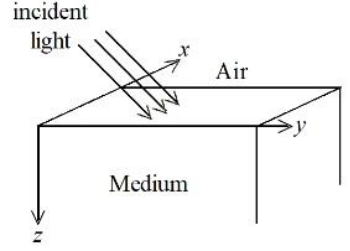
From the given figure, the incident light rays lie in the \(xz\)-plane. Therefore, the plane of incidence is the \(xz\)-plane.
The incident wave travels from the air (\(z < 0\)) towards the medium (\(z > 0\)), so it propagates in the \(+x\) and \(+z\) directions. The reflected wave will travel back into the air, meaning it propagates in the \(+x\) and \(-z\) directions.
The wave vector for the reflected wave can be written as \(\vec{k}_r = k_x \hat{i} - k_z \hat{k}\).
The phase of the reflected wave is given by \(\vec{k}_r \cdot \vec{r} - \omega t = k_x x - k_z z - \omega t\). This phase matches the expression in option (1).
According to Brewster's law, when unpolarized light is incident at the Brewster angle, the reflected light is completely polarized perpendicular to the plane of incidence. Since the plane of incidence is the \(xz\)-plane, the reflected electric field must be entirely along the \(y\)-axis (\(\hat{j}\) direction).
Let us verify this with option (1), which gives the electric field as \(\vec{E} = E_x \hat{i} + E_y \hat{j}\).
For an electromagnetic wave, the electric field must be perpendicular to the direction of propagation, so \(\vec{k}_r \cdot \vec{E} = 0\).
\((k_x \hat{i} - k_z \hat{k}) \cdot (E_x \hat{i} + E_y \hat{j}) = 0\)
\(k_x E_x = 0\)
Since \(k_x \neq 0\), we must have \(E_x = 0\). This leaves \(\vec{E} = E_y \hat{j}\), which means the wave is purely polarized along the \(y\)-axis. This perfectly satisfies the condition for reflection at the Brewster angle.
Thus, the correct expression representing the reflected wave is \((E_x\hat{i} + E_y\hat{j})\sin(kx - kz - \omega t)\).
Answer: \((E_x\hat{i} + E_y\hat{j})\sin(kx - kz - \omega t)\) -
- (A) \(3/4\)
- (B) \(4/3\)
- (C) \(9/4\)
- (D) \(4/9\)
Show answer and solution
Correct Answer: (C)
Let the intensity of the incident unpolarized light be \(I_0\).
After passing through the first polarizer, the intensity becomes \(I_1 = \dfrac{I_0}{2}\).
Without the third polarizer, the light passes directly from the first polarizer (at \(30^{\circ}\)) to the second polarizer (at \(90^{\circ}\)). The angle between their transmission axes is \(90^{\circ} - 30^{\circ} = 60^{\circ}\).
Using Malus's law, the output intensity without the third polarizer is:
\(I_{without} = I_1 \cos^2(60^{\circ}) = \dfrac{I_0}{2} \times \left(\dfrac{1}{2}\right)^2 = \dfrac{I_0}{8}\)
When the third polarizer (at \(60^{\circ}\)) is placed between them, the light first passes from the first polarizer to the third polarizer. The angle between their axes is \(60^{\circ} - 30^{\circ} = 30^{\circ}\).
The intensity after the third polarizer is:
\(I_3 = I_1 \cos^2(30^{\circ}) = \dfrac{I_0}{2} \times \left(\dfrac{\sqrt{3}}{2}\right)^2 = \dfrac{3I_0}{8}\)
The light then passes from the third polarizer to the second polarizer. The angle between their axes is \(90^{\circ} - 60^{\circ} = 30^{\circ}\).
The final output intensity with the third polarizer is:
\(I_{with} = I_3 \cos^2(30^{\circ}) = \dfrac{3I_0}{8} \times \left(\dfrac{\sqrt{3}}{2}\right)^2 = \dfrac{9I_0}{32}\)
The ratio of the output intensities with and without the third polarizer is:
\(\text{Ratio} = \dfrac{I_{with}}{I_{without}} = \dfrac{\dfrac{9I_0}{32}}{\dfrac{I_0}{8}} = \dfrac{9}{4}\)
Answer: \(9/4\) -
- (A) 15
- (B) 25
- (C) 30
- (D) 35
Show answer and solution
Correct Answer: (C)
Intensity of light after passing through the first polarizer is:
\(I_1 = \dfrac{I_o}{2}\)
Let the optically active solution rotate the plane of polarization by an angle \(\theta\). Since the angle between the polarizer and the analyser is \(0^\circ\), the angle between the plane of polarization of the light emerging from the solution and the transmission axis of the analyser is also \(\theta\).
According to Malus's law, the intensity of light emerging from the analyser is:
\(I_2 = I_1 \cos^2 \theta = \dfrac{I_o}{2} \cos^2 \theta\)
Given that the final intensity is \(\dfrac{3}{8}I_o\), we have:
\(\dfrac{I_o}{2} \cos^2 \theta = \dfrac{3}{8}I_o\)
\(\cos^2 \theta = \dfrac{3}{4}\)
\(\cos \theta = \dfrac{\sqrt{3}}{2}\)
\(\theta = 30^\circ\)
Answer: \(30\) -
- (A) Both Statement-I and Statement-II are false.
- (B) Both Statement-I and Statement-II are true.
- (C) Statement-I is true but Statement-II is false.
- (D) Statement-I is false but Statement-II is true.
Show answer and solution
Correct Answer: (C)
Increasing the slit width 'a' decreases the diffraction angle ( \(\theta=\lambda / a\) ) and reduces the spreading of the wave. A narrower slit produces a more pronounced spherical wave (high curvature) while a wider slit leads to a flatter, less curved wave. -
- (A) Both Statement I and Statement II are true
- (B) Both Statement I and Statement II are false
- (C) Statement I is false but Statement II is true
- (D) Statement I is true but Statement II is false
Show answer and solution
Correct Answer: (C)
Angular fringe width \(=\frac{\lambda}{d}\) -
- (A) \(8 \times 10^{-4}\)
- (B) \(6.0 \times 10^{-3}\)
- (C) \(5.6 \times 10^{-4}\)
- (D) \(5.0 \times 10^{-3}\)
Show answer and solution
Correct Answer: (A)
\(d \sin \theta=(\mu-1) t\)
\(d \left[\frac{ x }{ D }\right]=(\mu-1) t\)
\(t=\frac{x d}{D(\mu-1)}\)
\(=\frac{(0.2)(0.1)}{50(1.5-1)}\)
\(t =8 \times 10^{-4} cm\) -
- (A) 5600
- (B) 5625
- (C) 5650
- (D) 5700
Show answer and solution
Correct Answer: (B)
The shift in the central fringe due to the introduction of a transparent sheet of thickness \(t\) and refractive index \(\mu\) is given by \(\Delta y = \dfrac{D}{d}(\mu - 1)t\).
The position of the \(n^{th}\) bright fringe is \(y_n = n \dfrac{D\lambda}{d}\).
Equating the two, we get:
\(\dfrac{D}{d}(\mu - 1)t = n \dfrac{D\lambda}{d}\)
\((\mu - 1)t = n\lambda\)
Substituting the given values:
\((1.56 - 1)t = 7 \times 450 \times 10^{-9}\)
\(0.56 t = 3150 \times 10^{-9}\)
\(t = \dfrac{3150}{0.56} \times 10^{-9}\)
\(t = 5625 \times 10^{-9}\) m
Comparing with \(t = \alpha \times 10^{-9}\) m, we get \(\alpha = 5625\).
Answer: \(5625\) -
- (A) \(4000\)
- (B) \(3000\)
- (C) \(2000\)
- (D) \(1000\)
Show answer and solution
Correct Answer: (C)
Let the intensity due to each individual slit be \(I_0\).
The resultant intensity \(I_R\) at a point where the phase difference is \(\phi\) is given by:
\(I_R = I_1 + I_2 + 2\sqrt{I_1 I_2} \cos \phi\)
Given that \(I_1 = I_2 = I_0\) and the resultant intensity \(I_R = I_0\), we can substitute these values into the equation:
\(I_0 = I_0 + I_0 + 2\sqrt{I_0 \cdot I_0} \cos \phi\)
\(I_0 = 2I_0 + 2I_0 \cos \phi\)
\(I_0 = 2I_0 (1 + \cos \phi)\)
\(1 + \cos \phi = \dfrac{1}{2}\)
\(\cos \phi = -\dfrac{1}{2}\)
The minimum phase difference satisfying this condition is:
\(\phi = \dfrac{2\pi}{3}\)
The relationship between phase difference \(\phi\) and path difference \(\Delta x\) is:
\(\phi = \dfrac{2\pi}{\lambda} \Delta x\)
Substituting the value of \(\phi\):
\(\dfrac{2\pi}{3} = \dfrac{2\pi}{\lambda} \Delta x\)
\(\Delta x = \dfrac{\lambda}{3}\)
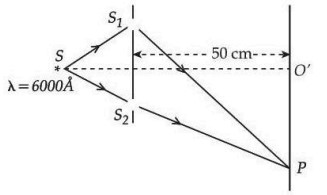
Given the wavelength \(\lambda = 6000 \text{ \AA}\):
\(\Delta x = \dfrac{6000}{3} = 2000 \text{ \AA}\)
Answer: \(2000\) -
- (A) 10
- (B) 12
- (C) 14
- (D) 16
Show answer and solution
Correct Answer: (C)
\(y _{\text {shift }}=\frac{(\mu-1) t \cdot D }{ d }\)
\(20910^{-3}=\frac{(\mu-1) \times 20 \times 10^{-6} \times 1}{0.4 \times 10^{-3}}\)
\((\mu-1) \Rightarrow 0.4\)
\(\mu \Rightarrow 1.4\)
\(\frac{\alpha}{10}=1.4, \alpha=14\) -
- (A) 1
- (B) 3
- (C) 5
- (D) 6
Show answer and solution
Correct Answer: (D)
The intensity at a point in Young's double slit experiment is given by \(I = I_{max} \cos^2\left(\dfrac{\phi}{2}\right)\)
Given \(I = \dfrac{3}{4} I_{max}\)
\(\dfrac{3}{4} I_{max} = I_{max} \cos^2\left(\dfrac{\phi}{2}\right)\)
\(\cos\left(\dfrac{\phi}{2}\right) = \dfrac{\sqrt{3}}{2}\)
\(\dfrac{\phi}{2} = \dfrac{\pi}{6}\)
\(\phi = \dfrac{\pi}{3}\)
The phase difference \(\phi\) is related to the path difference \(\Delta x\) by \(\phi = \dfrac{2\pi}{\lambda} \Delta x\)
\(\dfrac{2\pi}{\lambda} \Delta x = \dfrac{\pi}{3}\)
\(\Delta x = \dfrac{\lambda}{6}\)
Comparing with \(\Delta x = \dfrac{\lambda}{x}\), we get \(x = 6\)
Answer: \(6\) -
- (A) \(3\)
- (B) \(4\)
- (C) \(1/3\)
- (D) \(1/4\)
Show answer and solution
Correct Answer: (C)
The phase difference \(\Delta \phi\) is related to the path difference \(\Delta x\) by the relation \(\Delta \phi = \dfrac{2\pi}{\lambda} \Delta x\).
For point \(A\), the path difference is \(\Delta x_A = \dfrac{\lambda}{3}\).
\(\Delta \phi_A = \dfrac{2\pi}{\lambda} \times \dfrac{\lambda}{3} = \dfrac{2\pi}{3}\)
The intensity at point \(A\) is given by \(I_A = I_{max} \cos^2\left(\dfrac{\Delta \phi_A}{2}\right)\).
\(I_A = I_{max} \cos^2\left(\dfrac{\pi}{3}\right) = I_{max} \left(\dfrac{1}{2}\right)^2 = \dfrac{I_{max}}{4}\)
For point \(B\), the path difference is \(\Delta x_B = \dfrac{\lambda}{6}\).
\(\Delta \phi_B = \dfrac{2\pi}{\lambda} \times \dfrac{\lambda}{6} = \dfrac{\pi}{3}\)
The intensity at point \(B\) is given by \(I_B = I_{max} \cos^2\left(\dfrac{\Delta \phi_B}{2}\right)\).
\(I_B = I_{max} \cos^2\left(\dfrac{\pi}{6}\right) = I_{max} \left(\dfrac{\sqrt{3}}{2}\right)^2 = \dfrac{3I_{max}}{4}\)
The ratio of intensities at points \(A\) and \(B\) is:
\(\dfrac{I_A}{I_B} = \dfrac{\dfrac{I_{max}}{4}}{\dfrac{3I_{max}}{4}} = \dfrac{1}{3}\)
Answer: \(1/3\) -
- (A) 32
- (B) 36
- (C) 38
- (D) 40
Show answer and solution
Correct Answer: (B)
The angular width of the central maximum in a single slit diffraction pattern is given by \(\Delta \theta = \dfrac{2\lambda}{a}\)
Substituting the given values:
\(\lambda = 628 \times 10^{-9}\) m
\(a = 0.2 \times 10^{-3}\) m
\(\Delta \theta = \dfrac{2 \times 628 \times 10^{-9}}{0.2 \times 10^{-3}}\) rad
\(\Delta \theta = 6280 \times 10^{-6}\) rad \(= 6.28 \times 10^{-3}\) rad
To convert radians to degrees, multiply by \(\dfrac{180}{\pi}\):
\(\Delta \theta = 6.28 \times 10^{-3} \times \dfrac{180}{3.14}\) degrees
\(\Delta \theta = 2 \times 10^{-3} \times 180\) degrees
\(\Delta \theta = 360 \times 10^{-3}\) degrees \(= 36 \times 10^{-2}\) degrees
Comparing this with \(\alpha \times 10^{-2}\) degrees, we get \(\alpha = 36\).
Answer: \(36\) -
- (A) \(2I_{0}\)
- (B) \(I_{0}\)
- (C) \(\frac{I_{0}}{2}\)
- (D) \(4I_{0}\)
Show answer and solution
Correct Answer: (B)
\(d =2 mm\)
\(D =10 m\)
\(\lambda=6000 \)Å
\(y=\frac{d}{2}(\) in front of one slit \()\)
\(I=4 I_0 \cos ^2\left(\frac{2 \pi}{\lambda} \cdot \frac{y}{D} d\right)\)
\(\Rightarrow I = I _0\) -
- (A) 1
- (B) 2
- (C) 4
- (D) 8
Show answer and solution
Correct Answer: (C)
\(\beta_1=\beta_2\)
\(\frac{ D _1 \lambda_1}{d_1}=\frac{ D _2 \lambda_2}{d_2}\)
\(\frac{ D _1}{ D _2}=\frac{\lambda_2}{\lambda_1}\left(\frac{d_1}{d_2}\right)\)
\(=2 \times 2\)
\(\frac{ D _1}{ D _2}=4\) -
- (A) \(1.2\)
- (B) \(2\)
- (C) \(2.4\)
- (D) \(2.88\)
Show answer and solution
Correct Answer: (B)
The fringe width in Young's double slit experiment is given by \(\beta = \dfrac{\lambda D}{d}\).
When the experiment is performed in a medium of refractive index \(\mu\), the wavelength of light becomes \(\lambda' = \dfrac{\lambda}{\mu}\).
The new fringe width is \(\beta' = \dfrac{\lambda' D}{d} = \dfrac{\lambda D}{\mu d} = \dfrac{\beta}{\mu}\).
Substituting the given values, \(\beta = 2.4\) \(\mu\)m and \(\mu = 1.2\):
\(\beta' = \dfrac{2.4}{1.2} = 2\) \(\mu\)m.
Answer: \(2\) -
- (A) 200
- (B) 203
- (C) 208
- (D) 215
Show answer and solution
Correct Answer: (B)
The angular resolution \(\Delta \theta\) of a telescope is given by the formula:
\(\Delta \theta = \dfrac{1.22 \lambda}{a}\)
where \(\lambda\) is the wavelength of light and \(a\) is the diameter of the objective lens.
Given:
\(\Delta \theta = 3.0 \times 10^{-7}\) rad
\(\lambda = 500 \text{ nm} = 500 \times 10^{-9}\) m \(= 5 \times 10^{-7}\) m
Substituting the values into the formula:
\(3.0 \times 10^{-7} = \dfrac{1.22 \times 5 \times 10^{-7}}{a}\)
\(a = \dfrac{1.22 \times 5 \times 10^{-7}}{3.0 \times 10^{-7}}\)
\(a = \dfrac{6.1}{3.0}\) m
\(a = 2.0333...\) m
Converting the diameter into centimeters:
\(a = 2.0333... \times 100\) cm \(= 203.33\) cm
Rounding to the nearest integer, we get \(203\) cm.
Answer: \(203\) -
- (A) \(\dfrac{I_0}{4}\)
- (B) \(\dfrac{I_0}{2}\)
- (C) \(I_0\)
- (D) \(\dfrac{3I_0}{4}\)
Show answer and solution
Correct Answer: (B)
The position of the point on the screen exactly opposite to one of the slits is at a distance \(y = \dfrac{d}{2}\) from the central maximum.
The path difference \(\Delta x\) at this point is given by:
\(\Delta x = \dfrac{yd}{D}\)
Substituting \(y = \dfrac{d}{2}\) and \(D = 10d\):
\(\Delta x = \dfrac{\left(\dfrac{d}{2}\right)d}{10d} = \dfrac{d^2}{20d} = \dfrac{d}{20}\)
Given that the distance between the slits is \(d = 5\lambda\), we have:
\(\Delta x = \dfrac{5\lambda}{20} = \dfrac{\lambda}{4}\)
The corresponding phase difference \(\Delta \phi\) is:
\(\Delta \phi = \dfrac{2\pi}{\lambda} \Delta x = \dfrac{2\pi}{\lambda} \left(\dfrac{\lambda}{4}\right) = \dfrac{\pi}{2}\)
The intensity at this point is given by:
\(I = I_0 \cos^2\left(\dfrac{\Delta \phi}{2}\right)\)
Substituting \(\Delta \phi = \dfrac{\pi}{2}\):
\(I = I_0 \cos^2\left(\dfrac{\pi}{4}\right) = I_0 \left(\dfrac{1}{\sqrt{2}}\right)^2 = \dfrac{I_0}{2}\)
Answer: \(\dfrac{I_0}{2}\) -
- (A) 39.6\(^{\circ}\)
- (B) 32.3\(^{\circ}\)
- (C) 42.6\(^{\circ}\)
- (D) 36.3\(^{\circ}\)
Show answer and solution
Correct Answer: (B)
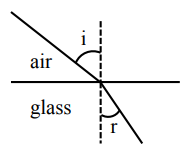
\(\tan i=\frac{\mu_2}{\mu_1}=\frac{\mu_{ g }}{\mu_{ a }}\)
\(\tan i =1.52\)
\(i =57.7^{\circ}\)
\(r =90^{\circ}- i\)
\(r =32.3^{\circ}\) -
- (A) A, D, E only
- (B) A, C only
- (C) B, D only
- (D) B, C only
Show answer and solution
Correct Answer: (B)
Explanation:
Let us derive the correctness of each statement using the standard formula for single slit Fraunhofer diffraction:
The linear width of the central maximum is given by the expression:
\( \beta = \frac{2\lambda D}{a} \)
Where \( \lambda \) is the wavelength of light, \( D \) is the distance between the slit and the screen, and \( a \) is the width of the slit.
1. Analysis of Statement (A) and (B):
From the formula, the width of the central maximum is directly proportional to the wavelength of light \( (\beta \propto \lambda) \). Therefore, if the wavelength increases, the width of the central maximum increases. This makes statement (A) correct and statement (B) incorrect.
2. Analysis of Statement (C) and (D):
The width of the central maximum is inversely proportional to the slit width \( (\beta \propto \frac{1}{a}) \). Therefore, if the slit width decreases, the width of the central maximum increases. This makes statement (C) correct and statement (D) incorrect.
3. Analysis of Statement (E):
The peak intensity (brightness) of the central maximum depends on the square of the slit width \( (I \propto a^2) \) and is independent of the wavelength of the incident light. Therefore, statement (E) is incorrect.
Since only statements (A) and (C) are true, the correct combination is A, C only.
Hence, Option B is the correct choice.
No questions on this page match these filters.