


Questions
14 questionsShowing 1–14 of 14 questions
-
- (A) 20
- (B) 35
- (C) 40
- (D) 50
Show answer and solution
Correct Answer: (B)
The net force acting on the block is the vector sum of the two forces:
\(\vec{F} = \vec{F}_1 + \vec{F}_2 = (2\hat{i} + 3\hat{j} + 4\hat{k}) + (3\hat{i} - \hat{j} - 2\hat{k}) = 5\hat{i} + 2\hat{j} + 2\hat{k}\) N
The block is moved a distance of \(25\) m along the direction of the vector \(3\hat{i} - 4\hat{j}\). The unit vector along this direction is:
\(\hat{n} = \dfrac{3\hat{i} - 4\hat{j}}{\sqrt{3^2 + (-4)^2}} = \dfrac{3\hat{i} - 4\hat{j}}{5}\)
The displacement vector \(\vec{s}\) is the magnitude multiplied by the unit vector:
\(\vec{s} = 25 \hat{n} = 25 \left( \dfrac{3\hat{i} - 4\hat{j}}{5} \right) = 15\hat{i} - 20\hat{j}\) m
The work done \(W\) is the dot product of the net force and the displacement vector:
\(W = \vec{F} \cdot \vec{s} = (5\hat{i} + 2\hat{j} + 2\hat{k}) \cdot (15\hat{i} - 20\hat{j})\)
\(W = (5 \times 15) + (2 \times -20) + (2 \times 0)\)
\(W = 75 - 40 = 35\) J
Answer: \(35\) -
- (A) \(0\)
- (B) \(250\)
- (C) \(1250\)
- (D) \(1000\)
Show answer and solution
Correct Answer: (C)
Given mass \(m = 1\) kg and velocity \(v = 2x^2\).
According to the work-energy theorem, the work done by the net force is equal to the change in kinetic energy of the body.
\(W = \Delta K = K_f - K_i\)
At \(x = 0\) m, initial velocity \(v_i = 2(0)^2 = 0\) m/s.
At \(x = 5\) m, final velocity \(v_f = 2(5)^2 = 50\) m/s.
Initial kinetic energy \(K_i = \dfrac{1}{2} m v_i^2 = 0\) J.
Final kinetic energy \(K_f = \dfrac{1}{2} m v_f^2 = \dfrac{1}{2} \times 1 \times (50)^2 = 1250\) J.
Work done \(W = 1250 - 0 = 1250\) J.
Answer: \(1250\) -
- (A) 200
- (B) 205
- (C) 210
- (D) 220
Show answer and solution
Correct Answer: (A)
Given \(\vec{F} = (2t\hat{i} + 6t^2\hat{j})\) N and \(m = 2\) kg.
Acceleration of the body is \(\vec{a} = \dfrac{\vec{F}}{m} = \dfrac{2t\hat{i} + 6t^2\hat{j}}{2} = t\hat{i} + 3t^2\hat{j}\) m/s\(^2\).
Since the body begins to move from rest, its velocity at time \(t\) is given by \(\vec{v} = \int \vec{a} dt = \int (t\hat{i} + 3t^2\hat{j}) dt = \dfrac{t^2}{2}\hat{i} + t^3\hat{j}\) m/s.
At \(t = 2\) s, the force is \(\vec{F} = 2(2)\hat{i} + 6(2)^2\hat{j} = 4\hat{i} + 24\hat{j}\) N.
At \(t = 2\) s, the velocity is \(\vec{v} = \dfrac{(2)^2}{2}\hat{i} + (2)^3\hat{j} = 2\hat{i} + 8\hat{j}\) m/s.
Power produced by the force is \(P = \vec{F} \cdot \vec{v} = (4\hat{i} + 24\hat{j}) \cdot (2\hat{i} + 8\hat{j})\).
\(P = (4 \times 2) + (24 \times 8) = 8 + 192 = 200\) W.
Answer: \(200\) -
- (A) 49
- (B) 42
- (C) 24
- (D) 12
Show answer and solution
Correct Answer: (C)
\( x(t)=t^{2}+t+1 \)
\( v(t)=2t+1 \)
\( a(t)=2 \)
\( F=4N. \)
\( Displacement=x(3)-x(2)\)
\(=13-7=6m \)
\( W=F.S=4\times6=24J \) -
- (A) \(20\)
- (B) \(25\)
- (C) \(30\)
- (D) \(10\)
Show answer and solution
Correct Answer: (A)
Since the assembly moves with a constant velocity, the acceleration of the mass is zero. The mass is in equilibrium relative to the incline.
The frictional force \(f\) acting on the mass balances the component of gravity along the inclined plane. Therefore, the magnitude of the frictional force is:
\(f = mg \sin 30^\circ\)
Substituting the given values (\(m = 1\text{ kg}\), \(g = 10\text{ m/s}^2\)):
\(f = 1 \times 10 \times \dfrac{1}{2} = 5\text{ N}\)
The direction of the frictional force is upwards along the incline. Since the incline makes an angle of \(30^\circ\) with the horizontal, the frictional force makes an angle of \(90^\circ - 30^\circ = 60^\circ\) with the vertical upward direction.
The displacement \(s\) of the assembly in time \(t = 2\text{ s}\) is vertically upwards:
\(s = vt = 4 \times 2 = 8\text{ m}\)
The work done by the frictional force is:
\(W = f s \cos 60^\circ\)
\(W = 5 \times 8 \times \dfrac{1}{2} = 20\text{ J}\)
Answer: \(20\) -
- (A) \( \frac{3}{5} \)
- (B) \( \frac{1}{5} \)
- (C) \( \frac{2+\sqrt{3}}{5} \)
- (D) \( \frac{2-\sqrt{3}}{5} \)
Show answer and solution
Correct Answer: (B)
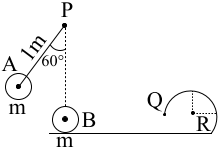
\( V_{A} \) at lowest point
\( V_{A}=\sqrt{2g\ell(1-\cos \theta)} \)
\( V_{A}=\sqrt{2\times10\times1(1-\frac{1}{2})}=\sqrt{10} \)
After collision velocity of B becomes,
\( V_{A}=\sqrt{10}=V_{B} \) (Same mass)
Now to complete circular motion
\( V_{B}=\sqrt{5gR} \)
\( R=\frac{1}{5} \) -
- (A) \(2\)
- (B) \(4\)
- (C) \(3\)
- (D) \(6\)
Show answer and solution
Correct Answer: (B)
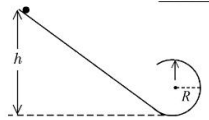
Let \(v\) be the velocity of the body at the highest point of the circular loop.
At the highest point, the forces acting on the body are its weight \(mg\) (downwards) and the normal reaction \(N\) (downwards). The net downward force provides the necessary centripetal acceleration:
\(N + mg = \dfrac{mv^2}{R}\)
Given that the body exerts a force equal to three times its weight on the track at the highest point, we have \(N = 3mg\). Substituting this into the equation:
\(3mg + mg = \dfrac{mv^2}{R}\)
\(4mg = \dfrac{mv^2}{R} \Rightarrow v^2 = 4gR\)
Applying the principle of conservation of mechanical energy between the point of release and the highest point of the loop (which is at a height of \(2R\) from the bottom):
\(mgh = mg(2R) + \dfrac{1}{2}mv^2\)
Substituting \(v^2 = 4gR\) into the energy equation:
\(mgh = 2mgR + \dfrac{1}{2}m(4gR)\)
\(mgh = 2mgR + 2mgR = 4mgR\)
Therefore, \(h = 4R\).
Comparing this with the given relation \(h = \alpha R\), we get \(\alpha = 4\).
Answer: \(4\) -
- (A) \(1980\)
- (B) \(2020\)
- (C) \(2000\)
- (D) \(1000\)
Show answer and solution
Correct Answer: (B)
Using the work-energy theorem, the total work done on the ball is equal to its change in kinetic energy.
Since the ball starts from rest and finally comes to rest, the change in kinetic energy is zero.
\(W_{\text{gravity}} + W_{\text{sand}} = \Delta K = 0\)
The work done by gravity is over the total distance \(h + d\), and the work done by the resistive force of the sand \(F\) is over the distance \(d\).
\(mg(h + d) - Fd = 0\)
\(F = \dfrac{mg(h + d)}{d}\)
Given \(m = 2\) kg, \(g = 10\) m/s\(^2\), \(h = 10\) m, and \(d = 10\) cm \(= 0.1\) m:
\(F = \dfrac{2 \times 10 \times (10 + 0.1)}{0.1}\)
\(F = \dfrac{20 \times 10.1}{0.1}\)
\(F = 20 \times 101 = 2020\) N
Answer: \(2020\) -
- (A) Both Statement I and Statement II are true
- (B) Statement I is false but Statement II is true
- (C) Statement I is true but Statement II is false
- (D) Both Statement I and Statement II are false
Show answer and solution
Correct Answer: (D)
Statement-I: Incorrect
Correct equation is \( W=\int\vec{F}\cdot d\vec{r} \)
Statement-II: Incorrect. -
- (A) 1.75
- (B) 1.44
- (C) 1.15
- (D) 1.95
Show answer and solution
Correct Answer: (B)
\(( K . E )_{\text {lost }}=\frac{1}{2} \mu V_{ rel }^2\left(1- e ^2\right)\)
\(=\frac{1}{2}\left(\frac{m_1 m_2}{m_1+ m _2}\right)(10+30)^2(1-0)\)
\(=\frac{1}{2}\left[\frac{(15)(25)}{40}\right][40]^2\)
\(=7500 J\)
\(( K . E )_{ loss }=\left( m _1+ m _2\right)( S )(\Delta T )\)
\(\left[ S =31 \times 4.2 J / kg -{ }^{\circ} C \right]\)
\(7500=(40)(31)(\Delta T )\)
\(\Delta T =\frac{7500}{40 \times 31 \times 4.2}=1.44^{\circ} C\) -
- (A) \(\sqrt{5gr}\)
- (B) \(\sqrt{\frac{7}{2}gr}\)
- (C) \(\sqrt{4gr}\)
- (D) \(\sqrt{\frac{5}{2}gr}\)
Show answer and solution
Correct Answer: (B)
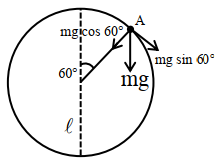
\(T + mg \cos 60^{\circ}=\frac{ mV ^2}{\ell}\)
\(T =0\)
\(V ^2=\frac{ g \ell}{2}\) here V is the speed at point A
M.E.C.
\(\frac{1}{2} mu ^2= mg \left(\ell+\ell \cos 60^{\circ}\right)+\frac{1}{2} mV ^2\)
\(u ^2=3 g \ell+\frac{ g \ell}{2}\)
\(u =\sqrt{\frac{7 g \ell}{2}}\) -
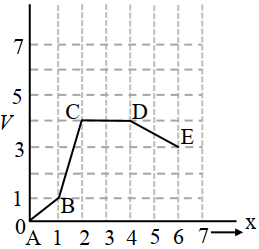
- (A) \(F _{ BC }> F _{ CD }> F _{ DE }> F _{ AB }\)
- (B) \(F _{ CD }> F _{ AB }> F _{ BC }> F _{ DE }\)
- (C) \(F _{ CD }> F _{ DE }> F _{ AB }> F _{ BC }\)
- (D) \(F _{ BC }> F _{ AB }> F _{ DE }> F _{ CD }\)
Show answer and solution
Correct Answer: (D)
Slope of potential energy \(v / s\) position curve gives negative of force.
\(\therefore \quad F _{ BC }> F _{ AB }> F _{ DE }> F _{ CD }\) -
- (A) \(-8.75\)
- (B) \(-8.35\)
- (C) \(-9.55\)
- (D) \(-9.98\)
Show answer and solution
Correct Answer: (D)
Using the work-energy theorem, the total work done by all forces equals the change in kinetic energy:
\(W_{g} + W_{r} = \Delta K\)
\(mgh + W_{r} = \dfrac{1}{2}mv^2 - 0\)
Substituting the given values (\(m = 10^{-3}\) kg, \(g = 10\) m/s\(^2\), \(h = 1000\) m, \(v = 5\) m/s):
\((10^{-3})(10)(1000) + W_{r} = \dfrac{1}{2}(10^{-3})(5)^2\)
\(10 + W_{r} = 0.0125\)
\(W_{r} = 0.0125 - 10 = -9.9875\) J
\(W_{r} \approx -9.98\) J
Answer: \(-9.98\) -
- (A) 4E
- (B) 2E
- (C) 3E
- (D) \( \frac{4}{3}E \)
Show answer and solution
Correct Answer: (C)
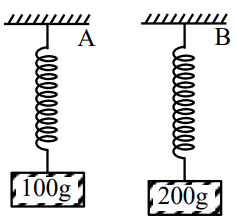
For equilibrium \( kx=mg \)
\( U=\frac{1}{2}kx^{2}=\frac{1}{2}\frac{m^{2}g^{2}}{k} \)
\( U\propto\frac{m^{2}}{k} \)
\( \frac{U_{A}}{U_{B}}=(\frac{m_{A}}{m_{B}})^{2}\frac{k_{B}}{k_{A}}=(\frac{1}{2})^{2}(\frac{4}{3})=\frac{1}{3} \)
\( \frac{E}{U_{B}}=\frac{1}{3}\Rightarrow U_{B}=3E \)
No questions on this page match these filters.