


JEE Mains · Physics · STD 11 - Units,dimensions and measurement
- JEE Mains 2026
- Hard
- MCQ
The diameter of a wire measured by a screw gauge of least count \(0.001\) cm is \(0.08\) cm. The length measured by a scale of least count \(0.1\) cm is \(150\) cm. When a weight of \(100\) N is applied to the wire, the extension in length is \(0.5\) cm, measured by a micrometer of least count \(0.001\) cm. The error in the measured Young's modulus is \(\alpha \times 10^9\) N/m\(^2\). The value of \(\alpha\) is _______.
(Ignore the contribution of the load to Young's modulus error calculation)
Pick an option to check your answer.
Answer & Solution
Correct Answer
(B) \(1.65\)
Step-by-step Solution
Detailed explanation
The formula for Young's modulus is given by:
\(Y = \dfrac{F L_0}{A \Delta L} = \dfrac{4 F L_0}{\pi d^2 \Delta L}\)
Substituting the given values into the formula:
\(Y = \dfrac{4 \times 100 \times 1.5}{\pi \times (0.08 \times 10^{-2})^2 \times (0.5 \times 10^{-2})}\)
\(Y = \dfrac{600}{\pi \times 64 \times 10^{-8} \times 5 \times 10^{-3}} = \dfrac{15}{8\pi} \times 10^{11} \text{ N/m}^2\)
The relative error in Young's modulus is:
\(\dfrac{\Delta Y}{Y} = \dfrac{\Delta L_0}{L_0} + 2\dfrac{\Delta d}{d} + \dfrac{\Delta (\Delta L)}{\Delta L}\)
Substituting the least counts as absolute errors and the measured values:
\(\dfrac{\Delta Y}{Y} = \dfrac{0.1}{150} + 2 \times \dfrac{0.001}{0.08} + \dfrac{0.001}{0.5}\)
\(\dfrac{\Delta Y}{Y} = \dfrac{1}{1500} + \dfrac{1}{40} + \dfrac{1}{500}\)
\(\dfrac{\Delta Y}{Y} = \dfrac{2 + 75 + 6}{3000} = \dfrac{83}{3000}\)
The absolute error in Young's modulus is:
\(\Delta Y = Y \times \dfrac{\Delta Y}{Y} = \left(\dfrac{15}{8\pi} \times 10^{11}\right) \times \dfrac{83}{3000}\)
\(\Delta Y = \dfrac{15 \times 83}{24000 \pi} \times 10^{11} = \dfrac{83}{1600 \pi} \times 10^{11} = \dfrac{83}{16\pi} \times 10^9 \text{ N/m}^2\)
Using \(\pi \approx 3.14\):
\(\Delta Y = \dfrac{83}{16 \times 3.14} \times 10^9 = \dfrac{83}{50.24} \times 10^9 \approx 1.65 \times 10^9 \text{ N/m}^2\)
Comparing this with \(\alpha \times 10^9 \text{ N/m}^2\), we get \(\alpha = 1.65\).
Answer: \(1.65\)
More questions from Physics
- Given is a thin convex lens of glass (refractive index \(\mu\) ) and each side having radius of curvature \(R\). One side is polished for complete reflection. At what distance from the lens, an object be placed on the optic axis so that the image gets formed on the object itself ?JEE Mains 2025 Easy
- The volume \(V\) of an enclosure contains a mixture of three gases, \(16\, g\) of oxygen, \(28\, g\) of nitrogen and \(44\, g\) of carbon dioxide at absolute temperature \(T\). Consider \(R\) as universal gas constant. The pressure of the mixture of gases isJEE Mains 2021 Medium
- Determine the electric dipole moment of the system of three charges, placed on the vertices of an equilateral triangle, as shown in the figure
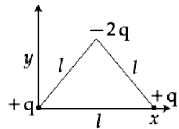 JEE Mains 2019 Hard
- The half life period of a radioactive substance is 60 days. The time taken for \(\frac{7}{8}\) th of its original mass to disintegrate will be \(......days\)JEE Mains 2022 Medium
- The equation of a plane progressive wave is given by \(y = 5\cos\pi\left(200t - \dfrac{x}{150}\right)\) where \(x\) and \(y\) are in cm and \(t\) is in second. The velocity of the wave is _______ m/s.JEE Mains 2026 Easy
- A galvanometer with its coil resistance \(25\,\Omega \) requires a current of \(1\,mA\) for its full deflection. In order to construct an ammeter to read up to a current of \(2\,A,\) the approximate value of the shunt resistance should beJEE Mains 2018 Hard
More PYQs from JEE Mains
- A monochromatic light of wavelength \(6000\)A is incident on the single slit of width \(0.01 \mathrm{~mm}\). If the diffraction pattern is formed at the focus of the convex lens of focal length \(20 \mathrm{~cm}\), the linear width of the central maximum is _______.JEE Mains 2024 Hard
- Consider a parallel plate capacitor of area A (of each plate) and separation 'd' between the plates. If \(E\) is the electric field and \(\varepsilon_0\) is the permittivity of free space between the plates, then potential energy stored in the capacitor isJEE Mains 2025 Easy
- Identify the correct truth table of the given logical circuit.
 JEE Mains 2026 Medium