


All JEE Mains 2026 Physics questions
31 chaptersShowing 401–450 of 469 questions
-
- (A) \(4\)
- (B) \(0.25\)
- (C) \(32\)
- (D) \(16\)
Show answer and solution
Correct Answer: (D)
The terminal velocity of a spherical drop of radius \(r\) falling through a viscous medium is given by Stokes' law:
\(v = \dfrac{2}{9} \dfrac{r^2 (\rho - \sigma) g}{\eta}\)
From this relation, the terminal velocity is directly proportional to the square of the radius of the drop:
\(v \propto r^2\)
When the large drop of radius \(R\) is broken into \(64\) identical droplets of radius \(r\), the total volume remains conserved:
\(\dfrac{4}{3} \pi R^3 = 64 \times \dfrac{4}{3} \pi r^3\)
\(R^3 = 64 r^3\)
\(R = 4r\)
The ratio of the terminal velocities of the original drop and the smaller droplet is:
\(\dfrac{v_1}{v_2} = \dfrac{R^2}{r^2}\)
Substituting \(R = 4r\):
\(\dfrac{v_1}{v_2} = \dfrac{(4r)^2}{r^2} = 16\)
Answer: \(16\) -
- (A) 385
- (B) 386
- (C) 387
- (D) 388
Show answer and solution
Correct Answer: (C)
Let \(A\) be the base area of the wooden cube.
\(A = 10 \text{ cm} \times 10 \text{ cm} = 100 \text{ cm}^2\)
Let \(\Delta x\) be the increase in the submerged depth of the cube when the coin is placed on it.
\(\Delta x = 3.87 \text{ cm}\)
The additional volume of water displaced due to the weight of the metal coin is \(\Delta V = A \times \Delta x\).
\(\Delta V = 100 \times 3.87 = 387 \text{ cm}^3\)
By Archimedes' principle, the weight of the metal coin is balanced by the additional buoyant force, which is equal to the weight of the additional water displaced.
\(m g = \Delta V \rho_w g\)
\(m = \Delta V \rho_w\)
Substituting the values of \(\Delta V\) and the density of water \(\rho_w = 1 \text{ g/cm}^3\):
\(m = 387 \text{ cm}^3 \times 1 \text{ g/cm}^3 = 387 \text{ g}\)
Answer: \(387\) -
- (A) \(100\) m/s
- (B) \(10\) m/s
- (C) \(1000\) m/s
- (D) \(15 \times 10^2\) m/s
Show answer and solution
Correct Answer: (B)
From the equation of continuity:
\(A_1 v_1 = n A_2 v_2\)
Here,
\(A_1 = 30 \text{ cm}^2 = 30 \times 10^{-4} \text{ m}^2\)
\(v_1 = 50 \text{ cm/s} = 0.5 \text{ m/s}\)
\(n = 10\)
\(A_2 = 15 \text{ mm}^2 = 15 \times 10^{-6} \text{ m}^2\)
Substituting the given values:
\((30 \times 10^{-4}) \times 0.5 = 10 \times (15 \times 10^{-6}) \times v_2\)
\(15 \times 10^{-4} = 150 \times 10^{-6} \times v_2\)
\(15 \times 10^{-4} = 1.5 \times 10^{-4} \times v_2\)
\(v_2 = \dfrac{15 \times 10^{-4}}{1.5 \times 10^{-4}} = 10 \text{ m/s}\)
Answer: \(10\) m/s -
- (A) \(0.88\)
- (B) \(8.8\)
- (C) \(88.8\)
- (D) \(0.088\)
Show answer and solution
Correct Answer: (B)
The terminal velocity of an air bubble rising in a liquid is given by Stokes' law:
\(v = \dfrac{2}{9} \dfrac{r^2 \rho g}{\eta}\)
Where:
\(r = \dfrac{D}{2} = 1 \text{ mm} = 10^{-3} \text{ m}\)
\(\rho = 2000 \text{ kg/m}^3\)
\(g = 10 \text{ m/s}^2\)
\(v = 0.5 \text{ cm/s} = 5 \times 10^{-3} \text{ m/s}\)
Rearranging the formula for the coefficient of viscosity \(\eta\):
\(\eta = \dfrac{2}{9} \dfrac{r^2 \rho g}{v}\)
Substituting the given values:
\(\eta = \dfrac{2}{9} \times \dfrac{(10^{-3})^2 \times 2000 \times 10}{5 \times 10^{-3}}\)
\(\eta = \dfrac{2}{9} \times \dfrac{10^{-6} \times 20000}{5 \times 10^{-3}}\)
\(\eta = \dfrac{2}{9} \times \dfrac{2 \times 10^{-2}}{5 \times 10^{-3}}\)
\(\eta = \dfrac{2}{9} \times 4 = \dfrac{8}{9} \text{ Pa}\cdot\text{s}\)
To convert the viscosity from SI units (Pa\(\cdot\)s) to CGS units (Poise), we multiply by \(10\):
\(\eta = \dfrac{8}{9} \times 10 = \dfrac{80}{9} \text{ Poise}\)
\(\eta \approx 8.88 \text{ Poise}\)
The closest given option is \(8.8\).
Answer: \(8.8\) -
- (A) 120
- (B) 80
- (C) 160
- (D) 40
Show answer and solution
Correct Answer: (C)
\(V _{ T }=\frac{2 r ^2 g}{9 n }[\sigma-\rho]\)
\(V _{ T } \propto r ^2\)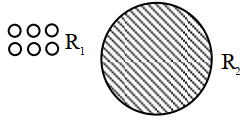
64 drop
\(64\left(\frac{4}{3} \pi R_1^3\right)=\frac{4}{3} \pi R_2^3\)
\(R _2=4 R _1\)
\(\frac{\left( V _{ T }\right)_1}{\left(V_{ T }\right)_2}=\left(\frac{ R _1}{ R _2}\right)^2=\left(\frac{1}{4}\right)^2\)
\(\frac{10}{\left(V_{ T }\right)_2}=\frac{1}{16}\)
\(\left( V _{ T }\right)_2=160 cm / sec\) -
- (A) 10
- (B) 5
- (C) 2.5
- (D) 15
Show answer and solution
Correct Answer: (B)
We know:
Terminal velocity \(\propto(\text { radius })^2\)
\(\frac{\left( v _{ T }\right)_1}{\left( v _{ T }\right)_2}=\left(\frac{6}{3}\right)^2\)
\(\left( v _{ T }\right)_2=\frac{\left( v _{ T }\right)_1}{4}=5 cm / sec\) -
- (A) \( \frac{200}{\sqrt{3}} \)
- (B) \( 200\sqrt{6} \)
- (C) \( 200\sqrt{3} \)
- (D) \( 100\sqrt{3} \)
Show answer and solution
Correct Answer: (C)
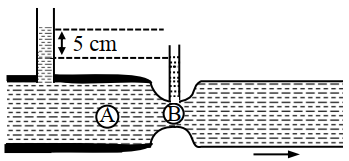
From continuity equation
\( A_{A}V_{A} = A_{B}V_{B} \Rightarrow 6V_{A} = 3V_{B} \Rightarrow V_{B} = 2V_{A} \)
Applying Bernoullis equation between A & B,
\( P_{A} + \frac{1}{2}\rho V_{A}^{2} = P_{B} + \frac{1}{2}\rho V_{B}^{2} \)
\( \Rightarrow \rho g \times 0.05 = \frac{1}{2}\rho [V_{B}^{2} - V_{A}^{2}] = \frac{1}{2}\rho (3V_{A}^{2}) \)
\( \Rightarrow V_{A} = \sqrt{\frac{2g \times 0.05}{3}} m/s = \frac{1}{\sqrt{3}} m/s = \frac{100}{\sqrt{3}} cm/s \)
Volume flow rate \( = A_{A}V_{A} = \frac{6 \times 100}{\sqrt{3}} cm^{3}/sec = 200\sqrt{3} cm^{3}/sec \) -
- (A) \(\vec{v}=3 \hat{i}+\frac{3}{2} ~\hat{j} \vec{r}=\frac{6}{5} \hat{i}+\hat{j}\)
- (B) \(\vec{v}=4 \hat{i}-\frac{3}{2} ~\hat{j} \vec{r}=\frac{8}{5} \hat{i}-\hat{j}\)
- (C) \(\vec{v}=4 \hat{i}+\frac{5}{2}~ \hat{j} \vec{r}=\frac{8}{5} \hat{i}+2 \hat{j}\)
- (D) \(\vec{v}=4 \hat{i}-\frac{3}{2} ~\hat{j} \vec{r}=\frac{6}{5} \hat{i}-\hat{j}\)
Show answer and solution
Correct Answer: (B)
\(\overrightarrow{ F }=4 t^3 \hat{ i }-3 t \hat{ j }\)
\(\overrightarrow{ a }=\frac{\overrightarrow{ F }}{ m }= t ^3 \hat{ i }-\frac{3}{4} \hat{ tj }\)
\(a_x=t^3\)
\(\frac{ dv _{ x }}{ dt }= t ^3\)
\(\int_{ v _{ x }=0}^{ v _{ x _2}} d v_{ x }=\int_{ t =0}^{ t =2} t^3 d t\)
\(v _{ x _2}-0=\left[\frac{ t ^4}{4}\right]_0^2\)
\(v_{x_2}=4\)
\(a_y=\frac{-3}{4} t\)
\(\frac{ dv _{ y }}{ dt }=-\frac{3}{4}\)
\(\int_0^{v_{v_2}} d v_y=\int_0^2 \frac{-3}{4} t d t\)
\(v _{ y _2}=\frac{-3}{4}\left[\frac{ t ^2}{2}\right]_0^2\)
\(v_{y_2}=\frac{-3}{2}\)
\(\vec{v}_2=4 \hat{i}-\frac{3}{2} \hat{j}\)
\(v_x=\frac{t^4}{4}\)
\(\int_0^{x_2} d x=\int_0^2 \frac{t^4}{4} d t\)
\(x_2-0=\left[\frac{t^5}{20}\right]_0^2\)
\(x_2=\frac{8}{5}\)
\(v_y=\frac{-3}{8} t^2\)
\(\int_0^{y_2} d x=\frac{-3}{8} t^2 d t\)
\(y _2-0=\frac{-3}{8}\left[\frac{ t ^3}{3}\right]_0^2\)
\(y_2=-1\)
\(\overrightarrow{ r }=\frac{8}{5} \hat{ i }-\hat{ j }\) -
- (A) \(t_{P}>t_{Q}\)
- (B) \(t_{p} < t_{Q}\)
- (C) \(t_{p}>1.25t_{Q}\)
- (D) \(t_{p}=t_{Q}\)
Show answer and solution
Correct Answer: (B)
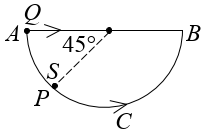
Horizontal displacement of Q is more than P. \(X_{Q}>X_{p}\)
Horizontal component of velocity is same
So \(t _{ p }=\frac{ x _{ p }}{ v }\)
\(t_Q=\frac{x_Q}{v}\)
\(t_{p} < t_{Q}\) -
- (A) 25
- (B) 12.5
- (C) 7.5
- (D) 15
Show answer and solution
Correct Answer: (B)
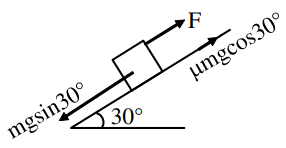
\(mg\sin 30^{\circ} = F + \mu mg\cos 30^{\circ}\)
\(F = 5 \times 10 \times \frac{1}{2} - \frac{\sqrt{3}}{2} \times 5 \times 10 \times \frac{\sqrt{3}}{2}\)
\(F =25-\frac{75}{2}=25-37.5\)
\(F =-12.5 N\)
∴ force will be downward on incline of magnitude 12.5 N. -
- (A) \(10\sqrt{2}\)
- (B) \(12\sqrt{2}\)
- (C) 12
- (D) \(24\sqrt{2}\)
Show answer and solution
Correct Answer: (B)
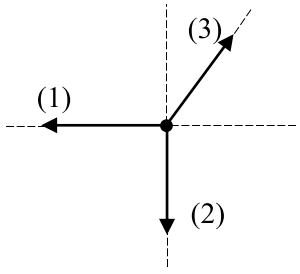
Apply C.O.M
\(M_{1}V_{1}+M_{2}V_{2}+M_{3}V_{3}=0\)
\(2(-18i)+2(-18j)+3V_{3}=0\)
\(V_{3}=12i+12j\)
\(|V_{3}|=12\sqrt{2}m/s\) -
- (A) \(\tan^{-1}(0.5)\)
- (B) \(\tan^{-1}(0.75)\)
- (C) \(\tan^{-1}(1.125)\)
- (D) \(\tan^{-1}(0.25)\)
Show answer and solution
Correct Answer: (C)
Speed of the car, \(v = 54 \times \dfrac{5}{18} = 15\) m/s.
In the frame of the car, the pendulum bob experiences a pseudo force (centrifugal force) horizontally outwards and the gravitational force downwards.
Let \(T\) be the tension in the string and \(\theta\) be the angle it makes with the vertical. For equilibrium in the car's frame, the horizontal and vertical forces balance:
\(T \sin \theta = \dfrac{mv^2}{r}\)
\(T \cos \theta = mg\)
Dividing the two equations, we get:
\(\tan \theta = \dfrac{v^2}{rg}\)
Substituting the given values \(v = 15\) m/s, \(r = 20\) m, and \(g = 10\) m/s\(^2\):
\(\tan \theta = \dfrac{(15)^2}{20 \times 10} = \dfrac{225}{200} = 1.125\)
\(\theta = \tan^{-1}(1.125)\)
Answer: \(\tan^{-1}(1.125)\) -
- (A) \(\frac{\sqrt{3}}{2} m g\)
- (B) \(\frac{1}{2} m g\)
- (C) mg
- (D) \(\sqrt{3}mg\)
Show answer and solution
Correct Answer: (A)
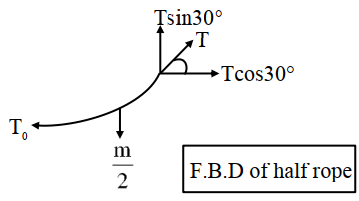
\(\operatorname{Tsin} 30^{\circ}=\frac{ m }{2} g\)
\(T \cos 30^{\circ}= T _0\)
\(\tan 30^{\circ}=\frac{ mg }{2 T_0}\)
\(T _0=\frac{\sqrt{3}}{2} mg\) -
- (A) \(2.56\)
- (B) \(3.89\)
- (C) \(4.32\)
- (D) \(5.16\)
Show answer and solution
Correct Answer: (A)
Maximum stress \(\sigma_{max} = 4 \times 10^8\) N/m\(^2\)
Radius of wire \(r = 4 \times 10^{-3}\) m
Mass of lift \(m = 1600\) kg
Maximum tension the wire can withstand is given by:
\(T_{max} = \sigma_{max} \times \pi r^2\)
\(T_{max} = 4 \times 10^8 \times 3.14 \times (4 \times 10^{-3})^2\)
\(T_{max} = 4 \times 10^8 \times 3.14 \times 16 \times 10^{-6} = 20096\) N
When the lift accelerates upwards with maximum acceleration \(a\), the tension in the wire is:
\(T_{max} = m(g + a)\)
\(20096 = 1600(10 + a)\)
\(10 + a = \dfrac{20096}{1600} = 12.56\)
\(a = 12.56 - 10 = 2.56\) m/s\(^2\)
Answer: \(2.56\) -
- (A) \(\sqrt{\frac{2L}{g~sin~2\theta-a_{0}(1+cos~2\theta)}}\)
- (B) \(\sqrt{\frac{4L}{g~sin~2\theta-a_{0}(1+cos~2\theta)}}\)
- (C) \(\sqrt{\frac{4L}{g~cos~2\theta-a_{0}sin\theta cos\theta}}\)
- (D) \(\sqrt{\frac{2L}{g~sin~\theta-a_{0}cos~\theta}}\)
Show answer and solution
Correct Answer: (B)
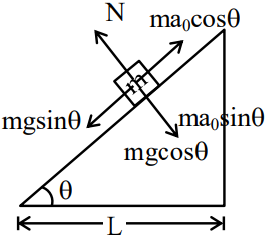
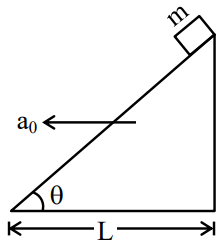
\(mgsin\theta + ma_{0}cos\theta=ma\)
\(a= g~sin\theta + a_{0}cos\theta\)
Now using,
\(S=ut+\frac{1}{2}a_{down}t^{2}\)
\(\frac{L}{cos~\theta}=\frac{1}{2}(g~sin~\theta-a_{0}cos~\theta)t^{2}\)
\(t=\sqrt{\frac{2L}{g~sin\theta cos\theta-a_{0}cos^{2}\theta}}\)
\(t=\sqrt{\frac{4L}{g~sin~2\theta-a_{0}(1+cos~2\theta)}}\) -
- (A) \(2\)
- (B) \(4\)
- (C) \(\sqrt{2}\)
- (D) \(2\sqrt{2}\)
Show answer and solution
Correct Answer: (A)
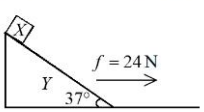
Horizontal acceleration of the wedge (assuming the block and wedge move together horizontally):
\(A = \dfrac{f}{M + m} = \dfrac{24}{10 + 2} = 2\text{ m/s}^2\)
Working in the non-inertial frame of the wedge, the block experiences a pseudo force \(mA\) directed opposite to the wedge's acceleration. The components along the incline are:
Component of gravity down the incline: \(g\sin 37^\circ\)
Component of pseudo force up the incline: \(A\cos 37^\circ\)
Net relative acceleration of the block down the incline:
\(a_{\text{rel}} = g\sin 37^\circ - A\cos 37^\circ\)
Using \(\sin 37^\circ = 0.6\) and \(\cos 37^\circ = 0.8\):
\(a_{\text{rel}} = 10(0.6) - 2(0.8) = 6 - 1.6 = 4.4\text{ m/s}^2\)
Time taken to slide a distance of \(8.8\text{ m}\) along the incline, starting from rest:
\(s = \dfrac{1}{2} a_{\text{rel}}\, t^2\)
\(8.8 = \dfrac{1}{2}(4.4)\,t^2\)
\(8.8 = 2.2\,t^2\)
\(t^2 = 4 \Rightarrow t = 2\text{ s}\)
Hence, the required time is \(2\text{ s}\). -
- (A) \(1:2\)
- (B) \(2:5\)
- (C) \(5:2\)
- (D) \(5:4\)
Show answer and solution
Correct Answer: (D)
Mass \(m = 100 \text{ g} = 0.1 \text{ kg}\)
Force \(\vec{F} = 5\hat{i} + 10\hat{j} \text{ N}\)
Acceleration \(\vec{a} = \dfrac{\vec{F}}{m} = \dfrac{5\hat{i} + 10\hat{j}}{0.1} = 50\hat{i} + 100\hat{j} \text{ m/s}^2\)
Since the body starts from rest, initial velocity \(\vec{u} = 0\).
Position after \(t = 2 \text{ s}\) is given by \(\vec{r} = \vec{u}t + \dfrac{1}{2}\vec{a}t^2\)
\(\vec{r} = \dfrac{1}{2}(50\hat{i} + 100\hat{j})(2)^2 = 100\hat{i} + 200\hat{j} \text{ m}\)
Comparing with the given position \(\vec{r} = 2x\hat{i} + 5y\hat{j}\):
\(2x = 100 \Rightarrow x = 50\)
\(5y = 200 \Rightarrow y = 40\)
The ratio \(x:y = 50:40 = 5:4\)
Answer: \(5:4\) -
- (A) A, B and C only
- (B) B, C and D only
- (C) A, C and D only
- (D) A, B and D only
Show answer and solution
Correct Answer: (D)
Given the position vector \(\vec{r} = 10t^2\hat{i} + 5t^3\hat{j}\)
Velocity \(\vec{v} = \dfrac{d\vec{r}}{dt} = 20t\hat{i} + 15t^2\hat{j}\)
Acceleration \(\vec{a} = \dfrac{d\vec{v}}{dt} = 20\hat{i} + 30t\hat{j}\)
At \(t = 1\) s:
\(\vec{r} = 10\hat{i} + 5\hat{j}\) m
\(\vec{v} = 20\hat{i} + 15\hat{j}\) m/s
\(\vec{a} = 20\hat{i} + 30\hat{j}\) m/s\(^2\)
Linear momentum \(\vec{p} = m\vec{v} = 0.1(20\hat{i} + 15\hat{j}) = 2\hat{i} + 1.5\hat{j}\) kg\(\cdot\)m/s (Statement A is correct)
Force \(\vec{F} = m\vec{a} = 0.1(20\hat{i} + 30\hat{j}) = 2\hat{i} + 3\hat{j}\) N (Statement B is correct)
Angular momentum \(\vec{L} = \vec{r} \times \vec{p} = (10\hat{i} + 5\hat{j}) \times (2\hat{i} + 1.5\hat{j}) = (10 \times 1.5 - 5 \times 2)\hat{k} = 5\hat{k}\) J\(\cdot\)s (Statement C is incorrect)
Torque \(\vec{\tau} = \vec{r} \times \vec{F} = (10\hat{i} + 5\hat{j}) \times (2\hat{i} + 3\hat{j}) = (10 \times 3 - 5 \times 2)\hat{k} = 20\hat{k}\) N\(\cdot\)m (Statement D is correct)
Therefore, statements A, B, and D are correct.
Answer: A, B and D only -
- (A) \(7.74\)
- (B) \(7.20\)
- (C) \(6.55\)
- (D) \(4.50\)
Show answer and solution
Correct Answer: (A)
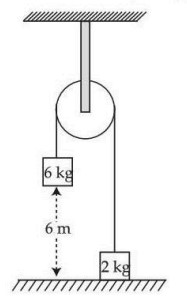
Let the acceleration of the system be \(a\) and the tension in the string be \(T\).
The equations of motion for the two masses are:
\(6g - T = 6a\)
\(T - 2g = 2a\)
Adding the two equations, we get:
\(4g = 8a\)
\(\Rightarrow a = \dfrac{4g}{8} = \dfrac{g}{2}\)
Substituting \(g = 10 \text{ m/s}^2\), the acceleration is:
\(a = \dfrac{10}{2} = 5 \text{ m/s}^2\)
The \(6 \text{ kg}\) mass is released from rest (\(u = 0\)) and travels a downward distance \(s = 6 \text{ m}\).
Using the kinematic equation \(v^2 = u^2 + 2as\):
\(v^2 = 0 + 2 \times 5 \times 6\)
\(v^2 = 60\)
\(v = \sqrt{60} \approx 7.74 \text{ m/s}\)
Answer: \(7.74\) -
- (A) \(5/3\)
- (B) \(2/3\)
- (C) \(3/5\)
- (D) \(2/5\)
Show answer and solution
Correct Answer: (A)
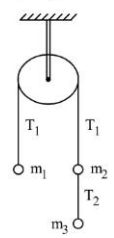
Let the acceleration of the system be \(a\). The total mass on the right side is \(m_2 + m_3 = 4 + 6 = 10\) kg, and the mass on the left side is \(m_1 = 4\) kg. Since \(10\) kg \(> 4\) kg, the right side accelerates downwards and the left side accelerates upwards.
The common acceleration \(a\) of the system is given by:
\(a = \dfrac{(m_2 + m_3) - m_1}{m_1 + m_2 + m_3} g\)
\(a = \dfrac{10 - 4}{4 + 4 + 6} g = \dfrac{6}{14} g = \dfrac{3}{7} g\)
For mass \(m_1\), the equation of motion is:
\(T_1 - m_1 g = m_1 a\)
\(T_1 = m_1(g + a) = 4 \left(g + \dfrac{3}{7}g\right) = 4 \left(\dfrac{10}{7}g\right) = \dfrac{40}{7}g\)
For mass \(m_3\), the equation of motion is:
\(m_3 g - T_2 = m_3 a\)
\(T_2 = m_3(g - a) = 6 \left(g - \dfrac{3}{7}g\right) = 6 \left(\dfrac{4}{7}g\right) = \dfrac{24}{7}g\)
The ratio of the tensions is:
\(\dfrac{T_1}{T_2} = \dfrac{\dfrac{40}{7}g}{\dfrac{24}{7}g} = \dfrac{40}{24} = \dfrac{5}{3}\)
Answer: \(5/3\) -
- (A) \(0.33\)
- (B) \(0.67\)
- (C) \(1\)
- (D) \(0.5\)
Show answer and solution
Correct Answer: (B)
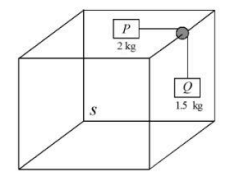
Let us analyze the forces acting on blocks \(P\) and \(Q\) in the non-inertial frame of reference of the cube \(S\), which is moving to the right with an acceleration \(a = \dfrac{g}{2} = 5 \text{ m/s}^2\).
In this frame, a pseudo force acts on both blocks towards the left.
For block \(P\) (mass \(m_P = 2 \text{ kg}\)):
The forces in the horizontal direction are the tension \(T\) in the string (acting towards the right) and the pseudo force \(F_{pP}\) (acting towards the left). Since block \(P\) is stationary relative to the cube and there is no friction on the top surface:
\(T = m_P a = 2 \times 5 = 10 \text{ N}\)
For block \(Q\) (mass \(m_Q = 1.5 \text{ kg}\)):
The horizontal forces are the normal reaction \(N\) from the side surface of the cube (acting towards the right) and the pseudo force \(F_{pQ}\) (acting towards the left). Since block \(Q\) is stationary horizontally relative to the cube:
\(N = m_Q a = 1.5 \times 5 = 7.5 \text{ N}\)
The vertical forces acting on block \(Q\) are the downward gravitational force \(m_Q g\), the upward tension \(T\), and the frictional force \(f\).
The downward force is \(m_Q g = 1.5 \times 10 = 15 \text{ N}\).
Since \(m_Q g > T\) (\(15 \text{ N} > 10 \text{ N}\)), the block has a tendency to slide downwards, so the static friction \(f\) must act upwards.
For vertical equilibrium of block \(Q\):
\(T + f = m_Q g\)
\(10 + f = 15 \Rightarrow f = 5 \text{ N}\)
To keep the block stationary, the required friction must be less than or equal to the maximum static friction (\(f \le \mu N\)). Assuming the limiting case to find the value of \(\mu\):
\(\mu N = f\)
\(\mu (7.5) = 5\)
\(\mu = \dfrac{5}{7.5} = \dfrac{2}{3} \approx 0.67\)
Answer: \(0.67\) -
- (A) \(\dfrac{1}{2}mgR_e\)
- (B) \(\dfrac{3}{4}mgR_e\)
- (C) \(\dfrac{1}{4}mgR_e\)
- (D) \(\dfrac{2}{3}mgR_e\)
Show answer and solution
Correct Answer: (D)
Initial potential energy of the body at the surface of the earth is given by:
\(U_i = -\dfrac{GMm}{R_e}\)
Final potential energy of the body at a height \(h = 2R_e\) from the surface of the earth is:
\(U_f = -\dfrac{GMm}{R_e + h} = -\dfrac{GMm}{R_e + 2R_e} = -\dfrac{GMm}{3R_e}\)
The increase in potential energy is:
\(\Delta U = U_f - U_i = -\dfrac{GMm}{3R_e} - \left(-\dfrac{GMm}{R_e}\right)\)
\(\Delta U = \dfrac{GMm}{R_e} \left(1 - \dfrac{1}{3}\right) = \dfrac{2GMm}{3R_e}\)
Acceleration due to gravity at the surface of the earth is \(g = \dfrac{GM}{R_e^2}\), which gives \(GM = gR_e^2\).
Substituting this value, we get:
\(\Delta U = \dfrac{2(gR_e^2)m}{3R_e} = \dfrac{2}{3}mgR_e\)
Answer: \(\dfrac{2}{3}mgR_e\) -
- (A) \(\dfrac{1}{2}\)
- (B) \(2\)
- (C) \(4\)
- (D) \(\dfrac{1}{4}\)
Show answer and solution
Correct Answer: (B)
Using Kepler's third law, the time period of revolution of a planet is given by \(T = 2\pi \sqrt{\dfrac{r^3}{GM_s}}\).
For planet \(P_1\), the orbital radius is \(r = R\) and the mass of the star is \(M_s = 2M\):
\(T_1 = 2\pi \sqrt{\dfrac{R^3}{G(2M)}}\)
For planet \(P_2\), the orbital radius is \(r = 2R\) and the mass of the star is \(M_s = 4M\):
\(T_2 = 2\pi \sqrt{\dfrac{(2R)^3}{G(4M)}} = 2\pi \sqrt{\dfrac{8R^3}{4GM}} = 2\pi \sqrt{\dfrac{2R^3}{GM}}\)
Taking the ratio of \(T_2\) and \(T_1\):
\(\dfrac{T_2}{T_1} = \dfrac{\sqrt{\dfrac{2R^3}{GM}}}{\sqrt{\dfrac{R^3}{2GM}}} = \sqrt{2 \times 2} = 2\)
Answer: \(2\) -
- (A) Both Statement I and Statement II are false
- (B) Both Statement I and Statement II are true
- (C) Statement I is true but Statement II is false
- (D) Statement I is false but Statement II is true
Show answer and solution
Correct Answer: (B)
\(T =2 \pi \sqrt{\frac{ R ^3}{ GM }}\)
\(\because M =\rho \cdot \frac{4}{3} \pi R ^3\)
\(\therefore T=2 g p \sqrt{\frac{1}{G \rho \frac{4}{3} \pi}}\)
Statement I is correct.
And \(\therefore \frac{ GM }{ R ^2}= g\)
\(\therefore T =2 \pi \sqrt{\frac{ R }{ g }}\)
Statement II is correct
Ans. (2) -
- (A) \(11.2\) km/s; \(6.27 \times 10^7\) J
- (B) \(11.2\) km/s; \(12.54 \times 10^7\) J
- (C) \(8.8\) km/s; \(6.27 \times 10^7\) J
- (D) \(8.8\) km/s; \(12.54 \times 10^7\) J
Show answer and solution
Correct Answer: (A)
By conservation of mechanical energy, the total energy of the body at infinity is zero.
When the body reaches the surface of the earth, its potential energy is \(-\dfrac{GMm}{R}\) and kinetic energy is \(k = \dfrac{1}{2}mv^2\).
\(0 = k - \dfrac{GMm}{R}\)
\(k = \dfrac{GMm}{R} = mgR\)
Substituting \(m = 1\) kg, \(g = 9.8\) m/s\(^2\), and \(R = 6400 \times 10^3\) m:
\(k = 1 \times 9.8 \times 6400 \times 10^3 = 6.272 \times 10^7\) J
The velocity \(v\) is given by \(\dfrac{1}{2}mv^2 = k\).
\(v = \sqrt{2gR} = \sqrt{2 \times 9.8 \times 6400 \times 10^3}\)
\(v = \sqrt{125.44 \times 10^6} = 11.2 \times 10^3\) m/s \(= 11.2\) km/s
Answer: \(11.2\) km/s; \(6.27 \times 10^7\) J -
- (A) 150
- (B) 500
- (C) 100
- (D) 1000
Show answer and solution
Correct Answer: (D)
Energy of a satellite in a circular orbit is given as\(E =\frac{- GM _{ E } m }{2 r } ; r =\) radius of circular orbit
Required energy to be supplied \(=\Delta E=E_f-E_i\)
\(\Delta E =\left(\frac{- GM _{ E } m }{2\left(3 R _{ E }\right)}\right)-\left(\frac{- GM _{ E } m }{2\left(1.5 R _{ E }\right)}\right)\)
\(=\frac{ GM _{ E } m }{6 R _{ E }}\)
Now, \(g =\frac{ GM _{ E }}{ R _{ E }^2} \Rightarrow \frac{ GM _{ E }}{ R _{ E }}= gR _{ E }\)
\(\therefore \quad \Delta E =\frac{1}{6} gmR _{ E }\)
\(=\frac{1}{6} \times 10 \times 100 \times 6 \times 10^6\)
\(=1000 \times 10^6\)
\(\alpha=1000\) -
- (A) 2
- (B) 3
- (C) 1
- (D) \( 2\sqrt{5} \)
Show answer and solution
Correct Answer: (A)
Initial configuration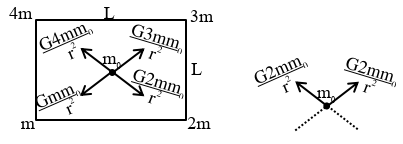
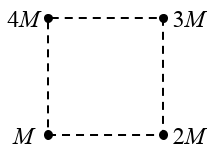
\( F=2\sqrt{2}\frac{Gmm_{0}}{r^{2}} \)
New configuration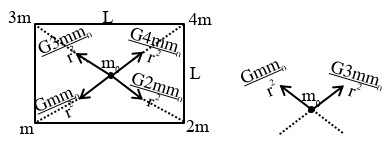
\( F'=\sqrt{10}\frac{Gmm_{0}}{r^{2}}\Rightarrow\frac{F}{F'}=2\sqrt{2}.\frac{1}{\sqrt{10}}=\frac{2}{\sqrt{5}} \)
\( \alpha=2 \) -
- (A) 1000
- (B) \( 200\sqrt{5} \)
- (C) \( 100\sqrt{10} \)
- (D) \( 1000\sqrt{2} \)
Show answer and solution
Correct Answer: (C)
\( V_{e}=\sqrt{\frac{2GM}{R}}=\sqrt{\frac{2G\times\rho\times\frac{4\pi R^{3}}{3}}{R}}\Rightarrow V_{e}\propto\sqrt{\rho}\times R \)
\( \frac{(V_{e})_{B}}{(V_{e})_{A}}=\sqrt{\frac{\rho_{B}}{P_{A}}}\times\frac{R_{B}}{R_{A}}=\sqrt{\frac{0.1P_{A}}{P_{A}}}\times(\frac{0.1R_{A}}{R_{A}}) \)
\( \frac{(V_{e})_{B}}{(V_{e})_{A}}=\frac{1}{10}\times\frac{1}{\sqrt{10}} \)
\( (V_{e})_{B}=\frac{10\times1000}{10\sqrt{10}}=100\sqrt{10}m/sec \) -
- (A) \(\sqrt{3}R\)
- (B) \(2\sqrt{2}R\)
- (C) \(2R\)
- (D) \(\dfrac{4}{9}R\)
Show answer and solution
Correct Answer: (C)
The acceleration due to gravity at a height \(h\) above the surface of the earth is given by
\(g' = \dfrac{g}{\left(1 + \dfrac{h}{R}\right)^2}\)
Given that \(g' = \dfrac{g}{9}\), we get
\(\dfrac{g}{9} = \dfrac{g}{\left(1 + \dfrac{h}{R}\right)^2}\)
\(\left(1 + \dfrac{h}{R}\right)^2 = 9\)
\(1 + \dfrac{h}{R} = 3\)
\(\dfrac{h}{R} = 2\)
\(h = 2R\)
Answer: \(2R\) -
- (A) \( 9.86\times10^{-6} \)
- (B) \( 2.85\times10^{-7} \)
- (C) \( 1.74\times10^{-7} \)
- (D) \( 4.77\times10^{-7} \)
Show answer and solution
Correct Answer: (C)
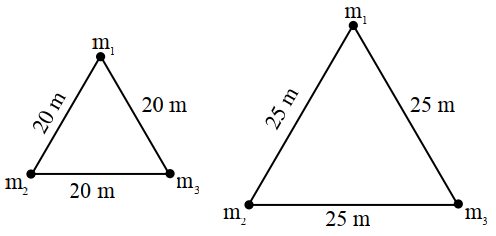
Work done by external agent :
\(w _{ ext }=\Delta U\)
\(U _{ i }=-\frac{ Gm _1 m_2}{ r _{ i }}-\frac{ Gm _2 m_3}{ r _{ i }}-\frac{ Gm _1 m_3}{ r _{ i }}: r _{ i }=20 m\)
\(U _{ f }=-\frac{ Gm _1 m_2}{ r _{ f }}-\frac{ Gm _2 m_3}{ r _{ f }}-\frac{ Gm _1 m_3}{ r _{ f }}: r _{ f }=25 m\)
\(U _{ i }=\frac{-6.67 \times 10^{-11}}{20}[200 \times 300+300 \times 400+200 \times 400]\)
\(=\frac{-6.67 \times 10^{-11}}{20} \times 26 \times 10^4=-86.71 \times 10^{-8} J\)
\(U_f=\frac{-6.67 \times 10^{-11}}{0.25}[200 \times 300+300 \times 400+200 \times 400]\)
\(=\frac{-6.67 \times 10^{-11}}{0.25} \times 26 \times 10^4=-693.68 \times 10^{-9}\)
\(=-69.36 \times 10^{-8} J\)
\(\Delta U = U _{ f }- U _{ i }=1.74 \times 10^{-7} J\) -
- (A) \(0.12\)
- (B) \(0.25\)
- (C) \(0.50\)
- (D) \(0.75\)
Show answer and solution
Correct Answer: (B)
The acceleration due to gravity at a depth \(d\) below the earth's surface is given by:
\(g_d = g\left(1 - \dfrac{d}{R}\right)\)
The acceleration due to gravity at a height \(h\) above the earth's surface (for \(h \ll R\)) is given by:
\(g_h = g\left(1 - \dfrac{2h}{R}\right)\)
Given \(d = 16\) km and \(h = 16\) km, we can find the values of \(g_d\) and \(g_h\):
\(g_d = g\left(1 - \dfrac{16}{6400}\right) = g\left(1 - \dfrac{1}{400}\right)\)
\(g_h = g\left(1 - \dfrac{2 \times 16}{6400}\right) = g\left(1 - \dfrac{2}{400}\right)\)
The magnitude of the change in acceleration due to gravity when moving from the depth \(d\) to the height \(h\) is:
\(\Delta g = g_d - g_h = g\left(1 - \dfrac{1}{400}\right) - g\left(1 - \dfrac{2}{400}\right)\)
\(\Delta g = g\left(\dfrac{2}{400} - \dfrac{1}{400}\right) = \dfrac{g}{400}\)
The percentage change in \(g\) is approximately:
\(\dfrac{\Delta g}{g} \times 100 = \dfrac{\dfrac{g}{400}}{g} \times 100 = \dfrac{100}{400} = 0.25\%\)
Thus, the value of \(\alpha\) is \(0.25\).
Answer: \(0.25\) -
- (A) 20
- (B) 35
- (C) 40
- (D) 50
Show answer and solution
Correct Answer: (B)
The net force acting on the block is the vector sum of the two forces:
\(\vec{F} = \vec{F}_1 + \vec{F}_2 = (2\hat{i} + 3\hat{j} + 4\hat{k}) + (3\hat{i} - \hat{j} - 2\hat{k}) = 5\hat{i} + 2\hat{j} + 2\hat{k}\) N
The block is moved a distance of \(25\) m along the direction of the vector \(3\hat{i} - 4\hat{j}\). The unit vector along this direction is:
\(\hat{n} = \dfrac{3\hat{i} - 4\hat{j}}{\sqrt{3^2 + (-4)^2}} = \dfrac{3\hat{i} - 4\hat{j}}{5}\)
The displacement vector \(\vec{s}\) is the magnitude multiplied by the unit vector:
\(\vec{s} = 25 \hat{n} = 25 \left( \dfrac{3\hat{i} - 4\hat{j}}{5} \right) = 15\hat{i} - 20\hat{j}\) m
The work done \(W\) is the dot product of the net force and the displacement vector:
\(W = \vec{F} \cdot \vec{s} = (5\hat{i} + 2\hat{j} + 2\hat{k}) \cdot (15\hat{i} - 20\hat{j})\)
\(W = (5 \times 15) + (2 \times -20) + (2 \times 0)\)
\(W = 75 - 40 = 35\) J
Answer: \(35\) -
- (A) \(0\)
- (B) \(250\)
- (C) \(1250\)
- (D) \(1000\)
Show answer and solution
Correct Answer: (C)
Given mass \(m = 1\) kg and velocity \(v = 2x^2\).
According to the work-energy theorem, the work done by the net force is equal to the change in kinetic energy of the body.
\(W = \Delta K = K_f - K_i\)
At \(x = 0\) m, initial velocity \(v_i = 2(0)^2 = 0\) m/s.
At \(x = 5\) m, final velocity \(v_f = 2(5)^2 = 50\) m/s.
Initial kinetic energy \(K_i = \dfrac{1}{2} m v_i^2 = 0\) J.
Final kinetic energy \(K_f = \dfrac{1}{2} m v_f^2 = \dfrac{1}{2} \times 1 \times (50)^2 = 1250\) J.
Work done \(W = 1250 - 0 = 1250\) J.
Answer: \(1250\) -
- (A) 200
- (B) 205
- (C) 210
- (D) 220
Show answer and solution
Correct Answer: (A)
Given \(\vec{F} = (2t\hat{i} + 6t^2\hat{j})\) N and \(m = 2\) kg.
Acceleration of the body is \(\vec{a} = \dfrac{\vec{F}}{m} = \dfrac{2t\hat{i} + 6t^2\hat{j}}{2} = t\hat{i} + 3t^2\hat{j}\) m/s\(^2\).
Since the body begins to move from rest, its velocity at time \(t\) is given by \(\vec{v} = \int \vec{a} dt = \int (t\hat{i} + 3t^2\hat{j}) dt = \dfrac{t^2}{2}\hat{i} + t^3\hat{j}\) m/s.
At \(t = 2\) s, the force is \(\vec{F} = 2(2)\hat{i} + 6(2)^2\hat{j} = 4\hat{i} + 24\hat{j}\) N.
At \(t = 2\) s, the velocity is \(\vec{v} = \dfrac{(2)^2}{2}\hat{i} + (2)^3\hat{j} = 2\hat{i} + 8\hat{j}\) m/s.
Power produced by the force is \(P = \vec{F} \cdot \vec{v} = (4\hat{i} + 24\hat{j}) \cdot (2\hat{i} + 8\hat{j})\).
\(P = (4 \times 2) + (24 \times 8) = 8 + 192 = 200\) W.
Answer: \(200\) -
- (A) 49
- (B) 42
- (C) 24
- (D) 12
Show answer and solution
Correct Answer: (C)
\( x(t)=t^{2}+t+1 \)
\( v(t)=2t+1 \)
\( a(t)=2 \)
\( F=4N. \)
\( Displacement=x(3)-x(2)\)
\(=13-7=6m \)
\( W=F.S=4\times6=24J \) -
- (A) \(20\)
- (B) \(25\)
- (C) \(30\)
- (D) \(10\)
Show answer and solution
Correct Answer: (A)
Since the assembly moves with a constant velocity, the acceleration of the mass is zero. The mass is in equilibrium relative to the incline.
The frictional force \(f\) acting on the mass balances the component of gravity along the inclined plane. Therefore, the magnitude of the frictional force is:
\(f = mg \sin 30^\circ\)
Substituting the given values (\(m = 1\text{ kg}\), \(g = 10\text{ m/s}^2\)):
\(f = 1 \times 10 \times \dfrac{1}{2} = 5\text{ N}\)
The direction of the frictional force is upwards along the incline. Since the incline makes an angle of \(30^\circ\) with the horizontal, the frictional force makes an angle of \(90^\circ - 30^\circ = 60^\circ\) with the vertical upward direction.
The displacement \(s\) of the assembly in time \(t = 2\text{ s}\) is vertically upwards:
\(s = vt = 4 \times 2 = 8\text{ m}\)
The work done by the frictional force is:
\(W = f s \cos 60^\circ\)
\(W = 5 \times 8 \times \dfrac{1}{2} = 20\text{ J}\)
Answer: \(20\) -
- (A) \( \frac{3}{5} \)
- (B) \( \frac{1}{5} \)
- (C) \( \frac{2+\sqrt{3}}{5} \)
- (D) \( \frac{2-\sqrt{3}}{5} \)
Show answer and solution
Correct Answer: (B)
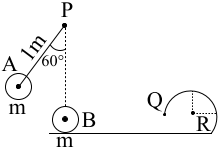
\( V_{A} \) at lowest point
\( V_{A}=\sqrt{2g\ell(1-\cos \theta)} \)
\( V_{A}=\sqrt{2\times10\times1(1-\frac{1}{2})}=\sqrt{10} \)
After collision velocity of B becomes,
\( V_{A}=\sqrt{10}=V_{B} \) (Same mass)
Now to complete circular motion
\( V_{B}=\sqrt{5gR} \)
\( R=\frac{1}{5} \) -
- (A) \(2\)
- (B) \(4\)
- (C) \(3\)
- (D) \(6\)
Show answer and solution
Correct Answer: (B)
Let \(v\) be the velocity of the body at the highest point of the circular loop.
At the highest point, the forces acting on the body are its weight \(mg\) (downwards) and the normal reaction \(N\) (downwards). The net downward force provides the necessary centripetal acceleration:
\(N + mg = \dfrac{mv^2}{R}\)
Given that the body exerts a force equal to three times its weight on the track at the highest point, we have \(N = 3mg\). Substituting this into the equation:
\(3mg + mg = \dfrac{mv^2}{R}\)
\(4mg = \dfrac{mv^2}{R} \Rightarrow v^2 = 4gR\)
Applying the principle of conservation of mechanical energy between the point of release and the highest point of the loop (which is at a height of \(2R\) from the bottom):
\(mgh = mg(2R) + \dfrac{1}{2}mv^2\)
Substituting \(v^2 = 4gR\) into the energy equation:
\(mgh = 2mgR + \dfrac{1}{2}m(4gR)\)
\(mgh = 2mgR + 2mgR = 4mgR\)
Therefore, \(h = 4R\).
Comparing this with the given relation \(h = \alpha R\), we get \(\alpha = 4\).
Answer: \(4\) -
- (A) \(1980\)
- (B) \(2020\)
- (C) \(2000\)
- (D) \(1000\)
Show answer and solution
Correct Answer: (B)
Using the work-energy theorem, the total work done on the ball is equal to its change in kinetic energy.
Since the ball starts from rest and finally comes to rest, the change in kinetic energy is zero.
\(W_{\text{gravity}} + W_{\text{sand}} = \Delta K = 0\)
The work done by gravity is over the total distance \(h + d\), and the work done by the resistive force of the sand \(F\) is over the distance \(d\).
\(mg(h + d) - Fd = 0\)
\(F = \dfrac{mg(h + d)}{d}\)
Given \(m = 2\) kg, \(g = 10\) m/s\(^2\), \(h = 10\) m, and \(d = 10\) cm \(= 0.1\) m:
\(F = \dfrac{2 \times 10 \times (10 + 0.1)}{0.1}\)
\(F = \dfrac{20 \times 10.1}{0.1}\)
\(F = 20 \times 101 = 2020\) N
Answer: \(2020\) -
- (A) Both Statement I and Statement II are true
- (B) Statement I is false but Statement II is true
- (C) Statement I is true but Statement II is false
- (D) Both Statement I and Statement II are false
Show answer and solution
Correct Answer: (D)
Statement-I: Incorrect
Correct equation is \( W=\int\vec{F}\cdot d\vec{r} \)
Statement-II: Incorrect. -
- (A) 1.75
- (B) 1.44
- (C) 1.15
- (D) 1.95
Show answer and solution
Correct Answer: (B)
\(( K . E )_{\text {lost }}=\frac{1}{2} \mu V_{ rel }^2\left(1- e ^2\right)\)
\(=\frac{1}{2}\left(\frac{m_1 m_2}{m_1+ m _2}\right)(10+30)^2(1-0)\)
\(=\frac{1}{2}\left[\frac{(15)(25)}{40}\right][40]^2\)
\(=7500 J\)
\(( K . E )_{ loss }=\left( m _1+ m _2\right)( S )(\Delta T )\)
\(\left[ S =31 \times 4.2 J / kg -{ }^{\circ} C \right]\)
\(7500=(40)(31)(\Delta T )\)
\(\Delta T =\frac{7500}{40 \times 31 \times 4.2}=1.44^{\circ} C\) -
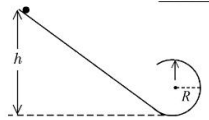
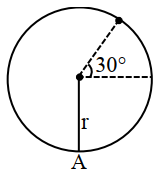
- (A) \(\sqrt{5gr}\)
- (B) \(\sqrt{\frac{7}{2}gr}\)
- (C) \(\sqrt{4gr}\)
- (D) \(\sqrt{\frac{5}{2}gr}\)
Show answer and solution
Correct Answer: (B)
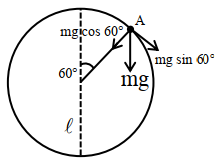
\(T + mg \cos 60^{\circ}=\frac{ mV ^2}{\ell}\)
\(T =0\)
\(V ^2=\frac{ g \ell}{2}\) here V is the speed at point A
M.E.C.
\(\frac{1}{2} mu ^2= mg \left(\ell+\ell \cos 60^{\circ}\right)+\frac{1}{2} mV ^2\)
\(u ^2=3 g \ell+\frac{ g \ell}{2}\)
\(u =\sqrt{\frac{7 g \ell}{2}}\) -
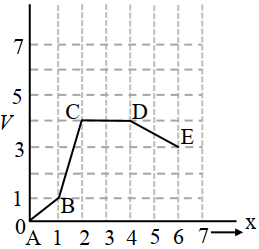
- (A) \(F _{ BC }> F _{ CD }> F _{ DE }> F _{ AB }\)
- (B) \(F _{ CD }> F _{ AB }> F _{ BC }> F _{ DE }\)
- (C) \(F _{ CD }> F _{ DE }> F _{ AB }> F _{ BC }\)
- (D) \(F _{ BC }> F _{ AB }> F _{ DE }> F _{ CD }\)
Show answer and solution
Correct Answer: (D)
Slope of potential energy \(v / s\) position curve gives negative of force.
\(\therefore \quad F _{ BC }> F _{ AB }> F _{ DE }> F _{ CD }\) -
- (A) \(-8.75\)
- (B) \(-8.35\)
- (C) \(-9.55\)
- (D) \(-9.98\)
Show answer and solution
Correct Answer: (D)
Using the work-energy theorem, the total work done by all forces equals the change in kinetic energy:
\(W_{g} + W_{r} = \Delta K\)
\(mgh + W_{r} = \dfrac{1}{2}mv^2 - 0\)
Substituting the given values (\(m = 10^{-3}\) kg, \(g = 10\) m/s\(^2\), \(h = 1000\) m, \(v = 5\) m/s):
\((10^{-3})(10)(1000) + W_{r} = \dfrac{1}{2}(10^{-3})(5)^2\)
\(10 + W_{r} = 0.0125\)
\(W_{r} = 0.0125 - 10 = -9.9875\) J
\(W_{r} \approx -9.98\) J
Answer: \(-9.98\) -
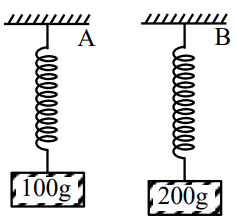
- (A) 4E
- (B) 2E
- (C) 3E
- (D) \( \frac{4}{3}E \)
Show answer and solution
Correct Answer: (C)
For equilibrium \( kx=mg \)
\( U=\frac{1}{2}kx^{2}=\frac{1}{2}\frac{m^{2}g^{2}}{k} \)
\( U\propto\frac{m^{2}}{k} \)
\( \frac{U_{A}}{U_{B}}=(\frac{m_{A}}{m_{B}})^{2}\frac{k_{B}}{k_{A}}=(\frac{1}{2})^{2}(\frac{4}{3})=\frac{1}{3} \)
\( \frac{E}{U_{B}}=\frac{1}{3}\Rightarrow U_{B}=3E \) -
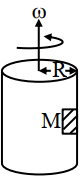
- (A) \(0.1\)
- (B) \(0.5\)
- (C) \(0.7\)
- (D) \(0.3\)
Show answer and solution
Correct Answer: (A)
The normal force \(N\) provides the necessary centripetal force for the mass to move in a circle:
\(N = m \omega^2 R\)
For the mass to remain stuck to the wall without falling, the upward frictional force must balance the downward gravitational force:
\(f \ge mg\)
Since the maximum static friction is \(f_{max} = \mu N\), we have:
\(\mu N \ge mg\)
\(\mu (m \omega^2 R) \ge mg\)
\(\mu \ge \dfrac{g}{\omega^2 R}\)
Substituting the given values \(g = 10\) m/s\(^2\), \(\omega = 5\) rad/s, and \(R = 4\) m:
\(\mu \ge \dfrac{10}{5^2 \times 4}\)
\(\mu \ge \dfrac{10}{100}\)
\(\mu \ge 0.1\)
The minimum coefficient of friction is \(0.1\).
Answer: \(0.1\) -
- (A) \( \sqrt{\frac{\mu g}{R}} \)
- (B) \( \sqrt{\frac{2g}{\mu R}} \)
- (C) \( \sqrt{\frac{g}{2\mu R}} \)
- (D) \( \sqrt{\frac{g}{\mu R}} \)
Show answer and solution
Correct Answer: (D)
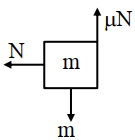
\(N = m \omega^2 r , mg =\mu N\)
\(\mu \times m \omega^2 r = mg\)
\(\omega=\sqrt{\frac{g}{\mu r}}\) -
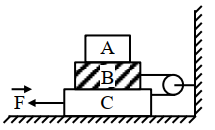
- (A) 150
- (B) 210
- (C) 180
- (D) 250
Show answer and solution
Correct Answer: (B)
For 8 kg to move with constant velocity \(F _{\text {net }}=0\).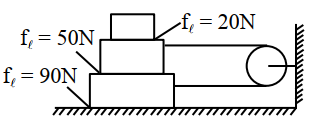
\(\therefore F =90+ T +50\) (for 8kg block)
\(T =20+50\) (for 6 kg block )
\(\therefore F =210 N\). -
- (A) \(3/4\)
- (B) \(2/3\)
- (C) \(5/9\)
- (D) \(4/9\)
Show answer and solution
Correct Answer: (C)
Let the length of the inclined plane be \(s\).
For the smooth inclined plane, the acceleration of the block is \(a_1 = g \sin \theta\).
The time taken to slide down is \(t_1 = \sqrt{\dfrac{2s}{a_1}} = \sqrt{\dfrac{2s}{g \sin \theta}}\).
For the rough inclined plane, the acceleration of the block is \(a_2 = g \sin \theta - \mu_k g \cos \theta\).
The time taken to slide down is \(t_2 = \sqrt{\dfrac{2s}{a_2}} = \sqrt{\dfrac{2s}{g (\sin \theta - \mu_k \cos \theta)}}\).
Given that \(t_2\) is \(50\%\) more than \(t_1\), we have \(t_2 = t_1 + 0.5 t_1 = \dfrac{3}{2} t_1\).
Squaring both sides gives \(t_2^2 = \dfrac{9}{4} t_1^2\).
Substituting the expressions for \(t_1^2\) and \(t_2^2\):
\(\dfrac{2s}{g (\sin \theta - \mu_k \cos \theta)} = \dfrac{9}{4} \left( \dfrac{2s}{g \sin \theta} \right)\)
\(\dfrac{1}{\sin \theta - \mu_k \cos \theta} = \dfrac{9}{4 \sin \theta}\)
\(4 \sin \theta = 9 \sin \theta - 9 \mu_k \cos \theta\)
\(9 \mu_k \cos \theta = 5 \sin \theta\)
\(\mu_k = \dfrac{5}{9} \tan \theta\)
Given \(\theta = 45^\circ\), we have \(\tan 45^\circ = 1\).
\(\mu_k = \dfrac{5}{9} \times 1 = \dfrac{5}{9}\)
Answer: \(5/9\) -
- (A) \(\frac{u^{2}}{4g~sin~\theta}\)
- (B) \(\frac{2u^{2}}{g~cos~\theta}\)
- (C) \(\frac{u^{2}}{\sqrt{2}g~cos~\theta}\)
- (D) \( \frac{u^2}{2g \sin \theta} \)
Show answer and solution
Correct Answer: (D)
Explanation:
The distance covered by the block moving up the smooth inclined plane can be determined using basic kinematic principles:
1. Forces Acting on the Block: When the block is projected upwards along the incline with an initial velocity \( u \), the component of gravitational force acting parallel to the inclined plane opposes its motion. This component acts directly downwards along the slope and is given by \( mg \sin \theta \).
2. Retardation (Deceleration): Using Newton's second law, the constant acceleration \( a \) of the block along the incline is:
\( a = -g \sin \theta \)
3. Applying the Third Equation of Motion:
\( v^2 = u^2 + 2aS \)
At the maximum distance \( S \), the final velocity of the block becomes zero (\( v = 0 \)):
\( 0 = u^2 + 2(-g \sin \theta)S \)
\( 2g \sin \theta \cdot S = u^2 \)
\( S = \frac{u^2}{2g \sin \theta} \)
Therefore, the mathematically accurate answer is \( \frac{u^2}{2g \sin \theta} \). Option A given in the original key is incorrect, as this question contained a typographical error in the option list during the official examination and is treated as a bonus/corrected to Option D.
Hence, Option D is the correct choice.
No questions on this page match these filters.