


JEE Mains · Physics · STD 11 - Units,dimensions and measurement
- JEE Mains 2026
- Hard
- MCQ
Consider the equation \(H = \dfrac{x^p \epsilon^q E^r}{t^s}\), where \(H=\) magnetic field; \(E=\) electric field, \(\epsilon=\) permittivity, \(x=\) distance, \(t=\) time. The values of \(p, q, r\) and \(s\) respectively are:
Pick an option to check your answer.
Answer & Solution
Correct Answer
(A) \(1, 1, 1, 1\)
Step-by-step Solution
Detailed explanation
The dimensional formulas for the given physical quantities are:
Magnetic field intensity \([H] = [M^0 L^{-1} T^0 A^1]\)
Distance \([x] = [M^0 L^1 T^0 A^0]\)
Permittivity \([\epsilon] = [M^{-1} L^{-3} T^4 A^2]\)
Electric field \([E] = [M^1 L^1 T^{-3} A^{-1}]\)
Time \([t] = [M^0 L^0 T^1 A^0]\)
Given the equation \(H = \dfrac{x^p \epsilon^q E^r}{t^s}\), we can write it in terms of dimensions as:
\([M^0 L^{-1} T^0 A^1] = [L]^p [M^{-1} L^{-3} T^4 A^2]^q [M L T^{-3} A^{-1}]^r [T]^{-s}\)
Combining the powers of \(M, L, T\), and \(A\) on the right side:
\([M^0 L^{-1} T^0 A^1] = [M^{-q+r} L^{p-3q+r} T^{4q-3r-s} A^{2q-r}]\)
Equating the powers of corresponding fundamental quantities from both sides:
For \(M\): \(0 = -q + r \implies q = r\)
For \(A\): \(1 = 2q - r\)
Substituting \(r = q\) into the equation for \(A\):
\(1 = 2q - q \implies q = 1\)
Since \(q = r\), we get \(r = 1\).
For \(L\): \(-1 = p - 3q + r\)
Substituting \(q = 1\) and \(r = 1\):
\(-1 = p - 3(1) + 1 \implies -1 = p - 2 \implies p = 1\)
For \(T\): \(0 = 4q - 3r - s\)
Substituting \(q = 1\) and \(r = 1\):
\(0 = 4(1) - 3(1) - s \implies 0 = 1 - s \implies s = 1\)
Thus, the values are \(p = 1\), \(q = 1\), \(r = 1\), and \(s = 1\).
Answer: \(1, 1, 1, 1\)
More questions from Physics
- Taking the wavelength of first Balmer line in hydrogen spectrum (\( n = 3\) to \(n = 2\) ) as \(660\,nm ,\) the wavelength of the \(2^{nd}\) Balmer line ( \(n =4\) to \(n = 2\) ) will be....\(nm\)JEE Mains 2019 Hard
- Sixty four rain drops of radius 1 mm each falling down with a terminal velocity of \(10 cm / s\) coalesce to form a bigger drop. The terminal velocity of bigger drop is _________ \(cm / s\).JEE Mains 2026 Hard
- Given below are two statements: one is labelled as Assertion \(A\) and the other is labelled as Reason \(R\) Assertion \(A\): Steel is used in the construction of buildings and bridges. Reason \(R:\) Steel is more elastic and its elastic limit is high. In the light of above statements, choose the most appropriate answer from the options given belowJEE Mains 2023 Easy
- A liquid of density \(\rho \) is coming out of a hose pipe of radius \(a\) with horizontal speed \(v\) and hits a mesh. \(50\%\) of the liquid passes through the mesh unaffected. \(25\%\) looses all of its momentum and \(25\%\) comes back with the same speed. The resultant pressure on the mesh will beJEE Mains 2019 Hard
- A green light is incident from the water to the air - water interface at the critical angle \((\theta)\). Select the correct statement .JEE Mains 2014 Easy
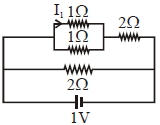
- The current \(I_{1}\) (in \(A\)) flowing through \(1\; \Omega\) resistor in the following circuit is:
 JEE Mains 2020 Medium
More PYQs from JEE Mains
- Young's moduli of the material of wires \(A\) and \(B\) are in the ratio of \(1: 4\), while its area of cross sections are in the ratio of \(1: 3\). If the same amount of load is applied to both the wires, the amount of elongation produced in the wires \(A\) and \(B\) will be in the ratio of [Assume length of wires \(A\) and \(B\) are same]JEE Mains 2023 Medium
- Two waves of intensity ratio \(1: 9\) cross each other at a point. The resultant intensities at the point, when (a) Waves are incoherent is \(I_1\) (b) Waves are coherent is \(I_2\) and differ in phase by \(60^{\circ}\). If \(\frac{I_1}{I_2}=\frac{10}{x}\), then \(x=\) _______.JEE Mains 2024 Medium
- in circular plate of mass \(M\) and radius \(R\) has its density varying as \(p\left( r \right) = {p_0}\,r\) with \(P_0\) as constant and \(r\) is the distance from its center. The moment of Inertia of the circular plate about an axis perpendicular to the plate and passing through its edge is \(I = aMR^2\) . The value of the coefficient \(a\) isJEE Mains 2019 Hard
- Two soap bubbles of radius 2 cm and 4 cm , respectively, are in contact with each other. The radius of curvature of the common surface, in cm , is ______ .JEE Mains 2025 Easy