


Questions
9 questionsShowing 1–9 of 9 questions
-
- (A) \(\frac{\pi \sqrt{ LC }}{3}\)
- (B) \(\frac{\pi \sqrt{ LC }}{6}\)
- (C) \(\frac{\pi \sqrt{ LC }}{2}\)
- (D) \(\pi \sqrt{\frac{ LC }{2}}\)
Show answer and solution
Correct Answer: (B)
\( U_{c_{f}}=75\%U_{c_{i}} \)
\( Q_{F}^{2}=\frac{3}{4}Q_{1}^{2} \)
\( Q_{i}cos~\omega t=\frac{\sqrt{3}}{2}Q_{i}\Rightarrow t=\frac{T}{12} \)
\( t=\frac{\pi}{6}\sqrt{LC} \) -
- (A) 600
- (B) 400
- (C) 300
- (D) 200
Show answer and solution
Correct Answer: (D)
Given \(L = 1.6\text{ H}\) and \(C = 40\ \mu\text{F} = 40 \times 10^{-6}\text{ F}\).
At resonance, the angular frequency is \(\omega_r = \dfrac{1}{\sqrt{LC}}\).
The inductive reactance at resonance is \(X_L = \omega_r L = \dfrac{L}{\sqrt{LC}} = \sqrt{\dfrac{L}{C}}\).
Substituting the given values:
\(X_L = \sqrt{\dfrac{1.6}{40 \times 10^{-6}}}\)
\(X_L = \sqrt{\dfrac{1.6}{4 \times 10^{-5}}}\)
\(X_L = \sqrt{4 \times 10^4}\)
\(X_L = 200\ \Omega\)
Answer: \(200\) -
- (A) \(\sqrt{\dfrac{6}{7}}\)
- (B) \(\sqrt{\dfrac{3}{5}}\)
- (C) \(\sqrt{\dfrac{7}{8}}\)
- (D) \(\sqrt{\dfrac{3}{4}}\)
Show answer and solution
Correct Answer: (C)
The current in the RC circuit at frequency \(\omega\) is given by
\(I = \dfrac{V}{\sqrt{R^2 + X_C^2}}\)
where \(X_C = \dfrac{1}{\omega C}\) is the capacitive reactance.
When the frequency is changed to \(\omega/4\), the new reactance becomes \(X_C' = \dfrac{1}{(\omega/4)C} = 4X_C\).
The new current is given as \(I/3\), so
\(\dfrac{I}{3} = \dfrac{V}{\sqrt{R^2 + (4X_C)^2}}\)
Substituting the expression for \(I\), we get
\(\dfrac{V}{3\sqrt{R^2 + X_C^2}} = \dfrac{V}{\sqrt{R^2 + 16X_C^2}}\)
Squaring both sides, we obtain
\(\dfrac{1}{9(R^2 + X_C^2)} = \dfrac{1}{R^2 + 16X_C^2}\)
\(9R^2 + 9X_C^2 = R^2 + 16X_C^2\)
\(8R^2 = 7X_C^2\)
\(\dfrac{R^2}{X_C^2} = \dfrac{7}{8}\)
\(\dfrac{R}{X_C} = \sqrt{\dfrac{7}{8}}\)
Answer: \(\sqrt{\dfrac{7}{8}}\) -
- (A) 50
- (B) 100
- (C) 125
- (D) 150
Show answer and solution
Correct Answer: (B)
The power factor of an LCR series circuit is given by \(\cos \phi = \dfrac{R}{Z}\).
Given \(\cos \phi = 0.5\) and \(R = 100 \ \Omega\).
Substituting the values, we get:
\(0.5 = \dfrac{100}{Z} \Rightarrow Z = 200 \ \Omega\)
The impedance \(Z\) of the circuit is also given by:
\(Z = \sqrt{R^2 + (X_L - X_C)^2}\)
Squaring both sides and substituting the values of \(Z\) and \(R\):
\((200)^2 = (100)^2 + (X_L - X_C)^2\)
\(40000 = 10000 + (X_L - X_C)^2\)
\((X_L - X_C)^2 = 30000\)
\(|X_L - X_C| = 100\sqrt{3} \ \Omega\)
The difference in inductive and capacitive reactance is given as \(\sqrt{3}\alpha \ \Omega\).
Comparing the two expressions:
\(\sqrt{3}\alpha = 100\sqrt{3}\)
\(\alpha = 100\)
Answer: \(100\) -
- (A) 157
- (B) 314
- (C) 628
- (D) 100
Show answer and solution
Correct Answer: (B)
\(\frac{1}{2}Li_{ms}^{2}=16\Rightarrow L=8\)
\(i^{2}R=32\Rightarrow R=8\)
\(x_{L}=\omega L\Rightarrow2\times3.14\times50\times8\)
\(\Rightarrow800\times3.14\)
\(R=8\)
\(\frac{x_{L}}{R}=314\) -
- (A) 4
- (B) 10
- (C) 6
- (D) 8
Show answer and solution
Correct Answer: (C)
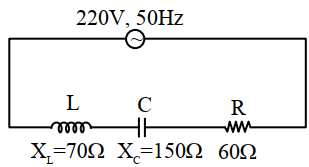
Power factor \( =\frac{R}{Z} \)
\( Z=\sqrt{R^{2}+(X_{L}-X_{C})^{2}} \)
\( =\sqrt{60^{2}+(150-70)^{2}}=100\Omega \)
∴ Power factor \(=\frac{60}{100}=\frac{6}{10}\)
Then \( a=6 \) -
- (A) \(\frac{i_{0}}{\sqrt{2}}\)
- (B) \(i_{0}\)
- (C) \(\frac{i_{0}}{\sqrt{6}}\)
- (D) \(\frac{i_{0}}{\sqrt{3}}\)
Show answer and solution
Correct Answer: (D)
\(i _{ rms }^2=\frac{\int_0^{ T }\left( i _0^2 t ^2 / T ^2\right) dt }{\int_0^{ T } dt }=\frac{ i _0^2}{T^3} \cdot \frac{T^3}{3}=\frac{ i _0^2}{3}\)
\(i _{ rms }=\frac{ i _0}{\sqrt{3}}\) -
- (A) \(\dfrac{9}{2}\)
- (B) \(\dfrac{2}{9}\)
- (C) \(\dfrac{1}{3}\)
- (D) \(3\)
Show answer and solution
Correct Answer: (B)
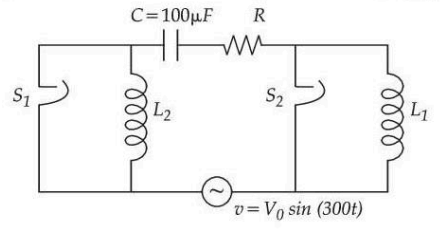
From the source \(v = V_0 \sin(300t)\), the angular frequency is \(\omega = 300\text{ rad/s}\).
Capacitance \(C = 100\ \mu\text{F} = 10^{-4}\text{ F}\), so \(X_C = \dfrac{1}{\omega C}\).
Case 1 (\(S_1\) closed, \(S_2\) open):
Closing \(S_1\) short-circuits \(L_2\), leaving an LCR series circuit with \(C\), \(R\) and \(L_1\). With phase difference \(\phi_1 = 30^\circ\):
\(\tan 30^\circ = \dfrac{\omega L_1 - X_C}{R}\)
\(\dfrac{1}{\sqrt{3}} = \dfrac{\omega L_1 - X_C}{R} \Rightarrow R = \sqrt{3}\,(\omega L_1 - X_C)\) ... (1)
Case 2 (\(S_2\) closed, \(S_1\) open):
Closing \(S_2\) short-circuits \(L_1\), leaving an LCR series circuit with \(C\), \(R\) and \(L_2\). With phase difference \(\phi_2 = 60^\circ\):
\(\tan 60^\circ = \dfrac{\omega L_2 - X_C}{R}\)
\(\sqrt{3} = \dfrac{\omega L_2 - X_C}{R} \Rightarrow \omega L_2 - X_C = R\sqrt{3}\) ... (2)
Substituting \(R\) from (1) into (2):
\(\omega L_2 - X_C = \sqrt{3}\,(\omega L_1 - X_C) \cdot \sqrt{3}\)
\(\omega L_2 - X_C = 3\omega L_1 - 3X_C\)
\(2X_C = 3\omega L_1 - \omega L_2 = \omega(3L_1 - L_2)\)
Therefore:
\(3L_1 - L_2 = \dfrac{2X_C}{\omega} = \dfrac{2}{\omega^2 C}\)
Substituting \(\omega = 300\text{ rad/s}\) and \(C = 10^{-4}\text{ F}\):
\(\omega^2 C = (300)^2 \cdot 10^{-4} = 9 \times 10^4 \cdot 10^{-4} = 9\)
\(3L_1 - L_2 = \dfrac{2}{9}\text{ H}\)
Hence, the correct option is \((2)\ \dfrac{2}{9}\). -
- (A) 25
- (B) 50
- (C) 75
- (D) 100
Show answer and solution
Correct Answer: (B)
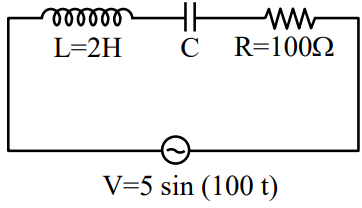
Current is maximum, so resonance
and \(\omega=\frac{1}{\sqrt{ LC }}\)
\(C=\frac{1}{\omega^2 L}=\frac{1}{2 \times 10^4}\)
\(=50 \times 10^{-6}=50 \mu F\)
No questions on this page match these filters.