


Questions
14 questionsShowing 1–14 of 14 questions
-
- (A) \(\vec{v}=3 \hat{i}+\frac{3}{2} ~\hat{j} \vec{r}=\frac{6}{5} \hat{i}+\hat{j}\)
- (B) \(\vec{v}=4 \hat{i}-\frac{3}{2} ~\hat{j} \vec{r}=\frac{8}{5} \hat{i}-\hat{j}\)
- (C) \(\vec{v}=4 \hat{i}+\frac{5}{2}~ \hat{j} \vec{r}=\frac{8}{5} \hat{i}+2 \hat{j}\)
- (D) \(\vec{v}=4 \hat{i}-\frac{3}{2} ~\hat{j} \vec{r}=\frac{6}{5} \hat{i}-\hat{j}\)
Show answer and solution
Correct Answer: (B)
\(\overrightarrow{ F }=4 t^3 \hat{ i }-3 t \hat{ j }\)
\(\overrightarrow{ a }=\frac{\overrightarrow{ F }}{ m }= t ^3 \hat{ i }-\frac{3}{4} \hat{ tj }\)
\(a_x=t^3\)
\(\frac{ dv _{ x }}{ dt }= t ^3\)
\(\int_{ v _{ x }=0}^{ v _{ x _2}} d v_{ x }=\int_{ t =0}^{ t =2} t^3 d t\)
\(v _{ x _2}-0=\left[\frac{ t ^4}{4}\right]_0^2\)
\(v_{x_2}=4\)
\(a_y=\frac{-3}{4} t\)
\(\frac{ dv _{ y }}{ dt }=-\frac{3}{4}\)
\(\int_0^{v_{v_2}} d v_y=\int_0^2 \frac{-3}{4} t d t\)
\(v _{ y _2}=\frac{-3}{4}\left[\frac{ t ^2}{2}\right]_0^2\)
\(v_{y_2}=\frac{-3}{2}\)
\(\vec{v}_2=4 \hat{i}-\frac{3}{2} \hat{j}\)
\(v_x=\frac{t^4}{4}\)
\(\int_0^{x_2} d x=\int_0^2 \frac{t^4}{4} d t\)
\(x_2-0=\left[\frac{t^5}{20}\right]_0^2\)
\(x_2=\frac{8}{5}\)
\(v_y=\frac{-3}{8} t^2\)
\(\int_0^{y_2} d x=\frac{-3}{8} t^2 d t\)
\(y _2-0=\frac{-3}{8}\left[\frac{ t ^3}{3}\right]_0^2\)
\(y_2=-1\)
\(\overrightarrow{ r }=\frac{8}{5} \hat{ i }-\hat{ j }\) -
- (A) \(t_{P}>t_{Q}\)
- (B) \(t_{p} < t_{Q}\)
- (C) \(t_{p}>1.25t_{Q}\)
- (D) \(t_{p}=t_{Q}\)
Show answer and solution
Correct Answer: (B)
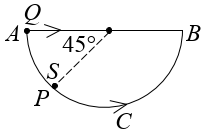
Horizontal displacement of Q is more than P. \(X_{Q}>X_{p}\)
Horizontal component of velocity is same
So \(t _{ p }=\frac{ x _{ p }}{ v }\)
\(t_Q=\frac{x_Q}{v}\)
\(t_{p} < t_{Q}\) -
- (A) 25
- (B) 12.5
- (C) 7.5
- (D) 15
Show answer and solution
Correct Answer: (B)
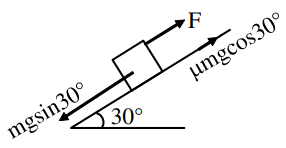
\(mg\sin 30^{\circ} = F + \mu mg\cos 30^{\circ}\)
\(F = 5 \times 10 \times \frac{1}{2} - \frac{\sqrt{3}}{2} \times 5 \times 10 \times \frac{\sqrt{3}}{2}\)
\(F =25-\frac{75}{2}=25-37.5\)
\(F =-12.5 N\)
∴ force will be downward on incline of magnitude 12.5 N. -
- (A) \(10\sqrt{2}\)
- (B) \(12\sqrt{2}\)
- (C) 12
- (D) \(24\sqrt{2}\)
Show answer and solution
Correct Answer: (B)
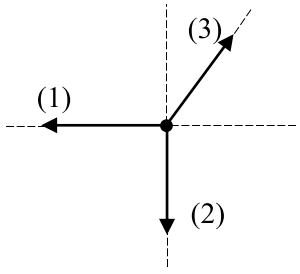
Apply C.O.M
\(M_{1}V_{1}+M_{2}V_{2}+M_{3}V_{3}=0\)
\(2(-18i)+2(-18j)+3V_{3}=0\)
\(V_{3}=12i+12j\)
\(|V_{3}|=12\sqrt{2}m/s\) -
- (A) \(\tan^{-1}(0.5)\)
- (B) \(\tan^{-1}(0.75)\)
- (C) \(\tan^{-1}(1.125)\)
- (D) \(\tan^{-1}(0.25)\)
Show answer and solution
Correct Answer: (C)
Speed of the car, \(v = 54 \times \dfrac{5}{18} = 15\) m/s.
In the frame of the car, the pendulum bob experiences a pseudo force (centrifugal force) horizontally outwards and the gravitational force downwards.
Let \(T\) be the tension in the string and \(\theta\) be the angle it makes with the vertical. For equilibrium in the car's frame, the horizontal and vertical forces balance:
\(T \sin \theta = \dfrac{mv^2}{r}\)
\(T \cos \theta = mg\)
Dividing the two equations, we get:
\(\tan \theta = \dfrac{v^2}{rg}\)
Substituting the given values \(v = 15\) m/s, \(r = 20\) m, and \(g = 10\) m/s\(^2\):
\(\tan \theta = \dfrac{(15)^2}{20 \times 10} = \dfrac{225}{200} = 1.125\)
\(\theta = \tan^{-1}(1.125)\)
Answer: \(\tan^{-1}(1.125)\) -
- (A) \(\frac{\sqrt{3}}{2} m g\)
- (B) \(\frac{1}{2} m g\)
- (C) mg
- (D) \(\sqrt{3}mg\)
Show answer and solution
Correct Answer: (A)
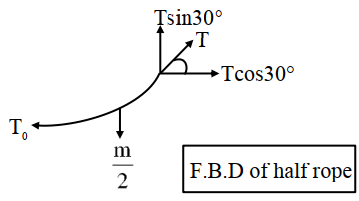
\(\operatorname{Tsin} 30^{\circ}=\frac{ m }{2} g\)
\(T \cos 30^{\circ}= T _0\)
\(\tan 30^{\circ}=\frac{ mg }{2 T_0}\)
\(T _0=\frac{\sqrt{3}}{2} mg\) -
- (A) \(2.56\)
- (B) \(3.89\)
- (C) \(4.32\)
- (D) \(5.16\)
Show answer and solution
Correct Answer: (A)
Maximum stress \(\sigma_{max} = 4 \times 10^8\) N/m\(^2\)
Radius of wire \(r = 4 \times 10^{-3}\) m
Mass of lift \(m = 1600\) kg
Maximum tension the wire can withstand is given by:
\(T_{max} = \sigma_{max} \times \pi r^2\)
\(T_{max} = 4 \times 10^8 \times 3.14 \times (4 \times 10^{-3})^2\)
\(T_{max} = 4 \times 10^8 \times 3.14 \times 16 \times 10^{-6} = 20096\) N
When the lift accelerates upwards with maximum acceleration \(a\), the tension in the wire is:
\(T_{max} = m(g + a)\)
\(20096 = 1600(10 + a)\)
\(10 + a = \dfrac{20096}{1600} = 12.56\)
\(a = 12.56 - 10 = 2.56\) m/s\(^2\)
Answer: \(2.56\) -
- (A) \(\sqrt{\frac{2L}{g~sin~2\theta-a_{0}(1+cos~2\theta)}}\)
- (B) \(\sqrt{\frac{4L}{g~sin~2\theta-a_{0}(1+cos~2\theta)}}\)
- (C) \(\sqrt{\frac{4L}{g~cos~2\theta-a_{0}sin\theta cos\theta}}\)
- (D) \(\sqrt{\frac{2L}{g~sin~\theta-a_{0}cos~\theta}}\)
Show answer and solution
Correct Answer: (B)
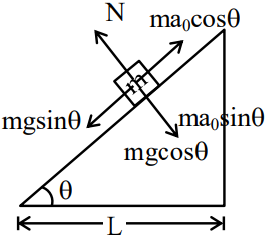
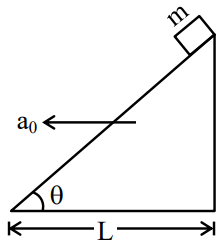
\(mgsin\theta + ma_{0}cos\theta=ma\)
\(a= g~sin\theta + a_{0}cos\theta\)
Now using,
\(S=ut+\frac{1}{2}a_{down}t^{2}\)
\(\frac{L}{cos~\theta}=\frac{1}{2}(g~sin~\theta-a_{0}cos~\theta)t^{2}\)
\(t=\sqrt{\frac{2L}{g~sin\theta cos\theta-a_{0}cos^{2}\theta}}\)
\(t=\sqrt{\frac{4L}{g~sin~2\theta-a_{0}(1+cos~2\theta)}}\) -
- (A) \(2\)
- (B) \(4\)
- (C) \(\sqrt{2}\)
- (D) \(2\sqrt{2}\)
Show answer and solution
Correct Answer: (A)
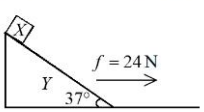
Horizontal acceleration of the wedge (assuming the block and wedge move together horizontally):
\(A = \dfrac{f}{M + m} = \dfrac{24}{10 + 2} = 2\text{ m/s}^2\)
Working in the non-inertial frame of the wedge, the block experiences a pseudo force \(mA\) directed opposite to the wedge's acceleration. The components along the incline are:
Component of gravity down the incline: \(g\sin 37^\circ\)
Component of pseudo force up the incline: \(A\cos 37^\circ\)
Net relative acceleration of the block down the incline:
\(a_{\text{rel}} = g\sin 37^\circ - A\cos 37^\circ\)
Using \(\sin 37^\circ = 0.6\) and \(\cos 37^\circ = 0.8\):
\(a_{\text{rel}} = 10(0.6) - 2(0.8) = 6 - 1.6 = 4.4\text{ m/s}^2\)
Time taken to slide a distance of \(8.8\text{ m}\) along the incline, starting from rest:
\(s = \dfrac{1}{2} a_{\text{rel}}\, t^2\)
\(8.8 = \dfrac{1}{2}(4.4)\,t^2\)
\(8.8 = 2.2\,t^2\)
\(t^2 = 4 \Rightarrow t = 2\text{ s}\)
Hence, the required time is \(2\text{ s}\). -
- (A) \(1:2\)
- (B) \(2:5\)
- (C) \(5:2\)
- (D) \(5:4\)
Show answer and solution
Correct Answer: (D)
Mass \(m = 100 \text{ g} = 0.1 \text{ kg}\)
Force \(\vec{F} = 5\hat{i} + 10\hat{j} \text{ N}\)
Acceleration \(\vec{a} = \dfrac{\vec{F}}{m} = \dfrac{5\hat{i} + 10\hat{j}}{0.1} = 50\hat{i} + 100\hat{j} \text{ m/s}^2\)
Since the body starts from rest, initial velocity \(\vec{u} = 0\).
Position after \(t = 2 \text{ s}\) is given by \(\vec{r} = \vec{u}t + \dfrac{1}{2}\vec{a}t^2\)
\(\vec{r} = \dfrac{1}{2}(50\hat{i} + 100\hat{j})(2)^2 = 100\hat{i} + 200\hat{j} \text{ m}\)
Comparing with the given position \(\vec{r} = 2x\hat{i} + 5y\hat{j}\):
\(2x = 100 \Rightarrow x = 50\)
\(5y = 200 \Rightarrow y = 40\)
The ratio \(x:y = 50:40 = 5:4\)
Answer: \(5:4\) -
- (A) A, B and C only
- (B) B, C and D only
- (C) A, C and D only
- (D) A, B and D only
Show answer and solution
Correct Answer: (D)
Given the position vector \(\vec{r} = 10t^2\hat{i} + 5t^3\hat{j}\)
Velocity \(\vec{v} = \dfrac{d\vec{r}}{dt} = 20t\hat{i} + 15t^2\hat{j}\)
Acceleration \(\vec{a} = \dfrac{d\vec{v}}{dt} = 20\hat{i} + 30t\hat{j}\)
At \(t = 1\) s:
\(\vec{r} = 10\hat{i} + 5\hat{j}\) m
\(\vec{v} = 20\hat{i} + 15\hat{j}\) m/s
\(\vec{a} = 20\hat{i} + 30\hat{j}\) m/s\(^2\)
Linear momentum \(\vec{p} = m\vec{v} = 0.1(20\hat{i} + 15\hat{j}) = 2\hat{i} + 1.5\hat{j}\) kg\(\cdot\)m/s (Statement A is correct)
Force \(\vec{F} = m\vec{a} = 0.1(20\hat{i} + 30\hat{j}) = 2\hat{i} + 3\hat{j}\) N (Statement B is correct)
Angular momentum \(\vec{L} = \vec{r} \times \vec{p} = (10\hat{i} + 5\hat{j}) \times (2\hat{i} + 1.5\hat{j}) = (10 \times 1.5 - 5 \times 2)\hat{k} = 5\hat{k}\) J\(\cdot\)s (Statement C is incorrect)
Torque \(\vec{\tau} = \vec{r} \times \vec{F} = (10\hat{i} + 5\hat{j}) \times (2\hat{i} + 3\hat{j}) = (10 \times 3 - 5 \times 2)\hat{k} = 20\hat{k}\) N\(\cdot\)m (Statement D is correct)
Therefore, statements A, B, and D are correct.
Answer: A, B and D only -
- (A) \(7.74\)
- (B) \(7.20\)
- (C) \(6.55\)
- (D) \(4.50\)
Show answer and solution
Correct Answer: (A)
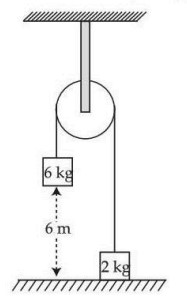
Let the acceleration of the system be \(a\) and the tension in the string be \(T\).
The equations of motion for the two masses are:
\(6g - T = 6a\)
\(T - 2g = 2a\)
Adding the two equations, we get:
\(4g = 8a\)
\(\Rightarrow a = \dfrac{4g}{8} = \dfrac{g}{2}\)
Substituting \(g = 10 \text{ m/s}^2\), the acceleration is:
\(a = \dfrac{10}{2} = 5 \text{ m/s}^2\)
The \(6 \text{ kg}\) mass is released from rest (\(u = 0\)) and travels a downward distance \(s = 6 \text{ m}\).
Using the kinematic equation \(v^2 = u^2 + 2as\):
\(v^2 = 0 + 2 \times 5 \times 6\)
\(v^2 = 60\)
\(v = \sqrt{60} \approx 7.74 \text{ m/s}\)
Answer: \(7.74\) -
- (A) \(5/3\)
- (B) \(2/3\)
- (C) \(3/5\)
- (D) \(2/5\)
Show answer and solution
Correct Answer: (A)
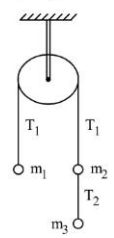
Let the acceleration of the system be \(a\). The total mass on the right side is \(m_2 + m_3 = 4 + 6 = 10\) kg, and the mass on the left side is \(m_1 = 4\) kg. Since \(10\) kg \(> 4\) kg, the right side accelerates downwards and the left side accelerates upwards.
The common acceleration \(a\) of the system is given by:
\(a = \dfrac{(m_2 + m_3) - m_1}{m_1 + m_2 + m_3} g\)
\(a = \dfrac{10 - 4}{4 + 4 + 6} g = \dfrac{6}{14} g = \dfrac{3}{7} g\)
For mass \(m_1\), the equation of motion is:
\(T_1 - m_1 g = m_1 a\)
\(T_1 = m_1(g + a) = 4 \left(g + \dfrac{3}{7}g\right) = 4 \left(\dfrac{10}{7}g\right) = \dfrac{40}{7}g\)
For mass \(m_3\), the equation of motion is:
\(m_3 g - T_2 = m_3 a\)
\(T_2 = m_3(g - a) = 6 \left(g - \dfrac{3}{7}g\right) = 6 \left(\dfrac{4}{7}g\right) = \dfrac{24}{7}g\)
The ratio of the tensions is:
\(\dfrac{T_1}{T_2} = \dfrac{\dfrac{40}{7}g}{\dfrac{24}{7}g} = \dfrac{40}{24} = \dfrac{5}{3}\)
Answer: \(5/3\) -
- (A) \(0.33\)
- (B) \(0.67\)
- (C) \(1\)
- (D) \(0.5\)
Show answer and solution
Correct Answer: (B)
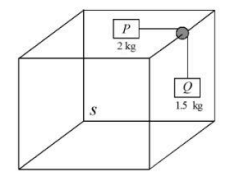
Let us analyze the forces acting on blocks \(P\) and \(Q\) in the non-inertial frame of reference of the cube \(S\), which is moving to the right with an acceleration \(a = \dfrac{g}{2} = 5 \text{ m/s}^2\).
In this frame, a pseudo force acts on both blocks towards the left.
For block \(P\) (mass \(m_P = 2 \text{ kg}\)):
The forces in the horizontal direction are the tension \(T\) in the string (acting towards the right) and the pseudo force \(F_{pP}\) (acting towards the left). Since block \(P\) is stationary relative to the cube and there is no friction on the top surface:
\(T = m_P a = 2 \times 5 = 10 \text{ N}\)
For block \(Q\) (mass \(m_Q = 1.5 \text{ kg}\)):
The horizontal forces are the normal reaction \(N\) from the side surface of the cube (acting towards the right) and the pseudo force \(F_{pQ}\) (acting towards the left). Since block \(Q\) is stationary horizontally relative to the cube:
\(N = m_Q a = 1.5 \times 5 = 7.5 \text{ N}\)
The vertical forces acting on block \(Q\) are the downward gravitational force \(m_Q g\), the upward tension \(T\), and the frictional force \(f\).
The downward force is \(m_Q g = 1.5 \times 10 = 15 \text{ N}\).
Since \(m_Q g > T\) (\(15 \text{ N} > 10 \text{ N}\)), the block has a tendency to slide downwards, so the static friction \(f\) must act upwards.
For vertical equilibrium of block \(Q\):
\(T + f = m_Q g\)
\(10 + f = 15 \Rightarrow f = 5 \text{ N}\)
To keep the block stationary, the required friction must be less than or equal to the maximum static friction (\(f \le \mu N\)). Assuming the limiting case to find the value of \(\mu\):
\(\mu N = f\)
\(\mu (7.5) = 5\)
\(\mu = \dfrac{5}{7.5} = \dfrac{2}{3} \approx 0.67\)
Answer: \(0.67\)
No questions on this page match these filters.