


All JEE Mains 2026 Physics questions
31 chaptersShowing 201–250 of 469 questions
-
- (A) 165
- (B) 168
- (C) 170
- (D) 171
Show answer and solution
Correct Answer: (D)
The magnetic force acting on a moving charge is given by \(\vec{F} = q(\vec{v} \times \vec{B})\).
Given:
\(q = 1 \, \mu\text{C} = 10^{-6} \text{ C}\)
\(\vec{v} = \hat{i} - 2\hat{j} + 3\hat{k}\)
\(\vec{B} = 2\hat{i} + 3\hat{j} - 5\hat{k}\)
Calculating the cross product \(\vec{v} \times \vec{B}\):
\(\vec{v} \times \vec{B} = \begin{vmatrix} \hat{i} & \hat{j} & \hat{k} \\ 1 & -2 & 3 \\ 2 & 3 & -5 \end{vmatrix}\)
\(\vec{v} \times \vec{B} = \hat{i}(10 - 9) - \hat{j}(-5 - 6) + \hat{k}(3 + 4)\)
\(\vec{v} \times \vec{B} = \hat{i} + 11\hat{j} + 7\hat{k}\)
The magnitude of \(\vec{v} \times \vec{B}\) is:
\(|\vec{v} \times \vec{B}| = \sqrt{1^2 + 11^2 + 7^2} = \sqrt{1 + 121 + 49} = \sqrt{171}\)
The magnitude of the force is:
\(|\vec{F}| = q |\vec{v} \times \vec{B}| = 10^{-6} \times \sqrt{171} = \sqrt{171} \times 10^{-6} \text{ N}\)
Comparing this with the given expression \(\sqrt{\alpha} \times 10^{-6} \text{ N}\), we get:
\(\alpha = 171\)
Answer: \(171\) -
- (A) 2
- (B) 4
- (C) 6
- (D) 8
Show answer and solution
Correct Answer: (A)
Given:
Mass of the particle, \(m = 5 \text{ mg} = 5 \times 10^{-6} \text{ kg}\)
Charge, \(q = 5\pi \times 10^{-6} \text{ C}\)
Velocity, \(\vec{v} = (3\hat{i} + 2\hat{k}) \times 10^{-2} \text{ m/s}\)
Magnetic field, \(\vec{B} = 0.1\hat{k} \text{ Wb/m}^2\)
The velocity component parallel to the magnetic field is \(v_{\parallel} = 2 \times 10^{-2} \text{ m/s}\).
The time period of one revolution is given by:
\(T = \dfrac{2\pi m}{qB}\)
Substituting the given values:
\(T = \dfrac{2\pi \times 5 \times 10^{-6}}{5\pi \times 10^{-6} \times 0.1} = \dfrac{2}{0.1} = 20 \text{ s}\)
The time taken to complete \(5\) revolutions is:
\(t = 5T = 5 \times 20 = 100 \text{ s}\)
The distance moved along the \(\hat{k}\) direction (pitch for \(5\) revolutions) is:
\(\alpha = v_{\parallel} \times t\)
\(\alpha = 2 \times 10^{-2} \times 100 = 2 \text{ m}\)
Answer: \(2\) -
- (A) 3.14
- (B) 314
- (C) 0.0314
- (D) 0.003
Show answer and solution
Correct Answer: (B)
The magnetic moment of the coil is given by \(M = NIA\).
The torque acting on the coil is \(\tau = MB \sin\theta = NIAB \sin\theta\).
Substituting the given values:
\(\tau = 125 \times 1 \times (\pi \times (0.02)^2) \times 0.4 \times \sin 30^\circ\)
\(\tau = 125 \times 1 \times 4\pi \times 10^{-4} \times 0.4 \times 0.5\)
\(\tau = 100\pi \times 10^{-4}\)
\(\tau = 100 \times 3.14 \times 10^{-4} = 314 \times 10^{-4}\) N.m
Comparing with \(\alpha \times 10^{-4}\) N.m, we get \(\alpha = 314\).
Answer: \(314\) -
- (A) \(16\times 10^{-5}\,\hat{k}\)
- (B) \(5024\times 10^{-7}\,\hat{k}\)
- (C) \(5024\times 10^{-7}\,\hat{i}\)
- (D) \(5024\times 10^{-7}\,\hat{j}\)
Show answer and solution
Correct Answer: (D)
Explanation:
1. Magnetic Dipole Moment (\( \vec{M} \)): The magnetic dipole moment of a current-carrying loop is given by the formula:
\( \vec{M} = I \cdot A \cdot \hat{n} \)
2. Area of the Circular Loop (\( A \)):
Given radius, \( r = 2\text{ cm} = 2 \times 10^{-2}\text{ m} \)
\( A = \pi r^2 = \pi \left(2 \times 10^{-2}\text{ m}\right)^2 = 4\pi \times 10^{-4}\text{ m}^2 \)
3. Calculating \( \vec{M} \):
Substitute \( I = 100\sqrt{2}\text{ A} \) and \( \hat{n} = \frac{\hat{i} + \hat{k}}{\sqrt{2}} \):
\( \vec{M} = \left(100\sqrt{2}\right) \times \left(4\pi \times 10^{-4}\right) \times \left(\frac{\hat{i} + \hat{k}}{\sqrt{2}}\right) \)
\( \vec{M} = 4\pi \times 10^{-2}(\hat{i} + \hat{k})\text{ A}\cdot\text{m}^2 \)
4. Torque (\( \vec{\tau} \)): The torque experienced by a magnetic dipole in a uniform magnetic field is given by:
\( \vec{\tau} = \vec{M} \times \vec{B} \)
Given, \( \vec{B} = 4 \times 10^{-3}(3\hat{i} + 2\hat{k})\text{ T} \)
Substituting the values:
\( \vec{\tau} = \left[4\pi \times 10^{-2}(\hat{i} + \hat{k})\right] \times \left[4 \times 10^{-3}(3\hat{i} + 2\hat{k})\right] \)
\( \vec{\tau} = 16\pi \times 10^{-5} \left[ (\hat{i} + \hat{k}) \times (3\hat{i} + 2\hat{k}) \right] \)
5. Evaluating Cross Product:
Using the cross product rules (\( \hat{i}\times\hat{i}=0 \), \( \hat{i}\times\hat{k}=-\hat{j} \), \( \hat{k}\times\hat{i}=\hat{j} \), \( \hat{k}\times\hat{k}=0 \)):
\( (\hat{i} + \hat{k}) \times (3\hat{i} + 2\hat{k}) = 2(\hat{i} \times \hat{k}) + 3(\hat{k} \times \hat{i}) = -2\hat{j} + 3\hat{j} = \hat{j} \)
Therefore:
\( \vec{\tau} = 16\pi \times 10^{-5}\hat{j} \)
6. Substituting \( \pi = 3.14 \):
\( \vec{\tau} = 16 \times 3.14 \times 10^{-5}\hat{j} = 50.24 \times 10^{-5}\hat{j} = 5024 \times 10^{-7}\hat{j}\text{ Wb}\cdot\text{A} \)
Hence, Option D is the correct choice. -
- (A) \( a = g \)
- (B) \( a > g \)
- (C) \( a = 0 \)
- (D) \( 0 < a < g \)
Show answer and solution
Correct Answer: (A)
Since the solenoid is placed vertically, the magnetic field inside the solenoid will be either along - y or + y axis.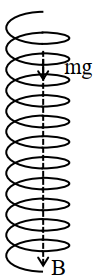
⇒ Particle will gain velocity along -y axis.
\(\Rightarrow \quad \overrightarrow{ F }_{ B }= q (\overrightarrow{ v } \times \overrightarrow{ B })\)
\(\Rightarrow \quad \overrightarrow{ F }_{ B }=0\)
\(\Rightarrow \quad \overrightarrow{ F }_{\text {net }}= mg\)
\(\Rightarrow \quad a _{\text {net }}= g\) -
- (A) \(30\)
- (B) \(300\)
- (C) \(150\)
- (D) \(0.0\)
Show answer and solution
Correct Answer: (B)
Let the distance between the wires be \(d = 8\text{ cm}\). The distance of the midpoint from each wire is \(r = \dfrac{d}{2} = 4\text{ cm} = 0.04\text{ m}\).
The current in each wire is \(I = 30\text{ A}\).
Since the currents flow in opposite directions, the magnetic fields produced by both wires at the midpoint point in the same direction and add up.
The total magnetic field at the midpoint is:
\(B_{\text{net}} = B_1 + B_2 = \dfrac{\mu_0 I}{2\pi r} + \dfrac{\mu_0 I}{2\pi r} = \dfrac{\mu_0 I}{\pi r}\)
Substituting the given values:
\(B_{\text{net}} = \dfrac{4\pi \times 10^{-7} \times 30}{\pi \times 0.04}\)
\(B_{\text{net}} = \dfrac{120 \times 10^{-7}}{0.04}\)
\(B_{\text{net}} = 3000 \times 10^{-7}\text{ T}\)
\(B_{\text{net}} = 300 \times 10^{-6}\text{ T} = 300\ \mu\text{T}\)
Answer: \(300\) -
- (A) D Only
- (B) A, D Only
- (C) B, C Only
- (D) E Only
Show answer and solution
Correct Answer: (A)
Solid cylinder
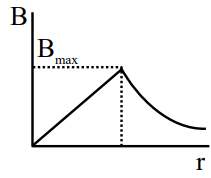
\(B_{max}\) at surface
\(B_{min}\) at Axis -
- (A) 25
- (B) 10
- (C) 0.5
- (D) 2.5
Show answer and solution
Correct Answer: (A)
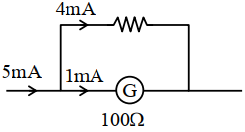
\(G =100 \Omega\)
\(i _{ g }=1 mA\)
\(i =5 mA\)
\(r_s=\frac{G}{\left(\frac{i}{i_g}-1\right)}\)
\(=\frac{100}{\left(\frac{5}{1}-1\right)}=25 \Omega\) -
- (A) 25
- (B) 50
- (C) 75
- (D) 100
Show answer and solution
Correct Answer: (B)
Let \(G\) be the resistance of the galvanometer and \(I_g\) be the current required for full scale deflection.
When the galvanometer is shunted with \(S = 2\,\Omega\), it acts as an ammeter of range \(I = 500\text{ mA} = 0.5\text{ A}\). The potential difference across the galvanometer and the shunt is equal:
\(I_g G = (I - I_g) S\)
\(I_g G = (0.5 - I_g) \times 2\)
\(I_g G + 2 I_g = 1\)
\(I_g = \dfrac{1}{G + 2}\)
When a resistance \(R = 470\,\Omega\) is connected in series, it acts as a voltmeter of range \(V = 10\text{ V}\). The total voltage is the sum of the voltage drops:
\(V = I_g (G + R)\)
\(10 = I_g (G + 470)\)
\(I_g = \dfrac{10}{G + 470}\)
Equating the two expressions for \(I_g\):
\(\dfrac{1}{G + 2} = \dfrac{10}{G + 470}\)
\(G + 470 = 10(G + 2)\)
\(G + 470 = 10G + 20\)
\(9G = 450\)
\(G = 50\,\Omega\)
Answer: \(50\) -
- (A) \(50\hat{i} + 100\hat{j}\)
- (B) \(100\hat{i} + 50\hat{j}\)
- (C) \(-50\hat{i} + 100\hat{j}\)
- (D) \(50\hat{i} - 100\hat{j}\)
Show answer and solution
Correct Answer: (A)
The Lorentz force experienced by a charged particle is given by \(\vec{F} = q(\vec{E} + \vec{v} \times \vec{B})\).
Given that the particle moves in the \(x\)-\(y\) plane, its velocity can be written as \(\vec{v} = v_x \hat{i} + v_y \hat{j}\).
Substituting the given values into the force equation:
\(\vec{F} = 10^{-9} [0.4\hat{j} + (v_x \hat{i} + v_y \hat{j}) \times (4 \times 10^{-3} \hat{k})]\)
Using the cross product rules \(\hat{i} \times \hat{k} = -\hat{j}\) and \(\hat{j} \times \hat{k} = \hat{i}\):
\(\vec{F} = 10^{-9} [0.4\hat{j} - 4 \times 10^{-3} v_x \hat{j} + 4 \times 10^{-3} v_y \hat{i}]\)
\(\vec{F} = 10^{-9} [4 \times 10^{-3} v_y \hat{i} + (0.4 - 4 \times 10^{-3} v_x) \hat{j}]\)
The given force is \(\vec{F} = (4\hat{i} + 2\hat{j}) \times 10^{-10}\) N, which can be rewritten as:
\(\vec{F} = 10^{-9} (0.4\hat{i} + 0.2\hat{j})\) N
Comparing the coefficients of \(\hat{i}\) and \(\hat{j}\) from both expressions:
For the \(\hat{i}\) component:
\(4 \times 10^{-3} v_y = 0.4\)
\(v_y = \dfrac{0.4}{4 \times 10^{-3}} = 100\) m/s
For the \(\hat{j}\) component:
\(0.4 - 4 \times 10^{-3} v_x = 0.2\)
\(4 \times 10^{-3} v_x = 0.2\)
\(v_x = \dfrac{0.2}{4 \times 10^{-3}} = 50\) m/s
Therefore, the velocity of the particle is \(\vec{v} = 50\hat{i} + 100\hat{j}\) m/s.
Answer: \(50\hat{i} + 100\hat{j}\) -
- (A) \(\dfrac{qE_0}{\lambda}[1 - e^{-\lambda L}]\)
- (B) \(\left(\dfrac{v_0 q B_0}{2\lambda}\right)[2 - e^{-2\lambda L}]\)
- (C) \(\dfrac{qE_0}{\lambda}[1 + e^{-\lambda L}]\)
- (D) \(q\left(\dfrac{E_0 + v_0 B_0}{\lambda}\right)[1 - e^{-\lambda L/2}]\)
Show answer and solution
Correct Answer: (A)
According to the work-energy theorem, the change in kinetic energy of a particle is equal to the total work done by all the forces acting on it.
The forces acting on the particle are the electric force and the magnetic force. The magnetic force is given by \(\vec{F}_B = q(\vec{v} \times \vec{B})\). Since the magnetic force is always perpendicular to the velocity vector of the particle, the work done by the magnetic field is zero.
The change in kinetic energy is equal to the work done by the electric field alone. The electric force is \(\vec{F}_E = q\vec{E} = qE_0 e^{-\lambda x}\hat{x}\).
The work done by the electric field as the particle moves from \(x = 0\) to \(x = L\) is given by
\(W_E = \int_{0}^{L} \vec{F}_E \cdot d\vec{r} = \int_{0}^{L} qE_0 e^{-\lambda x} dx\)
Evaluating the integral, we get
\(W_E = qE_0 \left[ \dfrac{e^{-\lambda x}}{-\lambda} \right]_{0}^{L}\)
\(W_E = -\dfrac{qE_0}{\lambda} (e^{-\lambda L} - e^{0})\)
\(W_E = \dfrac{qE_0}{\lambda} [1 - e^{-\lambda L}]\)
Thus, the change in kinetic energy is \(\dfrac{qE_0}{\lambda} [1 - e^{-\lambda L}]\).
Answer: \(\dfrac{qE_0}{\lambda}[1 - e^{-\lambda L}]\) -
- (A) \(6.28\)
- (B) \(6.28 \times 10^{-6}\)
- (C) \(628\)
- (D) \(6.28 \times 10^{-4}\)
Show answer and solution
Correct Answer: (A)
The magnetic field at the centre of the circular loop is given by \(B = \dfrac{\mu_0 I}{2R}\)
Substituting the given values, \(B = \dfrac{4\pi \times 10^{-7} \times 2}{2 \times 0.1} = 4\pi \times 10^{-6}\) T
The magnetic energy density is \(u = \dfrac{B^2}{2\mu_0}\)
\(u = \dfrac{(4\pi \times 10^{-6})^2}{2 \times 4\pi \times 10^{-7}} = \dfrac{16\pi^2 \times 10^{-12}}{8\pi \times 10^{-7}} = 2\pi \times 10^{-5}\) J/m\(^3\)
The volume of the small cube is \(V = (1 \text{ mm})^3 = (10^{-3} \text{ m})^3 = 10^{-9}\) m\(^3\)
The magnetic energy stored inside the cube is \(U = u \times V\)
\(U = 2\pi \times 10^{-5} \times 10^{-9} = 2\pi \times 10^{-14}\) J
Using \(\pi = 3.14\), we get \(U = 2 \times 3.14 \times 10^{-14} = 6.28 \times 10^{-14}\) J
Comparing with \(\alpha \times 10^{-14}\) J, we get \(\alpha = 6.28\)
Answer: \(6.28\) -
- (A) connect resistor of \(\dfrac{x}{2}\ \Omega\), in series with voltmeter.
- (B) connect resistor of \(\dfrac{x}{2}\ \Omega\), in parallel to voltmeter.
- (C) connect a resistor of \(x\ \Omega\) in series with voltmeter.
- (D) connect resistor of \(2x\ \Omega\) in parallel to voltmeter.
Show answer and solution
Correct Answer: (A)
Let the maximum current for full-scale deflection of the voltmeter be \(I_g\).
\(I_g = \dfrac{V_1}{R_v} = \dfrac{20}{x}\)
To increase the measuring range to \(V_2 = 30\) V, a resistance \(R\) must be connected in series with the voltmeter.
\(V_2 = I_g(R_v + R)\)
\(30 = \dfrac{20}{x}(x + R)\)
\(30x = 20x + 20R\)
\(10x = 20R\)
\(R = \dfrac{x}{2}\ \Omega\)
Thus, a resistor of \(\dfrac{x}{2}\ \Omega\) should be connected in series with the voltmeter.
Answer: connect resistor of \(\dfrac{x}{2}\ \Omega\), in series with voltmeter. -
- (A) \(\frac{\mu_0}{2 \pi} \frac{ I }{ r }(\pi+1) \hat{ i }\)
- (B) \(-\frac{\mu_0}{2 \pi} \frac{ I }{ r }(\pi-1) \hat{ i }\)
- (C) \(\frac{\mu_0}{2 \pi} \frac{ I }{ r }(\pi-1) \hat{ i }\)
- (D) \(-\frac{\mu_0}{2 \pi} \frac{ I }{ r }(\pi+1) \hat{ i }\)
Show answer and solution
Correct Answer: (B)
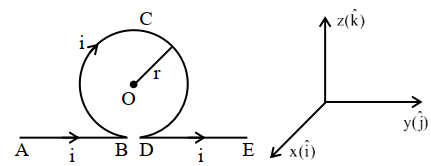
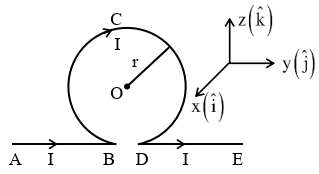
\(\overrightarrow{ B}_0=\overrightarrow{ B }_{ AB }+\overrightarrow{ B }_{ DE }+\overrightarrow{ B }_{ BCD }\)
\(=\frac{\mu_0 i }{4 \pi r } \hat{ i }+\frac{\mu_0 i }{4 \pi r } \hat{ i }-\frac{\mu_0 i }{2 r } \hat{ i }\)
\(=\frac{\mu_0 i }{2 \pi r } \hat{ i }-\frac{\mu_0 i }{2 r } \hat{ i }\)
\(=\frac{\mu_0 i }{2 \pi r }(1-\pi) \hat{ i }\)
\(=-\frac{\mu_0 i }{2 \pi r}(\pi-1) \hat{ i }\) -
- (A) \(4.4\)
- (B) \(2.64\)
- (C) \(3.25\)
- (D) \(1.2\)
Show answer and solution
Correct Answer: (B)
Let the number of turns per unit radial width be \(n = \dfrac{N}{r_2 - r_1}\).
Consider an elemental ring of radius \(r\) and width \(dr\). The number of turns in this element is \(dN = n \, dr\).
The magnetic moment of this elemental ring is \(dM = I \, dN \, A = I \left( \dfrac{N}{r_2 - r_1} \, dr \right) (\pi r^2)\).
Integrating from \(r_1\) to \(r_2\) to find the total magnetic moment \(M\):
\(M = \int_{r_1}^{r_2} \dfrac{I \pi N}{r_2 - r_1} r^2 \, dr = \dfrac{I \pi N}{3(r_2 - r_1)} (r_2^3 - r_1^3)\)
Substituting the given values: \(I = 20 \times 10^{-3}\) A, \(N = 200\), \(r_1 = 0.03\) m, and \(r_2 = 0.06\) m:
\(M = \dfrac{20 \times 10^{-3} \times \pi \times 200}{3(0.06 - 0.03)} \left( (0.06)^3 - (0.03)^3 \right)\)
\(M = \dfrac{4\pi}{0.09} (216 \times 10^{-6} - 27 \times 10^{-6})\)
\(M = \dfrac{4\pi}{0.09} \times 189 \times 10^{-6} = 4\pi \times 2100 \times 10^{-6}\)
\(M = 84\pi \times 10^{-4} \approx 84 \times 3.14 \times 10^{-4} = 263.76 \times 10^{-4} \approx 2.64 \times 10^{-2}\) A.m\(^2\)
Comparing with \(\alpha \times 10^{-2}\) A.m\(^2\), we get \(\alpha = 2.64\).
Answer: \(2.64\) -
- (A) 12
- (B) 24
- (C) 36
- (D) 48
Show answer and solution
Correct Answer: (A)
The magnetic force on a moving charged particle is given by \(\vec{F} = q(\vec{v} \times \vec{B})\).
Since the acceleration \(\vec{a}\) is in the direction of the magnetic force, it must be perpendicular to the magnetic field \(\vec{B}\).
Therefore, the dot product of acceleration and magnetic field is zero:
\(\vec{a} \cdot \vec{B} = 0\)
Substituting the given vectors:
\(\left(4\hat{i} - \dfrac{x}{2}\hat{j}\right) \cdot (3\hat{i} + 2\hat{j}) = 0\)
\((4)(3) + \left(-\dfrac{x}{2}\right)(2) = 0\)
\(12 - x = 0\)
\(x = 12\)
Answer: \(12\) -
- (A) \(2 \sqrt{3}\)
- (B) \(\sqrt{3}\)
- (C) \(3 \sqrt{3}\)
- (D) \(\frac{\sqrt{3}}{2}\)
Show answer and solution
Correct Answer: (C)
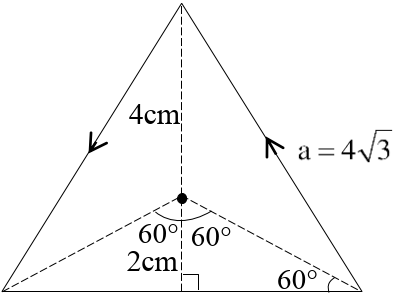
\(B =\frac{\mu_0}{4 \pi} \times \frac{ I }{ d }\left[\sin 60^{\circ}+\sin 60^{\circ}\right] \times 3\)
\(B =10^{-7} \times \frac{2}{2 \times 10^{-2}}\left(\frac{\sqrt{3}}{2}+\frac{\sqrt{3}}{2}\right) \times 3\)
\(=\sqrt{3} \times 10^{-5} \times 3=3 \sqrt{3} \times 10^{-5}\) -
- (A) \(2\sqrt{2}\)
- (B) 4
- (C) 2
- (D) 8
Show answer and solution
Correct Answer: (C)
\(\frac{\mu_{0}I}{2R} = 16 \mu T\)
\(\frac{\mu_0 I R^2}{2\left(x^2+R^2\right)^{3 / 2}}=\frac{\mu_0 I R^2}{2 \times 8 R^3}=2 \mu T\) -
- (A) \(6 \times 10^{-7}\) N towards P
- (B) \(6 \times 10^{-6}\) N towards R
- (C) \(6 \times 10^{-7}\) N towards R
- (D) \(6 \times 10^{-6}\) N towards P
Show answer and solution
Correct Answer: (B)
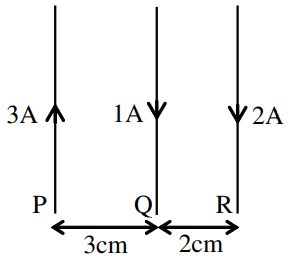
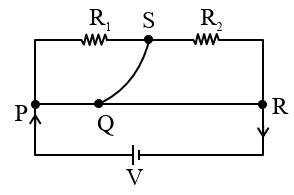
\(F _{ net }=\frac{\mu_0}{2 \pi} I _0\left(\frac{ I _1}{d_1}+\frac{ I _2}{d_2}\right) \ell\)
\(F _{ net }=2 \times 10^{-7} \times 1\left(\frac{3}{3}+\frac{2}{2}\right) \times \frac{15 \times 10^{-2}}{10^{-2}}\)
\(=4 \times 15 \times 10^{-7}\)
\(F _{\text {net }}=6 \times 10^{-6} N\) -
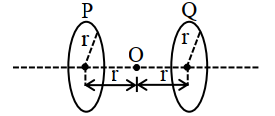
- (A) \(\frac{3\mu_{0}I}{4\sqrt{2}r}\) toward P
- (B) \(\frac{\mu_{0}I}{4\sqrt{2}r}\) toward P
- (C) \(\frac{\mu_{0}I}{4\sqrt{2}r}\) towards Q
- (D) \(\frac{3\mu_{0}I}{4\sqrt{2}r}\) towards Q
Show answer and solution
Correct Answer: (D)
\(B _{ net }= B _1- B _2\)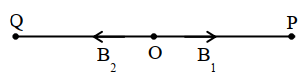
\(=\frac{4 \mu_0 i R^2}{2\left(R^2+R^2\right)^{3 / 2}}-\frac{\mu_0 i R^2}{2\left(R^2+R^2\right)^{3 / 2}}\)
\(=\frac{3 \mu_0 i }{4 \sqrt{2} R}\) -
- (A) \(\dfrac{2 + \pi}{1 + \pi}\)
- (B) \(\dfrac{1 + \pi}{1 - \pi}\)
- (C) \(\dfrac{2 + \pi}{1 - \pi}\)
- (D) \(\dfrac{1 + \pi}{2 - \pi}\)
Show answer and solution
Correct Answer: (A)
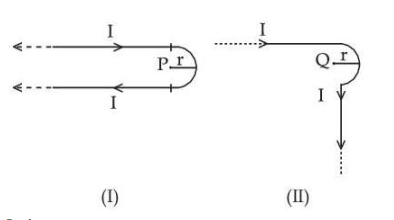
For the first figure, the magnetic field at the centre P is the vector sum of the magnetic fields due to two semi-infinite straight wires and one semicircular arc.
The magnetic field due to the top semi-infinite wire at P is \(B_{1a} = \dfrac{\mu_0 I}{4\pi r}\) directed into the plane.
The magnetic field due to the bottom semi-infinite wire at P is \(B_{1b} = \dfrac{\mu_0 I}{4\pi r}\) directed into the plane.
The magnetic field due to the semicircular arc at P is \(B_{1c} = \dfrac{\mu_0 I}{4r} = \dfrac{\pi \mu_0 I}{4\pi r}\) directed into the plane.
The total magnetic field at P is \(B_1 = B_{1a} + B_{1b} + B_{1c} = \dfrac{\mu_0 I}{4\pi r} (1 + 1 + \pi) = \dfrac{\mu_0 I}{4\pi r} (2 + \pi)\).
For the second figure, the magnetic field at the centre Q is the vector sum of the magnetic fields due to one horizontal semi-infinite wire, one semicircular arc, and one vertical semi-infinite wire.
The magnetic field due to the horizontal semi-infinite wire at Q is \(B_{2a} = \dfrac{\mu_0 I}{4\pi r}\) directed into the plane.
The magnetic field due to the semicircular arc at Q is \(B_{2c} = \dfrac{\mu_0 I}{4r} = \dfrac{\pi \mu_0 I}{4\pi r}\) directed into the plane.
Since the arc is semicircular, it ends at a point directly below Q. The vertical semi-infinite wire starts from this point and extends downwards, meaning its line of action passes through Q. Therefore, the magnetic field due to this vertical wire at Q is \(B_{2b} = 0\).
The total magnetic field at Q is \(B_2 = B_{2a} + B_{2b} + B_{2c} = \dfrac{\mu_0 I}{4\pi r} (1 + 0 + \pi) = \dfrac{\mu_0 I}{4\pi r} (1 + \pi)\).
The ratio of the magnetic fields is \(\dfrac{B_1}{B_2} = \dfrac{\dfrac{\mu_0 I}{4\pi r} (2 + \pi)}{\dfrac{\mu_0 I}{4\pi r} (1 + \pi)} = \dfrac{2 + \pi}{1 + \pi}\).
Answer: \(\dfrac{2 + \pi}{1 + \pi}\) -
- (A) 3
- (B) 4.5
- (C) 4
- (D) 2
Show answer and solution
Correct Answer: (C)
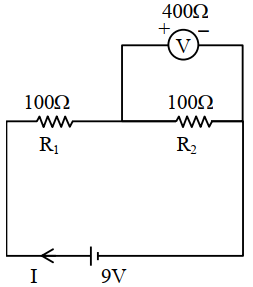
Current in circuit.
\(I=\frac{E}{\operatorname{Req}}\)
Req \(=100+\frac{400 \times 100}{400+100}=180 \Omega\)
\(\therefore I =\frac{9}{180}=\frac{1}{20} A\)
Reading of voltmeter \(= V = I \times 80=\frac{1}{20} \times 80=4 V\) -
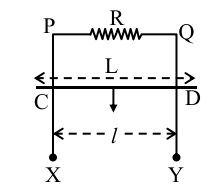
- (A) \( \frac{2mgR}{B^{2}l^{2}} \)
- (B) \( \frac{8mgR}{B^{2}l^{2}} \)
- (C) \( \frac{2mgR}{B^{2}L^{2}} \)
- (D) \( \frac{mgR}{B^{2}l^{2}} \)
Show answer and solution
Correct Answer: (D)
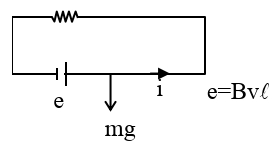
at equilibrium (Or for terminal velocity)
\( mg=iBl\Rightarrow mg=(\frac{Bvl}{R})Bl \)
\( V=\frac{mgR}{B^{2}l^{2}} \) -
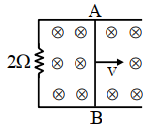
- (A) \( 7.5 \times 10^{-2} \)
- (B) \( 5.7 \times 10^{-3} \)
- (C) \( 5.7 \times 10^{-2} \)
- (D) \( 7.5 \times 10^{-3} \)
Show answer and solution
Correct Answer: (D)
To maintain constant speed
\(F _{ ext }= F _{ B }\)
\(=\left(\frac{ vB l}{ R }\right) l B\)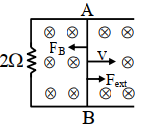
\(=\frac{ B ^2 l^2 v }{ R }\)
\(=\frac{(0.1)^2 \times(1)^2 \times 1.5}{2}\)
\(=7.5 \times 10^{-3} N\) -
- (A) \(0.2 \sqrt{10}\)
- (B) \( 20 \sqrt{10} \)
- (C) \( 2 \sqrt{10} \)
- (D) \( 200 \sqrt{10} \)
Show answer and solution
Correct Answer: (B)
\(\varepsilon= vB \ell\)
\( v=\sqrt{2gh}=\sqrt{2\times10\times200}=20\sqrt{10} \)
\( \varepsilon=(20\sqrt{10})(0.5\times10^{-4})20\)
\(=20 \sqrt{10} \times 10^{-3}=20 \sqrt{10} mV\) -
- (A) \(60\)
- (B) \(12\)
- (C) \(120\)
- (D) \(34\)
Show answer and solution
Correct Answer: (B)
Given:
Length of the solenoid, \(l = 30 \text{ cm} = 0.3 \text{ m}\)
Number of turns per unit length, \(n = 10 \text{ turns/cm} = 1000 \text{ turns/m}\)
Area of cross-section, \(A = 5 \text{ cm}^2 = 5 \times 10^{-4} \text{ m}^2\)
Change in current, \(\Delta I = 4 \text{ A} - 2 \text{ A} = 2 \text{ A}\)
Time interval, \(\Delta t = 3.14 \text{ s}\)
The self-inductance of the solenoid is given by:
\(L = \mu_0 n^2 A l\)
Substituting the given values:
\(L = 4\pi \times 10^{-7} \times (1000)^2 \times 5 \times 10^{-4} \times 0.3\)
\(L = 4\pi \times 10^{-7} \times 10^6 \times 1.5 \times 10^{-4}\)
\(L = 6\pi \times 10^{-5} \text{ H}\)
The magnitude of the induced e.m.f. is:
\(e = L \dfrac{\Delta I}{\Delta t}\)
Substituting the values of \(L\), \(\Delta I\), and \(\Delta t\):
\(e = 6\pi \times 10^{-5} \times \dfrac{2}{3.14}\)
Using \(\pi \approx 3.14\):
\(e = 6 \times 10^{-5} \times 2 = 12 \times 10^{-5} \text{ V}\)
Comparing this with \(e = \alpha \times 10^{-5} \text{ V}\), we get:
\(\alpha = 12\)
Answer: \(12\) -
- (A) 70
- (B) 75
- (C) 80
- (D) 85
Show answer and solution
Correct Answer: (B)
Let the length of the inclined plane be \(s\).
For the smooth inclined plane, the acceleration of the block is \(a_1 = g \sin \theta\).
The time taken is \(t_1 = \dfrac{t}{2}\). Using the second equation of motion \(s = ut + \dfrac{1}{2}at^2\) with \(u = 0\):
\(s = \dfrac{1}{2} (g \sin \theta) \left(\dfrac{t}{2}\right)^2 = \dfrac{1}{8} g \sin \theta t^2\)
For the rough inclined plane, the acceleration of the block is \(a_2 = g(\sin \theta - \mu \cos \theta)\).
The time taken is \(t_2 = t\). Using the equation of motion again:
\(s = \dfrac{1}{2} g(\sin \theta - \mu \cos \theta) t^2\)
Equating the two expressions for \(s\):
\(\dfrac{1}{8} g \sin \theta t^2 = \dfrac{1}{2} g(\sin \theta - \mu \cos \theta) t^2\)
\(\dfrac{1}{4} \sin \theta = \sin \theta - \mu \cos \theta\)
Given \(\theta = 45^{\circ}\), we have \(\sin 45^{\circ} = \cos 45^{\circ} = \dfrac{1}{\sqrt{2}}\). Substituting these values:
\(\dfrac{1}{4} = 1 - \mu\)
\(\mu = 1 - \dfrac{1}{4} = \dfrac{3}{4} = 0.75\)
We are given \(\mu = \dfrac{\alpha}{100}\).
\(\dfrac{\alpha}{100} = 0.75 \Rightarrow \alpha = 75\)
Answer: \(75\) -
- (A) \(2\sqrt{2} \, \dfrac{\mu_0 L^2}{R}\)
- (B) \(\sqrt{2} \, \dfrac{\mu_0 L^2}{R}\)
- (C) \(\sqrt{2} \, \dfrac{\mu_0 R^2}{L}\)
- (D) \(2\sqrt{2} \, \dfrac{\mu_0 R^2}{L}\)
Show answer and solution
Correct Answer: (D)
Using the reciprocity theorem, assume a current \(I\) flows through the larger square loop and compute the flux through the smaller circular loop. The mutual inductance is given by \(M = \dfrac{\Phi}{I}\).
Magnetic field at the centre of the square loop:
For a square of side \(L\), the perpendicular distance from the centre to any side is \(d = \dfrac{L}{2}\), and each side subtends angles \(\theta_1 = \theta_2 = 45^\circ\) at the centre.
The field due to one finite straight segment is:
\(B_{\text{segment}} = \dfrac{\mu_0 I}{4\pi d}(\sin\theta_1 + \sin\theta_2)\)
\(B_{\text{segment}} = \dfrac{\mu_0 I}{4\pi \cdot \frac{L}{2}}\left(\dfrac{1}{\sqrt{2}} + \dfrac{1}{\sqrt{2}}\right) = \dfrac{\mu_0 I}{2\pi L} \cdot \sqrt{2} = \dfrac{\sqrt{2}\,\mu_0 I}{2\pi L}\)
All four sides contribute equally in the same direction at the centre, so:
\(B_{\text{total}} = 4 \cdot \dfrac{\sqrt{2}\,\mu_0 I}{2\pi L} = \dfrac{2\sqrt{2}\,\mu_0 I}{\pi L}\)
Flux through the circular loop:
Since \(L \gg R\), the field \(B_{\text{total}}\) can be treated as uniform over the area \(A = \pi R^2\) of the circular loop.
\(\Phi = B_{\text{total}} \cdot A = \dfrac{2\sqrt{2}\,\mu_0 I}{\pi L} \cdot \pi R^2 = \dfrac{2\sqrt{2}\,\mu_0 R^2 I}{L}\)
Mutual inductance:
\(M = \dfrac{\Phi}{I} = \dfrac{2\sqrt{2}\,\mu_0 R^2}{L}\)
Hence, the correct option is \((4)\ \dfrac{2\sqrt{2}\,\mu_0 R^2}{L}\). -
- (A) 11
- (B) 22
- (C) 33
- (D) 44
Show answer and solution
Correct Answer: (D)
The magnetic flux linked with the circular loop is given by \(\Phi = BA \cos \theta\). Since the plane of the loop is perpendicular to the magnetic field, the angle between the area vector and the magnetic field is \(\theta = 0^{\circ}\).
\(\Phi = B \cdot \pi r^2\)
Given \(r = 20\text{ cm} = 0.2\text{ m}\), the area of the loop is:
\(A = \pi (0.2)^2 = 0.04\pi\text{ m}^2\)
The induced emf in the loop is given by Faraday's law of induction:
\(|E| = \dfrac{d\Phi}{dt} = A \dfrac{dB}{dt}\)
Given the magnetic field \(B = 2t^2 + 2t + 3\), we differentiate it with respect to time \(t\):
\(\dfrac{dB}{dt} = \dfrac{d}{dt}(2t^2 + 2t + 3) = 4t + 2\)
At \(t = 3\text{ s}\), the rate of change of the magnetic field is:
\(\dfrac{dB}{dt} = 4(3) + 2 = 14\text{ T/s}\)
Now, substituting the values into the emf equation:
\(|E| = 0.04\pi \times 14 = 0.56\pi\text{ V}\)
The induced current \(I\) in the loop is:
\(I = \dfrac{|E|}{R} = \dfrac{0.56\pi}{2} = 0.28\pi\text{ A}\)
Using \(\pi = \dfrac{22}{7}\), we get:
\(I = 0.28 \times \dfrac{22}{7} = 0.04 \times 22 = 0.88\text{ A}\)
We are given that the induced current is \(\dfrac{\alpha}{50}\text{ A}\). Equating the two values:
\(\dfrac{\alpha}{50} = 0.88\)
\(\alpha = 0.88 \times 50 = 44\)
Answer: \(44\) -
- (A) 6.6
- (B) 13.2
- (C) 8.25
- (D) 1.32
Show answer and solution
Correct Answer: (D)
induced EMF \(=\frac{ d \phi}{ dt }\)
circumference \(\simeq 14 \pi\)
side length of square loop \(=\frac{14 \pi}{4}=\frac{7 \pi}{2}\)
\(\Delta \phi= B \left( A _1- A _2\right)\)
\(=(.2)\left(\left(\frac{7 \pi}{2}\right) \times \frac{7 \pi}{2}-49 \pi\right) \times 10^{-4}\)
\(=.2\left(\frac{49 \pi^2}{4}-49 \pi\right) \times 10^{-4}\)
\(\Delta \phi=.2 \times 33.07 \times 10^{-4}\)
\(=.2\left(\frac{49 \pi^2}{4}-49 \pi\right) \times 10^{-4}\)
\(\Delta \phi=.2 \times 33.07 \times 10^{-4}\)
\(\Delta \phi=6.614 \times 10^{-4}\)
\(EMF =\frac{6.614 \times 10^{-4}}{\frac{1}{2}} V=13.23 \times 10^{-4} V\)
\(EMF =1.32 mV\) -
- (A) 7
- (B) 14
- (C) 21
- (D) 28
Show answer and solution
Correct Answer: (B)
\(E = B \omega A \sin \omega t\)
\(15.4 \times 10^{-3}=\frac{1}{2} \times 100 \times \frac{22}{7} r ^2 \times \frac{1}{2}\)
\(r =\sqrt{\frac{15.4 \times 28 \times 10^{-5}}{22}}\)
R=14mm -
- (A) \( \frac{\pi}{2} \)
- (B) \( 2\pi \)
- (C) \( \pi \)
- (D) \( \pi^{2} \)
Show answer and solution
Correct Answer: (C)
Area of the loop \(=1 m^2\)
\(B=\sin (100 t)\)
\(\therefore \quad \phi= BA =\sin (100 t )\)
\(\therefore \quad \frac{ d \phi}{ dt }=100 \cos (100 t )\)
\(\therefore \quad P=\frac{V^2}{R}=\frac{10^4 \cos ^2(100 t)}{100}\)
\(\therefore \quad\) Thermal energy dissipated in 1 time period
\(=\int_0^{ T } Pdt =\int_0^{ T } 100 \cos ^2(100 t ) dt\)
\(T =\frac{2 \pi}{100}=\frac{\pi}{50} sec\)
\(\therefore \quad Q=100 \int_0^{\pi / 50} \cos ^2(100 t) d t\)
\(=100 \int_0^{\pi / 50} \frac{1+\cos 200 t}{2} d t\)
\(=100\left[\frac{\pi}{100}\right]=\pi\) -
- (A) \(B_0 \omega \left[\dfrac{1}{\lambda^2} - e^{-\lambda L}\left(\dfrac{1}{\lambda^2} + \dfrac{L}{\lambda}\right)\right]\)
- (B) \(B_0 \omega \left[\dfrac{1}{\lambda^2} + e^{-\lambda L}\left(\dfrac{1}{\lambda^2} + \dfrac{L}{\lambda}\right)\right]\)
- (C) \(B_0 \omega \left[\dfrac{4}{\lambda^2} - e^{-2\lambda L}\left(\dfrac{1}{\lambda^2} + \dfrac{2L}{\lambda}\right)\right]\)
- (D) \(B_0 \omega \left[\dfrac{3}{\lambda^2} - e^{-3\lambda L}\left(\dfrac{3}{\lambda^2} + \dfrac{L}{\lambda}\right)\right]\)
Show answer and solution
Correct Answer: (A)
The motional emf \(dE\) induced in a small element of length \(dr\) at a distance \(r\) from the origin is given by:
\(dE = B(r) v(r) dr\)
Since the rod is rotating with angular velocity \(\omega\), the velocity of the element is \(v(r) = \omega r\).
\(dE = B_0 e^{-\lambda r} (\omega r) dr\)
The total emf induced \(E\) is the integral of \(dE\) from \(r = 0\) to \(r = L\):
\(E = \int_0^L B_0 \omega r e^{-\lambda r} dr\)
\(E = B_0 \omega \int_0^L r e^{-\lambda r} dr\)
Using integration by parts:
\(\int r e^{-\lambda r} dr = r \left( \dfrac{e^{-\lambda r}}{-\lambda} \right) - \int 1 \cdot \left( \dfrac{e^{-\lambda r}}{-\lambda} \right) dr\)
\(= -\dfrac{r}{\lambda} e^{-\lambda r} - \dfrac{1}{\lambda^2} e^{-\lambda r}\)
Evaluating the definite integral from \(0\) to \(L\):
\(\int_0^L r e^{-\lambda r} dr = \left[ -\dfrac{L}{\lambda} e^{-\lambda L} - \dfrac{1}{\lambda^2} e^{-\lambda L} \right] - \left[ 0 - \dfrac{1}{\lambda^2} e^0 \right]\)
\(= \dfrac{1}{\lambda^2} - e^{-\lambda L} \left( \dfrac{1}{\lambda^2} + \dfrac{L}{\lambda} \right)\)
Therefore, the total induced emf is:
\(E = B_0 \omega \left[ \dfrac{1}{\lambda^2} - e^{-\lambda L} \left( \dfrac{1}{\lambda^2} + \dfrac{L}{\lambda} \right) \right]\)
Answer: \(B_0 \omega \left[\dfrac{1}{\lambda^2} - e^{-\lambda L}\left(\dfrac{1}{\lambda^2} + \dfrac{L}{\lambda}\right)\right]\) -
- (A) 50
- (B) 100
- (C) 150
- (D) 200
Show answer and solution
Correct Answer: (B)
\(\varepsilon_{\max }=\frac{B \omega_{\max } \ell^2}{2}\) \(\quad\) ...(1)
Using energy conservation,
\(\operatorname{mg} \ell\left(1-\cos 60^{\circ}\right)=\frac{1}{2}\left(m \ell^2\right) \omega_{ m }^2\)
\(\omega_{ m }=\sqrt{\frac{ g }{\ell}}=10 rad / s\)
From eq.(1),
\(\varepsilon_{\max }=\frac{2 \times 10 \times 0.01}{2}=0.1 V\)
\(=100 mV\) -
- (A) \(12\)
- (B) \(18\)
- (C) \(21\)
- (D) \(24\)
Show answer and solution
Correct Answer: (D)
Given:
Side of the square loop, \(a = 2\) cm \(= 2 \times 10^{-2}\) m
Area of the loop, \(A = a^2 = 4 \times 10^{-4}\) m\(^2\)
Magnetic field, \(B = 0.4 \sin(300t)\) T
Angle between the normal to the plane and the magnetic field, \(\theta = 60^\circ\)
The magnetic flux through the loop is given by:
\(\Phi = \vec{B} \cdot \vec{A} = B A \cos\theta\)
\(\Phi = (0.4 \sin(300t))(4 \times 10^{-4}) \cos(60^\circ)\)
\(\Phi = 1.6 \times 10^{-4} \sin(300t) \times \dfrac{1}{2}\)
\(\Phi = 0.8 \times 10^{-4} \sin(300t)\) Wb
By Faraday's law of induction, the induced emf is:
\(e = -\dfrac{d\Phi}{dt}\)
\(e = -\dfrac{d}{dt} (0.8 \times 10^{-4} \sin(300t))\)
\(e = -0.8 \times 10^{-4} \times 300 \cos(300t)\)
\(e = -240 \times 10^{-4} \cos(300t)\) V
\(e = -24 \times 10^{-3} \cos(300t)\) V
The maximum induced emf is the amplitude of \(e\):
\(e_{\text{max}} = 24 \times 10^{-3}\) V \(= 24\) mV
Answer: \(24\) -
- (A) \(4/3\)
- (B) \(3/4\)
- (C) \(5/3\)
- (D) \(3/5\)
Show answer and solution
Correct Answer: (A)
In an LR circuit, the equation for the voltage is given by Kirchhoff's loop law:
\(E = L \dfrac{di}{dt} + iR\)
The instantaneous voltage across the ideal inductor is the induced EMF, which is given by:
\(V_L = L \dfrac{di}{dt} = E - iR\)
Given values are:
\(E = 1.0\) V
\(R = 100\,\Omega\)
For current \(i_1 = 2\) mA \(= 2 \times 10^{-3}\) A, the voltage across the inductor is:
\(V_{L1} = 1.0 - (2 \times 10^{-3} \times 100) = 1.0 - 0.2 = 0.8\) V
For current \(i_2 = 4\) mA \(= 4 \times 10^{-3}\) A, the voltage across the inductor is:
\(V_{L2} = 1.0 - (4 \times 10^{-3} \times 100) = 1.0 - 0.4 = 0.6\) V
The ratio of the instantaneous voltages is:
\(\dfrac{V_{L1}}{V_{L2}} = \dfrac{0.8}{0.6} = \dfrac{4}{3}\)
Answer: \(4/3\) -
- (A) 1
- (B) zero
- (C) 3
- (D) 2
Show answer and solution
Correct Answer: (A)
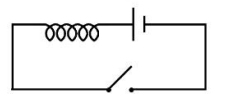
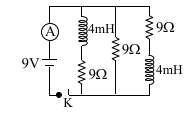
Just after closing the switch, inductor will behave as open circuit.
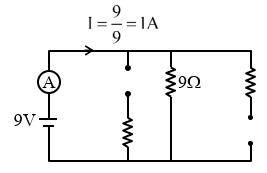
-
- (A) 0
- (B) 3
- (C) 6
- (D) 9
Show answer and solution
Correct Answer: (C)
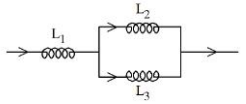
Let the inductance of each inductor be \(L\), so \(L_1 = L_2 = L_3 = L\).
Let the total current flowing through the circuit be \(I\). This current flows entirely through \(L_1\).
Since \(L_2\) and \(L_3\) are connected in parallel and have equal inductances, the current \(I\) divides equally between them. Therefore, the current through \(L_2\) is \(\dfrac{I}{2}\) and the current through \(L_3\) is \(\dfrac{I}{2}\).
The magnetic energy stored in an inductor is given by \(U = \dfrac{1}{2} L i^2\).
The energy stored in the inductor \(L_2\) is:
\(U_l = \dfrac{1}{2} L \left(\dfrac{I}{2}\right)^2 = \dfrac{1}{8} L I^2\)
The equivalent inductance of the entire circuit is:
\(L_{eq} = L_1 + \dfrac{L_2 L_3}{L_2 + L_3} = L + \dfrac{L \cdot L}{L + L} = L + \dfrac{L}{2} = \dfrac{3L}{2}\)
The total magnetic energy stored in the entire circuit is:
\(U_t = \dfrac{1}{2} L_{eq} I^2 = \dfrac{1}{2} \left(\dfrac{3L}{2}\right) I^2 = \dfrac{3}{4} L I^2\)
The ratio of the total energy to the energy stored in \(L_2\) is:
\(\dfrac{U_t}{U_l} = \dfrac{\dfrac{3}{4} L I^2}{\dfrac{1}{8} L I^2} = \dfrac{3}{4} \times 8 = 6\)
Answer: \(6\) -
- (A) 10
- (B) 20
- (C) 40
- (D) 5
Show answer and solution
Correct Answer: (B)
\(L =10 \times 10^{-3} H\)
N=104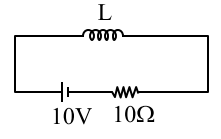
\(I _0=\frac{10}{10}=1 A\) (max current)
\(I =\frac{1}{ e }\)
\(\begin{array}{l} E _{ d }=\frac{ B ^2}{2 \mu_0} \\ B=\mu_0 nI \\ L =\mu_0 n ^2 \pi R ^2 \ell \\ E _{ d }=\frac{\mu_0 n ^2 I ^2}{2}\end{array}\)
\(=\frac{4 \pi \times 10^{-7} \times 10^8 \times \frac{1}{ e ^2}}{2}\)
\(=\frac{20 \pi}{ e ^2}\) -
- (A) A-IV, B-III, C-I, D-II
- (B) A-III, B-IV, C-II, D-I
- (C) A-I, B-III, C-IV, D-II
- (D) A-III, B-IV, C-I, D-II
Show answer and solution
Correct Answer: (D)
Magnetic induction
\( F=qvB \)
\( [B]=[\frac{F}{qV}] \)
\( [B]=[MT^{-2}A^{-1}] \)
Magnetic Flux (ф)
\( \phi=(B). \) (Area)
\( [\phi]=[ML^{2}T^{-2}A^{-1}] \)
Magnetic Permeability
\( [\mu]=[MLT^{-2}A^{-2}] \)
Self inductance
Using
\( U=\frac{1}{2}LI^{2} \)
[Self inductance] = \( [ML^{2}T^{-2}A^{-1}] \)
A-III, B-IV, C-I, D-II -
- (A) 197
- (B) 80
- (C) 280
- (D) 100
Show answer and solution
Correct Answer: (A)
EMF induced \(\varepsilon= A \frac{ dB }{ dt }= A \mu_0 n \frac{ di }{ dt }\)
\(\varepsilon= A \mu_0 n i _0 \omega \cos \omega t\)
current induced \(i =\frac{\varepsilon}{ R }=\frac{\pi r ^2 \mu_0 ni _0 \omega}{ R } \cos \omega t\)
So \(i =\frac{\pi r ^2 \mu_0 ni _0 \omega}{\sqrt{2} R }\)
\(=\frac{\pi \times 10^{-4} \times 4 \pi \times 10^{-7} \times 500 \times 10 \times 10^3}{\sqrt{2} \times 10}\)
\(=\frac{20 \pi^2}{\sqrt{2}} \times 10^{-6}\)
\(\simeq \frac{197}{\sqrt{2}} \mu A\) -
- (A) \( C_{1} \) and \( C_{3} \) move with equal speeds away from \( C_{2} \)
- (B) \( C_{1} \) moves towards \( C_{2} \) and \( C_{3} \) moves away from \( C_{2} \)
- (C) \( C_{1} \) moves away from \( C_{2} \) and \( C_{3} \) moves towards \( C_{2} \)
- (D) \( C_{1} \) and \( C_{3} \) move with equal speeds towards \( C_{2} \)
Show answer and solution
Correct Answer: (B)
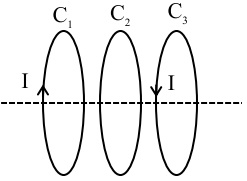
Magnetic field through the coil is
\( \vec{B}=(B_{C_{2}}-B_{C_{1}})\hat{i} \)
\( \phi=(B_{C_{2}}-B_{C_{1}})A \)
\( \epsilon=\frac{-d\phi}{dt} \)
Find the direction according to Lenz's law.
If coil move away then magnetic field decreases & vice versa
Correct Ans. (2) -
- (A) \(36\)
- (B) \(128\sqrt{2}\)
- (C) \(16\)
- (D) \(64\)
Show answer and solution
Correct Answer: (A)
The induced emf in the coil is given by Faraday's law:
\(E = N A \dfrac{dB}{dt}\)
The resistance of the coil is \(R = \rho \dfrac{l}{a}\), where \(l\) is the total length of the wire and \(a\) is its cross-sectional area.
The length of the wire is \(l = N (2\pi R_c)\), where \(R_c\) is the radius of the coil. Since the area of the coil is \(A = \pi R_c^2\), we have \(R_c = \sqrt{\dfrac{A}{\pi}}\).
Thus, \(l = 2N\sqrt{\pi A}\).
The cross-sectional area of the wire is \(a = \pi r^2\).
Therefore, the resistance is:
\(R = \rho \dfrac{2N\sqrt{\pi A}}{\pi r^2} \propto \dfrac{N\sqrt{A}}{r^2}\)
The power dissipated in the coil is:
\(P = \dfrac{E^2}{R} \propto \dfrac{(N A)^2}{\dfrac{N\sqrt{A}}{r^2}} = N A^{3/2} r^2\)
For the second coil, the parameters are \(N' = 2N\), \(A' = 2A\), and \(r' = 3r\). The new power dissipated is:
\(P' = P \left(\dfrac{2N}{N}\right) \left(\dfrac{2A}{A}\right)^{3/2} \left(\dfrac{3r}{r}\right)^2\)
\(P' = P (2) (2\sqrt{2}) (9) = 36\sqrt{2} P\)
Given that \(P' = \sqrt{2}\alpha P\), we can compare the expressions to find:
\(\sqrt{2}\alpha = 36\sqrt{2} \Rightarrow \alpha = 36\)
Answer: \(36\) -
- (A) 32
- (B) 64
- (C) 16
- (D) 128
Show answer and solution
Correct Answer: (B)
\( \tau=\mu B~sin~\theta\Rightarrow0.016=\mu\times B\times\frac{1}{2} \)
\( \Rightarrow\mu=\frac{0.032}{B} \)
\( W_{ext}=U_{f}-U_{i}=\mu B-(-\mu B)=2\mu B \)
\( =2\times\frac{0.032}{B}\times B \)
\( =0.064~J \) -
- (A) \(\dfrac{25}{\pi}\)
- (B) \(\dfrac{1}{16\pi}\)
- (C) \(\dfrac{1}{\pi}\)
- (D) \(\dfrac{1}{4\pi}\)
Show answer and solution
Correct Answer: (B)
The magnetic field \(B\) inside the solenoid is related to the magnetic intensity \(H\) by the formula:
\(B = \mu H = \mu_0 \mu_r H\)
Rearranging for \(H\), we get:
\(H = \dfrac{B}{\mu_0 \mu_r}\)
Substituting the given values (\(B = 1.0\) T, \(\mu_r = 400\), and \(\mu_0 = 4\pi \times 10^{-7}\) T m/A):
\(H = \dfrac{1.0}{4\pi \times 10^{-7} \times 400}\)
\(H = \dfrac{1.0}{1600\pi \times 10^{-7}}\)
\(H = \dfrac{1}{16\pi \times 10^{-5}}\)
\(H = \dfrac{1}{16\pi} \times 10^5\) A/m
Comparing this with the given expression \(H = \alpha \times 10^5\), we find:
\(\alpha = \dfrac{1}{16\pi}\)
Answer: \(\dfrac{1}{16\pi}\) -
- (A) (A) is true but (R) is false
- (B) Both true, but (R) is NOT the correct explanation
- (C) Both true, and (R) is the correct explanation
- (D) (A) is false but (R) is true
Show answer and solution
Correct Answer: (B)
Conceptual -
- (A) 10
- (B) 12
- (C) 14
- (D) 16
Show answer and solution
Correct Answer: (B)
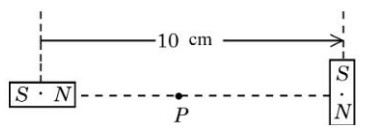
Let the magnetic moment of each magnet be \(M = 3\sqrt{5}\) J/T.
The distance of point P from the center of each magnet is \(r = 5\) cm \(= 0.05\) m.
For the first magnet (horizontal), point P lies on its axial line. The magnetic field at P due to the first magnet is:
\(B_1 = \dfrac{\mu_0}{4\pi} \dfrac{2M}{r^3}\)
The direction of \(\vec{B}_1\) is along the axis of the first magnet.
For the second magnet (vertical), point P lies on its equatorial line. The magnetic field at P due to the second magnet is:
\(B_2 = \dfrac{\mu_0}{4\pi} \dfrac{M}{r^3}\)
The direction of \(\vec{B}_2\) is parallel to the axis of the second magnet, which is perpendicular to the axis of the first magnet.
Since \(\vec{B}_1\) and \(\vec{B}_2\) are perpendicular to each other, the net magnetic field at P is:
\(B = \sqrt{B_1^2 + B_2^2}\)
Substituting the expressions for \(B_1\) and \(B_2\):
\(B = \sqrt{\left(\dfrac{\mu_0}{4\pi} \dfrac{2M}{r^3}\right)^2 + \left(\dfrac{\mu_0}{4\pi} \dfrac{M}{r^3}\right)^2}\)
\(B = \dfrac{\mu_0}{4\pi} \dfrac{M}{r^3} \sqrt{2^2 + 1^2} = \dfrac{\mu_0}{4\pi} \dfrac{\sqrt{5}M}{r^3}\)
Substituting the given values \(\dfrac{\mu_0}{4\pi} = 10^{-7}\) T m/A, \(M = 3\sqrt{5}\) J/T, and \(r = 0.05\) m:
\(B = 10^{-7} \times \dfrac{\sqrt{5} \times 3\sqrt{5}}{(0.05)^3}\)
\(B = 10^{-7} \times \dfrac{15}{125 \times 10^{-6}}\)
\(B = \dfrac{15 \times 10^{-1}}{125}\)
\(B = 0.1 \times 0.12\) T
\(B = 0.012\) T
\(B = 12 \times 10^{-3}\) T
Comparing this with the given value \(\alpha \times 10^{-3}\) T, we get \(\alpha = 12\).
Answer: \(12\) - 248. A battery with EMF E and internal resistance r is connected across a resistance R. The power consumption in R will be maximum when : 2026 Easy
- (A) \( R=2r \)
- (B) \( R=\frac{r}{2} \)
- (C) \( R=\sqrt{2}r \)
- (D) \( R=r \)
Show answer and solution
Correct Answer: (D)
For maximum power drawn across load
Resistance \(R _{\text {Load }}= R _{\text {intemal }}\)
\( R=r \) -
- (A) 1
- (B) 2
- (C) 0.5
- (D) 4
Show answer and solution
Correct Answer: (A)
\(V _{\ell}=\mu E =\mu \times \frac{ V }{\ell}\)
\(I = neAV _{ d }\)
\(V_d=\frac{I}{n e A}\)
\(\mu=\frac{ I \ell}{\text { NneA }}\)
\(\mu=\frac{1.6 \times 3}{2 \times 5 \times 10^{26} \times 1.6 \times 10^{-19} \times 2 \times 10^{-7}}\)
\(\mu=1 \times 10^{-3} m^2 / v \cdot s\)
\(\alpha=1\) -
- (A) \( R_{2}=16\Omega, R_{1}=\frac{16}{3}\Omega \)
- (B) \( R_{2}=4\Omega, R_{1}=\frac{4}{3}\Omega \)
- (C) \( R_{2}=8\Omega, R_{1}=\frac{16}{3}\Omega \)
- (D) \( R_{2}=12\Omega, R_{1}=\frac{12}{3}\Omega \)
Show answer and solution
Correct Answer: (C)
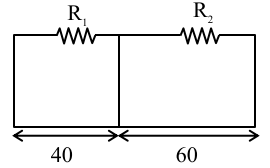
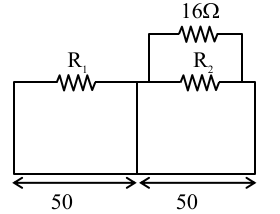
\( \frac{R_{1}}{R_{2}}=\frac{40}{60}=\frac{2}{3} \) \(\quad\)... (1)
\( \frac{R_{1}}{(\frac{R_{2}\times16}{R_{2}+16})}=\frac{50}{50}\Rightarrow R_{1}=\frac{16R_{2}}{16+R_{2}} \) \(\quad\)...(2)
\( \frac{2}{3}R_{2}=\frac{16R_{2}}{16+R_{2}} \)
\( \frac{32}{3}+\frac{2R_{2}}{3}=16 \)
\( \frac{2R_{2}}{3}=16-\frac{32}{3}=\frac{16}{3} \)
\( R_{2}=8\Omega \)
By equation (1)
\( R_{1}=\frac{2}{3}R_{2}=\frac{16}{3}\Omega \)
No questions on this page match these filters.