


All JEE Mains 2026 Physics questions
31 chaptersShowing 101–150 of 469 questions
-
- (A) 1.2
- (B) 2
- (C) 1.5
- (D) 1.7
Show answer and solution
Correct Answer: (C)
\(\omega = 2 \times 10^{15} rad/s\)
\(k = 10^{7} m^{-1}\)
\(V =\frac{2 \pi}{ k } \cdot \frac{\omega}{2 \pi}=\frac{\omega}{ k }=\frac{2 \times 10^{15}}{10^7}=2 \times 10^8=\frac{ C }{1.5}\)
\(\Rightarrow \mu = 1.5\) -
- (A) 1
- (B) 2
- (C) 3
- (D) 4
Show answer and solution
Correct Answer: (B)
Here, \(v=\frac{\omega}{K}=\frac{6.27 \times 10^3}{2.09 \times 10^{-5}}\)
\(=3 \times 10^8\)
So, wave moving in vacuum
Now, \(I =\left(\frac{1}{2} \varepsilon_0 E _0^2\right) c =\frac{1}{2} \varepsilon_0 E _0^2 \frac{1}{\sqrt{\mu_0 \varepsilon_0}}\)
\(=\frac{1}{2} \sqrt{\frac{\varepsilon_0}{\mu_0}} E _0^2=\frac{1}{2} \frac{1}{377} \times 377\)
\(\frac{1}{d}=\frac{1}{2}\)
\(d =2\) -
- (A) 36 : 1
- (B) 3 : 2
- (C) 6 : 1
- (D) \(\sqrt{6}:1\)
Show answer and solution
Correct Answer: (D)
\(\frac{ C }{ V }=\mu=\sqrt{\varepsilon_{ r } \mu_{ r }}\)
\(\frac{C}{V}=\sqrt{\frac{3 \times 2}{1}}=\frac{\sqrt{6}}{1}\) -
- (A) 429
- (B) 550
- (C) 650
- (D) 380
Show answer and solution
Correct Answer: (A)
\(y=n\frac{\lambda D}{d}\)
\(y_{1}=y_{2}\)
\(n_{1}\lambda_{1}\frac{D}{d}=n_{2}\lambda_{2}\frac{D}{d}\)
\(\frac{n_{1}}{n_{2}}=\frac{\lambda_{2}}{\lambda_{1}}=\frac{550}{650}=\frac{11}{13}\)
\(y=11\times\frac{\lambda_{1}D}{d}=\frac{11\times650\times10^{-9}\times1.2}{2\times10^{-3}}\)
\(y=429\times10^{-5}\) -
- (A) \(\dfrac{D\lambda}{a}\)
- (B) \(1.5\dfrac{D\lambda}{a}\)
- (C) \(2\dfrac{D\lambda}{a}\)
- (D) \(3\dfrac{D\lambda}{a}\)
Show answer and solution
Correct Answer: (C)
The position of the \(n^{th}\) minimum in a single slit diffraction pattern on a screen at distance \(D\) is given by \(y_n = \dfrac{n D \lambda}{a}\).
For the \(1^{st}\) minimum, \(n = 1\), so \(y_1 = \dfrac{D \lambda}{a}\).
For the \(3^{rd}\) minimum, \(n = 3\), so \(y_3 = \dfrac{3 D \lambda}{a}\).
The linear separation between the \(1^{st}\) and \(3^{rd}\) minima on the same side of the central maximum is \(\Delta y = y_3 - y_1\).
\(\Delta y = \dfrac{3 D \lambda}{a} - \dfrac{D \lambda}{a} = 2\dfrac{D \lambda}{a}\).
Answer: \(2\dfrac{D\lambda}{a}\) -
- (A) \(61\)
- (B) \(122\)
- (C) \(244\)
- (D) \(305\)
Show answer and solution
Correct Answer: (B)
The limit of resolution of a telescope is given by the formula:
\(\Delta \theta = \dfrac{1.22 \lambda}{R}\)
where \(\lambda\) is the wavelength of light and \(R\) is the diameter of the objective lens.
Given:
\(\lambda = 500 \text{ nm} = 500 \times 10^{-9} \text{ m} = 5 \times 10^{-7} \text{ m}\)
\(\Delta \theta = 5 \times 10^{-7} \text{ rad}\)
Substituting the values into the formula:
\(5 \times 10^{-7} = \dfrac{1.22 \times 5 \times 10^{-7}}{R}\)
\(R = 1.22 \text{ m}\)
Converting to centimeters:
\(R = 1.22 \times 100 \text{ cm} = 122 \text{ cm}\)
Answer: \(122\) -
- (A) \( 60^{\circ} \)
- (B) \( 10^{\circ} \)
- (C) \( 30^{\circ} \)
- (D) \( 45^{\circ} \)
Show answer and solution
Correct Answer: (A)
Brewester's law
\( tan~\theta=\mu_{rel}=\sqrt{3} \)
\( \theta=60^{\circ} \) -
- (A) \((E_x\hat{i} + E_y\hat{j})\sin(kx - kz - \omega t)\)
- (B) \((E_x\hat{i} + E_z\hat{k})\sin(kx + ky - \omega t)\)
- (C) \((E_x\hat{j} + E_y\hat{k})\sin(ky + kz - \omega t)\)
- (D) \((E_x\hat{i} + E_y\hat{j} + E_z\hat{k})\sin(kx + ky - kz - \omega t)\)
Show answer and solution
Correct Answer: (A)
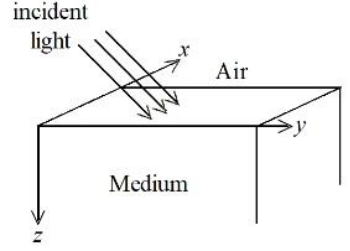
From the given figure, the incident light rays lie in the \(xz\)-plane. Therefore, the plane of incidence is the \(xz\)-plane.
The incident wave travels from the air (\(z < 0\)) towards the medium (\(z > 0\)), so it propagates in the \(+x\) and \(+z\) directions. The reflected wave will travel back into the air, meaning it propagates in the \(+x\) and \(-z\) directions.
The wave vector for the reflected wave can be written as \(\vec{k}_r = k_x \hat{i} - k_z \hat{k}\).
The phase of the reflected wave is given by \(\vec{k}_r \cdot \vec{r} - \omega t = k_x x - k_z z - \omega t\). This phase matches the expression in option (1).
According to Brewster's law, when unpolarized light is incident at the Brewster angle, the reflected light is completely polarized perpendicular to the plane of incidence. Since the plane of incidence is the \(xz\)-plane, the reflected electric field must be entirely along the \(y\)-axis (\(\hat{j}\) direction).
Let us verify this with option (1), which gives the electric field as \(\vec{E} = E_x \hat{i} + E_y \hat{j}\).
For an electromagnetic wave, the electric field must be perpendicular to the direction of propagation, so \(\vec{k}_r \cdot \vec{E} = 0\).
\((k_x \hat{i} - k_z \hat{k}) \cdot (E_x \hat{i} + E_y \hat{j}) = 0\)
\(k_x E_x = 0\)
Since \(k_x \neq 0\), we must have \(E_x = 0\). This leaves \(\vec{E} = E_y \hat{j}\), which means the wave is purely polarized along the \(y\)-axis. This perfectly satisfies the condition for reflection at the Brewster angle.
Thus, the correct expression representing the reflected wave is \((E_x\hat{i} + E_y\hat{j})\sin(kx - kz - \omega t)\).
Answer: \((E_x\hat{i} + E_y\hat{j})\sin(kx - kz - \omega t)\) -
- (A) \(3/4\)
- (B) \(4/3\)
- (C) \(9/4\)
- (D) \(4/9\)
Show answer and solution
Correct Answer: (C)
Let the intensity of the incident unpolarized light be \(I_0\).
After passing through the first polarizer, the intensity becomes \(I_1 = \dfrac{I_0}{2}\).
Without the third polarizer, the light passes directly from the first polarizer (at \(30^{\circ}\)) to the second polarizer (at \(90^{\circ}\)). The angle between their transmission axes is \(90^{\circ} - 30^{\circ} = 60^{\circ}\).
Using Malus's law, the output intensity without the third polarizer is:
\(I_{without} = I_1 \cos^2(60^{\circ}) = \dfrac{I_0}{2} \times \left(\dfrac{1}{2}\right)^2 = \dfrac{I_0}{8}\)
When the third polarizer (at \(60^{\circ}\)) is placed between them, the light first passes from the first polarizer to the third polarizer. The angle between their axes is \(60^{\circ} - 30^{\circ} = 30^{\circ}\).
The intensity after the third polarizer is:
\(I_3 = I_1 \cos^2(30^{\circ}) = \dfrac{I_0}{2} \times \left(\dfrac{\sqrt{3}}{2}\right)^2 = \dfrac{3I_0}{8}\)
The light then passes from the third polarizer to the second polarizer. The angle between their axes is \(90^{\circ} - 60^{\circ} = 30^{\circ}\).
The final output intensity with the third polarizer is:
\(I_{with} = I_3 \cos^2(30^{\circ}) = \dfrac{3I_0}{8} \times \left(\dfrac{\sqrt{3}}{2}\right)^2 = \dfrac{9I_0}{32}\)
The ratio of the output intensities with and without the third polarizer is:
\(\text{Ratio} = \dfrac{I_{with}}{I_{without}} = \dfrac{\dfrac{9I_0}{32}}{\dfrac{I_0}{8}} = \dfrac{9}{4}\)
Answer: \(9/4\) -
- (A) 15
- (B) 25
- (C) 30
- (D) 35
Show answer and solution
Correct Answer: (C)
Intensity of light after passing through the first polarizer is:
\(I_1 = \dfrac{I_o}{2}\)
Let the optically active solution rotate the plane of polarization by an angle \(\theta\). Since the angle between the polarizer and the analyser is \(0^\circ\), the angle between the plane of polarization of the light emerging from the solution and the transmission axis of the analyser is also \(\theta\).
According to Malus's law, the intensity of light emerging from the analyser is:
\(I_2 = I_1 \cos^2 \theta = \dfrac{I_o}{2} \cos^2 \theta\)
Given that the final intensity is \(\dfrac{3}{8}I_o\), we have:
\(\dfrac{I_o}{2} \cos^2 \theta = \dfrac{3}{8}I_o\)
\(\cos^2 \theta = \dfrac{3}{4}\)
\(\cos \theta = \dfrac{\sqrt{3}}{2}\)
\(\theta = 30^\circ\)
Answer: \(30\) -
- (A) Both Statement-I and Statement-II are false.
- (B) Both Statement-I and Statement-II are true.
- (C) Statement-I is true but Statement-II is false.
- (D) Statement-I is false but Statement-II is true.
Show answer and solution
Correct Answer: (C)
Increasing the slit width 'a' decreases the diffraction angle ( \(\theta=\lambda / a\) ) and reduces the spreading of the wave. A narrower slit produces a more pronounced spherical wave (high curvature) while a wider slit leads to a flatter, less curved wave. -
- (A) Both Statement I and Statement II are true
- (B) Both Statement I and Statement II are false
- (C) Statement I is false but Statement II is true
- (D) Statement I is true but Statement II is false
Show answer and solution
Correct Answer: (C)
Angular fringe width \(=\frac{\lambda}{d}\) -
- (A) \(8 \times 10^{-4}\)
- (B) \(6.0 \times 10^{-3}\)
- (C) \(5.6 \times 10^{-4}\)
- (D) \(5.0 \times 10^{-3}\)
Show answer and solution
Correct Answer: (A)
\(d \sin \theta=(\mu-1) t\)
\(d \left[\frac{ x }{ D }\right]=(\mu-1) t\)
\(t=\frac{x d}{D(\mu-1)}\)
\(=\frac{(0.2)(0.1)}{50(1.5-1)}\)
\(t =8 \times 10^{-4} cm\) -
- (A) 5600
- (B) 5625
- (C) 5650
- (D) 5700
Show answer and solution
Correct Answer: (B)
The shift in the central fringe due to the introduction of a transparent sheet of thickness \(t\) and refractive index \(\mu\) is given by \(\Delta y = \dfrac{D}{d}(\mu - 1)t\).
The position of the \(n^{th}\) bright fringe is \(y_n = n \dfrac{D\lambda}{d}\).
Equating the two, we get:
\(\dfrac{D}{d}(\mu - 1)t = n \dfrac{D\lambda}{d}\)
\((\mu - 1)t = n\lambda\)
Substituting the given values:
\((1.56 - 1)t = 7 \times 450 \times 10^{-9}\)
\(0.56 t = 3150 \times 10^{-9}\)
\(t = \dfrac{3150}{0.56} \times 10^{-9}\)
\(t = 5625 \times 10^{-9}\) m
Comparing with \(t = \alpha \times 10^{-9}\) m, we get \(\alpha = 5625\).
Answer: \(5625\) -
- (A) \(4000\)
- (B) \(3000\)
- (C) \(2000\)
- (D) \(1000\)
Show answer and solution
Correct Answer: (C)
Let the intensity due to each individual slit be \(I_0\).
The resultant intensity \(I_R\) at a point where the phase difference is \(\phi\) is given by:
\(I_R = I_1 + I_2 + 2\sqrt{I_1 I_2} \cos \phi\)
Given that \(I_1 = I_2 = I_0\) and the resultant intensity \(I_R = I_0\), we can substitute these values into the equation:
\(I_0 = I_0 + I_0 + 2\sqrt{I_0 \cdot I_0} \cos \phi\)
\(I_0 = 2I_0 + 2I_0 \cos \phi\)
\(I_0 = 2I_0 (1 + \cos \phi)\)
\(1 + \cos \phi = \dfrac{1}{2}\)
\(\cos \phi = -\dfrac{1}{2}\)
The minimum phase difference satisfying this condition is:
\(\phi = \dfrac{2\pi}{3}\)
The relationship between phase difference \(\phi\) and path difference \(\Delta x\) is:
\(\phi = \dfrac{2\pi}{\lambda} \Delta x\)
Substituting the value of \(\phi\):
\(\dfrac{2\pi}{3} = \dfrac{2\pi}{\lambda} \Delta x\)
\(\Delta x = \dfrac{\lambda}{3}\)
Given the wavelength \(\lambda = 6000 \text{ \AA}\):
\(\Delta x = \dfrac{6000}{3} = 2000 \text{ \AA}\)
Answer: \(2000\) -
- (A) 10
- (B) 12
- (C) 14
- (D) 16
Show answer and solution
Correct Answer: (C)
\(y _{\text {shift }}=\frac{(\mu-1) t \cdot D }{ d }\)
\(20910^{-3}=\frac{(\mu-1) \times 20 \times 10^{-6} \times 1}{0.4 \times 10^{-3}}\)
\((\mu-1) \Rightarrow 0.4\)
\(\mu \Rightarrow 1.4\)
\(\frac{\alpha}{10}=1.4, \alpha=14\) -
- (A) 1
- (B) 3
- (C) 5
- (D) 6
Show answer and solution
Correct Answer: (D)
The intensity at a point in Young's double slit experiment is given by \(I = I_{max} \cos^2\left(\dfrac{\phi}{2}\right)\)
Given \(I = \dfrac{3}{4} I_{max}\)
\(\dfrac{3}{4} I_{max} = I_{max} \cos^2\left(\dfrac{\phi}{2}\right)\)
\(\cos\left(\dfrac{\phi}{2}\right) = \dfrac{\sqrt{3}}{2}\)
\(\dfrac{\phi}{2} = \dfrac{\pi}{6}\)
\(\phi = \dfrac{\pi}{3}\)
The phase difference \(\phi\) is related to the path difference \(\Delta x\) by \(\phi = \dfrac{2\pi}{\lambda} \Delta x\)
\(\dfrac{2\pi}{\lambda} \Delta x = \dfrac{\pi}{3}\)
\(\Delta x = \dfrac{\lambda}{6}\)
Comparing with \(\Delta x = \dfrac{\lambda}{x}\), we get \(x = 6\)
Answer: \(6\) -
- (A) \(3\)
- (B) \(4\)
- (C) \(1/3\)
- (D) \(1/4\)
Show answer and solution
Correct Answer: (C)
The phase difference \(\Delta \phi\) is related to the path difference \(\Delta x\) by the relation \(\Delta \phi = \dfrac{2\pi}{\lambda} \Delta x\).
For point \(A\), the path difference is \(\Delta x_A = \dfrac{\lambda}{3}\).
\(\Delta \phi_A = \dfrac{2\pi}{\lambda} \times \dfrac{\lambda}{3} = \dfrac{2\pi}{3}\)
The intensity at point \(A\) is given by \(I_A = I_{max} \cos^2\left(\dfrac{\Delta \phi_A}{2}\right)\).
\(I_A = I_{max} \cos^2\left(\dfrac{\pi}{3}\right) = I_{max} \left(\dfrac{1}{2}\right)^2 = \dfrac{I_{max}}{4}\)
For point \(B\), the path difference is \(\Delta x_B = \dfrac{\lambda}{6}\).
\(\Delta \phi_B = \dfrac{2\pi}{\lambda} \times \dfrac{\lambda}{6} = \dfrac{\pi}{3}\)
The intensity at point \(B\) is given by \(I_B = I_{max} \cos^2\left(\dfrac{\Delta \phi_B}{2}\right)\).
\(I_B = I_{max} \cos^2\left(\dfrac{\pi}{6}\right) = I_{max} \left(\dfrac{\sqrt{3}}{2}\right)^2 = \dfrac{3I_{max}}{4}\)
The ratio of intensities at points \(A\) and \(B\) is:
\(\dfrac{I_A}{I_B} = \dfrac{\dfrac{I_{max}}{4}}{\dfrac{3I_{max}}{4}} = \dfrac{1}{3}\)
Answer: \(1/3\) -
- (A) 32
- (B) 36
- (C) 38
- (D) 40
Show answer and solution
Correct Answer: (B)
The angular width of the central maximum in a single slit diffraction pattern is given by \(\Delta \theta = \dfrac{2\lambda}{a}\)
Substituting the given values:
\(\lambda = 628 \times 10^{-9}\) m
\(a = 0.2 \times 10^{-3}\) m
\(\Delta \theta = \dfrac{2 \times 628 \times 10^{-9}}{0.2 \times 10^{-3}}\) rad
\(\Delta \theta = 6280 \times 10^{-6}\) rad \(= 6.28 \times 10^{-3}\) rad
To convert radians to degrees, multiply by \(\dfrac{180}{\pi}\):
\(\Delta \theta = 6.28 \times 10^{-3} \times \dfrac{180}{3.14}\) degrees
\(\Delta \theta = 2 \times 10^{-3} \times 180\) degrees
\(\Delta \theta = 360 \times 10^{-3}\) degrees \(= 36 \times 10^{-2}\) degrees
Comparing this with \(\alpha \times 10^{-2}\) degrees, we get \(\alpha = 36\).
Answer: \(36\) -
- (A) \(2I_{0}\)
- (B) \(I_{0}\)
- (C) \(\frac{I_{0}}{2}\)
- (D) \(4I_{0}\)
Show answer and solution
Correct Answer: (B)
\(d =2 mm\)
\(D =10 m\)
\(\lambda=6000 \)Å
\(y=\frac{d}{2}(\) in front of one slit \()\)
\(I=4 I_0 \cos ^2\left(\frac{2 \pi}{\lambda} \cdot \frac{y}{D} d\right)\)
\(\Rightarrow I = I _0\) -
- (A) 1
- (B) 2
- (C) 4
- (D) 8
Show answer and solution
Correct Answer: (C)
\(\beta_1=\beta_2\)
\(\frac{ D _1 \lambda_1}{d_1}=\frac{ D _2 \lambda_2}{d_2}\)
\(\frac{ D _1}{ D _2}=\frac{\lambda_2}{\lambda_1}\left(\frac{d_1}{d_2}\right)\)
\(=2 \times 2\)
\(\frac{ D _1}{ D _2}=4\) -
- (A) \(1.2\)
- (B) \(2\)
- (C) \(2.4\)
- (D) \(2.88\)
Show answer and solution
Correct Answer: (B)
The fringe width in Young's double slit experiment is given by \(\beta = \dfrac{\lambda D}{d}\).
When the experiment is performed in a medium of refractive index \(\mu\), the wavelength of light becomes \(\lambda' = \dfrac{\lambda}{\mu}\).
The new fringe width is \(\beta' = \dfrac{\lambda' D}{d} = \dfrac{\lambda D}{\mu d} = \dfrac{\beta}{\mu}\).
Substituting the given values, \(\beta = 2.4\) \(\mu\)m and \(\mu = 1.2\):
\(\beta' = \dfrac{2.4}{1.2} = 2\) \(\mu\)m.
Answer: \(2\) -
- (A) 200
- (B) 203
- (C) 208
- (D) 215
Show answer and solution
Correct Answer: (B)
The angular resolution \(\Delta \theta\) of a telescope is given by the formula:
\(\Delta \theta = \dfrac{1.22 \lambda}{a}\)
where \(\lambda\) is the wavelength of light and \(a\) is the diameter of the objective lens.
Given:
\(\Delta \theta = 3.0 \times 10^{-7}\) rad
\(\lambda = 500 \text{ nm} = 500 \times 10^{-9}\) m \(= 5 \times 10^{-7}\) m
Substituting the values into the formula:
\(3.0 \times 10^{-7} = \dfrac{1.22 \times 5 \times 10^{-7}}{a}\)
\(a = \dfrac{1.22 \times 5 \times 10^{-7}}{3.0 \times 10^{-7}}\)
\(a = \dfrac{6.1}{3.0}\) m
\(a = 2.0333...\) m
Converting the diameter into centimeters:
\(a = 2.0333... \times 100\) cm \(= 203.33\) cm
Rounding to the nearest integer, we get \(203\) cm.
Answer: \(203\) -
- (A) \(\dfrac{I_0}{4}\)
- (B) \(\dfrac{I_0}{2}\)
- (C) \(I_0\)
- (D) \(\dfrac{3I_0}{4}\)
Show answer and solution
Correct Answer: (B)
The position of the point on the screen exactly opposite to one of the slits is at a distance \(y = \dfrac{d}{2}\) from the central maximum.
The path difference \(\Delta x\) at this point is given by:
\(\Delta x = \dfrac{yd}{D}\)
Substituting \(y = \dfrac{d}{2}\) and \(D = 10d\):
\(\Delta x = \dfrac{\left(\dfrac{d}{2}\right)d}{10d} = \dfrac{d^2}{20d} = \dfrac{d}{20}\)
Given that the distance between the slits is \(d = 5\lambda\), we have:
\(\Delta x = \dfrac{5\lambda}{20} = \dfrac{\lambda}{4}\)
The corresponding phase difference \(\Delta \phi\) is:
\(\Delta \phi = \dfrac{2\pi}{\lambda} \Delta x = \dfrac{2\pi}{\lambda} \left(\dfrac{\lambda}{4}\right) = \dfrac{\pi}{2}\)
The intensity at this point is given by:
\(I = I_0 \cos^2\left(\dfrac{\Delta \phi}{2}\right)\)
Substituting \(\Delta \phi = \dfrac{\pi}{2}\):
\(I = I_0 \cos^2\left(\dfrac{\pi}{4}\right) = I_0 \left(\dfrac{1}{\sqrt{2}}\right)^2 = \dfrac{I_0}{2}\)
Answer: \(\dfrac{I_0}{2}\) -
- (A) 39.6\(^{\circ}\)
- (B) 32.3\(^{\circ}\)
- (C) 42.6\(^{\circ}\)
- (D) 36.3\(^{\circ}\)
Show answer and solution
Correct Answer: (B)
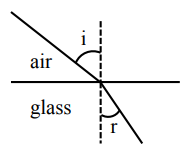
\(\tan i=\frac{\mu_2}{\mu_1}=\frac{\mu_{ g }}{\mu_{ a }}\)
\(\tan i =1.52\)
\(i =57.7^{\circ}\)
\(r =90^{\circ}- i\)
\(r =32.3^{\circ}\) -
- (A) A, D, E only
- (B) A, C only
- (C) B, D only
- (D) B, C only
Show answer and solution
Correct Answer: (B)
Explanation:
Let us derive the correctness of each statement using the standard formula for single slit Fraunhofer diffraction:
The linear width of the central maximum is given by the expression:
\( \beta = \frac{2\lambda D}{a} \)
Where \( \lambda \) is the wavelength of light, \( D \) is the distance between the slit and the screen, and \( a \) is the width of the slit.
1. Analysis of Statement (A) and (B):
From the formula, the width of the central maximum is directly proportional to the wavelength of light \( (\beta \propto \lambda) \). Therefore, if the wavelength increases, the width of the central maximum increases. This makes statement (A) correct and statement (B) incorrect.
2. Analysis of Statement (C) and (D):
The width of the central maximum is inversely proportional to the slit width \( (\beta \propto \frac{1}{a}) \). Therefore, if the slit width decreases, the width of the central maximum increases. This makes statement (C) correct and statement (D) incorrect.
3. Analysis of Statement (E):
The peak intensity (brightness) of the central maximum depends on the square of the slit width \( (I \propto a^2) \) and is independent of the wavelength of the incident light. Therefore, statement (E) is incorrect.
Since only statements (A) and (C) are true, the correct combination is A, C only.
Hence, Option B is the correct choice. -
- (A) \(-2\)
- (B) \(+2\)
- (C) \(+2.5\)
- (D) \(-2.5\)
Show answer and solution
Correct Answer: (A)
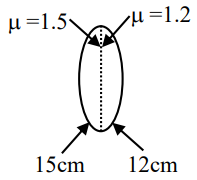
\(\frac{1}{v}-\frac{1}{u}=\frac{1}{f_{net}}=\frac{1}{f_{1}}+\frac{1}{f_{2}}\)
\(\frac{1}{v}+\frac{1}{30}=(1.5-1)(\frac{1}{15}-\frac{1}{\infty})+(1.2-1)(\frac{1}{\infty}+\frac{1}{12})\)
\(\frac{1}{v}+\frac{1}{30}=\frac{1}{30}+\frac{1}{60}\)
\(v=60\)
\(m=\frac{v}{u}=\frac{60}{-30}=-2\) -
- (A) 140
- (B) 280
- (C) 80
- (D) 200
Show answer and solution
Correct Answer: (B)
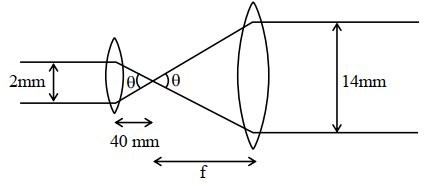
\(\frac{40}{2}=\frac{f}{14}\)
\(\Rightarrow f =280 mm\) -
- (A) increased two times
- (B) increased \(\dfrac{3}{2}\) times
- (C) decreased two times
- (D) decreased \(\dfrac{3}{2}\) times
Show answer and solution
Correct Answer: (A)
Focal length of the objective after cutting:
For a symmetric biconvex lens with both radii of magnitude \(R\):
\(\dfrac{1}{f_o} = (\mu - 1)\left(\dfrac{1}{R} - \dfrac{1}{-R}\right) = \dfrac{2(\mu - 1)}{R}\)
When the lens is cut vertically (perpendicular to the principal axis), each half becomes a plano-convex lens with one flat surface:
\(\dfrac{1}{f_o'} = (\mu - 1)\left(\dfrac{1}{R} - 0\right) = \dfrac{\mu - 1}{R}\)
Comparing the two: \(f_o' = 2f_o\), so the focal length of the objective doubles.
Magnification of a compound microscope:
\(M \approx \dfrac{L}{f_o} \cdot \dfrac{D}{f_e}\)
where \(L\) is the tube length, \(f_o\) is the objective focal length, \(f_e\) is the eyepiece focal length and \(D\) is the least distance of distinct vision.
Since the eyepiece and \(D\) are unchanged, equating the initial and final magnifications:
\(\dfrac{L_{\text{initial}}}{f_o} \cdot \dfrac{D}{f_e} = \dfrac{L_{\text{final}}}{2f_o} \cdot \dfrac{D}{f_e}\)
\(\dfrac{L_{\text{initial}}}{f_o} = \dfrac{L_{\text{final}}}{2f_o}\)
\(L_{\text{final}} = 2\,L_{\text{initial}}\)
Hence, to maintain the same magnification, the tube length must be doubled.
The correct option is \((1)\) increased two times. -
- (A) 5
- (B) 10
- (C) 45
- (D) 55
Show answer and solution
Correct Answer: (B)
Given focal length of the concave mirror, \(f = -10\) cm.
The image is double the size of the object, so the magnification can be \(m = \pm 2\).
Using the magnification formula in terms of focal length and object distance:
\(m = \dfrac{f}{f - u}\)
Case 1: For a real image, \(m = -2\)
\(-2 = \dfrac{-10}{-10 - u_1}\)
\(20 + 2u_1 = -10\)
\(2u_1 = -30 \Rightarrow u_1 = -15\) cm
Case 2: For a virtual image, \(m = +2\)
\(2 = \dfrac{-10}{-10 - u_2}\)
\(-20 - 2u_2 = -10\)
\(-2u_2 = 10 \Rightarrow u_2 = -5\) cm
The distance between the two positions of the object is:
\(\Delta u = |u_1 - u_2| = |-15 - (-5)| = 10\) cm
Answer: \(10\) -
- (A) \(0.5\)
- (B) \(2.5\)
- (C) \(0.8\)
- (D) \(1.25\)
Show answer and solution
Correct Answer: (D)
Using the lens maker's formula:
\(\dfrac{1}{f} = (\mu - 1) \left( \dfrac{1}{R_1} - \dfrac{1}{R_2} \right)\)
For an equiconvex lens, \(R_1 = R\) and \(R_2 = -R\). Given \(\mu = 1.4\):
\(\dfrac{1}{f} = (1.4 - 1) \left( \dfrac{1}{R} - \dfrac{1}{-R} \right)\)
\(\dfrac{1}{f} = 0.4 \times \dfrac{2}{R}\)
\(\dfrac{1}{f} = \dfrac{0.8}{R}\)
\(\dfrac{f}{R} = \dfrac{1}{0.8} = 1.25\)
Answer: \(1.25\) -
- (A) 1
- (B) 2
- (C) 3
- (D) 4
Show answer and solution
Correct Answer: (C)
Explanation:
According to the Lens Maker's Formula, the focal length of a lens is given by:
\( \frac{1}{f} = (\mu_{rel} - 1)\left(\frac{1}{R_1} - \frac{1}{R_2}\right) \)
1. When the lens is in the air:
\( \frac{1}{f_{air}} = (\mu_g - 1)\left(\frac{1}{R_1} - \frac{1}{R_2}\right) \)
Substituting \( \mu_g = 1.5 \) and \( f_{air} = f \):
\( \frac{1}{f} = (1.5 - 1)\left(\frac{1}{R_1} - \frac{1}{R_2}\right) = 0.5 \left(\frac{1}{R_1} - \frac{1}{R_2}\right) \) --- (Equation 1)
2. When the lens is immersed in water:
The relative refractive index becomes \( \frac{\mu_g}{\mu_w} \).
\( \frac{1}{f_{water}} = \left(\frac{\mu_g}{\mu_w} - 1\right)\left(\frac{1}{R_1} - \frac{1}{R_2}\right) \)
Substituting \( \mu_g = 1.5 \) and \( \mu_w = \frac{4}{3} \):
\( \frac{1}{f_{water}} = \left(\frac{1.5}{4/3} - 1\right)\left(\frac{1}{R_1} - \frac{1}{R_2}\right) = \left(\frac{4.5}{4} - 1\right)\left(\frac{1}{R_1} - \frac{1}{R_2}\right) \)
\( \frac{1}{f_{water}} = \left(1.125 - 1\right)\left(\frac{1}{R_1} - \frac{1}{R_2}\right) = 0.125 \left(\frac{1}{R_1} - \frac{1}{R_2}\right) \) --- (Equation 2)
3. Taking the ratio of Equation 1 and Equation 2:
\( \frac{f_{water}}{f} = \frac{0.5}{0.125} = 4 \)
Therefore, \( f_{water} = 4f \)
4. Finding the difference:
Difference in focal lengths = \( f_{water} - f_{air} \)
Difference = \( 4f - f = 3f \)
Given that the difference is \( \alpha \times f \), we can clearly see that \( \alpha = 3 \).
Hence, Option C is the correct choice. -
- (A) 50
- (B) 100
- (C) 150
- (D) 200
Show answer and solution
Correct Answer: (B)
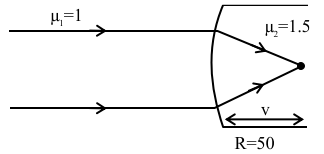
\( \frac{\mu_{2}}{v}-\frac{\mu_{1}}{u}=\frac{\mu_{2}-\mu_{1}}{R}\Rightarrow\frac{1.5}{v}-\frac{1}{\infty}=\frac{1.5-1}{50} \)
\( V=150~cm \)
\(x \rightarrow\) measure from center
x = V - R
= 150 - 50 = 100 cm -
- (A) between \(15^{\circ}\) and \(20^{\circ}\)
- (B) \(15^{\circ}\)
- (C) \(>25^{\circ}\)
- (D) \(<15^{\circ}\)
Show answer and solution
Correct Answer: (C)
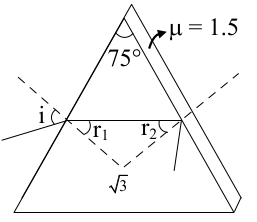
\(r_1+r_2=75^{\circ}\)
For T I R at back surface
\(\sqrt{3} \sin r_2=\frac{3}{2} \sin 90^{\circ}\)
\(r_2 \geq 60^{\circ}\)
\(r_1 \leq 15^{\circ}\)
\(1 \sin i=\sqrt{3} \sin 15^{\circ}\)
\(\sin i =1.73 \times .25\)
\(\sin i =.433\)
\(i=25^{\circ} \Rightarrow i<25^{\circ}\) -
- (A) \(45\)
- (B) \(30\)
- (C) \(28\)
- (D) \(58\)
Show answer and solution
Correct Answer: (B)
Velocity of light in vacuum, \(c = 3 \times 10^8\) m/s
Velocity of light in the prism, \(v = 2.12 \times 10^8\) m/s
Refractive index of the prism material, \(\mu = \dfrac{c}{v} = \dfrac{3 \times 10^8}{2.12 \times 10^8} \approx 1.414 \approx \sqrt{2}\)
For an equilateral prism, the angle of the prism \(A = 60^\circ\).
Using the prism formula:
\(\mu = \dfrac{\sin\left(\dfrac{A + \delta_m}{2}\right)}{\sin\left(\dfrac{A}{2}\right)}\)
\(\sqrt{2} = \dfrac{\sin\left(\dfrac{60^\circ + \delta_m}{2}\right)}{\sin(30^\circ)}\)
\(\sqrt{2} = \dfrac{\sin\left(30^\circ + \dfrac{\delta_m}{2}\right)}{\dfrac{1}{2}}\)
\(\sin\left(30^\circ + \dfrac{\delta_m}{2}\right) = \dfrac{\sqrt{2}}{2} = \dfrac{1}{\sqrt{2}}\)
\(30^\circ + \dfrac{\delta_m}{2} = 45^\circ\)
\(\dfrac{\delta_m}{2} = 15^\circ\)
\(\delta_m = 30^\circ\)
Answer: \(30\) -
- (A) \(2.5\)
- (B) \(5\)
- (C) \(7.5\)
- (D) \(7\)
Show answer and solution
Correct Answer: (B)
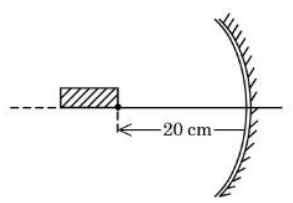
For the given concave mirror, the focal length is \(f = -10\) cm.
The rod lies along the principal axis. From the figure, the near end of the rod is at a distance of \(20\) cm from the pole of the mirror. Since the length of the rod is \(10\) cm, the far end is at a distance of \(20 + 10 = 30\) cm from the pole.
Let the near end be \(A\) and the far end be \(B\).
Object distance for end \(A\), \(u_A = -20\) cm.
Object distance for end \(B\), \(u_B = -30\) cm.
Using the mirror formula, \(\dfrac{1}{v} + \dfrac{1}{u} = \dfrac{1}{f}\)
For end \(A\):
\(\dfrac{1}{v_A} + \dfrac{1}{-20} = \dfrac{1}{-10}\)
\(\dfrac{1}{v_A} = \dfrac{1}{20} - \dfrac{1}{10} = -\dfrac{1}{20}\)
\(v_A = -20\) cm
For end \(B\):
\(\dfrac{1}{v_B} + \dfrac{1}{-30} = \dfrac{1}{-10}\)
\(\dfrac{1}{v_B} = \dfrac{1}{30} - \dfrac{1}{10} = \dfrac{1 - 3}{30} = -\dfrac{2}{30} = -\dfrac{1}{15}\)
\(v_B = -15\) cm
The length of the image is the distance between the images of the two ends:
\(\text{Length of image} = |v_A - v_B| = |-20 - (-15)| = |-5| = 5\) cm.
Answer: \(5\) -
- (A) \(1.66\)
- (B) \(2.33\)
- (C) \(2.66\)
- (D) \(1.33\)
Show answer and solution
Correct Answer: (A)
Given:
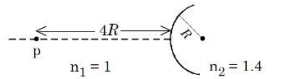
Refractive index of the first medium, \(n_1 = 1\)
Refractive index of the second medium, \(n_2 = 1.4 = \dfrac{7}{5}\)
Object distance, \(u = -4R\)
Radius of curvature of the spherical interface, \(R = +R\) (since the surface is convex towards the rarer medium)
Using the formula for refraction at a single spherical surface:
\(\dfrac{n_2}{v} - \dfrac{n_1}{u} = \dfrac{n_2 - n_1}{R}\)
Substituting the given values:
\(\dfrac{1.4}{v} - \dfrac{1}{-4R} = \dfrac{1.4 - 1}{R}\)
\(\dfrac{7}{5v} + \dfrac{1}{4R} = \dfrac{0.4}{R}\)
\(\dfrac{7}{5v} + \dfrac{1}{4R} = \dfrac{2}{5R}\)
\(\dfrac{7}{5v} = \dfrac{2}{5R} - \dfrac{1}{4R}\)
\(\dfrac{7}{5v} = \dfrac{8 - 5}{20R} = \dfrac{3}{20R}\)
\(v = \dfrac{7 \times 20R}{5 \times 3} = \dfrac{28R}{3}\)
The transverse magnification \(m\) for a spherical refracting surface is given by:
\(m = \dfrac{n_1 v}{n_2 u}\)
Substituting the values of \(n_1\), \(n_2\), \(u\), and \(v\):
\(m = \dfrac{1 \times \left(\dfrac{28R}{3}\right)}{1.4 \times (-4R)}\)
\(m = \dfrac{\dfrac{28R}{3}}{-\dfrac{28R}{5}}\)
\(m = -\dfrac{5}{3}\)
The magnitude of the magnification is:
\(|m| = \dfrac{5}{3} \approx 1.66\)
Answer: \(1.66\) -
- (A) \(10\)
- (B) \(12.5\)
- (C) \(13\)
- (D) \(13.5\)
Show answer and solution
Correct Answer: (A)
When one surface of a lens is silvered, the system behaves like an equivalent mirror. The light refracts through the lens, reflects off the silvered surface, and refracts through the lens again, so the equivalent power is:
\(P_{eq} = P_L + P_M + P_L = 2P_L + P_M\)
Power of the biconvex lens:
For a thin biconvex lens with \(R_1 = +20\text{ cm}\), \(R_2 = -20\text{ cm}\) and \(\mu = 1.5\), the lens maker's formula gives:
\(\dfrac{1}{f_L} = (\mu - 1)\left(\dfrac{1}{R_1} - \dfrac{1}{R_2}\right)\)
\(\dfrac{1}{f_L} = (1.5 - 1)\left(\dfrac{1}{20} - \dfrac{1}{-20}\right) = 0.5 \cdot \dfrac{2}{20} = \dfrac{1}{20}\text{ cm}^{-1}\)
So, \(P_L = \dfrac{1}{20}\text{ cm}^{-1}\).
Power of the silvered surface (acting as a concave mirror):
The back surface has radius of curvature \(R = 20\text{ cm}\), so its focal length is:
\(f_M = \dfrac{R}{2} = 10\text{ cm}\)
\(P_M = \dfrac{1}{f_M} = \dfrac{1}{10}\text{ cm}^{-1}\)
Equivalent focal length:
\(P_{eq} = 2P_L + P_M = 2 \cdot \dfrac{1}{20} + \dfrac{1}{10} = \dfrac{1}{10} + \dfrac{1}{10} = \dfrac{1}{5}\text{ cm}^{-1}\)
\(F_{eq} = \dfrac{1}{P_{eq}} = 5\text{ cm}\)
Since \(P_{eq} > 0\), the system behaves as a converging (concave) equivalent mirror of focal length \(5\text{ cm}\).
Object position for object and image to coincide:
For a concave mirror, the image coincides with the object when the object is placed at the centre of curvature, i.e., at a distance \(2F_{eq}\) from the mirror:
\(u = 2F_{eq} = 2 \times 5 = 10\text{ cm}\)
Hence, the correct option is \((1)\ 10\). -
- (A) behaves as concave lens if \(|f_{\text{convex}}| > |f_{\text{concave}}|\)
- (B) behaves as concave lens if \(|f_{\text{convex}}| < |f_{\text{concave}}|\)
- (C) behaves as convex lens if \(|f_{\text{convex}}| > |f_{\text{concave}}|\)
- (D) Focal length of the lens system will change if the positions of two lenses are interchanged
Show answer and solution
Correct Answer: (A)
The equivalent focal length \(F\) of two thin lenses in contact is given by \(\dfrac{1}{F} = \dfrac{1}{f_1} + \dfrac{1}{f_2}\)
For a convex lens, the focal length is positive, so \(f_1 = |f_{\text{convex}}|\)
For a concave lens, the focal length is negative, so \(f_2 = -|f_{\text{concave}}|\)
Substituting these values, we get \(\dfrac{1}{F} = \dfrac{1}{|f_{\text{convex}}|} - \dfrac{1}{|f_{\text{concave}}|}\)
If \(|f_{\text{convex}}| > |f_{\text{concave}}|\), then \(\dfrac{1}{|f_{\text{convex}}|} < \dfrac{1}{|f_{\text{concave}}|}\)
This implies \(\dfrac{1}{F} < 0\), so \(F\) is negative.
A negative equivalent focal length indicates that the combination behaves as a diverging or concave lens.
Interchanging the positions of the lenses does not change the equivalent focal length since \(\dfrac{1}{f_1} + \dfrac{1}{f_2} = \dfrac{1}{f_2} + \dfrac{1}{f_1}\).
Answer: behaves as concave lens if \(|f_{\text{convex}}| > |f_{\text{concave}}|\) -
- (A) \( \frac{5}{6} \)
- (B) \( \frac{5}{27} \)
- (C) \( \frac{3}{2} \)
- (D) \( \frac{25}{27} \)
Show answer and solution
Correct Answer: (A)
Explanation:
We determine the ratio of magnitudes of magnification by analyzing the system under two distinct configurations:
Case 1: Lenses in direct contact with no gap (\( d = 0 \))
1. Equivalent Focal Length Calculation:
The focal length of the convex lens is \( f_1 = +5\text{ cm} \) and the focal length of the concave lens is \( f_2 = -4\text{ cm} \). When two thin lenses are in contact, the net focal length (\( F \)) of the combination is:
\( \frac{1}{F} = \frac{1}{f_1} + \frac{1}{f_2} \)
\( \frac{1}{F} = \frac{1}{5} + \frac{1}{-4} = \frac{4 - 5}{20} = -\frac{1}{20} \implies F = -20\text{ cm} \)
2. Image Distance and Magnification (\( m_1 \)):
The object is situated at a distance of \( u = -10\text{ cm} \) from the combined lens system. Using the standard lens formula:
\( \frac{1}{v_1} - \frac{1}{u} = \frac{1}{F} \)
\( \frac{1}{v_1} - \frac{1}{-10} = \frac{1}{-20} \implies \frac{1}{v_1} = -\frac{1}{20} - \frac{1}{10} = -\frac{3}{20} \implies v_1 = -\frac{20}{3}\text{ cm} \)
The linear magnification \( m_1 \) for this combined case is:
\( m_1 = \frac{v_1}{u} = \frac{-20/3}{-10} = \frac{2}{3} \)
Case 2: Lenses separated by a distance (\( d = 1\text{ cm} \))
1. Refraction through the First Lens (Convex Lens):
For the convex lens alone, the object distance is \( u_1 = -10\text{ cm} \) and \( f_1 = +5\text{ cm} \):
\( \frac{1}{v'_1} - \frac{1}{u_1} = \frac{1}{f_1} \)
\( \frac{1}{v'_1} - \frac{1}{-10} = \frac{1}{5} \implies \frac{1}{v'_1} = \frac{1}{5} - \frac{1}{10} = \frac{1}{10} \implies v'_1 = +10\text{ cm} \)
The magnification produced by the first lens is:
\( m'_1 = \frac{v'_1}{u_1} = \frac{10}{-10} = -1 \)
2. Refraction through the Second Lens (Concave Lens):
The real image formed by the convex lens at a distance of \( 10\text{ cm} \) serves as a virtual object for the shifted concave lens. Since the concave lens is separated from the convex lens by a distance of \( 1\text{ cm} \), the virtual object distance (\( u_2 \)) measured from the concave lens is:
\( u_2 = +10\text{ cm} - 1\text{ cm} = +9\text{ cm} \)
Using the lens formula with \( f_2 = -4\text{ cm} \):
\( \frac{1}{v_2} - \frac{1}{u_2} = \frac{1}{f_2} \)
\( \frac{1}{v_2} - \frac{1}{9} = \frac{1}{-4} \implies \frac{1}{v_2} = \frac{1}{9} - \frac{1}{4} = \frac{4 - 9}{36} = -\frac{5}{36} \implies v_2 = -\frac{36}{5}\text{ cm} \)
The magnification produced by the second lens is:
\( m'_2 = \frac{v_2}{u_2} = \frac{-36/5}{9} = -\frac{4}{5} \)
3. Total Magnification (\( m_2 \)):
The net system magnification is the product of individual component magnifications:
\( m_2 = m'_1 \times m'_2 = (-1) \times \left(-\frac{4}{5}\right) = \frac{4}{5} \)
Finding the Ratio Magnitude:
Comparing the two calculated magnification parameters yields:
\( \left|\frac{m_1}{m_2}\right| = \frac{2/3}{4/5} = \frac{2}{3} \times \frac{5}{4} = \frac{5}{6} \)
Hence, Option A is the correct choice. -
- (A) \( 4.5^{\circ} \)
- (B) \( 6^{\circ} \)
- (C) \( 4^{\circ} \)
- (D) \( 5^{\circ} \)
Show answer and solution
Correct Answer: (C)
\( \delta_{net}=0 \)
\( \delta_{1}+\delta_{2}=0 \)
\( (\mu_{1}-1)A_{1}+(\mu_{2}-1)A_{2}=0 \)
\( A_{2}=\frac{(\mu_{1}-1)A_{1}}{(\mu_{2}-1)} \)
\( A_{2}=\frac{(1.72-1)}{(1.9-1)}\times5^{\circ}=4^{\circ} \) -
- (A) virtual, formed at \(7.5\text{ cm}\) right of lens \(Q\), with a size bigger than that of \(AB\)
- (B) real, formed at \(7.5\text{ cm}\) right of lens \(Q\), with a size same as that of \(AB\)
- (C) formed at infinity.
- (D) real, formed at \(7\text{ cm}\) right of lens \(Q\), with a size smaller than that of \(AB\)
Show answer and solution
Correct Answer: (B)
For lens \(P\):
\(\dfrac{1}{v_1} - \dfrac{1}{u_1} = \dfrac{1}{f_1}\)
\(\dfrac{1}{v_1} - \dfrac{1}{-15} = \dfrac{1}{10}\)
\(\dfrac{1}{v_1} = \dfrac{1}{10} - \dfrac{1}{15} = \dfrac{1}{30} \Rightarrow v_1 = 30\text{ cm}\)
Magnification \(m_1 = \dfrac{v_1}{u_1} = \dfrac{30}{-15} = -2\)
The image formed by lens \(P\) acts as a virtual object for lens \(Q\). Since the distance between the lenses is \(15\text{ cm}\), the object distance for lens \(Q\) is:
\(u_2 = 30 - 15 = +15\text{ cm}\)
For lens \(Q\):
\(\dfrac{1}{v_2} - \dfrac{1}{u_2} = \dfrac{1}{f_2}\)
\(\dfrac{1}{v_2} - \dfrac{1}{15} = \dfrac{1}{15}\)
\(\dfrac{1}{v_2} = \dfrac{2}{15} \Rightarrow v_2 = 7.5\text{ cm}\)
The positive sign indicates that the final image is real and formed \(7.5\text{ cm}\) to the right of lens \(Q\).
Magnification \(m_2 = \dfrac{v_2}{u_2} = \dfrac{7.5}{15} = \dfrac{1}{2}\)
Total magnification \(m = m_1 \times m_2 = -2 \times \dfrac{1}{2} = -1\)
Since \(|m| = 1\), the size of the final image is the same as that of the object \(AB\).
Answer: real, formed at \(7.5\text{ cm}\) right of lens \(Q\), with a size same as that of \(AB\) - 143. Angle of minimum deviation is equal to the half of the angle of prism in an equilateral prism. The refractive index of the prism is __________. 2026 Medium
- (A) \(1.5\)
- (B) \(\sqrt{3}\)
- (C) \(\sqrt{2}\)
- (D) \(1.65\)
Show answer and solution
Correct Answer: (C)
For an equilateral prism, the angle of the prism is \(A = 60^{\circ}\).
Given that the angle of minimum deviation is half of the angle of the prism:
\(\delta_{m} = \dfrac{A}{2} = \dfrac{60^{\circ}}{2} = 30^{\circ}\)
The refractive index of the prism is given by:
\(\mu = \dfrac{\sin\left(\dfrac{A + \delta_{m}}{2}\right)}{\sin\left(\dfrac{A}{2}\right)}\)
Substituting the values of \(A\) and \(\delta_{m}\):
\(\mu = \dfrac{\sin\left(\dfrac{60^{\circ} + 30^{\circ}}{2}\right)}{\sin\left(\dfrac{60^{\circ}}{2}\right)}\)
\(\mu = \dfrac{\sin(45^{\circ})}{\sin(30^{\circ})}\)
\(\mu = \dfrac{\dfrac{1}{\sqrt{2}}}{\dfrac{1}{2}} = \sqrt{2}\)
Answer: \(\sqrt{2}\) -
- (A) 60°
- (B) 75°
- (C) 90°
- (D) 45°
Show answer and solution
Correct Answer: (A)
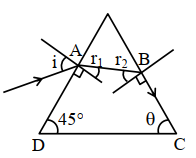
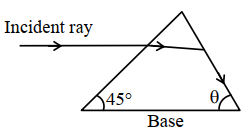
For grazing emergence
\(\sin r_2=\frac{1}{\mu}\)
By Snell's Law at incident surface
\(1 \times \frac{1}{\sqrt{2}}=\sqrt{2} \sin r _1\)
\(r_1=30\)
\(r _1+ r _2= A\)
\(A=75\)
\(75+45+\theta=180^{\circ}\)
\(\theta=60^{\circ}\) -
- (A) \( 15^{\circ} \)
- (B) \( 20^{\circ} \)
- (C) \( 40^{\circ} \)
- (D) \( 30^{\circ} \)
Show answer and solution
Correct Answer: (A)
Equilateral prism.
\( A=60^{\circ} \)
\( \mu~Sinr_{2}=1.sine=1 \)
\( Sinr_{2}=\frac{1}{\mu}=\frac{1}{\sqrt{2}} \)
\( r_{2}=45^{\circ} \)
\(\therefore r_1=A-r_2=15^{\circ}\) -
- (A) \( \cot^{-1}(\frac{3}{\sqrt{13}}) \)
- (B) \( \sin^{-1}(\frac{9}{8}) \)
- (C) \( \tan^{-1}(\frac{8}{\sqrt{17}}) \)
- (D) \( \cos^{-1}(\frac{8}{9}) \)
Show answer and solution
Correct Answer: (C)
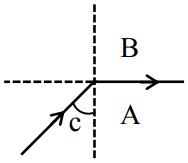
\(\mu_A \sin c=\mu_B \sin 90\)
\(\Rightarrow \sin c =\frac{\mu_{ B }}{\mu_{ A }}=\frac{ v _{ A }}{ v _{ B }}\)
\(\therefore \sin c=\frac{2.4 \times 10^8}{2.7 \times 10^8}=\frac{8}{9}\)
\(\Rightarrow \tan c=\frac{8}{\sqrt{81-64}}=\frac{8}{\sqrt{17}}\)
\(c=\tan ^{-1}\left(\frac{8}{\sqrt{17}}\right)\) - 147. Distance between an object and three times magnified real image is 40 cm . The focal length of the mirror used is _________ cm . 2026 Medium
- (A) \(-15 / 2\)
- (B) \(-10\)
- (C) \(-20\)
- (D) \(-15\)
Show answer and solution
Correct Answer: (D)
\(m=-3=\frac{v}{u}\)
\(v=-3u\)
\(|v|-|u|=40\)
\(u=20~cm,\)
\(v=60~cm\)
\(\therefore \frac{1}{v}+\frac{1}{u}=\frac{1}{f}\)
\(\frac{1}{-60}+\frac{1}{-20}=\frac{1}{ f }\)
\(f =-15 cm\) -
- (A) Readings recorded by all persons are correct
- (B) Reading recorded by \(P_{3}\) persons are incorrect
- (C) Reading recorded by \(P_{3}\) and \(P_{2}\) persons are incorrect
- (D) Reading recorded by \(P_{4}\) and \(P_{5}\) persons are incorrect
Show answer and solution
Correct Answer: (B)
\(P =+5 D\)
\(\frac{1}{ f }=5 \Rightarrow f =20 cm\)
⇒ If object is between f & 2f image will be beyond 2f & magnified.
⇒ If object is beyond 2 f , image will be between f & 2f & diminished.
Hence reading of \(P_3\) are incorrect. - 149. For a thin symmetric prism made of glass (refractive index \(1.5\)), the ratio of incident angle and minimum deviation will be _______. 2026 Medium
- (A) \(3 : 4\)
- (B) \(3 : 2\)
- (C) \(2 : 1\)
- (D) \(1 : 2\)
Show answer and solution
Correct Answer: (B)
For a thin prism, the angle of minimum deviation is given by \(\delta_m = (\mu - 1)A\).
At the position of minimum deviation, the angle of incidence \(i\) and angle of emergence \(e\) are equal, and the angle of refraction is \(r = \dfrac{A}{2}\).
Using Snell's law for small angles, \(i = \mu r = \mu \left(\dfrac{A}{2}\right)\).
The ratio of the incident angle to the minimum deviation is:
\(\dfrac{i}{\delta_m} = \dfrac{\dfrac{\mu A}{2}}{(\mu - 1)A} = \dfrac{\mu}{2(\mu - 1)}\)
Given \(\mu = 1.5\), substituting the value:
\(\dfrac{i}{\delta_m} = \dfrac{1.5}{2(1.5 - 1)} = \dfrac{1.5}{2(0.5)} = \dfrac{1.5}{1} = \dfrac{3}{2}\)
Answer: \(3 : 2\) -
- (A) \(\sqrt{2} < n < 2\sqrt{2}\)
- (B) \(1 < n < 2\)
- (C) \(n\ge 2\)
- (D) \(\sqrt{2} < n < 2\)
Show answer and solution
Correct Answer: (D)
Explanation:
The relation between the refractive index (\( n \)), refracting angle of the prism (\( A \)), and the angle of minimum deviation (\( \delta_{\text{min}} \)) is given by the prism formula:
\( n = \frac{\sin\left(\frac{A + \delta_{\text{min}}}{2}\right)}{\sin\left(\frac{A}{2}\right)} \)
1. Applying Given Condition:
According to the question, the angle of minimum deviation is equal to the refracting angle of the prism (\( \delta_{\text{min}} = A \)). Substituting this into the formula:
\( n = \frac{\sin\left(\frac{A + A}{2}\right)}{\sin\left(\frac{A}{2}\right)} = \frac{\sin A}{\sin\left(\frac{A}{2}\right)} \)
Using the trigonometric identity \( \sin A = 2\sin\left(\frac{A}{2}\right)\cos\left(\frac{A}{2}\right) \):
\( n = \frac{2\sin\left(\frac{A}{2}\right)\cos\left(\frac{A}{2}\right)}{\sin\left(\frac{A}{2}\right)} = 2\cos\left(\frac{A}{2}\right) \)
2. Determining Limiting Conditions:
For minimum deviation, the angle of incidence (\( i \)is given by:
\( i = \frac{A + \delta_{\text{min}}}{2} = \frac{A + A}{2} = A \)
For a light ray to physically enter the prism, the angle of incidence must be strictly less than the grazing angle of \( 90^\circ \):
\( i < 90^\circ \implies A < 90^\circ \)
Since \( A \) is a positive angle for a real prism, the range of \( A \) is:
\( 0^\circ < A < 90^\circ \implies 0^\circ < \frac{A}{2} < 45^\circ \)
3. Finding the Range of Refractive Index:
Taking the cosine function across this inequality (reversing the inequality signs as cosine values decrease from \( 0^\circ \) to \( 45^\circ \)):
\( \cos(45^\circ) < \cos\left(\frac{A}{2}\right) < \cos(0^\circ) \)
\( \frac{1}{\sqrt{2}} < \cos\left(\frac{A}{2}\right) < 1 \)
Multiplying the entire inequality by 2:
\( 2 \cdot \frac{1}{\sqrt{2}} < 2\cos\left(\frac{A}{2}\right) < 2 \cdot 1 \)
\( \sqrt{2} < n < 2 \)
Hence, Option D is the correct choice.
No questions on this page match these filters.