


Questions
23 questionsShowing 1–23 of 23 questions
-
- (A) \( R=2r \)
- (B) \( R=\frac{r}{2} \)
- (C) \( R=\sqrt{2}r \)
- (D) \( R=r \)
Show answer and solution
Correct Answer: (D)
For maximum power drawn across load
Resistance \(R _{\text {Load }}= R _{\text {intemal }}\)
\( R=r \) -
- (A) 1
- (B) 2
- (C) 0.5
- (D) 4
Show answer and solution
Correct Answer: (A)
\(V _{\ell}=\mu E =\mu \times \frac{ V }{\ell}\)
\(I = neAV _{ d }\)
\(V_d=\frac{I}{n e A}\)
\(\mu=\frac{ I \ell}{\text { NneA }}\)
\(\mu=\frac{1.6 \times 3}{2 \times 5 \times 10^{26} \times 1.6 \times 10^{-19} \times 2 \times 10^{-7}}\)
\(\mu=1 \times 10^{-3} m^2 / v \cdot s\)
\(\alpha=1\) -
- (A) \( R_{2}=16\Omega, R_{1}=\frac{16}{3}\Omega \)
- (B) \( R_{2}=4\Omega, R_{1}=\frac{4}{3}\Omega \)
- (C) \( R_{2}=8\Omega, R_{1}=\frac{16}{3}\Omega \)
- (D) \( R_{2}=12\Omega, R_{1}=\frac{12}{3}\Omega \)
Show answer and solution
Correct Answer: (C)
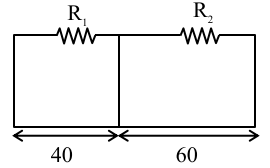
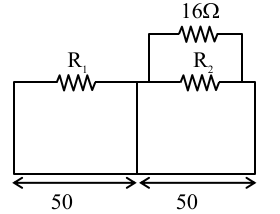
\( \frac{R_{1}}{R_{2}}=\frac{40}{60}=\frac{2}{3} \) \(\quad\)... (1)
\( \frac{R_{1}}{(\frac{R_{2}\times16}{R_{2}+16})}=\frac{50}{50}\Rightarrow R_{1}=\frac{16R_{2}}{16+R_{2}} \) \(\quad\)...(2)
\( \frac{2}{3}R_{2}=\frac{16R_{2}}{16+R_{2}} \)
\( \frac{32}{3}+\frac{2R_{2}}{3}=16 \)
\( \frac{2R_{2}}{3}=16-\frac{32}{3}=\frac{16}{3} \)
\( R_{2}=8\Omega \)
By equation (1)
\( R_{1}=\frac{2}{3}R_{2}=\frac{16}{3}\Omega \) -
- (A) \(\frac{4}{5}r\)
- (B) \(\frac{5}{8}r\)
- (C) \(\frac{3}{4}r\)
- (D) \(\frac{3}{5}r\)
Show answer and solution
Correct Answer: (A)
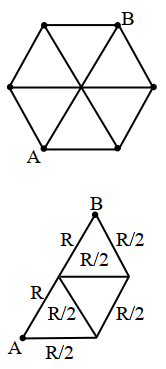
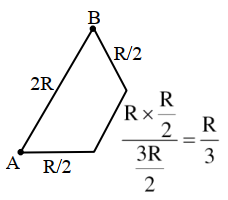
\(R_{e q}=\frac{2 R \times \frac{4 R}{3}}{2 R+\frac{4 R}{3}}=\frac{8 R^2}{10 R}=\frac{4}{5} R\) -
- (A) 1.05
- (B) 0
- (C) 0.95
- (D) 2
Show answer and solution
Correct Answer: (C)
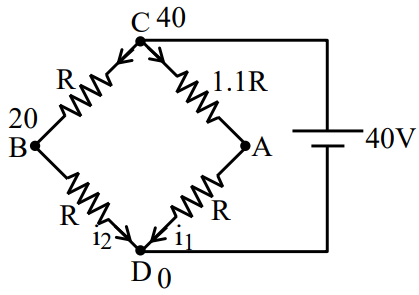
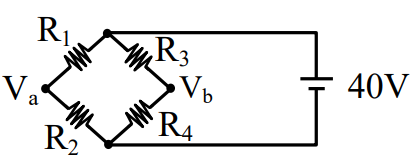
\(V_{A}=\frac{V}{2}\)
\(V_{B}=\frac{V}{2.1R}\times R=\frac{V}{2.1}\)
\(\therefore V _{ A }-V_{B}=V[\frac{1}{2}-\frac{1}{2.1}]\)
\(V_{A}-V_{B}=\frac{0.1}{2\times2.1}\times40\)
\(V_{A}-V_{B}=\frac{4}{4.2}=0.95\) -
- (A) \( \frac{3\pi\lambda r}{8} \)
- (B) \( (\pi+1)2r\lambda \)
- (C) \( \frac{6\pi\lambda r}{3\pi+16} \)
- (D) \( 2\pi\lambda r \)
Show answer and solution
Correct Answer: (C)
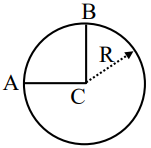
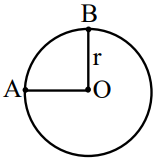
\( \frac{1}{R_{AB}}=\frac{2}{\lambda\pi r}+\frac{1}{\lambda.2r}+\frac{2}{\lambda.3\pi r} \)
\(=\frac{1}{\lambda r}[\frac{2}{\pi}+\frac{1}{2}+\frac{2}{3\pi}] \)
\( =\frac{1}{\lambda r}(\frac{12+3\pi+4}{6\pi})=\frac{1}{\lambda r}.(\frac{16+3\pi}{6\pi}) \)
\( R_{AB}=\lambda r(\frac{6\pi}{16+3\pi}) \) -
- (A) 96.9
- (B) 86.5
- (C) 100
- (D) 92.5
Show answer and solution
Correct Answer: (A)
\( P_{out}=1000\,W \)
\( P=VI \)
\(1000=250 \times I\)
I=4A
\( P_{loss}=I^{2}R=(4)^{2}\times2=3200\, \)
\( P_{net}=1000+32=103200\, \)
\( \eta=(\frac{P_{out}}{P_{net}})\times100=\frac{1000}{1032}\times100=96.89\% \) -
- (A) 3
- (B) 4
- (C) 9
- (D) 6
Show answer and solution
Correct Answer: (D)
In series, \(i_{1} = \frac{2E}{6+2r}\)
In parallel, \(i_{2} = \frac{E}{6 + \frac{r}{2}}\)
\(i_{1} = i_{2} \Rightarrow \frac{2E}{6+2r} = \frac{E}{6 + \frac{r}{2}}\)
\(12+r = 6+2r\)
\(\Rightarrow r = 6\Omega\) -
- (A) 3
- (B) 9
- (C) 6
- (D) 12
Show answer and solution
Correct Answer: (C)
In case I
\(\frac{2}{3}=\frac{\ell}{(100-\ell)} \ldots \ldots(1)\)
\(\ell=40 cm\)
In case II
\(\frac{2}{ R }=\frac{\ell+10}{100-(\ell+10)}\)
Put \(\ell=40 cm \&\) solve
\(R =2 \Omega\)
\(\therefore \frac{3 x}{3+x}=2\)
\(x=6 \Omega\) -
- (A) 3
- (B) 4
- (C) 12
- (D) 6
Show answer and solution
Correct Answer: (B)
Let E is emf and r is internal resistance of cell.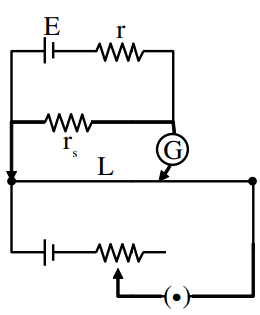
\(\frac{E \cdot 4}{r+4} = 120K\)
\(\frac{E \cdot 12}{r+12} = 180K\)
\(\Rightarrow \frac{1}{3} \frac{ r +12}{ r +4}=\frac{2}{3}\)
\(r+12=2(r+4)\)
\(\Rightarrow r=4\) -
- (A) 3477
- (B) 3488
- (C) 3492
- (D) 3498
Show answer and solution
Correct Answer: (A)
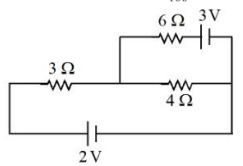
Taking the right-hand wire as the reference node at \(0\text{ V}\), let the left junction (where the \(3\,\Omega\), \(4\,\Omega\) and \(6\,\Omega\) resistors meet) be Node A at potential \(V_A\).
Bottom branch: The positive terminal of the \(2\text{ V}\) battery is at the reference, so its negative terminal (and hence the left end of the \(3\,\Omega\) resistor) is at \(-2\text{ V}\).
Top branch: The positive terminal of the \(3\text{ V}\) battery is at the reference, so its negative terminal (and hence the node between the \(6\,\Omega\) resistor and the \(3\text{ V}\) battery) is at \(-3\text{ V}\).
Applying KCL at Node A (sum of currents leaving the node is zero):
\(\dfrac{V_A - 0}{4} + \dfrac{V_A - (-2)}{3} + \dfrac{V_A - (-3)}{6} = 0\)
\(\dfrac{V_A}{4} + \dfrac{V_A + 2}{3} + \dfrac{V_A + 3}{6} = 0\)
Multiplying throughout by \(12\):
\(3V_A + 4(V_A + 2) + 2(V_A + 3) = 0\)
\(3V_A + 4V_A + 8 + 2V_A + 6 = 0\)
\(9V_A + 14 = 0 \Rightarrow V_A = -\dfrac{14}{9}\text{ V}\)
Current through the \(6\,\Omega\) resistor (from Node A towards the \(-3\text{ V}\) point):
\(I_6 = \dfrac{V_A - (-3)}{6} = \dfrac{-\dfrac{14}{9} + 3}{6} = \dfrac{\dfrac{13}{9}}{6} = \dfrac{13}{54}\text{ A}\)
Heat generated in the \(6\,\Omega\) resistor in \(t = 100\text{ s}\):
\(H = I_6^2 \cdot R \cdot t = \left(\dfrac{13}{54}\right)^2 \cdot 6 \cdot 100\)
\(H = \dfrac{169}{2916} \cdot 600 = \dfrac{169 \cdot 100}{486} = \dfrac{16900}{486}\text{ J}\)
Given \(H = \dfrac{\alpha}{100}\text{ J}\):
\(\dfrac{\alpha}{100} = \dfrac{16900}{486}\)
\(\alpha = \dfrac{16900 \cdot 100}{486} = \dfrac{1690000}{486} \approx 3477.37\)
Rounding to the nearest integer:
\(\alpha = 3477\)
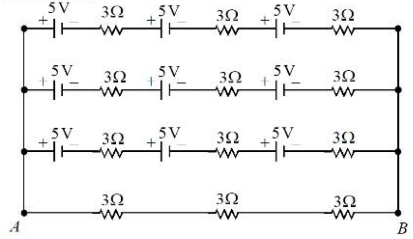
Hence, the answer is \(3477\). - 12. Refer to the figure given below, current between terminals \(A\) and \(B\) is _____ A.
 2026 Hard
- (A) \(12.5\)
- (B) \(1.25\)
- (C) \(7.5\)
- (D) \(5\)
Show answer and solution
Correct Answer: (B)
The given circuit consists of four parallel branches connected between the left and right common vertical wires.
Let's find the equivalent electromotive force (EMF) and resistance for each branch:
For the top three active branches, each contains three \(5\text{ V}\) cells and three \(3\ \Omega\) resistors in series.
Equivalent EMF of each active branch, \(E = 5 + 5 + 5 = 15\text{ V}\).
Equivalent resistance of each active branch, \(R = 3 + 3 + 3 = 9\ \Omega\).
Since these three identical active branches are connected in parallel, we can replace them with a single equivalent voltage source:
Equivalent EMF, \(E_{eq} = 15\text{ V}\) (as they are identical and in parallel).
Equivalent internal resistance, \(R_{eq} = \dfrac{9}{3} = 3\ \Omega\).
The fourth (bottom) branch is connected between terminals \(A\) and \(B\) and acts as the load for this equivalent source. It contains three \(3\ \Omega\) resistors in series.
Resistance of the branch \(AB\), \(R_{AB} = 3 + 3 + 3 = 9\ \Omega\).
Now, the circuit is simplified to an equivalent source of \(15\text{ V}\) with internal resistance \(3\ \Omega\) connected across a load of \(9\ \Omega\).
The current \(I\) flowing between terminals \(A\) and \(B\) (through the bottom branch) is given by Ohm's law:
\(I = \dfrac{E_{eq}}{R_{eq} + R_{AB}}\)
\(I = \dfrac{15}{3 + 9} = \dfrac{15}{12}\text{ A}\)
\(I = 1.25\text{ A}\)
Answer: \(1.25\) - 13. Refer to the figure given below. The values of \(I_1\), \(I_2\) and \(I_3\) are __________.
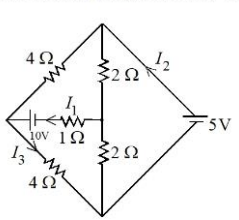 2026 Hard
- (A) \(I_1 = 2.5\) A, \(I_2 = 1.875\) A, \(I_3 = 1.875\) A
- (B) \(I_1 = 1.875\) A, \(I_2 = 2.5\) A, \(I_3 = 1.875\) A
- (C) \(I_1 = 1.875\) A, \(I_2 = 1.875\) A, \(I_3 = 2.5\) A
- (D) \(I_1 = 2.5\) A, \(I_2 = 2.5\) A, \(I_3 = 1.875\) A
Show answer and solution
Correct Answer: (A)
Using the principle of superposition, we analyse the circuit with one source active at a time.
Case 1: Only the \(10\text{ V}\) source is active (the \(5\text{ V}\) source is replaced by a short circuit).
With the \(5\text{ V}\) source shorted, the top and bottom nodes of the bridge are directly connected by a wire, forming a Wheatstone bridge.
Checking for balance:
Left arm ratio: \(\dfrac{4}{4} = 1\)
Right arm ratio: \(\dfrac{2}{2} = 1\)
The ratios are equal, so the bridge is balanced. Hence, no current flows through the middle branch connecting the two nodes, and the contribution to \(I_2\) from the \(10\text{ V}\) source is \(0\text{ A}\).
Equivalent resistance of the balanced bridge:
\((4 + 2)\,\Omega \parallel (4 + 2)\,\Omega = 6\,\Omega \parallel 6\,\Omega = 3\,\Omega\)
Total resistance including the series \(1\,\Omega\) resistor:
\(R_{eq} = 3 + 1 = 4\,\Omega\)
Current drawn from the \(10\text{ V}\) source:
\(I_{1(10V)} = \dfrac{10}{4} = 2.5\text{ A}\)
This current splits equally between the two \(6\,\Omega\) branches, so the current through the bottom \(4\,\Omega\) resistor is:
\(I_{3(10V)} = \dfrac{2.5}{2} = 1.25\text{ A}\)
Case 2: Only the \(5\text{ V}\) source is active (the \(10\text{ V}\) source is replaced by a short circuit).
Now the \(5\text{ V}\) source is applied across the top and bottom nodes, and the \(1\,\Omega\) resistor lies in the middle branch between the left and centre nodes.
For the left branch (\(4\,\Omega\) and \(4\,\Omega\) in series), the potential at the midpoint is \(\dfrac{5}{2} = 2.5\text{ V}\).
For the right branch (\(2\,\Omega\) and \(2\,\Omega\) in series), the potential at the midpoint is also \(\dfrac{5}{2} = 2.5\text{ V}\).
Since both midpoints are at the same potential, no current flows through the \(1\,\Omega\) middle branch. Hence, the contribution to \(I_1\) from the \(5\text{ V}\) source is \(0\text{ A}\).
Equivalent resistance seen by the \(5\text{ V}\) source:
\((4 + 4)\,\Omega \parallel (2 + 2)\,\Omega = 8\,\Omega \parallel 4\,\Omega = \dfrac{8 \times 4}{8 + 4} = \dfrac{8}{3}\,\Omega\)
Total current supplied by the \(5\text{ V}\) source:
\(I_{2(5V)} = \dfrac{5}{8/3} = \dfrac{15}{8} = 1.875\text{ A}\)
Current through the left branch (which includes the bottom \(4\,\Omega\) resistor):
\(I_{3(5V)} = \dfrac{5}{8} = 0.625\text{ A}\)
Applying superposition:
\(I_1 = I_{1(10V)} + I_{1(5V)} = 2.5 + 0 = 2.5\text{ A}\)
\(I_2 = I_{2(10V)} + I_{2(5V)} = 0 + 1.875 = 1.875\text{ A}\)
\(I_3 = I_{3(10V)} + I_{3(5V)} = 1.25 + 0.625 = 1.875\text{ A}\)
Hence, the correct option is \((1)\ I_1 = 2.5\text{ A},\ I_2 = 1.875\text{ A},\ I_3 = 1.875\text{ A}\). -
- (A) 15
- (B) 21
- (C) 10
- (D) 25
Show answer and solution
Correct Answer: (B)
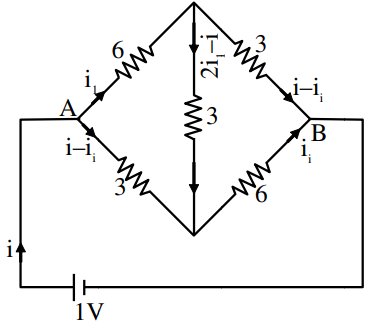
\(6i_{1} + 3(2i_{1} - i) = 3(i - i_{1})\)
\(\Rightarrow 15i_{1} = 6i \Rightarrow i_{1} = \frac{2}{5}i\)\(\quad\) ___(1)
\(3(i - i_{1}) + 6i_{1} = 1\)
\(3i + 3i_{1} = 1\)
\(\Rightarrow i =\frac{5}{21} A=\frac{1 V}{ R _{ eq }} \Rightarrow R _{ eq }=\frac{21}{5} \Omega\) -
- (A) 540
- (B) 1080
- (C) 2160
- (D) 120
Show answer and solution
Correct Answer: (B)
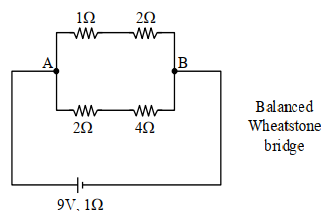
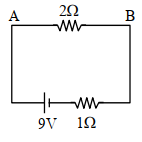
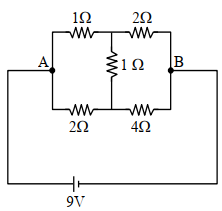
\(i =\frac{9}{3}=3 A\)
\(\therefore \quad H_{A B}=i^2 R_{A B} t\)
\(=(3)^2 \times 2 \times 60=1080 J\) -
- (A) 15
- (B) 30
- (C) 25
- (D) 20
Show answer and solution
Correct Answer: (B)
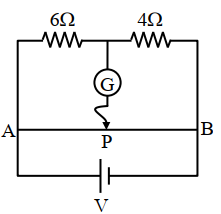
\(\frac{6}{ R _{ AP }}=\frac{4}{ R _{ PB }} ;\)
\(\ell_{ AP }+\ell_{ PB }=50\)....(i)
\(\frac{ R _{ AP }}{ R _{ PB }}=\frac{\ell_{ AP }}{\ell_{ PB }}=\frac{3}{2}\)
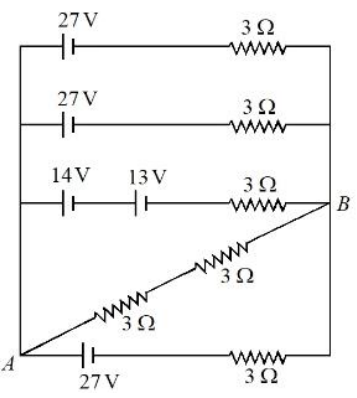
\(\ell_{ AP }=\frac{3}{5} \times 50=30 cm\) - 17. The voltage and the current between \(A\) and \(B\) points shown in the circuit are _____.
 2026 Hard
- (A) \(24\) V, \(12\) A
- (B) \(24\) V, \(4\) A
- (C) \(18\) V, \(12\) A
- (D) \(27\) V, \(4\) A
Show answer and solution
Correct Answer: (B)
The four parallel branches between the common left node \(A\) and the common right node are all identical: each consists of a \(27\text{ V}\) source in series with a \(3\ \Omega\) resistor. In the third branch, the two cells \((14\text{ V}\) and \(13\text{ V})\) aid each other, giving a net EMF of \(14 + 13 = 27\text{ V}\).
Thevenin equivalent between \(A\) and \(B\):
Since all four branches have the same EMF and polarity in parallel:
\(V_{th} = 27\text{ V}\)
The four \(3\ \Omega\) resistors in parallel give:
\(R_{th} = \dfrac{3}{4} = 0.75\ \Omega\)
Load branch (diagonal):
The diagonal connecting \(A\) and \(B\) consists of two \(3\ \Omega\) resistors in series, so:
\(R_L = 3 + 3 = 6\ \Omega\)
Current through the diagonal branch:
\(I = \dfrac{V_{th}}{R_{th} + R_L} = \dfrac{27}{0.75 + 6} = \dfrac{27}{6.75} = 4\text{ A}\)
Voltage across \(A\) and \(B\):
\(V_{AB} = I \cdot R_L = 4 \times 6 = 24\text{ V}\)
Hence, the voltage is \(24\text{ V}\) and the current is \(4\text{ A}\), which corresponds to option \((2)\ 24\text{ V},\ 4\text{ A}\). -
- (A) 1.45
- (B) 1.65
- (C) 1.75
- (D) 1.55
Show answer and solution
Correct Answer: (B)
\(\epsilon=\lambda \ell\)
Potential gradient
\(\epsilon_1=\lambda \ell_1\)
\(\epsilon_2=\lambda \ell_2\)
\(y =\frac{\epsilon_1}{\epsilon_2}=\frac{\ell_1}{\ell_2}\)
\(\frac{\Delta y }{ y }=\frac{\Delta \ell_1}{\ell_1}+\frac{\Delta \ell_2}{\ell_2}\)
\(\frac{\Delta y}{y}=\frac{1}{200}+\frac{1}{150}\)
\(\frac{\Delta y}{y} \times 100\left(\frac{1}{200}+\frac{1}{150}\right) \times 100\)
\(=\left(\frac{3+4}{600}\right) \times 100 \Rightarrow \frac{7}{6}=1.16 \%\) -
- (A) 1
- (B) 2
- (C) 3
- (D) 4
Show answer and solution
Correct Answer: (C)
For two cells connected in parallel with the same polarity, the equivalent emf \(E_{eq}\) and equivalent internal resistance \(r_{eq}\) are given by:
\(E_{eq} = \dfrac{E_1 r_2 + E_2 r_1}{r_1 + r_2}\)
\(r_{eq} = \dfrac{r_1 r_2}{r_1 + r_2}\)
Substituting the given values (\(E_1 = 1\) V, \(r_1 = 2\,\Omega\), \(E_2 = 2\) V, \(r_2 = 1\,\Omega\)):
\(E_{eq} = \dfrac{1 \times 1 + 2 \times 2}{2 + 1} = \dfrac{5}{3}\) V
\(r_{eq} = \dfrac{2 \times 1}{2 + 1} = \dfrac{2}{3}\,\Omega\)
The current \(I\) through the external resistance \(R\) is \(1\) A:
\(I = \dfrac{E_{eq}}{R + r_{eq}}\)
\(1 = \dfrac{\dfrac{5}{3}}{R + \dfrac{2}{3}}\)
\(R + \dfrac{2}{3} = \dfrac{5}{3} \Rightarrow R = 1\,\Omega\)
When the polarity of one cell is reversed, the new equivalent emf \(E'_{eq}\) becomes:
\(E'_{eq} = \dfrac{|E_1 r_2 - E_2 r_1|}{r_1 + r_2} = \dfrac{|1 \times 1 - 2 \times 2|}{3} = \dfrac{3}{3} = 1\) V
The equivalent internal resistance remains the same, \(r_{eq} = \dfrac{2}{3}\,\Omega\).
The new current \(I'\) through the external resistance \(R\) is:
\(I' = \dfrac{E'_{eq}}{R + r_{eq}} = \dfrac{1}{1 + \dfrac{2}{3}} = \dfrac{1}{\dfrac{5}{3}} = \dfrac{3}{5}\) A
Given that the new current is \(\dfrac{\alpha}{5}\) A, we have:
\(\dfrac{\alpha}{5} = \dfrac{3}{5} \Rightarrow \alpha = 3\)
Answer: \(3\) -
- (A) \( (\sqrt{3}-1)R \)
- (B) R
- (C) \( 2(\sqrt{3}-1)R \)
- (D) \( (\sqrt{3}+1)R \)
Show answer and solution
Correct Answer: (A)
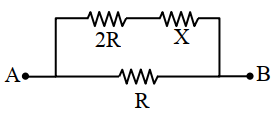
\( \frac{(2R+x).(R)}{3R+x}=x \)
\( x^{2}+2Rx-2R^{2}=0 \)
\( x=(\sqrt{3}-1)R \) -
- (A) 3
- (B) 2
- (C) 4
- (D) 1
Show answer and solution
Correct Answer: (B)
Initially, \(\frac{2}{3}=\frac{x}{100-x}\)
\(\Rightarrow x =40 cm\)
Now when ' R ' connected in parallel
\(\frac{2}{\frac{3 R}{3+R}}=\frac{40+22.5}{60-22.5}=\frac{62.5}{37.5}\)
\(\therefore R =2 \Omega\) -
- (A) \(25\)
- (B) \(50\)
- (C) \(66.6\)
- (D) \(100\)
Show answer and solution
Correct Answer: (B)
The resistance of the bulb is calculated using its power rating:
\(R_b = \dfrac{V^2}{P} = \dfrac{200^2}{100} = 400 \, \Omega\)
The bulb is connected in parallel with the \(400 \, \Omega\) resistor. The equivalent resistance of this parallel combination is:
\(R_p = \dfrac{400 \times 400}{400 + 400} = 200 \, \Omega\)
This parallel combination is in series with the \(200 \, \Omega\) resistor. The total equivalent resistance of the circuit is:
\(R_{eq} = 200 + R_p = 200 + 200 = 400 \, \Omega\)
The current drawn from the battery is:
\(I = \dfrac{V}{R_{eq}} = \dfrac{100}{400} = 0.25 \text{ A}\)
The potential drop across the bulb is the same as the potential drop across the parallel combination:
\(V_p = I \times R_p = 0.25 \times 200 = 50 \text{ V}\)
Answer: \(50\) -
- (A) 3
- (B) 2
- (C) 1
- (D) 0
Show answer and solution
Correct Answer: (C)
Let the EMF of the cell be \(E\) and its internal resistance be \(r\).
The current \(I\) in the circuit is given by \(I = \dfrac{E}{R + r}\).
For the first case, \(R_1 = 5\ \Omega\) and \(I_1 = 0.25\text{ A}\):
\(0.25 = \dfrac{E}{5 + r} \Rightarrow E = 0.25(5 + r)\)
For the second case, \(R_2 = 2\ \Omega\) and \(I_2 = 0.5\text{ A}\):
\(0.5 = \dfrac{E}{2 + r} \Rightarrow E = 0.5(2 + r)\)
Equating the expressions for \(E\):
\(0.25(5 + r) = 0.5(2 + r)\)
\(5 + r = 2(2 + r)\)
\(5 + r = 4 + 2r\)
\(r = 1\ \Omega\)
Answer: \(1\)
No questions on this page match these filters.