


Questions
30 questionsShowing 1–30 of 30 questions
-
- (A) 4
- (B) 8
- (C) 16
- (D) 32
Show answer and solution
Correct Answer: (C)
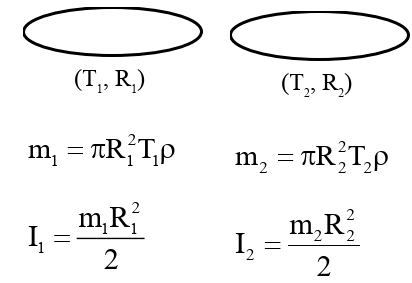
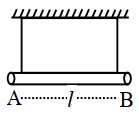
\(I _1= I _2\)
\(\frac{\pi R _1^2 T_1 \rho R _1^2}{2}=\frac{\pi R _2^2 T_2 \rho R _2^2}{2} \Rightarrow \frac{T_1}{T_2}=\frac{1}{16}\) -
- (A) 30
- (B) 60
- (C) 45
- (D) 90
Show answer and solution
Correct Answer: (A)
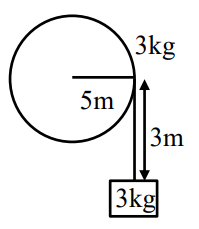
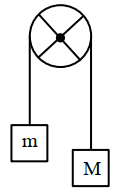
\(mg\times3=\frac{1}{2}.\frac{mR^{2}}{2}\omega^{2}+\frac{1}{2}mv^{2}\) ...(i)
& \(v=\omega R\) ...(ii)
From equation (i) & (ii)
\(g\times3=\frac{3}{4}.v^{2}\)
K.E. of flywheel \(=\frac{1}{2}\times\frac{mR^{2}}{2}\times\omega^{2}=\frac{1}{4}mv^{2}\)
\(=\frac{1}{4}\times3\times40=30\) Joule -
- (A) \(0.8\)
- (B) \(0.64\)
- (C) \(0.9\)
- (D) \(0.5\)
Show answer and solution
Correct Answer: (A)
The impedance of the LCR series circuit is given by \(Z = \sqrt{R^2 + (X_C - X_L)^2}\).
Substituting the given values:
\(Z = \sqrt{80^2 + (80 - 20)^2}\)
\(Z = \sqrt{80^2 + 60^2}\)
\(Z = \sqrt{6400 + 3600} = \sqrt{10000} = 100\,\Omega\)
The power factor of the circuit is given by \(\cos \phi = \dfrac{R}{Z}\).
\(\cos \phi = \dfrac{80}{100} = 0.8\)
Answer: \(0.8\) -
- (A) \(150\)
- (B) \(120\)
- (C) \(130\)
- (D) \(170\)
Show answer and solution
Correct Answer: (C)
Given \(\theta = \dfrac{5t^4}{40} - \dfrac{t^3}{3} = \dfrac{t^4}{8} - \dfrac{t^3}{3}\)
Angular velocity \(\omega = \dfrac{d\theta}{dt} = \dfrac{4t^3}{8} - \dfrac{3t^2}{3} = \dfrac{t^3}{2} - t^2\)
Angular acceleration \(\alpha = \dfrac{d\omega}{dt} = \dfrac{3t^2}{2} - 2t\)
At \(t = 10\) s, \(\alpha = \dfrac{3(10)^2}{2} - 2(10)\)
\(\alpha = 150 - 20 = 130\) rad/s\(^2\)
Answer: \(130\) -
- (A) \(15\)
- (B) \(5\)
- (C) \(10\)
- (D) \(7.5\)
Show answer and solution
Correct Answer: (B)
Initial translational velocity, \(v_0 = 49\) m/s.
Initial angular velocity, \(\omega_0 = \dfrac{v_0}{4R}\).
Velocity of the lowest point of the cylinder is \(v_{bottom} = v_0 - \omega_0 R = v_0 - \dfrac{v_0}{4} = \dfrac{3v_0}{4} > 0\).
Since the lowest point is slipping forward, kinetic friction \(f_k = \mu_k m g\) acts in the backward direction.
Translational acceleration, \(a = -\dfrac{f_k}{m} = -\mu_k g\).
Angular acceleration, \(\alpha = \dfrac{f_k R}{I} = \dfrac{\mu_k m g R}{\dfrac{1}{2} m R^2} = \dfrac{2\mu_k g}{R}\).
At time \(t\), the translational velocity is \(v = v_0 - \mu_k g t\).
The angular velocity is \(\omega = \omega_0 + \alpha t = \dfrac{v_0}{4R} + \dfrac{2\mu_k g}{R} t\).
For pure rolling to start, \(v = \omega R\).
\(v_0 - \mu_k g t = \left( \dfrac{v_0}{4R} + \dfrac{2\mu_k g}{R} t \right) R\)
\(v_0 - \mu_k g t = \dfrac{v_0}{4} + 2\mu_k g t\)
\(3\mu_k g t = \dfrac{3v_0}{4}\)
\(t = \dfrac{v_0}{4\mu_k g}\)
Substituting the given values \(v_0 = 49\) m/s, \(\mu_k = 0.25\), and \(g = 9.8\) m/s\(^2\):
\(t = \dfrac{49}{4 \times 0.25 \times 9.8} = \dfrac{49}{9.8} = 5\) s.
Answer: \(5\) -
- (A) \(5 : 21\)
- (B) \(6 : 10\)
- (C) \(21 : 25\)
- (D) \(1 : 5\)
Show answer and solution
Correct Answer: (A)
For a body of mass \(M\) and radius \(R\) rolling without slipping under a force \(F\) applied tangentially at the highest point, the torque about the point of contact with the ground is \(\tau = F(2R)\).
The moment of inertia about the point of contact is \(I = I_{cm} + MR^2\).
Using \(\tau = I\alpha\) and the rolling without slipping condition \(a = \alpha R\), we get:
\(F(2R) = (I_{cm} + MR^2) \dfrac{a}{R} \Rightarrow a = \dfrac{2FR^2}{I_{cm} + MR^2}\)
For the solid sphere \(A\) of mass \(5m\):
\(I_{cm,A} = \dfrac{2}{5}(5m)R^2 = 2mR^2\)
\(a_A = \dfrac{2FR^2}{2mR^2 + 5mR^2} = \dfrac{2F}{7m}\)
For the spherical shell \(B\) of mass \(m\):
\(I_{cm,B} = \dfrac{2}{3}mR^2\)
\(a_B = \dfrac{2FR^2}{\dfrac{2}{3}mR^2 + mR^2} = \dfrac{2F}{\dfrac{5}{3}m} = \dfrac{6F}{5m}\)
The ratio of their accelerations is:
\(\dfrac{a_A}{a_B} = \dfrac{\dfrac{2F}{7m}}{\dfrac{6F}{5m}} = \dfrac{2}{7} \times \dfrac{5}{6} = \dfrac{5}{21}\)
Answer: \(5 : 21\) -
- (A) 0.36
- (B) 0.72
- (C) 0.18
- (D) 0.63
Show answer and solution
Correct Answer: (D)
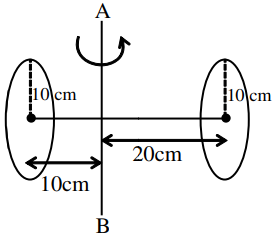
\( I=\frac{7}{5}[m_{1}R_{1}^{2}+m_{2}R_{2}^{2}] \)
\( =\frac{7}{5}[5(10)^{2}+10\times(20)^{2}]\times10^{-4} \)
\( I=63\times10^{-2}kg~m^{2} \)
\( I=0.63~kg~m^{2} \) -
- (A) \(35\)
- (B) \(70\)
- (C) \(140\)
- (D) \(210\)
Show answer and solution
Correct Answer: (B)
Let the mass of the original solid sphere be \(M\) and its radius be \(R\).
Mass of the smaller sphere, \(m_1 = \dfrac{M}{8}\).
Since the material remains the same, the density is constant. The volume is directly proportional to the mass.
\(\dfrac{4}{3}\pi r^3 = \dfrac{1}{8} \left(\dfrac{4}{3}\pi R^3\right) \Rightarrow r^3 = \dfrac{R^3}{8} \Rightarrow r = \dfrac{R}{2}\)
Moment of inertia of the smaller sphere about an axis through its centre is:
\(I_1 = \dfrac{2}{5} m_1 r^2 = \dfrac{2}{5} \left(\dfrac{M}{8}\right) \left(\dfrac{R}{2}\right)^2 = \dfrac{2}{5} \times \dfrac{M}{8} \times \dfrac{R^2}{4} = \dfrac{M R^2}{80}\)
Mass of the larger part (which is converted into a disc) is:
\(m_2 = M - \dfrac{M}{8} = \dfrac{7M}{8}\)
The radius of the disc is given as \(2R\). The moment of inertia of a disc about its diameter is:
\(I_2 = \dfrac{1}{4} m_2 (\text{radius})^2 = \dfrac{1}{4} \left(\dfrac{7M}{8}\right) (2R)^2 = \dfrac{1}{4} \times \dfrac{7M}{8} \times 4R^2 = \dfrac{7M R^2}{8}\)
The ratio of their moments of inertia is:
\(\dfrac{I_2}{I_1} = \dfrac{\dfrac{7M R^2}{8}}{\dfrac{M R^2}{80}} = \dfrac{7}{8} \times 80 = 70\)
Answer: \(70\) -
- (A) 265
- (B) 100
- (C) 325
- (D) 125
Show answer and solution
Correct Answer: (A)
Let radius of gyration is k
\( \Rightarrow mk^{2} = \frac{2}{5} mR^{2} + md^{2}\)
\(k^{2} = \frac{2}{3} \times 10^{2} + 15^{2} = 265\)
\((\sqrt{n})^{2} = 265 \Rightarrow n = 265\) -
- (A) \(0.128\pi\) Nm, \(100\)
- (B) \(0.0128\pi\) Nm, \(50\)
- (C) \(0.128\pi\) Nm, \(50\)
- (D) \(0.0128\pi\) Nm, \(100\)
Show answer and solution
Correct Answer: (D)
Initial angular velocity \(\omega_0 = 1200 \text{ rpm} = \dfrac{1200 \times 2\pi}{60} = 40\pi \text{ rad/s}\)
Final angular velocity \(\omega = 0\)
Time \(t = 10 \text{ s}\)
Angular acceleration \(\alpha = \dfrac{\omega - \omega_0}{t} = \dfrac{0 - 40\pi}{10} = -4\pi \text{ rad/s}^2\)
Moment of inertia of the solid sphere \(I = \dfrac{2}{5}MR^2 = \dfrac{2}{5} \times 5 \times (0.04)^2 = 0.0032 \text{ kg m}^2\)
Torque \(\tau = I|\alpha| = 0.0032 \times 4\pi = 0.0128\pi \text{ Nm}\)
Angle rotated \(\theta = \dfrac{\omega_0 + \omega}{2}t = \dfrac{40\pi + 0}{2} \times 10 = 200\pi \text{ rad}\)
Number of rotations \(N = \dfrac{\theta}{2\pi} = \dfrac{200\pi}{2\pi} = 100\)
Answer: \(0.0128\pi\) Nm, \(100\) -
- (A) \(\sqrt{\frac{3}{2} \frac{g}{ L }}\)
- (B) \(\frac{3}{\sqrt{2}}\sqrt{\frac{g}{L}}\)
- (C) \(\frac{1}{\sqrt{2}}\sqrt{\frac{g}{L}}\)
- (D) \(\sqrt{\frac{3g}{L}}\)
Show answer and solution
Correct Answer: (D)
Explanation:
To find the correct angular velocity of the rod when it hits the table top, we apply the law of conservation of mechanical energy step-by-step:
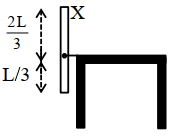
1. Determine the Center of Mass (CM) Position:
The center of mass of a thin uniform rod of length \( L \) lies at its geometric center, which is at a distance of \( \frac{L}{2} \) from either end.
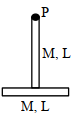
According to the figure, the pivot is located at a distance of \( \frac{L}{3} \) from the bottom end. Therefore, the distance (\( d \)) between the pivot and the center of mass is:
\( d = \frac{L}{2} - \frac{L}{3} = \frac{L}{6} \)
2. Calculate the Moment of Inertia (\( I \)) about the Pivot:
Using the parallel axis theorem (\( I = I_{\text{cm}} + Md^2 \)):
\( I = \frac{1}{12}ML^2 + M\left(\frac{L}{6}\right)^2 \)
\( I = \frac{1}{12}ML^2 + \frac{1}{36}ML^2 = \frac{3 + 1}{36}ML^2 = \frac{4}{36}ML^2 = \frac{1}{9}ML^2 \)
3. Calculate the Loss in Potential Energy (\( \Delta \text{PE} \)):
- In the initial vertical position, the center of mass is located at a height of \( \frac{L}{6} \) directly above the pivot point (table level).
- In the final horizontal position, the entire rod lies flat on the table, meaning its center of mass drops down to the exact level of the pivot.
Thus, the net vertical displacement of the center of mass is \( \Delta h = \frac{L}{6} \), giving a potential energy loss of:
\( \Delta \text{PE} = Mg\Delta h = Mg\left(\frac{L}{6}\right) \)
4. Apply Conservation of Energy:
The loss in potential energy is fully converted into rotational kinetic energy (\( \frac{1}{2}I\omega^2 \)):
\( \frac{1}{2}I\omega^2 = \Delta \text{PE} \)
\( \frac{1}{2}\left(\frac{1}{9}ML^2\right)\omega^2 = Mg\left(\frac{L}{6}\right) \)
\( \frac{1}{18}ML^2\omega^2 = \frac{1}{6}MgL \)
Simplifying the equation to solve for \( \omega \):
\( \omega^2 = \frac{18}{6}\frac{g}{L} = \frac{3g}{L} \)
\( \omega = \sqrt{\frac{3g}{L}} \)
The mathematical derivation confirms that the provided answer key is completely accurate.
Hence, Option D is the correct choice. -
- (A) 33
- (B) \( 2\sqrt{88} \)
- (C) 66
- (D) 32
Show answer and solution
Correct Answer: (A)
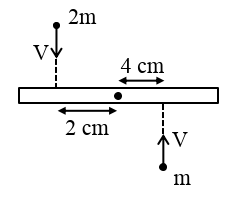
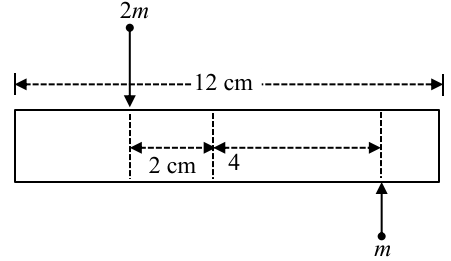
Using angular momentum conservation about COM of rod:
\( L_{i}=L_{f} \)
\( m\times V\times4+2m\times V\times2=(\frac{20m(12)^{2}}{12}+m\times4^{2}+2m\times2^{2})\omega \)
\( 8mV=(240m+24m)\omega \)
\( 8V=264 \omega \)
\( \frac{V}{\omega}=33 \) -
- (A) mg/2
- (B) mg/4
- (C) mg/3
- (D) mg
Show answer and solution
Correct Answer: (B)
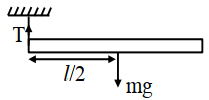
\(mg \frac{l}{2}=\frac{ m l^2}{3} \alpha\)
\(\alpha=\frac{3 g}{2 l}\)...(1)
\(mg - T = ma _{ c }\)
\(T = mg - ma _{ c }\)
\(= mg - m \left(\frac{l}{2} \alpha\right)\)
\(= mg - m \left(\frac{l}{2} \cdot \frac{3 g}{2 l}\right)\)
\(T =\frac{ mg }{4}\) -
- (A) 162
- (B) 81
- (C) 54
- (D) 27
Show answer and solution
Correct Answer: (A)
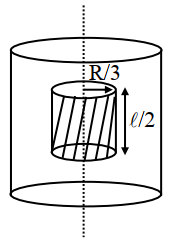
Original mass (M)
The removed mass (m)
\(m=\rho \times \pi\left(\frac{ R }{3}\right)^2 \times \frac{ L }{2}\)
\(=\frac{\rho \cdot \pi R ^2 L}{18}=\frac{ M }{18}\)
\(I ^{\prime}=\frac{1}{2} \cdot \frac{ M }{18} \cdot \frac{ R ^2}{9}=\frac{1}{324} MR ^2\)
\(\frac{ I }{ I ^{\prime}}=\frac{\frac{1}{2} MR ^2}{\frac{1}{324} MR ^2}=162\) -
- (A) \(6\)
- (B) \(3\)
- (C) \(4\)
- (D) \(\dfrac{1}{3}\)
Show answer and solution
Correct Answer: (B)
Using the equation of rotational kinematics \(\theta = \omega_0 t + \dfrac{1}{2} \alpha t^2\).
Since the wheel is initially at rest, \(\omega_0 = 0\).
Angle rotated in the first \(2\text{ s}\):
\(\theta_1 = \dfrac{1}{2} \alpha (2)^2 = 2\alpha\)
Angle rotated in the first \(4\text{ s}\):
\(\theta_{total} = \dfrac{1}{2} \alpha (4)^2 = 8\alpha\)
Angle rotated in the next \(2\text{ s}\):
\(\theta_2 = \theta_{total} - \theta_1 = 8\alpha - 2\alpha = 6\alpha\)
The ratio is:
\(\dfrac{\theta_2}{\theta_1} = \dfrac{6\alpha}{2\alpha} = 3\)
Answer: \(3\) -
- (A) Both Statement I and Statement II are true
- (B) Statement I is true but Statement II is false
- (C) Statement I is false but Statement II is true
- (D) Both Statement I and Statement II are false
Show answer and solution
Correct Answer: (A)
\( KE=\frac{1}{2}m_{1}v_{1}^{2}+\frac{1}{2}m_{2}v_{2}^{2} \)
\( KE=\frac{1}{2}(m_{1}+m_{2})v_{cm}^{2}+\frac{1}{2}\frac{m_{1}m_{2}}{m_{1}+m_{2}}|\vec{v}_{1}-\vec{v}_{2}|^{2} \)
So Ans. is (1) -
- (A) 10
- (B) 15
- (C) 20
- (D) 25
Show answer and solution
Correct Answer: (B)
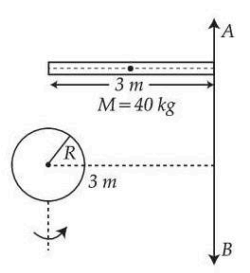
Moment of inertia of the rod about axis \(AB\) passing through one of its ends:
\(I_{\text{rod}} = \dfrac{ML^2}{3} = \dfrac{40 \times (3)^2}{3} = \dfrac{40 \times 9}{3} = 120\text{ kg}\cdot\text{m}^2\)
Moment of inertia of the solid sphere about the same axis \(AB\), using the parallel axis theorem \(I = I_{\text{cm}} + md^2\):
Mass \(m = 10\text{ kg}\), radius \(R\), distance from the centre of the sphere to axis \(AB\) is \(d = 3\text{ m}\).
\(I_{\text{sphere}} = \dfrac{2}{5}mR^2 + md^2 = \dfrac{2}{5}(10)R^2 + 10(3)^2 = 4R^2 + 90\)
Equating the two moments of inertia:
\(120 = 4R^2 + 90\)
\(4R^2 = 30\)
\(R^2 = \dfrac{15}{2}\)
\(R = \sqrt{\dfrac{15}{2}}\)
Comparing with \(R = \sqrt{\dfrac{\alpha}{2}}\):
\(\alpha = 15\)
Hence, \(\alpha = 15\). -
- (A) 100
- (B) 109
- (C) 128
- (D) 156
Show answer and solution
Correct Answer: (B)
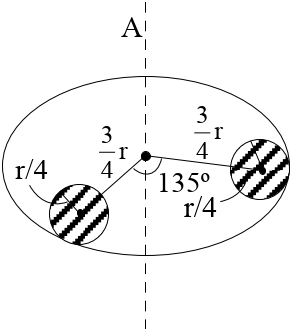
\(M =\sigma \pi R ^2\)
\(\sigma \pi R ^2=16 m\)
\(m =\frac{\sigma \pi R ^2}{16}\)
\(I _{\text {system }}=\frac{ MR ^2}{2}-2\left(\frac{ mR ^2}{2 \times 16}+\frac{9 mR ^2}{16}\right)\)
\(=\frac{ MR ^2}{2}-2 \times \frac{19 mR ^2}{32}\)
\(=\frac{ MR ^2}{2}-\frac{19}{16} mR ^2\)
\(=\frac{ MR ^2}{2}-\frac{19}{256} MR ^2 \quad\)becoz \(m =\frac{ M }{16}\)
\(=\frac{(128-19)\left( MR ^2\right)}{256}\)
\(=\frac{109 MR ^2}{256}\) -
- (A) \( \frac{3}{8}MR^{2}+\frac{7}{12}ML^{2} \)
- (B) \( \frac{3}{4}MR^{2}+\frac{1}{6}ML^{2} \)
- (C) \( \frac{3}{4}MR^{2}+\frac{7}{12}ML^{2} \)
- (D) \( \frac{3}{8}MR^{2}+\frac{1}{6}ML^{2} \)
Show answer and solution
Correct Answer: (D)
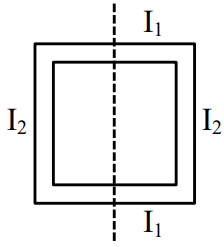
\(I _{ net }=2\left( I _1+ I _2\right)\)
\(=2\left(\frac{ M ^{\prime} R ^2}{4}+\frac{ M ^{\prime} \ell^2}{12}\right)+2\left(\frac{ M ^{\prime} R ^2}{2}+ M ^{\prime}\left(\frac{\ell}{2}\right)^2\right)\)
\(=\frac{M^{\prime} R^2}{2}+\frac{M^{\prime} R^2}{6}+M^{\prime} R^2+\frac{M^{\prime} \ell^2}{2}\)
\(=\frac{3 M ^{\prime} R ^2}{2}+\frac{2 M ^{\prime} \ell^2}{3}\)
Given masses \(M ^{\prime}=\frac{ M }{4}\)
So, \(I=\frac{3(M / 4) R^2}{2}+2 \frac{(M / 4) \ell^2}{3}\)
\(I =\frac{3}{8} MR ^2+\frac{ M \ell^2}{6}\) -
- (A) \(\left(\dfrac{\sqrt{3}}{4}, 1.25\right)\)
- (B) \(\left(\dfrac{\sqrt{3}}{4}, 1.0\right)\)
- (C) \((0, 0)\)
- (D) \((1.25, 0)\)
Show answer and solution
Correct Answer: (A)
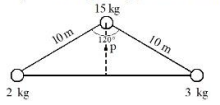
Let the midpoint \(p\) of the normal bisector be the origin \((0,0)\).
The triangle is isosceles with two sides of \(10\text{ m}\) and an included angle of \(120^\circ\). The altitude from the \(15\text{ kg}\) mass bisects the angle into two \(60^\circ\) angles.
The length of the altitude is \(10 \cos(60^\circ) = 5\text{ m}\).
Since \(p\) is the midpoint of this altitude, the \(15\text{ kg}\) mass is at a distance of \(2.5\text{ m}\) above \(p\), and the base is \(2.5\text{ m}\) below \(p\).
The distance of the \(2\text{ kg}\) and \(3\text{ kg}\) masses from the altitude is \(10 \sin(60^\circ) = 5\sqrt{3}\text{ m}\).
The coordinates of the masses with respect to \(p\) are:
\(m_1 = 15\text{ kg}\) at \((0, 2.5)\)
\(m_2 = 2\text{ kg}\) at \((-5\sqrt{3}, -2.5)\)
\(m_3 = 3\text{ kg}\) at \((5\sqrt{3}, -2.5)\)
The x-coordinate of the center of mass is:
\(x_{cm} = \dfrac{m_1 x_1 + m_2 x_2 + m_3 x_3}{m_1 + m_2 + m_3} = \dfrac{15(0) + 2(-5\sqrt{3}) + 3(5\sqrt{3})}{15 + 2 + 3} = \dfrac{5\sqrt{3}}{20} = \dfrac{\sqrt{3}}{4}\)
The y-coordinate of the center of mass is:
\(y_{cm} = \dfrac{m_1 y_1 + m_2 y_2 + m_3 y_3}{m_1 + m_2 + m_3} = \dfrac{15(2.5) + 2(-2.5) + 3(-2.5)}{20} = \dfrac{37.5 - 12.5}{20} = \dfrac{25}{20} = 1.25\)
The position of the center of mass is \(\left(\dfrac{\sqrt{3}}{4}, 1.25\right)\).
Answer: \(\left(\dfrac{\sqrt{3}}{4}, 1.25\right)\) -
- (A) \(\frac{(M-m) g}{\left[\left(\frac{13}{6}\right) M+m\right]}\)
- (B) \(\frac{( M - m ) g }{ M + m }\)
- (C) \(\frac{( M - m ) g }{\left[\left(\frac{8}{3}\right) M + m \right]}\)
- (D) \(\frac{( M - m ) g }{2 M + m }\)
Show answer and solution
Correct Answer: (C)
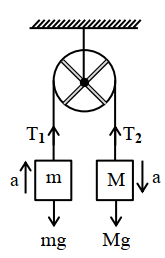
\(Mg - T _2= Ma\)\(\quad\)...(1)
\(T _1- mg = ma\)\(\quad\)...(2)
\(\left( T _2- T _1\right) r = I \frac{ a }{ r }\)\(\quad\)...(3)
\((1)+(2)+(3)\)
\((M-m) g=\left(M+m+\frac{I}{r^2}\right) a\)
Here \(I= Mr ^2+\frac{ M \times(2 r )^2}{12} \times 2\)
\(=\left(1+\frac{2}{3}\right) Mr ^2\)
\(=\frac{5}{3} Mr ^2\)
\((M-m) g=\left[M+m+\frac{5 M}{3}\right] a\)
\(a=\frac{(M-m) g}{\left[M+m+\frac{5 M}{3}\right]}\) -
- (A) \(3.33\)
- (B) \(3.12\)
- (C) \(2.22\)
- (D) \(1.42\)
Show answer and solution
Correct Answer: (C)
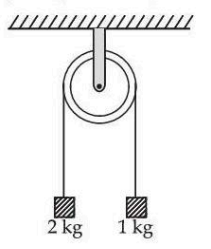
The acceleration of the blocks in the Atwood machine is given by:
\(a = \dfrac{m_1 - m_2}{m_1 + m_2} g\)
Substituting the given values (\(m_1 = 2\) kg, \(m_2 = 1\) kg):
\(a = \dfrac{2 - 1}{2 + 1} g = \dfrac{g}{3}\)
Taking the downward direction as positive, the acceleration of the \(2\) kg block is \(a_1 = \dfrac{g}{3}\) and the acceleration of the \(1\) kg block is \(a_2 = -\dfrac{g}{3}\).
The acceleration of the centre of mass is:
\(a_{cm} = \dfrac{m_1 a_1 + m_2 a_2}{m_1 + m_2}\)
\(a_{cm} = \dfrac{2 \left(\dfrac{g}{3}\right) + 1 \left(-\dfrac{g}{3}\right)}{2 + 1} = \dfrac{\dfrac{g}{3}}{3} = \dfrac{g}{9}\)
Since the system is released from rest, the initial velocity of the centre of mass is zero.
The distance traversed by the centre of mass in \(t = 2\) s is:
\(S_{cm} = \dfrac{1}{2} a_{cm} t^2\)
\(S_{cm} = \dfrac{1}{2} \left(\dfrac{10}{9}\right) (2)^2 = \dfrac{20}{9} \approx 2.22 \text{ m}\)
Answer: \(2.22\) -
- (A) \( 3.6\times10^{5} \)
- (B) \( 10^{5} \)
- (C) \( 3\times10^{5} \)
- (D) \( 2\times10^{5} \)
Show answer and solution
Correct Answer: (B)
\( L=m.V_{rel}r_{\perp} \)
\( =1000\times(36\times\frac{5}{18})\times10 \)
\( =10^{5}kg~m^{2}/s \) -
- (A) 22
- (B) 11
- (C) 100
- (D) 27
Show answer and solution
Correct Answer: (B)
\(\alpha = \frac{\tau}{I}\)
\(I =\frac{1}{4} mR ^2+ mR ^2+\frac{1}{4} mR ^2+ m (2 R )^2+\frac{ m (3 R )^2}{12}+ m \left(\frac{ R }{2}\right)^2\)
\(=\left(\frac{3}{2}+4+1\right) mR ^2=\frac{13}{2} mR ^2=\frac{13}{2} \times 600 \times 10^2=39 \times 10^4\)
\(\alpha=\frac{43 \times 10^5}{39 \times 10^4} rad / s ^2=\frac{430}{39} rad / s ^2 \approx 11 rad / s ^2\) -
- (A) circular
- (B) parabolic
- (C) straight line
- (D) elliptical
Show answer and solution
Correct Answer: (C)
Velocity of the centre of mass is given by:
\(\vec{v}_{cm} = \dfrac{m_1\vec{v}_1 + m_2\vec{v}_2}{m_1 + m_2}\)
Since \(m_1 = m_2 = m\), we get:
\(\vec{v}_{cm} = \dfrac{m(4\hat{i}) + m(4\hat{j})}{2m} = 2\hat{i} + 2\hat{j}\) m/s
Acceleration of the centre of mass is given by:
\(\vec{a}_{cm} = \dfrac{m_1\vec{a}_1 + m_2\vec{a}_2}{m_1 + m_2}\)
\(\vec{a}_{cm} = \dfrac{m(6\hat{i} + 6\hat{j}) + 0}{2m} = 3\hat{i} + 3\hat{j}\) m/s\(^2\)
Here, \(\vec{v}_{cm} = 2(\hat{i} + \hat{j})\) and \(\vec{a}_{cm} = 3(\hat{i} + \hat{j})\).
Since the initial velocity and acceleration of the centre of mass are parallel to each other, the centre of mass moves in a straight line path.
Answer: straight line -
- (A) 12
- (B) 17
- (C) 13
- (D) 15
Show answer and solution
Correct Answer: (B)
\(I =\frac{ ML ^2}{3}+\left(\frac{ ML ^2}{12}+ ML ^2\right)\)
\(=\frac{4 ML ^2+ ML ^2+12 ML ^2}{12}\)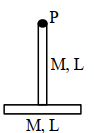
\(I =\frac{17}{12} ML ^2\)
\(\therefore \quad x =17\) -
- (A) \( 9.5\times10^{-3} \)
- (B) \( 4.75\times10^{-3} \)
- (C) \( 1.86\times10^{-2} \)
- (D) \( 8.3\times10^{-3} \)
Show answer and solution
Correct Answer: (A)
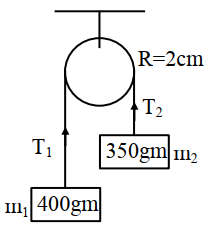
\(S=u t+\frac{1}{2} a t^2\)
\(a =\frac{2 s}{ t ^2}=\frac{2 \times 0.81}{81}=0.02 m / s ^2\)
\(m _1 g- T _1= m _1 a\)
\(T _2- m _2 g= m _2 a\)
\(\left( T _1- T _2\right) R = I \cdot \frac{ a }{ R }\)
\(\therefore a=\frac{\left(m_1-m_2\right) g}{m_1+m_2+\frac{I}{R^2}}\)
\(0.02=\frac{(400-350)\left(10^{-3}\right) g }{(400+350)\left(10^{-3}\right)+\frac{ I }{ R ^2}}\)
\(\frac{ I }{ R ^2}=\frac{50 \times 10^{-3} g}{0.02}-750 \times 10^{-3}=23.75\)
\(I =23.75 \times 4 \times 10^{-4}=9.5 \times 10^{-3} kg- m ^2\) -
- (A) 1
- (B) 2
- (C) 3
- (D) 4
Show answer and solution
Correct Answer: (B)
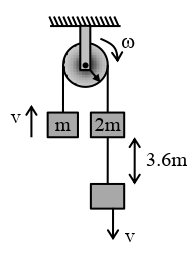
Using energy conservation
\( \frac{1}{2}mv^{2}+\frac{1}{2}2mv^{2}+\frac{1}{2}\frac{30mR^{2}}{2}\times\frac{v^{2}}{R^{2}}=mgh \)
\( 9\,mv^{2}=mgh \)
\( v=\sqrt{\frac{gh}{9}}=\sqrt{\frac{10\times3.6}{9}} \)
\( v=\sqrt{4}=2\,m/s \) -
- (A) \( \frac{3}{2}\frac{L}{md^{2}} \)
- (B) \( \frac{2L}{md^{2}} \)
- (C) \( \frac{4}{3}\frac{L}{md^{2}} \)
- (D) \( \frac{2L}{5md^{2}} \)
Show answer and solution
Correct Answer: (A)
\(L = I \omega\) and \(\omega=\frac{ L }{ I }\)
\(\omega=\frac{L}{m\left(\frac{2 d}{3}\right)^2+2 m\left(\frac{d}{3}\right)^2}=\frac{L}{\frac{4}{9} m d^2+\frac{2}{9} m d^2}=\frac{L}{\frac{6 m d^2}{9}}\)
\(\omega=\frac{3 L}{2 md ^2}\) -
- (A) Linear momentum
- (B) Velocity
- (C) Acceleration
- (D) Angular momentum
Show answer and solution
Correct Answer: (D)
\(\vec{r}=x\hat{i}+y\hat{j}+z\hat{k}\)
\(\vec{v}=\frac{d\vec{r}}{dt}=v_{x}\hat{i}+v_{y}\hat{j}+v_{z}\hat{k}\)
\(\vec{p}=m\vec{v}\)
\(\overline{L}=m(\vec{r}\times\vec{v})\)
\(=(x\hat{i}+y\hat{j}+z\hat{k})\times m(v_{x}\hat{i}+v_{y}\hat{j}+v_{z}\hat{k})\)
When sign of \(\vec{r}\) changes, \(\overrightarrow{ L }\) remains same.
No questions on this page match these filters.