


Chapters asked in 2025
26 chapters- 22Qs STD 11 Organic chemistry purification and characterization
- 28Qs STD 12 D and f- block elements Most asked
- 6Qs STD 11 Redox reactions
- 17Qs STD 12 Biomolecules
- 15Qs STD 11 Equilibrium - II (icon Equilibrium)
- 21Qs STD 12 Chemical kinetics
- 7Qs STD 11 Organic chemistry reaction mechanism
- 14Qs STD 12 Amines
- 7Qs STD 12 Carboxylic acids and their derivative
- 8Qs STD 12 Aldehydes and ketones
- 6Qs STD 12 Alcohol, phenol and ethers
- 6Qs STD 12 Haloalkanes and Haloarenes
- 9Qs STD 11 Organic chemistry isomerism
- 31Qs STD 12 Co-ordination chemistry Most asked
- 9Qs STD 12 P -Block elements - ll
- 23Qs STD 12 Electrochemistry
- 29Qs STD 12 Solution and colligative properties Most asked
- 14Qs STD 11 Some basic concept of chemistry
- 10Qs STD 11 Hydricarbon
- 3Qs STD 11 Organic chemistry Nomenclature of organic compounds
- 18Qs STD 11 Chemical bonding and molecular structure
- 17Qs STD 11 Classification of elements and periodicity in properties
- 12Qs STD 11 Equilibrium - 1 (chemical Equilibrium)
- 27Qs STD 11 Thermodynamics and thermochemistry
- 5Qs STD 11 P-Block elements - I
- 17Qs STD 11 Structure of atom
All JEE Mains 2025 Chemistry questions
26 chaptersShowing 1–50 of 381 questions
-
- (A) 20
- (B) 40
- (C) 60
- (D) 80
Show answer and solution
Correct Answer: (D)
Organic Compound\(\rightarrow \mathrm{CO}_2\)
Applying POAC on ' C ' (mole) of ' C ' in compound \(=\mathrm{n}_{\mathrm{CO}_2} \times 1\)
So mass of ' C ' in compound \(=\frac{1.46}{44} \times 12\)
So, \(\%\) of ' C ' in compound \(=\frac{1.46}{44} \times \frac{12}{0.5} \times 100\)
\(=79.63\) -
- (A) 14
- (B) 16
- (C) 12
- (D) 10
Show answer and solution
Correct Answer: (C)
Organic compound \(\xrightarrow[\Delta]{\mathrm{CuO}} \mathrm{CO}_2+\mathrm{H}_2 \mathrm{O}\)
\(\begin{aligned} & \mathrm{n}_{\mathrm{CO}_2}=\frac{220 \times 10^{-3}}{44}=5 \times 10^{-3} \mathrm{moles} \\ & \mathrm{m}_{\mathrm{C}}=5 \times 10^{-3} \times 12\end{aligned}\)
\(\% \mathrm{~m}\) carbon \(=\frac{5 \times 10^{-3} \times 12}{500 \times 10^{-3}} \times 100=12 \%\)
Correct answer is \(12\) -
- (A) A, D and E only
- (B) B, D and E only
- (C) A, B and C only
- (D) C, D and E only
Show answer and solution
Correct Answer: (C)
\(2 \mathrm{CuSO}_4+\mathrm{K}_4\left[\mathrm{Fe}(\mathrm{CN})_6\right] \xrightarrow{\mathrm{CH}_3 \mathrm{COOH}}\underset{\text{(Chocolate brown ppt.)}}{\mathrm{Cu}_2\left[\mathrm{Fe}(\mathrm{CN})_6\right]+2 \mathrm{~K}_2 \mathrm{SO}_4}\)
\(4 \mathrm{FeCl}_3+3 \mathrm{~K}_4\left[\mathrm{Fe}(\mathrm{CN})_6\right] \longrightarrow \underset{\text { (Prussian Blue ppt.) }}{\mathrm{Fe}_4\left[\mathrm{Fe}(\mathrm{CN})_6\right]_3}+12 \mathrm{KCl}\)
\(3 \mathrm{ZnCl}_4+2 \mathrm{~K}_4\left[\mathrm{Fe}(\mathrm{CN})_6\right] \xrightarrow{\mathrm{NH}_4 \mathrm{OH}} \underset{\text { (White or bluish white ppt.) }}{\mathrm{K}_2 \mathrm{Zn}_3\left[\mathrm{Fe}(\mathrm{CN})_6\right]_2}+6 \mathrm{KCl}\) -
- (A) B and D Only
- (B) D and E Only
- (C) C, D and E Only
- (D) A, C and D Only
Show answer and solution
Correct Answer: (D)
The primary standard is a highly pure stable compound with a known exact composition that can be accurately weighed and dissolved to creat a solution of known concentration.
NaOH is hygroscopic and can't be used.
\(\mathrm{FeSO}_4 \cdot 6 \mathrm{H}_2 \mathrm{O}\) is unstable and can be easily oxidised.
\(\mathrm{Na}_2 \mathrm{Cr}_2 \mathrm{O}_7\) is hygroscopic and can't be used. -
- (A) 111
- (B) 222
- (C) 333
- (D) 444
Show answer and solution
Correct Answer: (A)
M.wt. of given compound \(=86\)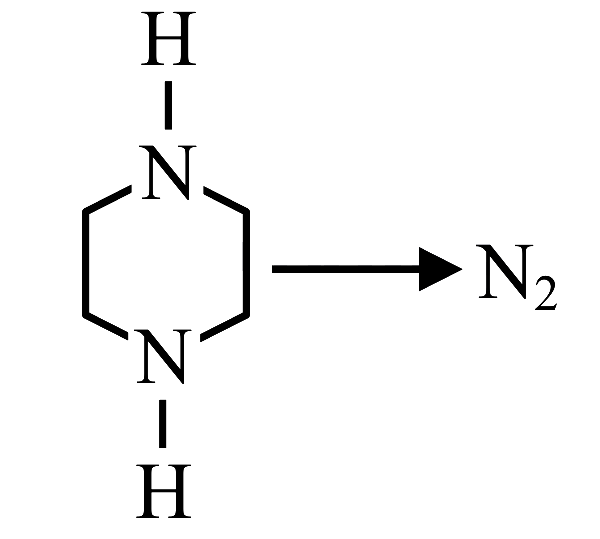
Applying POAC on ' N '
\(\begin{aligned}
& \mathrm{n}_{\mathrm{X}} \times 2=\mathrm{n}_{\mathrm{N}_2} \times 2 \\
& \frac{0.42}{86}=\mathrm{n}_{\mathrm{N}_2} \\
& \Rightarrow(\text { Volume })_{\mathrm{N}_2} \text { at } \mathrm{STP}=\frac{0.42}{86} \times 22.4 \mathrm{~L} \\
& =0.1108 \mathrm{~L}=110.8 \mathrm{~m} \ell
\end{aligned}\) -
- (A) 10
- (B) 20
- (C) 30
- (D) 40
Show answer and solution
Correct Answer: (D)
\(\begin{aligned} & \mathrm{m} \text { mole of } \mathrm{BaSO}_4=\text { mmoles of } \mathrm{S}=\frac{466}{233} \\ & \text { Mass of } \mathrm{S}=\frac{466}{233} \times 32 \mathrm{mg} \\ & =64 \mathrm{mg} \\ & \% \mathrm{~S}=\frac{64}{160} \times 100=40 \%\end{aligned}\) -
- (A) Statement I is true but Statement II is false
- (B) Both Statement I and Statement II are false
- (C) Statement I is false but Statement II is true
- (D) Both Statement I and Statement II are true
Show answer and solution
Correct Answer: (A)
In Dumas method nitrogen present in organic compound is converted into \(\mathrm{N}_2\) gas whose volumetric analysis gives the percentage of nitrogen atom in the organic compound. -
- (A) Statement I is true but Statement II is false
- (B) Statement I is false but Statement II is true
- (C) Both Statement I and Statement II are false
- (D) Both Statement I and Statement II are true
Show answer and solution
Correct Answer: (A)
Statement \(I\) is true.
In partition chromatography, stationary phase is thin liquid film present in the inert support.
Statement II is false.
Because stationary phase in paper chromatography is water. -
- (A) Statement I is true but Statement II is false
- (B) Both Statement I and Statement II are false
- (C) Both Statement I and Statement II are true
- (D) Statement I is false but Statement II is true
Show answer and solution
Correct Answer: (A)
Lassaigne's test is a general test for detection of halogen, nitrogen and sulphur in an organic compound. These elements covalently bonded to the organic compounds, In order to detect them, these have to converted into ionic forms.
-
- (A) Statement I is false but Statement II is true
- (B) Both Statement I and Statement II are true
- (C) Both Statement I and Statement II are false
- (D) Statement I is true but Statement II is false
Show answer and solution
Correct Answer: (D)
The elements present in the compound are converted from covalent form into ionic form by fusing the compound with sodium in Lassigne's test -
- (A) 20
- (B) 40
- (C) 60
- (D) 80
Show answer and solution
Correct Answer: (A)
\(\begin{aligned} & \mathrm{n}_{\mathrm{Cl}}=\mathrm{n}_{\mathrm{AgCl}}=\frac{143.5 \times 10^{-3}}{143.5}=10^{-3} \\ & \% \mathrm{Cl}=\frac{10^{-3} \times 35.5}{180 \times 10^{-3}} \times 100=19.72\end{aligned}\) -
- (A) 250
- (B) 255
- (C) 260
- (D) 665
Show answer and solution
Correct Answer: (B)
Mass of organic compound \(=0.25 \mathrm{~g}\)
Mass of \(\mathrm{AgBr}=0.15 \mathrm{~g}\)
No. of moles of \(\mathrm{Br}=\) No. of moles of \(\mathrm{AgBr}=\frac{0.15}{188}\)
\(\begin{aligned}
& \text { Mass of } \mathrm{Br}=\frac{0.15 \times 80}{188} \mathrm{~g} \\
& \% \text { of } \mathrm{Br}=\frac{0.15 \times 80 \times 100}{188 \times 0.25} \\
& =25.5 \% \\
& =255 \times 10^{-1} \%
\end{aligned}\) -
- (A) 20
- (B) 18
- (C) 16
- (D) 14
Show answer and solution
Correct Answer: (B)
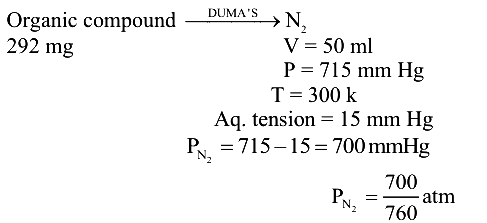
\(\begin{aligned} & \mathrm{n}_{\mathrm{N}_2}=\frac{\mathrm{P}_{\mathrm{N}_2} \cdot \mathrm{~V}}{\mathrm{RT}} \\ & \mathrm{n}_{\mathrm{N}_2}=\frac{700}{760} \times \frac{50}{1000} \times \frac{1}{0.0821 \times 300} \\ & \mathrm{n}_{\mathrm{N}}=2 \times \mathrm{n}_{\mathrm{N}_2} \\ & \text { Mass of } \mathrm{N}=2 \times \mathrm{n}_{\mathrm{N}} \times 14 \\ & \% \mathrm{~N}=\frac{\text { mass of } \mathrm{N}}{\text { mass of organic compound }} \times 100 \\ & \% \mathrm{~N}=\frac{700}{760} \times \frac{50}{1000} \times \frac{2 \times 14}{0.0821 \times 300} \times \frac{1000}{292} \times 100 \\ & \% \mathrm{~N}=18 \%\end{aligned}\) -
- (A) \(15.71 \%\)
- (B) \(20.95 \%\)
- (C) \(17.46 \%\)
- (D) \(7.85 \%\)
Show answer and solution
Correct Answer: (A)
\(\text { Pressure of }
\mathrm{N}_2 \text { gas evolved } =715-15 \\
=700 \mathrm{~mm} \mathrm{Hg} \\
=\frac{700}{760} \mathrm{~atm}.
\)
\(\begin{aligned}
\therefore \text { Mole of } \mathrm{N}_2 \text { evolved } & =\frac{\mathrm{PV}}{\mathrm{RT}} \\
& =\frac{700 \times 60 \times 10^{-3}}{760 \times 0.0821 \times 300} \\
& =0.0022 \mathrm{~mole}
\end{aligned}\)
\(\therefore \mathrm{wt}. \%\) of nitrogen in compound
\(\begin{aligned}
& =\frac{\text { wt. of nitrogen }}{\text { wt. of compound }} \times 100 \\
& =\frac{0.063}{0.4} \times 100 \\
& =15.71 \%
\end{aligned}\) -
- (A) 1.257
- (B) 20.87
- (C) 18.67
- (D) 12.57
Show answer and solution
Correct Answer: (D)
\(\begin{aligned} & \text { Pressure of } \mathrm{N}_2 \text { gas }=(715-15) \\ & \begin{array}{l}=700 \mathrm{mmHg} \\ \mathrm{n}_{\mathrm{N}_2}=\frac{\mathrm{PV}}{\mathrm{RT}} \\ \mathrm{n}_{\mathrm{N}_2}=\frac{700 \times 60 \times 10^{-3}}{760 \times 0.0821 \times 300} \\ \quad=2.24 \times 10^{-3} \mathrm{~mol}\end{array} \\ & \begin{array}{r}\text { Mass of } \mathrm{N}_2=2.24 \times 10^{-3} \times 28 \mathrm{~g} \\ \quad=0.06272 \mathrm{~g}\end{array} \\ & \begin{array}{r}\% \mathrm{~N}_2=\frac{0.06272}{0.5} \times 100 \simeq 12.57\end{array}\end{aligned}\) -
- (A) 22
- (B) 24
- (C) 20
- (D) 18
Show answer and solution
Correct Answer: (C)
Partial pressure of \(\mathrm{N}_2=(900-15)=885 \mathrm{~mm} \mathrm{Hg}\)
Mole of \(\mathrm{N}_2=\frac{\left(\frac{885}{760} \times 0.15\right)}{(0.0821 \times 300)}=0.0071\)
Moles \(\%\) of nitrogen in organic compound
\(\begin{aligned}
& =\frac{(0.0071 \times 28)}{1} \times 10 \\
& =19.85 \%
\end{aligned}\) -
- (A) 250
- (B) 275
- (C) 300
- (D) 325
Show answer and solution
Correct Answer: (B)
\(\begin{array}{ll}\text { Organic Compound } \longrightarrow & \mathrm{BaSO}_4 \\ 0.20 \mathrm{gm} & 0.40 \mathrm{gm} \\ & \frac{0.40}{233} \mathrm{~mol}\left(\mathrm{BaSO}_4\right) \\ & \frac{0.40}{233} \mathrm{~mol} \text { (Sulphur) } \\ & \frac{0.40}{233} \times 32 \mathrm{gm} \text { (sulphur) }\end{array}\)
\(\% \mathrm{~S}=\frac{\frac{0.40 \times 32}{233} \times 100}{0.20}=27.5 \%\) or \(275 \times 10^{-1} \%\) -
- (A) (A)-(II), (B)-(III), (C)-(IV), (D)-(I)
- (B) (A)-(II), (B)-(IV), (C)-(I), (D)-(III)
- (C) (A)-(III), (B)-(IV), (C)-(II), (D)-(I)
- (D) (A)-(III), (B)-(I), (C)-(IV), (D)-(II)
Show answer and solution
Correct Answer: (D)
List-I (Purification technique) List-II (Mixture of organic compounds) (A) Distillation (simple) (III) Chloroform + Aniline (B) Fractional distillation (I) Diesel + Petrol (C) Distillation under reduced pressure (IV) Glycerol + Spent-lye (D) Steam distillation (II) Aniline + Water -
- (A) (A)-(IV), (B)-(III), (C)-(II), (D)-(I)
- (B) (A)-(I), (B)-(II), (C)-(III), (D)-(IV)
- (C) (A)-(III), (B)-(IV), (C)-(I), (D)-(II)
- (D) (A)-(II), (B)-(I), (C)-(IV), (D)-(III)
Show answer and solution
Correct Answer: (A)
(A) Aniline \(-\mathrm{H}_2 \mathrm{O}\) : Steam Distillation
(B) Glycerol from spent-lye in soap industry - Distillation under reduced pressure
(C) Different fraction of crude oil in petroleum industry - Fractional distillation
(D) \(\mathrm{CHCl}_3-\) Aniline - Simple distillation -
- (A) A-II, B-III, C-IV, D-I
- (B) A-II, B-III, C-I, D-IV
- (C) A-III, B-II, C-IV, D-I
- (D) A-II, B-IV, C-III, D-I
Show answer and solution
Correct Answer: (A)
(1) Carboxylic acid gives efferve scence with sodium bicarbonate solution
(2) Phenolic-OH gives voilet coloured complex with Neutral \(\mathrm{FeCl}_3\).
(3) Alcoholic-OH gives Red colour with cerric ammonium Nitrate.
(4) When alkaline \(\mathrm{KMnO}_4\) reacts with an unsaturated compound (Alkene or alkyne) the purple colour of \(\mathrm{KMnO}_4\) solution disappears, indicating positive test for unsaturation. -
- (A) Distillation
- (B) Extraction
- (C) Sublimation
- (D) Crystallization
Show answer and solution
Correct Answer: (C)
Phase transfer from solid to vapour directly is known as sublimation. -
- (A) \(\mathrm{X}=\mathrm{NH}_3\) and \(\mathrm{Y}=\mathrm{HgO}\)
- (B) \(\mathrm{X}=\mathrm{NH}_3\) and \(\mathrm{Y}=\mathrm{K}_2 \mathrm{HgI}_4+\mathrm{KOH}\)
- (C) \(\mathrm{X}=\mathrm{NH}_4 \mathrm{Cl}\) and \(\mathrm{Y}=\mathrm{KOH}\)
- (D) \(\mathrm{X}=\mathrm{HCl}\) and \(\mathrm{Y}=\mathrm{NH}_4 \mathrm{Cl}\)
Show answer and solution
Correct Answer: (B)
\(\mathrm{NH}_4^{+}+\mathrm{NaOH} \longrightarrow \mathrm{H}_2 \mathrm{O}+\mathrm{NH}_3 \uparrow\)
\(\mathrm{NH}_4^{+}+\mathrm{NaOH} \longrightarrow \mathrm{H}_2 \mathrm{O}+\mathrm{NH}_3 \uparrow\)
\(\mathrm{NH}_3\) is identify by \(\mathrm{K}_2\left[\mathrm{HgI}_4\right]+\mathrm{KOH}\) -
- (A) 4
- (B) 5
- (C) 6
- (D) 7
Show answer and solution
Correct Answer: (A)
Sc Mn Co Cu Enthalpy of Atomisation (kJ/mole) 326 281 425 339 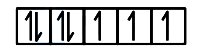
\(\begin{aligned}
& \mathrm{n}=3 \\
& \mu=\sqrt{15}=3.87
\end{aligned}\)
Nearest integer \(=4\) -
- (A) 5
- (B) 6
- (C) 7
- (D) 8
Show answer and solution
Correct Answer: (B)
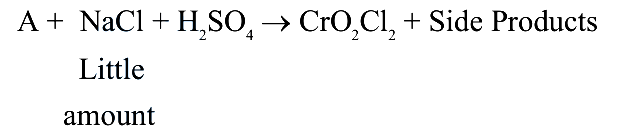
\(\begin{aligned} & \mathrm{Cr}_2 \mathrm{O}_7^{2-}+\mathrm{NaCl}+\mathrm{H}_2 \mathrm{SO}_4 \rightarrow \mathrm{CrO}_2 \mathrm{Cl}_2 \\ & \mathrm{CrO}_2 \mathrm{Cl}_2(\text { Vapour })+\mathrm{NaOH} \rightarrow \mathrm{Na}_2 \mathrm{CrO}_4+\mathrm{NaCl}+\mathrm{H}_2 \mathrm{O}\end{aligned}\)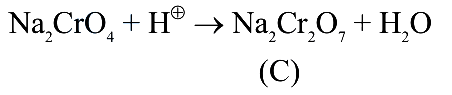
\(\mathrm{Na}_2 \mathrm{Cr}_2 \mathrm{O}_7 \rightarrow 2 \mathrm{Na}^{\oplus}+\mathrm{Cr}_2 \mathrm{O}_7^{2-}\)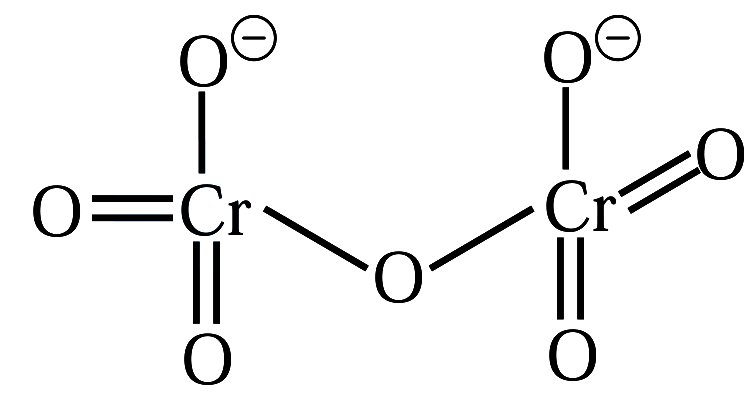
No of terminal "O" = 6 -
- (A) \(\mathrm{K}_2 \mathrm{CrO}_4\) and CrO
- (B) \(\mathrm{K}_2 \mathrm{CrO}_4\) and \(\mathrm{Cr}_2 \mathrm{O}_3\)
- (C) \(\mathrm{K}_2 \mathrm{CrO}_4\) and \(\mathrm{K}_2 \mathrm{Cr}_2 \mathrm{O}_7\)
- (D) \(\mathrm{K}_2 \mathrm{Cr}(\mathrm{OH})_6\) and \(\mathrm{Cr}_2 \mathrm{O}_3\)
Show answer and solution
Correct Answer: (C)
\(\mathrm{K}_2 \mathrm{Cr}_2 \mathrm{O}_7 \xrightarrow[-\mathrm{H}_2 \mathrm{O}]{\mathrm{KOH}} \mathrm{K}_2 \mathrm{CrO}_4 \xrightarrow[-\mathrm{H}_2 \mathrm{O}]{\mathrm{H}_2 \mathrm{SO}_4} \mathrm{~K}_2 \mathrm{Cr}_2 \mathrm{O}_7+\mathrm{K}_2 \mathrm{SO}_4\)
[A] \(\mathrm{K}_2 \mathrm{CrO}_4\)
[B] \(\mathrm{K}_2 \mathrm{Cr}_2 \mathrm{O}_7\) -
- (A) Statement I is false but Statement II is true
- (B) Statement I is true but Statement II is false
- (C) Both Statement I and Statement II are true
- (D) Both Statement I and Statement II are false
Show answer and solution
Correct Answer: (B)
Statement-I is true but statement II is false.
\(\mathrm{Cr}(\mathrm{VI})\) is less stable than \(\mathrm{Mo}(\mathrm{VI})\)
Hence, \(\mathrm{CrO}_3\) easily reduce into \(\mathrm{Cr}^{+3}\) as compared to \(\mathrm{MoO}_3\) and show stronger oxidizing nature. -
- (A) Both Statement I and Statement II are false
- (B) Both Statement I and Statement II are true
- (C) Statement I is false but Statement II is true
- (D) Statement I is true but Statement II is false
Show answer and solution
Correct Answer: (B)
Heating is required in oxalic acid filtration due to High activation energy.
Heating is not required in FAS vs \(\mathrm{KMnO}_4\) titration because \(\mathrm{Fe}^{2+}\) will get converted into \(\mathrm{Fe}^{3+}\) by oxygen of air and error may be introduced in the experiment.
Both Statement-I and Statement-II are correct. -
- (A) 20
- (B) 10
- (C) 15
- (D) 25
Show answer and solution
Correct Answer: (B)
\(\underset{(\mathrm{O}. \mathrm{A})}{\stackrel{+7}{\mathrm{KMnO}}} \xrightarrow{\text { Acidic medium }} \mathrm{Mn}^{2+}\)
X is difference in oxidation state.
\(6 \mathrm{CH}_3 \mathrm{COO}^{\ominus}+\mathrm{Fe}^{3+}+\mathrm{H}_2 \mathrm{O} \rightarrow\left[\mathrm{Fe}_3\left(\mathrm{OH}_2\right)\left(\mathrm{CH}_3 \mathrm{COO}\right)_6\right]^{\oplus}+2 \mathrm{H}^{\oplus}\)
\(\left[\mathrm{Fe}_3(\mathrm{OH})_2\left(\mathrm{CH}_3 \mathrm{COO}\right)_6\right]^{\oplus} \text{(Brown red ppt)} +4 \mathrm{H}_2 \mathrm{O}\rightarrow\left[\mathrm{Fe}(\mathrm{OH})_2\left(\mathrm{CH}_3 \mathrm{COO}\right]+\mathrm{CH}_3 \mathrm{COOH}+\mathrm{H}^{\oplus}\right.\)
\(\mathrm{Fe}^{3+} \Rightarrow 3 \mathrm{~d}^5 4 \mathrm{~s}^0\) contains 5 d electrons
So \(Y=5\)
\(X+Y=5+5=10\) -
- (A) (A) and (D) only
- (B) (B) and (C) only
- (C) (A) and (B) only
- (D) (B) and (E) only
Show answer and solution
Correct Answer: (C)
\(\begin{aligned} & { }_{63} \mathrm{Eu}^{2+}-[\mathrm{Xe}] 4 \mathrm{f}^7 6 \mathrm{~s}^0 \\ & { }_{64} \mathrm{Gd}^{3+}-[\mathrm{Xe}] 4 \mathrm{f}^7 5 \mathrm{~d}^0 6 \mathrm{~s}^0 \\ & { }_{63} \mathrm{Eu}^{3+}-[\mathrm{Xe}] 4 \mathrm{f}^6 6 \mathrm{~s}^0 \\ & { }_{65} \mathrm{~Tb}^{3+}-[\mathrm{Xe}] 4 \mathrm{f}^8 6 \mathrm{~s}^0 \\ & { }_{62} \mathrm{Sm}^{2+}-[\mathrm{Xe}] 4 \mathrm{f}^6 6 \mathrm{~s}^0 \\ & \mathrm{Eu}^{2+} \& \mathrm{Gd}^{3+}\end{aligned}\) -
- (A) (A) \(-(\mathrm{III}),(\mathrm{B})-(\mathrm{I}),(\mathrm{C})-(\mathrm{IV}),(\mathrm{D})-(\mathrm{II})\)
- (B) (A) \(-(\mathrm{III}),(\mathrm{B})-(\mathrm{I}),(\mathrm{C})-(\mathrm{II}),(\mathrm{D})-(\mathrm{IV})\)
- (C) (A) \(-(\mathrm{IV}),(\mathrm{B})-(\mathrm{II}),(\mathrm{C})-(\mathrm{III}),(\mathrm{D})-(\mathrm{I})\)
- (D) \((\mathrm{A})-(\mathrm{II}),(\mathrm{B})-(\mathrm{IV}),(\mathrm{C})-(\mathrm{I}),(\mathrm{D})-(\mathrm{III})\)
Show answer and solution
Correct Answer: (A)
\(\begin{array}{lc}\mathrm{Sc}^{+3}=3 \mathrm{~d}^{\mathrm{o}} & \therefore \mu_{\text {spin }}=0 \\ \mathrm{~V}^{+2}=3 \mathrm{~d}^3 & \therefore \mu_{\text {spin }}=3.87 \mathrm{~B} \cdot \mathrm{M} . \\ \mathrm{Ni}^{+2}=3 \mathrm{~d}^8 & \therefore \mu_{\text {spin }}=2.84 \mathrm{~B} \cdot \mathrm{M} . \\ \mathrm{Ti}^{+3}=3 \mathrm{~d}^1 & \therefore \mu_{\text {spin }}=1.73 \text { B.M. }\end{array}\) -
- (A) 11
- (B) 22
- (C) 33
- (D) 44
Show answer and solution
Correct Answer: (A)
\(\begin{aligned} & \mathrm{Z}=41 \rightarrow \mathrm{Nb} \text { (Niobium) : }[\mathrm{Kr}]_{36} 4 \mathrm{~d}^4 5 \mathrm{~s}^1 \\ & \text { Number of electron in } 4 \mathrm{~d}=4=\mathrm{x} \\ & \mathrm{Z}=44 \rightarrow \mathrm{Ru} \text { (Ruthenium) }[\mathrm{Kr}]_{36} 4 \mathrm{~d}^7 5 \mathrm{~s}^1 \\ & \text { Number of electron in } 4 \mathrm{~d}=7=\mathrm{y} \\ & \mathrm{x}+\mathrm{y}=11\end{aligned}\) - 32. Pair of transition metal ions having the same number of unpaired electrons is _______. 2025 Medium
- (A) \(\mathrm{V}^{2+}, \mathrm{Co}^{2+}\)
- (B) \(\mathrm{Ti}^{i+}, \mathrm{Co}^{2+}\)
- (C) \(\mathrm{Fe}^{3+}, \mathrm{Cr}^{2+}\)
- (D) \(\mathrm{Ti}^{3+}, \mathrm{Mn}^{2+}\)
Show answer and solution
Correct Answer: (A)
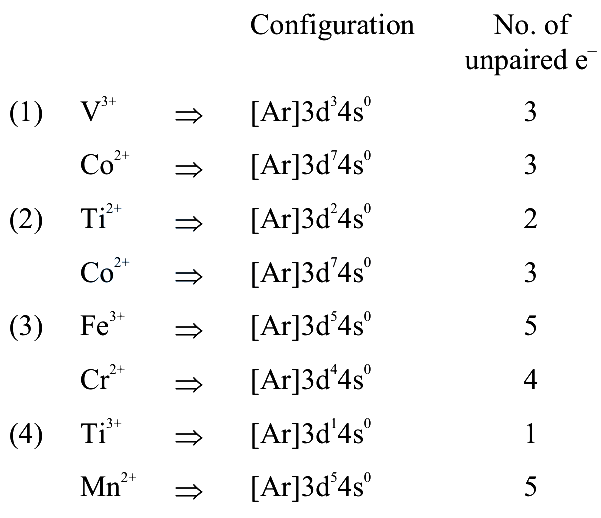
So \(\mathrm{V}^{2+} \& \mathrm{Co}^{2+}\) same number of unpaired electron. -
- (A) \(\mathrm{K}_3 \mathrm{MnO}_4\)
- (B) \(\mathrm{K}_4\left[\mathrm{Mn}(\mathrm{OH})_6\right]\)
- (C) \(\mathrm{KMnO}_4\)
- (D) \(\mathrm{K}_2 \mathrm{MnO}_4\)
Show answer and solution
Correct Answer: (D)
Preparation of \(\mathrm{KMnO}{ }_4\)
\(\mathrm{MnO}_2 \xrightarrow[\mathrm{KNO}_3]{\mathrm{KOH}} \mathrm{K}_2 \mathrm{MnO}_4 \xrightarrow[\substack{\text { Oxidation in } \\ \text { Alkaline solution }}]{\text { Elecrolta }} \mathrm{KMnO}_4\) -
- (A) \(+3\)
- (B) \(+4\)
- (C) \(+7\)
- (D) \(+5\)
Show answer and solution
Correct Answer: (D)
\(\mathrm{V}_2 \mathrm{O}_5\) is amphoteric oxide.
\(\mathrm{V}_2 \mathrm{O}_5\) gives \(\mathrm{VO}_4{ }^{3-}\) on reaction with alkali oxidation state of V in \(\mathrm{VO}_4{ }^{3-}=+5\) -
- (A) 3.87 and 4.90 B.M.
- (B) 4.90 and 5.92 B.M.
- (C) 4.90 and 4.90 B.M.
- (D) 5.92 and 4.90 B.M.
Show answer and solution
Correct Answer: (D)
\(\begin{aligned}
& \mathrm{K}_3\left[\mathrm{Fe}(\mathrm{OH})_6\right] \\
& \mathrm{Fe}^{3+} \Rightarrow 3 \mathrm{~d}^5 \\
& \mathrm{Fe}^{3+} \text { with } \mathrm{OH}^{-}(\mathrm{WFL}) \\
& =\mathrm{t}_{29}{ }^3 \mathrm{e}_{\mathrm{g}}{ }^2
\end{aligned}\)
Number of unpaired electron ( \(n\) ) \(=5\)
\(\mu\) spin only \(=5.92 \mathrm{BM}\)
\(\begin{aligned}
& \mathrm{K}_4\left[\mathrm{Fe}(\mathrm{OH})_6\right] \\
& \mathrm{Fe}^{2+} \Rightarrow \mathrm{OH}^{-} \mathrm{(WFL)} \\
& \mathrm{Fe}^{2+} \Rightarrow 3 \mathrm{~d}^6=\mathrm{t}_{2 \mathrm{~g}}^4 \mathrm{e}_{\mathrm{g}}^2 \\
& \mathrm{n}=4
\end{aligned}\)
\(\mu_{\text {spin only }}=4.90 \mathrm{BM}\) -
- (A) \(\mathrm{Cu}^{+} \gt \mathrm{Cu}^{2+} \gt \mathrm{Cr}^{3+} \gt \mathrm{Cr}^{2+}\)
- (B) \(\mathrm{Cu}^{2+} \gt \mathrm{Cu}^{+} \gt \mathrm{Cr}^{2+} \gt \mathrm{Cr}^{3+}\)
- (C) \(\mathrm{Cr}^{2+} \gt \mathrm{Cr}^{3+} \gt \mathrm{Cu}^{2+} \gt \mathrm{Cu}^{+}\)
- (D) \(\mathrm{Cr}^{3+} \gt \mathrm{Cr}^{2+} \gt \mathrm{Cu}^{+} \gt \mathrm{Cu}^{2+}\)
Show answer and solution
Correct Answer: (C)
\(\mathrm{Cu}^{+}:[\mathrm{Ar}] 3 \mathrm{~d}^{10}\), Spin only magnetic moment \(=0\)
B.M.
\(\mathrm{Cu}^{+2}:[\mathrm{Ar}] 3 \mathrm{~d}^9\), Spin only magnetic moment \(=\sqrt{3}\)
B.M.
\(\mathrm{Cr}^{+2}:[\mathrm{Ar}] 3 \mathrm{~d}^4\), Spin only magnetic moment \(=\sqrt{24}\)
B.M.
\(\mathrm{Cr}^{+3}:[\mathrm{Ar}] 3 \mathrm{~d}^3\), Spin only magnetic moment \(=\sqrt{15}\)
B.M.
Order of \(\mu\) : \(\mathrm{Cr}^{+2} \gt \mathrm{Cr}^{+3} \gt \mathrm{Cu}^{+2} \gt \mathrm{Cu}^{+}\) -
- (A) \(\mathrm{Fe} \lt \mathrm{Mn}, \mathrm{Ru} \lt \mathrm{Tc}\) and \(\mathrm{Re} \lt \mathrm{Os}\)
- (B) \(\mathrm{Mn} \lt \mathrm{Fe}, \mathrm{Tc} \lt \mathrm{Ru}\) and \(\mathrm{Os} \lt \mathrm{Re}\)
- (C) \(\mathrm{Mn} \lt \mathrm{Fe}, \mathrm{Tc} \lt \mathrm{Ru}\) and \(\mathrm{Re} \lt \mathrm{Os}\)
- (D) \(\mathrm{Fe} \lt \mathrm{Mn}, \mathrm{Ru} \lt \mathrm{Tc}\) and \(\mathrm{Os} \lt \mathrm{Re}\)
Show answer and solution
Correct Answer: (B)
Melting point order
\(\begin{aligned}
& \mathrm{Fe}>\mathrm{Mn} \\
& \mathrm{Ru}>\mathrm{Tc} \\
& \mathrm{Re}>\mathrm{Os}
\end{aligned}\) - 38. The correct set of ions (aqueous solution) with same colour from the following is which? 2025 Easy
- (A) \(\mathrm{Sc}^{3+}, \mathrm{Ti}^{3+}, \mathrm{Cr}^{2+}\)
- (B) \(\mathrm{V}^{2+}, \mathrm{Cr}^{3+}, \mathrm{Mn}^{3+}\)
- (C) \(\mathrm{Ti}^{4+}, \mathrm{V}^{4+}, \mathrm{Mn}^{2+}\)
- (D) \(\mathrm{Zn}^{2+}, \mathrm{V}^{3+}, \mathrm{Fe}^{3+}\)
Show answer and solution
Correct Answer: (B)
(1) \(\mathrm{V}^{2+}\) (Violet), \(\mathrm{Cr}^{3+}\) (Violet), \(\mathrm{Mn}^{3+}(\) Violet \()\)
(2) \(\mathrm{Zn}^{2+}\) (Colourless), \(\mathrm{V}^{3+}\) (Green), \(\mathrm{Fe}^{3+}\) (Yellow)
(3) \(\mathrm{Ti}^{4+}\) (Colourless), \(\mathrm{V}^{4+}\) (Blue), \(\mathrm{Mn}^{2+}\) (Pink)
(4) \(\mathrm{Sc}^{3+}(\) Colourless \(), \mathrm{Ti}^{3+}\) (Purple), \(\mathrm{Cr}^{2+}\) (Blue) -
- (A) (A), (B), (C), (D) and (E)
- (B) (A), (B), (D) and (E) only
- (C) (B), (D) and (E) only
- (D) (A), (C) and (D) only
Show answer and solution
Correct Answer: (B)
(i) True, \(\mathrm{T} \ell^{+}\)is more stable than \(\mathrm{T} \ell^{3+}\), due to inert pair effect. So \(\mathrm{T} \ell^{3+}\) is a powerful oxidising agent.
(ii) True, \(\mathrm{E}_{\mathrm{Al}^{3+/ A 1}}^0=-1.66 \mathrm{~V}\). So it is difficult to reduce \(\mathrm{A} \ell^{3+}\). So \(\mathrm{A} \ell^{3+}\) is highly stable.
(iii) False, as \(\mathrm{T} \ell^{3+}\) is unstable
(iv) True, \(\mathrm{T} \ell^{+}\)is more stable than \(\mathrm{T} \ell^{3+}\)
(v) True, \(\mathrm{A} \ell^{3+}\) and \(\mathrm{T} \ell^{+}\)are highly stable -
- (A) neutral
- (B) acidic
- (C) basic
- (D) amphoteric
Show answer and solution
Correct Answer: (C)
In 3d series Vanadium has highest enthalpy of atomization and colour of \(\mathrm{V}^{+3}\) is green.
* Oxide form by \(\mathrm{V}^{+3}\) is \(\mathrm{V}_2 \mathrm{O}_3\) (Basic oxide) - 41. The incorrect relationship in the following pairs in relation to ionisation enthalpies is _______. 2025 Medium
- (A) \(\mathrm{Mn}^{+} \lt \mathrm{Cr}^{+}\)
- (B) \(\mathrm{Mn}^{+} \lt \mathrm{Mn}^{2+}\)
- (C) \(\mathrm{Fe}^{2+} \lt \mathrm{Fe}^{3+}\)
- (D) \(\mathrm{Mn}^{2+} \lt \mathrm{Fe}^{2+}\)
Show answer and solution
Correct Answer: (D)
\(\mathrm{Mn}^{2+}:[\mathrm{Ar}] 3 \mathrm{~d}^5\)
Half filled stability
More 1 E than \(\mathrm{Fe}^{2+}\)
\(\mathrm{Fe}^{2+}:[\mathrm{Ar}] 3 \mathrm{~d}^6\) -
- (A) \(\mathrm{Mn}^{2+}\)
- (B) \(\mathrm{Cr}^{3+}\)
- (C) \(\mathrm{Ni}^{2+}\)
- (D) \(\mathrm{Ti}^{3+}\)
Show answer and solution
Correct Answer: (C)
\(\mathrm{Ni}^{2+}\) gives violet colour with borax bead test in nonluminous flame under hot conditions. \(\mathrm{Ni}^{2+}\) has \(\mathrm{d}^8\) configuration which does not depend on nature of ligand present in octahedral field.
\(\mathrm{Ni}^{2+} \Rightarrow \mathrm{t}_{2 g}^6 \mathrm{eg}^2\) -
- (A) A, C and E only
- (B) A, D and E only
- (C) B and E only
- (D) A, B and E only
Show answer and solution
Correct Answer: (D)
Given magnetic moment \(=4.9\) B.M.
We know M.M \(=\sqrt{\mathrm{n}(\mathrm{n}+2)}\) B.M.
Where, \(\mathrm{n} \rightarrow\) No. of unpaired \(\mathrm{e}^{-}\)
\(4.9=\sqrt{\mathrm{n}(\mathrm{n}+2)}\)
We get \(\mathrm{n}=4\)
(A) \({ }_{24} \mathrm{Cr}^{2+} \Rightarrow[\mathrm{Ar}] 3 \mathrm{~d}^4\) (4 unpaired e)
(B) \({ }_{26} \mathrm{Fe}^{2+} \Rightarrow[\mathrm{Ar}] 3 \mathrm{~d}^6\) (4 unpaired e)
(C) \({ }_{26} \mathrm{Fe}^{3+} \Rightarrow[\mathrm{Ar}] 3 \mathrm{~d}^5\) (5 unpaired e)
(D) \({ }_{27} \mathrm{Co}^{2+} \Rightarrow[\mathrm{Ar}] 3 \mathrm{~d}^7\) (3 unpaired \(\mathrm{e}^{-}\))
(E) \({ }_{25} \mathrm{Mn}^{3+} \Rightarrow[\mathrm{Ar}] 3 \mathrm{~d}^4 \left(4\right.\) unpaired \(\left.\mathrm{e}^{-}\right)\) -
- (A) 120
- (B) 140
- (C) 160
- (D) 180
Show answer and solution
Correct Answer: (C)
\(\mathrm{FeCr}_2 \mathrm{O}_4+\mathrm{Na}_2 \mathrm{CO}_3+\mathrm{O}_2 \rightarrow \mathrm{Na}_2 \mathrm{CrO}_4+\mathrm{Fe}_2 \mathrm{O}_3+\mathrm{CO}_2\)
Insoluble product will be \(\mathrm{Fe}_2 \mathrm{O}_3\)
molar mass \(=56 \times 2+16 \times 3\)
\(\begin{aligned}
& =112+48 \\
& =160
\end{aligned}\) -
- (A) \(8\)
- (B) \(9\)
- (C) \(6\)
- (D) \(10\)
Show answer and solution
Correct Answer: (C)
Out of \(\mathrm{Cr}, \mathrm{Co}, \mathrm{Fe}\) and \(\mathrm{Ni}\)
Chromium has lowest heat of atomisation.
\(\mathrm{Cr}=[\mathrm{Ar}] 3 \mathrm{~d}^5 4 \mathrm{~s}^1\)
\(\because\) Total six valence \(\mathrm{e}^{-}\)in \(\mathrm{Cr}\). -
- (A) 10
- (B) 15
- (C) 5
- (D) 20
Show answer and solution
Correct Answer: (C)
Strongest oxidising power among the option is \(\mathrm{Mn}_2 \mathrm{O}_3\) because of \(\mathrm{E}^{\circ}\) value
\(\begin{aligned}
& \mathrm{E}_{\mathrm{Mn}^{+3} / \mathrm{Mn}^{+2}}^{\circ}=+1.57 \mathrm{~V} \\
& \mathrm{Mn}^{+3} \rightarrow \mathrm{~d}^4 \text { configuration } \\
& \mu=\sqrt{24} \mathrm{BM} \\
& =4.89 \mathrm{BM} \\
& \Rightarrow 5
\end{aligned}\) -
- (A) \(0\)
- (B) 1
- (C) 2
- (D) 3
Show answer and solution
Correct Answer: (A)
\(\mathrm{K}_2\left[\mathrm{NiCl}_4\right] \Rightarrow \mathrm{sp}^3\), Paramagnetic
\(\left[\mathrm{Zn}\left(\mathrm{H}_2 \mathrm{O}\right)_6\right] \mathrm{Cl}_2 \Rightarrow \mathrm{sp}^3 \mathrm{~d}^2\), Diamagnetic
\(\mathrm{K}_3\left[\mathrm{Mn}(\mathrm{CN})_6\right] \Rightarrow \mathrm{d}^2 \mathrm{sp}^3\), Paramagnetic
\(\left[\mathrm{Cu}\left(\mathrm{PPh}_3\right)_3 \mathrm{I}\right] \Rightarrow \mathrm{sp}^3\), Diamagnetic
Hence the value of \(n\) is 2
Least value of enthalpy of atomisation among Ni ,
\(\mathrm{Zn}, \mathrm{Mn}\) and Cu is of Zn
\(\begin{aligned}
& \mathrm{Zn}^{+2}:-[\mathrm{Ar}] 3 \mathrm{~d}^{10} \\
& \mu=0
\end{aligned}\) -
- (A) \(\mathrm{Eu}^{2+}\)
- (B) \(\mathrm{Tb}^{4+}\)
- (C) \(\mathrm{Lu}^{3+}\)
- (D) \(\mathrm{Ce}^{3+}\)
Show answer and solution
Correct Answer: (B)
\(\mathrm{Tb}^{4+}\) is strongest oxidising agent as it will reduce to \(\mathrm{Tb}^{3+}\) (common O.S. of Ln) -
- (A) 5
- (B) 4
- (C) 2
- (D) 3
Show answer and solution
Correct Answer: (A)
\(\begin{aligned} & \mathrm{CrO}_3=\text { Acidic } \\ & \mathrm{Mn}_2 \mathrm{O}_7=\text { Acidic } \\ & \therefore \mathrm{x}=2\end{aligned}\)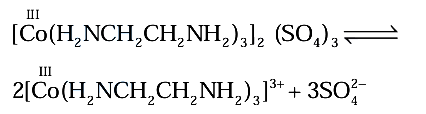
\(\begin{aligned} & \therefore \text { Primary valency }=3 \\ & \therefore \mathrm{x}+\mathrm{y}=5\end{aligned}\) -
- (A) Acidic
- (B) Neutral
- (C) Basic
- (D) Amphoteric
Show answer and solution
Correct Answer: (D)
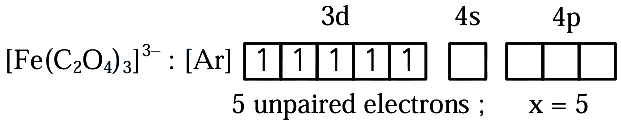
Explanation:
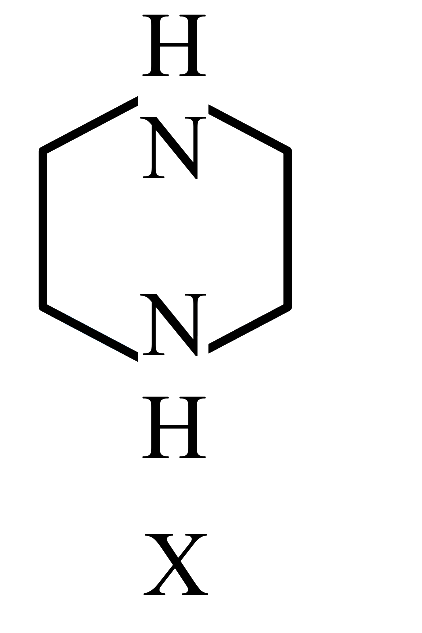
1. Identifying the Most Stable Complex: Among the given coordination complexes, \( \text{[Fe(C}_2\text{O}_4\text{)}_3\text{]}^{3-} \) is the most stable due to the chelation effect. The oxalate ion (\( \text{C}_2\text{O}_4^{2-} \)) is a bidentate ligand that binds to the central metal ion at two sites, forming three stable five-membered rings. Chelated complexes are significantly more stable than similar non-chelated complexes containing monodentate ligands.
2. Finding the Value of X: In the most stable complex \( \text{[Fe(C}_2\text{O}_4\text{)}_3\text{]}^{3-} \), the oxidation state of iron (\( \text{Fe} \)) is \( +3 \).
- Atomic number of \( \text{Fe} = 26 \)
- Ground state configuration of \( \text{Fe} = \text{[Ar] } 3d^6 4s^2 \)
- Configuration of \( \text{Fe}^{3+} = \text{[Ar] } 3d^5 4s^0 \)
Thus, the total number of electrons present in the \( d \)-orbitals of the central metal ion is \( X = 5 \).
3. Determining the Nature of the Oxide: Substituting \( X = 5 \) into the general oxide formula \( \text{V}_2\text{O}_X \) gives Vanadium Pentoxide (\( \text{V}_2\text{O}_5 \)). As the oxidation state of a transition metal increases, its oxides shift from basic to amphoteric/acidic characters. \( \text{V}_2\text{O}_5 \) is classically amphoteric because it reacts with both non-oxidizing acids and alkalis to form corresponding salts.
Hence, Option D is the correct choice.

No questions on this page match these filters.
Other years
Frequently asked
How many JEE Mains 2025 Chemistry questions are on ExamBro?
381 questions, each with the correct answer and a full solution.
Which JEE Mains 2025 Chemistry chapter is asked the most?
Co-ordination chemistry, with 31 questions, followed by Solution and colligative properties with 29.
How difficult are JEE Mains 2025 Chemistry questions?
29% are easy, 58% medium and 14% hard.