


Chapters asked in 2026
26 chapters- 22Qs STD 11 Organic chemistry purification and characterization
- 29Qs STD 12 D and f- block elements Most asked
- 8Qs STD 11 Redox reactions
- 17Qs STD 12 Biomolecules
- 15Qs STD 11 Equilibrium - II (icon Equilibrium)
- 28Qs STD 12 Chemical kinetics Most asked
- 16Qs STD 11 Organic chemistry reaction mechanism
- 21Qs STD 12 Amines
- 10Qs STD 12 Carboxylic acids and their derivative
- 12Qs STD 12 Aldehydes and ketones
- 10Qs STD 12 Alcohol, phenol and ethers
- 13Qs STD 12 Haloalkanes and Haloarenes
- 7Qs STD 11 Organic chemistry isomerism
- 32Qs STD 12 Co-ordination chemistry Most asked
- 10Qs STD 12 P -Block elements - ll
- 20Qs STD 12 Electrochemistry
- 20Qs STD 12 Solution and colligative properties
- 19Qs STD 11 Some basic concept of chemistry
- 9Qs STD 11 Hydricarbon
- 7Qs STD 11 Organic chemistry Nomenclature of organic compounds
- 20Qs STD 11 Chemical bonding and molecular structure
- 19Qs STD 11 Classification of elements and periodicity in properties
- 16Qs STD 11 Equilibrium - 1 (chemical Equilibrium)
- 20Qs STD 11 Thermodynamics and thermochemistry
- 5Qs STD 11 P-Block elements - I
- 27Qs STD 11 Structure of atom
All JEE Mains 2026 Chemistry questions
26 chaptersShowing 1–50 of 432 questions
-
- (A) 73%
- (B) 71%
- (C) 76%
- (D) 68%
Show answer and solution
Correct Answer: (A)
\(\begin{array}{l}\quad { C _{ x } H _{ z }}+ O _2 \rightarrow CO _2+ H _2 O \\ t =0 \quad 0.25 gm \\ t _{ eq }\quad-\quad 0.18 gm \quad 0.15 gm \end{array}\)
Mass of ' H ' \(=\frac{0.15}{18} \times 2=0.016 \simeq 0.017 gm\).
Mass of ' O ' \(=0.25-0.05-0.017=0.1833 gm\)
Mass \(\%\) of ' O ' \(=\frac{0.1833}{0.25} \times 100=73.32 \%\). -
- (A) 2%
- (B) 6%
- (C) 1%
- (D) 4%
Show answer and solution
Correct Answer: (D)
\(\begin{array}{cl} C _{ x } H _{ y } Br _{ z } & \rightarrow \quad CO _2 \\ 1 g & 1.32 g\end{array}\)
\(\% C=\frac{1.32 \times 12}{44 \times 1} \times 100=36 \%\)
\(\begin{array}{clc} C _{ x } H _{ y } Br _{ z } & \rightarrow & AgBr \\ 0.53 g & & 0.75 g\end{array}\)
\(\% Br =\frac{0.75 \times 80}{188 \times 0.53} \times 100=60.2 \%\)
\(\% H =100-(36+60.2)\)
\(\% H \simeq 4 \%\) -
- (A) 4
- (B) 5
- (C) 6
- (D) 7
Show answer and solution
Correct Answer: (B)
Mass of \(AgBr\) formed = \(3.36\) g
Molar mass of \(AgBr = 108 + 80 = 188\) g mol\(^{-1}\)
Moles of \(AgBr\) formed = \(\dfrac{3.36}{188} \approx 0.01787\) mol
Since \(1\) mole of \(AgBr\) contains \(1\) mole of \(Br\), moles of \(Br\) in the compound = \(0.01787\) mol.
Mass of \(Br = 0.01787 \times 80 = 1.43\) g
Percentage of \(Br\) in compound \((X) = \dfrac{1.43}{2.0} \times 100 = 71.5\%\)
Given percentage of \(C = 26.7\%\)
Percentage of \(H = 100\% - (71.5\% + 26.7\%) = 1.8\%\)
Now, we find the molar ratio of the elements in the compound:
Moles of \(C = \dfrac{26.7}{12} = 2.225\)
Moles of \(H = \dfrac{1.8}{1} = 1.8\)
Moles of \(Br = \dfrac{71.5}{80} = 0.893\)
Dividing by the smallest value (\(0.893\)) to get the simplest ratio:
\(C : H : Br = \dfrac{2.225}{0.893} : \dfrac{1.8}{0.893} : \dfrac{0.893}{0.893}\)
\(C : H : Br \approx 2.5 : 2 : 1\)
Multiplying by \(2\) to obtain whole numbers, we get the ratio \(5 : 4 : 2\).
The empirical formula of the compound is \(C_5H_4Br_2\).
The total number of carbon atoms in the empirical formula is \(5\).
Answer: \(5\) -
- (A) \(Ca^{2+}\) and \(SO_4^{2-}\)
- (B) \(Ba^{2+}\) and \(PO_4^{3-}\)
- (C) \(Mn^{2+}\) and \(PO_4^{3-}\)
- (D) \(Ba^{2+}\) and \(SO_4^{2-}\)
Show answer and solution
Correct Answer: (B)
An apple green colour in the flame test indicates the presence of \(Ba^{2+}\) ion.
The group precipitate of \(Ba^{2+}\) is \(BaCO_3\), which dissolves in acetic acid to form barium acetate. Upon treatment with \(K_2CrO_4\), it gives a yellow precipitate of barium chromate (\(BaCrO_4\)), confirming the presence of \(Ba^{2+}\).
When the sodium carbonate extract is heated with conc. \(HNO_3\) and ammonium molybdate, the formation of a canary yellow precipitate indicates the presence of phosphate (\(PO_4^{3-}\)) ion. The canary yellow precipitate is ammonium phosphomolybdate, \((NH_4)_3PO_4 \cdot 12MoO_3\).
Therefore, the cation is \(Ba^{2+}\) and the anion is \(PO_4^{3-}\).
Answer: \(Ba^{2+}\) and \(PO_4^{3-}\) -
- (A) 42.10%
- (B) 63.15%
- (C) 21.05%
- (D) 48.24%
Show answer and solution
Correct Answer: (C)
\(\% S=\frac{32}{233} \times \frac{0.4813}{0.314} \times 100\)
\(=21.052 \%\) -
- (A) 50
- (B) 30
- (C) 20
- (D) 40
Show answer and solution
Correct Answer: (A)
% of \(P = \frac{n_{Mg_{2}P_{2}O_{7}} \times 2 \times 31}{w_{(unknown~compound)}} \times 100\)
\(= \frac{(\frac{1.79}{222} \times 2 \times 31)}{1} \times 100\)
\(= 49.99\% \approx 50\%\) -
- (A) \(273\)
- (B) \(27\)
- (C) \(2730\)
- (D) \(227\)
Show answer and solution
Correct Answer: (A)
Mass of carbon in the compound is calculated from the mass of \(CO_2\) produced:
Mass of C \(= \dfrac{12}{44} \times \text{mass of } CO_2 = \dfrac{12}{44} \times 0.25 = \dfrac{3}{44}\) g
Given that the percentage of carbon in the compound is \(25\%\):
\(\% \text{ of C} = \dfrac{\text{Mass of C}}{\text{Total mass } X} \times 100\)
\(25 = \dfrac{\dfrac{3}{44}}{X} \times 100\)
\(X = \dfrac{3}{44} \times \dfrac{100}{25} = \dfrac{3}{44} \times 4 = \dfrac{3}{11}\) g
\(X \approx 0.2727\) g
Verifying this using the percentage of hydrogen:
Mass of H \(= \dfrac{2}{18} \times \text{mass of } H_2O = \dfrac{2}{18} \times 0.12 = \dfrac{1}{75}\) g
\(\% \text{ of H} = \dfrac{\dfrac{1}{75}}{X} \times 100 = 4.89\)
\(X = \dfrac{100}{75 \times 4.89} \approx 0.2727\) g
Thus, \(X = 272.7 \times 10^{-3}\) g.
Rounding to the nearest integer, the required value is \(273\).
Answer: \(273\) -
- (A) Both Statement I and Statement II are true
- (B) Both Statement I and Statement II are false
- (C) Statement I is true but Statement II is false
- (D) Statement I is false but Statement II is true
Show answer and solution
Correct Answer: (D)
Statement I: \(1,2,3\)-Trihydroxypropane (glycerol) has a very high boiling point (around \(290^{\circ}\text{C}\)) and it decomposes at its boiling point under normal atmospheric pressure. Therefore, it cannot be separated from water by simple distillation. Instead, it is separated by distillation under reduced pressure (vacuum distillation). Hence, Statement I is false.
Statement II: An azeotropic mixture is a constant boiling mixture in which the liquid and vapour phases have the exact same composition. Because there is no change in composition upon boiling, the components of an azeotropic mixture cannot be separated by fractional distillation. Hence, Statement II is true.
Therefore, Statement I is false but Statement II is true.
Answer: Statement I is false but Statement II is true -
- (A) Both Statement I and Statement II are true
- (B) Both Statement I and Statement II are false
- (C) Statement I is true but Statement II is false
- (D) Statement I is false but Statement II is true
Show answer and solution
Correct Answer: (A)
Statement I : Sugar (\(\text{C}_{12}\text{H}_{22}\text{O}_{11}\)) is soluble in alcohol, whereas sodium chloride (\(\text{NaCl}\)) is insoluble in alcohol. Therefore, a mixture of sugar and salt can be separated based on their differential solubility in alcohol. This statement is true.
Statement II : Steam distillation is used to separate and purify organic compounds that are steam volatile and immiscible (insoluble) in water. Rose essence (essential oil) from rose petals possesses these properties, making steam distillation the appropriate method for its extraction. This statement is also true.
Therefore, both Statement I and Statement II are true.
Answer: Both Statement I and Statement II are true -
- (A) Both Statement I and Statement II are true
- (B) Both Statement I and Statement II are false
- (C) Statement I is true but Statement II is false
- (D) Statement I is false but Statement II is true
Show answer and solution
Correct Answer: (D)
Statement I is false because Kolbe's electrolysis of sodium acetate produces ethane, not methane. The reaction is: \(2\text{CH}_3\text{COONa} + 2\text{H}_2\text{O} \xrightarrow{\text{Electrolysis}} \text{CH}_3-\text{CH}_3 + 2\text{CO}_2 + \text{H}_2 + 2\text{NaOH}\). Decarboxylation of sodium ethanoate and the reaction of \(\text{CH}_3\text{MgBr}\) with water do produce methane.
Statement II is true because the simplest unsaturated hydrocarbon is ethene (\(\text{C}_2\text{H}_4\)), which upon hydrogenation yields ethane, meaning methane cannot be prepared from unsaturated hydrocarbons. Additionally, the Wurtz reaction involves the coupling of two alkyl halide molecules to form an alkane with at least two carbon atoms (\(2\text{RX} + 2\text{Na} \rightarrow \text{R}-\text{R} + 2\text{NaX}\)), so methane cannot be prepared by this method.
Therefore, Statement I is false but Statement II is true.
Answer: Statement I is false but Statement II is true -
- (A) Statement-I is false but Statement-II is true
- (B) Statement-I is true but Statement-II is false
- (C) Both Statement-I and Statement-II are true
- (D) Both Statement-I and Statement-II are false
Show answer and solution
Correct Answer: (D)
Theory based. -
- (A) 41
- (B) 42
- (C) 43
- (D) 44
Show answer and solution
Correct Answer: (A)
Mass of the organic compound, \(W = 0.2\) g
Mass of \(\text{BaSO}_4\) formed, \(m = 0.6\) g
Molar mass of \(\text{BaSO}_4 = 233 \text{ g mol}^{-1}\)
Molar mass of \(\text{S} = 32 \text{ g mol}^{-1}\)
The percentage of sulphur in the organic compound is given by the formula:
\(\% \text{S} = \dfrac{32}{233} \times \dfrac{m}{W} \times 100\)
Substituting the given values:
\(\% \text{S} = \dfrac{32}{233} \times \dfrac{0.6}{0.2} \times 100\)
\(\% \text{S} = \dfrac{32}{233} \times 3 \times 100\)
\(\% \text{S} = \dfrac{9600}{233} \approx 41.20\%\)
Rounding off to the nearest integer, the percentage of sulphur is \(41\).
Answer: \(41\) -
- (A) 53.58%
- (B) 87.65%
- (C) 37.57%
- (D) 34.79%
Show answer and solution
Correct Answer: (A)
Organic compound 0.2425 gm
AgCl obtained: 0.5253 gm
In carius method for estimation of halogen amount of AgCl obtained is 0.5253 gm from 0.2425 gm of organic compound.
Hence percentage of Cl .
Percentage of \( Cl = \frac{35.5}{143.5} \times \frac{0.5253}{0.2425} \times 100 = 53.58\% \) -
- (A) 4.55%
- (B) 10.30%
- (C) 21.97%
- (D) 16.48%
Show answer and solution
Correct Answer: (C)
\( \frac{n_{BaSO_{4}} \times 32}{W_{(unknown comp.)}} \times 100 \)
\( = \frac{1.2 \times 32}{233} \times \frac{100}{0.75} = 21.97\% \) -
- (A) 10
- (B) 15
- (C) 20
- (D) 25
Show answer and solution
Correct Answer: (B)
\(P_{ N _2}=(715-15) mm =\frac{700}{760} atm\)
\(V _{ N _2}=70 ml =\frac{70}{1000} l\)
\(n _{ N _2}=\frac{ PV }{ RT }=\frac{\left(\frac{700}{760}\right) \times\left(\frac{70}{1000}\right)}{0.0821 \times 300}\)
\(W _{ N _2}=\frac{700}{760} \times \frac{\frac{70}{1000}}{0.0821 \times 300} \times 28\)
\(\% N=\frac{ W _{ N _2}}{0.5} \times 100=\frac{700}{760} \times \frac{\frac{70 / 1000}{0.0821 \times 300} \times 28}{0.5} \times 100\)
\(=14.65 \% \approx 15\) -
- (A) A-III, B-IV, C-II, D-I
- (B) A-III, B-IV, C-I, D-II
- (C) A-IV, B-I, C-II, D-III
- (D) A-IV, B-III, C-II, D-I
Show answer and solution
Correct Answer: (C)
(A)-IV, (B)-I, (C)-II, (D)-III -
- (A) A-IV, B-II, C-I, D-III
- (B) A-IV, B-II, C-III, D-I
- (C) A-II, B-IV, C-I, D-III
- (D) A-II, B-IV, C-III, D-I
Show answer and solution
Correct Answer: (D)
Diethyl amine is a secondary amine and ethyl amine is a primary amine. Primary amines give the carbylamine test with \(CHCl_3\) and \(KOH\) on heating, while secondary amines do not. Thus, A matches with II.
Acetaldehyde is an aldehyde and acetone is a ketone. Aldehydes reduce ammoniacal silver nitrate (Tollens' reagent) to form a silver mirror, while ketones do not. Thus, B matches with IV.
Phenol reacts with neutral \(FeCl_3\) to form a violet-colored complex, whereas ethanol does not react. Thus, C matches with III.
Cinnamic acid contains a carbon-carbon double bond which decolorizes bromine water, whereas benzoic acid does not react with bromine water. Thus, D matches with I.
The correct matching is A-II, B-IV, C-III, D-I.
Answer: A-II, B-IV, C-III, D-I -
- (A) A-II, B-III, C-I, D-IV
- (B) A-II, B-IV, C-I, D-III
- (C) A-II, B-IV, C-III, D-I
- (D) A-IV, B-III, C-II, D-I
Show answer and solution
Correct Answer: (B)
Simple distillation is used to separate two liquids with a large difference in boiling points.
Fractional distillation is used to separate two liquids with close boiling points.
Steam distillation is used to separate steam volatile compounds.
Distillation under reduced pressure is used to separate liquids that decompose at their boiling points.
Therefore, the correct match is A-II, B-IV, C-I, D-III.
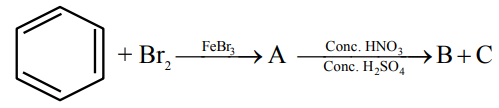
Answer: A-II, B-IV, C-I, D-III - 19. Method used for separation of mixture of products (B and C) obtained in the following reaction is:
 2026 Hard
- (A) Simple distillation
- (B) Sublimation
- (C) Steam distillation
- (D) Fractional distillation
Show answer and solution
Correct Answer: (D)
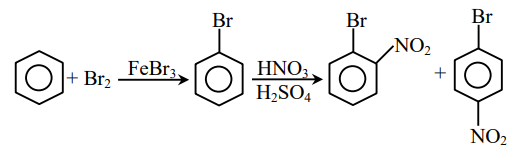
B & C separate by
Fractional Distillation method
Due to their different boiling point. -
- (A) \(0.42\)
- (B) \(0.82\)
- (C) \(0.62\)
- (D) \(0.12\)
Show answer and solution
Correct Answer: (D)
\(2\)-methylpropene reacts with dilute \(H_2SO_4\) to undergo hydration, forming tert-butyl alcohol as the major product (X).
The reaction is:
\(CH_2=C(CH_3)_2 \xrightarrow{\text{dil. } H_2SO_4} (CH_3)_3C-OH\)
Product (X) is an alcohol, which is significantly more polar than the starting alkene due to the presence of the \(-OH\) group. In normal phase chromatography, the stationary phase (such as silica gel) is highly polar. The polar \(-OH\) group forms strong hydrogen bonds with the stationary phase, causing the alcohol to be adsorbed more strongly than the non-polar alkene.
Consequently, the alcohol travels a shorter distance along the chromatography plate, resulting in a lower \(R_f\) value compared to the alkene.
Since the \(R_f\) value of \(2\)-methylpropene is \(0.42\), the \(R_f\) value of product (X) must be less than \(0.42\). Among the given choices, only \(0.12\) satisfies this condition.
Answer: \(0.12\) -
- (A) 40
- (B) 43
- (C) 45
- (D) 48
Show answer and solution
Correct Answer: (B)
Iodine gives violet colour
\(\%\) of \(I =\frac{\text { Atomic weight of } I }{\text { Molecular weight of } AgI } \times \frac{ m }{ W } \times 100\)
\(=\frac{127}{235} \times \frac{0.12}{0.15} \times 100\)
\(\%\) of \(I =43.23 \% \approx 43 \%\) -
- (A) 21
- (B) 0.42
- (C) 42
- (D) 0.21
Show answer and solution
Correct Answer: (C)
eq. of \(H_{2}SO_{4}\) = eq. of Ammonia
\(\Rightarrow \frac{15 \times 1 \times 2}{1000}\) = moles of ammonia \(\times 1\)
\(\Rightarrow\) Moles of ammonia = moles of 'N'
\(\Rightarrow\) Weight of nitrogen = \(\frac{15 \times 1 \times 2}{1000} \times 14 = 0.42\)
% weight of 'N' = \(\frac{0.42}{1} \times 100 = 42\)% - 23. 200 cc of \( x \times 10^{-3} M \) potassium dichromate is required to oxidise 750 cc of 0.6 M Mohr's salt solution in acidic medium. Here x = 2026 Medium
- (A) 125
- (B) 250
- (C) 375
- (D) 500
Show answer and solution
Correct Answer: (C)
\(M_1 V_1 n_1 = M_2 V_2 n_2\)
\(0.6 \times 750 \times 1 = x \times 10^{-3} \times 200 \times 6\)
\(450 = x \times 1.2\)
\(x = \frac{450}{1.2}\)
\(x = 375\)
-
- (A) 1
- (B) 2
- (C) 3
- (D) 4
Show answer and solution
Correct Answer: (C)
\(MnO _4^{-}+ I ^{-} \rightarrow MnO _2+ I _2\)
\(I _2+ S _2 O _3^{2-} \rightarrow S _4 O _6^{2-}+ I ^{-}\)
gram eq of \(KMnO _4=\) gram eq of \(Na _2 S_2 O _3\)
\(0.2 \times \frac{500}{1000} \times 3=0.1 \times V \times 1\)
\(V =3 L\) -
- (A) KI-starch
- (B) \(KMnO_4\)
- (C) \(Pb(CH_3COO)_2\)
- (D) \(K_2Cr_2O_7\)
Show answer and solution
Correct Answer: (D)
\(SO_2\) gas acts as a reducing agent. When a paper dipped in an acidified solution of potassium dichromate (\(K_2Cr_2O_7\)) is exposed to \(SO_2\) gas, the orange-colored dichromate ion (\(Cr_2O_7^{2-}\)) is reduced to the green-colored chromium(III) ion (\(Cr^{3+}\)).
The chemical reaction is:
\(K_2Cr_2O_7 + H_2SO_4 + 3SO_2 \rightarrow K_2SO_4 + Cr_2(SO_4)_3 + H_2O\)
The formation of chromium(III) sulfate, \(Cr_2(SO_4)_3\), is responsible for the green color.
Thus, the compound '\(X\)' is \(K_2Cr_2O_7\).
Answer: \(K_2Cr_2O_7\) -
- (A) \(Fe^{2+}\)
- (B) \(Zn^{2+}\)
- (C) \(Cr^{2+}\)
- (D) \(Fe^{3+}\)
Show answer and solution
Correct Answer: (D)
The borax bead test is given by transition metal ions that have unpaired electrons and form coloured compounds.
\(Zn^{2+}\) has a completely filled \(3d^{10}\) configuration, making it colourless, so it does not give a positive borax bead test.
The remaining ions and their electronic configurations are:
\(Fe^{2+} : [Ar] 3d^{6}\)
\(Cr^{2+} : [Ar] 3d^{4}\)
\(Fe^{3+} : [Ar] 3d^{5}\)
The ionisation enthalpy of an ion refers to the energy required to remove an electron from it. \(Fe^{3+}\) has a highly stable half-filled \(d\)-subshell configuration (\(3d^{5}\)). Removing an electron from this stable configuration requires significantly more energy compared to removing an electron from \(Fe^{2+}\) (\(3d^{6}\)) or \(Cr^{2+}\) (\(3d^{4}\)).
Therefore, \(Fe^{3+}\) shows a positive borax bead test and has the highest ionisation enthalpy among the given ions.
Answer: \(Fe^{3+}\) -
- (A) 11
- (B) 13
- (C) 15
- (D) 17
Show answer and solution
Correct Answer: (B)
\(A \rightarrow CrO _2 Cl _2\)
\(B \rightarrow Na _2 CrO _4\)
\(C \rightarrow CrO _5\)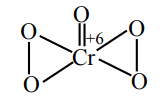
\(X=2, Y=5\) and \(Z=6\) -
- (A) \( Na_{2}[Pb(OH)_{2}], PbCrO_{4} \) and \( (NH_{4})_{2}[Pb(CH_{3}COO)_{4}] \)
- (B) \( PbCrO_{4}, Na_{2}[Pb(OH)_{4}] \) and \( [Pb(NH_{3})_{4}]SO_{4} \)
- (C) \( Na_{2}[Pb(OH)_{2}], PbCrO_{4} \) and \( [Pb(NH_{3})_{4}]SO_{4} \)
- (D) \( PbCrO_{4}, Na_{2}[Pb(OH)_{4}] \) and \( (NH_{4})_{2}[Pb(CH_{3}COO)_{4}] \)
Show answer and solution
Correct Answer: (D)
The reactions are as follows:
\( PbCl_{2}+K_{2}CrO_{4}\rightarrow PbCrO_{4}+2KCl \)
(Hot solution)
\( PbCrO_{4}+4NaOH \) (excess) \( (A) \rightarrow Na_{2}[Pb(OH)_{4}]+Na_{2}CrO_{4} \)
\( PbSO_{4}+4CH_{3}COONH_{4} \rightarrow(NH_{4})_{2}[Pb(CH_{3}COO)_{4}]+(NH_{4})_{2}SO_{4} \) -
- (A) \(Cr^{3+}>Fe^{3+}>Co^{3+}>Mn^{3+}\)
- (B) \(Mn^{3+}>Fe^{3+}>Co^{3+}>Cr^{3+}\)
- (C) \(Fe^{3+}>Co^{3+}>Mn^{3+}>Cr^{3+}\)
- (D) \(Cr^{3+}>Mn^{3+}>Fe^{3+}>Co^{3+}\)
Show answer and solution
Correct Answer: (D)
\(Co^{3+}\rightarrow3d^{6}\Rightarrow t_{2g}^{2,2,2}e_{g}^{0,0}\), unpaired electron \(=0\)
\(Fe^{3+}\rightarrow3d^{5}\Rightarrow t_{2g}^{2,2,1}e_{g}^{0,0}\) unpaired electron \(=1\)
\(Cr^{3+}\rightarrow3d^{3}\Rightarrow t_{2g}^{1,1,1}e_{g}^{0,0}\) unpaired electron \(=3\)
\(Mn^{3+}\rightarrow3d^{4}\Rightarrow t_{2g}^{2,1,1}e_{g}^{0,0}\) unpaired electron \(=2\) -
- (A) A and B Only
- (B) C, D and E Only
- (C) C and E Only
- (D) B and E Only
Show answer and solution
Correct Answer: (C)
The highest manganese fluoride is \(MnF_4\), where the oxidation state of Mn is \(+4\).
The highest manganese oxide is \(Mn_2O_7\), where the oxidation state of Mn is \(+7\).
The difference in oxidation states is \(|x| = |7 - 4| = 3\).
The number of unpaired electrons in the given ions are:
\(Sc^{3+}\): \([Ar] 3d^0 \Rightarrow 0\) unpaired electrons
\(Zn^{2+}\): \([Ar] 3d^{10} \Rightarrow 0\) unpaired electrons
\(V^{2+}\): \([Ar] 3d^3 \Rightarrow 3\) unpaired electrons
\(Fe^{2+}\): \([Ar] 3d^6 \Rightarrow 4\) unpaired electrons
\(Co^{2+}\): \([Ar] 3d^7 \Rightarrow 3\) unpaired electrons
Thus, \(V^{2+}\) (C) and \(Co^{2+}\) (E) have \(3\) unpaired electrons.
Answer: C and E Only -
- (A) A, B and C Only
- (B) A, C and D Only
- (C) A and C Only
- (D) B and D Only
Show answer and solution
Correct Answer: (B)
Statement A is correct. Potassium dichromate acts as a strong oxidising agent in acidic medium and oxidises \(Fe^{2+}\) to \(Fe^{3+}\), converting \(FeSO_4\) to \(Fe_2(SO_4)_3\).
Statement B is incorrect. Sodium dichromate is deliquescent (absorbs moisture from the atmosphere), which prevents it from being weighed accurately. Therefore, it cannot be used as a primary standard in volumetric estimation. Potassium dichromate is used instead.
Statement C is correct. Chromate (\(CrO_4^{2-}\)) and dichromate (\(Cr_2O_7^{2-}\)) ions are interconvertible in aqueous solution depending on the \(pH\) of the solution. In acidic medium, chromate changes to dichromate, and in basic medium, dichromate changes to chromate: \(2CrO_4^{2-} + 2H^+ \rightleftharpoons Cr_2O_7^{2-} + H_2O\).
Statement D is correct. The structure of the dichromate ion consists of two tetrahedral \(CrO_3\) groups joined by a bridging oxygen atom, and the \(Cr-O-Cr\) bond angle is \(126^\circ\).
Therefore, statements A, C, and D are correct.
Answer: A, C and D Only -
- (A) A, B, C and D
- (B) A, B and D Only
- (C) A, C and D Only
- (D) A, B and C Only
Show answer and solution
Correct Answer: (B)
\(Mn _2 O _7: Mn\) in +7 oxidation state.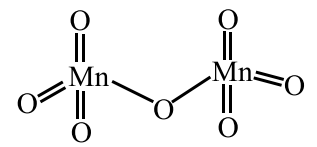
-
- (A) Both Statement I and Statement II are correct
- (B) Both Statement I and Statement II are incorrect
- (C) Statement I is correct but Statement II is incorrect
- (D) Statement I is incorrect but Statement II is correct
Show answer and solution
Correct Answer: (B)
Statement I is incorrect because first row transition metals utilise both 3d and 4s electrons for the formation of bonds between reactant molecules and atoms on the surface of the catalyst.
Statement II is incorrect because the increase in the concentration of reactants on the surface of the catalyst weakens the bonds in the reacting molecules, which lowers the activation energy.
Therefore, both Statement I and Statement II are incorrect.
Answer: Both Statement I and Statement II are incorrect -
- (A) Both Statement I and Statement II are correct
- (B) Both Statement I and Statement II are incorrect
- (C) Statement I is correct but Statement II is incorrect
- (D) Statement I is incorrect but Statement II is correct
Show answer and solution
Correct Answer: (A)
Statement I: The enthalpy of atomisation of transition metals depends on the strength of metallic bonding. A greater number of unpaired electrons in the d-orbitals leads to stronger metallic bonding, which results in a higher enthalpy of atomisation. Thus, Statement I is correct.
Statement II: \([Fe(H_2O)_6]^{3+}\) is an octahedral complex. In an octahedral crystal field, the d-orbitals split such that the \(t_{2g}\) set of orbitals (\(d_{xy}, d_{xz}, d_{yz}\)) has lower energy than the \(e_g\) set of orbitals (\(d_{x^2-y^2}, d_{z^2}\)). Therefore, \(d_{xy} = d_{xz} = d_{yz} < d_{x^2-y^2} = d_{z^2}\).
\([Ni(Cl)_4]^{2-}\) is a tetrahedral complex because \(Cl^{-}\) is a weak field ligand and the coordination number is \(4\). In a tetrahedral crystal field, the splitting is reversed compared to the octahedral field. The \(e\) set of orbitals (\(d_{x^2-y^2}, d_{z^2}\)) has lower energy than the \(t_2\) set of orbitals (\(d_{xy}, d_{xz}, d_{yz}\)). Therefore, \(d_{x^2-y^2} = d_{z^2} < d_{xy} = d_{xz} = d_{yz}\). Thus, Statement II is also correct.
Both Statement I and Statement II are correct.
Answer: Both Statement I and Statement II are correct -
- (A) Both Statement I and Statement II are true
- (B) Both Statement I and Statement II are false
- (C) Statement I is true but Statement II is false
- (D) Statement I is false but Statement II is true
Show answer and solution
Correct Answer: (B)
Statement I is false because sodium dichromate is deliquescent (absorbs moisture from the atmosphere) and cannot be weighed accurately, so it is not used as a primary standard. Potassium dichromate, however, is a primary standard.
Statement II is false because phenolphthalein is a weak organic acid, not a weak base. It remains largely undissociated in an acidic medium (colorless) and dissociates in a basic medium to give a pink color.
Therefore, both Statement I and Statement II are false.
Answer: Both Statement I and Statement II are false -
- (A) Both Statement-I and Statement-II are false.
- (B) Statement-I is true but Statement-II is false.
- (C) Both Statement-I and Statement-II are true.
- (D) Statement-I is false but Statement-II is true.
Show answer and solution
Correct Answer: (B)
\(Cr = (Ar)3d^{5}4s^{1}\)
\(Mn = (Ar)3d^{5}4s^{2}\)
\(IE_{1}(Cr) < IE_{1}(Mn)\)
\(IE_{2}(Cr) > IE_{2}(Mn)\)
\(IE_{3}(Cr) < IE_{3}(Mn)\) -
- (A) Statement I is true but Statement II is false
- (B) Statement I is false but Statement II is true
- (C) Both Statement I and Statement II are false
- (D) Both Statement I and Statement II are true
Show answer and solution
Correct Answer: (C)
\(Sc ^{3+} Ti ^{4+}\) and \(Zn ^{2+}\) are colourless
\(Th ^{4+}\) cannot act as a reducing agent. -
- (A) Both Statement I and Statement II are correct
- (B) Both Statement I and Statement II are incorrect
- (C) Statement I is correct but Statement II is incorrect
- (D) Statement I is incorrect but Statement II is correct
Show answer and solution
Correct Answer: (A)
For Statement I:
The electronic configurations of the given transition metal ions are:
\(\text{Ti}^{4+} : 3d^0\) (colourless due to absence of unpaired electrons)
\(\text{V}^{2+} : 3d^3\) (coloured)
\(\text{Mn}^{2+} : 3d^5\) (coloured)
\(\text{Fe}^{3+} : 3d^5\) (coloured)
\(\text{Cr}^{2+} : 3d^4\) (coloured)
The pairs in which both ions are coloured are \([\text{V}^{2+}, \text{Mn}^{2+}]\), \([\text{Mn}^{2+}, \text{Fe}^{3+}]\), and \([\text{V}^{2+}, \text{Cr}^{2+}]\). The pair \([\text{Ti}^{4+}, \text{V}^{2+}]\) contains \(\text{Ti}^{4+}\) which is colourless. Thus, there are exactly \(3\) pairs where both ions are coloured. Statement I is correct.
For Statement II:
The electronic configurations of the given f-block ions are:
\(\text{La}^{3+} : [\text{Xe}] 4f^0\) (diamagnetic)
\(\text{Yb}^{2+} : [\text{Xe}] 4f^{14}\) (diamagnetic)
\(\text{Lu}^{3+} : [\text{Xe}] 4f^{14}\) (diamagnetic)
\(\text{Ce}^{4+} : [\text{Xe}] 4f^0\) (diamagnetic)
\(\text{Ac}^{3+} : [\text{Rn}] 5f^0\) (diamagnetic)
\(\text{Lr}^{3+} : [\text{Rn}] 5f^{14}\) (diamagnetic)
All the given ions have either an \(f^0\) or \(f^{14}\) configuration, meaning they have no unpaired electrons and are diamagnetic. Therefore, in all \(3\) pairs, both ions are diamagnetic. Statement II is correct.
Both Statement I and Statement II are correct.
Answer: Both Statement I and Statement II are correct -
- (A) 7
- (B) 5
- (C) 9
- (D) 4
Show answer and solution
Correct Answer: (A)
\(V^{3+}=(A r)_{18} 3 d^2\)
\(Ti ^{2+}=( Ar )_{18} 3 d^2\)
\(Ni ^{2+}=( Ar )_{18} 3 d^8\)
\(Fe ^{2+}=( Ar )_{18} 3 d^6\)
\(Co ^{2+}=( Ar )_{18} 3 d^7\)
Only for \(Fe ^{2+}\) and \(Co ^{2+} \mu\) is more than 3.0 B.M.
\(Fe ^{2+} 3 d^6\)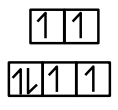 \(n =4, \mu>3\)
\(Co ^{2+} 3 d^7\)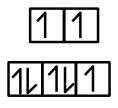 \(n =3, \mu>3\)
\(\therefore\) Number of unpaired electrons = 4 + 3 = 7 -
- (A) \( Mn_{2}O_{7} \) and \( MnO_{2} \)
- (B) \( MnO_{4}^{-} \) and MnO
- (C) \( MnO_{4}^{-} \) and \( MnO_{2} \)
- (D) \( Mn_{2}O_{7} \) and MnO
Show answer and solution
Correct Answer: (C)
\( 3MnO_{4}^{2-}+4H^{+} \rightarrow 2MnO_{4}^{-}+MnO_{2}+2H_{2}O \) -
- (A) 1
- (B) 2
- (C) 3
- (D) 4
Show answer and solution
Correct Answer: (C)
The magnetic nature of an ion depends on the presence of unpaired electrons. Ions with at least one unpaired electron are paramagnetic, while those with all paired electrons are diamagnetic.
Let us write the electronic configurations of the given ions:
\(Mn^{2+} (Z=25) : [Ar] 3d^5\) \(\rightarrow\) \(5\) unpaired electrons (Paramagnetic)
\(Cu^{2+} (Z=29) : [Ar] 3d^9\) \(\rightarrow\) \(1\) unpaired electron (Paramagnetic)
\(Zn^{2+} (Z=30) : [Ar] 3d^{10}\) \(\rightarrow\) \(0\) unpaired electrons (Diamagnetic)
\(Yb^{2+} (Z=70) : [Xe] 4f^{14}\) \(\rightarrow\) \(0\) unpaired electrons (Diamagnetic)
\(Sc^{3+} (Z=21) : [Ar] 3d^0\) \(\rightarrow\) \(0\) unpaired electrons (Diamagnetic)
\(La^{3+} (Z=57) : [Xe] 4f^0\) \(\rightarrow\) \(0\) unpaired electrons (Diamagnetic)
\(Gd^{3+} (Z=64) : [Xe] 4f^7\) \(\rightarrow\) \(7\) unpaired electrons (Paramagnetic)
\(Lu^{3+} (Z=71) : [Xe] 4f^{14}\) \(\rightarrow\) \(0\) unpaired electrons (Diamagnetic)
\(Ti^{4+} (Z=22) : [Ar] 3d^0\) \(\rightarrow\) \(0\) unpaired electrons (Diamagnetic)
\(Ce^{4+} (Z=58) : [Xe] 4f^0\) \(\rightarrow\) \(0\) unpaired electrons (Diamagnetic)
The paramagnetic ions are \(Mn^{2+}\), \(Cu^{2+}\), and \(Gd^{3+}\).
Total number of paramagnetic ions = \(3\).
Answer: \(3\) -
- (A) \(CrO_{2}Cl_{2}\) and +5
- (B) \(CrO_{2}Cl_{2}\) and +6
- (C) \(Cr_{2}O_{2}Cl_{2}\) and +6
- (D) \(Cr_{2}O_{2}Cl_{2}\) and +3
Show answer and solution
Correct Answer: (B)
\(4 NaCl + K _2 Cr _2 O _7+6 H _2 SO _4\)
\(\longrightarrow 2 KHSO _4+2 CrO _2 Cl _2+4 NaHSO _4+3 H _2 O\) (Chromyl chloride)
In Chromyl chloride Cr is in +6 oxidation state. -
- (A) B and C Only
- (B) A and B Only
- (C) A and D Only
- (D) A and C Only
Show answer and solution
Correct Answer: (D)
The electronic configurations of the given elements are:
Eu (63): [Xe] \(4f^7 6s^2\)
Gd (64): [Xe] \(4f^7 5d^1 6s^2\)
Dy (66): [Xe] \(4f^{10} 6s^2\)
Ho (67): [Xe] \(4f^{11} 6s^2\)
Tm (69): [Xe] \(4f^{13} 6s^2\)
Yb (70): [Xe] \(4f^{14} 6s^2\)
Lu (71): [Xe] \(4f^{14} 5d^1 6s^2\)
Hf (72): [Xe] \(4f^{14} 5d^2 6s^2\)
From the above configurations:
Eu and Gd both have 7 electrons in their \(4f\) orbitals.
Yb and Hf both have 14 electrons in their \(4f\) orbitals.
Dy and Ho have 10 and 11 electrons respectively in their \(4f\) orbitals.
Lu and Tm have 14 and 13 electrons respectively in their \(4f\) orbitals.
Thus, pairs A (Eu and Gd) and C (Yb and Hf) have the same number of electrons in their respective \(4f\) orbitals.
Answer: A and C Only -
- (A) A and B only
- (B) B and C only
- (C) A and D only
- (D) C and D only
Show answer and solution
Correct Answer: (B)
The electronic configuration of Cr is \([Ar] 3d^5 4s^1\) and Mn is \([Ar] 3d^5 4s^2\).
For the first ionization enthalpy, the electron is removed from the \(4s\) orbital. Mn has a fully filled \(4s^2\) configuration and a higher effective nuclear charge compared to Cr. Thus, the first ionization enthalpy of Mn is greater than that of Cr (\(\Delta_i H_1 :\) Mn \(>\) Cr). This makes statement C correct.
After the first ionization, the electronic configurations become:
\(Cr^+ : [Ar] 3d^5\)
\(Mn^+ : [Ar] 3d^5 4s^1\)
For the second ionization enthalpy, the electron is removed from the highly stable half-filled \(3d^5\) subshell in \(Cr^+\), whereas in \(Mn^+\), it is removed from the \(4s^1\) orbital. Removing an electron from a stable half-filled configuration requires significantly more energy. Thus, the second ionization enthalpy of Cr is greater than that of Mn (\(\Delta_i H_2 :\) Cr \(>\) Mn). This makes statement B correct.
Therefore, the correct statements are B and C.
Answer: B and C only -
- (A) A and B Only
- (B) A, C and D Only
- (C) C and D Only
- (D) B, C and D Only
Show answer and solution
Correct Answer: (C)
Statement A: Vanadium pentoxide (\(\text{V}_2\text{O}_5\)) is used as a catalyst in the manufacture of \(\text{H}_2\text{SO}_4\) by the Contact process. \(\text{V}_2\text{O}_5\) is an amphoteric oxide, not a basic oxide. Thus, statement A is incorrect.
Statement B: The transition metal halide used in Ziegler-Natta polymerization is \(\text{TiCl}_4\). In \(\text{TiCl}_4\), titanium is in the \(+4\) oxidation state with a \(3\text{d}^0\) electronic configuration. The number of unpaired electrons is zero, so its spin-only magnetic moment is \(0\) BM. Thus, statement B is incorrect.
Statement C: The p-block metal compound used in Ziegler-Natta polymerization is triethylaluminium, \(\text{Al}(\text{C}_2\text{H}_5)_3\). Aluminium is a p-block element and is in the \(+3\) oxidation state. Thus, statement C is correct.
Statement D: The metal halide employed in the Wacker process is \(\text{PdCl}_2\). Palladium (Pd) has the electronic configuration \([\text{Kr}] 4\text{d}^{10}\). In \(\text{PdCl}_2\), Pd is in the \(+2\) oxidation state, giving it a \(4\text{d}^8\) configuration. The number of electrons in the outermost d-orbital is \(8\). Thus, statement D is correct.
Therefore, only statements C and D are correct. -
- (A) A and B Only
- (B) C and D Only
- (C) B and D Only
- (D) A and C Only
Show answer and solution
Correct Answer: (C)
In d-block elements, the stability of higher oxidation states increases down a group. Therefore, \(Mo(VI)\) and \(W(VI)\) are more stable than \(Cr(VI)\). Statement A is incorrect.
The most stable oxidation state for lanthanoids is \(+3\). Ions like \(Ce^{4+}\) and \(Tb^{4+}\) tend to gain an electron to achieve the \(+3\) state, acting as oxidants. Conversely, \(Eu^{2+}\) and \(Yb^{2+}\) tend to lose an electron to achieve the \(+3\) state, acting as reductants. Statement B is correct.
The electronic configuration of \(Am\) is \([Rn] 5f^{7} 7s^{2}\), which has \(7\) unpaired electrons. The electronic configuration of \(Cm\) is \([Rn] 5f^{7} 6d^{1} 7s^{2}\), which has \(8\) unpaired electrons (\(7\) in \(5f\) and \(1\) in \(6d\)). Statement C is incorrect.
The \(5f\) electrons have a poorer shielding effect compared to \(4f\) electrons. As a result, the effective nuclear charge increases more significantly across the actinoid series, leading to a greater actinoid contraction from element to element than the lanthanoid contraction. Statement D is correct.
Thus, only statements B and D are correct.
Answer: B and D Only - 47. The oxidation state of chromium in the final product formed in the reaction between KI and acidified \( K_{2}Cr_{2}O_{7} \) solution is: 2026 Medium
- (A) \(+4\)
- (B) \(+3\)
- (C) \(+2\)
- (D) \(+6\)
Show answer and solution
Correct Answer: (B)
\( K_{2}Cr_{2}O_{7} + KI \xrightarrow{H^{+}} I_{2} + Cr^{3+} \) -
- (A) NO and \([\text{Fe(NO)}]\text{SO}_4\)
- (B) NO\(_2\) and \([\text{Fe(NO}_2)]\text{SO}_4\)
- (C) N\(_2\)O and \([\text{Fe(N}_2\text{O})]\text{SO}_4\)
- (D) N\(_2\)O\(_4\) and \([\text{Fe(N}_2\text{O}_4)]\text{SO}_4\)
Show answer and solution
Correct Answer: (A)
The brown ring test is used for the detection of nitrate (\(\text{NO}_3^-\)) or nitrite (\(\text{NO}_2^-\)) ions.
In this test, nitric oxide (NO) gas is evolved which reacts with the freshly prepared ferrous sulphate (\(\text{FeSO}_4\)) solution to form a brown ring of nitroso ferrous sulphate.
The gas \(X\) is NO.
The reaction is given by:
\(\text{FeSO}_4 + \text{NO} \rightarrow [\text{Fe(NO)}]\text{SO}_4\)
The actual composition of the brown ring complex is \([\text{Fe(H}_2\text{O})_5(\text{NO})]\text{SO}_4\), which is often represented as \([\text{Fe(NO)}]\text{SO}_4\).
Thus, \(X\) is NO and \(Y\) is \([\text{Fe(NO)}]\text{SO}_4\).
Answer: NO and \([\text{Fe(NO)}]\text{SO}_4\) - 49. Which of the following is NOT a physical or chemical characteristics of interstitial compounds? 2026 Easy
- (A) They have high melting points, higher than those of pure metals.
- (B) They are very soft and ionic in nature.
- (C) They retain metallic conductivity.
- (D) They are chemically inert and usually non-stoichiometric.
Show answer and solution
Correct Answer: (B)
Interstitial compounds are formed when small atoms like H, C, or N are trapped inside the crystal lattices of transition metals.
The principal physical and chemical characteristics of interstitial compounds are:
(i) They have high melting points, higher than those of pure metals.
(ii) They are very hard, and some borides approach diamond in hardness.
(iii) They retain metallic conductivity.
(iv) They are chemically inert.
(v) They are usually non-stoichiometric.
Therefore, the statement that they are very soft and ionic in nature is incorrect. They are very hard and are neither typically ionic nor covalent.
Answer: They are very soft and ionic in nature. -
- (A) 6
- (B) 10
- (C) 12
- (D) 8
Show answer and solution
Correct Answer: (C)
\(Cr _2 O _7^{2-}+14 H ^{+}+6 I ^{-} \rightarrow 2 Cr ^{3+}+3 I _2+7 H _2 O\)
no. of moles \(e ^{-}\)involved \(= x =6\)
\(Cr _2 O _7^{2-}+3 S^{2-}+14 H ^{+} \rightarrow+ S +2 Cr ^{3+}+7 H _2 O\)
No. of moles \(e ^{-}\) involved \(= y =6\)
Sum of \(x+y=6+6=12\)
No questions on this page match these filters.
Other years
Frequently asked
How many JEE Mains 2026 Chemistry questions are on ExamBro?
432 questions, each with the correct answer and a full solution.
Which JEE Mains 2026 Chemistry chapter is asked the most?
Co-ordination chemistry, with 32 questions, followed by D and f- block elements with 29.
How difficult are JEE Mains 2026 Chemistry questions?
24% are easy, 45% medium and 32% hard.