


Questions
12 questionsShowing 1–12 of 12 questions
-
- (A) 900
- (B) 950
- (C) 962
- (D) 942
Show answer and solution
Correct Answer: (C)
Initial pressure of \(\mathrm{N}_2 \mathrm{O}_5\)
\(\begin{aligned}
& =\frac{\frac{37.8}{108} \times 0.082 \times 500}{1}=14.35 \text { bar } \\
& 2 \mathrm{~N}_2 \mathrm{O}_5 \rightleftharpoons 2 \mathrm{~N}_2 \mathrm{O}_4+\mathrm{O}_2
\end{aligned}\)
\(\begin{array}{lll}\mathrm{t}=0 & 14.35 \\ \mathrm{t}=\mathrm{eq} & 14.35-2 \mathrm{P} & 2 \mathrm{P}\end{array}\)
\(\begin{aligned} & \mathrm{P}_{\text {Total }} \text { at eqb }=14.35+\mathrm{P}=18.65 \\ & \mathrm{P}=4.3 \\ & \mathrm{P}_{\mathrm{N}_2 \mathrm{O}_5}=5.75 \text { bar } \\ & \mathrm{P}_{\mathrm{N}_2 \mathrm{O}_4}=8.6 \mathrm{bar} \\ & \mathrm{P}_{\mathrm{O}_2}=4.3 \text { bar } \\ & \mathrm{k}_{\mathrm{p}}=\frac{(8.6)^2 \times(4.3)}{(5.75)^2}=9.619=\mathrm{x} \times 10^{-2} \\ & \mathrm{x}=961.9 \approx 962\end{aligned}\) -
- (A) 1.8 atm
- (B) 0.3 atm
- (C) 3 atm
- (D) 0.18 atm
Show answer and solution
Correct Answer: (A)
\(\begin{array}{lc}\mathrm{CO}_2(\mathrm{~g})+\mathrm{C}(\mathrm{s}) \rightleftharpoons & 2 \mathrm{CO}(\mathrm{g}) \\ 0.5 & - \\ 0.5-\mathrm{x} & 2 \mathrm{x}\end{array}\)
\(\begin{aligned}\mathrm{P}_{\text {total }}=0.5+\mathrm{x}=0.8 \\ \mathrm{x}=0.3 \\ \mathrm{~K}_{\mathrm{P}}=\frac{(0.6)^2}{0.2}=1.8\end{aligned}\) -
- (A) \(\sqrt[4]{\frac{2 K_p}{p}}\)
- (B) \(\sqrt[3]{\frac{2 K_{\mathrm{p}}}{\mathrm{p}}}\)
- (C) \(\sqrt[3]{\frac{2 \mathrm{~K}_{\mathrm{p}}^2}{\mathrm{p}}}\)
- (D) \(\sqrt{K_p}\)
Show answer and solution
Correct Answer: (C)
\(\begin{array}{lcc}
& \mathrm{AB}_2(\mathrm{g}) & \rightleftharpoons & \mathrm{AB}(\mathrm{g}) & + & \frac{1}{2} \mathrm{~B}_2(\mathrm{g}) \\
t=0 & p_0 & \\
t=t_{\text {eq }} & p_0(1-x) & & p_0 x & & \frac{p_0 x}{2}
\end{array}\)
\(\mathrm{p}=\mathrm{p}_0 \mathrm{x}-\mathrm{p}_0 \mathrm{x}+\mathrm{p}_0 \mathrm{x}+\frac{\mathrm{p}_0 \mathrm{x}}{2}\)
\(\begin{gathered}p=p_0\left(1+\frac{x}{2}\right) \\ p_0=\frac{p}{\left(1+\frac{x}{2}\right)} \\ K_p=\frac{\left(p_{A B}\right)\left(p_{B_2}\right)^{1 / 2}}{\left(p_{\mathrm{AB}_2}\right)} \\ K_p=\frac{\left(p_0 x\right)\left(\frac{p_0 x}{2}\right)^{1 / 2}}{p_0(1-x)}\end{gathered}\)
\(\mathrm{K}_{\mathrm{p}}=\frac{\frac{\mathrm{px}}{\left(1+\frac{x}{2}\right)}\left(\frac{\mathrm{p}}{1+\frac{x}{2}} \times \frac{\mathrm{x}}{2}\right)^{1 / 2}}{\frac{\mathrm{p}(1-\mathrm{x})}{\left(1+\frac{x}{2}\right)}}\)
Since \(x \ll 1\)
\(\begin{aligned}
& K_p=\frac{\mathrm{p}^{1 / 2} \mathrm{x}^{3 / 2}}{2^{1 / 2}} \\
& \mathrm{x}=\sqrt[3]{\frac{2 \mathrm{~K}_{\mathrm{p}}^2}{\mathrm{p}}}
\end{aligned}\) -
- (A) (A), (B) and (C) only
- (B) (A) and (B) only
- (C) (A), (B) and (D) only
- (D) (B) and (C) only
Show answer and solution
Correct Answer: (B)
\(\begin{aligned} & \mathrm{CO}(\mathrm{g})+3 \mathrm{H}_2 \rightleftharpoons \mathrm{CH}_4(\mathrm{~g})+\mathrm{H}_2 \mathrm{O}(\mathrm{g}) \\ & \Delta \mathrm{n}_{\mathrm{g}}=-2\end{aligned}\)
If pressure of system increases then according to Le-Chatelier's principle reaction will move in forward direction.
Concentration of reactant and products both increases but concentration of product increases more. -
- (A) If p value is extremely high compared to \(\mathrm{K}_{\mathrm{p}}, \alpha \approx 1\)
- (B) When \(p\) increases \(\alpha\) decreases
- (C) If \(k_p\) value is extremely high compared to \(p, \alpha\) becomes much less than unity
- (D) When \(p\) increases \(\alpha\) increases
Show answer and solution
Correct Answer: (B)
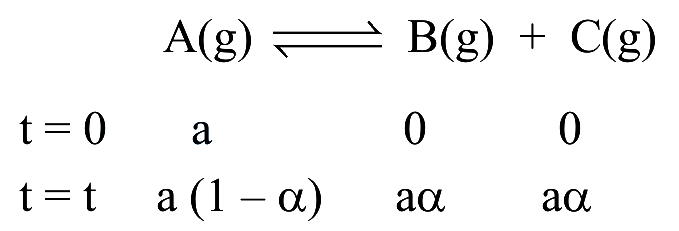
a moles of \(A(g)\) taken initially and at time Now moles fraction of \(\mathrm{A}(\mathrm{g}), \mathrm{B}(\mathrm{g})\) and \(\mathrm{C}(\mathrm{g})\) are
\(\begin{aligned}
& X_A=\frac{a-a \alpha}{a+a \alpha}=\frac{1-\alpha}{1+\alpha} \\
& X_B=\frac{a \alpha}{a+a \alpha}=\frac{\alpha}{1+\alpha} \\
& X_C=\frac{a \alpha}{a+a \alpha}=\frac{\alpha}{1+\alpha}
\end{aligned}\)
Now if \(P\) is total pressure then partial pressure o \(\mathrm{A}(\mathrm{g}), \mathrm{B}(\mathrm{g})\) and \(\mathrm{C}(\mathrm{g})\) are
\(\begin{aligned}
& \mathrm{P}_{\mathrm{A}}=\left(\frac{1-\alpha}{1+\alpha}\right) \mathrm{P} \\
& \mathrm{P}_{\mathrm{B}}=\left(\frac{\alpha}{1+\alpha}\right) \mathrm{P} \\
& \mathrm{P}_{\mathrm{C}}=\left(\frac{\alpha}{1+\alpha}\right) \mathrm{P} \\
& \mathrm{~K}_{\mathrm{P}}=\frac{\left(\frac{\alpha}{1+\alpha}\right) \mathrm{P}\left(\frac{\alpha}{1+\alpha}\right) \mathrm{P}}{\left(\frac{1-\alpha}{1+\alpha}\right) \mathrm{P}} \\
& \mathrm{~K}_{\mathrm{P}}=\frac{\alpha^2 \mathrm{P}}{1-\alpha^2}
\end{aligned}\)
As \(K_P\) is only function of temperature.
So as P \(\uparrow \quad \alpha \downarrow\) -
- (A) 70
- (B) 74
- (C) 76
- (D) 78
Show answer and solution
Correct Answer: (B)
\(\begin{array}{llll}
& \mathrm{CO}(\mathrm{g}) & + & 2 \mathrm{H}_2(\mathrm{g}) & \rightleftharpoons & \mathrm{CH}_3 \mathrm{OH}(\mathrm{g}) \\
\mathrm{t}=0 & 0.1 \mathrm{~mol} & & \mathrm{a} \mathrm{~mol} & & - \\
\mathrm{t}_{\text {eq }} & 0.1-\mathrm{x} & & \mathrm{a}-2 \mathrm{x} & & \mathrm{x}=0.04 \\
& =0.06 & & =\mathrm{a}-0.08 & \\
& & & =0.23-0.08 \\
& & & =0.15 \mathrm{~mole}
\end{array}\)
\(\begin{aligned} & \mathrm{V}=2 \mathrm{~L} \\ & \mathrm{~T}=500 \mathrm{~K} \\ & \mathrm{P}_{\text {total }}=5 \mathrm{bar} \\ & \mathrm{n}_{\text {Total }}=0.25=\frac{1}{4} \mathrm{~mol} \\ & \mathrm{P}_{\text {total }}=\mathrm{n}_{\text {total }} \times \frac{\mathrm{RT}}{\mathrm{V}} \\ & \Rightarrow 5=(0.06+\mathrm{a}-0.08+0.04) \times \frac{0.08 \times 500}{2} \\ & \Rightarrow 10=(0.02+\mathrm{a}) \times 0.08 \times 500\end{aligned}\)
\(\Rightarrow \mathrm{a}=0.25-0.02=0.23 \mathrm{~mol}.\)
\(\begin{aligned}
& \mathrm{K}_{\mathrm{P}}=\frac{\mathrm{X}_{\mathrm{CH}_3 \mathrm{OH}}}{\mathrm{X}_{\mathrm{CO}} \times \mathrm{X}_{\mathrm{H}_2}^2} \times \frac{1}{\left(\mathrm{P}_{\mathrm{T}}\right)^2}=\frac{0.04}{0.06 \times(0.15)^2} \times\left[\frac{1 / 4}{5}\right]^2 \\
& =\frac{4}{6 \times(0.15)^2 \times 16} \times \frac{1}{25} \\
& =\frac{100 \times 100}{24 \times 225 \times 25}=\frac{100 \times 100}{135000} \\
& =0.074=74 \times 10^{-3}
\end{aligned}\) -
- (A) \(x=\sqrt[3]{\frac{2 \mathrm{Kp}}{\mathrm{p}}}\)
- (B) \(x=\sqrt[3]{\frac{2 \mathrm{Kp}^2}{\mathrm{p}}}\)
- (C) \(x=\sqrt[3]{\frac{\mathrm{Kp}}{\mathrm{p}}}\)
- (D) \(x=\sqrt[3]{\frac{K \mathrm{p}}{2 \mathrm{p}}}\)
Show answer and solution
Correct Answer: (B)
\(\begin{aligned} & 1 \mathrm{~mol} \\ & \mathrm{X}_2 \mathrm{Y}(\mathrm{g}) \rightarrow \underset{\mathrm{x}}{\mathrm{X}} \mathrm{X}_2(\mathrm{~g})+\frac{1}{2} \mathrm{Y}_2(\mathrm{~g}) \\ & \frac{\mathrm{x}}{2} \\ & \therefore \quad P_{\mathrm{x}_2 \mathrm{y}} \\ & =\frac{1-\mathrm{x}}{1+\frac{x}{2}} \times \mathrm{p} \\ & P_{x_2}=\frac{x}{1+\frac{x}{2}} \times p\end{aligned}\)
\(\begin{aligned}
& P_{y_2}=\frac{x / 2}{1+\frac{x}{2}} \times p \\
\therefore \quad K_p= & \frac{\left(\frac{x}{1+\frac{x}{2}} p\right)\left(\frac{x}{2\left(1+\frac{x}{2}\right)} p\right)^{1 / 2}}{\left(\frac{1-x}{1+\frac{x}{2}}\right) \times p} \\
\therefore \quad & K_p=\left(\frac{x}{1-x}\right)\left(\frac{x}{2\left(1+\frac{x}{2}\right)}\right)^{1 / 2} \times p^{1 / 2}
\end{aligned}\)
\(\therefore \quad \mathrm{x}\) to be very small
\(\begin{aligned}
\therefore & K_p=\frac{x^{3 / 2}}{2^{(1 / 2)}} \times p^{1 / 2} \\
\therefore & x^{3 / 2}=\frac{K_p \times 2^{1 / 2}}{p^{1 / 2}} \\
& x^3=\frac{K_p^2 \times 2}{p} \\
& x=\left(\frac{K_p^2 \times 2}{p}\right)^{1 / 3}
\end{aligned}\) -
- (A) 5 times of initial pressure
- (B) \(5 / 2\) times of initial pressure
- (C) \(7 / 2\) times of initial pressure
- (D) \(7 / 4\) times of initial pressure
Show answer and solution
Correct Answer: (D)
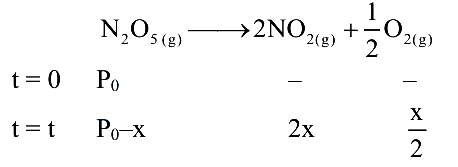
\(\begin{gathered}x=\frac{P_0}{2} \\ P_{\text {total }}=P_0-\frac{P_0}{2}+P_0+\frac{P_0}{4}=\frac{7}{4} P_0\end{gathered}\) -
- (A) Statement I is false but Statement II is true
- (B) Both Statement I and Statement II are true
- (C) Both Statement I and Statement II is false
- (D) Statement I is true but Statement II is false
Show answer and solution
Correct Answer: (B)
A catalyst can change equilibrium composition if it is added at constant pressure, but it can not change equilibrium constant. -
- (A) \(\mathrm{PCl}_5\) will increase
- (B) \(\mathrm{Cl}_2\) will decrease
- (C) \(\mathrm{PCl}_5, \mathrm{PCl}_3 \& \mathrm{Cl}_2\) remain constant
- (D) \(\mathrm{PCl}_3\) will increase
Show answer and solution
Correct Answer: (D)
On addition of inert gas at constant P & T, reaction moves in the direction of greater no. of moles so it will shift in forward direction, so \(\left[\mathrm{PCl}_5\right]\) decrease and \(\left[\mathrm{PCl}_3\right] \&\left[\mathrm{Cl}_2\right]\) will increase. -
- (A) 10
- (B) 15
- (C) 5
- (D) 20
Show answer and solution
Correct Answer: (C)
\(\begin{aligned} & \mathrm{H}_2 \mathrm{O}(\mathrm{g}) \rightleftharpoons \mathrm{H}_{2(\mathrm{~g})}+\frac{1}{2} \mathrm{O}_{2(\mathrm{~g})} \\ & \mathrm{t}=0 \quad 1 \mathrm{~mole} \\ & \mathrm{t}=\mathrm{t}_{\mathrm{eq}} \quad 1-\alpha \quad \alpha \quad \frac{\alpha}{2} \\ & \mathrm{n}_{\mathrm{T}}=1+\frac{\alpha}{2} \simeq 1(\alpha \ll 1) \\ & \mathrm{k}_{\mathrm{P}}=\frac{\mathrm{P}_{\mathrm{H}_2} \cdot \mathrm{P}_{\mathrm{O}_2}^{1 / 2}}{\mathrm{P}_{\mathrm{H}_2 \mathrm{O}}}=\frac{(\alpha \cdot \mathrm{P})\left(\frac{\alpha}{2} \mathrm{P}\right)^{\frac{1}{2}}}{(1-\alpha) \mathrm{P}} \\ & 8 \times 10^{-3}=\frac{\alpha^{3 / 2}}{\sqrt{2}} \\ & \alpha^{3 / 2}=8 \sqrt{2} \times 10^{-3} \\ & \alpha^3=128 \times 10^{-6} \\ & \alpha=\sqrt[3]{128} \times 10^{-2} \\ & =5.03 \times 10^{-2}\end{aligned}\) -
- (A) 20
- (B) 25
- (C) 30
- (D) 35
Show answer and solution
Correct Answer: (B)
\(\begin{aligned}
& \quad \mathrm{HX}_{(\mathrm{aq)}} \rightleftharpoons \mathrm{H}_{(\mathrm{aq})}^{+}+\mathrm{X}_{(\mathrm{aq})}^{-} \quad \mathrm{K}_{\mathrm{a}}=4 \times 10^{-10} \\
& 0.01(1-\alpha) \quad 0.01 \alpha \quad 0.01 \alpha \quad \text { Not justified } \\
& \Rightarrow 0.01 \alpha=10^{-5} \Rightarrow \alpha=10^{-3} \\
& \mathrm{~K}_{\mathrm{a}}=0.01 \alpha^2=10^{-8}
\end{aligned}\)
On dilution let final concentration of \(\mathrm{HX}=\mathrm{c} \mathrm{M}\)
\(\begin{aligned}
& \mathrm{Hx}_{(\mathrm{an})} \rightleftharpoons \mathrm{H}_{(\mathrm{aq})}^{+}+\mathrm{X}_{(\mathrm{an})}^{-} \\
& \mathrm{C}(1-\alpha) \quad \mathrm{C} \alpha \quad \mathrm{C} \alpha \\
& \Rightarrow \mathrm{C} \alpha=10^{-6}...(1) \\
& \quad \frac{\mathrm{C} \alpha^{2}}{1-\alpha}=\mathrm{K}_{\mathrm{a}}=10^{-8}...(2) \\
& \Rightarrow \frac{10^{-6} \alpha}{1-\alpha}=10^{-8}
\end{aligned}\)
Data given is inconsistent \& contradictory. This should be bonus.
No questions on this page match these filters.