


All JEE Mains 2025 Chemistry questions
26 chaptersShowing 251–300 of 381 questions
-
- (A) 120
- (B) 122
- (C) 124
- (D) 125
Show answer and solution
Correct Answer: (D)
Moles of solute \(=\frac{70}{70}=1\)
Volume of solution \(=\frac{100}{1.25}=80 \mathrm{~mL}\)
\(\begin{aligned}
& M=\frac{1}{80} \times 1000=12.5 \\
& M=125 \times 10^{-1}
\end{aligned}\) -
- (A) 25
- (B) 50
- (C) 75
- (D) 100
Show answer and solution
Correct Answer: (C)
Normal molar mass of \(\mathrm{MX}_2=164.0 \mathrm{~g} \mathrm{~mol}^{-1}\)
Observed molar mass of \(\mathrm{MX}_2=65.6 \mathrm{~g} \mathrm{~mol}^{-1}\)
\(\begin{aligned}
& \text { Van't Hoff factor }(\mathrm{i})=\frac{\text { Normal molar mass }}{\text { Observed molar mass }} \\
& =\frac{164}{65.6}=2.5
\end{aligned}\)
If \(\alpha\) is the degree of ionisation, then
\(\begin{aligned}
& \underset{1-\alpha}{\mathrm{MX}_2} \rightleftharpoons \mathrm{M}_\alpha^{2+}+\underset{2 \alpha}{2 \mathrm{X}^{-}} \\
& \mathrm{i}=1-\alpha+\alpha+2 \alpha=1+2 \alpha \\
& 1+2 \alpha=2.5 \\
& \alpha=0.75
\end{aligned}\)
\(\therefore\) Percent degree of ionisation \(=75 \%\) -
- (A) 11
- (B) 22
- (C) 33
- (D) 44
Show answer and solution
Correct Answer: (C)
\(\mathrm{MX}_3 \rightarrow \mathrm{M}^{+3}+3 \mathrm{X}^{\ominus}\)
\(\begin{aligned} & \mathrm{i}=1+(\mathrm{n}-1) \alpha \\ & \mathrm{i}=1+(4-1) \alpha=2\end{aligned}\)
\(\alpha=\frac{1}{3}=33.33 \% \approx 33 \%\) -
- (A) \(3.72 \mathrm{~K} \mathrm{~kg} \mathrm{~mol}^{-1}\)
- (B) \(1.86 \mathrm{~K} \mathrm{~kg} \mathrm{~mol}^{-1}\)
- (C) \(4.43 \mathrm{~K} \mathrm{~kg} \mathrm{~mol}^{-1}\)
- (D) \(5.12 \mathrm{~K} \mathrm{~kg} \mathrm{~mol}^{-1}\)
Show answer and solution
Correct Answer: (D)
\(\begin{aligned} \Delta \mathrm{T}_{\mathrm{f}} & =\mathrm{K}_{\mathrm{b}} \cdot \mathrm{m} \\ 0.4 & =\mathrm{K}_{\mathrm{b}} \frac{\frac{1}{256}}{50 \times 10^{-3}} \\ \mathrm{~K}_{\mathrm{b}} & =5.12 \mathrm{~K} \mathrm{~kg} / \mathrm{mol}\end{aligned}\) -
- (A) 20
- (B) 30
- (C) 35
- (D) 25
Show answer and solution
Correct Answer: (D)
For AB
\(\begin{aligned}
& \Delta \mathrm{T}_{\mathrm{b}}=2.7 \mathrm{~K} \\
& 2.7=1 \times 0.5 \times \mathrm{m} \\
& \mathrm{~m}=\frac{27}{5}
\end{aligned}\)
Let molar mass of \(\mathrm{AB}=\mathrm{x}\).
\(\begin{aligned}
& \text { So } \frac{1 / x}{15} \times 1000=\frac{27}{5} \\
& x=12.34
\end{aligned}\)
For \(\mathrm{AB}_2\)
\(\begin{aligned}
& \Delta \mathrm{T}_{\mathrm{b}}=1.5 \mathrm{~K} \\
& 1.5=1 \times 0.5 \times \mathrm{m} \\
& \mathrm{~m}=3
\end{aligned}\)
Let molar mass of \(\mathrm{AB}_2=\mathrm{y}\)
So \(\frac{1 / \mathrm{y}}{15} \times 1000=3\)
\(\begin{aligned}
& y=\frac{1000}{45} \\
& y=22.22
\end{aligned}\)
Now let a and b be atomic masses of A and B respectively, then
\(\begin{aligned}
& \mathrm{A}+\mathrm{b}=12.34 \quad...(i)\\
& \mathrm{~A}+2 \mathrm{~b}=22.22 \quad...(ii) \\
& \mathrm{~B}=22.22-12.34=9.88 \\
& \text { Now } \mathrm{a}=12.34-9.88=2.46 \\
& =24.6 \times 10^{-1}=25 \times 10^{-1}
\end{aligned}\) -
- (A) 0.8
- (B) 0.4
- (C) 0.2
- (D) 0.6
Show answer and solution
Correct Answer: (D)
\(\begin{aligned} & \because \mathrm{P}^{\circ}-\mathrm{P} \propto \mathrm{X}_{\text {solute }} \\ & \text { and } \because 10 \propto 0.2 \\ & \therefore 20 \propto 0.4 \\ & \therefore \mathrm{X}_{\text {solvent }}=1-\mathrm{X}_{\text {solute }} \\ & \quad=1-0.4 \\ & \quad=0.6\end{aligned}\) - 257. Which of the following binary mixture does not show the behaviour of minimum boiling azeotropes? 2025 Easy
- (A) \(\mathrm{H}_2 \mathrm{O}+\mathrm{CH}_3 \mathrm{COC}_2 \mathrm{H}_5\)
- (B) \(\mathrm{C}_6 \mathrm{H}_5 \mathrm{OH}+\mathrm{C}_6 \mathrm{H}_5 \mathrm{NH}_2\)
- (C) \(\mathrm{CS}_2+\mathrm{CH}_3 \mathrm{COCH}_3\)
- (D) \(\mathrm{CH}_3 \mathrm{OH}+\mathrm{CHCl}_3\)
Show answer and solution
Correct Answer: (B)
Binary mixture of \(\mathrm{C}_6 \mathrm{H}_5 \mathrm{OH}\) and \(\mathrm{C}_6 \mathrm{H}_5 \mathrm{NH}_2\) shows negative deviation from Raoult's law
So vapour pressure of solution is less than V.P of pure \(\mathrm{C}_6 \mathrm{H}_5 \mathrm{OH} \& \mathrm{C}_6 \mathrm{H}_5 \mathrm{NH}_2\)
So B.P. of solution is greater than boiling point of pure \(\mathrm{C}_6 \mathrm{H}_5 \mathrm{OH} \& \mathrm{C}_6 \mathrm{H}_5 \mathrm{NH}_2\)
So shows maximum Boiling azeotrope. -
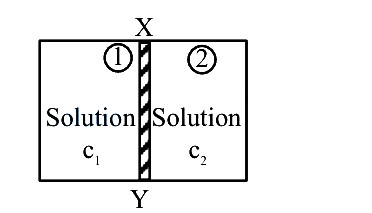
- (A) B and D only
- (B) A and D only
- (C) A and C only
- (D) C only
Show answer and solution
Correct Answer: (C)
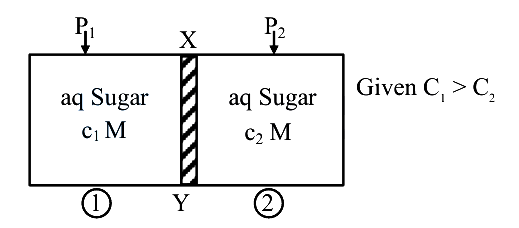
Normal osmosis occurs from (2) to (1)
For reverse osmosis from (1) to (2)
Pressure : \(\mathrm{P}_1 \gt \pi\)
\(\therefore\) Answer [A & C] only -
- (A) 200
- (B) 320
- (C) 100
- (D) 150
Show answer and solution
Correct Answer: (C)
Organic compound \(\xrightarrow{\text { combustion }} \underset{\substack{\mathrm{0.9} \mathrm{gm}}}{\mathrm{H}_2 \mathrm{O}}\)
\(\therefore\) mole of \(\mathrm{H}_2 \mathrm{O}=\frac{0.9}{18}=0.05 \mathrm{~mole}\)
\(\therefore\) mole of H in \(\mathrm{H}_2 \mathrm{O}=0.05 \times 2=0.1\) mole
\(=\) mole of H in 0.01 mole
Organic compound
\(\therefore\) wt of H atom in 0.01 mole compound \(=0.1 \times 1\) \(=0.1 \mathrm{gm}\)
\(\therefore\) wt of H atom in one mole compound
\(=\frac{0.1}{0.01}=10 \mathrm{gm}\)
\(\because \mathrm{wt} . \%\) of \(\mathrm{H}=\frac{\mathrm{wt} \text {. of } \mathrm{H} \text { in one mole compound }}{\text { Molar mass of compound }} \times 1\)
\(\begin{aligned}
& 10=\frac{10}{M} \times 100 \\
& \therefore M=100
\end{aligned}\) -
- (A) 375
- (B) 372
- (C) 370
- (D) 376
Show answer and solution
Correct Answer: (B)
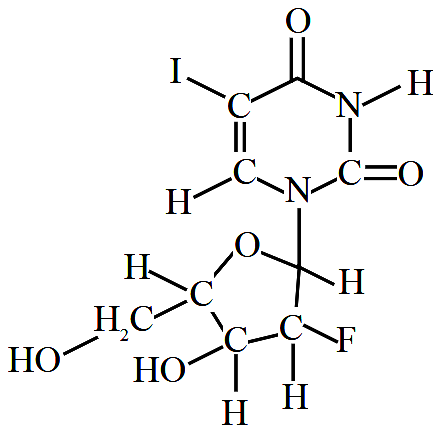
\(\begin{aligned} & \text {Molar mass }=372 \mathrm{gm} \\ & \therefore 0.1 \text { mole has }=372 \times 10^{-1} \mathrm{gm}\end{aligned}\) -
- (A) 98 .3 mg
- (B) 48.2 mg
- (C) 196 .2 mg
- (D) 150 .4 mg
Show answer and solution
Correct Answer: (C)
Moles of removed \(\mathrm{CO}_2=\frac{10^{21}}{6.02 \times 10^{23}} \mathrm{~mol}\)
\(=1.66 \times 10^{-3} \mathrm{~mol}\)
mole of \(\mathrm{CO}_2\) left \(=2.8 \times 10^{-3} \mathrm{moles}\) total moles of \(\mathrm{CO}_2\) taken initially
\(=(2.8+1.66) \times 10^{-3} \mathrm{~mol}\)
mass of \(\mathrm{CO}_2\) taken initially
\(\begin{aligned}
& =4.46 \times 10^{-3} \times 44 \\
& =196.24 \times 10^{-3} \mathrm{~g} \\
& =196.24 \mathrm{mg}
\end{aligned}\) -
- (A) Po
- (B) Pr
- (C) Pb
- (D) Pt
Show answer and solution
Correct Answer: (B)
\(\text { No. of atoms }=\frac{\text { Massin } g}{\operatorname{Molar} \operatorname{Mas}(\mathrm{~g} / \mathrm{mol})} \times \mathrm{N}_{\mathrm{A}}\)
Therefore for the same Mass element having the least Molar mass will have the higher no. of atoms.
- \(\mathrm{M}_{\mathrm{Po}}=209\)
- \(\mathrm{M}_{\mathrm{Pr}}=141\)
- \(\mathrm{M}_{\mathrm{Pb}}=207\)
- \(\mathrm{M}_{\mathrm{Pt}}=195\) -
- (A) 3.908 g
- (B) 2.636 g
- (C) 10.545 g
- (D) 5.272 g
Show answer and solution
Correct Answer: (C)
\(\begin{aligned}
& \mathrm{CaCO}_3+2 \mathrm{HCl} \rightarrow \mathrm{CaCl}_2+\mathrm{CO}_2+\mathrm{H}_2 \mathrm{O} \\
& \text { Moles of } \mathrm{CaCO}_3=\frac{1000}{100}=10
\end{aligned}\)
Moles of \(\mathrm{HCl}=0.76 \times \frac{250}{1000}=0.19\) (L.R.)
Moles of \(\mathrm{CaCl}_2\) formed \(=\frac{0.19}{2}\)
Mass of \(\mathrm{CaCl}_2=\frac{0.19}{2} \times 111=10.545 \mathrm{gm}\) -
- (A) (A), (D) and (E) Only
- (B) (C), (D) and (E) Only
- (C) (A), (B) and (C) Only
- (D) (B), (C) and (D) Only
Show answer and solution
Correct Answer: (B)
Mass of substance is amount of matter present in it. Weight is force exerted by gravity on object. -
- (A) 400
- (B) 420
- (C) 440
- (D) 460
Show answer and solution
Correct Answer: (B)
\(\begin{aligned}
& \text { moles of } \mathrm{Fe}_3 \mathrm{O}_4=\frac{2.32 \times 10^3 \times 10^3}{232}=10000 \mathrm{~mol} \\
& \text { moles of } \mathrm{CO}=\frac{2.8 \times 10^2 \times 10^3}{28}=10000 \mathrm{~mol} \\
& \mathrm{Fe}_3^3 \mathrm{O}_4+4 \mathrm{CO} \longrightarrow 3 \mathrm{Fe}+4 \mathrm{CO}_2 \\
& 10^4 \mathrm{~mol} \quad 10^4 \mathrm{~mol}
\end{aligned}\)
CO is L.R.
mole of \(\mathrm{Fe}=\frac{3}{4} \times 10^4\)
mass of \(\mathrm{Fe}=\frac{3}{4} \times \frac{10^4 \times 56}{1000} \mathrm{~kg}=420 \mathrm{~kg}\) -
- (A) 235.7 g
- (B) 0.24 mg
- (C) 236 mg
- (D) 2.444 g
Show answer and solution
Correct Answer: (C)
\(\mathrm{Mg}+2 \mathrm{HCl} \rightarrow \mathrm{MgCl}_2+\mathrm{H}_2\)
Volume \(\mathrm{H}_2\) evolved \(=220 \mathrm{ml}\)
Mole of \(\mathrm{H}_2=\frac{220 \times 10^{-3}}{22.4}=\) mole of Mg used
\(\begin{aligned}
\therefore \text { Mass of Mg used } & =\frac{220 \times 10^{-3}}{22.4} \times 24 \\
& =235.7 \times 10^{-3} \mathrm{gm} \\
& =235.7 \mathrm{mg}
\end{aligned}\) -
- (A) 30
- (B) 45
- (C) 60
- (D) 15
Show answer and solution
Correct Answer: (A)
Moles of ' C ' \(=\mathrm{n}_{\mathrm{CO}_2}=\frac{1.46}{44}=0.033\)
Moles of ' C ' \(=\mathrm{W}_{\mathrm{C}}=0.033 \times 12\)
Moles of 'H' \(=2 \times \mathrm{n}_{\mathrm{H}_2 \mathrm{O}}=2 \times \frac{0.567}{18}=0.063\)
Mass of ' H ' \(=0.0063\)
Mass of Oxygen \((\mathrm{O})=1-\left(\mathrm{W}_{\mathrm{c}}+\mathrm{W}_{\mathrm{H}}\right)\) \(=1-(0.033 \times 12+0.063 \times 1)=0.541 \mathrm{gm}\)
Moles of ' O ' \(=\frac{0.541}{16}=0.033\)
Empirical formula \(=\mathrm{CH}_2 \mathrm{O}\)
Empirical formula mass \(=30\). -
- (A) 1655
- (B) 1600
- (C) 1650
- (D) 1645
Show answer and solution
Correct Answer: (A)
\(\begin{array}{ll:cccl} & \mathrm{C} & \mathrm{Cl} & \mathrm{H} & \mathrm{O} & \\ \text { %mass } & 14.5 & 64.46 & 1.8 & 19.24\end{array}\)
Molar ratio \(\frac{14.5}{12} \quad \frac{64.46}{35.5} \quad \frac{1.8}{1} \quad \frac{19.24}{16}\)
\(\begin{aligned}
&\begin{array}{ccccc}
& 1.2 & 1.8 & 1.8 & 1.2 \\
\text { Minimum } & 2 & 3 & 3 & 2
\end{array}\\
&\text { integral ratio }
\end{aligned}\)
\(\begin{aligned} & \text { Empiricial formula }=\mathrm{C}_2 \mathrm{H}_3 \mathrm{Cl}_3 \mathrm{O}_2 \\ & \text { Mass }=165.5 \\ & \text { Mass }=1655 \times 10^{-1}\end{aligned}\) -
- (A) 60
- (B) 63
- (C) 66
- (D) 67
Show answer and solution
Correct Answer: (B)
\(\begin{aligned} & \mathrm{CaCO}_3 \rightarrow \mathrm{CaO}+\mathrm{CO}_2 \\ & \text { mass of } \mathrm{CaCO}_3=\frac{150 \times 75}{100}=112.5 \mathrm{~kg} \\ & =112500 \mathrm{~g} \\ & \mathrm{n}_{\mathrm{CaCO}_3}=1125 \\ & \mathrm{So} \text { moles of } \mathrm{CaO}=1125 \\ & \quad \text { mass of } \mathrm{CaO}=\frac{1125 \times 56}{1000}=63 \mathrm{~kg} \\ & \text { Correct answer } \Rightarrow 63\end{aligned}\) -
- (A) \(\mathrm{C}_4 \mathrm{H}_9 \mathrm{O}_3\)
- (B) \(\mathrm{C}_6 \mathrm{H}_{12} \mathrm{O}_6\)
- (C) \(\mathrm{C}_4 \mathrm{H}_8 \mathrm{O}_2\)
- (D) \(\mathrm{C}_6 \mathrm{H}_{12} \mathrm{O}_3\)
Show answer and solution
Correct Answer: (D)
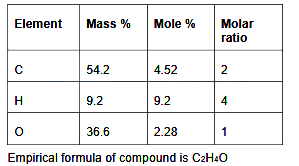
Molecular mass of compound \(=132 \mathrm{~g} \mathrm{~mol}^{-1}\) Molecular formula of compound is \(\left(\mathrm{C}_2 \mathrm{H}_4 \mathrm{O}\right)_n\)
\(\mathrm{n}=\frac{\text { Molecular mass }}{\mathrm{EF} \text { mass }}=\frac{132}{44}=3\)
\(\therefore\) Molecular formula of compound is \(\mathrm{C}_6 \mathrm{H}_{12} \mathrm{O}_3\) -
- (A) 60
- (B) 65
- (C) 70
- (D) 75
Show answer and solution
Correct Answer: (B)
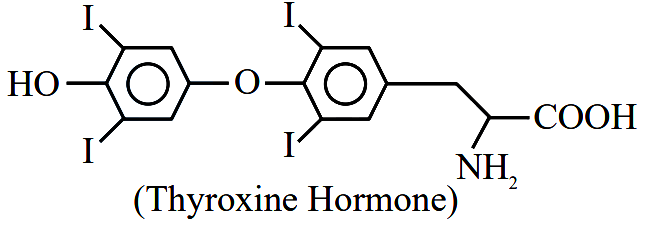
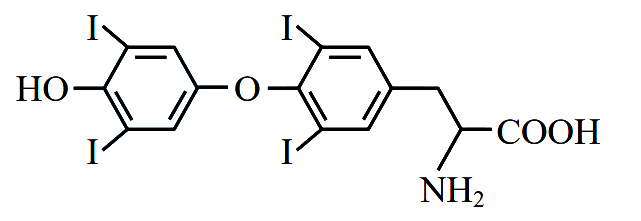
\(\rightarrow\) Molecular formula of Thyroxine \(\Rightarrow\) \(\mathrm{C}_{15} \mathrm{H}_{11} \mathrm{O}_4 \mathrm{NI}_4\)
\(\rightarrow\) Molecular mass of Thyroxine -
\(\begin{aligned} & \mathrm{C} \rightarrow 15 \times 12=180 \\ & \mathrm{H} \rightarrow 11 \times 1=11 \\ & \mathrm{O} \rightarrow 16 \times 4=64 \\ & \mathrm{~N} \rightarrow 14 \times 1=14 \\ & \mathrm{I} \rightarrow 127 \times 4=508\end{aligned}\)
\(\rightarrow\) Molecular mass of Thyroxine \(\Rightarrow 777\)
\(\begin{aligned}& \rightarrow \% \text { of Iodine }=\frac{508}{777} \times 100 \\& =65.38 \%\end{aligned}\)
Nearest integer \(=65\) -
- (A) 150
- (B) 153
- (C) 145
- (D) 140
Show answer and solution
Correct Answer: (B)
\(\begin{aligned} & 4 \mathrm{Al}+3 \mathrm{O}_2 \longrightarrow 2 \mathrm{Al}_2 \mathrm{O}_3 \\ & \frac{81}{27}=3 \text { mole } \frac{128}{32}=4 \mathrm{~mole}\end{aligned}\)
Limiting reagent
\(\begin{aligned}
& \therefore \text { mole of } \mathrm{Al}_2 \mathrm{O}_3 \text { formed }=\frac{1}{2} \times 3 \text { mole } \\
& \therefore \text { wt. of } \mathrm{Al}_2 \mathrm{O}_3 \text { formed }=\frac{3}{2} \times 102 \\
& \quad=153 \mathrm{gm}
\end{aligned}\) -
- (A) 15
- (B) 16
- (C) 17
- (D) 27
Show answer and solution
Correct Answer: (D)
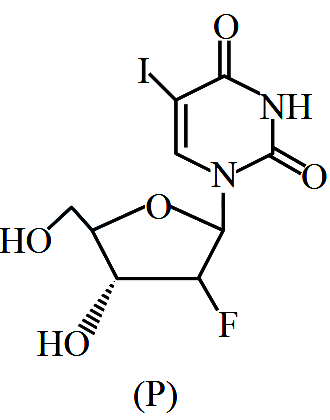
So, the total number of sigma \((\sigma)\) bonds present in compound X is 27. -
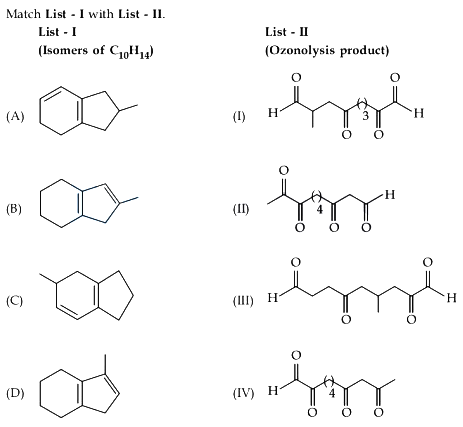
- (A) (A)-(I), (B)-(IV), (C)-(III), (D)-(II)
- (B) (A)-(III), (B)-(II), (C)-(I), (D)-(IV)
- (C) (A)-(III), (B)-(IV), (C)-(I), (D)-(II)
- (D) (A)-(II), (B)-(III), (C)-(I), (D)-(IV)
Show answer and solution
Correct Answer: (C)
Ozonolysis product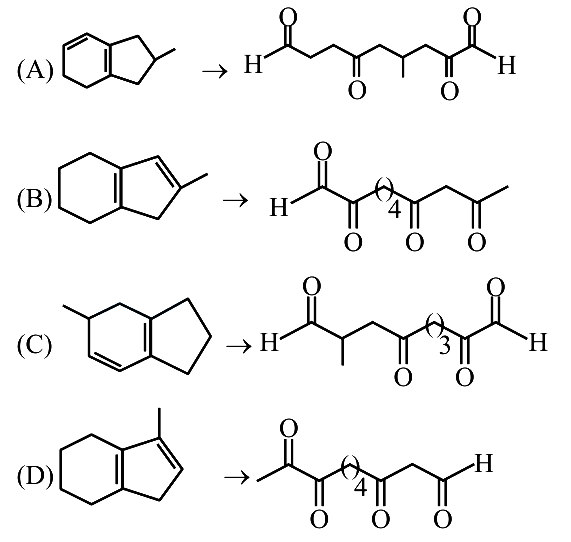
-
- (A) R
- (B) P
- (C) Q
- (D) S
Show answer and solution
Correct Answer: (C)
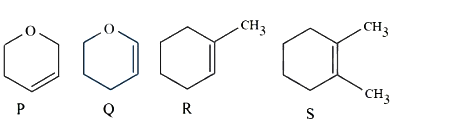
Addition of \(\mathrm{H}-\mathrm{Br}_{(\mathrm{aq})}\) to alkene follows electrophilic addition mechanism. In the rate determining step a carbocation intermediate is formed. Among P, Q, R & S compound Q will form most stable carbocation intermediate since it is resonance stabilized.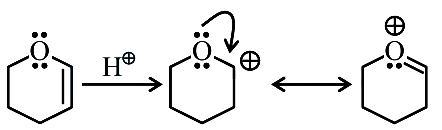
-
- (A) Statement I is correct but Statement II is incorrect
- (B) Both Statement I and Statement II are correct
- (C) Both Statement I and Statement II are incorrect
- (D) Statement I is incorrect but Statement II is correct
Show answer and solution
Correct Answer: (B)
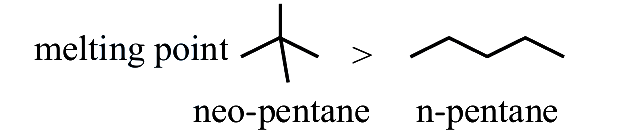
Both Statement-I and Statement-II are correct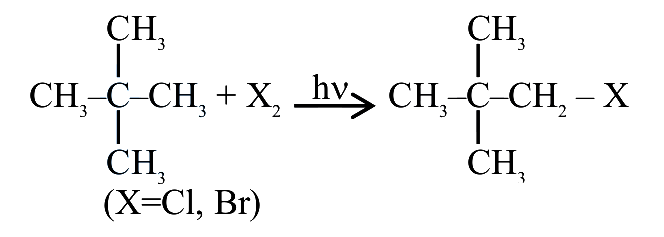
-
- (A) Both Statement I and Statement II are true
- (B) Statement I is false but Statement II are true
- (C) Statement I is true but Statement II is false
- (D) Both Statement I and Statement II are false
Show answer and solution
Correct Answer: (C)
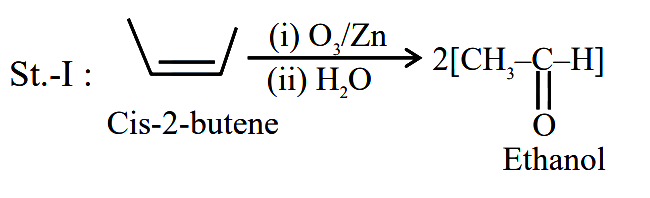
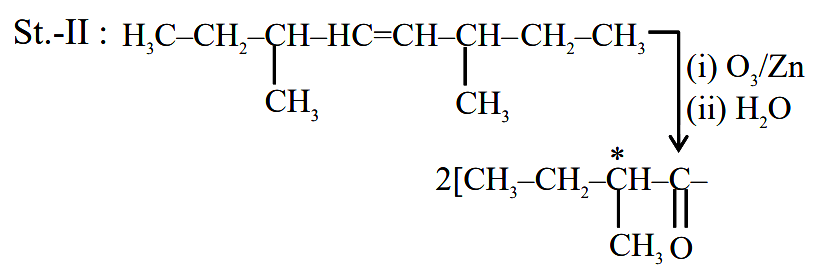
St-I : Correct statement
St-II : In correct statement because product has chiral centre. -
- (A) \(2\)
- (B) \(1\)
- (C) \(4\)
- (D) \(3\)
Show answer and solution
Correct Answer: (C)
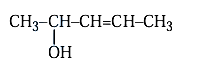
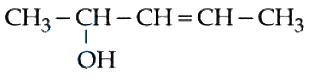
It has 4 stereoisomers \(\left[\begin{array}{ll}R \text { cis } & \mathrm{R} \text { trans } \\ \mathrm{Scis} & \text { Strans }\end{array}\right]\) -
- (A) (A) only
- (B) (A), (B) and (E) only
- (C) (A) and (C) only
- (D) (A), (C) and (D) only
Show answer and solution
Correct Answer: (D)
Explanation:
Let us analyze each statement for electrophilic aromatic substitution on a benzene ring:
1. Statement (A) is correct: Both \(-\text{OCH}_3\) and \(-\text{NHCOCH}_3\) have lone pairs on the heteroatom directly attached to the benzene ring. They donate electron density via the resonance effect (\(+R\)), which outweighs their inductive withdrawal (\(-I\)), making them ring-activating.
2. Statement (B) is incorrect: While \(-\text{CN}\) is meta-directing, the \(-\text{OH}\) group is a powerful ortho/para-directing group due to strong resonance electron donation.
3. Statement (C) is correct: Both \(-\text{CN}\) and \(-\text{SO}_3\text{H}\) are electron-withdrawing groups due to the combined \(-R\) and \(-I\) effects, which deactivates the ring and directs incoming electrophiles to the meta position.
4. Statement (D) is correct: Activating groups increase electron density specifically at the ortho and para positions via resonance, making them ortho- and para-directing.
5. Statement (E) is incorrect: Halides (\(-\text{Cl}\), \(-\text{Br}\), etc.) possess lone pairs and display a \(+R\) effect, but they are also highly electronegative, causing a very dominant inductive electron-withdrawing effect (\(-I\)). For halogens, the \(-I\) effect outweighs the \(+R\) effect. Consequently, they act as net deactivating groups, even though they direct incoming groups to the ortho/para positions.
Hence, statements (A), (C), and (D) are correct, making Option D the right choice. - 280. The reactions which cannot be applied to prepare an alkene by elimination, are
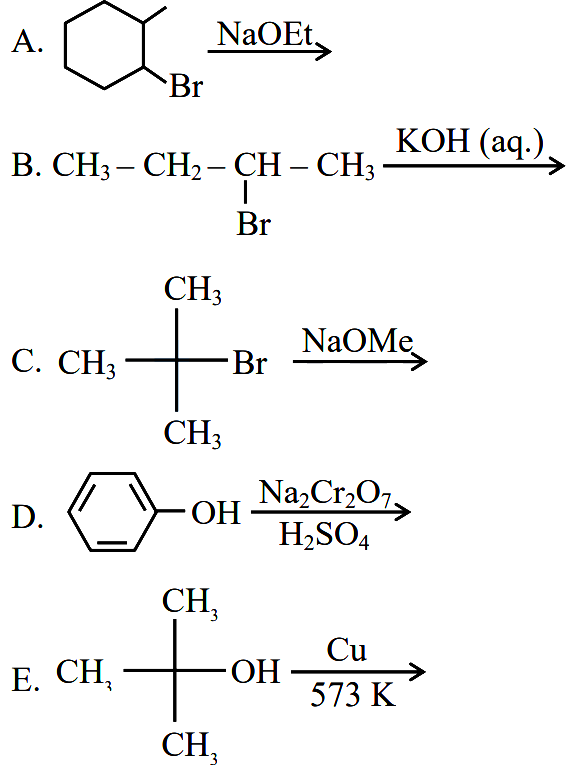
Choose the correct answer from the option given below : 2025 Easy- (A) B \(\&\) E Only
- (B) B, C \(\&\) D Only
- (C) A, C \(\&\) D Only
- (D) B \(\&\) D Only
Show answer and solution
Correct Answer: (D)
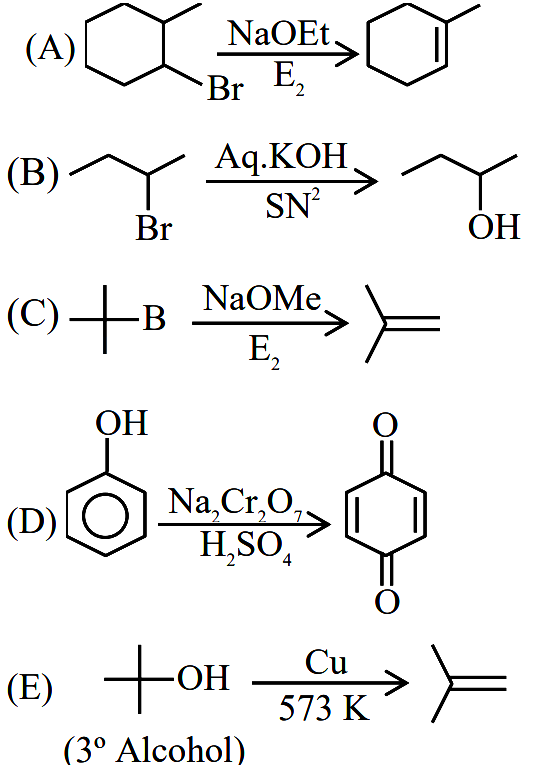
Option (B) and (D) reaction are not able to form alkene as a product. - 281. The sum of sigma \((\sigma)\) and pi \((\pi)\) bonds in Hex-1,3-dien-5-yne is _______. 2025 Medium
- (A) 10
- (B) 15
- (C) 20
- (D) 25
Show answer and solution
Correct Answer: (B)
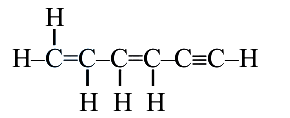
Number of \(\sigma\) bond \(=11\)
Number of \(\pi\) bond \(=4\)
\(\sigma+\pi=11+4=15\) - 282. Total number of sigma (\(\sigma\)) and \(\mathrm{pi}(\pi)\) bonds respectively present in hex-1-en-4-yne are : 2025 Medium
- (A) 3 and 13
- (B) 11 and 3
- (C) 13 and 3
- (D) 14 and 3
Show answer and solution
Correct Answer: (C)
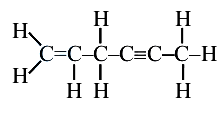
\(\begin{aligned} \sigma \text { bonds } & =13 \\ \pi \text { bonds } & =3\end{aligned}\) -
- (A) 4,2,2
- (B) 3,3,2
- (C) 2,4,2
- (D) 2,2,4
Show answer and solution
Correct Answer: (A)
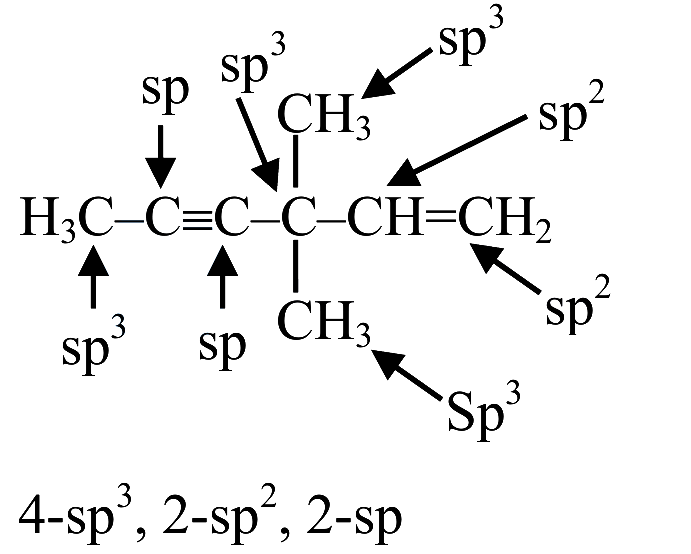
1. Priority Rule in IUPAC: Your assumption about priority is slightly reversed for this case. When numbering the parent carbon chain, multiple bonds (double and triple bonds) are actually given higher priority than alkyl substituents (like methyl groups) to get the lowest possible numbers (locants). While principal functional groups (like -OH, -COOH) have the highest priority, simple substituents like alkyl groups or halogens have lower priority than multiple bonds.
2. Numbering the Chain:
- Numbering from left to right: The multiple bonds get positions 2 and 5.
- Numbering from right to left: The multiple bonds get positions 1 and 4.
Since the locant set (1, 4) is lower than (2, 5), the correct numbering must start from the right (alkene side). Thus, the given IUPAC name "3,3-dimethylhex-1-ene-4-yne" is absolutely correct.
3. Structure & Hybridization Count:
Based on the correct name, the structure is: \( \text{CH}_3-\text{C}\equiv\text{C}-\text{C}(\text{CH}_3)_2-\text{CH}=\text{CH}_2 \)
Let's break down the hybridization of each carbon atom in this molecule:
- \( \text{C}_1 \) (\( =\text{CH}_2 \)): \( \text{sp}^2 \) hybridized (due to double bond)
- \( \text{C}_2 \) (\( -\text{CH}= \)): \( \text{sp}^2 \) hybridized (due to double bond)
- \( \text{C}_3 \) (\( -\text{C}- \)): \( \text{sp}^3 \) hybridized (attached to 4 single bonds)
- Two \( -\text{CH}_3 \) groups attached to \( \text{C}_3 \): Both are \( \text{sp}^3 \) hybridized
- \( \text{C}_4 \) (\( -\text{C}\equiv \)): \( \text{sp} \) hybridized (due to triple bond)
- \( \text{C}_5 \) (\( \equiv\text{C}- \)): \( \text{sp} \) hybridized (due to triple bond)
- \( \text{C}_6 \) (\( -\text{CH}_3 \)): \( \text{sp}^3 \) hybridized (attached to 4 single bonds)
Total Count:
- \( \text{sp}^3 \) carbons: \( 1 \) (at C3) + \( 2 \) (methyls) + \( 1 \) (at C6) = 4
- \( \text{sp}^2 \) carbons: \( 2 \) (C1 and C2) = 2
- \( \text{sp} \) carbons: \( 2 \) (C4 and C5) = 2
Hence, the sequence is 4, 2, 2. Option A is indeed the correct choice. -
- (A) 3-Bromo-2-hydroxy-5-nitrobenzoic acid
- (B) 3-Bromo-4-hydroxy-1-nitrobenzoic acid
- (C) 2-Hydroxy-3-bromo-5-nitrobenzoic acid
- (D) 5-Nitro-3-bromo-2-hydroxybenzoic acid
Show answer and solution
Correct Answer: (A)
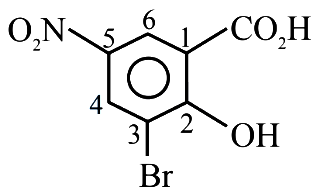
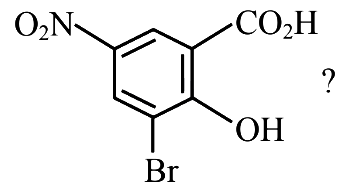
IUPAC 3-Bromo-2-hydroxy-5-nitro-Benzoic acid - 285. Which of the following is the correct IUPAC name of given organic compound \((\mathrm{X})\) ?
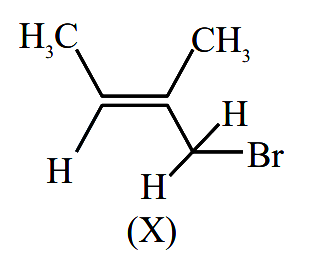
2025 Medium- (A) 2-Bromo-2-methylbut-2-ene
- (B) 3-Bromo-3-methylprop-2-ene
- (C) 1-Bromo-2-methylbut-2-ene
- (D) 4-Bromo-3-methylbut-2-ene
Show answer and solution
Correct Answer: (C)
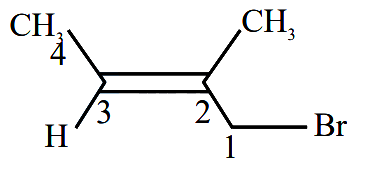
1-Bromo-2-methyl but-2-ene -
- (A) Square pyramidal
- (B) Octahedral
- (C) Pentagonal planar
- (D) Trigonal bipyramidal
Show answer and solution
Correct Answer: (A)
Given A is rarest, monoatomic, non-radioactive p-block element and form \(\mathrm{AX}_4 \mathrm{Y}\) type of molecule.
\(\therefore\) It is concluded that it is Xe
It is given the electronegativity of A is less than X & Y
It is given the electronegativity of \(\mathrm{X} ~\&~ \mathrm{Y}\) is highest and second highest respectively among all element.
\(\therefore \mathrm{X} ~\&~ \mathrm{Y}\) are \(\mathrm{F} ~\&~ \mathrm{O}\)
\(\therefore\) Compound is consider as \(\mathrm{XeOF}_4\) with square pyramidal shape.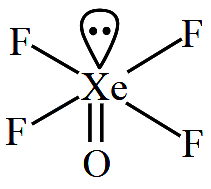
-
- (A) \(\mathrm{sp}^3\)
- (B) \(\mathrm{dsp}^2\)
- (C) \(\mathrm{sp}^3 \mathrm{~d}^2\)
- (D) \(\mathrm{sp}^3 \mathrm{~d}\)
Show answer and solution
Correct Answer: (D)
\(\begin{array}{|c|c|c|c|}
\hline \text { Molecule } & \text { Hybridisation } & \begin{array}{c}
\text { Dipole } \\
\text { Moment }
\end{array} & \begin{array}{c}
\text { Lone pair on the } \\
\text { central atom }
\end{array} \\
\hline \mathrm{SO}_2 & \mathrm{sp}^2 & \text { Non-zero } & \mathrm{1} \\
\hline \mathrm{NF}_3 & \mathrm{sp}^3 & \text { Non-zero } & \mathrm{1} \\
\hline \mathrm{NH}_3 & \mathrm{sp}^3 & \text { Non-zero } & \mathrm{1} \\
\hline \mathrm{XeF}_2 & \mathrm{sp}^3 \mathrm{~d} & \text { zero } & \mathrm{3} \\
\hline{\mathrm{C} \ell \mathrm{~F}_3}^{\mathrm{SF}_4} & \mathrm{sp}^3 \mathrm{~d} & \text { Non-zero } & \mathrm{2} \\
\hline \mathrm{sp}^3 \mathrm{~d} & \text { Non-zero } & \mathrm{1} \\
\hline
\end{array}\) -
- (A) \(\mathrm{H}_2 \mathrm{~S} \lt \mathrm{HBr} \lt \mathrm{NF}_3 \lt \mathrm{CHCl}_3\)
- (B) \(\mathrm{NF}_3 \lt \mathrm{HBr} \lt \mathrm{H}_2 \mathrm{~S} \lt \mathrm{CHCl}_3\)
- (C) \(\mathrm{HBr} \lt \mathrm{H}_2 \mathrm{~S} \lt \mathrm{NF}_3 \lt \mathrm{CHCl}_3\)
- (D) \(\mathrm{CHCl}_3 \lt \mathrm{NF}_3 \lt \mathrm{HBr} \lt \mathrm{H}_2 \mathrm{~S}\)
Show answer and solution
Correct Answer: (B)
\(\begin{aligned}
& \mu_{\mathrm{HBr}}=0.78 \mathrm{D} \\
& \mu_{\mathrm{H}_2 \mathrm{~S}}=0.95 \mathrm{D} \\
& \mu_{\mathrm{NF}_3}=0.24 \mathrm{D} \\
& \mu_{\mathrm{CHCl}_3}=1.01 \mathrm{D}
\end{aligned}\)
Hence dipole moment of
\(\mathrm{NF}_3 < \mathrm{HBr} < \mathrm{H}_2 \mathrm{~S} < \mathrm{CHCl}_3\) -
- (A) A and C Only
- (B) A, D and E Only
- (C) B and D Only
- (D) B and C Only
Show answer and solution
Correct Answer: (B)
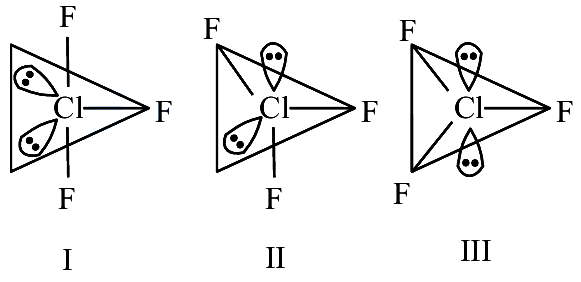
\(\mathrm{ClF}_3\)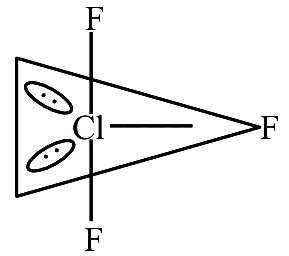
\(\mathrm{n}=2(\) No of lone pair present in equitorial plane \()\) (Unpaired \(\mathrm{e}^{-}\))
(A) \(\mathrm{V}^{+3}:[\mathrm{Ar}] 3 \mathrm{~d}^2 \quad 2\)
(B) \(\mathrm{Ti}^{3+}:[\mathrm{Ar}] 3 \mathrm{~d}^1 \quad 1\)
(C) \(\mathrm{Cu}^{+2}:[\mathrm{Ar}] 3 \mathrm{~d}^9 \quad 1\)
(D) \(\mathrm{Ni}^{+2}:[\mathrm{Ar}] 3 \mathrm{~d}^8 \quad 2\)
(E) \(\mathrm{Ti}^{+2}:[\mathrm{Ar}] 3 \mathrm{~d}^2 \quad 2\) -
- (A) Both Statement I and Statement II are false
- (B) Statement I is false but Statement II is true
- (C) Statement I is true but Statement II is false
- (D) Both Statement I and Statement II are true
Show answer and solution
Correct Answer: (C)
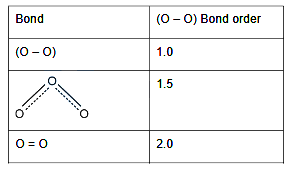
Bond length \(\propto \frac{1}{\text { Bond order }}\)
Order of \(\mathrm{O}-\mathrm{O}\) bond length
\(\mathrm{O}=\mathrm{O} < \mathrm{O}_3 < \mathrm{O}-\mathrm{O}\)
\(\therefore\) Statement \(I\) is true.
Lone pair-lone pair repulsion between O-atoms is not solely responsible for the correct order of O-O bond length. Bond order also should be considered.
\(\therefore \quad\) Statement II is false. -
- (A) Statement I is incorrect but statement II is correct.
- (B) Statement I is correct but statement II is incorrect.
- (C) Both Statement I and statement II are correct.
- (D) Both Statement I and statement II are incorrect.
Show answer and solution
Correct Answer: (B)
Statement 1 is correct.
Statement 2 is incorrect since in \(\mathrm{sp}^3 \mathrm{~d}\) hybridization; lone pair cannot occupy axial position. -
- (A) Both Statement I and Statement II are true
- (B) Statement I is true but Statement II is false
- (C) Statement I is false but Statement II is true
- (D) Both Statement I and Statement II are false
Show answer and solution
Correct Answer: (A)
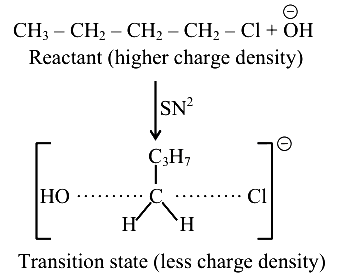
\(\Rightarrow\) This reaction will proceed faster in less polar medium which will not increase the activation energy value.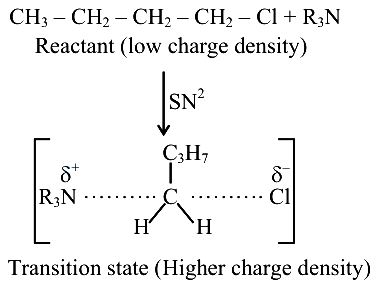
\(\Rightarrow\) This reaction will proceed faster in more polar medium which will decrease the activation energy value. - 293. In the given structure, number of sp and \(\mathrm{sp}^2\) hybridized carbon atoms present respectively are :
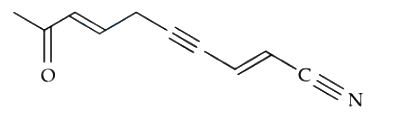
2025 Easy- (A) 4 and 5
- (B) 3 and 5
- (C) 3 and 6
- (D) 4 and 6
Show answer and solution
Correct Answer: (B)
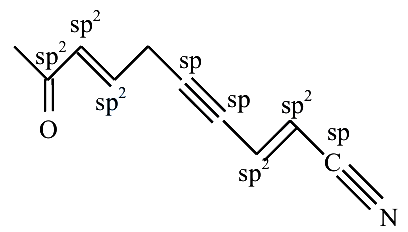
Number of sp and \(\mathrm{sp}^2\) hybridised carbon atom are 3 and 5. -
- (A) (A) \(-(\mathrm{IV}),(\mathrm{B})-(\mathrm{II}),(\mathrm{C})-(\mathrm{I}),(\mathrm{D})-(\mathrm{III})\)
- (B) \((\mathrm{A})-(\mathrm{III}),(\mathrm{B})-(\mathrm{I}),(\mathrm{C})-(\mathrm{II}),(\mathrm{D})-(\mathrm{IV})\)
- (C) (A) \(-(\mathrm{IV}),(\mathrm{B})-(\mathrm{I}),(\mathrm{C})-(\mathrm{II}),(\mathrm{D})-(\mathrm{III})\)
- (D) \((\mathrm{A})-(\mathrm{III}),(\mathrm{B})-(\mathrm{II}),(\mathrm{C})-(\mathrm{I}),(\mathrm{D})-(\mathrm{IV})\)
Show answer and solution
Correct Answer: (A)
\(\begin{aligned}
& \text { (A) }\left[\mathbf{M n B r}_4\right]^{2-} \\
& \mathrm{Mn}^{+2} \Rightarrow[\mathrm{Ar}] 3 \mathrm{~d}^5
\end{aligned}\)
In presence of ligand field
\(\Rightarrow \mathrm{sp}^3\) hybridization, paramagnetic in nature
(B) \(\left[\mathrm{FeF}_6\right]^{3-}\)
\(\mathrm{Fe}^{+3} \Rightarrow[\mathrm{Ar}] 3 \mathrm{~d}^5\)
In presence of ligand field
\(\Rightarrow \mathrm{sp}^3 \mathrm{~d}^2\) hybridization, paramagnetic in nature
(C) \(\left[\mathrm{Co}\left(\mathrm{C}_2 \mathrm{O}_4\right)_3\right]^{3-}\)
\(\mathrm{Co}^{+3} \Rightarrow[\mathrm{Ar}] 3 \mathrm{~d}^6\)
In presence of ligand field
\(\Rightarrow d^2 \mathrm{sp}^3\) hybridization, diamagnetic in nature
(D) \(\left[\mathrm{Ni}(\mathrm{CO})_4\right]\)
\(\mathrm{Ni}^0 \Rightarrow[\mathrm{Ar}] 3 \mathrm{~d}^8 4 \mathrm{~s}^2\)
In presence of ligand field
\(\Rightarrow \mathrm{sp}^3\) hybridization, diamagnetic in nature -
- (A) A-IV, B-I, C-III, D-II
- (B) A-IV, B-II, C-I, D-III
- (C) A-II, B-IV, C-III, D-I
- (D) A-III, B-II, C-I, D-IV
Show answer and solution
Correct Answer: (B)
\(\mathrm{NO}=7 \mathrm{e}^{-}\)Incomplete octet with
\(\mathrm{NO}_2=7 \mathrm{e}^{-} \int \quad\) odd electron
\(\left.\begin{array}{l}\mathrm{BCl}_3=6 \mathrm{e}^{-} \\ \mathrm{AlCl}_3=6 \mathrm{e}^{-}\end{array}\right\}\)Incomplete octet
\(\mathrm{H}_2 \mathrm{SO}_4=12 \mathrm{e}^{-}, \mathrm{PCl}_5=10 \mathrm{e}^{-} \Rightarrow\) molecules with expanded octet
\(\mathrm{CCl}_4=8 \mathrm{e}^{-}, \mathrm{CO}_2=8 \mathrm{e}^{-} \Rightarrow\) molecules obeying octet rule -
- (A) A-IV, B-III, C-II, D-I
- (B) A-III, B-IV, C-II, D-I
- (C) A-III, B-IV, C-I, D-II
- (D) A-II, B-I, C-IV, D-III
Show answer and solution
Correct Answer: (B)
(A)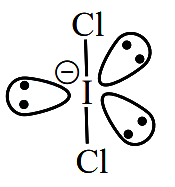
________ B.P : L.P = \(2: 3\)
(B)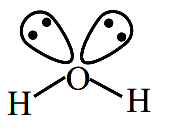
________ B.P : L.P = \(2: 2\)
(C)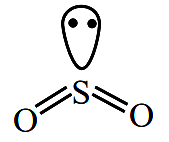
________ B.P : L.P = \(4: 1\)
(D)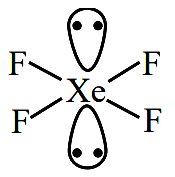
________ B.P : L.P = \(4: 2\) -
- (A) (B), (D) and (E) only
- (B) \((\mathrm{A}),(\mathrm{B}),(\mathrm{D})\) and (E) only
- (C) (B), (C) and (D) only
- (D) (A), (B) and (D) only
Show answer and solution
Correct Answer: (B)
Extra stability of half filled is due to :
(i) Symmetrical distribution of electrons
(ii) Large exchange energy
(iii) Smaller coulombic repulsion
(iv) Smaller shielding of electrons by one another -
- (A) \(\mathrm{BrF}_5 \& \mathrm{PCl}_5\)
- (B) \(\mathrm{SbF}_5 \& \mathrm{PCl}_5\)
- (C) \(\mathrm{SbF}_5 \& \mathrm{XeOF}_4\)
- (D) \(\mathrm{BrF}_5 \& \mathrm{XeOF}_4\)
Show answer and solution
Correct Answer: (D)
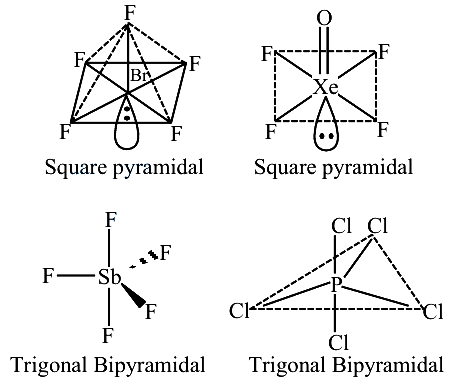
\(\mathrm{BrF}_5\) : Square pyramedal
\(\mathrm{XeOF}_4\) : Square pyramedal
\(\mathrm{SbF}_5\) : Trigonal bipyramidal
\(\mathrm{PCl}_5\) : Trigonal bipyramidal -
- (A) 4
- (B) 6
- (C) 8
- (D) 10
Show answer and solution
Correct Answer: (B)
Linear species are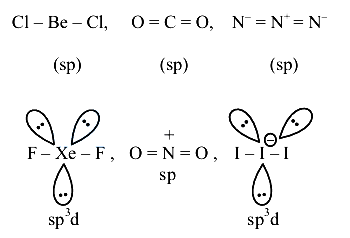
-
- (A) 10
- (B) 8
- (C) 6
- (D) 12
Show answer and solution
Correct Answer: (C)
\(\mathrm{O}_2 \rightarrow 2\) unpaired electrons according to MOT
\(\mathrm{O}_2^{+} \rightarrow 1\) unpaired electrons according to MOT
\(\mathrm{O}_2^{-} \rightarrow 1\) unpaired electrons according to MOT
\(\mathrm{NO} \rightarrow\) odd electron species
\(\mathrm{NO}_2 \rightarrow\) odd electron species
\(\mathrm{K}_2\left[\mathrm{NiCl}_4\right] \rightarrow \mathrm{Ni}^{2+} \Rightarrow 3 \mathrm{~d}^8\) weak Ligand, C.N. \(=4\)
\(\Rightarrow\) Tetrahedral, Paramagnetic with 2 unpaired electrons


No questions on this page match these filters.