


Questions
27 questionsShowing 1–27 of 27 questions
-
- (A) 378 K and 500 J
- (B) 368 K and 500 J
- (C) 348 K and 300 J
- (D) 378 K and 300 J
Show answer and solution
Correct Answer: (C)
\(\begin{aligned} & \mathrm{q}_{\mathrm{p}}=\mathrm{n} \times \mathrm{c}_{\mathrm{p}} \times \Delta \mathrm{T} \\ & \Rightarrow 500=0.5 \times \frac{5}{2} \times 8.3\left(\mathrm{~T}_{\mathrm{f}}-298\right) \\ & \Rightarrow \mathrm{T}_{\mathrm{f}} \simeq 346.2 \mathrm{~K} \\ & \frac{\Delta \mathrm{H}}{\Delta \mathrm{U}}=\frac{\mathrm{C}_{\mathrm{p}}}{\mathrm{C}_{\mathrm{v}}}=\left(\frac{5}{3}\right) \\ & \Rightarrow \Delta \mathrm{U}=\frac{3}{5} \times 500=300 \mathrm{~J}\end{aligned}\) -
- (A) \(\Delta \mathrm{U} \lt 0, \mathrm{q}=0, \mathrm{w}\gt0\)
- (B) \(\Delta \mathrm{U}=0, \mathrm{q}=0, \mathrm{w}=0\)
- (C) \(\Delta \mathrm{U}\gt0, \mathrm{q}=0, \mathrm{w}\gt0\)
- (D) \(\Delta \mathrm{U}=0, \mathrm{q} \lt 0, \mathrm{w}\gt0\)
Show answer and solution
Correct Answer: (C)
Thermally insulated \(\Rightarrow q=0\) from \(\mathrm{I}^{\text {st }}\) law
\(\begin{aligned}
& \Delta \mathrm{U}=\mathrm{q}+\mathrm{w} \\
& \Delta \mathrm{U}=\mathrm{w} \\
& \mathrm{w}>0, \Delta \mathrm{U}>0
\end{aligned}\) -
- (A) 304
- (B) 305
- (C) 306
- (D) 307
Show answer and solution
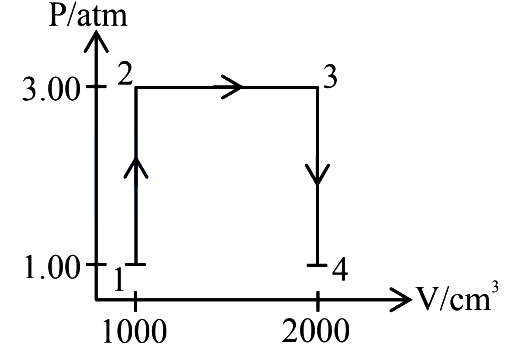
Correct Answer: (A)
\(\begin{aligned}
& \mathrm{W}_{1 \rightarrow 2}=0 \\
& \mathrm{~W}_{2 \rightarrow 3}=-\mathrm{P} \Delta \mathrm{~V} \\
& =-3[2-1] \\
& =-3 \mathrm{~atm}-\ell
\end{aligned}\)
\(\mathrm{W}_{3 \rightarrow 4}=0\)
Total work done
\(\begin{aligned}
& =-3 \mathrm{~atm}-\ell \\
& =-3 \times 101.3 \text { Joule } \\
& =-304 \text { Joule }
\end{aligned}\) -
- (A) 3000
- (B) 2500
- (C) 200
- (D) 3500
Show answer and solution
Correct Answer: (B)
\(\text { Mole of octane }=\frac{1.14}{114}=0.01 \mathrm{~mole}\)
Heat evolved \(=\mathrm{C} \times \Delta \mathrm{T}\)
\(\begin{aligned}
& =5 \times 5 \mathrm{~kJ} \\
& =25 \mathrm{~kJ}
\end{aligned}\)
\(\therefore\) Magnitude of Heat of combustion \(=\frac{25}{0.01}=2500\) \(\mathrm{kJ} /\) mole -
- (A) \(x+y \mathrm{kcal}\)
- (B) \(y-2 x \mathrm{kcal}\)
- (C) \(\frac{2 x}{y} \mathrm{kcal}\)
- (D) \(2 x+y \mathrm{kcal}\)
Show answer and solution
Correct Answer: (B)
(i) \(\mathrm{S}(\mathrm{g})+\frac{3}{2} \mathrm{O}_2(\mathrm{~g}) \rightarrow \mathrm{SO}_3(\mathrm{~g})+2 x\) kcal \(\Delta \mathrm{H}_1\)
(ii) \(\mathrm{SO}_2(\mathrm{~g})+\frac{1}{2} \mathrm{O}_2(\mathrm{~g}) \rightarrow \mathrm{SO}_3(\mathrm{~g})+y\) kcal \(\Delta \mathrm{H}_2\)
(i) - (ii)
\(\begin{aligned}
& \mathrm{S}(\mathrm{~g})+\mathrm{O}_2(\mathrm{~g}) \rightarrow \mathrm{SO}_2(\mathrm{~g}) \Delta \mathrm{H} \\
& \Delta \mathrm{H}=\Delta \mathrm{H}_1-\Delta \mathrm{H}_2 \\
& =-2 x-(-y)=(y-2 x) \mathrm{kcal}
\end{aligned}\) -
- (A) \(\mathrm{ED}\gt\mathrm{EC}\gt\mathrm{EB}\gt\mathrm{EA}\)
- (B) \(\mathrm{EA}\gt\mathrm{EB}\gt\mathrm{EC}\gt\mathrm{ED}\)
- (C) \(\mathrm{EB}\gt\mathrm{EA}\gt\mathrm{EC}\gt\mathrm{ED}\)
- (D) \(\mathrm{ED}\gt\mathrm{EC}\gt\mathrm{EA}\gt\mathrm{EB}\)
Show answer and solution
Correct Answer: (C)
The element having high value of Electron gain enthalpy (magnitude) will form a compound having higher ionic character so order of ionic character
\(E B>E A>E C>E D\) -
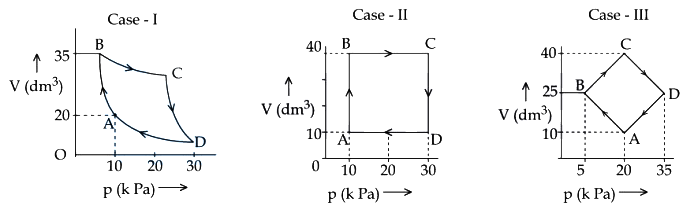
- (A) \(\Delta \mathrm{U}(\) Case-I \()=\Delta \mathrm{U}(\) Case-II \()=\Delta \mathrm{U}(\) Case-III \()\)
- (B) \(\Delta \mathrm{U}(\) Case-I \()\gt\Delta \mathrm{U}(\) Case-III \()\gt\Delta \mathrm{U}(\) Case-II \()\)
- (C) \(\Delta \mathrm{U}(\) Case-III \()\gt\Delta \mathrm{U}(\) Case-II \()\gt\Delta \mathrm{U}(\) Case-I \()\)
- (D) \(\Delta \mathrm{U}(\) Case-I \()\gt\Delta \mathrm{U}(\) Case-II \()\gt\Delta \mathrm{U}(\) Case-III \()\)
Show answer and solution
Correct Answer: (A)
As internal energy ' \(U\) ' is a state function, its cyclic integral must be zero in a cyclic process
\(\therefore \Delta U \text { case }(I)=\Delta U \text { case }(\text { II })=\Delta U \text { case }(\text { III })\) -
- (A) \(a \gt b \gt c \gt d\)
- (B) \(d \gt c=a \gt b\)
- (C) \(c=a \gt d \gt b\)
- (D) \(a \gt c \gt b \gt d\)
Show answer and solution
Correct Answer: (B)
For isothermal process
\(\begin{aligned}
& \left|\mathrm{W}_{\text {reversible }}\right|_{\text {expansion }}=\left|\mathrm{W}_{\text {reversible }}\right|_{\text {compression }} \\
& =-\mathrm{nRT} \ln \frac{\mathrm{~V}_{\mathrm{f}}}{\mathrm{~V}_{\mathrm{i}}} \\
& \left|\mathrm{~W}_{\text {irreversible }}\right|_{\text {expansion }} \lt \left|\mathrm{W}_{\text {irreversible }}\right|_{\text {compression }} \\
& \mathrm{d} \gt \mathrm{c}=\mathrm{a} \gt \mathrm{b} \\
& \left|\mathrm{~W}_{\text {irreversible }}\right|_{\text {expansion }}=-\mathrm{P}_{\text {ext }}\left(\mathrm{V}_{\mathrm{f}}-\mathrm{V}_{\mathrm{i}}\right)
\end{aligned}\)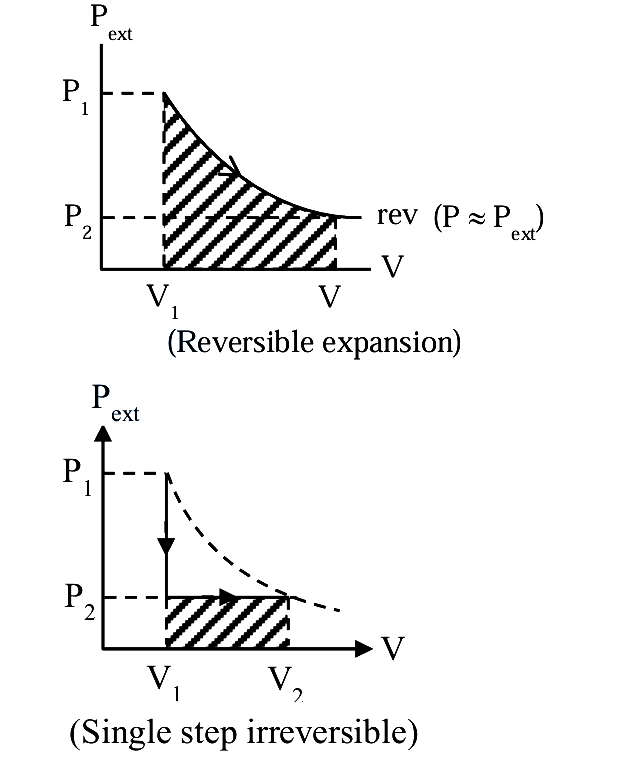
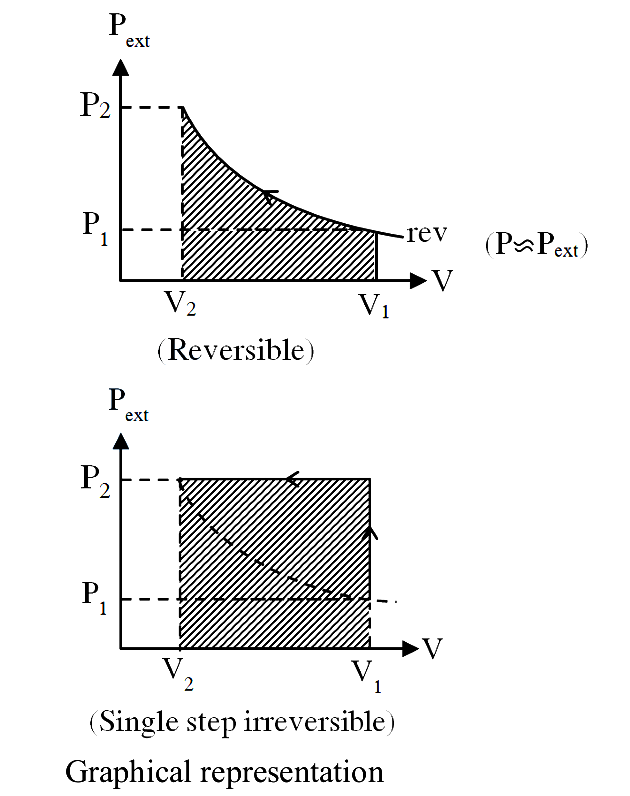
We can compare work by area of PV graph -
- (A) 140
- (B) 147
- (C) 138
- (D) 146
Show answer and solution
Correct Answer: (C)
\(\begin{aligned}
& \mathrm{C}_4 \mathrm{H}_{10}+\frac{13}{2} \mathrm{O}_2 \rightarrow 4 \mathrm{CO}_2+5 \mathrm{H}_2 \mathrm{O} \\
& 3 \times 10^3 \quad 10 \times 10^3
\end{aligned}\)
Moles of \(\mathrm{H}_2 \mathrm{O}\) formed \(=\mathrm{n}_{\mathrm{H}_2 \mathrm{O}}=5 \times \frac{2}{13} \times 10 \times 10^3\)
Then \(\mathrm{w}_{\mathrm{H}_2 \mathrm{O}}=\frac{10^5}{13} \times 18\)
\(=1.3846 \times 10^5 \mathrm{~g}\)
Volume of \(\mathrm{H}_2 \mathrm{O}\) will be \(=138.46\) litre.
Ans. 138 -
- (A) 90
- (B) 100
- (C) 95
- (D) 97
Show answer and solution
Correct Answer: (C)
\(\begin{aligned} & 2 \mathrm{C}_{\text {(graphite) }}+3 \mathrm{H}_2(\mathrm{~g}) \rightarrow \mathrm{C}_2 \mathrm{H}_6(\mathrm{~g}) \quad \Delta \mathrm{H}_{\mathrm{f}}=? \\ & \mathrm{C}_2 \mathrm{H}_6(\mathrm{~g})+\frac{7}{2} \mathrm{O}_2(\mathrm{~g}) \rightarrow 2 \mathrm{CO}_2(\mathrm{~g})+3 \mathrm{H}_2 \mathrm{O}(l) \\ & \quad \Delta \mathrm{H}_1=-1550 \\ & \mathrm{C}_{\text {(graphite) }}+\mathrm{O}_2(\mathrm{~g}) \rightarrow \mathrm{CO}_2(\mathrm{~g}) \Delta \mathrm{H}_2=-393.5 \\ & \mathrm{H}_2(\mathrm{~g})+\frac{1}{2} \mathrm{O}_2(\mathrm{~g}) \rightarrow \mathrm{H}_2 \mathrm{O}(/) \Delta \mathrm{H}_3=-286 \\ & \Delta \mathrm{H}_{\mathrm{f}}=2 \Delta \mathrm{H}_2+3 \Delta \mathrm{H}_3-\Delta \mathrm{H}_1 \\ & \quad=95 \mathrm{~kJ} / \mathrm{mole}^2\end{aligned}\) -
- (A) 46
- (B) 47
- (C) 48
- (D) 49
Show answer and solution
Correct Answer: (C)
\(\begin{aligned} & \Delta \mathrm{H}_{\mathrm{f}}\left[\mathrm{CO}_2(\mathrm{~g})\right]=-393.5 \mathrm{~kJ} / \mathrm{mole} \\ & \Delta \mathrm{H}_{\mathrm{f}}\left[\mathrm{H}_2 \mathrm{O}(\ell)\right]=-286.0 \mathrm{~kJ} / \mathrm{mole} \\ & \Delta \mathrm{H}_{\mathrm{c}}\left[\mathrm{C}_6 \mathrm{H}_6\right]=-3267.0 \mathrm{~kJ} / \mathrm{mole} \\ & \Delta \mathrm{H}_{\mathrm{f}} \mathrm{C}_6 \mathrm{H}_6=(?) \\ & \mathrm{C}_6 \mathrm{H}_6+\frac{15}{2} \mathrm{O}_2(\mathrm{~g}) \longrightarrow 6 \mathrm{CO}_2(\mathrm{~g})+3 \mathrm{H}_2 \mathrm{O}(\ell) \\ & \Delta \mathrm{H}_{\mathrm{R}}=\Delta \mathrm{H}_{\mathrm{C}}=\Sigma \Delta \mathrm{H}_{\mathrm{f}}(\mathrm{P})-\Sigma \Delta \mathrm{H}_{\mathrm{f}}(\mathrm{R}) \\ & -3267=6 \times(-393.5)+3(-286)-\Delta \mathrm{H}_{\mathrm{f}}\left(\mathrm{C}_6 \mathrm{H}_6\right) \\ & \Delta \mathrm{H}_{\mathrm{f}}\left(\mathrm{C}_6 \mathrm{H}_6\right)=48 \mathrm{~kJ} / \mathrm{mole}\end{aligned}\) -
- (A) Dissolution of gas in water is an endothermic process
- (B) The heat of solution depends on the amount of solvent.
- (C) The heat of dilution for the \(\mathrm{HCl}\left(\mathrm{HCl} \cdot 10 \mathrm{H}_2 \mathrm{O}\right.\) to \(\left.\mathrm{HCl}.40 \mathrm{H}_2 \mathrm{O}\right)\) is \(3.78 \mathrm{~kJ} \mathrm{~mol}^{-1}\).
- (D) The heat of formation of HCl solution is represented by both (a) and (b)
Show answer and solution
Correct Answer: (B)
From the given information
\(\Delta \mathrm{H}\) is negative so it means dissolution of gas \(\mathrm{HCl}(\mathrm{g})\) is exothermic.
\(\mathrm{HCl}(\mathrm{g})+10 \mathrm{H}_2 \mathrm{O}(\mathrm{l}) \rightarrow \mathrm{HCl}.10 \mathrm{H}_2 \mathrm{O}\) ...(1)
\(\Delta \mathrm{H}_1=-69.01 \frac{\mathrm{~kJ}}{\mathrm{~mol}}\)
\(\mathrm{HCl}(\mathrm{g})+40 \mathrm{H}_2 \mathrm{O}(\mathrm{l}) \rightarrow \mathrm{HCl}.40 \mathrm{H}_2 \mathrm{O}\) ...(2)
\(\Delta \mathrm{H}_2=-72.79 \frac{\mathrm{~kJ}}{\mathrm{~mol}}\)
Hence heat of solution depends upon amount of solvent
By equation..(2) - equation
\(\mathrm{HCl}.10 \mathrm{H}_2 \mathrm{O}+30 \mathrm{H}_2 \mathrm{O}(\ell) \rightarrow \mathrm{HCl} \cdot 40 \mathrm{H}_2 \mathrm{O}\)
So Heat of dilution \(=-72.79-(-69.01)\)
\(=-3.78 \frac{\mathrm{~kJ}}{\mathrm{~mol}}\)
Hence option (3) is incorrect.
For heat of formation reactant should be in elemental form hence option (4) is incorrect -
- (A) 30
- (B) 35
- (C) 20
- (D) 25
Show answer and solution
Correct Answer: (D)
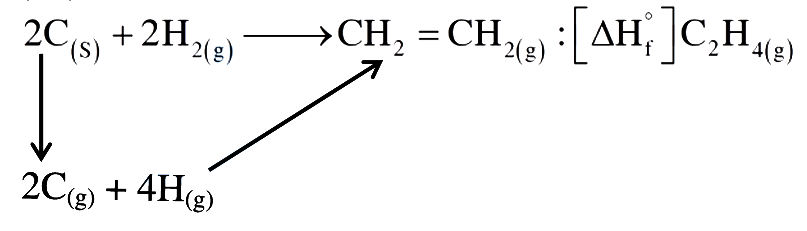
\(\left[\Delta H _{ f }^{ o }\right]_{ C _2 H _{(4)}}=2 \times\left[\Delta H _{ sub }^{ o }\right]_{ C _{( s )}}+2 \times \Delta H _{ H - H }^{ o }\) \(-1 \times \Delta H _{ C = C }^{ o }-4 \times \Delta H _{ CH }^{ o }\)
\(\Rightarrow\left[\Delta H _{ f }^{ o }\right]_{ C _2 H _{4(g)}}=(2 \times 710)+(2 \times 436)\) \(-611-4 \times 414\)
\(\Rightarrow {\left[\Delta \mathrm{H}_{\mathrm{f}}^{\mathrm{o}}\right]_{\mathrm{C}_2 \mathrm{H}_{4(\mathrm{~g})}}=25 \mathrm{~kJ} / \mathrm{mol} }\) -
- (A) \(\mathrm{T}=\mathrm{Te}\)
- (B) \(\mathrm{Te} \gt \mathrm{T}\)
- (C) \(\mathrm{T} \gt \mathrm{Te}\)
- (D) \(\mathrm{Te}=5 \mathrm{~T}\)
Show answer and solution
Correct Answer: (C)
For reaction to be spontaneous according to \(2^{\text {nd }}\) law:
\(\begin{aligned}
& \Delta \mathrm{G} \lt 0 \\
& \Rightarrow \Delta \mathrm{H}-\mathrm{T} \Delta \mathrm{~S} \lt 0 \\
& \Rightarrow \mathrm{~T} \gt \left(\frac{\Delta \mathrm{H}}{\Delta \mathrm{~S}}\right)=\mathrm{T}_{\mathrm{e}} \\
& \Rightarrow \mathrm{~T} \gt \mathrm{T}_{\mathrm{e}}
\end{aligned}\) -
- (A) Both \(\Delta \mathrm{H}\) and \(\Delta \mathrm{S}\) are (-ve)
- (B) \(\Delta \mathrm{H}\) is (-ve) but \(\Delta \mathrm{S}\) is (+ve)
- (C) \(\Delta \mathrm{H}\) is \((+\mathrm{ve})\) but \(\Delta \mathrm{S}\) is \((-\mathrm{ve})\)
- (D) Both \(\Delta \mathrm{H}\) and \(\Delta \mathrm{S}\) are (+ve)
Show answer and solution
Correct Answer: (D)
On increasing temperature, the given endothermic reaction becomes spontaneous.
\(\Delta G=\Delta H-T \Delta S\)
For spontaneity,
\(\Delta \mathrm{G} < 0\)
Given,
\(\Delta \mathrm{H}>0\)
So, \(\Delta \mathrm{S}\) should be +ve. -
- (A) (A)-(II), (B)-(I), (C)-(III), (D)-(IV)
- (B) (A)-(I), (B)-(II), (C)-(IV), (D)-(III)
- (C) (A)-(II), (B)-(I), (C)-(IV), (D)-(III)
- (D) (A)-(II), (B)-(III), (C)-(I), (D)-(IV)
Show answer and solution
Correct Answer: (C)
\(\begin{aligned} & \because \mathrm{dH}=\mathrm{dq} \text { (at } \mathrm{P}=\text { constant) } \\ & \mathrm{dH}=\mathrm{CpdT}^{\mathrm{dT}} \\ & \left(\frac{\mathrm{dH}}{\mathrm{dT}}\right)_{\mathrm{P}}=\mathrm{C}_{\mathrm{P}} \\ & \mathrm{dU}=\mathrm{dq} \quad \text { (at } \mathrm{V}=\text { constant) } \\ & \mathrm{dU}=\mathrm{C}_{\mathrm{V}} \mathrm{dT} \\ & \left(\frac{\mathrm{dU}}{\mathrm{dT}}\right)_{\mathrm{V}}=\mathrm{C}_{\mathrm{V}} \\ & \because \mathrm{dG}=\mathrm{VdP}-\mathrm{SdT} \\ & \text { at } \mathrm{P}=\text { constant, } \mathrm{dP}=0\end{aligned}\)
\(\left(\frac{d G}{d T}\right)_P=-S\)
at \(\mathrm{T}=\) constant
\(\left(\frac{\mathrm{dG}}{\mathrm{dP}}\right)_{\mathrm{T}}=\mathrm{V}\) -
- (A) \(0,21.84 \mathrm{~kJ},-1.26 \mathrm{~kJ}\)
- (B) \(0,-17.18 \mathrm{~kJ}, 1.718 \mathrm{~J}\)
- (C) \(0,21.84 \mathrm{~kJ}, 21,84 \mathrm{~kJ}\)
- (D) \(0,1.78 \mathrm{~kJ},-1.718 \mathrm{~kJ}\)
Show answer and solution
Correct Answer: (D)
\(\begin{aligned} & (10 \mathrm{~L}, 300 \mathrm{~K}) \xrightarrow{\mathrm{n}=1}(20 \mathrm{~L}, 300 \mathrm{~K}) \\ & -\mathrm{q}=\mathrm{w}=-\mathrm{nRT} \ln \frac{\mathrm{V}_2}{\mathrm{~V}_1} \\ & =-8.3 \times 300 \times \ln \left(\frac{20}{10}\right) \\ & =-1.718 \mathrm{~kJ} \\ & \Rightarrow \mathrm{q}=1.718 \mathrm{~kJ} \\ & \mathrm{w}=-1.718 \mathrm{~kJ} \\ & \Delta \mathrm{U}=0(\because \Delta \mathrm{~T}=0)\end{aligned}\) -
- (A) 800
- (B) 900
- (C) 1000
- (D) 700
Show answer and solution
Correct Answer: (D)
\(\begin{aligned} & \frac{1}{2} \mathrm{X}_2+\frac{5}{2} \mathrm{Y}_2 \rightleftharpoons \mathrm{XY}_5 \\ & \Delta \mathrm{~S}_{\mathrm{Rxn}}^0=110-\left[\left(\frac{1}{2} \times 70\right)+\left(\frac{5}{2} \times 50\right)\right] \\ & =110-160=-50 \mathrm{JK}^{-1} \mathrm{~mol}^{-1} \\ & \Delta \mathrm{G}^0=0 \text { at eqb } \\ & \Delta \mathrm{G}^0=\Delta \mathrm{H}^0-\mathrm{T} \Delta \mathrm{S}^0 \\ & 0=-35000-\mathrm{T}(-50) \\ & \mathrm{T}=700 \mathrm{Kelvin}\end{aligned}\) -
- (A) 250
- (B) 100
- (C) 200
- (D) 105
Show answer and solution
Correct Answer: (C)
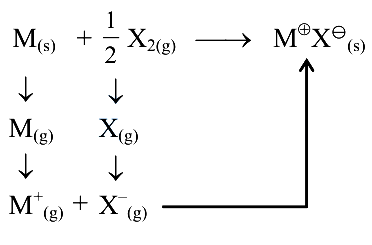
\(\therefore \Delta \mathrm{H}_{\mathrm{f}}(\mathrm{MX})= \)
\( \Delta \mathrm{H}_{\text {sub }}(\mathrm{M})+\text { I.E. }(\mathrm{M})+\frac{1}{2}[\text { B.E. }(\mathrm{X}-\mathrm{X})] +\mathrm{EG}(\mathrm{X})+\text { L.E. }(\mathrm{MX})\)
\( -400=(100)+(500)+\frac{1}{2}(\text { B.E. })+(-300)+(-800)\)
\(\therefore \text { B.E. }=200 \mathrm{~kJ} \mathrm{~mole}^{-1}\) -
- (A) The term 'standard state' implies that the temperature is \(0^{\circ} \mathrm{C}\)
- (B) The standard state of pure gas is the pure gas at a pressure of 1 bar and temperature 273 K
- (C) \(\Delta_{\mathrm{f}} \mathrm{H}_{298}^\theta\) is zero for \(\mathrm{O}(\mathrm{g})\)
- (D) \(\Delta_{\mathrm{f}} \mathrm{H}_{500}^\theta\) is zero for \(\mathrm{O}_2(\mathrm{~g})\)
Show answer and solution
Correct Answer: (D)
For standard state \(\Rightarrow\) pressure \(=1\) bar and temperature is specified only
\(\Rightarrow\left(\Delta \mathrm{H}_{\mathrm{f}}^{\mathrm{o}}\right)_{\mathrm{O}_{2,(\mathrm{~g})}}=0\) -
- (A) (B) and (C) only
- (B) (B) and (D) only
- (C) (A) and (D) only
- (D) (A) and (C) only
Show answer and solution
Correct Answer: (A)
\(\because \Delta \mathrm{G}=\Delta \mathrm{H}-\mathrm{T} \Delta \mathrm{~S}\)
For spontaneity of reaction: \(\Delta \mathrm{G}=-\mathrm{ve}\) -
- (A) 460
- (B) 466
- (C) 450
- (D) 444
Show answer and solution
Correct Answer: (B)
\(\begin{aligned} & \frac{1}{2} \mathrm{H}_{2(\mathrm{~g})} \rightarrow \mathrm{H}(\mathrm{g}) \quad ; \quad \Delta_{\mathrm{f}} \mathrm{H}\left(\mathrm{H}_{(\mathrm{g})}\right)=220 \mathrm{KJ} / \mathrm{mol} \\ & \frac{1}{2} \mathrm{O}_{2(\mathrm{~g})} \rightarrow \mathrm{O}(\mathrm{g}) \quad ; \quad \Delta_{\mathrm{f}} \mathrm{H}\left(\mathrm{O}_{(\mathrm{g})}\right)=250 \mathrm{KJ} / \mathrm{mol}\end{aligned}\)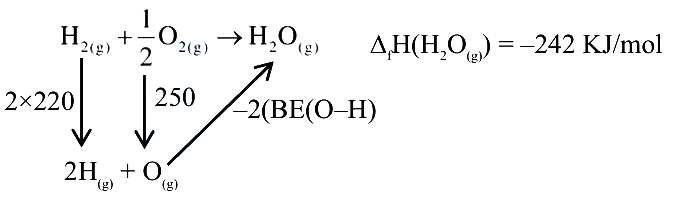
\(\begin{aligned} & \Delta \mathrm{H}_{\mathrm{f}}\left(\mathrm{H}_2 \mathrm{O}_{(\mathrm{l})}\right)=-242=440+250-2(\mathrm{~B} . \mathrm{E} .(\mathrm{O}-\mathrm{H})) \\ & \mathrm{BE}(\mathrm{O}-\mathrm{H})=466 \mathrm{KJ} / \mathrm{mol}\end{aligned}\) -
- (A) \(+x-y-z\)
- (B) \(x+y+z\)
- (C) \(z-(x+y)\)
- (D) \(-\mathrm{z}-(\mathrm{x}+\mathrm{y})\)
Show answer and solution
Correct Answer: (C)
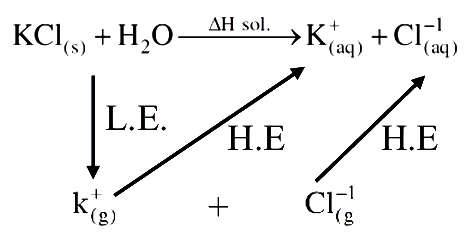
\(\begin{aligned} \Delta \mathrm{H}_{\text {Sol}^{\mathrm{n}}.} & =\mathrm{L} \cdot \mathrm{E} \cdot+(\mathrm{H} \cdot \mathrm{E})_{\mathrm{K}_{(\mathrm{g})}^{+}}+(\mathrm{HE})_{\mathrm{Cl}_{(\mathrm{g})}^{-1}} \\ & =\mathrm{Z}-\mathrm{x}-\mathrm{y} \\ & =\mathrm{z}-(\mathrm{x}+\mathrm{y})\end{aligned}\) -
- (A) 2850
- (B) 2750
- (C) 2950
- (D) 2650
Show answer and solution
Correct Answer: (A)
\(\begin{aligned} & \Delta \mathrm{H}_{\mathrm{rxn}}^{\mathrm{o}}=55 \mathrm{~kJ} / \mathrm{mol}, \quad \mathrm{T}=298 \mathrm{~K} \\ & \Delta \mathrm{~S}_{\mathrm{rxn}}^{\mathrm{o}}=175 \mathrm{~J} / \mathrm{mol} \\ & \Delta \mathrm{G}_{\mathrm{rxn}}^{\mathrm{o}}=\Delta \mathrm{H}_{\mathrm{rxn}}^{\mathrm{o}}-\mathrm{T} \Delta \mathrm{S}_{\mathrm{rxn}}^{\circ} \\ & \Rightarrow \Delta \mathrm{G}_{\mathrm{rxn}}^{\mathrm{o}}=55000 \mathrm{~J} / \mathrm{mol}-298 \times 175 \mathrm{~J} / \mathrm{mol} \\ & \Rightarrow \Delta \mathrm{G}_{\mathrm{rxn}}^{\mathrm{o}}=55000-52150 \\ & \Rightarrow \Delta \mathrm{G}_{\mathrm{rxn}}^{\mathrm{o}}=2850 \mathrm{~J} / \mathrm{mol}\end{aligned}\) -
- (A) \(-x-10 y-10 z\)
- (B) \(-10(100 x+y+z)\)
- (C) \(10(100 x+y+z)\)
- (D) \(x-10 y-10 z\)
Show answer and solution
Correct Answer: (B)
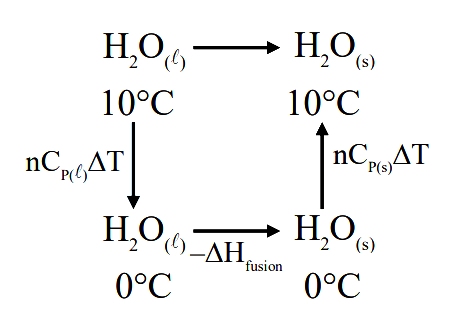
\(\begin{aligned} & \Delta H=1 \times y(0-10)-x \times 1000+1 \times z\left(-10^{\circ}-0^{\circ}\right) \\ & \Delta H=-10(100 x+y+z) \text { Joule. }\end{aligned}\) -
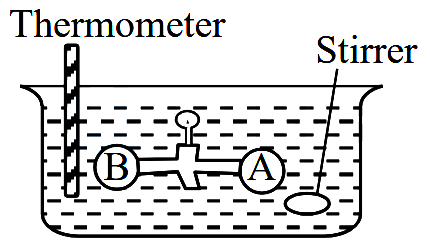
- (A) \(d w \neq 0\)
- (B) \(\mathrm{dq} \neq 0\)
- (C) \(\mathrm{dU} \neq 0\)
- (D) The pressure in the vessel \(B\) before opening the stopcock is zero.
Show answer and solution
Correct Answer: (D)
It is free expansion of gas \(\Rightarrow P_{\text {ext }}=0\)
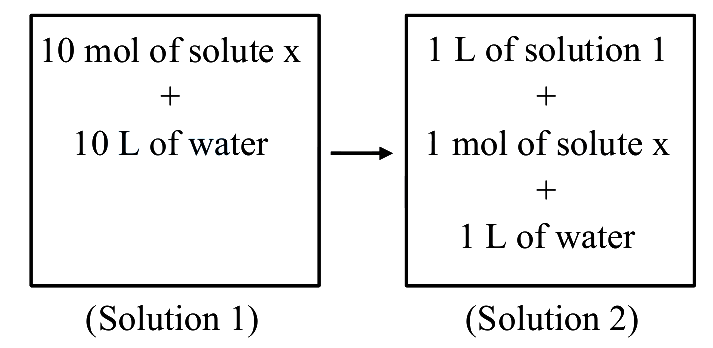
Where \(\mathrm{w}=0, \mathrm{q}=0\) and \(\Delta \mathrm{U}=0\) - 27. Which of the following properties will change when system containing solution 1 will become solution 2?
2025 Easy- (A) Molar heat capacity
- (B) Density
- (C) Concentration
- (D) Gibbs free energy
Show answer and solution
Correct Answer: (D)
Both solutions are having same composition, which is 1 mole of ' \(x\) ' in 1 ' \(\ell\) ' water, so all the intensive properties will remain same, but as total amount is greater in solution ' 1 ' compared to solution ' 2 '. So extensive properties will be different hence Gibbs free energy will be different.
No questions on this page match these filters.