


Chapters asked in 2023
25 chapters- 12Qs STD 11 Organic chemistry purification and characterization
- 22Qs STD 12 D and f- block elements
- 6Qs STD 11 Redox reactions
- 10Qs STD 12 Biomolecules
- 19Qs STD 11 Equilibrium - II (icon Equilibrium)
- 21Qs STD 12 Chemical kinetics
- 7Qs STD 11 Organic chemistry reaction mechanism
- 7Qs STD 12 Amines
- 4Qs STD 12 Carboxylic acids and their derivative
- 8Qs STD 12 Aldehydes and ketones
- 8Qs STD 12 Alcohol, phenol and ethers
- 14Qs STD 12 Haloalkanes and Haloarenes
- 40Qs STD 12 Co-ordination chemistry Most asked
- 21Qs STD 12 P -Block elements - ll
- 20Qs STD 12 Electrochemistry
- 25Qs STD 12 Solution and colligative properties Most asked
- 21Qs STD 11 Some basic concept of chemistry
- 5Qs STD 11 Hydricarbon
- 1Qs STD 11 Organic chemistry Nomenclature of organic compounds
- 17Qs STD 11 Chemical bonding and molecular structure
- 10Qs STD 11 Classification of elements and periodicity in properties
- 6Qs STD 11 Equilibrium - 1 (chemical Equilibrium)
- 25Qs STD 11 Thermodynamics and thermochemistry Most asked
- 14Qs STD 11 P-Block elements - I
- 23Qs STD 11 Structure of atom
All JEE Mains 2023 Chemistry questions
25 chaptersShowing 1–50 of 366 questions
-
- (A) \(20\)
- (B) \(30\)
- (C) \(50\)
- (D) \(40\)
Show answer and solution
Correct Answer: (D)
mole of \(AgBr =\frac{0.376}{188}\)mole of \(Br ^{-}=\)mole of \(AgBr =\frac{0.376}{188}\)
mass of \(Br ^{-}=\frac{0.376}{188} \times 80\)
\(\%\) of \(Br ^{-}=\frac{0.376 \times 80}{188 \times 0.4} \times 100=40 \%\)
-
- (A) \(10\)
- (B) \(11\)
- (C) \(12\)
- (D) \(13\)
Show answer and solution
Correct Answer: (B)
Percentage of Carbon\(=\frac{12}{44} \times \frac{\text { mass of } CO _2 \text { formed }}{\text { mass of compound taken }} \times 100\)
\(60=\frac{12}{44} \times \frac{\text { mass of } CO _2 \text { formed }}{0.5} \times 100\)
Mass of \(CO _2\) formed \(=\frac{60 \times 44 \times 0.5}{12 \times 100}\,g\)
\(=1.1 \text { gram }\)
\(=11 \times 10^{-1} \text { gram }\)
-
- (A) \(41\)
- (B) \(42\)
- (C) \(40\)
- (D) \(38\)
Show answer and solution
Correct Answer: (B)
\(\%\) sulphur \(=\frac{32}{233} \times \frac{\text { weight of } BaSO _4 \text { formed }}{\text { weight of organic compound }} \times 100\)\(=\frac{32}{233} \times \frac{1.4439}{0.471} \times 100\)
\(=42.10\)
Nearest integer \(42\)
-
- (A) \(A-(iii), B-(iv), C-(ii), D-(i)\)
- (B) \(A-(i), B-(iii), C-(ii), D-(iv)\)
- (C) \(A-(ii), B-(iii), C-(iv), D-(i)\)
- (D) \(A-(ii), B-(iv), C-(i), D-(iii)\)
Show answer and solution
Correct Answer: (C)
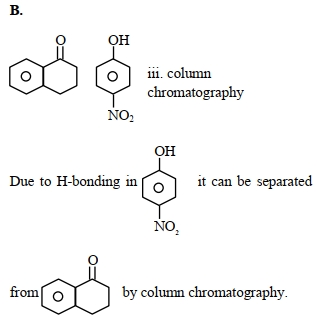
\(A\). \(H _2 O / CH _2 Cl _2 \rightarrow\) \(ii\), \(CH _2 Cl _2> H _2 O\) (density) so they can be separated by differential solvent extraction.\(B\).\(C.\) Kerosene / Naphthalene \(\rightarrow\) iv. Fractional distillation.
Due to different B.P. of kerosene and Naphthalene it can be separated by fractional distillation.
\(D.\) \(C _6 H _{12} O _6 / NaCl \rightarrow\) i. Crystallization.
\(NaCl\) (ionic compound) can be crystallized.
-
- (A) \(A-II, B-IV, C-I, D-III\)
- (B) \(A-IV, B-II, C-I, D-III\)
- (C) \(A-II, B-I, C-IV, D-III\)
- (D) \(A-III, B-I, C-IV, D-II\)
Show answer and solution
Correct Answer: (D)
Nitrogen detection by lassaigne's method\(Na + C + N \rightarrow NaCN\)
\(6 NaCN + FeSO _4 \rightarrow Na _4\left[ Fe ( CN )_6\right]+ Na _2 SO _4\)
\(Na _4\left[ Fe ( CN )_6\right]+ Fe ^{3+} \rightarrow Fe _4\left[ Fe ( CN )_6\right]_3\)
(Prussian blue)
Sulphur detection by Sodium nitroprusside
\(Na _2\left[ Fe ( CN )_5 NO \right]+ Na _2 S \rightarrow Na 4\left[ Fe ( CN )_5 NOS \right]\)
\(\text { [Purple }]\)
Phosphorus detection by ammonium molybdate
\(Na _3 PO _4+3 HNO _3 \rightarrow H _3 PO _4+3 NaNO _3\)
\(H _3 PO _4+12\left( NH _4\right)_2 MoO _4+21 HNO _3 \rightarrow\)
\(\left( NH _4\right)_3 PO _4 .12 MoO _3+21 NH _4 NO _3+12 H _2 O\)
\(\text { (canary yellow) }\)
\(\text { Halogen give specific coloured ppt with }\)
\(AgNO _3( aq )\)
\(NaCl + AgNO _3( aq ) \rightarrow AgCl + NaNO _3\)
\(\text { (White) }\)
\(NaBr + AgNO _3( aq ) \rightarrow AgBr + NaNO _3\)
\(\text { (Pale yellow) }\)
\(NaI + AgNO _3( aq ) \rightarrow AgI + NaNO _3\)
\(\text { (Yellow) }\)
-
- (A) \(A-IV, B-I, C-III, D-II\)
- (B) \(A-III, B-IV, C-I, D-II\)
- (C) \(A-II, B-I, C-III, D-IV\)
- (D) \(A-III, B-I, C-IV, D-II\)
Show answer and solution
Correct Answer: (B)
List \(I\) (Mixture) List \(II\) (Separation Technique) \(A\) \(CHCl _3+ C _6 H _5 NH _2\) \(I\) Distillation \(B\) \(C _6 H _{14}+ C _5 H _{12}\) \(II\) Fractional distillation \(C\) \(C _6 H _5 NH _2+ H _2 O\) \(III\) Steam distillation \(D\) Organic compound in \(H _2 O\) \(IV\) Differential extraction NCERT \((XI)\) Vol. \(2\) Page No. \(359, 360. \)
-
- (A) \(42\)
- (B) \(43\)
- (C) \(48\)
- (D) \(44\)
Show answer and solution
Correct Answer: (D)
weight of \(C\) in \(0.792\,gm CO _2\)\(=\frac{12}{44} \times 0.792=0.216\)
\(\% \text { of } C \text { in compound }=\frac{0.216}{0.492} \times 100\)
\(=43.90 \%\)
Ans:\(44\)
-
- (A) prevent oxidation
- (B) prevent reduction
- (C) prevent hydrolysis
- (D) prevent breaking
Show answer and solution
Correct Answer: (A)
Prolonged heating will cause oxidation of \(Fe ^{+2}\) to \(Fe ^{+3}\). -
- (A) \(A,C,B\)
- (B) \(B,C,A\)
- (C) \(C,A,B\)
- (D) \(B,A,C\)
Show answer and solution
Correct Answer: (A)
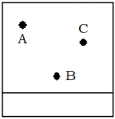
According to the observation,\(A\) is more mobile and interacts with the mobile phase more than \(C\), and \(C\) is more drawn to the mobile phase than \(B\).Hence, the correct order of elution in the silico gel column chromatography is \(- B < C < A\)

-
- (A) \(24\)
- (B) \(25\)
- (C) \(23\)
- (D) \(22\)
Show answer and solution
Correct Answer: (B)
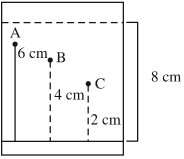
More \(R _{ f }\), less its polarity\(R _{ f }=\frac{\text { Distance travelled by compound ' } X \text { ' }}{\text { Distance travelled by solvent ' } Y '}\)
\(=\frac{2}{8}=0.25=25 \times 10^{-2}\)
- 11. Using column chromatography, mixture of two compounds ' \(A\) ' and ' \(B\) ' was separated. '\(A\)' eluted first, this indicates ' \(B\) ' has 2023 Medium
- (A) low \(R_f\), weaker adsorption
- (B) high \(R _{ f }\), stronger adsorption
- (C) high \(R_f\), weaker adsorption
- (D) low \(R _{ f }\), stronger adsorption
Show answer and solution
Correct Answer: (D)
If any component eluted second then it means that its \(R_f\) value is low and its adsorption is stronger\(R _{ f }=\frac{\text { distance covered by substance from base line }}{\text { total distance covered by solvent from base line }}\)
-
- (A) Water present in the mobile phase gets absorbed by the paper which then forms the stationary phase.
- (B) Water present in the pores of the paper forms the stationary phase.
- (C) Paper sheet forms the stationary phase.
- (D) Paper and water present in its pores together form the stationary phase.
Show answer and solution
Correct Answer: (B)
In paper chromatography, a special quality paper known as chromatography paper is used. Paper contains water trapped in it, which acts as the stationary phase. -
- (A) Black
- (B) Red
- (C) Green
- (D) Blue
Show answer and solution
Correct Answer: (C)
\(Cr _2 O _7^{2-}+ SO _3^{2-} \stackrel{ H ^{+}}{\longrightarrow} \underset{\text { Green }}{ Cr ^{3+}}+ SO _4^{2-}\) -
- (A) Both \(A\) and \(R\) are true but \(R\) is NOT the correct explanation of \(A\)
- (B) \(A\) is false but \(R\) is true
- (C) \(A\) is true but \(R\) is false
- (D) Both \(A\) and \(R\) are true and \(R\) is the correct explanation of \(A\)
Show answer and solution
Correct Answer: (A)
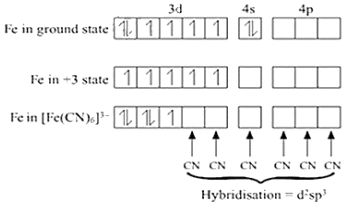
Unpaired electron \(=1\)\(\mu=\sqrt{ n ( n +2)}=\sqrt{1 \times 3}=1.74 \text { B.M. }\)
\(\left[ Fe \left( H _2 O \right)_6\right]^{3+}\) No pairing because \(H _2 O\) is WFL Number of unpaired electrons \(=5, \mu=5.92\,BM\) Assertion is true, Reason is true but not correct explanation.
-
- (A) Both Statement \(I\) and Statement \(II\) are true
- (B) Both Statement \(I\) and Statement \(II\) are false
- (C) Both Statement \(I\) is true but Statement \(II\) is false
- (D) Both Statement \(I\) is false but Statement \(II\) is true
Show answer and solution
Correct Answer: (C)
(1) \(K _2 Cr _2 O\), is used as primary standard. The concentration \(Na _2 Cr _2 O _7\) changes in aq. solution.(2) It is less soluble than \(Na _2 Cr _2 O _7\).
-
- (A) A, B, D only
- (B) C and E only
- (C) A and E only
- (D) A, B and E only
Show answer and solution
Correct Answer: (C)
(1) \(Na > Cs > Li\) - true \{If considered with sign\}
The low solubility of Csl is due to smaller hydration enthalpy of it's two ions.
\(Li _2 CO _3\) is highly stable to heat - false.
In Conc. \(NH _3, K\) formed blue solution - true
All the alkali metal hydrides are ionic solid (True). - 17. In alkaline medium, the reduction of permanganate anion involves a gain of \(........\) electrons. 2023 Easy
- (A) \(4\)
- (B) \(5\)
- (C) \(3\)
- (D) \(7\)
Show answer and solution
Correct Answer: (C)
In faintly alkaline medium,\(MnO _4^{-}+3 e ^{-}+2 H _2 O \longrightarrow MnO _2+4 OH ^{-}\)
No. of electrons gained \(=3\)
-
- (A) \(T_i\,(III)\)
- (B) \(Fe\, (III)\)
- (C) \(V\, (IV)\)
- (D) \(Mn\,(VII)\)
Show answer and solution
Correct Answer: (D)
In \(CrO _2 Cl _2\) oxidation state of \(Cr\) is +6\(Cr ( VI )=[ Ar ]^{18} 3 d ^0\)
\(Mn ( VII )=[ Ar ]^{18} 3 d ^0\)
\(Fe ( III )=[ Ar ]^{18} 3 d ^5\)
\(Ti ( III )=[ Ar ]^{18} 3 d ^1\)
\(V ( IV )=[ Ar ]^{18} 3 d ^1\)
Hence \(Cr\) (VI) and \(Mn\) (VII) have same \(d^0\) configuration.
- 19. \(K _2 Cr _2 O _7\) paper acidified with dilute \(H _2 SO _4\) turns green when exposed to 2023 Medium
- (A) Carbon dioxide
- (B) Sulphur trioxide
- (C) Hydrogen sulphide
- (D) Sulphur dioxide
Show answer and solution
Correct Answer: (D)
\(3 SO _2+ Cr _2 O _7^{2-}+2 H ^{+} \rightarrow 3 SO _4^{2-}+2 Cr ^{+3}+ H _2 O\) -
- (A) \(67\)
- (B) \(65\)
- (C) \(68\)
- (D) \(66\)
Show answer and solution
Correct Answer: (C)
By balancing the redox reaction we get\(10\left[ FeSO _4 \cdot\left( NH _4\right)_2 SO _4 \cdot 6 H _2 O \right]+2 KMnO _4+8 H _2 SO _4\)
\(\downarrow\)
\(5 Fe _2\left( SO _4\right)_3+2 MnSO _4+10\left( NH _4\right)_2 SO _4+ K _2 SO _4+68 H _2 O\)
- 21. \(KMnO _4\) oxidises \(I ^{-}\)in acidic and neutral/faintly alkaline solution, respectively to 2023 Hard
- (A) \(I _2\) and \(IO _3^{-}\)
- (B) \(IO _3^{-}\) and \(I _2\)
- (C) \(IO _3^{-}\) and \(IO _3^{-}\)
- (D) \(I_2\) and \(I_2\)
Show answer and solution
Correct Answer: (A)
In acidic medium\(2 MnO _4^{-}+10 I ^{-}+16 H ^{+} \rightarrow 2 Mn ^{2+}+5 I _2+8 H _2 O\)
In neutral/faintly alkaline solution
\(2 MnO _4^{-}+ I ^{-}+ H _2 O \rightarrow 2 MnO _2+2 OH ^{-}+ IO _3^{-}\)
-
- (A) \(4 f^2 6 s^2\)
- (B) \(4 f^4\)
- (C) \(4 f^3\)
- (D) \(4 f ^4 6 s ^2\)
Show answer and solution
Correct Answer: (B)
\(Nd (60)=[ Xe ] 4 f ^4 5 d ^0 6 s ^2\)\(Nd ^{2+}=[ Xe ] 4 f ^4 5 d ^0 5 s ^0\)
-
- (A) \(Ce ^{4+}\) and \(Eu ^{2+}\)
- (B) \(Ce ^{4+}\) and \(Tb ^{4+}\)
- (C) \(Ce ^{3+}\) and \(Ce ^{4+}\)
- (D) \(Eu ^{2+}\) and \(Ce ^{4+}\)
Show answer and solution
Correct Answer: (D)
Factual -
- (A) \(V _2 O _3 > V _2 O _4 > V _2 O _5\)
- (B) \(V _2 O _3 > V _2 O _5 > V _2 O _4\)
- (C) \(V _2 O _5 > V _2 O _4 > V _2 O _3\)
- (D) \(V _2 O _4 > V _2 O _3 > V _2 O _5\)
Show answer and solution
Correct Answer: (A)
With increase in \(\%\) of oxygen acidic nature of oxide of an element increase and basic nature decreases -
- (A) \({\left[ Fe ( CN )_6\right]^{3-} < \left[ CoF _6\right]^{3-} < \left[ MnBr _4\right]^{2-}} < \left[ Mn ( CN )_6\right]^{3-}\)
- (B) \({\left[ Fe ( CN )_6\right]^{3-} < \left[ Mn ( CN )_6\right]^{3-} < \left[ CoF _6\right]^{3-}} < \left[ MnBr _4\right]^{2-}\)
- (C) \({\left[ MnBr _4\right]^{2-} < \left[ CoF _6\right]^{3-} < \left[ Fe ( CN )_6\right]^{3-}} < \left[ Mn ( CN )_6\right]^{3-}\)
- (D) \({\left[ CoF _6\right]^{3-} < \left[ MnBr _4\right]^{2-} < \left[ Fe ( CN )_6\right]^{3-}} < \left[ Mn ( CN )_6\right]^{3-}\)
Show answer and solution
Correct Answer: (B)
Spin magnetic moment \(\mu=\sqrt{n(n+2)}\) B.M - 26. The magnetic moment of a transition metal compound has been calculated to be \(3.87\) \(B.M.\) The metal ion is 2023 Medium
- (A) \(Cr ^{2+}\)
- (B) \(Mn ^{2+}\)
- (C) \(V ^{2+}\)
- (D) \(Ti ^{2+}\)
Show answer and solution
Correct Answer: (C)
\(Cr ^{+2}:[ Ar ], 3 d ^4, 4 s ^0 n =4, \mu=\sqrt{4(4+2)}=\sqrt{24}\)\(=4.89\,BM\)
\(Mn ^{+2}:[ Ar ], 3 d ^5, 4 s ^0 n =5, \mu=\sqrt{5(5+2)}=\sqrt{35}\)
\(=5.91\,BM\)
\(V ^{+2}:[ Ar ], 3 d ^3, 4 s ^0 n =3, \mu=\sqrt{3(3+2)}=\sqrt{15}\)
\(=3.87\,BM\)
\(Ti ^{+2}:[ Ar ], 3 d ^2, 4 s ^0 n =2, \mu=\sqrt{2(2+2)}=\sqrt{8}\)
\(=2.82\,BM\)
- 27. The number of electrons involved in the reduction of permanganate to manganese dioxide in acidic medium is \(.......\). 2023 Medium
- (A) \(4\)
- (B) \(3\)
- (C) \(2\)
- (D) \(1\)
Show answer and solution
Correct Answer: (B)
\(\stackrel{+7}{ MnO _4^{-}}+4 H ^{+}+3 e ^{-} \longrightarrow \stackrel{+4} MnO _2+2 H _2 O\) - 28. The pair of lanthanides in which both elements have high third-ionization energy is: 2023 Medium
- (A) \(Eu , Gd\)
- (B) \(Eu , Yb\)
- (C) \(Lu , Yb\)
- (D) \(Dy, Gd\)
Show answer and solution
Correct Answer: (B)
\(\left.Eu ^{+2}:[ Xe ] 4 f ^7\right\}\) High IE due to half\(\left.Yb ^{+2}:[ Xe ] 4 f ^{14}\right\}\) filled \& fully filled configurations
-
- (A) \((ii)\) and \((iii)\)
- (B) \((i), (ii)\) and \((iv)\)
- (C) \((i)\) and \((iii)\)
- (D) \((ii), (iii)\) and \((iv)\)
Show answer and solution
Correct Answer: (B)
\((i), (ii)\) and \((iv)\) correct.Manganese exhibits \(+7\) oxidation state in its oxide. \(\left( Mn _2 O _7\right)\)
\(Ru\) and \(Os\) from \(RuO _4\) and \(OsO _4\) oxide in \(+8\) oxidation state
\(Cr\) in \(+6\) oxidation act is oxidizing.
\(Sc\) does not show \(+4\) oxidation state.
-
- (A) \(5\)
- (B) \(4\)
- (C) \(3\)
- (D) \(2\)
Show answer and solution
Correct Answer: (A)
Change in oxidation state of \(Mn =5\) - 31. Which halogen is known to cause the reaction given below: \(2 Cu ^{2+}+4 X ^{-} \rightarrow Cu _2 X _2( s )+ X _2\) 2023 Medium
- (A) Only Iodine
- (B) Only Bromine
- (C) All halogens
- (D) Only Chlorine
Show answer and solution
Correct Answer: (A)
\(2 Cu ^{2+}+4 I ^{-} \rightarrow Cu _2 I _2( s )+ I _2\) -
- (A) \(B\) and \(D\) only
- (B) \(A\) and \(E\) only
- (C) \(A\) and \(B\) only
- (D) \(C\) and \(D\) only
Show answer and solution
Correct Answer: (A)
\(1.\) \({ }_{62} Sm : 4 f ^6 6 s ^2\)\(2.\) \({ }_{64} Gd : 4 f ^7 5 d ^1 6 s ^2\)
\(3.\) \({ }_{63} Eu : 4 f^7 6 s ^2\)
\(4.\) \({ }_{65} Tb : 4 f ^9 6 s ^2\)
\(5.\) \({ }_{61} Pm : 4 f ^5 6 s ^2\)
-
- (A) \((B), (C)\) only
- (B) \((A), (B), (D)\) only
- (C) \((C), (D)\) only
- (D) \((A), (B)\) only
Show answer and solution
Correct Answer: (A)
\((A)\) The \(M ^{3+} / M ^{2+}\) reduction potential formanganese is greater than iron
\((B)\) \(E _{ Fe ^{+3} / Fe ^{+2}}^0=+0.77\)
\(E _{ Mn ^{+3} / Mn ^{+2}}^0=+1.57\)
(C) \(E _{ Cr ^{+3} / Cr ^{+2}}^0=-0.26\)
\(\therefore \quad Cr ^{2 \oplus}+ H ^{\oplus} \longrightarrow Cr ^{3 \oplus}+\frac{1}{2} H _2\)
(D) \(V ^{2 \oplus}=3\) unpaired electron
Magnetic Moment \(=3.87\) B.M
-
- (A) \(C\) only
- (B) \(D\) only
- (C) \(A\) and \(B\) only
- (D) \(C\) and \(D\) only
Show answer and solution
Correct Answer: (D)
\(Ce ^{+4}\) and \(Tb ^{+4}\) act as oxidising agent. - 35. \(2 IO _3^{-}+ xI ^{-}+12 H ^{+} \rightarrow 6 I _2+6 H _2 O\) What is the value of \(x\) ? 2023 Easy
- (A) \(12\)
- (B) \(2\)
- (C) \(6\)
- (D) \(10\)
Show answer and solution
Correct Answer: (D)
Number of atoms of iodine on reactant side \(=\) number of atoms of Iodine on product side\(2+ x =6 \times 2\)
\(X =10\)
\(2 IO _3^{-}+10 I ^{-}+12 H ^{+} \rightarrow 6 I _2+6 H _2 O\)
-
- (A) Both statement \(I\) and statement \(II\) are correct.
- (B) Statement \(I\) is incorrect but Statement \(II\) is correct.
- (C) Statement \(I\) is correct but Statement \(II\) is incorrect.
- (D) Both statement \(I\) and statement \(II\) are incorrect.
Show answer and solution
Correct Answer: (D)
In redox titration, indicators are sensitive to oxidation potential and in acid base titration, indicators are sensitive to change in \(pH\) of solution Both statement are false. -
- (A) \(6\)
- (B) \(5\)
- (C) \(4\)
- (D) \(3\)
Show answer and solution
Correct Answer: (A)
\(CrO _2 Cl _2 x -4-2=0\)Oxidation State \(=+6\)
-
- (A) \(22\)
- (B) \(21\)
- (C) \(20\)
- (D) \(23\)
Show answer and solution
Correct Answer: (D)
\(Cr _2 O _7^{2-}+14 H ^{+}+6 Fe ^{2+} \rightarrow 6 Fe ^{3+}+2 Cr ^{3+}+7 H _2 O\)\(x =14\)
\(y =2\)
\(z =7\)
Hence \((x+y+z)=14+2+7=23\)
- 39. The sum of oxidation state of the metals in \(Fe ( CO )_5, VO ^{2+}\) and \(WO _3\) is \(.........\). 2023 Medium
- (A) \(10\)
- (B) \(8\)
- (C) \(6\)
- (D) \(4\)
Show answer and solution
Correct Answer: (A)
So, Sum of oxidation state \(=0+4+6=10\) -
- (A) \(A\) and \(B\) only
- (B) \(A\) only
- (C) \(C\) and \(D\) only
- (D) \(A\) and \(D\) only
Show answer and solution
Correct Answer: (A)
\(2\left[\stackrel{+1}{ Au ( CN )_2}\right]^{-}+\stackrel{0}{ Z } n ( s ) \longrightarrow 2 \stackrel{0}{ Au }+\left[\stackrel{+2}{ Zn }( CN )_4\right]^{-2}\)\(Zn\) displaced \(Au ^{+}\)
Reduction and Oxidation both are taking place.
-
- (A) \(4\)
- (B) \(2\)
- (C) \(8\)
- (D) \(6\)
Show answer and solution
Correct Answer: (D)
Number of peptide linkage \(=(\) amino acid \(-1)\)\(=7-1=6\)
-
- (A) Both statement 1 and 2 are correct..
- (B) Statement 1 is correct but statement 2 is incorrect
- (C) Statement 1 is incorrect but statement 2 is correct
- (D) Both statement 1 and 2 are correct
Show answer and solution
Correct Answer: (B)
Norepinephrine, also known as noradrenaline is both a neurotransmitter and a hormone. It plays an important role in our body's "fight-or-or flight" response. Low level of noradrenaline is cause of depression in human. -
- (A) \(P \rightarrow iv,Q \rightarrow iii,R \rightarrow i, S \rightarrow ii\)
- (B) \(P \rightarrow i , Q \rightarrow\) ii, \(R \rightarrow\) iii, \(S \rightarrow\) iv
- (C) \(P \rightarrow iii, i \rightarrow iv , R \rightarrow ii, S \rightarrow i\)
- (D) \(P \rightarrow iii, Q \rightarrow iv, R \rightarrow i, S \rightarrow ii\)
Show answer and solution
Correct Answer: (D)
(from the given options best answer is \(D\))
-
- (A) \(A-II, B-I, C-IV, D-III\)
- (B) \(A-IV, B-III, C-I, D-II\)
- (C) \(A-III, B-I, C-IV, D-II\)
- (D) \(A-III, B-IV, C-I, D-II\)
Show answer and solution
Correct Answer: (C)
\(A-III, B-I, C-IV, D-II\) -
- (A) A-II, B-I, C-III, D-IV
- (B) A-IV, B-III, C-II, D-I
- (C) A-I, B-III, C-II, D-IV
- (D) A-I, B-II, C-III, D-IV
Show answer and solution
Correct Answer: (D)
(Antifertility – Norethindrone; Tranquilizer – Meprobamate; Antihistamine – Seldane; Antibiotic – Ampicillin) -
- (A) \(A-IV, B-II,C-III, D-I\)
- (B) \(A-III, B-II, C-IV, D-I\)
- (C) \(A-IV, B-I,C-III, D-II\)
- (D) \(A-III,B-I,C-IV, D-II\)
Show answer and solution
Correct Answer: (D)
Factual -
- (A) \(2\)
- (B) \(4\)
- (C) \(3\)
- (D) \(5\)
Show answer and solution
Correct Answer: (A)
Both Amylose and Sucrose does not give Benedict's test.
- 48. The naturally occurring amino acid that contains only one basic functional group in its chemical structure is 2023 Hard
- (A) arginine
- (B) lysine
- (C) asparagine
- (D) histidine
Show answer and solution
Correct Answer: (C)
Asparagine has only one basic functional group in its chemical structure.Others are basic amino acid with more than one basic functional group.

- 49. The one that does not stabilize \(2^{\circ}\) and \(3^{\circ}\) structures of proteins is 2023 Medium
- (A) \(H-\)bonding
- (B) \(-S-S-\)linkage
- (C) \(-O-O-\)linkage
- (D) van der Waals forces
Show answer and solution
Correct Answer: (C)
\(2^{\circ}\) and \(3^{\circ}\) structure of proteins are stabilized by hydrogen bonding, disulphide linkages, Van der Waals force of attraction and electrostatic force of attraction. - 50. Total number of tripeptides possible by mixing of valine and proline is \(............\). 2023 Medium
- (A) \(8\)
- (B) \(4\)
- (C) \(2\)
- (D) \(6\)
Show answer and solution
Correct Answer: (A)
No. of possible tripeptide : Val and Pro is \(2^3\)\((1)\) val - val - val
\((2)\) pro - pro - pro
\((3)\) val - pro - pro
\((4)\) pro - val - pro
\((5)\) val - val - pro
\((6)\) val - pro - val
\((7)\) pro - pro - val
\((8)\) pro - val - val

No questions on this page match these filters.
Other years
Frequently asked
How many JEE Mains 2023 Chemistry questions are on ExamBro?
366 questions, each with the correct answer and a full solution.
Which JEE Mains 2023 Chemistry chapter is asked the most?
Co-ordination chemistry, with 40 questions, followed by Solution and colligative properties with 25.
How difficult are JEE Mains 2023 Chemistry questions?
3% are easy, 66% medium and 31% hard.