


Chapters asked in 2015
19 chapters- 3Qs STD 11 Organic chemistry purification and characterization
- 4Qs STD 12 D and f- block elements Most asked
- 3Qs STD 12 Biomolecules
- 4Qs STD 12 Chemical kinetics Most asked
- 1Qs STD 12 Amines
- 2Qs STD 12 Carboxylic acids and their derivative
- 2Qs STD 12 Aldehydes and ketones
- 1Qs STD 12 Haloalkanes and Haloarenes
- 3Qs STD 11 Organic chemistry isomerism
- 3Qs STD 12 Co-ordination chemistry
- 7Qs STD 12 P -Block elements - ll Most asked
- 3Qs STD 12 Electrochemistry
- 2Qs STD 12 Solution and colligative properties
- 2Qs STD 11 Some basic concept of chemistry
- 3Qs STD 11 Chemical bonding and molecular structure
- 2Qs STD 11 Classification of elements and periodicity in properties
- 3Qs STD 11 Equilibrium - 1 (chemical Equilibrium)
- 3Qs STD 11 Thermodynamics and thermochemistry
- 3Qs STD 11 Structure of atom
All JEE Mains 2015 Chemistry questions
19 chaptersShowing 1–50 of 54 questions
-
- (A) \(10\)
- (B) \(3\)
- (C) \(24\)
- (D) \(5\)
Show answer and solution
Correct Answer: (A)
Mili equivalents of \(H_2SO_4\)\( = 60 \times \frac{{M \times 2}}{{10}} = 12\)
Mili equivalents of \(NaOH = 20 \times \frac{M}{{10}} = 2\)
Mili equivalents of \(N{H_3} = 12 - 2 = 10\)
\(\% \,\) of nitrogen \( = \frac{{1.4 \times (N \times V)N{H_3}}}{{(Wt.\,of\,organic\,compound)}}\)
\(\frac{{1.4 \times 10}}{{1.4}} = 10\)
-
- (A) \(48\)
- (B) \(60\)
- (C) \(24\)
- (D) \(36\)
Show answer and solution
Correct Answer: (C)
Mass of substance \(=250 \mathrm{mg}=0.250 \mathrm{g}\)Mass of \(A g B r=141 \mathrm{mg}=0.141 \mathrm{g}\)
\(1\; mole\) of \(A g B r=1\; g\) atom of \(B r\)
\(188 g\) of \(A g B r=80 g\) of \(B r\)
\(188 g\) of \(A g B r\) contain bromine \(=80 g\)
\(0.141 g\) of \(A g B r\) contain bromine \(=\frac{80}{188} \times 0.141\)
This much amount of bromine present in \(0.250 \mathrm{g}\) of organic compound
\(\because \%\) of bromine \(=\frac{80}{188} \times \frac{0.414}{0.250} \times 100=24 \%\)
-
- (A) \(A - (ii); B - (iii) ; C - (i)\)
- (B) \(A - (iii); B - (i) ; C - (ii)\)
- (C) \(A - (iii); B - (ii) ; C - (i)\)
- (D) \(A - (ii); B - (i) ; C - (iii)\)
Show answer and solution
Correct Answer: (C)
\((c)\) In Lassaigne's test, fusion with sodium take place and following species formed respectively.\((a)\) Aniline \(\to \) \(CN^-\)
\((b)\) Benzene sulfonic acid \(\to \) (figure)
\((c)\) Thiourea \(\to \) \(S^{2-}\)
Reaction of \(CN^-\) with hot and acidic solution of \(FeSO_4\) lead to formation of \(Fe_4[Fe(CN)_6]_3\) which is blue in colour. It contains iron in both \(II\) and \(III\) oxidation state.
Reaction of \(S^{2-}\) with sodium nitroprusside
\(N{a_2}S + N{a_2}[Fe{(CN)_5}NO] \to \mathop {N{a_4}[Fe{{(CN)}_5}NOS]}\limits_{(violet\,in\,colour)} \)
Phenoxide ion on reacting with \(FeCl_3\) give red colour with \(FeCl_3\).

- 4. A pink coloured salt turns blue on heating. The presence of which cation is most likely ? 2015 Medium
- (A) \(Co^{2+}\)
- (B) \(Cu^{2+}\)
- (C) \(Zn^{2+}\)
- (D) \(Fe^{2+}\)
Show answer and solution
Correct Answer: (A)
\(Zn^{2+}\) salts are white. Usually \(Fe^{2+}\) salts are rarely pink. \(Cu^{2+}\) salts are usually blue in hydrated form. \(Co^{2+}\) is pink in aqueous solution -
- (A) \(L\to M\) charge transfer transition
- (B) \(\sigma - \sigma ^*\) transition
- (C) \(M\to L\) charge transfer transition
- (D) \(d - d\) transition
Show answer and solution
Correct Answer: (A)
\(K M n O_{4} \rightarrow K^{+}+M n O_{4}^{-}\)\(\therefore \ln M n O_{4}^{-},\) Mn has \(+7\) oxidation state having no electron in d-orbitals. It ts considered that higher the oxidation state of metal, greater is the tendency to occur \(L \rightarrow M\) charge transfer,
because ligand is able to donate the electron into the vacant ( - orbital of metal.
since, charge transfer is laporate as well as spin allowed, therefore, it shows colour
-
- (A) \((NH_4)_3 [As (Mo_3O_{10})_4]\)
- (B) \(BaCrO_4\)
- (C) \(Zn_2[Fe(CN)_6]\)
- (D) \(K_3[Co(NO_2)_6]\)
Show answer and solution
Correct Answer: (C)
\(Z n_{2}\left[F e(C N)_{6}\right], K_{3}\left[C o\left(N O_{2}\right)_{6}\right] \) and \(\left(N H_{4}\right)_{3} A s\left[M o_{3} O_{l 0}\right]_{4}\) show color due to d-d transition while \(B a C r O_{4}\) is coloured due to charge transfer phenomenon.Further according to spectrochemical series the strong ligand possessing complex has higher energy and hence lower wavelength. Therefore, complexes containing \(N O_{2}, N H_{4}^{+}, O^{2-}\) etc., ligands show yellow colour while \(\mathrm{CN}^{-}\) forces the complex to impart white colour.
Spectrochemical series \(I^{-} < B r^{-} < S^{2-} < S C N^{-} < C I^{-} < N O_{3}^{-} < N_{3}^{-} < F^{-} < O H^{-}\)
\( < C_{2} O_{4}^{2-}=H_{2} O < N C S^{-} < C H_{3} C N < p y < N H_{3} < e n\)
\( < b i p y < phen < N o_{2}^{-} < p p h_{3} < C N^{-}=C O\)
-
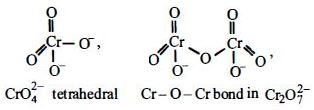
- (A) \(Na_2Cr_2O_7\) is less soluble than \(K_2Cr_2O_7\)
- (B) \(Na_2Cr_2O_7\) is primary standard in volumetry
- (C) \(CrO_4^{2-}\) is tetrahedral in shape
- (D) \(CrO_7^{2-}\) has a \(Cr- O- Cr\) bond
Show answer and solution
Correct Answer: (A)
\(Na_2Cr_2O_7\) is used as primary standard in volumetryHydration energy of \(Na^+\) is greater then \(K^+\). Because of smaller size of \(Na^+\) , \(Na_2Cr_2O_7\) is more soluble than \(K_2Cr_2O_7\).
- 8. Accumulation of which of the following molecules in the muscles occurs as a result of vigorous exercise ? 2015 Hard
- (A) Glycogen
- (B) Glucose
- (C) Pyruvic acid
- (D) \(L-\) lactic acid
Show answer and solution
Correct Answer: (D)
\(\underset{\begin{smallmatrix}
stored\,\,in \\
the\,\,form\,\,of\,\,\downarrow
\\
Glycogen
\end{smallmatrix}}{\mathop{Glu\cos e}}\,\,\xrightarrow[\begin{smallmatrix}
(does\,\,not\,\,need\,\,oxygen; \\
enzymes\,\,are\,\,need\,\,only)
\end{smallmatrix}]{1}\)\(\underset{\underset{Lactic\,\,acid}{\mathop{\downarrow }}\,}{\mathop{Pyruvic\,\,acid}}\,\xrightarrow{{{O}_{2}}}C{{O}_{2}}\,+\,{{H}_{2}}O\)
During vigorous exercise suffcient oxygen is not available to meet the energy demand so, energy is derived through conversion of pyruvic acid to lactic acid.
-
- (A) glucose only
- (B) galactose and fructose in equimolar amounts
- (C) glucose and galactose in equimolar amounts
- (D) glucose and fructose in equimolar amounts
Show answer and solution
Correct Answer: (A)
Starch is a mixture of amylose and amylopectin polysaccharides and monomer is glucose. Thus on complete hydrolysis it gives only glucose. -
- (A) Vitamin \(E\)
- (B) Vitamin \(K\)
- (C) Vitamin \(C\)
- (D) Vitamin \(D\)
Show answer and solution
Correct Answer: (C)
Vitamin \(B\) and \(C\) are water soluble while vitamin \(\mathrm{A}, \mathrm{D}, \mathrm{E}\) and \(\mathrm{K}\) are fat soluble or water insoluble. -
- (A) halved
- (B) the same
- (C) doubled
- (D) quadrupled
Show answer and solution
Correct Answer: (C)
Rate \(= K[A][B]=R\)\(R'\, = \,K\left[ A \right]\left[ {2B} \right]\)
\(\frac{R}{{R'}}\, = \,\frac{{k[A][B]}}{{k[A][2B]}}\, = \,\frac{{k[A][B]}}{{2k[A][B]}}\)
\( \Rightarrow \,2R\, = \,R'\) i.e., rate become doubles.
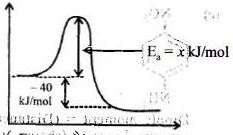
-
- (A) \(E_f\, = 80\, k\,J/mol ; E_b\, = 120\, k\,J/mol\)
- (B) \(E_f\, = 60\, k\,J/mol ; E_b\, = 100\, k\,J/mol\)
- (C) \(E_f\, = 30\, k\,J/mol ; E_b\, = 70\, k\,J/mol\)
- (D) \(E_f\, = 70\, k\,J/mol ; E_b\, = 30\, k\,J/mol\)
Show answer and solution
Correct Answer: (A)
\(\left( {\frac{{{E_{\mathop {forwad}\limits_{(A \to B)} }}}}{{{E_{\mathop {backward}\limits_{(B \to A)} }}}}} \right) = \frac{2}{3} = \frac{x}{{ - 40 + x}}\)\( \Rightarrow - 80 + 2x = 3x\)
\( \Rightarrow x = - 80\,kJ/mol\) for forward
For backward \( = - 40 + ( - 80 = - 120\,kJ/mol)\)
Because activation energy cannot be negative
so, for forwad reaction \(E_a=80\,kJ/mol\)
for forwad reaction \(E_a=120\,kJ/mol\)
-
- (A) shifting of equilibrium towards reactants due to elastic collisions
- (B) loss of active species on collision
- (C) low probability of simultaneous collision of all the reacting species
- (D) increase in entropy and activation energy as more molecules are involved
Show answer and solution
Correct Answer: (C)
Reactions of higher order \((>3 )\) are very rate due to very less chances of many molecules to undergo effective collisions. -
- (A) \(106.25\)
- (B) \(150\)
- (C) \(125\)
- (D) \(116.25\)
Show answer and solution
Correct Answer: (A)
\((a)\) Rate law forr first order reaction \(=\,k[N_2O_5]\)\(2{{N}_{2}}{{O}_{5}}\,(g)\,\to \,4N{{O}_{2}}\,(g)\,+\,{{O}_{2}}(g)\)
\(\mathop {t = 0\,\,\min }\limits_{(\Pr essure\,\,\,in\,\,\,mm\,\,\,Hg)} \) \(50\) \(0\) \(0\)
\(\mathop {t =30\,\,\min }\limits_{(\Pr essure\,\,\,in\,\,\,mm\,\,\,Hg)} \) \(50-2p\) \(4p\) \(p\)
Total pressure \(50-2p+4p+p=50+3p=87.5\,mm\,Hg\)
\(\therefore \,\,P\, = \,12.5\,mm\,Hg\)
\(\therefore \,\,{P_0}\, = 50\) and \(P\) \((t=30\,min)\)
\(=\,25\) for \(N_2O_5\) reactant
\(\therefore \,\,k\, = \,\frac{{2.303}}{{30\,\,\min }}\, \times \,\log \,\left( {\frac{{50}}{{25}}} \right)\,\) \( = \,\frac{{2.303}}{{60\,\,\min }}\, \times \,\log \,\left( {\frac{{50}}{x}} \right)\)
On solving \(x=12.5\,\,mm\,Hg\,=\,50-2p\)
\(\therefore P=18.75\,\,mm\,Hg\)
\(\therefore \) Total pressure \(=50+3P=106.25\,\,mm\,Hg\)
-
- (A) \(< CH_3NH_2 \)

- (B) \(< CH_3NH_2 \)

- (C) \(< CH_3NH_2\)

- (D) \(< CH_3NH_2 \)

Show answer and solution
Correct Answer: (C)
Aliphatic amines are more basic than aromatic amines thus methylamine is most basic. Electron donating groups increase the basicity whereas electron withdrawing groups decrease the basicity of the aromatic amines. Thus \(p-\) methoxyaniline is more basic than aniline which is further more basic than \(p-\) nitroaniline.
- (A) \(< CH_3NH_2 \)
- 16. Determination of the molar mass of acetic acid in benzene using freezing point depression is affected by 2015 Hard
- (A) partial ionization
- (B) dissociation
- (C) complex formation
- (D) association
Show answer and solution
Correct Answer: (D)
Acetic acid contain carboxylic group \(-\,COOH\) which can form \(H\,-\) bonding so acetic acid dimerises.
-
- (A) Wolff - Kishner reaction
- (B) Rosenmund reaction
- (C) Etard reaction
- (D) Hell - Volhard - Zelinsky reaction
Show answer and solution
Correct Answer: (D)
Hell - Volhard - Zelinsky Reaction :It is \(\alpha \) - subtitution when a carboxylic acid having \(\alpha \) - hydrogens is treated with chlorine or bromine in presence of small amount of red phosphorous.
\(R-C{{H}_{2}}COOH\,+\,{{X}_{2}}\,\xrightarrow{P}\) \(\begin{matrix}
X\,\,\,\,\,\,\,\,\,\,\,\,\,\,\,\,\,\,\,\,\,\,\,\,\,\,\,\,\,\,\,\,\,\,\,\,\,\, \\
|\,\,\,\,\,\,\,\,\,\,\,\,\,\,\,\,\,\,\,\,\,\,\,\,\,\,\,\,\,\,\,\,\,\,\,\,\,\,\,\,\, \\
RCH-COOH+HX \\
\end{matrix}\) \((X\,=\,Cl,\,Br)\) -
- (A) \(C_6H_5 - CH_2 - CH_2 - CH_2 - CH_2 - Cl\)
- (B) \(\begin{array}{*{20}{c}}
{{C_6}{H_5} - C{H_2} - C{H_2} - CH - C{H_3}}\\
{\,\,\,\,\,\,\,\,\,\,\,\,\,\,\,\,\,\,\,\,\,\,\,\,\,\,\,\,\,\,\,\,\,\,\,\,\,\,\,\,\,\,\,\,\,\,|\,\,\,\,\,\,\,\,\,\,}\\
{\,\,\,\,\,\,\,\,\,\,\,\,\,\,\,\,\,\,\,\,\,\,\,\,\,\,\,\,\,\,\,\,\,\,\,\,\,\,\,\,\,\,\,\,Cl}\,\,\,\,\,\,
\end{array}\) - (C) \(C_6H_5 -CH_2\) \( - \begin{array}{*{20}{c}}
{} \\
{} \\
C \\
| \\
{Cl}
\end{array} < \begin{array}{*{20}{c}}
{C{H_3}} \\
{C{H_3}}
\end{array}\)
Show answer and solution
Correct Answer: (C)
Compound \(A\) reacts with alc. \(KOH\) to give compound \(B\) which on further ozonolysis gives \(C\) (does not contains \(\alpha -H\) atom) and \(D\) (contains \(\alpha -H\) atom). This reaction sequence can be achieved by compound in option \((a)\) and \((c)\). Since compound \(A\) gives white ppt. with \(AgNO_3\) preferable option will be \((c)\) as tert alkyl reacts with \(AgNO_3\) more quickly.
-
- (A) \(C_6H_5CH_2OH\)
- (B) \(C_6H_5CHO\)
- (C) \(C_6H_5COOH\)
- (D) \(C_6H_5CH_3\)
Show answer and solution
Correct Answer: (B)
Toluene undergoes oxidation with \(K M n O_{4},\) fonns benzoic acid. In this conversion, alkyl part of toluene converts into carboxylic group. Further, benzoic acid reacts with thionyl chloride \(\left(S O C l_{2}\right)\) to give benzoyl chloride which upon reduction with \(H_{2} / P d\) or \(B a S O_{4}\) forms benzaldehyde (Rosenmund reduction)
-
- (A) Finkelstein reaction
- (B) Swarts reaction
- (C) Free radical fluorination
- (D) Sandmeyer's reaction
Show answer and solution
Correct Answer: (B)
Alkyl fluorides can be prepared by action of mercurous fluoride or antimony trifluorides (inorganic fluorides) on corresponding alkyl halide. This reaction is known as Swarts reaction.\(C H_{3} B r+A g F \rightarrow \underset{\text { Methyl fluoride}}{C H_3F}+A g B r\)
But, when aciton of Nallacetone takes place on alkyl chloride of bromide alkyl lodide forms. This reaction is called Finkelstein reaction
\(C_{2} H_{2} C I \stackrel{N a t}{\longrightarrow} C_{2} H_{5} I+N a C I\)
Free redical fluorination is highly explosive reaction, so not preferred for the preparation of fluoride.
-
- (A) \(2 -\) chloropropanal
- (B) \(2 -\) chlorobutane
- (C) \(2 -\) chloropentane
- (D) \(2 -\) chloro \(- 2-\) methylbutane
Show answer and solution
Correct Answer: (D)
The optically inactive compound must containst achiral carbon atoms \((s)\). Option \((d)\) contains achiral carbon atom\(\underset{2-chloropropanol}{\mathop{\begin{matrix}
\,Cl\, \\
|\,\, \\
C{{H}_{3}}-C-CHO \\
|\,\, \\
H\, \\
\end{matrix}}}\,\) \(\underset{2-chlorobu\tan e\,(chiral)}{\mathop{\begin{matrix}
\,\,\,\,\,\,\,\,\,\,\,\,\,\,\,\,Cl \\
\,\,\,\,\,\,\,\,\,\,\,\,\,\,\,\,\,\,\,\,\,|\,\,\,\,\,\, \\
C{{H}_{3}}-C{{H}_{2}}-C-C{{H}_{3}} \\
\,\,\,\,\,\,\,\,\,\,\,\,\,\,\,| \\
\,\,\,\,\,\,\,\,\,\,\,\,\,\,\,\,H \\
\end{matrix}}}\,\)\(\underset{(chiral)}{\mathop{\underset{2-chloropen\tan e}{\mathop{\begin{matrix}
\,\,\,\,\,\,\,\,\,\,\,\,\,\,\,\,\,\,\,\,\,\,\,\,\,\,\,\,\,\,\,\,\,\,\,\,Cl \\
\,\,\,\,\,\,\,\,\,\,\,\,\,\,\,\,\,\,\,\,\,\,\,\,\,\,\,\,\,\,\,\,\,\,\,| \\
C{{H}_{3}}-C{{H}_{2}}-C{{H}_{2}}-C-C{{H}_{3}} \\
\,\,\,\,\,\,\,\,\,\,\,\,\,\,\,\,\,\,\,\,\,\,\,\,\,\,\,\,\,\,\,\,\,\,| \\
\,\,\,\,\,\,\,\,\,\,\,\,\,\,\,\,\,\,\,\,\,\,\,\,\,\,\,\,\,\,\,\,H \\
\end{matrix}}}\,}}\,\) \(\underset{(achiral)}{\mathop{\underset{2-chloro-2-methylbu\tan e}{\mathop{\begin{matrix}
C{{H}_{3}} \\
| \\
C{{H}_{2}}-C-C{{H}_{3}} \\
| \\
Cl \\
\end{matrix}}}\,}}\,\) -
- (A) \(2 -\) Phenyl \(-1 -\) butene
- (B) \(1, 1 -\) Diphenyl \(- 1 -\) propene
- (C) \(1 -\) Phenyl \(- 2 -\) butene
- (D) \(3 -\) Phenyl \(-1 -\) butene
Show answer and solution
Correct Answer: (C)
\(1 -\) Phenyl- \(2 -\)butene the two groups around each of the doubly bonded carbon Because, all are different. This compound can show \(c i s -\) and \(t r a n s -\) isomerism -
- (A) \(\begin{array}{*{20}{c}}
{C{H_3} - C{H_2} - C{H_2} - C - C{H_3}} \\
{\,\,\,\,\,\,\,\,\,\,\,\,\,\,\,\,\,\,\,\,\,\,\,\,\,\,\,\,\,\,\,\,\,\,\,\,\,||\,} \\
{\,\,\,\,\,\,\,\,\,\,\,\,\,\,\,\,\,\,\,\,\,\,\,\,\,\,\,\,\,\,\,\,\,\,\,\,O}
\end{array}\) and \(\begin{array}{*{20}{c}}
{C{H_3} - C{H_2} - C - C{H_2} - C{H_3}} \\
{\,\,\,\,\,\,\,\,\,\,\,\,\,\,\,\,\,\,\,\,\,\,\,\,\,\,\,\,\,\,\,\,\,\,\,\,\,||\,\,\,\,\,\,\,\,\,\,\,\,\,\,\,\,\,\,\,\,\,\,\,\,\,\,\,\,\,\,\,\,\,\,\,\,} \\
{\,\,\,\,\,\,\,\,\,\,\,\,\,\,\,\,\,\,\,\,\,\,\,\,\,\,\,\,\,\,\,\,\,\,\,\,O\,\,\,\,\,\,\,\,\,\,\,\,\,\,\,\,\,\,\,\,\,\,\,\,\,\,\,\,\,\,\,\,\,\,\,}
\end{array}\) - (B) \(C{H_3} - C{H_2} - C{H_2} - C{H_2} - CHO\) and \(\begin{array}{*{20}{c}}
{\,\,\,\,\,\,\,\,\,\,\,\,\,\,\,\,\,\,\,\,\,\,\,\,\,\,\,\,\,\,\,\,\,\,\,\,\,O} \\
{\,\,\,\,\,\,\,\,\,\,\,\,\,\,\,\,\,\,\,\,\,\,\,\,\,\,\,\,\,\,\,\,\,\,\,\,||} \\
{C{H_3} - C{H_2} - C{H_2} - C - C{H_3}}
\end{array}\) - (C) \(\begin{array}{*{20}{c}}
{C{H_3} - C{H_2} - C{H_2} - C - C{H_3}} \\
{\,\,\,\,\,\,\,\,\,\,\,\,\,\,\,\,\,\,\,\,\,\,\,\,\,\,\,\,\,\,\,\,\,\,\,\,||} \\
{\,\,\,\,\,\,\,\,\,\,\,\,\,\,\,\,\,\,\,\,\,\,\,\,\,\,\,\,\,\,\,\,\,\,\,\,\,O}
\end{array}\) and \(\begin{array}{*{20}{c}}
{C{H_3} - CH - C{H_2} - CHO} \\
{|\,\,\,\,\,\,\,\,\,\,\,\,\,\,\,\,\,\,\,\,\,\,\,\,} \\
{C{H_3}\,\,\,\,\,\,\,\,\,\,\,\,\,\,\,\,\,\,\,}
\end{array}\) - (D) \(\begin{array}{*{20}{c}}
{C{H_3} - C{H_2} - C - C{H_2} - C{H_3}} \\
{\,\,\,\,\,\,\,\,\,\,\,\,\,\,\,\,\,\,\,\,\,\,\,\,\,\,\,\,\,\,\,\,\,\,\,\,||\,\,\,\,\,\,\,\,\,\,\,\,\,\,\,\,\,\,\,\,\,\,\,\,\,\,\,\,\,\,\,\,\,\,\,\,} \\
{\,\,\,\,\,\,\,\,\,\,\,\,\,\,\,\,\,\,\,\,\,\,\,\,\,\,\,\,\,\,\,\,\,\,\,\,\,O\,\,\,\,\,\,\,\,\,\,\,\,\,\,\,\,\,\,\,\,\,\,\,\,\,\,\,\,\,\,\,\,\,\,\,\,\,}
\end{array}\) and \(\begin{array}{*{20}{c}}
{C{H_3}} \\
{C{H_3}}
\end{array} > CH\) \(-CH_2-CHO\)
Show answer and solution
Correct Answer: (A)
Pentan \(-2-\) one and pentan \(-3-\) one are position isomers \((b) , (c) , (d)\) contain different compounds aldehyde and ketones. - (A) \(\begin{array}{*{20}{c}}
-
- (A) \(4\)
- (B) \(6\)
- (C) \(2\)
- (D) \(3\)
Show answer and solution
Correct Answer: (D)
\(\left[\mathrm{Pt}(\mathrm{Cl})(\mathrm{py})\left(\mathrm{NH}_{3}\right)\left(\mathrm{NH}_{2} \mathrm{OH}\right)\right]^{+}\) is square planar complex.The structures are formed by fixing a group and then arranging all the groups. Hence, this complex shows three geometrical isomers.

-
- (A) \({\left[ {CoC{l_4}} \right]^{2 - }}\)
- (B) \({\left[ {CoC{l_6}} \right]^{3 - }}\)
- (C) \({\left[ {CoC{l_6}} \right]^{4 - }}\)
- (D) \({\left[ {Co{{\left( {{H_2}O} \right)}_6}} \right]^{2 + }}\)
Show answer and solution
Correct Answer: (A)
Aqueous of solution of \(CoCl_2\) contains \([Co(H_2O)_6]^{2+}\) which is pinkish in colour so option \((d)\) is incorrect. Reduction potential of \(C{o^{3 \oplus }} \to C{o^{2 \oplus }}\) is high so option \((b)\) is incorrect. \(Co^{2+}\) does not oxidises easily to \(Co^{3+}\). It is general case that symmetrical substituted octahedral complexes are less deeper in colour than tetrahedral complexes. So \([CoCl_4]^{-2}\) is deep blue in colour. -
- (A) \(CH_4\)
- (B) \(CO\)
- (C) \(CN^-\)
- (D) \(Br^-\)
Show answer and solution
Correct Answer: (A)
The donor atoms, molecules or anions which donate a pair of electrons to the metal atom or ion and form a coordinate bond with it are called ligands. In methane there is no electrons for donation to central metal atom/ ion it is stable with complete octet configuration. -
- (A) The assertion is incorrect, but the reason is correct
- (B) Both the assertion and reason are incorrect
- (C) Both assertion and reason are correct, and the reason is the correct explanation for the assertion
- (D) Both assertion and reason are correct, but the reason is not the correct explanation for the assertion
Show answer and solution
Correct Answer: (C)
Nitrogen and oxygen in air do not react to form oxides of nitrogen in atmosphere because the reaction between nitrogen and oxygen requires high temperature. -
- (A) \(HCl\) only
- (B) \(HCl\) and \(HClO_2\)
- (C) \(HCl\) and \(HOCl\)
- (D) \(HOCl\) and \(HOCl_2\)
Show answer and solution
Correct Answer: (C)
Chlorinated water is yellow in colour on standing reaction occurs \(Cl_2 + H_2O \to HCl + HOCl\) -
- (A) \(X_2O_3\)
- (B) \(X_2Cl_3\)
- (C) \(X_2(SO_4)_3\)
- (D) \(XPO_4\)
Show answer and solution
Correct Answer: (B)
\(X_2O_3\Rightarrow X^{3+}O^{2-}\)\(X_2Cl_3\Rightarrow X^{3+}Cl^{2-}\)
\(X_2(SO_4)_3\Rightarrow X^{3+}SO_4^{2-}\)
\(XPO_4\Rightarrow X^{3+}PO_4^{3-}\)
Because \(Cl^{2-}\) does not exist. So, \(X_2Cl_3\) is incorrect. The correct formula should be \(XCl_3\).
- 30. From the following statements regarding \(H_2O_2,\) choose the incorrect statement : 2015 Medium
- (A) It has to be stored in plastic or wax lined glass bottles in dark
- (B) It has to be kept away from dust
- (C) It can act only as an oxidizing agent
- (D) It decomposes on exposure to light
Show answer and solution
Correct Answer: (C)
(A) It has to be stored in plastic or wax, lined glass bottles in dark to prevent its decomposition. Thus, the option (A) is correct.(B) It has to be kept away from dust as it decomposes in presence of dust. Thus, the option (B) is correct.
(C) Hydrogen peroxide can act as oxidizing as well as reducing agent. For example, in acidic medium, it oxidizes ferrous ions to ferric ions. \(2 \mathrm{Fe}^{2+}+\mathrm{H}_{2} \mathrm{O}_{2}+2 \mathrm{H}^{+} \rightarrow 2 \mathrm{Fe}^{3+}+2 \mathrm{H}_{2} \mathrm{O}\)
In acidic medium, hydrogen peroxide reduces HOCI to chloride ion. \(\mathrm{HOCl}+\mathrm{H}_{2} \mathrm{O}_{2} \rightarrow \mathrm{H}^{+}+\mathrm{Cl}^{-}+\mathrm{H}_{2} \mathrm{O}+\mathrm{O}_{2}\)
Thus, the option \(C\) is incorrect.
(D) It decomposes on exposure to light to form water and oxygen. \(2 \mathrm{H}_{2} \mathrm{O}_{2} \rightleftharpoons 2 \mathrm{H}_{2} \mathrm{O}+\mathrm{O}_{2}\)
Thus, the option (D) is correct.
-
- (A) Chlorine
- (B) Nitrogen
- (C) Fluorine
- (D) Sulphur
Show answer and solution
Correct Answer: (C)
Flourine is the most electronegative element and has least tendency to form double bonds. -
- (A) \(H_4P_2O_5\)
- (B) \((HPO_3)_3\)
- (C) \(H_4P_2O_6\)
- (D) \(H_4P_2O_7\)
Show answer and solution
Correct Answer: (C)
\(H_4P_2O_6\) has \(P-P\) linkage\(\begin{array}{*{20}{c}}
{\begin{array}{*{20}{c}}
{\,\,O\,\,\,\,\,\,\,\,O\,} \\
{\,||\,\,\,\,\,\,\,\,\,||}
\end{array}} \\
{HO - P - P - OH} \\
{|\,\,\,\,\,\,\,\,\,|\,} \\
{\,\,\,\,OH\,\,\,OH}
\end{array}\) -
- (A) \(Kr\)
- (B) \(Xe\)
- (C) \(He\)
- (D) \(Ne\)
Show answer and solution
Correct Answer: (B)
As we move down the group, the melting and boiling points show a regular increase due to corresponding increase in the magnitude of their van der waal forces of attraction as the size of the atom increases. -
- (A) anode to cathode in both cases
- (B) cathode to anode and anode to cathode
- (C) anode to cathode and cathode to anode
- (D) cathode to anode in both cases
Show answer and solution
Correct Answer: (C)
\(EMF\) of galvanic cell \(= 1 .1\,volt\)
If \(E_{ext} < EMF\) then electron flows steadily from anode to cathode while If \(E_{ext} > EMF\) there electron flows from cathode to anode as polarity is changed. -
- (A) \(Cl^-, Br^-\) and \(I^-\)
- (B) \(Br^-\) and \(I^-\)
- (C) \(Cl^-\) and \(Br^-\)
- (D) \(I^-\) only
Show answer and solution
Correct Answer: (B)
\(MnO_4^ - \, + \,8{H^ + }\, + \,5{e^ - }\, \to \,M{n^{2 + }}\, + \,4{H_2}O\)\(E\, = \,1.51 - \,\frac{{0.059}}{5}\log \frac{{[M{n^{2 + }}]}}{{[MnO_4^ - ]\,\,{{[{H^ + }]}^8}}}\)
Taking \(Mn^{2+}\) and \(MnO_4^-\) in standard state i.e.\(1\,M,\)
\(E\, = \,1.51 - \,\frac{{0.059}}{5}\, \times \,\,8\,\,\log \frac{1}{{\,[{H^ + }]}}\)\(\, = \,1.51 - \,\frac{{0.059}}{5}\, \times \,\,8\, \times \,3 = 1.2268\,\,V\)
Hence at this \(pH,\) \(MnO_4^-\) will oxidise only \(Br^-\) and \(I^-\) as \(SRP\) of \(Cl_2/Cl^-\) is \(1.36\,V\) which is greater than that for \(MnO_4^-\) \(/Mn^{2+}\).
-
- (A) \(2\)
- (B) \(127\)
- (C) \(0 \)
- (D) \(63.5\)
Show answer and solution
Correct Answer: (D)
\(C u^{2+}+2 e^{-} \longrightarrow C u\)\(2 F\) i.e. \(2 \times 96500 C\) deposit \(C u=1 \mathrm{mol}=63.5 \mathrm{g}\)
-
- (A) \(35.8\,torr\) and \(0.280\)
- (B) \(38.0\,torr\) and \(0.589\)
- (C) \(30.5\,torr\) and \(0.389\)
- (D) \(30.5\,torr\) and \(0.480\)
Show answer and solution
Correct Answer: (B)
Total \(V.P.\) of solution \(=\,P^o_Ax_A\,+\,P^o_Bx_B\)Given, \(P^o_A\,=\,74.7\,torr\), \(P^o_B\,=\,22.3\,torr\)
\(n_{benzene}\,=\,1.5\,mol\), \(n_{toluene}\,=\,3.5\,mol\)
\(n_{solution}\,=\,1.5+3.5=5\,mol\)
\(X_A\,=\,\frac {n_{benzene}}{n_{solution}}\,=\,\frac {1.5}{5}\)
Total \(V.P.\) of solution
\( = \left( {\frac{{1.5}}{5}\, \times \,74.7\, + \,\frac{{3.5}}{5}\, \times \,22.3} \right)\,torr\)
\(=\,(15.6+22.4)\,torr\,\,=\,38\,torr\)
Mole fraction of benzene in vapour form
\(=\,\frac {22.4}{38}\,=\,0.589\)
-
- (A) \(128\)
- (B) \(488\)
- (C) \(32\)
- (D) \(64\)
Show answer and solution
Correct Answer: (D)
\(\frac{P^{o}-P_{x}}{P_{x}}=\frac{w_{2} M_{1}}{w_{1} M_{2}}\)where \(w_{1}, \,M_{1}=\) mass in \(g\)
and mol. mass of solvent
\(w_{2}, M_{2}=\) mass in \(g\)
and mol. mass of solute
Let \(M_{2}=x\)
\(P^{o}=185\,torr\) ; \(P_{s}=183\,torr\)
\(\frac{185-183}{183}=\frac{1.2 \times 58}{100 x}\)
(Mol. mass of acetone \(=58\) )
\(x=64\)
Molar mass of substance \(=64\)
-
- (A) \(50\)
- (B) \(60\)
- (C) \(70\)
- (D) \(40\)
Show answer and solution
Correct Answer: (A)
\(A+3B+3C\rightleftharpoons A{{B}_{2}}{{C}_{3}}.....(1)\)No. of moles of \(A=\frac{6.0\,g}{60\,g/mol}=0.1\,mol\)
No. of moles of \(B=\frac{6.00\times {{10}^{23}}}{6.000\times {{10}^{23}}}=1\,mol\)
No. of moles of \(C = 0.036\)
\(AB_2C_3\) formed accordingly to \(C\) which is a limiting reagent.
Since \(3\) moles of \(C\) are used in \((1)\)
So it gives \(1\) mole of \(AB_2C_3\)
\(n_{A{{B}_{2}}{{C}_{3}}}=\frac{0.036}{3}=0.012\)
\(=\frac{Given\,mass\,(4.8)}{Molecular\,mass\,(M.M)}\)
Mol.mass \(=\frac{4.8}{0.012}=400\)
\(\Rightarrow 400=60+(2\times x)+(80\times 3)\)
\(\Rightarrow x=50\)
-
- (A) \(BaC{l_2}.4{H_2}O\)
- (B) \(BaC{l_2}.3{H_2}O\)
- (C) \(BaC{l_2}.{H_2}O\)
- (D) \(BaC{l_2}.2{H_2}O\)
Show answer and solution
Correct Answer: (D)
Weight of hydrated \(BaCl_2 = 61\,g\)Weight of anhydrous \(BaCl_2 = 52\,g\)
Loss in mass \(= 9\,g\)
Assuming \(BaCl_2.xH_2O\) as hydrate mass of \(H_2O = 9\,g\)
Moles of \({{H}_{2}}O=\frac{9}{18}=0.5\)
Grass molecular let of \(BaCl_2 = 208\)
\(\%\) of \(H_2O\) in this hydrated \(BaC{{l}_{2}}=\frac{9}{61}\times 100\)
\(=14.75\%\)
\(=\frac{18x}{208+18x}\times 100\) on solving \(x = 2\)
This percentage is present in \(BaCl_2.2H_2O\)
-
- (A) Assertion is incorrect, reason is correct.
- (B) Assertion is correct, reason is incorrect
- (C) Assertion and reason are correct and reason is the correct explanation for the assertion
- (D) Assertion and reason are correct, but reason is not the correct explanation for the assertion
Show answer and solution
Correct Answer: (B)
Assertion is correct but reason is incorrect. Bonding \(MO\) shows constructive interference of the combining electron oxide waves. -
- (A) \(0.5\)
- (B) \(0.05\)
- (C) \(0\)
- (D) \(1.0\)
Show answer and solution
Correct Answer: (B)
\(1\,e = 1.602 \times {10^{ - 19}}\,C\)\(1\,esu = 3.33 \times {10^{ - 10}}\,C\)
\(\frac{{1\,e}}{{1\,esu}} = \frac{{1.602 \times {{10}^{ - 19}}\,C}}{{3.33 \times {{10}^{ - 10}}\,C}}\)
\(1\,e = 4.802 \times {10^{ - 10}}\,esu\,\)
Dipole moment \(= q \times \) distance
\( \Rightarrow \,1\,D \approx {10^{ - 18}}\,esu\,cm\)
\(0.38 \times {10^{ - 18}}\,esu\,cm = q \times (1.61 \times {10^{ - 8}}\,cm)\)
\(q = 2.36 \times {10^{ - 11}}\,esu\)
\(q = \frac{{2.36 \times {{10}^{ - 11}}\,esu}}{{4.802 \times {{10}^{ - 10}}\,esu}}\)
\(q = 0.049\)
\(q \approx 0.05\) fractional charge
-
- (A) pentagonal planar
- (B) octahedral
- (C) square pyramidal
- (D) trigonal bipyramidal
Show answer and solution
Correct Answer: (C)
In \(XeOF_4\), \(Xe\) is \(sp^3d^2\), hybridised having \(6\) bond pairs and \(1\) lone pair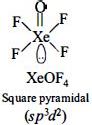
- 44. In the long form of the periodic table, the valence shell electronic configuration of \(5s^2\,5p^4\) corresponds to the element present in 2015 Medium
- (A) Group \(16\) and period \(6\)
- (B) Group \(17\) and period \(6\)
- (C) Group \(16\) and period \(5\)
- (D) Group \(17\) and period \(5\)
Show answer and solution
Correct Answer: (C)
Tellurium \((Te)\) has \(5s^2\,5p^4\) valence shell configuration. It belongs to group \(16\) and present in period \(5\) of the periodic table. - 45. The ionic radii (in \(\mathop A\limits^o \)) of \(N^{3-} , O^{2-}\) and \(F^-\) are respectively : 2015 Easy
- (A) \(1.71, 1.40\) and \(1.36\)
- (B) \(1.71, 1.36\) and \(1.40\)
- (C) \(1.36, 1.40\) and \(1.71\)
- (D) \(1.36, 1.71\) and \(1.40\)
Show answer and solution
Correct Answer: (A)
The ionic radii (in \(\dot{A}\) ) of \(N^{3-}, O^{2-}\) and \(F^{-}\) are respectively 1.71,1.40 and \(1.36 .\)\(N^{3-}, O^{2-}\) and \(F^{-}\) contains ten electrons each. Hence, they are isoelectronic species.
For isoelectronic species, the nuclear charge increases on moving from left to right in a period.
This decreases the ionic radii as the valence electrons are more strongly attracted by the nucleus.
-
- (A) \(1.56\)
- (B) \(6.22\)
- (C) \(3.11\)
- (D) \(4.56\)
Show answer and solution
Correct Answer: (C)
\(\mathop {\mathop {\,\,\,}\limits_{t = 0} }\limits_{t = equilibrium} \mathop {\mathop {{N_2}{O_4}(g)}\limits_1 }\limits_{1 - \alpha } \leftrightarrow \mathop {\mathop {2N{O_2}(g)}\limits_0 }\limits_{2\alpha } \)Where \(\alpha =\) Degree of dissociation.
Mol. wt. of mixture
\( = \frac{{(1 - \alpha ) \times {M_{{N_2}{O_4}}} + 2\alpha \times {M_{N{O_2}}}}}{{(1 + \alpha )}}\)
\( = \frac{{(1 - 0.2)92 + 2 \times 0.2 \times 46}}{{(1 + 0.2)}} = 76.66\)
Now, As per ideal gas equation
\(PV = nRT\)
\(P{M_{mixture}} = dRT\)
\(\therefore d = \frac{{P{M_{mix.}}}}{{RT}} = \frac{{1 \times 76.66}}{{0.0821 \times 300}} = 3.11\,g/L\)
- 47. The increase of pressure on ice \(\rightleftharpoons\) water system at constant temperature will lead to 2015 Medium
- (A) a decrease in the entropy of the system
- (B) an increase in the Gibb's energy of the system
- (C) no effect on the equilibrium
- (D) a shift of the equilibrium in the forward direction
Show answer and solution
Correct Answer: (D)
Volume of ice is greater than that of water. The direction in which the reaction will proceed can be predicted by applying LeChatelier's principle
\({\text{Pressure }} \propto {\text{ }}\frac{1}{{{\text{Vo1ume}}}}\)
So equilibrium, will shift forward. -
- (A) forward direction because \(Q < K_c\)
- (B) reverse direction because \(Q < K_c\)
- (C) forward direction because \(Q > K_c\)
- (D) reverse direction because \(Q > K_c\)
Show answer and solution
Correct Answer: (D)
\(\Delta G^{\circ}=2494.2 \,J\)\(2 A \rightleftharpoons B+C\)
\(R=8.314 \,J / K / \mathrm{\,mol}\)
\(e=2.718\)
\([A]=\frac{1}{2},[B]=2\)
\([C]=\frac{1}{2} ; Q=\frac{|B||C|}{|A|^{2}}\)
\(=\frac{2 \times 1 / 2}{\left(\frac{1}{2}\right)^{2}}=4\)
\(\Delta G^{\circ}=-2.303 R T \log K_{c}\)
\(2494.2 \,J=-2.303 \times(8.314 \,J / K /\, m o l) \times(300 K) \log K_{c}\)
\(\Rightarrow \log K_{e}\)
\(=-\frac{2494.2 \,J}{2.303 \times 8.314 \,J / K /\, m o l \times 300 \,K}\)
\(\Rightarrow \log K_{c}=-0.4341 ; K_{c}=0.37 ; Q>K_{c}\)
-
- (A) \(86600 - \frac{\ln (1.6 \times 10^{12})}{ R (298) }\)
- (B) \(0.5[2 \times 86,600-R(298)\ln (1.6 \times 10^{12} )]\)
- (C) \(R(298) \ln (1.6 \times 10^{12} )-86600\)
- (D) \(86600+R( 298) \ln (1.6 \times 10^{12})\)
Show answer and solution
Correct Answer: (B)
\( {\Delta G_{N O}^{\circ}} _{(g)}=86.6 \,k J / m o l=86600 \,J / m o l\)\(G_{N O_{2}(g)}^{\circ}=x \,J / m o l\)
\(T=298, K_{p}=1.6 \times 10^{12}\)
\(\Delta G^{\circ}=-R T \ln K_{p}\)
Given equation,
\(2 \mathrm{NO}(g)+\mathrm{O}_{2}(g) \rightleftharpoons 2 \mathrm{NO}_{2}(g)\)
\(2 \Delta G_{N O_{2}}^{\circ}-2 \Delta G_{N O}^{\circ}=-R(298) \ln \left(1.6 \times 10^{12}\right)\)
\(2 \Delta G_{N O_{2}}^{\circ}-2 \times 86600=-R(298) \ln \left(1.6 \times 10^{12}\right)\)
\(2 \Delta G_{N O_{2}}^{\circ}=2 \times 86600-R(298) \ln \left(1.6 \times 10^{12}\right)\)
\(\Delta G^{\circ}_{N O_{2}}=\frac{1}{2}\left[2 \times 86600-R(298) \ln \left(1.6 \times 10^{12}\right)\right]\)
\(=0.5\left[2 \times 86600-R(298) \ln \left(1.6 \times 10^{12}\right)\right]\)
- 50. The following statements relate to the adsorption of gases on a solid surfuce. Identify the incorrect statement among them 2015 Medium
- (A) Enthalpy of adsorption is negative
- (B) Energy appears as heat
- (C) On adsorption, the residual forces on the surface are increased
- (D) Entropy of adsorption is negative
Show answer and solution
Correct Answer: (C)
Adsorption is a phenomena of attracting and retaining the molecules of a substance on the surface of a liquid or a solid resulting into a higher concentration of the molecules on the surface.After adsorption there is a decrease in the residual forces due to bond formation \(\Delta G\), \(\Delta H\) and \(\Delta S\) all are negative in the case of adsorption.
No questions on this page match these filters.
Other years
Frequently asked
How many JEE Mains 2015 Chemistry questions are on ExamBro?
54 questions, each with the correct answer and a full solution.
Which JEE Mains 2015 Chemistry chapter is asked the most?
P -Block elements - ll, with 7 questions, followed by D and f- block elements with 4.
How difficult are JEE Mains 2015 Chemistry questions?
7% are easy, 22% medium and 70% hard.