


Questions
17 questionsShowing 1–17 of 17 questions
-
- (A) \(\mathrm{r}_{\mathrm{Br}} \lt \mathrm{r}_{\mathrm{K}}\)
- (B) \(\mathrm{r}_{\mathrm{Mg}} \lt \mathrm{r}_{\mathrm{Al}}\)
- (C) \(\mathrm{r}_{\mathrm{Rb}} \lt \mathrm{r}_{\mathrm{Cs}}\)
- (D) \(\mathrm{r}_{\mathrm{At}} \lt \mathrm{r}_{\mathrm{Cs}}\)
Show answer and solution
Correct Answer: (B)
In a period from left to right atomic size decreases. -
- (A) A < D < B < C
- (B) A < C < B < D
- (C) A < B < C < D
- (D) D < A < B < C
Show answer and solution
Correct Answer: (D)
\(\mathrm{N}:-1 \mathrm{~s}^2 2 \mathrm{~s}^2 2 \mathrm{p}^3\) (Electronegativity \(\left.=3\right)\)
\(\mathrm{O}:-1 \mathrm{~s}^2 2 \mathrm{~s}^2 2 \mathrm{p}^4\) (Electronegativity \(=3.5\))
\(\mathrm{F}:-1 \mathrm{~s}^2 2 \mathrm{~s}^2 2 \mathrm{p}^5\) (Electronegativity \(=4\))
\(\mathrm{C}:-1 \mathrm{~s}^2 2 \mathrm{~s}^2 2 \mathrm{p}^2\) (Electronegativity \(=2.55\))
Correct order \(=\mathrm{C} \gt \mathrm{B} \gt \mathrm{A} \gt \mathrm{D}\) -
- (A) \(1402 \mathrm{~kJ} \mathrm{~mol}^{-1}\)
- (B) \(834 \mathrm{~kJ} \mathrm{~mol}^{-1}\)
- (C) \(1012 \mathrm{~kJ} \mathrm{~mol}^{-1}\)
- (D) \(947 \mathrm{~kJ} \mathrm{~mol}^{-1}\)
Show answer and solution
Correct Answer: (C)
The main component of apatite family is phosphorus.
Order of \(\mathrm{IE}_1\) of group 15 elements \(\mathrm{N}>\mathrm{P}>\mathrm{As}>\mathrm{Sb}\) IE of phosphorus \(=1012 \mathrm{~kJ} \mathrm{~mol}^{-1}\). -
- (A) Both Statement I and Statement II are true
- (B) Statement I is false but Statement II is true
- (C) Both Statement I and Statement II are false
- (D) Statement I is true but Statement II is false
Show answer and solution
Correct Answer: (C)
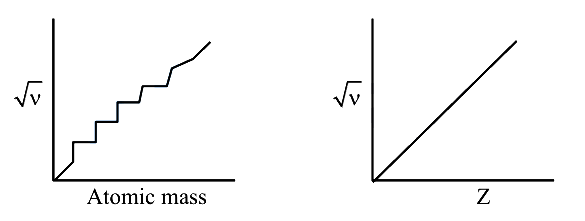
Explanation:
According to Moseley's Law for characteristic X-ray spectra, the relationship between frequency and atomic number is expressed as:
\( \sqrt{\nu} = a(Z - b) \)
Where \( \nu \) represents the frequency of the emitted X-rays, \( Z \) represents the atomic number, and \( a \) and \( b \) are constants.
1. Analysis of Statement (I): The graph plotted between \( \sqrt{\nu} \) and atomic mass is not a straight line; instead, it forms a jagged, irregular curve. This discovery led Henry Moseley to conclude that the atomic number is a far more fundamental property of an element than its atomic mass. Therefore, Statement I is false.
2. Analysis of Statement (II): Moseley's law specifies that the square root of the frequency (\( \sqrt{\nu} \)) is directly proportional to the atomic number, which means a plot of \( \sqrt{\nu} \) versus \( Z \) yields a straight line. Conversely, a plot of frequency (\( \nu \)) versus atomic number (\( Z \)) will yield a parabola (\( \nu \propto Z^2 \)), not a straight line. Therefore, Statement II is also false.
Since both statements are entirely false, Option C is the correct choice. -
- (A) Both Statement (I) and Statement (II) are false.
- (B) Both Statement (I) and Statement (II) are true.
- (C) Statement (I) is false but Statement (II) is true.
- (D) Statement (I) is true but Statement (II) is false.
Show answer and solution
Correct Answer: (A)
Law of octaves was arranged in the increasing order of their atomic weight.
Lothar Meyer plotted the physical properties such as atomic volume, melting point and boiling point against atomic weight. -
- (A) Statement I is true but Statement II is false
- (B) Both Statement I and Statement II are true
- (C) Both Statement I and Statement II are false
- (D) Statement I is false but Statement II is true
Show answer and solution
Correct Answer: (D)
Statement-I : False but Statement-II is true.
On moving left to right in periodic table nonmetallic character increases and we know that nonmetal oxides are acidc in nature.
Non metallic character \(\uparrow\) Acidic strength of oxide \(\uparrow\) -
- (A) Both Statement I and Statement II are incorrect
- (B) Statement I is incorrect but Statement II is correct
- (C) Statement I is correct but Statement II is incorrect
- (D) Both Statement I and Statement II are correct
Show answer and solution
Correct Answer: (B)
\(\Rightarrow\) The metallic radius order of \(\mathrm{Al} ~\&~ \mathrm{Ga}\) is
\(\mathrm{B} \lt \underbrace{\mathrm{Ga} \lt \mathrm{Al}}_{\downarrow} \lt \mathrm{In} \lt \mathrm{T} \ell\)
(due to poor shielding of d-subshell electrons)
\(\Rightarrow\) The ionic radius order of \(\mathrm{Al}^{+3} ~\&~ \mathrm{Ga}^{+3}\) is \(\mathrm{B}^{+3} \lt \mathrm{Al}^{+3} \lt \mathrm{Ga}^{+3} \lt \mathrm{In}^{+3} \lt \mathrm{T} \ell^{+3}\) -
- (A) Statement I is false but Statement II is true
- (B) Statement I is true but Statement II is false
- (C) Both Statement I and Statement II are true
- (D) Both Statement I and Statement II are false
Show answer and solution
Correct Answer: (B)
First ionization energy of Lead \(=715 \mathrm{~kJ} \mathrm{~mol}^{-1}\)
First ionization energy of Tin \(=708 \mathrm{~kJ} \mathrm{~mol}^{-1}\)
\(\left(\mathrm{IE}_1\right)\) of Lead is greater than that of Tin due to ineffective shielding of d - and f -electrons.
Therefore Statement-I is true.
First ionization energy of Germanium \(=761 \mathrm{~kJ} \mathrm{~mol}^{-1}\)
First ionization energy of Silicon \(=786 \mathrm{~kJ} \mathrm{~mol}^{-1}\)
\(\left(\mathrm{IE}_1\right)\) of Germanium is lower than that of Silicon as the effect of higher atomic radius of Ge outweighs the increase in nuclear charge from Si to Ge and effective shielding of inner electrons.
Therefore Statement-II is false. -
- (A) Statement I is incorrect but Statement II is correct
- (B) Statement I is correct but Statement II is incorrect
- (C) Both Statement I and Statement II are incorrect
- (D) Both Statement I and Statement II are correct
Show answer and solution
Correct Answer: (D)
\(\mathrm{r} \propto \mathrm{q}^{-}\)(for isoelectronic species)
\(\propto \frac{1}{q^{+}}\)
\(\therefore\) Statement I is correct
Magnitude of electron gain enthalpy
\(\mathrm{Cl}>\mathrm{F}>\mathrm{Br}>\mathrm{I}\) -
- (A) (A)-(IV), (B)-(I), (C)-(II), (D)-(III)
- (B) (A)-(IV), (B)-(I), (C)- (III), (D)-(II)
- (C) (A)-(III), (B)-(IV), (C)- (II), (D)-(I)
- (D) (A)-(II), (B)-(III), (C)-(IV), (D)-(I)
Show answer and solution
Correct Answer: (A)
Ionic radii \(-\mathrm{Al}^{3+} < \mathrm{Mg}^{2+} < \mathrm{Na}^{+} < \mathrm{F}^{-}\)
Ionisation energy - \(\mathrm{B} < \mathrm{C} < \mathrm{O} < \mathrm{N}\)
Metallic character \(-\mathrm{B} < \mathrm{Al} < \mathrm{Mg} < \mathrm{K}\)
Electron negativity \(-\mathrm{Si} < \mathrm{P} < \mathrm{S} < \mathrm{Cl}\) - 11. The element that does not belong to the same period of the remaining elements (modern periodic table) is _______. 2025 Easy
- (A) Iridium
- (B) Platinum
- (C) Osmium
- (D) Palladium
Show answer and solution
Correct Answer: (D)
Palladium \(\Rightarrow 5^{\text {th }}\) period
Iridium, Osmium, Platinum \(\Rightarrow 6^{\text {th }}\) Period - 12. The elements of Group 13 with highest and lowest first ionisation enthalpies are respectively: 2025 Medium
- (A) \(\mathrm{B} ~\&~ \mathrm{Ga}\)
- (B) B & Tl
- (C) \(\mathrm{Tl} ~\&~ \mathrm{~B}\)
- (D) B & In
Show answer and solution
Correct Answer: (D)
IE order
\(\mathrm{B} \gt \mathrm{T} \ell \gt \mathrm{Ga} \gt \mathrm{Al} \gt \mathrm{In}\) -
- (A) \(\mathrm{Si}\gt\mathrm{P}\gt\mathrm{Cl}\gt\mathrm{F}\)
- (B) \(\mathrm{Be}\gt\mathrm{Mg}\gt\mathrm{Al}\gt\mathrm{Si}\)
- (C) \(\mathrm{Al}\gt\mathrm{B}\gt\mathrm{N}\gt\mathrm{F}\)
- (D) \(\mathrm{Mg}\gt\mathrm{Al}\gt\mathrm{C}\gt\mathrm{O}\)
Show answer and solution
Correct Answer: (B)
Correct order of atomic radius : \(\mathrm{Be} < \mathrm{Mg}>\mathrm{Al}>\mathrm{Si}\) -
- (A) Group 13
- (B) Group 14
- (C) Group 2
- (D) Group 4
Show answer and solution
Correct Answer: (A)
The successive 5 ionisation energies of an element are \(800,2427,3658,25024\) and \(32824 \mathrm{~kJ} / \mathrm{mol}\), respectively.
\(\begin{aligned}
& \frac{\mathrm{IE}_2}{\mathrm{IE}_1}=\frac{2427}{800}=3.03 \\
& \frac{\mathrm{IE}}{\mathrm{IE}_2}=\frac{3658}{2427}=1.51 \\
& \frac{\mathrm{IE}}{\mathrm{IE}_3}=\frac{25024}{3658}=6.84
\end{aligned}\)
\(\frac{\mathrm{IE}_5}{\mathrm{IE}_4}=\frac{32824}{25024}=1.31\)
Since ( \(\mathrm{IE}_4 / \mathrm{IE}_3\) ) value is maximum, the element belongs to group 13. -
- (A) \(\mathrm{A}_2 \mathrm{O}\)
- (B) \(\mathrm{A}_2 \mathrm{O}_3\)
- (C) \(\mathrm{AO}_2\)
- (D) \(\mathrm{AO}\)
Show answer and solution
Correct Answer: (B)
Among given atoms, Boron has least atomic radius oxide of Boron \(=\mathrm{B}_2 \mathrm{O}_3\) -
- (A) B & C only
- (B) A, C and d only
- (C) B and D only
- (D) B,C and E only
Show answer and solution
Correct Answer: (A)
(A) The process of adding an \(\mathrm{e}^{-}\)to a neutral gaseous atom is not always exothermic it may be exothermic or endothermic.
(C) \(\mathrm{Be} \quad \mathrm{B}\)
\(1 s^2 2 s^2 \quad 1 s^2 2 s^2 2 p^1\)
In Be 2 s subshell in fully filled
So, need high energy to remove \(\mathrm{e}^{-}\)as compared to B.
(D)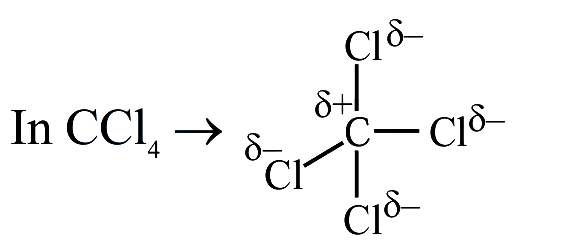
due to partially positive charge \(z_{\text {eff }} \uparrow, \mathrm{EN} \uparrow\)
So, EN of \(\mathrm{C} \Rightarrow \mathrm{CCl}_4 \gt \mathrm{CH}_4\)
(E) Cs is most electropositive. -
- (A) \(\mathrm{A}, \mathrm{C}\) and E Only
- (B) A and E Only
- (C) \(\mathrm{B}, \mathrm{C}\) and E Only
- (D) D and E Only
Show answer and solution
Correct Answer: (A)
Properties of elements are function of atomic numbers.
Elements having similar outer electronic configuration are arranged in same group.
Number of elements in a period is double of number of atomic orbitals available in energy level that is being filled.
No questions on this page match these filters.