


All JEE Mains 2025 Chemistry questions
26 chaptersShowing 51–100 of 381 questions
-
- (A) A-II, B-III, C-I, D-IV
- (B) A-III, B-IV, C-I, D-II
- (C) A-IV, B-I, C-II, D-III
- (D) A-II, B-III, C-IV, D-I
Show answer and solution
Correct Answer: (D)
(A) \(\mathrm{CH}_4(\mathrm{~g})+2 \mathrm{O}_2(\mathrm{~g}) \xrightarrow{\Delta} 2 \mathrm{CO}_2(\mathrm{~g})+\mathrm{H}_2 \mathrm{O}(\mathrm{l}) \Rightarrow\) combination reaction
(B) 2 NaH (s) \(\xrightarrow{\Delta} 2 \mathrm{Na}(\mathrm{s}) \quad+\mathrm{H}_2(\mathrm{~g}) \quad \Rightarrow\) Decomposition reaction
(C) \(\mathrm{V}_2 \mathrm{O}_5(\mathrm{~s})+5 \mathrm{Ca}(\mathrm{s}) \xrightarrow{\Delta} 2 \mathrm{~V}(\mathrm{~s})+5 \mathrm{CaO}(\mathrm{s})\) \(\Rightarrow\) Displacement reaction
(D) \(2 \mathrm{H}_2 \mathrm{O}_2\) (aq.) \(\xrightarrow{\Delta} 2 \mathrm{H}_2 \mathrm{O}(\mathrm{l})+\mathrm{O}_2(\mathrm{~g})\) \(\Rightarrow\) Disproportionation reaction -
- (A) \(+4,+2,0,+2\)
- (B) \(+2,0,+2,+4\)
- (C) \(0,+2,+4,+2\)
- (D) \(+2,0,0,+4\)
Show answer and solution
Correct Answer: (B)
For charging of lead storage battery cell reaction is \(2 \mathrm{PbSO}_4(\mathrm{~s})+2 \mathrm{H}_2 \mathrm{O}(\mathrm{l}) \rightarrow \mathrm{Pb}(\mathrm{s})+\mathrm{PbO}_2(\mathrm{~s})+2 \mathrm{H}_2 \mathrm{SO}_4(\mathrm{aq})\) At anode \(\mathrm{PbSO}_4\) reduced back to Pb and at cathode \(\mathrm{PbSO}_4\) oxidised back to \(\mathrm{PbO}_2\).
\(\begin{aligned}
& \because \quad \mathrm{x}_1=+2, \mathrm{y}_1=0 \\
& \mathrm{x}_2=+2, \mathrm{y}_2=4
\end{aligned}\) -
- (A) 40
- (B) 45
- (C) 50
- (D) 55
Show answer and solution
Correct Answer: (B)
Let moles of \(\mathrm{CO}_2=\mathrm{n}\)
moles of \(\mathrm{Ca}(\mathrm{OH})_2\) total initially \(=2 \mathrm{n}\)
excess \(\mathrm{Ca}(\mathrm{OH})_2=\mathrm{n}\)
gm equivalent of \(\mathrm{Ca}(\mathrm{OH})_2=\mathrm{gm}\) equivalent of HCl
\(\begin{aligned}
& \mathrm{n} \times 2=0.1 \times \frac{40}{1000} \times 1 \\
& \mathrm{n}=2 \times 10^{-3}
\end{aligned}\)
Volume of \(\mathrm{CO}_2=2 \times 10^{-3} \times 22400=44.8 \mathrm{~cm}^3\) -
- (A) both reducing
- (B) both oxidising
- (C) reducing and oxidising
- (D) oxidising and reducing
Show answer and solution
Correct Answer: (C)
As per given information of ionisation energy
\(\mathrm{A}=\mathrm{Sn} \& \mathrm{~B}=\mathrm{Pb}\)
\(\begin{aligned} & \mathrm{A}^{+2}=\mathrm{Sn}^{2+}=\text { Reducing agent } \\ & \mathrm{B}^{+4}=\mathrm{Pb}^{+4}=\text { Oxidising agent }\end{aligned}\) -
- (A) \(\mathrm{ClO}_3^{-}\)
- (B) \(\mathrm{ClO}^{-}\)
- (C) \(\mathrm{ClO}_2^{-}\)
- (D) \(\mathrm{ClO}_4^{-}\)
Show answer and solution
Correct Answer: (D)
\(\mathrm{ClO}_4^{-} \rightarrow x+\{(-2) \times 4\}=-1 \Rightarrow x=+7\)
Chlorine is in its maximum oxidation state, so disproportionation not possible in \(\mathrm{ClO}_4^{-}\). -
- (A) C, D and E Only
- (B) B, C and D Only
- (C) A, D and E Only
- (D) A, B and C Only
Show answer and solution
Correct Answer: (D)
\(\mathrm{I}^{-} \xrightarrow{\mathrm{OH}} \mathrm{IO}_3^{-}\)
\(\mathrm{S}^{-2} \xrightarrow{\mathrm{H}^{+}} \mathrm{S}\)
\(\mathrm{S}_2 \mathrm{O}_3^{2-} \xrightarrow{\mathrm{OH}} \mathrm{SO}_4^{2-}\)
\(\begin{aligned}
& \mathrm{Fe}^{+2} \longrightarrow \mathrm{Fe}^{+3} \\
& \mathrm{~S}_2 \mathrm{O}_3^{2-} \xrightarrow{\mathrm{H}^{+}} \mathrm{S} \downarrow+\mathrm{SO}_4^{2-}
\end{aligned}\) -
- (A) 16
- (B) 32
- (C) 8
- (D) 24
Show answer and solution
Correct Answer: (D)
The number of tetrapeptides (sequences) possible involving each of these amino acids (glycine, alanine, valine, leucine) ; It has three (3) peptides linkage the number of permutations in which they can be arranged
\(\begin{aligned}
& =4 \times 3 \times 2 \times 1 \\
& =24
\end{aligned}\) -
- (A) C & D Only
- (B) A & B Only
- (C) B & C Only
- (D) C & E Only
Show answer and solution
Correct Answer: (D)
Vit D, E, K. A are fat soluble vitamins. -
- (A) Statement I is false but Statement II is true
- (B) Both Statement I and Statement II are false
- (C) Both Statement I and Statement II are true
- (D) Statement I is true but Statement II is false
Show answer and solution
Correct Answer: (A)
- D-glucose pentaacetate do not react with 2.4 DNP
- Starch \(\frac{\text { conc. } \mathrm{H}_2 \mathrm{SO}_4}{\Delta}\) Glucose
\(\begin{gathered}2-3 \mathrm{~atm} \\ 100^{\circ} \mathrm{C}\end{gathered}\) -
- (A) Both Statement I and Statement II are true.
- (B) Statement I is false but Statement II are true.
- (C) Statement I is true but Statement II is false.
- (D) Both Statement I and Statement II are false.
Show answer and solution
Correct Answer: (B)
On hydrolysis of sucrose gives D-(+)-glucose and D-(-)-fructose while in Statement (1) D-(+)-fructose is given evince Statement-(1) is incorrect.
Statement II - It is correct because sucrose on hydrolysis gives invert sugar -
- (A) Both statement I and statement II are correct
- (B) Statement I is incorrect but Statement II is correct
- (C) Both statement I and statement II are incorrect
- (D) Statement I is correct but Statement II is incorrect
Show answer and solution
Correct Answer: (C)
(i) Protein does not gives \(\beta\)-amino acid on hydrolysis
(ii) Fibrous protein are not water soluble
So both statement's are wrong -
- (A) Statement I is false but Statement II is true
- (B) Statement I is true but Statement II is false
- (C) Both Statement I and Statement II are true
- (D) Both Statement I and Statement II are false
Show answer and solution
Correct Answer: (B)
Cellulose derivcative has more number of hydroxy groups, so more H -bonding is present with water in cellulose derivatives cotton cloths. -
- (A) (A), (B) and (C) only
- (B) (B), (C) and (E) only
- (C) (C), (D) and (E) only
- (D) (B), (C) and (D) only
Show answer and solution
Correct Answer: (B)
\((\mathrm{A})\) Starch \(\xrightarrow{\mathrm{H}^{+} / \mathrm{H}_2 \mathrm{O}}\) Glucose
(B) Cane sugar \(\xrightarrow{\mathrm{H}^{+} / \mathrm{H}_2 \mathrm{O}}\) glucose + fructose (Sucrose) \(50 \% \quad 50 \%\)
(C) Milk sugar \(\xrightarrow{\mathrm{H}^{+} / \mathrm{H}_2 \mathrm{O}}\) glucose + galactose (Lactose)
(D) Amylopectin \(\xrightarrow{\mathrm{H}^{+} / \mathrm{H}_2 \mathrm{O}}\) Glucose
(E) Amylose \(\xrightarrow{\mathrm{H}^{+} / \mathrm{H}_2 \mathrm{O}}\) Glucose
So, correct options are B,C,and E only. -
- (A) All naturally occurring amino acids except glycine contain one chiral centre.
- (B) All naturally occurring amino acids are optically active.
- (C) Glutamic acid is the only amino acid that contains a-COOH group at the side chain.
- (D) Amino acid, cysteine easily undergo dimerization due to the presence of free SH group.
Show answer and solution
Correct Answer: (D)
* Isoleucine has 2 chiral centre
* Glycine is optically inactive
* Aspartic acid also contain COOH group at the side chain.
* Cysteine easily dimmerise due to free SH group -
- (A) (A), (C) and (E) only
- (B) (A), (C) and (D) only
- (C) (C), (D) and (E) only
- (D) (B), (C) and (E) only
Show answer and solution
Correct Answer: (B)
Valine, Lysine and Threonine are essential amino acids. - 66. Identify the number of structures from the following which can be correlated to D-glyceraldehyde.
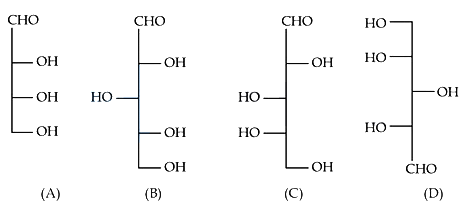 2025 Medium
- (A) four
- (B) one
- (C) two
- (D) three
Show answer and solution
Correct Answer: (D)
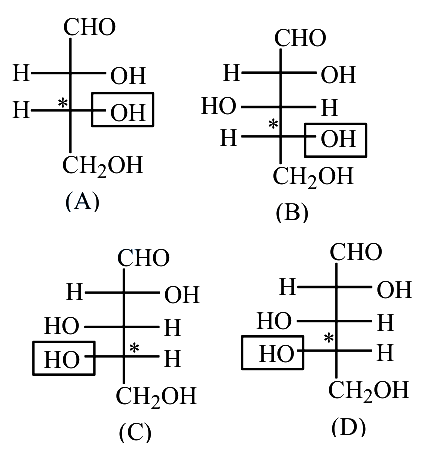
In \(\mathrm{A}, \mathrm{B}, \mathrm{D}^*-\mathrm{OH}\) group in right hand side then D-configuration is assign -
- (A) 4
- (B) 6
- (C) 8
- (D) 2
Show answer and solution
Correct Answer: (D)
\(\begin{aligned}
\text { Degree of unsaturation } & =\mathrm{C}+1-\frac{\mathrm{H}}{2} \\
& =9+1-6=4
\end{aligned}\)
Benzene shows negative Baeyer's test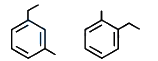
Both compounds have four different non-aliphatic substitution sites. -
- (A) (A)-(IV), (B)-(I), (C)-(III), (D)-(II)
- (B) (A)-(III), (B)-(II), (C)-(I), (D)-(IV)
- (C) (A)-(II), (B)-(III), (C)-(I), (D)-(IV)
- (D) (A)-(IV), (B)-(I), (C)-(II), (D)-(III)
Show answer and solution
Correct Answer: (D)
Amylose \(\Rightarrow \mathrm{It}\) is a plant based starch it has \(\alpha-\mathrm{C}_1-\mathrm{C}_4\) glycosidic linkage.
Cellulose \(\Rightarrow\) It has \(\beta-\mathrm{C}_1-\mathrm{C}_4\) glycosidic linkage
Glycogen \(\Rightarrow\) It has \(\alpha-\mathrm{C}_1-\mathrm{C}_4\) and glycosidic linkage (animal starch)
Amylopectin \(\Rightarrow\) It is a plant based with \(\alpha-\mathrm{C}_1-\mathrm{C}_4\) and \(\mathrm{C}_1-\mathrm{C}_6\) glycosidic linkage -
- (A) (A)-(IV), (B)-(II), (C)-(I), (D)-(III)
- (B) (A)-(I), (B)-(II), (C)-(III), (D)-(IV)
- (C) (A)-(III), (B)-(I), (C)-(IV), (D)-(II)
- (D) (A)-(II), (B)-(IV), (C)-(III), (D)-(I)
Show answer and solution
Correct Answer: (C)
(A) Sucrose \(\rightarrow \alpha_1-\beta_2\) Glycosidic linkage
(B) Maltose \(\rightarrow \alpha\) 1-4 Glycosidic linkage
(C) Lactose \(\rightarrow \beta\) 1-4 Glycosidic linkage
(D) Amylopectin \(\rightarrow \alpha 1-4\) and \(\alpha 1-6\)
Glycosidic linkage
A-III, B-I, C-IV, D-II -
- (A) A, D and E Only
- (B) A, C and D Only
- (C) A, B and E Only
- (D) B, D and E Only
Show answer and solution
Correct Answer: (B)
In Ribose carbohydrate present in DNA is \(\beta-2-\) Deoxy-D-Ribose whose structure is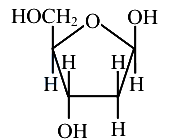
which is a reducing \(D\)-sugar in \(\beta\) anomeric form & it is a pentose sugar. - 71. The \(\alpha\)-Helix and \(\beta\) - Pleated sheet which structures of protein are associated with its? 2025 Easy
- (A) tertiary structure
- (B) quaternary structure
- (C) secondary structure
- (D) primary structure
Show answer and solution
Correct Answer: (C)
\(\alpha\)-helix and \(\beta\)-pleated sheet belongs to secondary structure of protein, which have hydrogen bonds. -
- (A) 11
- (B) 22
- (C) 33
- (D) 44
Show answer and solution
Correct Answer: (C)
Two nucleic acid chains are wound about each other and held together by H bonds between pair of bases.
Adenine from two hydrogen bonds with thymine and Guanine form three hydrogen bond with cytosine.
\(5^{\prime} \mathrm{G}-\mathrm{G}-\mathrm{C}-\mathrm{A}-\mathrm{A}-\mathrm{A}-\mathrm{T}-\mathrm{C}-\mathrm{G}-\mathrm{G}-\mathrm{C}-\mathrm{T}-\mathrm{A}-3^{\prime}\)
In given DNA strand total seven guanine and cytosine bases which form total 21 H -bonds and six adenine and thymine base which will form total 12 H-bonds with other DNA strand.
Total no. of H bonds \(=7 \times 3+6 \times 2=33\) -
- (A) Adipic acid
- (B) Ascorbic acid
- (C) Saccharic acid
- (D) Aspartic acid
Show answer and solution
Correct Answer: (B)
Vitamin-C is Ascorbic acid. - 74. A weak acid HA has degree of dissociation x . Which option gives the correct expression of ( pH - \(\mathrm{pK}_{\mathrm{a}}\) )? 2025 Medium
- (A) 0
- (B) \(\log (1+2 \mathrm{x})\)
- (C) \(\log \left(\frac{1-x}{x}\right)\)
- (D) \(\log \left(\frac{x}{1-x}\right)\)
Show answer and solution
Correct Answer: (D)
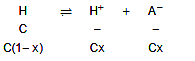
\(\begin{aligned} & \mathrm{K}_{\mathrm{a}}=\frac{\left[\mathrm{H}^{+}\right](\mathrm{x})}{\mathrm{C}(1-\mathrm{x})} \\ & {\left[\mathrm{H}^{+}\right]=\mathrm{K}_{\mathrm{a}} \frac{(1-\mathrm{x})}{\mathrm{x}}} \\ & \log \mathrm{H}^{+}=\log \mathrm{K}_{\mathrm{a}}+\log \left(\frac{1-\mathrm{x}}{\mathrm{x}}\right) \\ & -\log \mathrm{H}^{+}=-\log \mathrm{K}_{\mathrm{a}}-\log \frac{1-\mathrm{x}}{\mathrm{x}} \\ & \mathrm{pH}=\mathrm{pK}_{\mathrm{a}}-\log \frac{1-\mathrm{x}}{\mathrm{x}} \\ & \mathrm{pH}-\mathrm{pK}_{\mathrm{a}}=\log \frac{\mathrm{x}}{1-\mathrm{x}}\end{aligned}\) -
- (A) reduce to \(0.5\)
- (B) increase to \(1.3\)
- (C) remain same
- (D) increase to \(2\)
Show answer and solution
Correct Answer: (B)
\(\mathrm{HCl}_{(\mathrm{aq})} \mathrm{pH}=1 ;\left[\mathrm{H}^{+}\right]=10^{-1}\)
If equal volume of water is added concentration will become half
\(\begin{aligned}& {\left[\mathrm{H}^{+}\right]_{\mathrm{sol}}=\frac{10^{-1}}{2}} \\& \mathrm{pH}=1.3\end{aligned}\) - 76. Arrange the following in increasing order of solubility product :
\(\mathrm{Ca}(\mathrm{OH})_2, \mathrm{AgBr}, \mathrm{PbS}, \mathrm{HgS}\) 2025 Medium- (A) \(\mathrm{HgS} \lt \mathrm{AgBr} \lt \mathrm{PbS} \lt \mathrm{Ca}(\mathrm{OH})_2\)
- (B) \(\mathrm{Ca}(\mathrm{OH})_2 \lt \mathrm{AgBr} \lt \mathrm{HgS} \lt \mathrm{PbS}\)
- (C) \(\mathrm{PbS} \lt \mathrm{HgS} \lt \mathrm{Ca}(\mathrm{OH})_2 \lt \mathrm{AgBr}\)
- (D) \(\mathrm{HgS} \lt \mathrm{PbS} \lt \mathrm{AgBr} \lt \mathrm{Ca}(\mathrm{OH})_2\)
Show answer and solution
Correct Answer: (D)
Based on the Ksp values and salt analysis cation identification, we can say that order of Ksp value is:
\(\mathrm{HgS} < \mathrm{PbS} < \mathrm{AgBr} < \mathrm{Ca}(\mathrm{OH})_2\)
K sp values
\(\begin{aligned}
& \mathrm{HgS} \rightarrow 4 \times 10^{-53} \\
& \mathrm{PbS} \rightarrow 8 \times 10^{-28} \\
& \mathrm{AgBr} \rightarrow 5 \times 10^{-13} \\
& \mathrm{Ca}(\mathrm{OH})_2 \rightarrow 5.5 \times 10^{-6}
\end{aligned}\) -
- (A) CoS
- (B) ZnS
- (C) NiS
- (D) MnS
Show answer and solution
Correct Answer: (A)
Compound \((A)\) in the given reaction sequence is likely to be CoS.
\(\begin{aligned} \mathrm{CoS}+\mathrm{HNO}_3+3 \mathrm{HCl} \rightarrow \mathrm{Co}^{2+} & +\mathrm{S} \downarrow+\mathrm{NOCl} \uparrow \\ & +2 \mathrm{Cl}^{-}+2 \mathrm{H}_2 \mathrm{O}\end{aligned}\)
The above solution is neutralised with \(\mathrm{NH}_4 \mathrm{OH}\).
To a neutral solution of \(\mathrm{Co}^{2+}\), acetic acid and saturated solution of \(\mathrm{KNO}_2\) are added which results in the formation of yellow precipitate of \(\mathrm{K}_3\left[\mathrm{Co}\left(\mathrm{NO}_2\right)_6\right]\)
\(\mathrm{Co}^{2+}+7 \mathrm{NO}_2^{-}+2 \mathrm{H}^{+}+3 \mathrm{~K}^{+} \rightarrow \mathrm{K}_3\left[\mathrm{Co}\left(\mathrm{NO}_2\right)_6\right]+\mathrm{NO} \uparrow+\mathrm{H}_2 \mathrm{O}\) -
- (A) Statement I is true but Statement II is false
- (B) Both Statement I and Statement II are false
- (C) Both Statement I and Statement II are true
- (D) Statement I is false but Statement II is true
Show answer and solution
Correct Answer: (C)
At melting point when ice melts, supplied heat is utilised to overcome intermolecular attraction within the molecules so temperature remain constant. -
- (A) (A), (D) and (E) only
- (B) (D) and (E) only
- (C) (A) and (B) only
- (D) (A) and (C) only
Show answer and solution
Correct Answer: (B)
\(\mathrm{As}_2 \mathrm{~S}_3\) and \(\mathrm{As}_2 \mathrm{~S}_5\) are yellow colour sulphides, \(\left(\mathrm{NH}_4\right)_2 \mathrm{~S}\) is colourless, PbS is black, CuS is black in colour -
- (A) 10
- (B) 17
- (C) 7
- (D) 5
Show answer and solution
Correct Answer: (C)
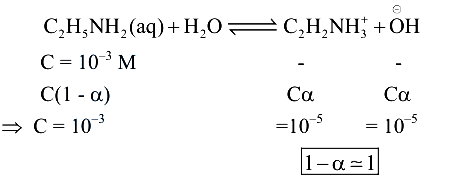
Given, \(\mathrm{P}^{\mathrm{H}}=9 \Rightarrow \mathrm{P}^{\mathrm{OH}}=5 \Rightarrow[\stackrel{\ominus}{\mathrm{OH}}]=10^{-5} \mathrm{M}\)
Now, \(\mathrm{K}_{\mathrm{b}}=\frac{\left[\mathrm{C}_2 \mathrm{H}_5 \mathrm{NH}_3^{+}\right][\stackrel{\ominus}{\mathrm{O}} \mathrm{H}]}{\left[\mathrm{C}_2 \mathrm{H}_5 \mathrm{NH}_2\right]}\)
\(\Rightarrow K_{\mathrm{b}}=\frac{10^{-5} \times 10^{-5}}{10^{-3}}=10^{-7}\) -
- (A) \(3.6 \times 10^{-3} \mathrm{M}~ \mathrm{AB}_2, 5.0 \times 10^{-4} \mathrm{M}~ \mathrm{XY}\)
- (B) \(2.0 \times 10^{-4} \mathrm{M}~ \mathrm{AB}_2, 0.8 \times 10^{-3} \mathrm{M}~ \mathrm{XY}\)
- (C) \(2.0 \times 10^{-2} \mathrm{M}~ \mathrm{AB}_2, 2.0 \times 10^{-2} \mathrm{M}~ \mathrm{XY}\)
- (D) \(1.5 \times 10^{-4} \mathrm{M}~ \mathrm{AB}_2, 1.5 \times 10^{-3} \mathrm{M}~ \mathrm{XY}\)
Show answer and solution
Correct Answer: (C)
When equal volumes are mixed molarity reduce to half.
For precipitation \(\mathrm{Q}_{\mathrm{SP}}=\left[\mathrm{A}^{+2}\right]\left[\mathrm{Y}^{-}\right]^2 \gt \mathrm{K}_{\mathrm{SP}}\)
(1) \(\mathrm{Q}_{\mathrm{SP}}=\left(1.8 \times 10^{-3}\right)\left(\frac{5}{2} \times 10^{-4}\right)^2 \lt \mathrm{K}_{\mathrm{sP}}\)
(2) \(\mathrm{Q}_{\mathrm{SP}}=\left(10^{-4}\right)\left(0.4 \times 10^{-3}\right)^2 \lt \mathrm{K}_{\mathrm{sp}}\)
(3) \(\mathrm{Q}_{\mathrm{SP}}=\left(10^{-2}\right)\left(10^{-2}\right)^2 \gt \mathrm{K}_{\mathrm{sP}}\)
(4) \(\mathrm{Q}_{\mathrm{SP}}=\left(\frac{1.5}{2} \times 10^{-4}\right)\left(\frac{1.5}{2} \times 10^{-3}\right)^2 \lt \mathrm{K}_{\mathrm{sP}}\) - 82. \(\mathrm{K}_{\text {sp }}\) for \(\mathrm{Cr}(\mathrm{OH})_3\) is \(1.6 \times 10^{-30}\). What is the molar solubility of this salt in water? 2025 Medium
- (A) \(\frac{1.8 \times 10^{-30}}{27}\)
- (B) \(\sqrt[5]{1.8 \times 10^{-30}}\)
- (C) \(\sqrt[4]{\frac{1.6 \times 10^{-30}}{27}}\)
- (D) \(\sqrt[2]{1.6 \times 10^{-30}}\)
Show answer and solution
Correct Answer: (C)
\(\begin{aligned} & \mathrm{Cr}(\mathrm{OH})_3 \rightleftharpoons \underset{ \mathrm{s}}{\mathrm{Cr}^{3+}}(\mathrm{aq})+\underset{3 \mathrm{~s}}{3 \mathrm{OH}^{-}(\mathrm{aq})} \\ & \mathrm{K}_{\mathrm{sp}}=\mathrm{s}(3 \mathrm{~s})^3 \\ & 1.6 \times 10^{-30}=27 \mathrm{~s}^4 \\ & \sqrt[4]{\frac{1.6 \times 10^{-30}}{27}}=\mathrm{s}\end{aligned}\) -
- (A) 40
- (B) 48
- (C) 50
- (D) 52
Show answer and solution
Correct Answer: (B)
\(\begin{aligned}
& \mathrm{pOH}=\mathrm{pK}_{\mathrm{b}}+\log \frac{\left[\mathrm{NH}_4^{+}\right]}{\left[\mathrm{NH}_3\right]} \\
& \mathbf{p O H}=4.745
\end{aligned}\)
on adding 0.05 mole HCl
\(\begin{aligned}
& \begin{array}{llll}
\mathrm{NH}_3+ & \mathrm{H}^{\oplus} & \rightarrow & \mathrm{NH}_4^{\oplus} \\
0.1 & 0.05 & & 0.1 \\
0.05 & 0 & & 0.15
\end{array} \\
& \mathrm{pOH}^{\prime}=4.745+\log 3 \\
& \mathrm{pOH}^{\prime}-\mathrm{pOH}=0.477 \\
& 14-\mathrm{pH}^{\prime}-14+\mathrm{pH}=0.477 \\
& \Delta \mathrm{pH}=0.477 \\
& =47.7 \times 10^{-2} \approx 48 \times 10^{-2}
\end{aligned}\) - 84. pH of water is 7 at \(25^{\circ} \mathrm{C}\). If water is heated to \(80^{\circ} \mathrm{C}\)., it's pH will : 2025 Easy
- (A) Decrease
- (B) \(\mathrm{H}^{+}\)concentration increases, \(\mathrm{OH}^{-}\)concentration decreases
- (C) Remains the same
- (D) Increase
Show answer and solution
Correct Answer: (A)
At \(25^{\circ} \mathrm{C}\), pure water has \(\mathrm{pH}=7\)
As temperature increased, water molecules dissociate more into hydrogen ions ( \(\mathrm{H}^{+}\)) and hydroxide ions \(\left(\mathrm{OH}^{-}\right)\).
This increased dissociation leads to slightly decrease in pH .
At \(80^{\circ} \mathrm{C}, \mathrm{pH} \approx 6.93\) -
- (A) \(\left(\frac{\mathrm{K}_{\mathrm{sp}}}{9612}\right)^{\frac{1}{3}}\)
- (B) \(\left(\frac{\mathrm{K}_{\mathrm{sp}}}{6912}\right)^{\frac{1}{7}}\)
- (C) \(\left(\frac{\mathrm{K}_{\mathrm{sp}}}{8435}\right)^{\frac{1}{7}}\)
- (D) \(\left(\frac{\mathrm{K}_{\mathrm{sp}}}{5348}\right)^{\frac{1}{6}}\)
Show answer and solution
Correct Answer: (B)
\(\begin{array}{cc}\mathrm{Zr}_3\left(\mathrm{PO}_4\right)_4(\mathrm{~s}) \rightleftharpoons & 3 \mathrm{Zr}^{+4}(\mathrm{aq})+4 \mathrm{PO}_4^{-3}(\mathrm{aq}) \\ - & 3 \mathrm{~s} \quad 4 \mathrm{~s}\end{array}\)
\(\begin{aligned} & \mathrm{K}_{\text {sp }}=(3 \mathrm{~s})^3(4 \mathrm{~s})^4=6912 \mathrm{~s}^7 \\ & \mathrm{~s}=\left(\frac{\mathrm{K}_{\mathrm{sp}}}{6912}\right)^{1 / 7}\end{aligned}\) -
- (A) Both \(\mathrm{A}(\mathrm{OH})_2\) and \(\mathrm{B}(\mathrm{OH})_3\) do not show precipitation with \(\mathrm{NH}_4 \mathrm{OH}\)
- (B) \(\mathrm{A}(\mathrm{OH})_2\) will precipitate before \(\mathrm{B}(\mathrm{OH})_3\)
- (C) \(\mathrm{B}(\mathrm{OH})_3\) will precipitate before \(\mathrm{A}(\mathrm{OH})_2\)
- (D) \(\mathrm{A}(\mathrm{OH})_2\) and \(\mathrm{B}(\mathrm{OH})_3\) will precipitate together
Show answer and solution
Correct Answer: (C)
Condition for precipitation \(\mathrm{Q}_{\text {ip }}>\mathrm{K}_{\text {sp }}\)
For \(\left[\mathrm{A}(\mathrm{OH})_2\right]\)
\(\begin{aligned}
& {\left[\mathrm{A}^{2+}\right][\mathrm{OH}]^2>9 \times 10^{-10}} \\
& {\left[\mathrm{~A}^{+2}\right]=1 \mathrm{M}} \\
& \Rightarrow\left[\mathrm{OH}^{-}\right]>3 \times 10^{-5} \mathrm{M}
\end{aligned}\)
For \(\left[\mathrm{B}(\mathrm{OH})_3\right]\)
\(\begin{aligned}
& {\left[\mathrm{B}^{3+}\right]\left[\mathrm{OH}^{-}\right]^3>27 \times 10^{-18}} \\
& {\left[\mathrm{~B}^{3+}\right]=1 \mathrm{M}} \\
& \Rightarrow\left[\mathrm{OH}^{-}\right]>3 \times 10^{-6} \mathrm{M}
\end{aligned}\)
So, \(\mathrm{B}(\mathrm{OH})_3\) will precipitate before \(\mathrm{A}(\mathrm{OH})_2\) - 87. Which of the following mixing of 1 M base and 1 M acid leads to the largest increase in temperature? 2025 Hard
- (A) \(30 \mathrm{~mL} \mathrm{CH}_3 \mathrm{COOH}\) and 30 mL NaOH
- (B) 45 mL \(\mathrm{CH}_3\) COOH and 25 mL NaOH
- (C) 30 mL HCl and 30 mL NaOH
- (D) 50 mL HCl and 20 mL NaOH
Show answer and solution
Correct Answer: (C)
The rise in temperature of neutralization reaction will be maximum for maximum number of moles of strong acid and strong base neutralized and lower volume of final solution.
(3) \(\mathrm{HCl}+\mathrm{NaOH} \rightarrow \mathrm{NaCl}+\mathrm{H}_2 \mathrm{O}\)
mmol \(30 \quad 30\)
Final volume of solution \(=60 \mathrm{~mL}\)
Option (1) and (2) have weak acids and in option (4) only 20 mmol of HCl will be neutralized with 70 mL final volume. -
- (A) 3
- (B) 4
- (C) 5
- (D) 6
Show answer and solution
Correct Answer: (A)
\(\begin{aligned}
& \mathrm{pH}=10 \\
& \mathrm{pOH}=4 \\
& {\left[\mathrm{OH}^{-}\right]=10^{-4}}
\end{aligned}\)
no. of moles of \(\mathrm{OH}^{-}=10^{-4}\)
no. of moles of \(\operatorname{Mg}(\mathrm{OH})_2=\frac{10^{-4}}{2}=5 \times 10^{-5}\)
\(\text { mass of } \begin{aligned}
\mathrm{Mg}(\mathrm{OH})_2 & =5 \times 10^{-5} \times 58 \times 10^3 \mathrm{mg} \\
& =2.9
\end{aligned}\) -
- (A) 68
- (B) 69
- (C) 70
- (D) 71
Show answer and solution
Correct Answer: (B)
\(\begin{aligned} & \mathrm{t}_{1 / 2}=\frac{0.693}{\mathrm{~K}} \\ & \mathrm{~K}=\mathrm{Ae}^{-\mathrm{Ea} / \mathrm{RT}} \\ & =10^{20} \times \mathrm{e}^{-\frac{191.48 \times 10^3}{8.314 \times 1000}} \\ & =10^{20} \times \mathrm{e}^{-23.031}=10^{20} \times-\mathrm{e}^{\ln 10 \times 10} \\ & =\frac{10^{20}}{10^{10}}=10^{10} \mathrm{sec} . \\ & \mathrm{t}_{1 / 2}=\frac{0.693}{10^{10}}=6.93 \times 10^{-11} \\ & \quad=69.3 \times 10^{-12} \mathrm{sec} .\end{aligned}\) -
- (A) \(\mathrm{k}=\frac{1}{\mathrm{t}} \ln \frac{2\left(\mathrm{p}_{\infty}-\mathrm{P}_{\mathrm{t}}\right)}{\mathrm{P}_{\mathrm{t}}}\)
- (B) \(\mathrm{k}=\frac{1}{\mathrm{t}} \ln \frac{\mathrm{p}_{\infty}}{\mathrm{P}_{\mathrm{t}}}\)
- (C) \(\mathrm{k}=\frac{1}{\mathrm{t}} \ln \frac{\mathrm{p}_{\infty}}{2\left(\mathrm{p}_{\infty}-\mathrm{P}_{\mathrm{t}}\right)}\)
- (D) \(\mathrm{k}=\frac{1}{\mathrm{t}} \ln \frac{\mathrm{p}_{\infty}}{\left(\mathrm{p}_{\infty}-\mathrm{P}_{\mathrm{t}}\right)}\)
Show answer and solution
Correct Answer: (C)
\(\begin{aligned}
& \begin{array}{lllll}
& A_{(g)} & \rightarrow & B_{(g)} & +
C_{(g)} \\
t=0 & P^o & & 0 & 0 \\
t=t & P^o-x & & x & x \\
t=\infty & 0 & & P^o & P^o
\end{array} \\
& \mathrm{P}_{\mathrm{t}}=\mathrm{P}^{\mathrm{o}}+\mathrm{x} \Rightarrow \mathrm{x}=\mathrm{P}_{\mathrm{t}}-\mathrm{P}^{\mathrm{o}}=\mathrm{P}_{\mathrm{t}}-\frac{\mathrm{P}_{\infty}}{2} \\
& \mathrm{P}_{\infty}=2 \mathrm{P}^{\mathrm{o}} \Rightarrow \mathrm{P}^0=\frac{\mathrm{P} \infty}{2} \\
& \mathrm{k}=\frac{1}{\mathrm{t}} \ell \ln \frac{\mathrm{P}^{\mathrm{o}}}{\mathrm{P}^{\mathrm{o}}-\mathrm{x}} \\
& k=\frac{1}{t} \ell n \frac{P_{\infty}}{2\left(P_{\infty}-P_t\right)}
\end{aligned}\) -
- (A) 10
- (B) 20
- (C) 30
- (D) 40
Show answer and solution
Correct Answer: (B)
\(\mathrm{k}_1, \mathrm{k}_2\) and \(\mathrm{k}_3\) are given as rate constants of three steps of a complex reaction. Rate constant (k) of the overall reaction is given as
\(k=\sqrt{\frac{k_1 k_3}{k_2}}\)
Activation energies of the three steps are given as
\(\begin{aligned}
& \mathrm{E}_{\mathrm{a}_1}=60 \mathrm{~kJ} \mathrm{~mol}^{-1}, \mathrm{E}_{\mathrm{a}_2}=30 \mathrm{~kJ} \mathrm{~mol}^{-1}, \\
& \mathrm{E}_{\mathrm{a}_3}=10 \mathrm{~kJ} \mathrm{~mol}^{-1}
\end{aligned}\)
From Arrhenius equation, we know that
\(\mathrm{k}=\mathrm{Ae}^{-\mathrm{Ea} / \mathrm{RT} T}\)
If \(E_a\) is the activation energy of the overall reaction, then
\(\begin{aligned}
& E_a=\frac{1}{2}\left[E_{a_1}+E_{a_3}-E_{a_2}\right] \\
& =\frac{1}{2}[60+10-30]=20 \mathrm{~kJ} \mathrm{~mol}^{-1}
\end{aligned}\) -
- (A) \(3\)
- (B) \(\frac{1}{9}\)
- (C) \(9\)
- (D) \(\frac{1}{3}\)
Show answer and solution
Correct Answer: (C)
Since, the reaction is elementary
\(\text { Rate }=k[A]^1[B]^1\)
When V is reduced to \(\frac{1}{3} \mathrm{~V}\), concentration will be tripled.
Hence, rate \(=9 \times(\text { rate })_{\text {initial }}\)
\(x=9\) -
- (A) \(\mathrm{Ea}_2 \gt \mathrm{Ea}_1 \gt \mathrm{Ea}_3\)
- (B) \(\mathrm{Ea}_1 \gt \mathrm{Ea}_3 \gt \mathrm{Ea}_2\)
- (C) \(\mathrm{Ea}_1 \gt \mathrm{Ea}_2 \gt \mathrm{Ea}_3\)
- (D) \(\mathrm{Ea}_3 \gt \mathrm{Ea}_2 \gt \mathrm{Ea}_1\)
Show answer and solution
Correct Answer: (A)
\(\begin{aligned}
& \mathrm{K}=\mathrm{A} \mathrm{e}^{-\mathrm{E} a \mathrm{RT}} \\
& \operatorname{logk}=\log \mathrm{A}-\frac{\mathrm{Ea}}{2.303 \mathrm{RT}}
\end{aligned}\)
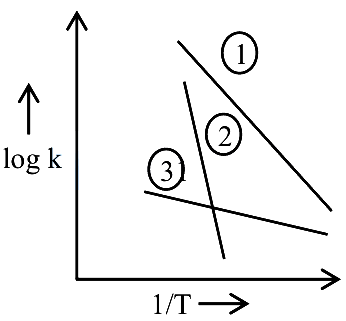
For graph between logk with \(\frac{1}{\mathrm{~T}}\)
\(\mid \text { Slope of curve } \left\lvert\,=\frac{\mathrm{Ea}}{2.303 \mathrm{R}}\right.\)
From given graph
Magnitude of slope \(\Rightarrow(2) \gt (1) \gt (3)\)
Hence \(\mathrm{Ea}_2 \gt \mathrm{Ea}_1 \gt \mathrm{Ea}_3\) -
- (A) A, C and D Only
- (B) B , D and E Only
- (C) B and C Only
- (D) A and B Only
Show answer and solution
Correct Answer: (C)
Arrhenious equation hold true for elementary as well as complex reactions.
Unit of A is same as unit of k. Rate of reaction is high if activation energy is low,
A and Ea are temperature independent. -
- (A) Activation energy of both forward and backward reaction is \(\mathrm{E}_1+\mathrm{E}_2\) and reactant is more stable than product.
- (B) Activation energy of forward reaction is \(\mathrm{E}_1+\mathrm{E}_2\) and product is less stable than reactant.
- (C) Activation energy of backward reaction is \(\mathrm{E}_1\) and product is more stable than reactant.
- (D) Activation energy of forward reaction is \(\mathrm{E}_1+\mathrm{E}_2\) and product is more stable than reactant.
Show answer and solution
Correct Answer: (B)
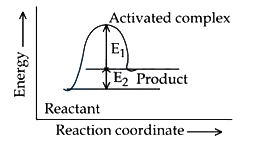
Activation energy of forward reaction \(=E_1+E_2\)
Energy of product \(>\) Energy of reactant
Stability
Reactant \(>\) Product -
- (A) 2
- (B) 6
- (C) 12
- (D) 3
Show answer and solution
Correct Answer: (B)
Drug \(\mathrm{X} \xrightarrow{\text { 1st order }}\) Product
Initial concentration of drug \(=16 \mathrm{mg} / \mathrm{mL}\)
Concentration of drug after 12 months \(=4 \mathrm{mg} / \mathrm{mL}\)
Half life of drug = 6 months
Drug become ineffective after 50\% decomposition. The expiry time of drug \(=6\) months -
- (A) Catalyst does not alter the Gibbs energy change of a reaction.
- (B) Catalyst can cause non-spontaneous reactions to occur.
- (C) The enthalpy change for the reaction is \(+20 \mathrm{~kJ} \mathrm{~mol}^{-1}\).
- (D) The enthalpy change for the catalysed reaction is different from that of uncatalysed reaction.
Show answer and solution
Correct Answer: (A)
\(\mathrm{A}_2+\mathrm{B}_2 \rightleftharpoons 2 \mathrm{AB}\)
\(\mathrm{E}_{\mathrm{f}}=180 \mathrm{~kJ} \mathrm{~mol}^{-1}\)
\(\mathrm{E}_{\mathrm{b}}=200 \mathrm{~kJ} \mathrm{~mol}^{-1}\)
\(\Delta \mathrm{H}=\mathrm{E}_{\mathrm{f}}-\mathrm{E}_{\mathrm{b}}=-20 \mathrm{~kJ} \mathrm{~mol}^{-1}\)
In presence of catalyst :
\(\begin{aligned}
& \mathrm{E}_{\mathrm{f}}=180-100=80 \mathrm{~kJ} \mathrm{~mol}^{-1} \\
& \mathrm{E}_{\mathrm{b}}=200-100=100 \mathrm{~kJ} \mathrm{~mol}^{-1}
\end{aligned}\)
Catalyst does not change \(\Delta \mathrm{H}\) or \(\Delta \mathrm{G}\) of a reaction. -
- (A) A and C Only
- (B) A, B and D Only
- (C) C and D Only
- (D) A and B Only
Show answer and solution
Correct Answer: (B)
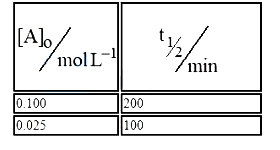
\(\frac{t_1}{2} \propto\left(C_0\right)^{1-\eta}\)
\(\frac{t_1}{t_2}=\left(\frac{C_1}{C_2}\right)^{1-\eta} \)
\( \Rightarrow \frac{200}{100}=\left(\frac{0.100}{0.025}\right)^{1-\eta} \)
\( \Rightarrow 2=(4)^{1-\eta} \)
\( (1-\eta)=\frac{1}{2} \)
\( \eta=\frac{1}{2} \)
\( \text { For } \eta=\frac{1}{2} \)
\( \frac{-d A}{d t}=k(A)^{\frac{1}{2}} \)
\( \int_{C_0}^C \frac{d A}{(A)^{\frac{1}{2}}}=-\int_0^t k d t \)
\( \Rightarrow 2 \mathrm{~A}^{\frac{1}{2}}=-\mathrm{kt} \)
\( \Rightarrow \sqrt{\mathrm{C}}-\sqrt{\mathrm{C}_0}=\frac{-\mathrm{kt}}{2} \)
\( \sqrt{\mathrm{C}}-\sqrt{\mathrm{C}_0}-\frac{\mathrm{kt}}{2} \)
\( \text { For } \mathrm{C}_0=0.1 \Rightarrow \mathrm{t}_{\frac{1}{2}}=200 \mathrm{~min} \)
\( \sqrt{\frac{c_0}{2}}=\sqrt{c_0}-\frac{k t}{2} \)
\( \frac{\mathrm{kt}}{2}=\sqrt{\mathrm{c}_0}-\sqrt{\frac{\mathrm{c}_0}{2}} \)
\( \frac{\mathrm{kt}}{2}=\sqrt{\mathrm{c}_0}\left(\frac{\sqrt{2}-1}{\sqrt{2}}\right) \)
\( t_{\frac{1}{2}}=\frac{2 \sqrt{c_0}}{k}\left(\frac{\sqrt{2}-1}{\sqrt{2}}\right) \)
\( 200=\frac{2 \sqrt{0.1}}{k}\left(\frac{\sqrt{2}-1}{\sqrt{2}}\right) \)
\(\mathrm{k}=\frac{\sqrt{0.1}}{100}\left(\frac{\sqrt{2}-1}{\sqrt{2}}\right)\)
For \(\mathrm{C}_0=1 \mathrm{M}\)
\(t_{\frac{1}{2}}=\frac{2 \times 100(\sqrt{2})}{\sqrt{0.1}(\sqrt{2}-1)} \times \frac{(\sqrt{2}-1)}{\sqrt{2}}\)
\(\Rightarrow 200 \sqrt{10} \mathrm{~min}\).
\(\Rightarrow B\) is correct
C is incorrect
For \(\mathrm{C}_0=1.6 \mathrm{M}\)
\(\mathrm{t}_{\frac{1}{2}}=\frac{2 \sqrt{1.6}(\sqrt{2})(\sqrt{2}-1) \times 100}{\sqrt{0.1}(\sqrt{2}-1)(\sqrt{2})} \)
\( \mathrm{t}_{\frac{1}{2}}=400 \times 2 \mathrm{~min} \)
\( \mathrm{t}_{\frac{1}{2}}=800 \mathrm{~min}\) -
- (A) 43
- (B) 46
- (C) 49
- (D) 50
Show answer and solution
Correct Answer: (A)
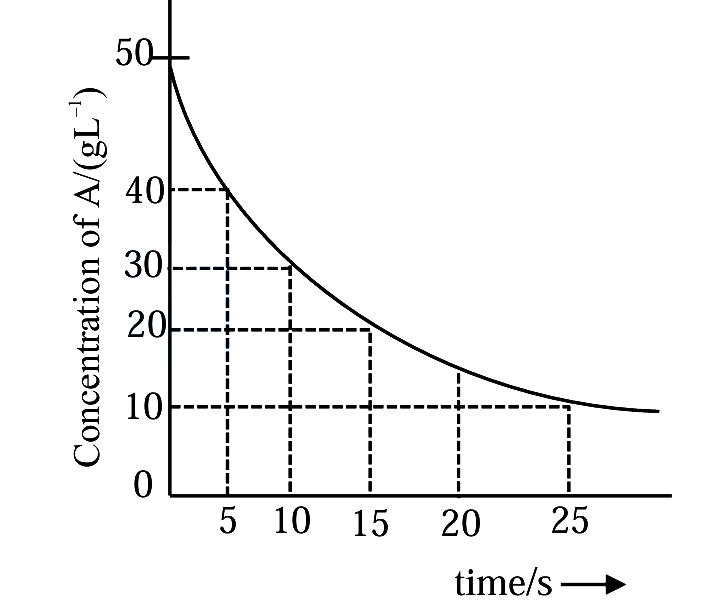
As it is difficult to predict order using data provided in graph.
For specific time interval \(0-5 \mathrm{sec}, 5-10 \mathrm{sec}\) and \(10-15 \mathrm{sec}\). order comes to be zero, but graph is not a straight line.
Assuming \(1^{\text {st }}\) order kinetics
\(\begin{aligned}
& \mathrm{K}=\frac{1}{\mathrm{t}} \ln \frac{\mathrm{~A}_0}{\mathrm{~A}_{\mathrm{t}}} \\
& \mathrm{~K}=\frac{1}{10} \ln \frac{40}{20}
\end{aligned}\)
Time required to reduce to \(2.5 \mathrm{~g} / \mathrm{L}\)
\(\begin{aligned}
& \mathrm{K}=\frac{1}{\mathrm{t}} \ln \frac{50}{2.5} \\
& \frac{1}{10} \ln 2=\frac{1}{\mathrm{t}} \ln 20 \\
& \mathrm{t}=\frac{1.3010 \times 10}{0.3010}=43.3 \mathrm{sec}
\end{aligned}\) -
- (A) 2435
- (B) 2400
- (C) 2541
- (D) 1254
Show answer and solution
Correct Answer: (A)
\(\begin{aligned}
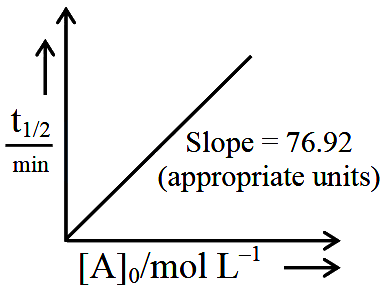
& \mathrm{t}_{1 / 2} \propto[\mathrm{A}]_0 \Rightarrow \text { Order }=\text { zero } \\
& \mathrm{t}_{1 / 2}=\frac{\mathrm{A}_0}{2 \mathrm{~K}} \Rightarrow \text { Slope }=\frac{1}{2 \mathrm{~K}}=76.92 \\
& \mathrm{~K}=\frac{1}{2 \times 76.92} \\
& {[\mathrm{A}]_{10}=-\mathrm{Kt}+\mathrm{A}_0=-\frac{1}{2 \times 76.92} \times 10+2.5=2.435} \\
& =2435 \times 10^{-3} \mathrm{~mol} / \mathrm{L}
\end{aligned}\)
No questions on this page match these filters.