


Questions
6 questionsShowing 1–6 of 6 questions
-
- (A) 11
- (B) 12
- (C) 13
- (D) 14
Show answer and solution
Correct Answer: (C)
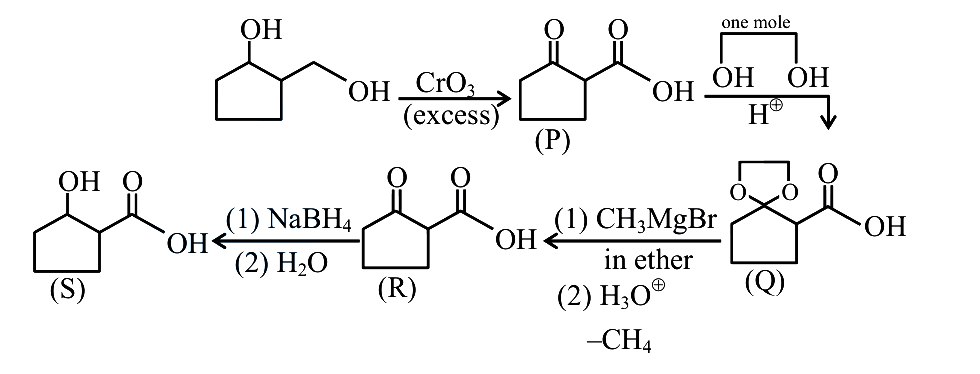
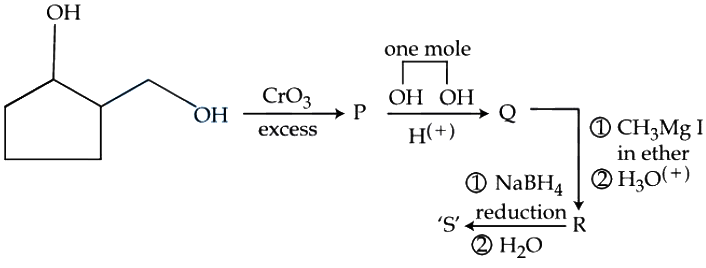
0.1 mole of compound ( S ) weight in gm
\(\begin{aligned}
& =0.1 \times \text { molar mass of compound }(\mathrm{S}) \\
& =0.1 \times 130=13 \mathrm{gm}
\end{aligned}\) -
- (A) Statement I is false but Statement II are true
- (B) Both Statement I and Statement II are false
- (C) Statement I is true but Statement II is false
- (D) Both Statement I and Statement II are true
Show answer and solution
Correct Answer: (D)
St-I : - St-I is correct because both given ether are soluble in water \(\rightarrow\) Di ethyl ether and butan-1-ol are miscible to almost same extent i.e., 7.5 and 9 gm per 100 ml water due to H -bonding St-II : - St. II is also correct because sodium metal is not used with ethyl alcohol as \(\mathrm{H}_2\) gas release with ethyl a below -
- (A) Both Statement I and Statement II are false
- (B) Both Statement I and Statement II are true
- (C) Statement I is false but Statement II is true
- (D) Statement I is true but Statement II is false
Show answer and solution
Correct Answer: (B)
Statement I is correct as boiling point of alcohol phenols increase with increase in the number of C -atoms due to increase in van der Waals forces.
Statement II is correct, since alcohols phenols have intermolecular H -bonding therefore their boiling points are higher in comparison to other class of compounds such as ethers, haloalkanes. -
- (A) (A)-(II), (B)-(III), (C)-(I), (D)-(IV)
- (B) (A)-(III), (B)-(IV), (C)-(II), (D)-(I)
- (C) (A)-(IV), (B)-(III), (C)-(II), (D)-(I)
- (D) (A)-(IV), (B)-(III), (C)-(I), (D)-(II)
Show answer and solution
Correct Answer: (C)
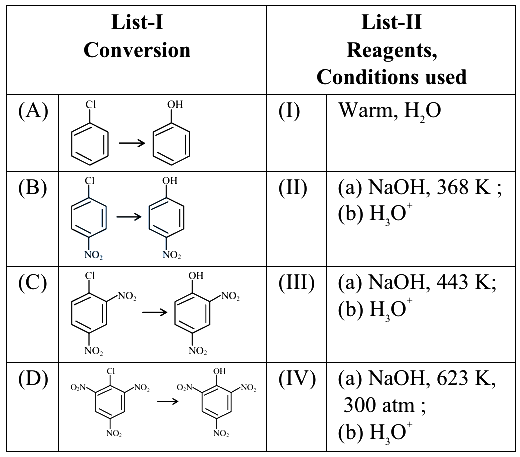
Aromatic halide give nucleophilic substitution reaction at high temperature or in presence of \(-\mathrm{I} /-\) M group rate of reaction high even at low temperature.
A-IV
B-III
C-II
D-I - 5. The steam volatile compounds among the following are _______.
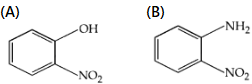
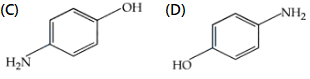
Choose the correct answer from the options given below : 2025 Medium- (A) (B) and (D) Only
- (B) (A) and (C) Only
- (C) (A), (B) and (C) Only
- (D) (A) and (B) Only
Show answer and solution
Correct Answer: (D)
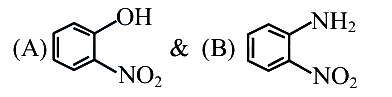
are steam volatile due to intramolecular hydrogen bonding. -
- (A) 20.44 g
- (B) 4.0 g
- (C) 6.0 g
- (D) 10.22 g
Show answer and solution
Correct Answer: (D)
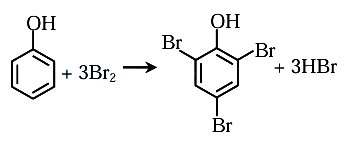
\(\begin{aligned} & \text { Moles of phenol }=\frac{2}{94}=0.021 \\ & \therefore \text { Moles of bromine }=0.021 \times 3=0.064 \\ & \therefore \text { Mass of bromine }=0.064 \times 160=10.22 \mathrm{~g}\end{aligned}\)
No questions on this page match these filters.