


Questions
10 questionsShowing 1–10 of 10 questions
-
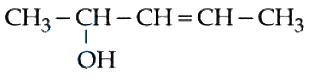
- (A) 15
- (B) 16
- (C) 17
- (D) 27
Show answer and solution
Correct Answer: (D)
So, the total number of sigma \((\sigma)\) bonds present in compound X is 27. -
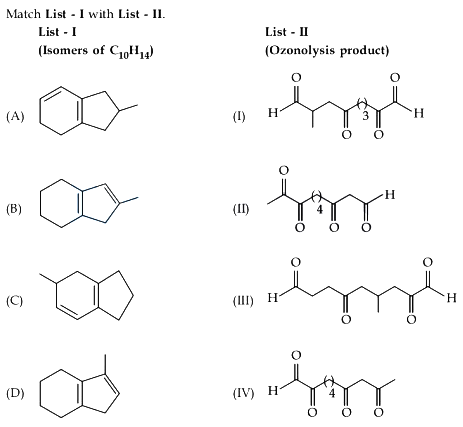
- (A) (A)-(I), (B)-(IV), (C)-(III), (D)-(II)
- (B) (A)-(III), (B)-(II), (C)-(I), (D)-(IV)
- (C) (A)-(III), (B)-(IV), (C)-(I), (D)-(II)
- (D) (A)-(II), (B)-(III), (C)-(I), (D)-(IV)
Show answer and solution
Correct Answer: (C)
Ozonolysis product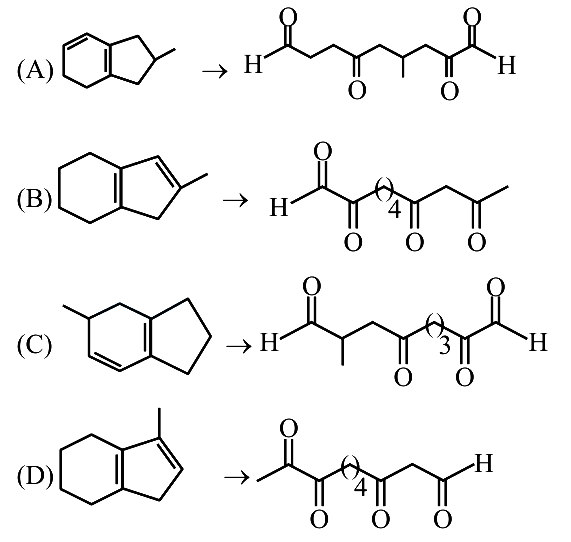
-
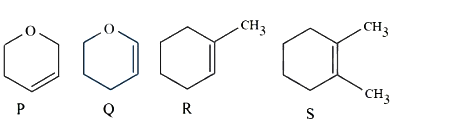
- (A) R
- (B) P
- (C) Q
- (D) S
Show answer and solution
Correct Answer: (C)
Addition of \(\mathrm{H}-\mathrm{Br}_{(\mathrm{aq})}\) to alkene follows electrophilic addition mechanism. In the rate determining step a carbocation intermediate is formed. Among P, Q, R & S compound Q will form most stable carbocation intermediate since it is resonance stabilized.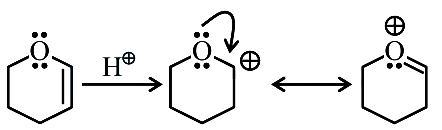
-
- (A) Statement I is correct but Statement II is incorrect
- (B) Both Statement I and Statement II are correct
- (C) Both Statement I and Statement II are incorrect
- (D) Statement I is incorrect but Statement II is correct
Show answer and solution
Correct Answer: (B)
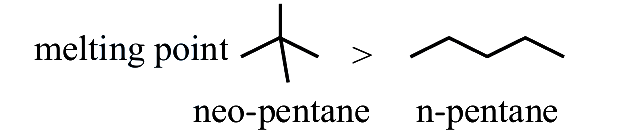
Both Statement-I and Statement-II are correct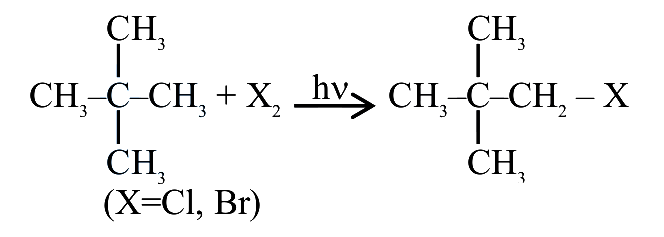
-
- (A) Both Statement I and Statement II are true
- (B) Statement I is false but Statement II are true
- (C) Statement I is true but Statement II is false
- (D) Both Statement I and Statement II are false
Show answer and solution
Correct Answer: (C)
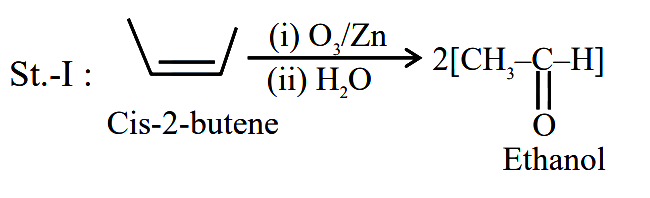
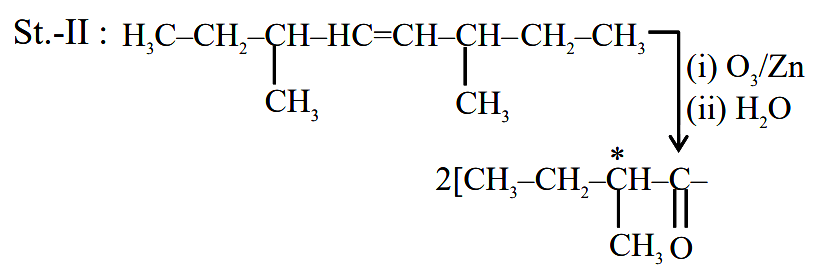
St-I : Correct statement
St-II : In correct statement because product has chiral centre. -
- (A) \(2\)
- (B) \(1\)
- (C) \(4\)
- (D) \(3\)
Show answer and solution
Correct Answer: (C)
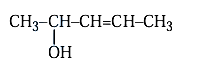
It has 4 stereoisomers \(\left[\begin{array}{ll}R \text { cis } & \mathrm{R} \text { trans } \\ \mathrm{Scis} & \text { Strans }\end{array}\right]\) -
- (A) (A) only
- (B) (A), (B) and (E) only
- (C) (A) and (C) only
- (D) (A), (C) and (D) only
Show answer and solution
Correct Answer: (D)
Explanation:
Let us analyze each statement for electrophilic aromatic substitution on a benzene ring:
1. Statement (A) is correct: Both \(-\text{OCH}_3\) and \(-\text{NHCOCH}_3\) have lone pairs on the heteroatom directly attached to the benzene ring. They donate electron density via the resonance effect (\(+R\)), which outweighs their inductive withdrawal (\(-I\)), making them ring-activating.
2. Statement (B) is incorrect: While \(-\text{CN}\) is meta-directing, the \(-\text{OH}\) group is a powerful ortho/para-directing group due to strong resonance electron donation.
3. Statement (C) is correct: Both \(-\text{CN}\) and \(-\text{SO}_3\text{H}\) are electron-withdrawing groups due to the combined \(-R\) and \(-I\) effects, which deactivates the ring and directs incoming electrophiles to the meta position.
4. Statement (D) is correct: Activating groups increase electron density specifically at the ortho and para positions via resonance, making them ortho- and para-directing.
5. Statement (E) is incorrect: Halides (\(-\text{Cl}\), \(-\text{Br}\), etc.) possess lone pairs and display a \(+R\) effect, but they are also highly electronegative, causing a very dominant inductive electron-withdrawing effect (\(-I\)). For halogens, the \(-I\) effect outweighs the \(+R\) effect. Consequently, they act as net deactivating groups, even though they direct incoming groups to the ortho/para positions.
Hence, statements (A), (C), and (D) are correct, making Option D the right choice. -
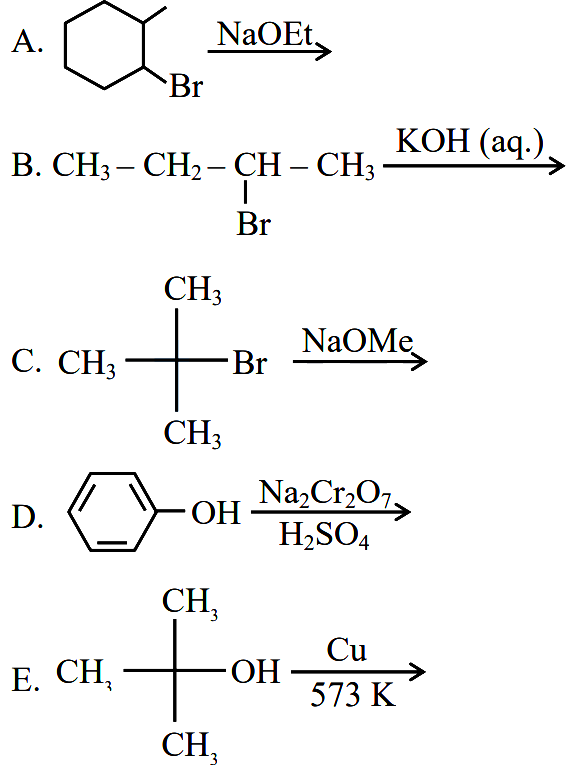
- (A) B \(\&\) E Only
- (B) B, C \(\&\) D Only
- (C) A, C \(\&\) D Only
- (D) B \(\&\) D Only
Show answer and solution
Correct Answer: (D)
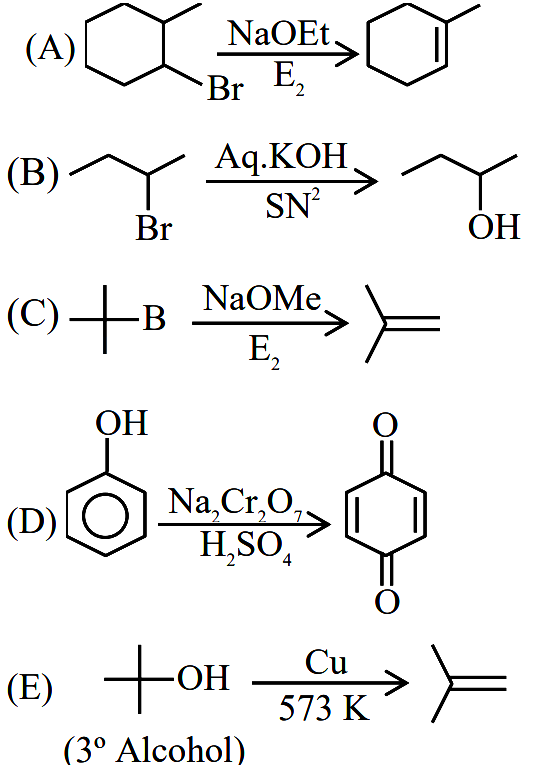
Option (B) and (D) reaction are not able to form alkene as a product. - 9. The sum of sigma \((\sigma)\) and pi \((\pi)\) bonds in Hex-1,3-dien-5-yne is _______. 2025 Medium
- (A) 10
- (B) 15
- (C) 20
- (D) 25
Show answer and solution
Correct Answer: (B)
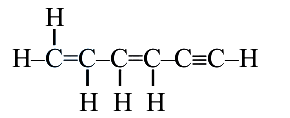
Number of \(\sigma\) bond \(=11\)
Number of \(\pi\) bond \(=4\)
\(\sigma+\pi=11+4=15\) - 10. Total number of sigma (\(\sigma\)) and \(\mathrm{pi}(\pi)\) bonds respectively present in hex-1-en-4-yne are : 2025 Medium
- (A) 3 and 13
- (B) 11 and 3
- (C) 13 and 3
- (D) 14 and 3
Show answer and solution
Correct Answer: (C)
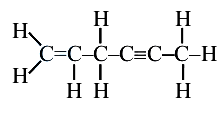
\(\begin{aligned} \sigma \text { bonds } & =13 \\ \pi \text { bonds } & =3\end{aligned}\)

No questions on this page match these filters.