


Questions
29 questionsShowing 1–29 of 29 questions
-
- (A) (A) and (D) only
- (B) (C) and (D) only
- (C) (B) and (C) only
- (D) (A) and (B) only
Show answer and solution
Correct Answer: (A)
\(\begin{aligned} & \mathrm{E}_{\mathrm{KIO}_3}=\frac{\text { Molecular welght }}{\mathrm{n}_{\mathrm{f}}} \\ & \mathrm{n}_{\mathrm{f}}=5 \\ & \mathrm{E}_{\mathrm{KIO}_3}=\frac{\text { Molecular welght }}{5}\end{aligned}\)
(D) is correct meq of \(\mathrm{KI}=0.1 \times 200=20\) meq of \(\mathrm{KIO}_3=4 \times 5=20\)
\((\mathrm{A})\) is correct -
- (A) \(\mathrm{AX}_2\) is fully ionised while \(\mathrm{AY}_2\) is completely unionised.
- (B) \(\mathrm{AX}_2\) is completely unionised while \(\mathrm{AY}_2\) is fully ionised.
- (C) \(\mathrm{AX}_2\) and \(\mathrm{AY}_2\) (both) are completely unionised.
- (D) \(\mathrm{AX}_2\) and \(\mathrm{AY}_2\) (both) are fully ionised.
Show answer and solution
Correct Answer: (A)
For \(\mathrm{AX}_2\)
\(\begin{aligned}
& \Delta \mathrm{T}_{\mathrm{b}}=\mathrm{i} \mathrm{~K} \mathrm{~m} \\
& 0.0156=\mathrm{i} \times 0.52 \times \frac{1.24}{124 \times 1} \\
& 3=\mathrm{i} \\
& 3=1+2 \alpha \\
& 1=\alpha
\end{aligned}\)
For \(\mathrm{AY}_2\)
\(\begin{aligned}
& \Delta \mathrm{T}_{\mathrm{b}}=\mathrm{i} \mathrm{~K}_{\mathrm{b}} \mathrm{~m} \\
& 0.0260=\mathrm{i} \times 0.52 \times \frac{25.4}{250 \times 2} \\
& \mathrm{i} \approx 1
\end{aligned}\)
\(\therefore A X_2\) is completely ionised \(\& A Y_2\) is completely unionised -
- (A) 0.2 M NaCl solution
- (B) 20 M HCl solution
- (C) 10 M HCl solution
- (D) Neutral solution
Show answer and solution
Correct Answer: (B)
When \(10 \mathrm{ml}, 2 \mathrm{M} \mathrm{NaOH}\) solution is added to 20 ml of 1 M HCl solution :
\(\mathrm{NaOH}+\mathrm{HCl} \rightarrow \mathrm{NaCl}+\mathrm{H}_2 \mathrm{O}\)
Initial : MV \(=2 \times 0.1 \quad \mathrm{MV}=1 \times 0.2\)
\(=0.2 \text { mole } \quad=0.2 \mathrm{~mole}\)
Final \(0 \quad 0\)
\(\therefore\) Resulting solution becomes neutral.
Now when 10 mol of above solution is poured into a flask containing 2 mole HCl and made solution 100 ml will distilled water.
Molarity of \(\mathrm{HCl}=\frac{2}{100} \times 1000=20\) -
- (A) 379.2 K
- (B) 377.3 K
- (C) 375.3 K
- (D) 277.3 K
Show answer and solution
Correct Answer: (B)
\(\begin{aligned} & \Delta \mathrm{T}_{\mathrm{b}}=\mathrm{i}_1 \mathrm{~m}_1 \mathrm{k}_{\mathrm{b}}+\mathrm{i}_2 \mathrm{~m}_2 \mathrm{k}_{\mathrm{b}} \\ & =1 \times \frac{2}{0.5} \times 0.52+\frac{1 \times 2}{0.5} \times 0.52=4.16 \\ & \left(\mathrm{~T}_{\mathrm{b}}\right)_{\text {solution }}=373.16+4.16=377.3 \mathrm{~K}.\end{aligned}\) -
- (A) 50
- (B) 57
- (C) 43
- (D) 63
Show answer and solution
Correct Answer: (B)
\(\begin{aligned} & M_F=\frac{M_1 V_1+M_2 V_2}{V_1+V_2} \\ & =\frac{2 \times 20+0.5 \times 400}{420}=0.571 \mathrm{M} \\ & =57.1 \times 10^{-2} \mathrm{M} \\ & =57\end{aligned}\) -
- (A) 5
- (B) 4
- (C) 3
- (D) 1
Show answer and solution
Correct Answer: (D)
\(\begin{aligned}
& \mathrm{NaI}_{(\mathrm{aq})}+\mathrm{AgNO}_{3(\mathrm{aq)}} \rightarrow \mathrm{AgI}_{(\mathrm{s})}+\mathrm{NaNO}_3(\mathrm{aq}) \\
& \mathrm{M}, 20 \mathrm{ml} \text { excess } \\
& 4.74 \mathrm{~g}
\end{aligned}\)
\(\text { Moles of } \mathrm{I}^{-} \text {in } \mathrm{NaI}=\text { Moles of }\left(\mathrm{I}^{-}\right) \text {in } \mathrm{AgI}=\frac{4.74}{235}\)
\(\text { Moles of } \mathrm{NaI}=\frac{4.74}{235}\)
\(\text { Molarity }[\mathrm{NaI}]=\frac{4.74}{235 \times 0.02}=1.008\) -
- (A) \(1400 \mathrm{~mm} \mathrm{Hg}, \mathrm{A}\)
- (B) \(1400 \mathrm{~mm} \mathrm{Hg}, \mathrm{B}\)
- (C) \(600 \mathrm{~mm} \mathrm{Hg}, \mathrm{B}\)
- (D) \(600 \mathrm{~mm} \mathrm{Hg}, \mathrm{A}\)
Show answer and solution
Correct Answer: (D)
\(\begin{aligned}
& \mathrm{P}_{\mathrm{S}}=\mathrm{P}_{\mathrm{A}}^{\mathrm{o}} \cdot \mathrm{X}_{\mathrm{A}}+\mathrm{P}_{\mathrm{B}}^{\mathrm{o}} \cdot \mathrm{X}_{\mathrm{B}} \\
& 500=200 \times \frac{1}{4}+\mathrm{P}_{\mathrm{B}}^{\mathrm{o}} \cdot \frac{3}{4} \\
& \mathrm{P}_{\mathrm{B}}^{\mathrm{o}}=600 \mathrm{~mm} \mathrm{Hg}
\end{aligned}\)
As \(\mathrm{P}_{\mathrm{A}}^{\mathrm{o}} \lt \mathrm{P}_{\mathrm{B}}^{\mathrm{o}} \Rightarrow \mathrm{A}\) is least volatile. -
- (A) (i) < (ii) < (iii) < (iv)
- (B) (iv) < (iii) < (i) < (ii)
- (C) (ii) < (i\() \equiv(\)iii) < (iv)
- (D) (ii) < (i) < (iii) < (iv)
Show answer and solution
Correct Answer: (D)
\(\Delta \mathrm{T}_{\mathrm{b}}=\mathrm{i} \mathrm{~K}_{\mathrm{b}} . \mathrm{m} . \propto \mathrm{i} . \mathrm{C} .\)
where \(\mathrm{C}=\) concentration
\(\begin{array}{|l|c|}
\hline \text { Options } & \text { i.C. } \\
\hline \text { (i) } & 2 \times 10^{-4} \\
\hline \text { (ii) } & 1 \times 10^{-4} \\
\hline \text { (iii) } & 2 \times 10^{-3} \\
\hline \text { (iv) } & 2 \times 10^{-2} \\
\hline
\end{array}\)
B.P. order :
\(\text { (ii) } < \text { (i) } < \text { (iii) } < \text { (iv) }\) -
- (A) show no change in volume since solution is \(0.9 \%(\omega / \omega)\)
- (B) shrink since solution is \(0.5 \%(\omega / \omega)\)
- (C) swell up since solution is \(1 \%(\omega / \omega)\)
- (D) None of these
Show answer and solution
Correct Answer: (D)
Living cell \(=0.9 \mathrm{gm}\) in 100 gm of solution
\(\% \mathrm{w} / \mathrm{w}=0.9\)
Solution is have equal moles of glucose and water \(=0.5\)
Weight of solution \(=0.5 \times 180+0.5 \times 18=99 \mathrm{gm}\) \(\% \mathrm{w} / \mathrm{w} \simeq 90 \%\)
Concentrated solution = Cell will shrink. -
- (A) \(4.26,19.3\)
- (B) \(2.59,11.85\)
- (C) \(5.46,17.8\)
- (D) \(2.96,11.2\)
Show answer and solution
Correct Answer: (D)
\(\frac{\mathrm{P}_{\mathrm{N}_2}}{\mathrm{Po}_2}=\frac{\mathrm{x}_{\mathrm{N}_2} \cdot \mathrm{P}_{\mathrm{T}}}{\mathrm{x}_{\mathrm{O}_2} \cdot \mathrm{P}_{\mathrm{T}}}=\frac{\mathrm{n}_{\mathrm{N}_2}}{\mathrm{n}_{\mathrm{O}_2}}\) {using Dalton's law of partial pressure}
\(\begin{aligned} & =\frac{70 / 28}{27 / 32}=2.96 \\ & \frac{\mathrm{P}_{\mathrm{O}_2}}{\mathrm{P}_{\mathrm{Ar}}}=\frac{\mathrm{n}_{\mathrm{O}_2}}{\mathrm{n}_{\mathrm{Ar}}}=\frac{27 / 32}{3 / 40}=11.25\end{aligned}\) -
- (A) \(40\)
- (B) \(32\)
- (C) \(45\)
- (D) \(55\)
Show answer and solution
Correct Answer: (B)
\(75 \%\) by mass means :
\(\because \quad 75 \mathrm{~g} \mathrm{HNO}_3\) in 100 g solution.
\(\therefore \quad 30 \mathrm{~g} \mathrm{HNO}_3\) in \(\frac{100}{75} \times 30 \mathrm{~g}\) solution.
\(\begin{aligned}
& \mathrm{m}_{\text {solution }}=\frac{100 \times 30}{75} \mathrm{~g} \\
\because \quad & \mathrm{~V}_{\text {sol }}=\frac{\mathrm{m}_{\text {sol }}}{\mathrm{d}_{\text {sol }}}=\frac{100 \times 30}{75 \times 1.25}=32 \mathrm{~mL}
\end{aligned}\) -
- (A) \(\frac{\mathrm{P}_2^0}{\mathrm{P}_1^0}, \frac{\mathrm{P}_2^0-\mathrm{P}_1^0}{\mathrm{P}_2^0}\)
- (B) \(\frac{\mathrm{P}_1^0}{\mathrm{P}_2^0}, \frac{\mathrm{P}_2^0-\mathrm{P}_1^0}{\mathrm{P}_2^0}\)
- (C) \(\frac{\mathrm{P}_1^0}{\mathrm{P}_2^0}, \frac{\mathrm{P}_1^0-\mathrm{P}_2^0}{\mathrm{P}_2^0}\)
- (D) \(\frac{\mathrm{P}_2^0}{\mathrm{P}_1^0}, \frac{\mathrm{P}_1^0-\mathrm{P}_2^0}{\mathrm{P}_2^0}\)
Show answer and solution
Correct Answer: (B)
Given mole fraction of liquid 1 in liquid and vapour phase is \(x_1\) and \(y_1\) respectively.
\(\begin{aligned} & \mathrm{P}_1=\mathrm{P}_{\mathrm{T}} y_1=\mathrm{P}_1^0 x_1 \\ & \frac{\mathrm{P}_{\mathrm{T}}}{x_1}=\frac{\mathrm{P}_1^0}{y_1} \\ & \frac{\mathrm{P}_2^0+x_1\left(\mathrm{P}_1^0+\mathrm{P}_2^0\right)}{x_1}=\frac{\mathrm{P}_1^0}{y_1} \\ & \frac{\mathrm{P}_2^0}{x_1}+\left(\mathrm{P}_1^0+\mathrm{P}_2^0\right)=\frac{\mathrm{P}_1^0}{y_1} \\ & \frac{\mathrm{P}_2^0}{x_1}=\frac{\mathrm{P}_1^0}{y_1}-\left(\mathrm{P}_1^0+\mathrm{P}_2^0\right) \\ & \frac{1}{x_1}=\frac{1}{y_2}\left(\frac{\mathrm{P}_1^0}{\mathrm{P}_2^0}\right)-\frac{\left(\mathrm{P}_1^0+\mathrm{P}_2^0\right)}{\mathrm{P}_2^0}\end{aligned}\)
\(\begin{aligned} & \frac{1}{x_1}=\frac{1}{y_2}\left(\frac{P_1^0}{P_2^0}\right)+\frac{\left(P_2^0-P_1^0\right)}{P_2^0} \\ & y=m x+c \\ & \text { Slope }=\frac{P_1^0}{P_2^0} ; \text { Intercept }=\frac{P_2^0-P_1^0}{P_2^0}\end{aligned}\) - 13. Density of 3 M NaCl solution is \(1.25 \mathrm{~g} / \mathrm{mL}\). The molality of the solution is _______. 2025 Medium
- (A) 1.79 m
- (B) 2.79 m
- (C) 2 m
- (D) 3 m
Show answer and solution
Correct Answer: (B)
\(\begin{aligned} & 3 \mathrm{M} \mathrm{NaCl}, \mathrm{d}_{\text {sol }}=1.25 \mathrm{gm} / \mathrm{mol} \\ & \begin{aligned} \text { Molality } & =\frac{\mathrm{M} \times 1000}{1000 \mathrm{~d}-\mathrm{M} \times \mathrm{M}_{\mathrm{W}}} \\ & =\frac{3000}{1250-175.5}=2.79\end{aligned}\end{aligned}\) -
- (A) 9
- (B) 10
- (C) 11
- (D) 12
Show answer and solution
Correct Answer: (A)
\(\begin{aligned}
& \text { Let mass of iron }=\mathrm{wg} \\
& \Rightarrow \frac{\mathrm{w}}{150 \times 10^3} \times 10^6=12 \\
& \Rightarrow \mathrm{w}=150 \times 12 \times 10^{-3}=1.8 \mathrm{gm}
\end{aligned}\)
Let mass of \(\mathrm{FeSO}_4 \cdot 7 \mathrm{H}_2 \mathrm{O}=\mathrm{w}_1 \mathrm{gm}\)
\(\begin{aligned}
& \Rightarrow \text { Moles of } \mathrm{Fe}=\frac{1.8}{56}=\left(\frac{\mathrm{w}_1}{56+96+7 \times 18}\right) \\
& \Rightarrow \mathrm{w}_1=8.935 \mathrm{gm}
\end{aligned}\) -
- (A) Statement I is incorrect but Statement II is correct
- (B) Both Statement I and Statement II are incorrect
- (C) Both Statement I and Statement II are correct
- (D) Statement I is correct but Statement II is incorrect
Show answer and solution
Correct Answer: (D)
Statement-I
Molar depression constant \(\mathrm{k}_f=\frac{\mathrm{M}_1 \mathrm{RT}_{\mathrm{f}}^2}{\Delta \mathrm{H}_{\text {fus }}}\)
\(\begin{aligned}
& \mathrm{k}_f=\frac{\mathrm{M}_1 \mathrm{RT}_{\mathrm{f}}}{\left[\frac{\Delta \mathrm{H}_{\text {fus }}}{\mathrm{T}_{\mathrm{f}}}\right]} \\
& \mathrm{k}_f=\frac{\mathrm{M}_1 \mathrm{RT}_f}{\Delta \mathrm{~S}_{\text {fus }}}
\end{aligned}\)
Hence statement-I is correct
\(\text { but } \mathrm{k}_{\mathrm{f}} \text { for benzene }=5.12 \frac{{ }^{\circ} \mathrm{C}}{\mathrm{molal}}\)
\(\mathrm{k}_{\mathrm{f}}\) for water \(=1.86 \frac{{ }^{\circ} \mathrm{C}}{\text { molal }}\) Hence statement- II is incorrect -
- (A) Both Statement I and Statement II are false
- (B) Statement I is false but Statement II is true
- (C) Statement I is true but Statement II is false
- (D) Both Statement I and Statement II are true
Show answer and solution
Correct Answer: (D)
A mixture of salt and ice is known as freezing mixture. Freezing mixture decreases freezing point of ice. Both statements are true. -
- (A) Volume of system increases .
- (B) The solid phase (ice) disappears completely.
- (C) Liquid phase disappears completely.
- (D) The amount of ice decreases.
Show answer and solution
Correct Answer: (B)
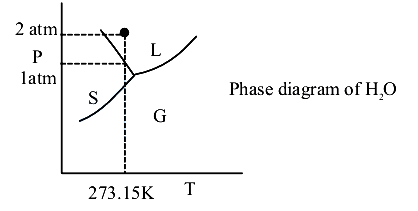
If pressure is made two time then mixture of ice and water will completely convert into water (liquid) form. -
- (A) 12
- (B) 14
- (C) 16
- (D) 18
Show answer and solution
Correct Answer: (C)
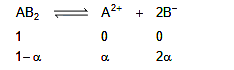
\(\begin{aligned} & \mathrm{i}=1+2 \alpha \\ & =1+2 \times(0.3) \\ & =1.6 \\ & =16 \times 10^{-1}\end{aligned}\) -
- (A) \(\frac{\mathrm{x}_{\mathrm{A}}}{\mathrm{x}_{\mathrm{B}}} \lt \frac{\mathrm{y}_{\mathrm{A}}}{\mathrm{y}_{\mathrm{B}}}\)
- (B) \(\frac{\mathrm{x}_{\mathrm{A}}}{\mathrm{x}_{\mathrm{B}}}=\frac{\mathrm{y}_{\mathrm{A}}}{\mathrm{y}_{\mathrm{B}}}\)
- (C) \(\frac{\mathrm{x}_{\mathrm{A}}}{\mathrm{x}_{\mathrm{B}}} \gt \frac{\mathrm{y}_{\mathrm{A}}}{\mathrm{y}_{\mathrm{B}}}\)
- (D) \(\left(\mathrm{x}_{\mathrm{A}}-\mathrm{y}_{\mathrm{A}}\right) \lt \left(\mathrm{x}_{\mathrm{B}}-\mathrm{y}_{\mathrm{B}}\right)\)
Show answer and solution
Correct Answer: (C)
\(\begin{aligned} & \mathrm{P}_{\mathrm{A}}^{\mathrm{o}} \lt \mathrm{P}_{\mathrm{B}}^{\mathrm{o}} \\ & \frac{\mathrm{P}_{\mathrm{A}}^o}{\mathrm{P}_{\mathrm{B}}^o} \lt 1 \\ & \frac{\mathrm{y}_{\mathrm{A}}}{\mathrm{y}_{\mathrm{B}}}=\frac{\mathrm{P}_{\mathrm{A}}^o}{\mathrm{P}_{\mathrm{B}}^o} \frac{\mathrm{x}_{\mathrm{A}}}{\mathrm{x}_{\mathrm{B}}} \\ & \frac{\mathrm{y}_{\mathrm{A}}}{\mathrm{y}_{\mathrm{B}}} \\ & \frac{\mathrm{x}_{\mathrm{A}}}{\mathrm{x}_{\mathrm{B}}}\end{aligned}\) -
- (A) (A)-(III), (B)-(I), (C)-(IV), (D)-(II)
- (B) (A)-(II), (B)-(IV), (C)-(I), (D)-(III)
- (C) (A)-(III), (B)-(IV), (C)-(I), (D)-(II)
- (D) (A)-(II), (B)-(I), (C)-(IV), (D)-(III)
Show answer and solution
Correct Answer: (A)
(A) Solution of chloroform and acetone shows -ve deviation, so maximum boiling azeotrope.
(B) Solution of ethanol \& water shows +ve deviation. So minimum boiling azeotrope.
(C) Solution of benzene and toluene form ideal solution. \(\Delta \mathrm{V}_{\text {mix }}=0\).
(D) Acetic acid in benzene form dimer. -
- (A) 1
- (B) 2
- (C) 3
- (D) 4
Show answer and solution
Correct Answer: (B)
Sea water is 6 Molar in NaCl , So 1000 ml of sea water contains 6 mol of NaCl.
mass of solution \(=\) Volume \(\times\) density
\(=1000 \times 2\)
mass of solution \(=2000 \mathrm{~g}\)
\(\begin{aligned}
& \text { ppm }=\frac{\text { mass of } \mathrm{O}_2}{2000} \times 10^6 \\
& \text { mass of } \mathrm{O}_2=5.8 \times 2 \times 10^{-3} \\
& \quad=1.16 \times 10^{-2} \mathrm{~g}
\end{aligned}\)
molality for \(\mathrm{O}_2=\frac{1.16 \times 10^{-2} / 32}{(2000-6 \times 58.5)} \times 1000\)
\(\begin{aligned} & =\frac{1.16 \times 10}{32 \times 1649} \\ = & 0.000219 \\ = & 2.19 \times 10^{-4}\end{aligned}\)
Correct answer \(\Rightarrow 2\) -
- (A) 120
- (B) 122
- (C) 124
- (D) 125
Show answer and solution
Correct Answer: (D)
Moles of solute \(=\frac{70}{70}=1\)
Volume of solution \(=\frac{100}{1.25}=80 \mathrm{~mL}\)
\(\begin{aligned}
& M=\frac{1}{80} \times 1000=12.5 \\
& M=125 \times 10^{-1}
\end{aligned}\) -
- (A) 25
- (B) 50
- (C) 75
- (D) 100
Show answer and solution
Correct Answer: (C)
Normal molar mass of \(\mathrm{MX}_2=164.0 \mathrm{~g} \mathrm{~mol}^{-1}\)
Observed molar mass of \(\mathrm{MX}_2=65.6 \mathrm{~g} \mathrm{~mol}^{-1}\)
\(\begin{aligned}
& \text { Van't Hoff factor }(\mathrm{i})=\frac{\text { Normal molar mass }}{\text { Observed molar mass }} \\
& =\frac{164}{65.6}=2.5
\end{aligned}\)
If \(\alpha\) is the degree of ionisation, then
\(\begin{aligned}
& \underset{1-\alpha}{\mathrm{MX}_2} \rightleftharpoons \mathrm{M}_\alpha^{2+}+\underset{2 \alpha}{2 \mathrm{X}^{-}} \\
& \mathrm{i}=1-\alpha+\alpha+2 \alpha=1+2 \alpha \\
& 1+2 \alpha=2.5 \\
& \alpha=0.75
\end{aligned}\)
\(\therefore\) Percent degree of ionisation \(=75 \%\) -
- (A) 11
- (B) 22
- (C) 33
- (D) 44
Show answer and solution
Correct Answer: (C)
\(\mathrm{MX}_3 \rightarrow \mathrm{M}^{+3}+3 \mathrm{X}^{\ominus}\)
\(\begin{aligned} & \mathrm{i}=1+(\mathrm{n}-1) \alpha \\ & \mathrm{i}=1+(4-1) \alpha=2\end{aligned}\)
\(\alpha=\frac{1}{3}=33.33 \% \approx 33 \%\) -
- (A) \(3.72 \mathrm{~K} \mathrm{~kg} \mathrm{~mol}^{-1}\)
- (B) \(1.86 \mathrm{~K} \mathrm{~kg} \mathrm{~mol}^{-1}\)
- (C) \(4.43 \mathrm{~K} \mathrm{~kg} \mathrm{~mol}^{-1}\)
- (D) \(5.12 \mathrm{~K} \mathrm{~kg} \mathrm{~mol}^{-1}\)
Show answer and solution
Correct Answer: (D)
\(\begin{aligned} \Delta \mathrm{T}_{\mathrm{f}} & =\mathrm{K}_{\mathrm{b}} \cdot \mathrm{m} \\ 0.4 & =\mathrm{K}_{\mathrm{b}} \frac{\frac{1}{256}}{50 \times 10^{-3}} \\ \mathrm{~K}_{\mathrm{b}} & =5.12 \mathrm{~K} \mathrm{~kg} / \mathrm{mol}\end{aligned}\) -
- (A) 20
- (B) 30
- (C) 35
- (D) 25
Show answer and solution
Correct Answer: (D)
For AB
\(\begin{aligned}
& \Delta \mathrm{T}_{\mathrm{b}}=2.7 \mathrm{~K} \\
& 2.7=1 \times 0.5 \times \mathrm{m} \\
& \mathrm{~m}=\frac{27}{5}
\end{aligned}\)
Let molar mass of \(\mathrm{AB}=\mathrm{x}\).
\(\begin{aligned}
& \text { So } \frac{1 / x}{15} \times 1000=\frac{27}{5} \\
& x=12.34
\end{aligned}\)
For \(\mathrm{AB}_2\)
\(\begin{aligned}
& \Delta \mathrm{T}_{\mathrm{b}}=1.5 \mathrm{~K} \\
& 1.5=1 \times 0.5 \times \mathrm{m} \\
& \mathrm{~m}=3
\end{aligned}\)
Let molar mass of \(\mathrm{AB}_2=\mathrm{y}\)
So \(\frac{1 / \mathrm{y}}{15} \times 1000=3\)
\(\begin{aligned}
& y=\frac{1000}{45} \\
& y=22.22
\end{aligned}\)
Now let a and b be atomic masses of A and B respectively, then
\(\begin{aligned}
& \mathrm{A}+\mathrm{b}=12.34 \quad...(i)\\
& \mathrm{~A}+2 \mathrm{~b}=22.22 \quad...(ii) \\
& \mathrm{~B}=22.22-12.34=9.88 \\
& \text { Now } \mathrm{a}=12.34-9.88=2.46 \\
& =24.6 \times 10^{-1}=25 \times 10^{-1}
\end{aligned}\) -
- (A) 0.8
- (B) 0.4
- (C) 0.2
- (D) 0.6
Show answer and solution
Correct Answer: (D)
\(\begin{aligned} & \because \mathrm{P}^{\circ}-\mathrm{P} \propto \mathrm{X}_{\text {solute }} \\ & \text { and } \because 10 \propto 0.2 \\ & \therefore 20 \propto 0.4 \\ & \therefore \mathrm{X}_{\text {solvent }}=1-\mathrm{X}_{\text {solute }} \\ & \quad=1-0.4 \\ & \quad=0.6\end{aligned}\) - 28. Which of the following binary mixture does not show the behaviour of minimum boiling azeotropes? 2025 Easy
- (A) \(\mathrm{H}_2 \mathrm{O}+\mathrm{CH}_3 \mathrm{COC}_2 \mathrm{H}_5\)
- (B) \(\mathrm{C}_6 \mathrm{H}_5 \mathrm{OH}+\mathrm{C}_6 \mathrm{H}_5 \mathrm{NH}_2\)
- (C) \(\mathrm{CS}_2+\mathrm{CH}_3 \mathrm{COCH}_3\)
- (D) \(\mathrm{CH}_3 \mathrm{OH}+\mathrm{CHCl}_3\)
Show answer and solution
Correct Answer: (B)
Binary mixture of \(\mathrm{C}_6 \mathrm{H}_5 \mathrm{OH}\) and \(\mathrm{C}_6 \mathrm{H}_5 \mathrm{NH}_2\) shows negative deviation from Raoult's law
So vapour pressure of solution is less than V.P of pure \(\mathrm{C}_6 \mathrm{H}_5 \mathrm{OH} \& \mathrm{C}_6 \mathrm{H}_5 \mathrm{NH}_2\)
So B.P. of solution is greater than boiling point of pure \(\mathrm{C}_6 \mathrm{H}_5 \mathrm{OH} \& \mathrm{C}_6 \mathrm{H}_5 \mathrm{NH}_2\)
So shows maximum Boiling azeotrope. -
- (A) B and D only
- (B) A and D only
- (C) A and C only
- (D) C only
Show answer and solution
Correct Answer: (C)
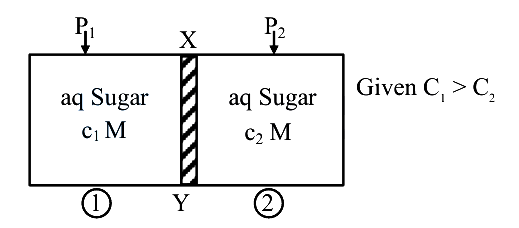
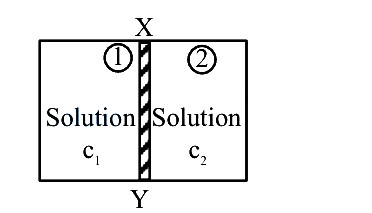
Normal osmosis occurs from (2) to (1)
For reverse osmosis from (1) to (2)
Pressure : \(\mathrm{P}_1 \gt \pi\)
\(\therefore\) Answer [A & C] only
No questions on this page match these filters.