


Chapters asked in 2019
26 chapters- 3Qs STD 11 Organic chemistry purification and characterization
- 13Qs STD 12 D and f- block elements
- 4Qs STD 11 Redox reactions
- 12Qs STD 12 Biomolecules
- 10Qs STD 11 Equilibrium - II (icon Equilibrium)
- 15Qs STD 12 Chemical kinetics
- 4Qs STD 11 Organic chemistry reaction mechanism
- 7Qs STD 12 Amines
- 3Qs STD 12 Carboxylic acids and their derivative
- 4Qs STD 12 Aldehydes and ketones
- 8Qs STD 12 Alcohol, phenol and ethers
- 3Qs STD 12 Haloalkanes and Haloarenes
- 2Qs STD 11 Organic chemistry isomerism
- 22Qs STD 12 Co-ordination chemistry Most asked
- 9Qs STD 12 P -Block elements - ll
- 13Qs STD 12 Electrochemistry
- 19Qs STD 12 Solution and colligative properties Most asked
- 12Qs STD 11 Some basic concept of chemistry
- 4Qs STD 11 Hydricarbon
- 1Qs STD 11 Organic chemistry Nomenclature of organic compounds
- 11Qs STD 11 Chemical bonding and molecular structure
- 11Qs STD 11 Classification of elements and periodicity in properties
- 10Qs STD 11 Equilibrium - 1 (chemical Equilibrium)
- 21Qs STD 11 Thermodynamics and thermochemistry Most asked
- 11Qs STD 11 P-Block elements - I
- 16Qs STD 11 Structure of atom
All JEE Mains 2019 Chemistry questions
26 chaptersShowing 1–50 of 248 questions
-
- (A) \(C_{12}H_8N\)
- (B) \(C_{12}H_8N_2\)
- (C) \(C_6H_8N_2\)
- (D) \(C_6H_8N\)
Show answer and solution
Correct Answer: (C)
\(CO_2 = 6\,mole,\,N_1 = 1\,mole\)\(C_{atom}= 6,\,N_{atom} = 2\)
Hence \(C_6H_8N_2\)
-
- (A) \(a\, \to \,q,\,\,b \to \,p,\,\,c \to r\)
- (B) \(a\, \to \,r,\,\,b \to \,q,\,\,c \to p\)
- (C) \(a\, \to \,q,\,\,b \to \,r,\,\,c \to p\)
- (D) \(a\, \to \,p,\,\,b \to \,r,\,\,c \to q\)
Show answer and solution
Correct Answer: (B)
Acetonitrile is used as mobile phase for most of the reverse chromatography. Benzaldehyde is adsorbed on alumina. -
- (A) \(a - d, b -r, c -p\)
- (B) \(a -q, b -r, c -s\)
- (C) \(a -r, b -p, c -s\)
- (D) \(a -q, b -r, c -p\)
Show answer and solution
Correct Answer: (B)
(mixture) \(\quad\quad\quad\quad\) (seperation method)\(H _2 O : \text { Sugar } \Rightarrow \text { Recrystallization }\)
\(H _2 O : \text { Aniline } \Rightarrow \text { Steam distillation }\)
\(H _2 O \text { : Toluene } \Rightarrow \text { Differential extraction }\)
-
- (A) \(KI\) and \(KMnO_4\)
- (B) \(MnO_2\) and \(KIO_3\)
- (C) \(KIO_3\) and \(MnO_2\)
- (D) \(KI\) and \(K_2MnO_4\)
Show answer and solution
Correct Answer: (B)
\(Mn{O_2}\,\xrightarrow{{4KOH,\,{O_2}}}\mathop {2{K_2}Mn{O_4}}\limits_{(Green)} \, + \,2{H_2}O\)\(3{K_2}Mn{O_4}\,\xrightarrow{{4\,HCl}}\mathop {2KMn{O_4}}\limits_{(purple)} \, + \,Mn{O_2}\, + \,2{H_2}O\)
\(2KMn{O_4}\,\xrightarrow{{{H_2}O,\,KI}}2Mn{O_2}\, + \,2KOH\, + \,KI{O_3}\)
-
- (A) \(Ti^{3+} < T^{2+} < Sc^{3+} < V^{2+}\)
- (B) \(Sc^{3+} < Ti^{3+} < Ti^2 < V^{2+}\)
- (C) \(V^{2+} < Ti^{2+} < Ti^{3+} < Sc^{3+}\)
- (D) \(Sc^{3+} < Ti^{3+} < V^{2+} < Ti^{2+}\)
Show answer and solution
Correct Answer: (B)
\(T{i^{ + 2}}\, = \,1{s^2}\,2{s^2}\,2{p^6}\,3{s^2}\,3{p^6}\,3{d^2}\)unpaired electron \(=\,2\)
spin only magnetic moment \((\mu )\, = \,\sqrt {2(2 + 2)} \, = \,\sqrt 8 \,B.M\)
\(T{i^{ + 3}}\, = \,1{s^2}\,2{s^2}\,2{p^6}\,3{s^2}\,3{p^6}\,3{d^1}\)
unpaired electron \(=\,1\)
\((\mu )\, = \,\sqrt {1(1 + 2)} \, = \,\sqrt 3 \,B.M\)
\({V^{ + 2}}\, = \,1{s^2}\,2{s^2}\,2{p^6}\,3{s^2}\,3{p^6}\,3{d^3}\)
\((\mu )\, = \,\sqrt {3(3 + 2)} \, = \,\sqrt {15} \,B.M\)
\(S{c^{ + 3}}\, = \,1{s^2}\,2{s^2}\,2{p^6}\,3{s^2}\,3{p^6}\)
\((\mu )\, =0\)
-
- (A) \((a)-(iii)\); \((b)-(iv)\); \((c)-(i)\); \((d)-(ii)\)
- (B) \((a)-(iv)\); \((b)-(iii)\); \((c)-(ii)\); \((d)-(i)\)
- (C) \((a)-(ii)\); \((b)-(iii)\); \((c)-(i)\); \((d)-(iv)\)
- (D) \((a)-(iii)\); \((b)-(i)\); \((c)-(ii)\); \((d)-(iv)\)
Show answer and solution
Correct Answer: (D)
\(V_2O_5\) is used in contact process for \(H_2SO_4\) \(TiCl_4/Al(Me)_3\) Ziegler natal catalyst used fin polymerization \(PdCl_2\) is used in ethanol formation Iron oxide is used in Haber process for \(NH_3\) -
- (A) \(Mn < Ti < Zn < Ni\)
- (B) \(Zn < Ni < Mn < Ti\)
- (C) \(Ti < Mn < Zn < Ni\)
- (D) \(Ti < Mn < Ni < Zn\)
Show answer and solution
Correct Answer: (D)
As \(Zn\) is fully filled and left to right in group \(IP\) increases. - 8. The effect of lanthanoid contraction in the lanthanoid series of elements by the large means 2019 Easy
- (A) increase in both atomic and ionic radii
- (B) decrease in atomic radii and increase in ionic radii
- (C) decrease in both atomic and ionic radii
- (D) increase in atomic radii and decrease in ionic radii
Show answer and solution
Correct Answer: (C)
Atomic and ionic radii decreases -
- (A) \(Cu\)
- (B) \(Ti\)
- (C) \(Sc\)
- (D) \(V\)
Show answer and solution
Correct Answer: (C)
\(Sc^{3+}\) has noble gas configuration hence only \(+3\) exists. -
- (A) \(6\) and \(4\)
- (B) \(7\) and \(6\)
- (C) \(4\) and \(6\)
- (D) \(6\) and \(7\)
Show answer and solution
Correct Answer: (D)
The highest oxidation state of \(U\) and \(Pu\) is \(6+\) and \(7+\) respectively. -
- (A) \(Gd^{3+}\)
- (B) \(La^{3+}\)
- (C) \(Lu^{3+}\)
- (D) \(Sm^{3+}\)
Show answer and solution
Correct Answer: (D)
\(Sm^{3+}\,(4f^5) =\) yellow colour, other ions have stable electron configurations with half filled or full-filled electron configuration. -
- (A) berkelium \((Bk)\) and californium \((Cf)\)
- (B) nobelium \((No)\) and lawrencium \((Lr)\)
- (C) actinium \((Ac)\) and thorium \((Th)\)
- (D) neptunium \((Np)\) and plutonium \((Pu)\)
Show answer and solution
Correct Answer: (D)
neptunium \( (Np) \) and plutonium \( (Pu) \)
- 13. The pair of metal ions that can give a spin-only magnetic moment of \(3.9\, BM\) for the complex \([M(H_2O)_6]Cl_2\) is 2019 Hard
- (A) \(V^{2+}\) and \(Co^{2+}\)
- (B) \(V^{2+}\) and \(Fe^{2+}\)
- (C) \(Co^{2+}\) and \(Fe^{2+}\)
- (D) \(Cr^{2+}\) and \(Mn^{2+}\)
Show answer and solution
Correct Answer: (A)
\(H_2O\) is weak field ligand and magnetic moment \(=\) moment \(=\,\sqrt {n(n+2)} \,BM\)Solving for \('n'\) we get it as \(3;\) i.e., no. of unpaired electron \(=\,3\)
\(F{e^{2 + }}\, = \,{t_{2g}}^4\,{e_g}^2\)
\(C{o^{2 + }}\, = \,{t_{2g}}^5\,{e_g}^2\)
\({V^{2 + }}\, = \,t_{2g}^3\,{e_g}^0\)
\(\therefore \,\,M\) is \(V,\,Co\)
-
- (A) they have metallic conductivity
- (B) they have high melting points
- (C) they are chemically reactive
- (D) they are very hard
Show answer and solution
Correct Answer: (C)
In case of interstial compounds there is presence of small atoms (or impurity) in the lattice of metal. So interstial compounds are hard, high melting point and chemically inert. -
- (A) \(Fe\)
- (B) \(Cu\)
- (C) \(V\)
- (D) \(Zn\)
Show answer and solution
Correct Answer: (D)
Due to weak metallic bonding. -
- (A) \(K_2MnO_4, KMnO_4\) and \(SO_2\)
- (B) \(K_3MnO_4, K_2MnO_4\) and \(Cl_2\)
- (C) \(K_2MnO_4, KMnO_4\) and \(Cl_2\)
- (D) \(KMnO_4, K_2MnO_4\) and \(Cl_2\)
Show answer and solution
Correct Answer: (D)
\(\mathop {2KMn{O_4}\,}\limits_{(X)} \xrightarrow[\Delta ]{{513\,\,K}}\,\mathop {{K_2}Mn{O_4}}\limits_{(Y)} \, + \,Mn{O_2}\, + {O_{2(g)}}\)\(Mn{O_2}\, + \,4NaCl\, + 4{H_2}S{O_4}\, \to \) \(MnC{{l}_{2}}\,+\,4NaHS{{O}_{4}}\,+\,2{{H}_{2}}O\,+\underset{\begin{smallmatrix}
(Z) \\
pungent
\\
gas
\end{smallmatrix}}{\mathop{\,C{{l}_{2(g)}}}}\,\) -
- (A) \(2KMnO_4 \longrightarrow K_2MnO_4 + MnO_2 + O_2\)
- (B) \(2NaBr + Cl_2 \longrightarrow 2NaCl + Br_2\)
- (C) \(2CuBr \longrightarrow CuBr_2 + Cu\)
- (D) \(2MnO_4^ - + 10{I^ - } + 16{H^ + } \longrightarrow 2M{n^{2 + }} + 5{I_2} + 8{H_2}O\)
Show answer and solution
Correct Answer: (C)
\(2C{u^ \oplus }\) \(\longrightarrow\) \(C{u^{2 + }} + Cu\) -
- (A) \(1\)
- (B) \(1.5\)
- (C) \(2\)
- (D) \(3\)
Show answer and solution
Correct Answer: (C)
\(n-\) factors of \(KMnO_4=5,\,n-\) factor of \(FeSO_4=1\)\(n-\) factors of \(FeC_2O_4=3,\,Fe_2(SO_4)_3\) does not react
\(n-\) factors of \(Fe_2(C_2O_4)_3=6\),
\(n_{eq}\,KMnO_4=n_{eq}[FeC_2O_4+Fe_2(C_2O_4)_3+FeSO_4]\)
or, \(x \times 5=1 \times 3+1\times 6+1\times1 \)
\(x=2\)
- 19. In the reaction of oxalate with permanganate in acidic medium, the number of electrons involved in producing one molecule of \(CO_2\) is 2019 Medium
- (A) \(1\)
- (B) \(10\)
- (C) \(2\)
- (D) \(5\)
Show answer and solution
Correct Answer: (A)
Explanation:
The redox reaction between oxalate ions (\( \text{C}_2\text{O}_4^{2-} \)) and permanganate ions (\( \text{MnO}_4^- \)) in an acidic medium consists of oxidation and reduction half-reactions.
To find the number of electrons involved per molecule of \( \text{CO}_2 \) produced, we look at the balanced oxidation half-reaction of the oxalate ion:
\( \text{C}_2\text{O}_4^{2-} \rightarrow 2\text{CO}_2 + 2e^- \)
From this balanced half-reaction:
- Oxidation of \( 1 \) molecule of oxalate ion (\( \text{C}_2\text{O}_4^{2-} \)) produces \( 2 \) molecules of \( \text{CO}_2 \).
- This process releases a total of \( 2 \) electrons.
Therefore, the number of electrons involved in producing one single molecule of \( \text{CO}_2 \) is calculated as:
\( \text{Number of electrons} = \frac{2\text{ electrons}}{2\text{ molecules of CO}_2} = 1\text{ electron} \)
Hence, Option A is the correct choice. - 20. The correct order of the oxidation states of nitrogen in \(NO, N_2O, NO_2\) and \(N_2O_3\) is 2019 Hard
- (A) \(N_2O < N_2O_3 < NO < NO_2\)
- (B) \(NO_2 < NO < N_2O_3 < N_2O\)
- (C) \(NO_2 < N_2O_3 < NO < N_2O\)
- (D) \(N_2O < NO < N_2O_3 < NO_2\)
Show answer and solution
Correct Answer: (D)
\(\mathop {NO}\limits^{ + 2} ,{\mkern 1mu} \mathop {{N_2}}\limits^{ + 1} O{\mkern 1mu} ,{\mkern 1mu} \mathop {{\text{ }}N}\limits^{ + 4} {O_2},\mathop {{N_2}}\limits^{ + 3} {O_3}\) -
- (A) Asparagine
- (B) Lysine
- (C) Serine
- (D) Histidine
Show answer and solution
Correct Answer: (B)
Compound \(Pl\) valueHistidine \(7.6\)
Serine \(5.7\)
Lysine \(9.8\)
Asparagine \(5.4\)
-
- (A) \(\alpha-D-\) glucose, \(C_1-C_4\) and \(C_2-C_6\) linkages
- (B) \(\beta-D-\) glucose, \(C_1-C_4\) and \(C_2-C_6\) linkages
- (C) \(\alpha-D-\) glucose, \(C_1-C_4\) and \(C_1-C_6\) linkages
- (D) \(\beta-D-\) glucose, \(C_1-C_4\) and \(C_1-C_6\) linkages
Show answer and solution
Correct Answer: (C)
Amylopetcin is a homopolymer of \(a-D-\) glucose where \(C_1-C_4\) linkage and \(C_1 -C_6\) linkage are present -
- (A) Benedict’s test
- (B) Fehling’s test
- (C) Barfoed’s test
- (D) Seliwanoff’s test
Show answer and solution
Correct Answer: (D)
Barfoed's test \(\to \) Detecting presence of monosaccharidesFehling's test \(\to \) For aldehyes
Benedict's test \(\to \) For reduving sugars
Seliwanoff's test \(\to \) Differentiate between aldose and ketose
-
- (A) Neurotransmitter
- (B) Antidepresessant
- (C) Antihistamine
- (D) Antacid
Show answer and solution
Correct Answer: (A)
It is an organic chemical in the catecholamine family that functions in the brain and body as hormone and neurotransmitter. -
- (A) \(A -Q, B -S, C -P\)
- (B) \(A -R, B -Q, C -P\)
- (C) \(A -R, B -S, C -Q\)
- (D) \(A -Q, B -S, C -R\)
Show answer and solution
Correct Answer: (A)
Go through structure of amino acids -
- (A) \(I\) and \(II\) only
- (B) \(I\) and \(III\) only
- (C) \(I, II\) and \(III\)
- (D) \(III\) only
Show answer and solution
Correct Answer: (D)
Active transport proteins exchanges \(Na^+\) ions for \(K^+\) ions across the plasma membrane of animal cells. - 27. The increasing order of \(pKa\) of following amino acids in aqueous solution is \(Gly, \,Asp,\, Lys,\, Arg\) 2019 Hard
- (A) \(Asp < Gly < Arg < Lys\)
- (B) \(Gly < Asp < Arg < Lys\)
- (C) \(Asp < Gly < Lys < Arg\)
- (D) \(Arg < Lys < Gly < Asp\)
Show answer and solution
Correct Answer: (C)
\(\underset{\begin{smallmatrix}
*Ly\sin e \\
(pl\,\,Value\,=\,9.8)
\end{smallmatrix}}{\mathop{\begin{matrix}
\begin{matrix}
\,\,\,\,\,\,CO{{O}^{-}} \\
|\,\,\, \\
{{H}_{3}}\bar{N}-C-H\,\,\,\,\,\,\,\,\, \\
\,\,|\,\,\,\,\, \\
\end{matrix} \\
\,\,\,C{{H}_{2}} \\
\,\,\,|\,\,\,\,\,\, \\
\begin{matrix}
\,\,\,C{{H}_{2}} \\
\,\,\,\,|\,\,\,\,\,\, \\
\,\,\,\,C{{H}_{2}} \\
\begin{matrix}
\,\,\,\,\,\,|\,\,\,\,\,\,\, \\
\,\,\,\,\,C{{H}_{2}} \\
\,\,\,\,|\,\,\,\,\, \\
\,\,\,{}^{+}N{{H}_{3}} \\
\end{matrix} \\
\end{matrix} \\
\end{matrix}}}\,\) \(\underset{\begin{smallmatrix}
*Arginine \\
(pl\,\,Value\,=\,10.8)
\end{smallmatrix}}{\mathop{\begin{matrix}
\begin{matrix}
\,\,\,\,\,\,CO{{O}^{-}} \\
|\,\,\, \\
{{H}_{3}}\overset{+}{\mathop{N}}\,-C-H\,\,\,\,\,\,\,\,\, \\
\,\,|\,\,\,\,\, \\
\end{matrix} \\
\,\,\,C{{H}_{2}} \\
\,\,\,|\,\,\,\,\,\, \\
\begin{matrix}
\,\,\,C{{H}_{2}} \\
\,\,\,\,|\,\,\,\,\,\, \\
\,\,\,\,C{{H}_{2}} \\
\begin{matrix}
\,\,\,\,\,\,|\,\,\,\,\,\,\, \\
\,\,\,\,\,NH \\
\,\,\,\,|\,\,\,\,\, \\
\begin{align}
\,\,\,\,\,\,\,\,\,\,\,\,\,\,\,\,C=\overset{+}{\mathop{N}}\,{{H}_{2}} \\
\,\,\,\,\,\,\,\,\,\,\,\,\,\,\begin{matrix}
|\,\,\,\,\,\,\,\,\,\, \\
\,\,\,\,N{{H}_{2}}\,\,\,\,\, \\
\end{matrix} \\
\end{align} \\
\end{matrix} \\
\end{matrix} \\
\end{matrix}}}\,\) \(\underset{\begin{smallmatrix}
\,\,\,\,\,\,\,\,\,Aspartate \\
(pl\,\,value\,\,=\,3.0)
\end{smallmatrix}}{\mathop{\begin{matrix}
\begin{matrix}
\,\,\,\,\,\,\,\,\,\,\,\,\,\,\,CO{{O}^{-}} \\
\,\,\,\,\,\,| \\
{{H}_{3}}\overset{+}{\mathop{N}}\,-C-H \\
\,\,\,\,\,\,| \\
\end{matrix} \\
\,\,\,\,\,\,\,\,\,\,C{{H}_{2}} \\
\,\,\,\,\,| \\
\,\,\,\,\,\,\,\,\,\,\,\,\,\,\,CO{{O}^{-}} \\
\end{matrix}}}\,\) \(\underset{\begin{smallmatrix}
\,\,\,\,\,\,\,\,\,\,\,Glycine \\
(pl\,\,\,Value\,\,=\,\,6.0)
\end{smallmatrix}}{\mathop{\begin{matrix}
\,\,\,\,\,\,\,\,\,\begin{matrix}
\,\,\,\,\,CO{{O}^{-}} \\
|\,\,\,\, \\
\end{matrix} \\
{{H}_{3}}\overset{+}{\mathop{N}}\,-C-H \\
\,\,\,\,\,\,| \\
\,\,\,\,\,\,\,H \\
\end{matrix}}}\,\) -
- (A) \(Lys - Asp\)
- (B) \(Ser -Lys\)
- (C) \(Gln - Asp\)
- (D) \(Asp -Gln\)
Show answer and solution
Correct Answer: (B)
Due to \(-OH\) group of serine it give cerric ammonium nitrate test whereas due to \(-NH_2\) group lysine give \(+ve\) carbylamine test. -
- (A) It has always double stranded \(\alpha - \) helix structure
- (B) It is present in the nucleus of the cell
- (C) It controls the synthesis of protein
- (D) It usually does not replicate
Show answer and solution
Correct Answer: (A)
Not always double stranded \(\alpha - \) helix. -
- (A) The glycosidic linkage is present between \(C_1\) of \(\alpha -\) glucose and \(C_1\) of \(\beta -\) fructose
- (B) It is a non-reducing sugar
- (C) It is also named as invert sugar
- (D) On hydrolysis it produces glucose and fructose
Show answer and solution
Correct Answer: (A)
\(C_1\) of \(\alpha -\) glucose and \(C_2\) of \(\beta -\) fructose -
- (A) Biuret test
- (B) Barfoed test
- (C) Ninhydrin test
- (D) Xanthoproteic test
Show answer and solution
Correct Answer: (B)
Barfoed test is used to detect monosaccirides. -
- (A) It is present in some yeast and fungi
- (B) It is present in animal cells
- (C) Only \(\alpha -\) linkages are present in the molecule
- (D) It is a straight chain polymer similar to amylase
Show answer and solution
Correct Answer: (D)
Glycogen is a multibranched polysaccharide. -
- (A) \(5.2\)
- (B) \(9\)
- (C) \(5\)
- (D) \(9.4\)
Show answer and solution
Correct Answer: (B)
\(\mathop {\mathop {{H_2}S{O_4}}\limits_{2\,m.m} }\limits_ - + \mathop {\mathop {2N{H_4}OH}\limits_{6\,m.m} }\limits_{2\,m.m} \to \mathop {{{(N{H_4})}_2}S{O_4}}\limits_{2\,m.m} + 2{H_2}O\)\(pOH = 4.7 + \log \frac{4}{2} = 5\)
\(pH = 14 - 5 = 9\)
-
- (A) \(1.9\, g, 0.28\, mol\, L^{-1}\)
- (B) \(13.6\, g, 0.28\, mol\, L^{-1}\)
- (C) \(1.9\, g, 0.14\, mol\, L^{-1}\)
- (D) \(13.6\, g, 0.14\, mol\, L^{-1}\)
Show answer and solution
Correct Answer: (A)
\(\mathop {\mathop {Ca{{(OH)}_2}}\limits_{100\,m\,mol} }\limits_ - + \mathop {\mathop {N{a_2}S{O_4}}\limits_{14\,m\,mol} }\limits_ - \to \mathop {\mathop {CaS{O_4}}\limits_ - }\limits_{14\,m\,mol} + \mathop {\mathop {2NaOH}\limits_ - }\limits_{28\,m\,mol} \)\({w_{CaS{O_4}}} = 14 \times {10^{ - 3}} \times 136 = 1.9\,gm\)
\([O{H^ - }] = \frac{{28}}{{100}} = 0.28\,M\)
-
- (A) \((a)\) and \((b)\)
- (B) \((a), (b)\) and \((c)\)
- (C) \((b)\) and \((c)\)
- (D) \((a), (b)\) and \((d)\)
Show answer and solution
Correct Answer: (B)
\((a)\,\mathop {\mathop {{H_2}S{O_4}}\limits_{400 \times 1 = 40} }\limits_{20} + \mathop {\mathop {2NaOH}\limits_{400 \times 1 = 40} }\limits_0 \to N{a_2}S{O_4} + 2{H_2}O\)\(\therefore [{H^ + }] = \frac{{20 \times 2}}{{800}} = \frac{1}{{20}} \Rightarrow pH = - log\left( {\frac{1}{{20}}} \right)\)
\(\therefore \,pH = 1.3\,\) so \((a)\) is correct
\((b)\,\log \,\left( {\frac{{{K_{{w_2}}}}}{{{K_{{w_1}}}}}} \right) = \frac{{\Delta H}}{{2.303\,R}}\left[ {\frac{1}{{{T_1}}} - \frac{1}{{{T_2}}}} \right]\)
so ionic product of water is temp. dependent hence \((b)\) is correct.
\((c)\,{K_a} = {10^{ - 5}},\,pH = 5 \Rightarrow [{H^ + }] = {10^{ - 5}}\)
\({K_a} = \frac{{c{\alpha ^2}}}{{(1 - \alpha )}} \Rightarrow {K_a} = \frac{{{{[H]}^ + }.\alpha }}{{(1 - \alpha )}}\)
\(\therefore \,{10^{ - 5}} = \frac{{{{10}^{ - 5}}.\alpha }}{{(1 - \alpha )}} \Rightarrow 1 - \alpha = \alpha = \frac{1}{2} = 50\% \)
so \((c)\) is correct
\((d)\) Le-chatelier's principle is applicable to cpmmon-Ion effect so option \((d)\) is wrong
- 36. If \(K_{sp}\) of \(Ag_2CO_3\) is \(8 \times10^{-12},\) the molar solubility of \(Ag_2CO_3\) in \(0.1\,M\,AgNO_3\) is 2019 Medium
- (A) \(8\times 10^{-12}\,M\)
- (B) \(8\times 10^{-11}\,M\)
- (C) \(8\times 10^{-10}\,M\)
- (D) \(8\times 10^{-13}\,M\)
Show answer and solution
Correct Answer: (C)
\(8 \times {10^{ - 12}} = {(2S' + 0.1)^2}S'\)Or \(S' = 8\times 10^{-10}\,M\)
-
- (A) \(S = {\left( {\frac{{{K_{SP}}}}{{6912}}} \right)^{1/7}}\)
- (B) \(S = {\left( {\frac{{{K_{SP}}}}{{144}}} \right)^{1/6}}\)
- (C) \(S = {\left( {\frac{{{K_{SP}}}}{{929}}} \right)^{1/9}}\)
- (D) \(S = {\left( {\frac{{{K_{SP}}}}{{216}}} \right)^{1/7}}\)
Show answer and solution
Correct Answer: (A)
\(Z{r_4}{(P{O_4})_4}(s) \rightleftharpoons \mathop {3Z{r^{4 + }}(aq.)}\limits_{3S\,M} + \mathop {4PO_4^{3 - }(aq.)}\limits_{4S\,M} \)\({K_{sp}} = {[Z{r^{4 + }}]^3}{[P{O_4}^{3 - }]^4} = {(3S)^3}.{(4S)^4} = 6912\,{S^7}\)
\(\therefore S = {\left( {\frac{{{K_{sp}}}}{{6912}}} \right)^{1/7}}\)
-
- (A) \((a)\)
- (B) \((c)\)
- (C) \((d)\)
- (D) \((b)\)
Show answer and solution
Correct Answer: (A)
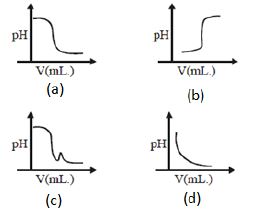
The nature of the curve is such that the \(pH\) change of the reaction becomes larger for very small change in volume of titrant. -
- (A) \(a > c > b\)
- (B) \(c > a > b\)
- (C) \(c > b > a\)
- (D) \(a > b > c\)
Show answer and solution
Correct Answer: (A)
Stronger the acidic strength greater will be its electrical conductivity. \(K_a\) value of formic acid \(>\) benzoic acid \(>\) acetic acid -
- (A) \(6.23\times10^{-11}\, M\)
- (B) \(1.84\times10^{-9}\, M\)
- (C) \(\frac{{2.49}}{{1.84}} \times {10^{ - 9}}\,M\)
- (D) \(2.49\times10^{-10}\, M\)
Show answer and solution
Correct Answer: (D)
\({K_{sp}}\) of \(Cd{(OH)_2} = 4{s^3} = 4 \times {(1.84 \times {10^{ - 5}})^3}\)If \(pH = 12\)
\(pOH = 2\)
\([O{H^ - }] = {10^{ - 2}}\,M\)
\({K_{sp}} = [C{d^{2 + }}]{[O{H^ - }]^2}\)
\(4 \times {(1.84 \times {10^{ - 5}})^3} = [C{d^{2 + }}]{[O{H^ - }]^2}\)
\([C{d^{2 + }}] = \frac{{4 \times {{(1.84)}^3} \times {{10}^{ - 15}}}}{{{{10}^{ - 4}}}}\)
\(C{d^{2 + }} = 4 \times 6.22 \times {10^{ - 11}} = 2.49 \times {10^{ - 10}}\,M\)
- 41. The \(pH\) of a \(0.02\,M\,\,NH_4Cl\) solution will be [given \(K_b\,(NH_4OH) = 10^{-5}\) and \(log\,2 = 0.301\) ] 2019 Hard
- (A) \(2.65\)
- (B) \(5.35\)
- (C) \(4.35\)
- (D) \(4.65\)
Show answer and solution
Correct Answer: (B)
For the salt of strong acid and weak base\({H^ + } = \sqrt {\frac{{{K_w} \times C}}{{{K_b}}}} \)
\([{H^ + }] = \sqrt {\frac{{{{10}^{ - 14}} \times 2 \times {{10}^{ - 2}}}}{{{{10}^{ - 5}}}}} \)
\( - \log [{H^ + }] = 6 - \frac{1}{2}\log \,20\)
\(\therefore \,pH = 5.35\)
-
- (A) \(3 \times {10^{ - 19}}\)
- (B) \(12 \times {10^{ - 21}}\)
- (C) \(12 \times {10^{ - 23}}\)
- (D) \(3 \times {10^{ - 22}}\)
Show answer and solution
Correct Answer: (D)
\(Al(O{H_3}) \rightleftharpoons \mathop {A{l^{3 + }}}\limits_s + \mathop {3O{H^ - }}\limits_{(3s + 0.2)} \)\(2.4 \times {10^{ - 24}} = s{(3s + 0.2)^3}\)
-
- (A) \(C\) is the thermodynamically stable product
- (B) Formation of \(A\) and \(B\) from \(C\) has highest enthalpy of activation
- (C) \(D\) is kinetically stable product
- (D) Activation enthalpy to form \(C\) is \(5\,kJ\, mol^{-1}\) less than that to form \(D\)
Show answer and solution
Correct Answer: (D)
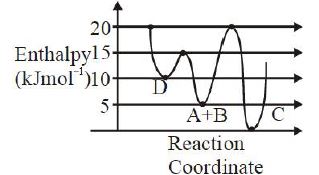
\({E_a} = (D \to C)\)\( = 15 - 0 = 15\,kJ\,mo{l^{ - 1}}\)
\({E_a} = (A + B) \to C = 15\,kJ\,mo{l^{ - 1}}\)
\({E_a} = (A + B) \to D = 10\,kJ\,mo{l^{ - 1}}\)
\({E_a} = C \to (A + B) = 20\,kJ\,mo{l^{ - 1}}\) (high activation enthalpy in the reaction)
\(\therefore \) Activation enthalpy to form \(C\) is \(5\,kJ\,mol^{-1}\) more than that of form \(D\).
-
- (A) \(I\) is right but \(II\) is wrong
- (B) Both \(I\) and \(II\) are correct
- (C) \(I\) is wrong but \(II\) is right
- (D) Both \(I\) and \(II\) are wrong
Show answer and solution
Correct Answer: (A)
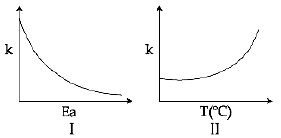
\(K = A{e^{ - {E_a}/RT}}\)
\((i)\) is true but \((ii)\) is false
\((ii)\) should be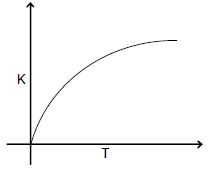
-
- (A) \(50\)
- (B) \(25\)
- (C) \(20\)
- (D) \(40\)
Show answer and solution
Correct Answer: (A)
According to unit of rate constant it is a zero order reaction then half life of reaction will be \({t_{1/2}} = \frac{{{C_0}}}{{2k}} = \frac{{5\,\mu g}}{{2 \times 0.05\,\mu g/year}} = 50\,years\) -
- (A) \(10^{-6}\,s^{-1}\)
- (B) \(2\times 10^{-4}\,s^{-1}\)
- (C) \(10^{-4}\,s^{-1}\)
- (D) \(4\times 10^{-4}\,s^{-1}\)
Show answer and solution
Correct Answer: (C)
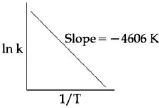
\(\ln \, = \,\ln \,A\, - \,\frac{{Ea}}{{RT}}\, = \,\ln \,A\, - \,\frac{{4606}}{T}\)\(\ln \,\left( {\frac{k}{{{{10}^{ - 5}}}}} \right) = \left( {\frac{{Ea}}{R}} \right)\, \times \,\frac{{500 - 400}}{{500 \times 400}}\)
\(\ln \,\left( {\frac{k}{{{{10}^{ - 5}}}}} \right) = 4606 \times \frac{1}{{2000}}\, = \,2.303\, = \,\ln \,10\)
\(\ln \,\left( {\frac{k}{{{{10}^{ - 5}}}}} \right) = \,\ln \,10\)
\(k\,=\,10^{-4}\)
-
- (A) \(\left( {\frac{{{k_1}}}{{{k_2}}}} \right)\left[ A \right]\)
- (B) \(\left( {{k_1} - {k_2}} \right)\left[ A \right]\)
- (C) \({k_1}{k_2}\left[ A \right]\)
- (D) \(\left( {{k_1} + {k_2}} \right)\left[ A \right]\)
Show answer and solution
Correct Answer: (A)
Applying steady state of approximation\(\frac{d}{{dt}}[B]\, = \,{K_1}[A]\, - \,{K_2}[B]\)
\(O\, = \,{K_1}[A]\, - \,{K_2}[B]\)
\(\frac{{{K_1}}}{{{K_2}}}[A]\, = \,[B]\)
-
- (A) \({k_1}\left[ {{A_2}} \right] - {k_{ - 1}}{\left[ A \right]^2}\)
- (B) \(2{k_1}\left[ {{A_2}} \right] - {k_{ - 1}}{\left[ A \right]^2}\)
- (C) \({k_1}\left[ {{A_2}} \right] + {k_{ - 1}}{\left[ A \right]^2}\)
- (D) \(2{k_1}\left[ {{A_2}} \right] - {2k_{ - 1}}{\left[ A \right]^2}\)
Show answer and solution
Correct Answer: (D)
\(\frac{1}{2}\frac{{d[A]}}{{dt}}\, = \, - \,{K_1}\,{[A]_2}\, + \,{K_{ - 1}}\,{[A]^2}\)\(\frac{{d[A]}}{{dt}}\, = \,2{K_1}\,{[A]_2}\, - \,2{K_{ - 1}}\,{[A]^2}\)
-
- (A) Rate \(= k[A]^2[B]^2\)
- (B) Rate \(= k[A][B]^2\)
- (C) Rate \(= k[A][B]\)
- (D) Rate \(= k[A]^2[B]\)
Show answer and solution
Correct Answer: (B)
\(r\, = \,K{[A]^x}\,{[B]^y}\)\(0.045\, = \,K{(0.05)^x}{(0.05)^y}\) ...... \((1)\)
\(0.090\, = \,K{(0.10)^x}{(0.05)^y}\) .......\((2)\)
\(0.72\, = \,K{(0.20)^x}{(0.10)^y}\) ........\((3)\)
Diving \((1)\) by \((2)\) We get
\(\frac{{0.045}}{{0.090}}\, = \,{\left( {\frac{{0.05}}{{0.10}}} \right)^x}\, \Rightarrow \,x = 1\)
Diving \((2)\) by \((3)\)
\(\frac{{0.090}}{{0.720}}\, = \,{\left( {\frac{{0.10}}{{0.20}}} \right)^x}\,{\left( {\frac{{0.05}}{{0.10}}} \right)^y}\, \Rightarrow \,y = 2\,\)
Hence, \(r\, = \,K[A]\,{[B]^2}\)
-
- (A) Total order of the reaction is \(4\)
- (B) Order of the reaction with respect to \(B\) is \(2\)
- (C) Order of the reaction with respect to \(B\) is \(1\)
- (D) Order of the reaction with respect to \(A\) is \(2\)
Show answer and solution
Correct Answer: (B)
\(2A+B\to \) productsRate \(=\,K\,[A]^x[B]^y\)
\(r\,=\,K\,[A]^x[B]^y\) ..... \((i)\)
\(0.3\,=\,K\,[A]^x[B]^y\) ..... \((1)\)
\(2.4\, = \,K{[2A]^x}\,{[2B]^y}\) ...... \((2)\)
\(0.6\, = \,K{[2A]^x}\,{[B]^y}\) ...... \((3)\)
From \((1)\,(2)\) and \((3)\)
\(X\,=\,1,\) \(Y\,=\,2\)
Overall order \(=\,2+1\,=3\)
Order w.r.t \(A=1\)
Order w.r.t \(B=2\)
No questions on this page match these filters.
Other years
Frequently asked
How many JEE Mains 2019 Chemistry questions are on ExamBro?
248 questions, each with the correct answer and a full solution.
Which JEE Mains 2019 Chemistry chapter is asked the most?
Co-ordination chemistry, with 22 questions, followed by Thermodynamics and thermochemistry with 21.
How difficult are JEE Mains 2019 Chemistry questions?
4% are easy, 22% medium and 74% hard.