


JEE Mains · Chemistry · STD 12 - D and f- block elements
- JEE Mains 2025
- Easy
- MCQ
' \(X\) ' is the number of electrons in \(t_{2 g}\) orbitals of the most stable complex ion among \(\left[\mathrm{Fe}\left(\mathrm{NH}_3\right)_6\right]^{3+}\), \(\left[\mathrm{Fe}\left(\mathrm{Cl}_6\right)\right]^{3-},\left[\mathrm{Fe}\left(\mathrm{C}_2 \mathrm{O}_4\right)_3\right]^{3-}\) and \(\left[\mathrm{Fe}\left(\mathrm{H}_2 \mathrm{O}\right)_6\right]^{3+}\). The nature of oxide of vanadium of the type \(\mathrm{V}_2 \mathrm{O}_{\mathrm{X}}\) is _______.
Pick an option to check your answer.
Answer & Solution
Correct Answer
(D) Amphoteric
Step-by-step Solution
Detailed explanation
Explanation:
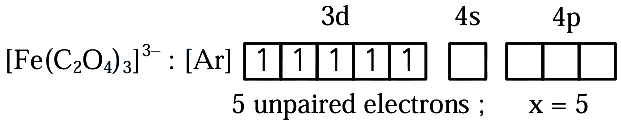
1. Identifying the Most Stable Complex: Among the given coordination complexes, \( \text{[Fe(C}_2\text{O}_4\text{)}_3\text{]}^{3-} \) is the most stable due to the chelation effect. The oxalate ion (\( \text{C}_2\text{O}_4^{2-} \)) is a bidentate ligand that binds to the central metal ion at two sites, forming three stable five-membered rings. Chelated complexes are significantly more stable than similar non-chelated complexes containing monodentate ligands.
2. Finding the Value of X: In the most stable complex \( \text{[Fe(C}_2\text{O}_4\text{)}_3\text{]}^{3-} \), the oxidation state of iron (\( \text{Fe} \)) is \( +3 \).
- Atomic number of \( \text{Fe} = 26 \)
- Ground state configuration of \( \text{Fe} = \text{[Ar] } 3d^6 4s^2 \)
- Configuration of \( \text{Fe}^{3+} = \text{[Ar] } 3d^5 4s^0 \)
Thus, the total number of electrons present in the \( d \)-orbitals of the central metal ion is \( X = 5 \).
3. Determining the Nature of the Oxide: Substituting \( X = 5 \) into the general oxide formula \( \text{V}_2\text{O}_X \) gives Vanadium Pentoxide (\( \text{V}_2\text{O}_5 \)). As the oxidation state of a transition metal increases, its oxides shift from basic to amphoteric/acidic characters. \( \text{V}_2\text{O}_5 \) is classically amphoteric because it reacts with both non-oxidizing acids and alkalis to form corresponding salts.
Hence, Option D is the correct choice.
More questions from Chemistry
- A student has studied the decomposition of a gas \(AB _3\) at \(25^{\circ} C\). He obtained the following data.
The order of the reaction is\(p ( mm Hg )\) \(50\) \(100\) \(200\) \(400\) Relative \(t _{1 / 2}( s )\) \(4\) \(2\) \(1\) \(0.5\) JEE Mains 2023 Hard - At 298 K, the mole percentage of \(N_{2}(g)\) in air is 80%. Water is in equilibrium with air at a pressure of 10 atm. What is the mole fraction of \(N_{2}(g)\) in water at 298 K ? (\(K_{H}\) for \(N_{2}\) is \(6.5 \times 10^{7}\) mm Hg)JEE Mains 2026 Hard
- Strong reducing and oxidizing agents among the following, respectively, areJEE Mains 2023 Medium
- The number of bent-shaped molecule/s from the following is \(.....\). \(N _3^{-}, NO _2^{-}, I _3^{-}, O _3, SO _2\)JEE Mains 2023 Medium
- Arrange the following metal complex / compounds in the increasing order of spin only magnetic moment. Presume all the three, high spin system. (Atomic numbers \(Ce =58, Gd =64\) and \(Eu =63 .)\) \((a)\) \(\left( NH _{4}\right)_{2}\left[ Ce \left( NO _{3}\right)_{6}\right]\) \((b)\) \(Gd \left( NO _{3}\right)_{3}\) and \((c)\) \(Eu \left( NO _{3}\right)_{3}\) Answer is :JEE Mains 2021 Medium
- The adsorbent used in adsorption chromatography is _______. \(A\). silica gel \(B\). alumina \(C\). quick lime \(D\). magnesia Choose the most appropriate answer from the options given below :JEE Mains 2024 Medium
More PYQs from JEE Mains
- The \(\mathrm{pH}\) of a solution obtained by mixing \(50 \,\mathrm{~mL}\) of \(1\, \mathrm{M}\, \mathrm{HCl}\) and \(30 \,\mathrm{~mL}\) of \(1\, \mathrm{M} \,\mathrm{NaOH}\) is \(\mathrm{x} \times 10^{-4}\). The value of \(\mathrm{x}\) is ...... . (Nearest integer) \([\log 2.5=0.3979]\)JEE Mains 2021 Hard
- Consider the following thermochemical data:
(i) \( 2Al(s) + 6HCl(aq) \rightarrow Al_2Cl_6(aq) + 3H_2(g) \) ; \( \Delta H_1 = -1200\text{ kJ/mol} \)
(ii) \( H_2(g) + Cl_2(g) \rightarrow 2HCl(g) \) ; \( \Delta H_2 = -164\text{ kJ/mol} \)
(iii) \( HCl(g) + aq \rightarrow HCl(aq) \) ; \( \Delta H_3 = -83\text{ kJ/mol} \)
(iv) \( Al_2Cl_6(s) + aq \rightarrow Al_2Cl_6(aq) \) ; \( \Delta H_4 = -663\text{ kJ/mol} \)
The enthalpy of formation of anhydrous solid \( Al_2Cl_6 \) is:JEE Mains 2026 Hard - Consider the following reactions:
\( NaCl+K_{2}Cr_{2}O_{7}+H_{2}SO_{4}\rightarrow A+KHSO_{4}+NaHSO_{4}+H_{2}O \)
\( A+NaOH\rightarrow B+NaCl+H_{2}O \)
\( B+H_{2}SO_{4}+H_{2}O_{2}\rightarrow C+Na_{2}SO_{4}+H_{2}O \)
In the product 'C', 'X' is the number of \( O_{2}^{2-} \) units, 'Y' is the total number oxygen atoms present and 'Z' is the oxidation state of Cr. The value of X+Y+Z is __________ .JEE Mains 2026 Hard - In the following nuclear rection, \(D \stackrel{\alpha}{\longrightarrow} D _{1} \stackrel{\beta-}{\longrightarrow} D _{2} \stackrel{\alpha}{\longrightarrow} D _{3} \stackrel{\gamma}{\longrightarrow} D _{4}\) Mass number of \(D\) is \(182\) and atomic number is \(74\) . Mass number and atomic number of \(D _{4}\) respectively will beJEE Mains 2022 Medium
- The number of following factors which affect the percent covalent character of the ionic bond is \(............\). \((a)\) Polarising power of cation \((b)\) Extent of distortion of anion \((c)\) Polarisability of the anion \((d)\) Polarising power of anionJEE Mains 2023 Medium
- The trajectory of a projectile near the surface of the earth is given as\( y = 2x -9x^2\). If it were launched at an angle \(\theta_0\) with speed \(v_0\) then \((g = 10\, ms^{-2}\))JEE Mains 2019 Hard