


Questions
28 questionsShowing 1–28 of 28 questions
-
- (A) 4
- (B) 5
- (C) 6
- (D) 7
Show answer and solution
Correct Answer: (A)
Sc Mn Co Cu Enthalpy of Atomisation (kJ/mole) 326 281 425 339 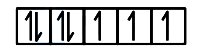
\(\begin{aligned}
& \mathrm{n}=3 \\
& \mu=\sqrt{15}=3.87
\end{aligned}\)
Nearest integer \(=4\) -
- (A) 5
- (B) 6
- (C) 7
- (D) 8
Show answer and solution
Correct Answer: (B)
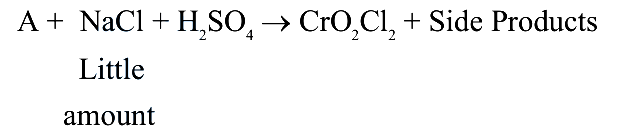
\(\begin{aligned} & \mathrm{Cr}_2 \mathrm{O}_7^{2-}+\mathrm{NaCl}+\mathrm{H}_2 \mathrm{SO}_4 \rightarrow \mathrm{CrO}_2 \mathrm{Cl}_2 \\ & \mathrm{CrO}_2 \mathrm{Cl}_2(\text { Vapour })+\mathrm{NaOH} \rightarrow \mathrm{Na}_2 \mathrm{CrO}_4+\mathrm{NaCl}+\mathrm{H}_2 \mathrm{O}\end{aligned}\)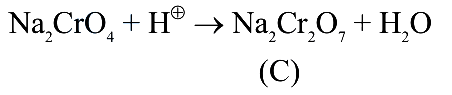
\(\mathrm{Na}_2 \mathrm{Cr}_2 \mathrm{O}_7 \rightarrow 2 \mathrm{Na}^{\oplus}+\mathrm{Cr}_2 \mathrm{O}_7^{2-}\)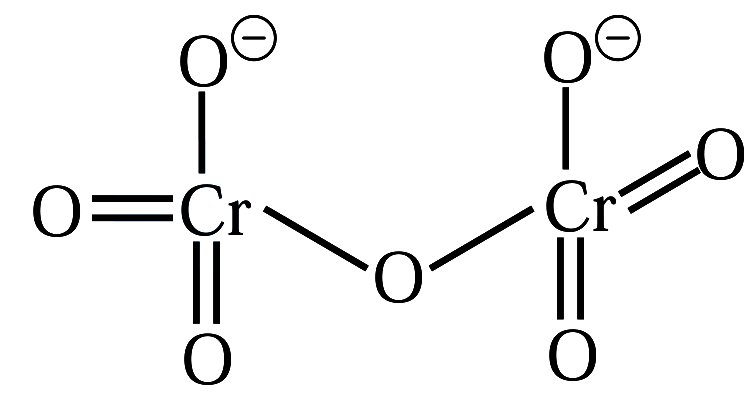
No of terminal "O" = 6 -
- (A) \(\mathrm{K}_2 \mathrm{CrO}_4\) and CrO
- (B) \(\mathrm{K}_2 \mathrm{CrO}_4\) and \(\mathrm{Cr}_2 \mathrm{O}_3\)
- (C) \(\mathrm{K}_2 \mathrm{CrO}_4\) and \(\mathrm{K}_2 \mathrm{Cr}_2 \mathrm{O}_7\)
- (D) \(\mathrm{K}_2 \mathrm{Cr}(\mathrm{OH})_6\) and \(\mathrm{Cr}_2 \mathrm{O}_3\)
Show answer and solution
Correct Answer: (C)
\(\mathrm{K}_2 \mathrm{Cr}_2 \mathrm{O}_7 \xrightarrow[-\mathrm{H}_2 \mathrm{O}]{\mathrm{KOH}} \mathrm{K}_2 \mathrm{CrO}_4 \xrightarrow[-\mathrm{H}_2 \mathrm{O}]{\mathrm{H}_2 \mathrm{SO}_4} \mathrm{~K}_2 \mathrm{Cr}_2 \mathrm{O}_7+\mathrm{K}_2 \mathrm{SO}_4\)
[A] \(\mathrm{K}_2 \mathrm{CrO}_4\)
[B] \(\mathrm{K}_2 \mathrm{Cr}_2 \mathrm{O}_7\) -
- (A) Statement I is false but Statement II is true
- (B) Statement I is true but Statement II is false
- (C) Both Statement I and Statement II are true
- (D) Both Statement I and Statement II are false
Show answer and solution
Correct Answer: (B)
Statement-I is true but statement II is false.
\(\mathrm{Cr}(\mathrm{VI})\) is less stable than \(\mathrm{Mo}(\mathrm{VI})\)
Hence, \(\mathrm{CrO}_3\) easily reduce into \(\mathrm{Cr}^{+3}\) as compared to \(\mathrm{MoO}_3\) and show stronger oxidizing nature. -
- (A) Both Statement I and Statement II are false
- (B) Both Statement I and Statement II are true
- (C) Statement I is false but Statement II is true
- (D) Statement I is true but Statement II is false
Show answer and solution
Correct Answer: (B)
Heating is required in oxalic acid filtration due to High activation energy.
Heating is not required in FAS vs \(\mathrm{KMnO}_4\) titration because \(\mathrm{Fe}^{2+}\) will get converted into \(\mathrm{Fe}^{3+}\) by oxygen of air and error may be introduced in the experiment.
Both Statement-I and Statement-II are correct. -
- (A) 20
- (B) 10
- (C) 15
- (D) 25
Show answer and solution
Correct Answer: (B)
\(\underset{(\mathrm{O}. \mathrm{A})}{\stackrel{+7}{\mathrm{KMnO}}} \xrightarrow{\text { Acidic medium }} \mathrm{Mn}^{2+}\)
X is difference in oxidation state.
\(6 \mathrm{CH}_3 \mathrm{COO}^{\ominus}+\mathrm{Fe}^{3+}+\mathrm{H}_2 \mathrm{O} \rightarrow\left[\mathrm{Fe}_3\left(\mathrm{OH}_2\right)\left(\mathrm{CH}_3 \mathrm{COO}\right)_6\right]^{\oplus}+2 \mathrm{H}^{\oplus}\)
\(\left[\mathrm{Fe}_3(\mathrm{OH})_2\left(\mathrm{CH}_3 \mathrm{COO}\right)_6\right]^{\oplus} \text{(Brown red ppt)} +4 \mathrm{H}_2 \mathrm{O}\rightarrow\left[\mathrm{Fe}(\mathrm{OH})_2\left(\mathrm{CH}_3 \mathrm{COO}\right]+\mathrm{CH}_3 \mathrm{COOH}+\mathrm{H}^{\oplus}\right.\)
\(\mathrm{Fe}^{3+} \Rightarrow 3 \mathrm{~d}^5 4 \mathrm{~s}^0\) contains 5 d electrons
So \(Y=5\)
\(X+Y=5+5=10\) -
- (A) (A) and (D) only
- (B) (B) and (C) only
- (C) (A) and (B) only
- (D) (B) and (E) only
Show answer and solution
Correct Answer: (C)
\(\begin{aligned} & { }_{63} \mathrm{Eu}^{2+}-[\mathrm{Xe}] 4 \mathrm{f}^7 6 \mathrm{~s}^0 \\ & { }_{64} \mathrm{Gd}^{3+}-[\mathrm{Xe}] 4 \mathrm{f}^7 5 \mathrm{~d}^0 6 \mathrm{~s}^0 \\ & { }_{63} \mathrm{Eu}^{3+}-[\mathrm{Xe}] 4 \mathrm{f}^6 6 \mathrm{~s}^0 \\ & { }_{65} \mathrm{~Tb}^{3+}-[\mathrm{Xe}] 4 \mathrm{f}^8 6 \mathrm{~s}^0 \\ & { }_{62} \mathrm{Sm}^{2+}-[\mathrm{Xe}] 4 \mathrm{f}^6 6 \mathrm{~s}^0 \\ & \mathrm{Eu}^{2+} \& \mathrm{Gd}^{3+}\end{aligned}\) -
- (A) (A) \(-(\mathrm{III}),(\mathrm{B})-(\mathrm{I}),(\mathrm{C})-(\mathrm{IV}),(\mathrm{D})-(\mathrm{II})\)
- (B) (A) \(-(\mathrm{III}),(\mathrm{B})-(\mathrm{I}),(\mathrm{C})-(\mathrm{II}),(\mathrm{D})-(\mathrm{IV})\)
- (C) (A) \(-(\mathrm{IV}),(\mathrm{B})-(\mathrm{II}),(\mathrm{C})-(\mathrm{III}),(\mathrm{D})-(\mathrm{I})\)
- (D) \((\mathrm{A})-(\mathrm{II}),(\mathrm{B})-(\mathrm{IV}),(\mathrm{C})-(\mathrm{I}),(\mathrm{D})-(\mathrm{III})\)
Show answer and solution
Correct Answer: (A)
\(\begin{array}{lc}\mathrm{Sc}^{+3}=3 \mathrm{~d}^{\mathrm{o}} & \therefore \mu_{\text {spin }}=0 \\ \mathrm{~V}^{+2}=3 \mathrm{~d}^3 & \therefore \mu_{\text {spin }}=3.87 \mathrm{~B} \cdot \mathrm{M} . \\ \mathrm{Ni}^{+2}=3 \mathrm{~d}^8 & \therefore \mu_{\text {spin }}=2.84 \mathrm{~B} \cdot \mathrm{M} . \\ \mathrm{Ti}^{+3}=3 \mathrm{~d}^1 & \therefore \mu_{\text {spin }}=1.73 \text { B.M. }\end{array}\) -
- (A) 11
- (B) 22
- (C) 33
- (D) 44
Show answer and solution
Correct Answer: (A)
\(\begin{aligned} & \mathrm{Z}=41 \rightarrow \mathrm{Nb} \text { (Niobium) : }[\mathrm{Kr}]_{36} 4 \mathrm{~d}^4 5 \mathrm{~s}^1 \\ & \text { Number of electron in } 4 \mathrm{~d}=4=\mathrm{x} \\ & \mathrm{Z}=44 \rightarrow \mathrm{Ru} \text { (Ruthenium) }[\mathrm{Kr}]_{36} 4 \mathrm{~d}^7 5 \mathrm{~s}^1 \\ & \text { Number of electron in } 4 \mathrm{~d}=7=\mathrm{y} \\ & \mathrm{x}+\mathrm{y}=11\end{aligned}\) - 10. Pair of transition metal ions having the same number of unpaired electrons is _______. 2025 Medium
- (A) \(\mathrm{V}^{2+}, \mathrm{Co}^{2+}\)
- (B) \(\mathrm{Ti}^{i+}, \mathrm{Co}^{2+}\)
- (C) \(\mathrm{Fe}^{3+}, \mathrm{Cr}^{2+}\)
- (D) \(\mathrm{Ti}^{3+}, \mathrm{Mn}^{2+}\)
Show answer and solution
Correct Answer: (A)
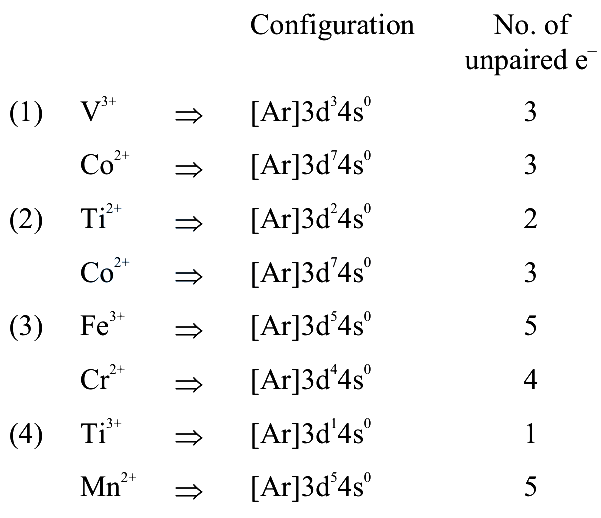
So \(\mathrm{V}^{2+} \& \mathrm{Co}^{2+}\) same number of unpaired electron. -
- (A) \(\mathrm{K}_3 \mathrm{MnO}_4\)
- (B) \(\mathrm{K}_4\left[\mathrm{Mn}(\mathrm{OH})_6\right]\)
- (C) \(\mathrm{KMnO}_4\)
- (D) \(\mathrm{K}_2 \mathrm{MnO}_4\)
Show answer and solution
Correct Answer: (D)
Preparation of \(\mathrm{KMnO}{ }_4\)
\(\mathrm{MnO}_2 \xrightarrow[\mathrm{KNO}_3]{\mathrm{KOH}} \mathrm{K}_2 \mathrm{MnO}_4 \xrightarrow[\substack{\text { Oxidation in } \\ \text { Alkaline solution }}]{\text { Elecrolta }} \mathrm{KMnO}_4\) -
- (A) \(+3\)
- (B) \(+4\)
- (C) \(+7\)
- (D) \(+5\)
Show answer and solution
Correct Answer: (D)
\(\mathrm{V}_2 \mathrm{O}_5\) is amphoteric oxide.
\(\mathrm{V}_2 \mathrm{O}_5\) gives \(\mathrm{VO}_4{ }^{3-}\) on reaction with alkali oxidation state of V in \(\mathrm{VO}_4{ }^{3-}=+5\) -
- (A) 3.87 and 4.90 B.M.
- (B) 4.90 and 5.92 B.M.
- (C) 4.90 and 4.90 B.M.
- (D) 5.92 and 4.90 B.M.
Show answer and solution
Correct Answer: (D)
\(\begin{aligned}
& \mathrm{K}_3\left[\mathrm{Fe}(\mathrm{OH})_6\right] \\
& \mathrm{Fe}^{3+} \Rightarrow 3 \mathrm{~d}^5 \\
& \mathrm{Fe}^{3+} \text { with } \mathrm{OH}^{-}(\mathrm{WFL}) \\
& =\mathrm{t}_{29}{ }^3 \mathrm{e}_{\mathrm{g}}{ }^2
\end{aligned}\)
Number of unpaired electron ( \(n\) ) \(=5\)
\(\mu\) spin only \(=5.92 \mathrm{BM}\)
\(\begin{aligned}
& \mathrm{K}_4\left[\mathrm{Fe}(\mathrm{OH})_6\right] \\
& \mathrm{Fe}^{2+} \Rightarrow \mathrm{OH}^{-} \mathrm{(WFL)} \\
& \mathrm{Fe}^{2+} \Rightarrow 3 \mathrm{~d}^6=\mathrm{t}_{2 \mathrm{~g}}^4 \mathrm{e}_{\mathrm{g}}^2 \\
& \mathrm{n}=4
\end{aligned}\)
\(\mu_{\text {spin only }}=4.90 \mathrm{BM}\) -
- (A) \(\mathrm{Cu}^{+} \gt \mathrm{Cu}^{2+} \gt \mathrm{Cr}^{3+} \gt \mathrm{Cr}^{2+}\)
- (B) \(\mathrm{Cu}^{2+} \gt \mathrm{Cu}^{+} \gt \mathrm{Cr}^{2+} \gt \mathrm{Cr}^{3+}\)
- (C) \(\mathrm{Cr}^{2+} \gt \mathrm{Cr}^{3+} \gt \mathrm{Cu}^{2+} \gt \mathrm{Cu}^{+}\)
- (D) \(\mathrm{Cr}^{3+} \gt \mathrm{Cr}^{2+} \gt \mathrm{Cu}^{+} \gt \mathrm{Cu}^{2+}\)
Show answer and solution
Correct Answer: (C)
\(\mathrm{Cu}^{+}:[\mathrm{Ar}] 3 \mathrm{~d}^{10}\), Spin only magnetic moment \(=0\)
B.M.
\(\mathrm{Cu}^{+2}:[\mathrm{Ar}] 3 \mathrm{~d}^9\), Spin only magnetic moment \(=\sqrt{3}\)
B.M.
\(\mathrm{Cr}^{+2}:[\mathrm{Ar}] 3 \mathrm{~d}^4\), Spin only magnetic moment \(=\sqrt{24}\)
B.M.
\(\mathrm{Cr}^{+3}:[\mathrm{Ar}] 3 \mathrm{~d}^3\), Spin only magnetic moment \(=\sqrt{15}\)
B.M.
Order of \(\mu\) : \(\mathrm{Cr}^{+2} \gt \mathrm{Cr}^{+3} \gt \mathrm{Cu}^{+2} \gt \mathrm{Cu}^{+}\) -
- (A) \(\mathrm{Fe} \lt \mathrm{Mn}, \mathrm{Ru} \lt \mathrm{Tc}\) and \(\mathrm{Re} \lt \mathrm{Os}\)
- (B) \(\mathrm{Mn} \lt \mathrm{Fe}, \mathrm{Tc} \lt \mathrm{Ru}\) and \(\mathrm{Os} \lt \mathrm{Re}\)
- (C) \(\mathrm{Mn} \lt \mathrm{Fe}, \mathrm{Tc} \lt \mathrm{Ru}\) and \(\mathrm{Re} \lt \mathrm{Os}\)
- (D) \(\mathrm{Fe} \lt \mathrm{Mn}, \mathrm{Ru} \lt \mathrm{Tc}\) and \(\mathrm{Os} \lt \mathrm{Re}\)
Show answer and solution
Correct Answer: (B)
Melting point order
\(\begin{aligned}
& \mathrm{Fe}>\mathrm{Mn} \\
& \mathrm{Ru}>\mathrm{Tc} \\
& \mathrm{Re}>\mathrm{Os}
\end{aligned}\) - 16. The correct set of ions (aqueous solution) with same colour from the following is which? 2025 Easy
- (A) \(\mathrm{Sc}^{3+}, \mathrm{Ti}^{3+}, \mathrm{Cr}^{2+}\)
- (B) \(\mathrm{V}^{2+}, \mathrm{Cr}^{3+}, \mathrm{Mn}^{3+}\)
- (C) \(\mathrm{Ti}^{4+}, \mathrm{V}^{4+}, \mathrm{Mn}^{2+}\)
- (D) \(\mathrm{Zn}^{2+}, \mathrm{V}^{3+}, \mathrm{Fe}^{3+}\)
Show answer and solution
Correct Answer: (B)
(1) \(\mathrm{V}^{2+}\) (Violet), \(\mathrm{Cr}^{3+}\) (Violet), \(\mathrm{Mn}^{3+}(\) Violet \()\)
(2) \(\mathrm{Zn}^{2+}\) (Colourless), \(\mathrm{V}^{3+}\) (Green), \(\mathrm{Fe}^{3+}\) (Yellow)
(3) \(\mathrm{Ti}^{4+}\) (Colourless), \(\mathrm{V}^{4+}\) (Blue), \(\mathrm{Mn}^{2+}\) (Pink)
(4) \(\mathrm{Sc}^{3+}(\) Colourless \(), \mathrm{Ti}^{3+}\) (Purple), \(\mathrm{Cr}^{2+}\) (Blue) -
- (A) (A), (B), (C), (D) and (E)
- (B) (A), (B), (D) and (E) only
- (C) (B), (D) and (E) only
- (D) (A), (C) and (D) only
Show answer and solution
Correct Answer: (B)
(i) True, \(\mathrm{T} \ell^{+}\)is more stable than \(\mathrm{T} \ell^{3+}\), due to inert pair effect. So \(\mathrm{T} \ell^{3+}\) is a powerful oxidising agent.
(ii) True, \(\mathrm{E}_{\mathrm{Al}^{3+/ A 1}}^0=-1.66 \mathrm{~V}\). So it is difficult to reduce \(\mathrm{A} \ell^{3+}\). So \(\mathrm{A} \ell^{3+}\) is highly stable.
(iii) False, as \(\mathrm{T} \ell^{3+}\) is unstable
(iv) True, \(\mathrm{T} \ell^{+}\)is more stable than \(\mathrm{T} \ell^{3+}\)
(v) True, \(\mathrm{A} \ell^{3+}\) and \(\mathrm{T} \ell^{+}\)are highly stable -
- (A) neutral
- (B) acidic
- (C) basic
- (D) amphoteric
Show answer and solution
Correct Answer: (C)
In 3d series Vanadium has highest enthalpy of atomization and colour of \(\mathrm{V}^{+3}\) is green.
* Oxide form by \(\mathrm{V}^{+3}\) is \(\mathrm{V}_2 \mathrm{O}_3\) (Basic oxide) - 19. The incorrect relationship in the following pairs in relation to ionisation enthalpies is _______. 2025 Medium
- (A) \(\mathrm{Mn}^{+} \lt \mathrm{Cr}^{+}\)
- (B) \(\mathrm{Mn}^{+} \lt \mathrm{Mn}^{2+}\)
- (C) \(\mathrm{Fe}^{2+} \lt \mathrm{Fe}^{3+}\)
- (D) \(\mathrm{Mn}^{2+} \lt \mathrm{Fe}^{2+}\)
Show answer and solution
Correct Answer: (D)
\(\mathrm{Mn}^{2+}:[\mathrm{Ar}] 3 \mathrm{~d}^5\)
Half filled stability
More 1 E than \(\mathrm{Fe}^{2+}\)
\(\mathrm{Fe}^{2+}:[\mathrm{Ar}] 3 \mathrm{~d}^6\) -
- (A) \(\mathrm{Mn}^{2+}\)
- (B) \(\mathrm{Cr}^{3+}\)
- (C) \(\mathrm{Ni}^{2+}\)
- (D) \(\mathrm{Ti}^{3+}\)
Show answer and solution
Correct Answer: (C)
\(\mathrm{Ni}^{2+}\) gives violet colour with borax bead test in nonluminous flame under hot conditions. \(\mathrm{Ni}^{2+}\) has \(\mathrm{d}^8\) configuration which does not depend on nature of ligand present in octahedral field.
\(\mathrm{Ni}^{2+} \Rightarrow \mathrm{t}_{2 g}^6 \mathrm{eg}^2\) -
- (A) A, C and E only
- (B) A, D and E only
- (C) B and E only
- (D) A, B and E only
Show answer and solution
Correct Answer: (D)
Given magnetic moment \(=4.9\) B.M.
We know M.M \(=\sqrt{\mathrm{n}(\mathrm{n}+2)}\) B.M.
Where, \(\mathrm{n} \rightarrow\) No. of unpaired \(\mathrm{e}^{-}\)
\(4.9=\sqrt{\mathrm{n}(\mathrm{n}+2)}\)
We get \(\mathrm{n}=4\)
(A) \({ }_{24} \mathrm{Cr}^{2+} \Rightarrow[\mathrm{Ar}] 3 \mathrm{~d}^4\) (4 unpaired e)
(B) \({ }_{26} \mathrm{Fe}^{2+} \Rightarrow[\mathrm{Ar}] 3 \mathrm{~d}^6\) (4 unpaired e)
(C) \({ }_{26} \mathrm{Fe}^{3+} \Rightarrow[\mathrm{Ar}] 3 \mathrm{~d}^5\) (5 unpaired e)
(D) \({ }_{27} \mathrm{Co}^{2+} \Rightarrow[\mathrm{Ar}] 3 \mathrm{~d}^7\) (3 unpaired \(\mathrm{e}^{-}\))
(E) \({ }_{25} \mathrm{Mn}^{3+} \Rightarrow[\mathrm{Ar}] 3 \mathrm{~d}^4 \left(4\right.\) unpaired \(\left.\mathrm{e}^{-}\right)\) -
- (A) 120
- (B) 140
- (C) 160
- (D) 180
Show answer and solution
Correct Answer: (C)
\(\mathrm{FeCr}_2 \mathrm{O}_4+\mathrm{Na}_2 \mathrm{CO}_3+\mathrm{O}_2 \rightarrow \mathrm{Na}_2 \mathrm{CrO}_4+\mathrm{Fe}_2 \mathrm{O}_3+\mathrm{CO}_2\)
Insoluble product will be \(\mathrm{Fe}_2 \mathrm{O}_3\)
molar mass \(=56 \times 2+16 \times 3\)
\(\begin{aligned}
& =112+48 \\
& =160
\end{aligned}\) -
- (A) \(8\)
- (B) \(9\)
- (C) \(6\)
- (D) \(10\)
Show answer and solution
Correct Answer: (C)
Out of \(\mathrm{Cr}, \mathrm{Co}, \mathrm{Fe}\) and \(\mathrm{Ni}\)
Chromium has lowest heat of atomisation.
\(\mathrm{Cr}=[\mathrm{Ar}] 3 \mathrm{~d}^5 4 \mathrm{~s}^1\)
\(\because\) Total six valence \(\mathrm{e}^{-}\)in \(\mathrm{Cr}\). -
- (A) 10
- (B) 15
- (C) 5
- (D) 20
Show answer and solution
Correct Answer: (C)
Strongest oxidising power among the option is \(\mathrm{Mn}_2 \mathrm{O}_3\) because of \(\mathrm{E}^{\circ}\) value
\(\begin{aligned}
& \mathrm{E}_{\mathrm{Mn}^{+3} / \mathrm{Mn}^{+2}}^{\circ}=+1.57 \mathrm{~V} \\
& \mathrm{Mn}^{+3} \rightarrow \mathrm{~d}^4 \text { configuration } \\
& \mu=\sqrt{24} \mathrm{BM} \\
& =4.89 \mathrm{BM} \\
& \Rightarrow 5
\end{aligned}\) -
- (A) \(0\)
- (B) 1
- (C) 2
- (D) 3
Show answer and solution
Correct Answer: (A)
\(\mathrm{K}_2\left[\mathrm{NiCl}_4\right] \Rightarrow \mathrm{sp}^3\), Paramagnetic
\(\left[\mathrm{Zn}\left(\mathrm{H}_2 \mathrm{O}\right)_6\right] \mathrm{Cl}_2 \Rightarrow \mathrm{sp}^3 \mathrm{~d}^2\), Diamagnetic
\(\mathrm{K}_3\left[\mathrm{Mn}(\mathrm{CN})_6\right] \Rightarrow \mathrm{d}^2 \mathrm{sp}^3\), Paramagnetic
\(\left[\mathrm{Cu}\left(\mathrm{PPh}_3\right)_3 \mathrm{I}\right] \Rightarrow \mathrm{sp}^3\), Diamagnetic
Hence the value of \(n\) is 2
Least value of enthalpy of atomisation among Ni ,
\(\mathrm{Zn}, \mathrm{Mn}\) and Cu is of Zn
\(\begin{aligned}
& \mathrm{Zn}^{+2}:-[\mathrm{Ar}] 3 \mathrm{~d}^{10} \\
& \mu=0
\end{aligned}\) -
- (A) \(\mathrm{Eu}^{2+}\)
- (B) \(\mathrm{Tb}^{4+}\)
- (C) \(\mathrm{Lu}^{3+}\)
- (D) \(\mathrm{Ce}^{3+}\)
Show answer and solution
Correct Answer: (B)
\(\mathrm{Tb}^{4+}\) is strongest oxidising agent as it will reduce to \(\mathrm{Tb}^{3+}\) (common O.S. of Ln) -
- (A) 5
- (B) 4
- (C) 2
- (D) 3
Show answer and solution
Correct Answer: (A)
\(\begin{aligned} & \mathrm{CrO}_3=\text { Acidic } \\ & \mathrm{Mn}_2 \mathrm{O}_7=\text { Acidic } \\ & \therefore \mathrm{x}=2\end{aligned}\)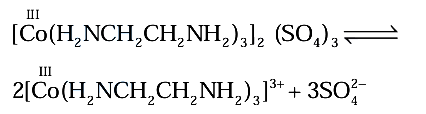
\(\begin{aligned} & \therefore \text { Primary valency }=3 \\ & \therefore \mathrm{x}+\mathrm{y}=5\end{aligned}\) -
- (A) Acidic
- (B) Neutral
- (C) Basic
- (D) Amphoteric
Show answer and solution
Correct Answer: (D)
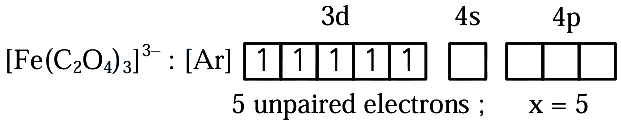
Explanation:
1. Identifying the Most Stable Complex: Among the given coordination complexes, \( \text{[Fe(C}_2\text{O}_4\text{)}_3\text{]}^{3-} \) is the most stable due to the chelation effect. The oxalate ion (\( \text{C}_2\text{O}_4^{2-} \)) is a bidentate ligand that binds to the central metal ion at two sites, forming three stable five-membered rings. Chelated complexes are significantly more stable than similar non-chelated complexes containing monodentate ligands.
2. Finding the Value of X: In the most stable complex \( \text{[Fe(C}_2\text{O}_4\text{)}_3\text{]}^{3-} \), the oxidation state of iron (\( \text{Fe} \)) is \( +3 \).
- Atomic number of \( \text{Fe} = 26 \)
- Ground state configuration of \( \text{Fe} = \text{[Ar] } 3d^6 4s^2 \)
- Configuration of \( \text{Fe}^{3+} = \text{[Ar] } 3d^5 4s^0 \)
Thus, the total number of electrons present in the \( d \)-orbitals of the central metal ion is \( X = 5 \).
3. Determining the Nature of the Oxide: Substituting \( X = 5 \) into the general oxide formula \( \text{V}_2\text{O}_X \) gives Vanadium Pentoxide (\( \text{V}_2\text{O}_5 \)). As the oxidation state of a transition metal increases, its oxides shift from basic to amphoteric/acidic characters. \( \text{V}_2\text{O}_5 \) is classically amphoteric because it reacts with both non-oxidizing acids and alkalis to form corresponding salts.
Hence, Option D is the correct choice.
No questions on this page match these filters.