


Questions
9 questionsShowing 1–9 of 9 questions
-
- (A) 10
- (B) 15
- (C) 20
- (D) 25
Show answer and solution
Correct Answer: (B)
Phosphorus belongs to \(15^{\text {th }}\) group and forms \(\mathrm{d} \pi-\mathrm{d} \pi\) bond with transition metal and \(\mathrm{PH}_3\) is strongest base among the other group members except \(\mathrm{NH}_3\). -
- (A) Statement I is true but Statement II is false
- (B) Both Statement I and Statement II are false
- (C) Statement I is false but Statement II is true
- (D) Both Statement I and Statement II are true
Show answer and solution
Correct Answer: (D)
In oxide of nitrogen it can achieve +5 oxidation state because it can form \(\mathrm{p} \pi-\mathrm{p} \pi\) bond with oxygen e.g. \(\mathrm{N}_2 \mathrm{O}_5\)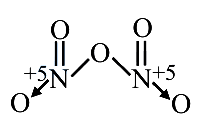
Nitrogen cannot form halide in +5 oxidation state because it does not contain d-orbital.
e.g. \(\mathrm{NX}_5\) does not exist
\(\mathrm{X}=\text { halide }\) -
- (A) Statement I is true but statement II is false
- (B) Both statement I and statement II are false
- (C) Statement I is false but statement II is true
- (D) Both statement I and statement II are true
Show answer and solution
Correct Answer: (B)
\(\ddot{\mathrm{N}}-\ddot{\mathrm{N}}\) single bond weaker than \(\ddot{\mathrm{P}}-\ddot{\mathrm{P}}\) due to more \(\ell \mathrm{p}-\ell \mathrm{p}\) repulsion.
Bond length \(\Rightarrow d_{p-p} \gt d_{N-N}(\operatorname{size} \uparrow\), B.L. \(\uparrow)\)
In group 15 elements only N & P show disproportionation in +3 oxidation state, As, Sb & Bi have almost inert for disproportionation in +3 oxidation state.
So both statements are false. -
- (A) A-IV, B-I, C-II, D-III
- (B) A-IV, B-III, C-I, D-II
- (C) A-III, B-I, C-IV, D-II
- (D) A-II, B-III, C-IV, D-I
Show answer and solution
Correct Answer: (B)
(A) Pnictogen \(\Rightarrow\) Mc (Moscovium),
Atomic No. \(=115\)
(B) Chalcogen \(\Rightarrow \mathrm{Lv}\) (Livermorium),
Atomic No. \(=116\)
(C) Halogen \(\Rightarrow \mathrm{Ts}\) (Tennessine),
Atomic No. \(=117\)
(D) Noble gas \(\Rightarrow \mathrm{Og}\) (Oganesson),
Atomic No. \(=118\) -
- (A) \(\mathrm{PH}_3\) shows lower proton affinity than \(\mathrm{NH}_3\).
- (B) \(\mathrm{SO}_2\) can act as an oxidizing agent, but not as a reducing agent.
- (C) \(\mathrm{PF}_3\) exists but \(\mathrm{NF}_5\) does not.
- (D) \(\mathrm{NO}_2\) can dimerise easily.
Show answer and solution
Correct Answer: (B)
\(\stackrel{+4}{\mathrm{SO}_2}\) can acts as both oxidising agent as well reducing agents because due to intermediate oxidation state, it can oxidise and reduce as well. -
- (A) Atomicity
- (B) Electron gain enthalpy
- (C) Electronegativity
- (D) Atomic size
Show answer and solution
Correct Answer: (A)
The large difference in the melting and boiling points of oxygen and sulphur is due to atomicity as oxygen exists as \(\mathrm{O}_2\) and sulphur exists as \(\mathrm{S}_8\). -
- (A) 4
- (B) 6
- (C) 3
- (D) 5
Show answer and solution
Correct Answer: (A)
\(\mathrm{N}-\mathrm{N} < \mathrm{P}-\mathrm{P}\) : single \((\sigma)\) bond strength
Due to L.P.-L.P. replusion and maximum possible covalency of nitrogen is 4 . -
- (A) Oxidising and acidic
- (B) Reducing and basic
- (C) Reducing and acidic
- (D) Oxidising and basic
Show answer and solution
Correct Answer: (A)
\(\mathrm{TeO}_2\) is oxidizing in nature because it can be reduced from +4 oxidation state to lower oxidation state.
\(\mathrm{TeH}_2\) due to less bond dissociation energy easily breaks and hence acidic in nature. -
- (A) B and D only
- (B) A and C only
- (C) B only
- (D) A, B, C and D
Show answer and solution
Correct Answer: (C)
The order of first four elements of group-17 are as follows.
\(\mathrm{F} \lt \mathrm{Cl} \lt \mathrm{Br} \lt \mathrm{I}\) (Covalent radius)
\(\mathrm{Cl} \gt \mathrm{F} \gt \mathrm{Br} \gt \mathrm{I}\) (Electron affinity)
\(\mathrm{F}^{-} \lt \mathrm{Cl}^{-} \lt \mathrm{Br}^{-} \lt \mathrm{I}^{-}\)(Ionic radius)
\(\mathrm{F} \gt \mathrm{Cl} \gt \mathrm{Br} \gt \mathrm{I}\left(\mathrm{I}^{\text {st }}\right.\) ionization energy)
Electron affinity order is irregular.
No questions on this page match these filters.