


Chapters asked in 2024
26 chapters- 25Qs STD 11 Organic chemistry purification and characterization
- 42Qs STD 12 D and f- block elements Most asked
- 16Qs STD 11 Redox reactions
- 18Qs STD 12 Biomolecules
- 10Qs STD 11 Equilibrium - II (icon Equilibrium)
- 21Qs STD 12 Chemical kinetics
- 16Qs STD 11 Organic chemistry reaction mechanism
- 14Qs STD 12 Amines
- 4Qs STD 12 Carboxylic acids and their derivative
- 12Qs STD 12 Aldehydes and ketones
- 12Qs STD 12 Alcohol, phenol and ethers
- 14Qs STD 12 Haloalkanes and Haloarenes
- 10Qs STD 11 Organic chemistry isomerism
- 40Qs STD 12 Co-ordination chemistry Most asked
- 19Qs STD 12 P -Block elements - ll
- 31Qs STD 12 Electrochemistry
- 17Qs STD 12 Solution and colligative properties
- 23Qs STD 11 Some basic concept of chemistry
- 8Qs STD 11 Hydricarbon
- 14Qs STD 11 Organic chemistry Nomenclature of organic compounds
- 34Qs STD 11 Chemical bonding and molecular structure Most asked
- 21Qs STD 11 Classification of elements and periodicity in properties
- 12Qs STD 11 Equilibrium - 1 (chemical Equilibrium)
- 20Qs STD 11 Thermodynamics and thermochemistry
- 17Qs STD 11 P-Block elements - I
- 20Qs STD 11 Structure of atom
All JEE Mains 2024 Chemistry questions
26 chaptersShowing 1–50 of 490 questions
-
- (A) Extraction
- (B) Chromatography
- (C) Distillation
- (D) Sublimation
Show answer and solution
Correct Answer: (B)
Principle used in chromotography is adsorption. -
- (A) \(\mathrm{Br}\)
- (B) \(\mathrm{N}\)
- (C) \(\mathrm{N}\) and \(\mathrm{S}\)
- (D) \(\mathrm{S}\)
Show answer and solution
Correct Answer: (C)
\(\mathrm{Fe}^{2+} \xrightarrow[\text { Conc. } \mathrm{H}_2 \mathrm{SO}_4]{\mathrm{H}^{+}} \mathrm{Fe}^{+3}\)\(\mathrm{Fe}^{+3} \xrightarrow{-\mathrm{SCN}} \mathrm{Fe}(\mathrm{SCN})_3(\) blood red colour \()\)
Appearance of blood red colour indicates presence of both nitrogen and sulphur.
-
- (A) \(B\) only
- (B) \(A\) only
- (C) \(A\) & \(B\) only
- (D) \(C\) only
Show answer and solution
Correct Answer: (C)
Memory Based -
- (A) \(50\)
- (B) \(56\)
- (C) \(70\)
- (D) \(80\)
Show answer and solution
Correct Answer: (B)
\(\mathrm{H}_2 \mathrm{SO}_4+2 \mathrm{NH}_3 \rightarrow\left(\mathrm{NH}_4\right)_2 \mathrm{SO}_4\)Millimole of \(\mathrm{H}_2 \mathrm{SO}_4 \rightarrow 10 \times 2\)
So Millimole of \(\mathrm{NH}_3=20 \times 2=40\)
Organic \(\rightarrow\) \(\mathrm{NH}_3\)
Compound 40 Millimole
\(\therefore\) Mole of \(\mathrm{N}=\frac{40}{1000}\)
wt. of \(\mathrm{N}=\frac{40}{1000} \times 14\)
\(\%\) composition of \(\mathrm{N}\) in organic compound
\(=\frac{40 \times 14}{1000 \times 1} \times 100\)
\(=56 \%\)
-
- (A) Both Statement \(I\) and Statement \(II\) is false
- (B) Statement \(I\) is false but Statement \(II\) is true
- (C) Both Statement \(I\) and Statement \(II\) is true
- (D) Statement \(I\) is true but Statement \(II\) is false
Show answer and solution
Correct Answer: (A)
Nitrogen present in pyridine can not be estimated by Kjeldahl method as the nitrogen present in pyridine can not be easily converted into ammonium sulphate. -
- (A) Reducing agent
- (B) Catalytic agent
- (C) Hydrolysis agent
- (D) Oxidising agent
Show answer and solution
Correct Answer: (B)
Kjeldahl's method is used for estimation of \(\mathrm{N}_1\) trogen where \(\mathrm{CuSO}_4\) acts as a catalyst. -
- (A) \(Na _3 PO _4 \cdot 12 MoO _3\)
- (B) \(\left( NH _4\right)_3 PO _4 \cdot 12 MoO _3\)
- (C) \(MoPO _4 \cdot 21 NH _4 NO _3\)
- (D) \(\left( NH _4\right)_3 PO _4 \cdot 12\left( NH _4\right)_2 MoO _4\)
Show answer and solution
Correct Answer: (B)
\(2 P +3 Na _2 O _2+\underset{\text { air }}{ O _2} \xrightarrow{\text { fusion }} 2 Na _3 PO _4\)
\(Na _3 PO _4+12\left( NH _4\right)_3 MoO _4+21 HNO _3 \rightarrow\) \(\left( NH _4\right)_3 PO _4 \cdot \underset{\text { yellow }}{12 MoO _3}+21 NH _4 NO _3+12 H _2 O\) -
- (A) 15
- (B) 20
- (C) 25
- (D) 30
Show answer and solution
Correct Answer: (A)
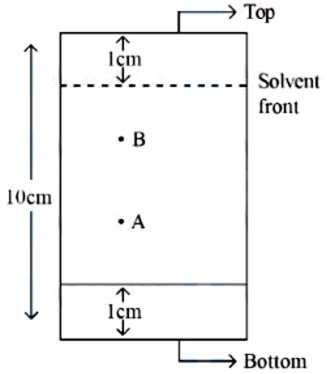
\(\begin{array}{l}R_{f_A}=\frac{\text { distance traveled by substance from base line }}{\text { distance traveled by Solvent from base line }} \\ R_{f_A}=\frac{4}{8} R_{f_B}=\frac{6}{8} \\ \frac{R_{f_B}}{R_{f_A}}=\frac{6}{8} \times \frac{8}{4} \\ R_{f_B}=1.5 \times R_{f_A} \\ x =15\end{array}\) -
- (A) Nitrogen and Sulphur only
- (B) Nitrogen, Sulphur and Phosphorous Only
- (C) Phosphorous and halogens only
- (D) Nitrogen, Sulphur, phosphorous and halogens
Show answer and solution
Correct Answer: (D)
Lassaigne's test is used for detection of all element \(\mathrm{N}, \mathrm{S}, \mathrm{P}, \mathrm{X}\). -
- (A) \(A-III, B-I, C-II, D-IV\)
- (B) \(A-IV, B-I, C-II, D-III\)
- (C) \(A-II, B-III, C-IV, D-I\)
- (D) \(A-I, B-II, C-III, D-IV\)
Show answer and solution
Correct Answer: (A)
\(\mathrm{Fe}_4\left[\mathrm{Fe}(\mathrm{CN})_6\right]_3 \cdot \mathrm{xH}_2 \mathrm{O} \rightarrow \text { Prussian Blue }\)\({\left[\mathrm{Fe}(\mathrm{CN})_5 \mathrm{NOS}\right]^{4-} \rightarrow \text { Violet }}\)
\({[\mathrm{Fe}(\mathrm{SCN})]^{2+} \rightarrow \text { Blood Red }}\)
\(\left(\mathrm{NH}_4\right)_3 \mathrm{PO}_4 \cdot 12 \mathrm{MoO}_3 \rightarrow \text { Yellow }\)
-
- (A) \(A-IV, B-I, C-II, D-III\)
- (B) \(A-IV, B-III, C-II. D-I\)
- (C) \(A-I. B-II, C-IV, D-III\)
- (D) \(A-II, B-III. C-I, D-IV\)
Show answer and solution
Correct Answer: (B)
Fact \((NCERT)\) -
- (A) (A)-(IV), (B)-(III), (C)-(I), (D)-(II)
- (B) (A)-(II), (B)-(III), (C)-(IV), (D)-(I)
- (C) (A)-(IV), (B)-(I), (C)-(II), (D)-(III)
- (D) (A)-(III), (B)-(I), (C)-(IV), (D)-(II)
Show answer and solution
Correct Answer: (A)
(A)-(IV), (B)-(III), (C)-(I), (D)-(II) -
- (A) A-III, B-IV, C-I, D-II
- (B) A-I, B-II, C-III, D-IV
- (C) A-IV, B-I, C-II, D-III
- (D) A-II, B-III, C-IV, D-I
Show answer and solution
Correct Answer: (D)
A-II, B-III, C-IV, D-I -
- (A) neither on nature of compound nor on the impurity present.
- (B) nature of compound only.
- (C) nature of compound and presence of impurity.
- (D) presence of impurity only.
Show answer and solution
Correct Answer: (C)
Organic compounds are purified based on their nature and impruity present in it. -
- (A) \(06\)
- (B) \(07\)
- (C) \(8\)
- (D) \(5\)
Show answer and solution
Correct Answer: (B)
Retardation factor \(=\frac{\text { Distance travelled by sample/organic compound }}{\text { Distance travelled by solvent }}\) \(=\frac{3.5}{5}=7 \times 10^{-1}\) -
- (A) \(B\) only
- (B) \(C\) and \(D\) only
- (C) \(A\) and \(B\) only
- (D) \(A\) only
Show answer and solution
Correct Answer: (C)
The most common polar and acidic support used is adsorption chromatography is silica. The surface silanol groups on their supported to adsorb polar compound and work particularly well for basic substances. Alumina is the example of polar and basic adsorbent that is used in adsorption chromatography. -
- (A) ammonium sulphide
- (B) lead sulphate
- (C) lead iodide
- (D) ammonium arsinomolybdate
Show answer and solution
Correct Answer: (B)
Lead sulphate - white
Ammonium sulphide -soluble
Lead iodide - Bright yellow
Ammonium arsinomolybdate - yellow - 18. The correct statements among the following for a ' chromatography ' purification method is _______. 2024 Medium
- (A) Organic compounds run faster than solvent in the thin layer chromatographic plate.
- (B) Non-polar compounds are retained at top and polar compounds come down in column chromatography.
- (C) \(R_f\) of a polar compound is smaller than that of a non-polar compound.
- (D) \(R_f\) is an integral value.
Show answer and solution
Correct Answer: (C)
Non polar compounds are having higher value of \(R_f\) than polar compound. -
- (A) crystallisation
- (B) distillation under reduced pressure
- (C) distillation
- (D) steam distillation
Show answer and solution
Correct Answer: (D)
Steam distillation technique is applied to separate substances which are steam volatile and are immiscible with water. - 20. The Lassiagne's extract is boiled with dil \(\mathrm{HNO}_3\) before testing for halogens because, 2024 Hard
- (A) \(\mathrm{AgCN}\) is soluble in \(\mathrm{HNO}_3\)
- (B) Silver halides are soluble in \(\mathrm{HNO}_3\)
- (C) \(\mathrm{Ag}_2 \mathrm{~S}\) is soluble in \(\mathrm{HNO}_3\)
- (D) \(\mathrm{Na}_2 \mathrm{~S}\) and \(\mathrm{NaCN}\) are decomposed by \(\mathrm{HNO}_3\)
Show answer and solution
Correct Answer: (D)
If nitrogen or sulphur is also present in the compound, the sodium fusion extract is first boiled with concentrated nitric acid to decompose cyanide or sulphide of sodium during Lassaigne's test. -
- (A) Fractional distillation
- (B) Fractional distillation under reduced pressure
- (C) Distillation
- (D) Steam distillation
Show answer and solution
Correct Answer: (D)
Steam distillation is used for those liquids which are insoluble in water, containing non-volatile impurities and are steam volatile. -
- (A) \(50\)
- (B) \(40\)
- (C) \(30\)
- (D) \(20\)
Show answer and solution
Correct Answer: (A)
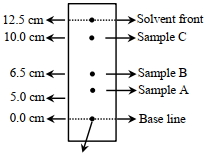
\(R_r \text { of } A=\frac{5}{12.5} \quad R_r \text { of } C=\frac{10}{12.5}\)\(\text { Ratio }=\frac{R_{f(A)}}{R_{f(C)}}=\frac{1}{2}=0.5 \text { or } 50 \times 10^{-2}\)
- 23. Which among the following purification methods is based on the principle of "Solubility" in two different solvents? 2024 Hard
- (A) Column Chromatography
- (B) Sublimation
- (C) Distillation
- (D) Differential Extraction
Show answer and solution
Correct Answer: (D)
Different ExtractionDifferent layers are formed which can be separated in funnel. (Theory based).
- 24. Which of the following nitrogen containing compound does not give Lassaigne's test ? 2024 Medium
- (A) Phenyl hydrazine
- (B) Glycene
- (C) Urea
- (D) Hydrazine
Show answer and solution
Correct Answer: (D)
Hydrazine \(\left(\mathrm{NH}_2-\mathrm{NH}_2\right)\) have no carbon so does not show Lassaigne's test. -
- (A) \(A, B, C\) only
- (B) \(A, C, D\) only
- (C) \(B, C, D\) only
- (D) \(A, B, D\) only
Show answer and solution
Correct Answer: (B)
Option \((B)\) is incorrect because aniline is immisible in water. -
- (A) \(\mathrm{A}=\mathrm{Na}_2 \mathrm{CrO}_4, \mathrm{~B}=\mathrm{CrO}_5\)
- (B) \(\mathrm{A}=\mathrm{Na}_2 \mathrm{Cr}_2 \mathrm{O}_4, \mathrm{~B}=\mathrm{CrO}_4\)
- (C) \(\mathrm{A}=\mathrm{Na}_2 \mathrm{Cr}_2 \mathrm{O}_7, \mathrm{~B}=\mathrm{CrO}_3\)
- (D) \(\mathrm{A}=\mathrm{Na}_2 \mathrm{Cr}_2 \mathrm{O}_7,\mathrm{~B}=\mathrm{CrO}_5\)
Show answer and solution
Correct Answer: (A)
\(\mathrm{CrO}_2 \mathrm{Cl}_2+4 \mathrm{NaOH} \rightarrow \underset{\text { (A) }}{\mathrm{Na}_2 \mathrm{CrO}_4}+\underset{\text { (B) }}{2 \mathrm{NaCl}}+2 \mathrm{H}_2 \mathrm{O}\)\(\mathrm{Na}_2 \mathrm{CrO}_4+2 \mathrm{H}_2 \mathrm{O}_2+2 \mathrm{HCl} \rightarrow \underset{\begin{array}{l}\text { Missing from }\text { balanced eqaution }\end{array}}{2 \mathrm{NaCl}}+3 \mathrm{H}_2 \mathrm{O}\)
-
- (A) \(25\)
- (B) \(26\)
- (C) \(22\)
- (D) \(23\)
Show answer and solution
Correct Answer: (D)
\({ }_{22} \mathrm{Ti}^{+2} \Rightarrow[\mathrm{Ar}] 3 \mathrm{~d}^2\)\({ }_{23} \mathrm{~V}^{-2} \Rightarrow[\mathrm{Ar}] 3 \mathrm{~d}^3\)
\({ }_{25} \mathrm{Mn}^{+2} \Rightarrow[\mathrm{Ar}] 3 \mathrm{~d}^5\)
\({ }_{26} \mathrm{Fe}^{+2} \Rightarrow[\mathrm{Ar}] 3 \mathrm{~d}^0\)
-
- (A) \(1\)
- (B) \(2\)
- (C) \(3\)
- (D) \(0\)
Show answer and solution
Correct Answer: (D)
\(\mathrm{V}\) ' has highest enthalpy of atomisation ( \(515 \mathrm{~kJ} / \mathrm{mol}\) ) among first row transition elements.\(\mathrm{V}_2 \mathrm{O}_5\)
Here ' \(\mathrm{V}\) ' is in \(+5\) oxidation state
\(\mathrm{V}^{-5} \Rightarrow 1 \mathrm{~s}^2 2 \mathrm{~s}^2 2 \mathrm{p}^6 3 \mathrm{~s}^2 3 \mathrm{p}^6 \text { (no unpaired electrons) }\)
-
- (A) \(5\)
- (B) \(6\)
- (C) \(9\)
- (D) \(10\)
Show answer and solution
Correct Answer: (B)
Among given metals, \(\mathrm{Cr}\) has maximum \(\mathrm{IE}_2\)because Second electron is removed from stable
configuration \(3 \mathrm{~d}^5\)
\(\mathrm{Cr}^{+}:[\mathrm{Ar}] 3 \mathrm{~d}^5 4 \mathrm{~s}^0\)
\(\therefore\) No of unpaired \(\mathrm{e}^{-}\)in \(\mathrm{Cr}^{+}\)is \(5, \mathrm{n}=5\)
\(\text { So, Magnetic moment } =\sqrt{\mathrm{n}(\mathrm{n}+2)} \text { B.M }\)
\(=\sqrt{5(5+2)}=5.92 \mathrm{BM} \approx 6\)
-
- (A) \(\mathrm{Mn}_2 \mathrm{O}_7\) and \(\mathrm{MnO}_4^{-}\)
- (B) \(\mathrm{MnO}_4{ }^{2-}\) and \(\mathrm{MnO}_4^{-}\)
- (C) \(\mathrm{Mn}_2 \mathrm{O}_3\) and \(\mathrm{MnO}_4{ }^{2-}\)
- (D) \(\mathrm{MnO}_4{ }^{2-}\) and \(\mathrm{Mn}_2 \mathrm{O}_7\)
Show answer and solution
Correct Answer: (B)
Alkaline oxidative fusion of \(\mathrm{MnO}_2\) :\(2\mathrm{MnO}_2+4 \mathrm{OH}^{-}+\mathrm{O}_2 \rightarrow 2 \mathrm{MnO}_4^{2-}+2 \mathrm{H}_2 \mathrm{O}\)
Electrolytic oxidation of \(\mathrm{MnO}_4^{2-}\) in alkaline medium.
\(\mathrm{MnO}_4^{2-} \rightarrow \mathrm{MnO}_4^{-}+e^{-}\)
-
- (A) \(877\)
- (B) \(879\)
- (C) \(880\)
- (D) \(881\)
Show answer and solution
Correct Answer: (A)
CrO Basic oxide\(\mathrm{Cr}_2 \mathrm{O}_3\) Amphoteric oxide
In \(\mathrm{CrO}, \mathrm{Cr}\) exist as \(\mathrm{Cr}^{+2}\) and have \(\mu\) only \(=4.90\)
In \(\mathrm{Cr}_2 \mathrm{O}_3, \mathrm{Cr}\) exist as \(\mathrm{Cr}^{+3}\) and have \(\mu\) only \(=3.87\)
Sum of spin only magnetic moment
\(=4.90+3.87=8.77\)
\(\mu_{\text {only }}=877 \times 10^{-2}\)
Ans. \(877\)
-
- (A) \(1\)
- (B) \(0\)
- (C) \(5\)
- (D) \(8\)
Show answer and solution
Correct Answer: (B)
For \(3\)d transition series;Oxidising power : \(\mathrm{V}^{+5}<\mathrm{Cr}^{+6}<\mathrm{Mn}^{+7}\)
\(\mathrm{V}^{-5}:[\mathrm{Ar}] 4 \mathrm{~s}^0 3 \mathrm{~d}^0\)
Number of unpaired electron \(=0\)
\(u=0\)
-
- (A) \((C) < (E) < (B) < (A) < (D)\)
- (B) \((B) < (C) < (D) < (E) < (A)\)
- (C) \((A) < (D) < (C) < (B) < (E)\)
- (D) \(( A ) < (D) < (C) < (E) < (B)\)
Show answer and solution
Correct Answer: (D)
Unpaired electron\(\operatorname{Sc}[\mathrm{Ar}] 4 \mathrm{~s}^2 3 \mathrm{~d}^1 \ \ 1\)
\(\mathrm{Cr}[\mathrm{Ar}] 4 \mathrm{~s}^1 3 \mathrm{~d}^5 \ \ 6\)
\(\mathrm{~V}[\mathrm{Ar}] 4 \mathrm{~s}^2 3 \mathrm{~d}^3 \ \ 3\)
\(\mathrm{~T}[\mathrm{Ar}] 4 \mathrm{~s}^2 3 \mathrm{~d}^2 \ \ 2\)
\(\mathrm{Mn}[\mathrm{Ar}] 4 \mathrm{~s}^2 3 \mathrm{~d}^5 \ \ 5\)
- 34. Choose the correct option having all the elements with \(\mathrm{d}^{10}\) electronic configuration from the following: 2024 Hard
- (A) \({ }^{27} \mathrm{Co},{ }^{28} \mathrm{Ni},{ }^{26} \mathrm{Fe},{ }^{24} \mathrm{Cr}\)
- (B) \({ }^{29} \mathrm{Cu},{ }^{30} \mathrm{Zn},{ }^{48} \mathrm{Cd},{ }^{47} \mathrm{Ag}\)
- (C) \({ }^{46} \mathrm{Pd},{ }^{28} \mathrm{Ni},{ }^{26} \mathrm{Fe},{ }^{24} \mathrm{Cr}\)
- (D) \({ }^{28} \mathrm{Ni},{ }^{24} \mathrm{Cr},{ }^{26} \mathrm{Fe},{ }^{29} \mathrm{Cu}\)
Show answer and solution
Correct Answer: (B)
\( {[\mathrm{Cr}]=[\mathrm{Ar}] 4 \mathrm{~s}^1 3 \mathrm{~d}^5} \)\( {[\mathrm{Cd}]=[\mathrm{Kr}] 5 \mathrm{~s}^2 4 \mathrm{~d}^{10}} \)
\( {[\mathrm{Cu}]=[\mathrm{Ar}] 4 \mathrm{~s}^1 3 \mathrm{~d}^{10}} \)
\( {[\mathrm{Ag}]=[\mathrm{Kr}] 5 \mathrm{~s}^1 4 \mathrm{~d}^{10}} \)
\( {[\mathrm{Zn}]=[\mathrm{Ar}] 4 \mathrm{~s}^2 3 \mathrm{~d}^{10}}\)
-
- (A) \(A\), \(B\) and \(D\) only
- (B) \(A\) and \(C\) only
- (C) \(A\), \(B\) and \(C\) only
- (D) \(B\) and \(C\) only
Show answer and solution
Correct Answer: (B)
\((A)\) \(\mathrm{Mn}_2 \mathrm{O}_7\) is green oil at room temperature.\((B)\) \(\mathrm{V}_2 \mathrm{O}_4\) dissolve in acids to give \(\mathrm{VO}^{2+}\) salts.
\((C)\) \(\mathrm{CrO}\) is basic oxide
\((D)\) \(\mathrm{V}_2 \mathrm{O}_5\) is amphoteric it reacts with acid as well as base.
-
- (A) \(3\)
- (B) \(4\)
- (C) \(5\)
- (D) \(7\)
Show answer and solution
Correct Answer: (B)
\(\mathrm{MnO}_2+\mathrm{KOH}+\mathrm{O}_2 \rightarrow \mathrm{K}_2 \mathrm{MnO}_4+\mathrm{H}_2 \mathrm{O}\)\((A)\)
\({K}_2 \mathrm{MnO}_4 \xrightarrow{\text { Neutral/acidic solution }} \mathrm{KMnO}_4+\mathrm{MnO}_2\)
\(\mathrm{Mn}^{+4}:-[\mathrm{Ar}] 3 \mathrm{~d}^3\)
\(\mathrm{n}=3, \mu=\sqrt{3(3+2)}=3.87 \text { B.M. }\)
Nearest integer is (4)
-
- (A) \(\mathrm{Nd}^{3+}\) and \(\mathrm{Eu}^{3+}\)
- (B) \(\mathrm{La}^{3+}\) and \(\mathrm{Ce}^{4+}\)
- (C) \(\mathrm{Nd}^{3+}\) and \(\mathrm{Ce}^{4+}\)
- (D) \(\mathrm{Lu}^{3+}\) and \(\mathrm{Eu}^{3+}\)
Show answer and solution
Correct Answer: (B)
\(\mathrm{Ce}:[\mathrm{Xe}] 4 \mathrm{f}^1 5 \mathrm{~d}^1 6 \mathrm{~s}^2 ; \mathrm{Ce}^{4+}\) diamagnetic\(\mathrm{La}:[\mathrm{Xe}] 4 \mathrm{f}^0 5 \mathrm{~d}^1 6 \mathrm{~s}^2 ; \mathrm{La}^{3+}\) diamagnetic
-
- (A) Both \((A)\) and \((R)\) are true and \((R)\) is the correct explanation of \((A)\)
- (B) Both \((A)\) and \((R)\) are true but \((R)\) is not the correct explanation of \((A)\)
- (C) \((A)\) is false but \((R)\) is true
- (D) \((A)\) is true but \((R)\) is false
Show answer and solution
Correct Answer: (A)
\(\mathrm{Cr}^{2+}\) is reducing as it configuration changes from \(\mathrm{d}^4\) to \(\mathrm{d}^3\) due to formation of \(\mathrm{Cr}^{3+}\), which has half filled \(\mathrm{t}_{2 \mathrm{g}}\) level, on other hand, the change \(\mathrm{Mn}^{3+}\) to \(\mathrm{Mn}^{2+}\) result half filled \(d^3\) configuration which has extra stability. -
- (A) Both Statement \(I\) and Statement \(II\) is true
- (B) Both Statement \(I\) and Statement \(II\) is false
- (C) Statement \(I\) is true but Statement \(II\) is false
- (D) Statement \(I\) is false but Statement \(II\) is true
Show answer and solution
Correct Answer: (A)
\(\mathrm{MnO}_2+4 \mathrm{KOH}+\mathrm{O}_2 \xrightarrow{\text { fused }} 2 \mathrm{~K}_2 \mathrm{MnO}_4+2 \mathrm{H}_2 \mathrm{O}\)Dark green
Electrolytic oxidation in alkaline medium :
At anode :
\(\mathrm{MnO}_4^{2-} \rightarrow \mathrm{MnO}_4^{-}+\mathrm{e}^{-}\)
-
- (A) Statement \(I\) is false but Statement \(II\) is true
- (B) Both Statement \(I\) and Statement \(II\) are true
- (C) Statement \(I\) is true but Statement \(II\) is false
- (D) Both Statement \(I\) and Statement \(II\) are false
Show answer and solution
Correct Answer: (B)
Statement \((1)\) is true, \(\mathrm{Ce}^{+4}\) has noble gas electronic configuration.Statement \((2)\) is also true due to high reduction potential for \(\mathrm{Ce}^{4+} / \mathrm{Ce}^{3+}(+1.74 \mathrm{~V})\), and stability of \(\mathrm{Ce}^{3+}, \mathrm{Ce}^{4+}\) acts as strong oxidizing agent.
-
- (A) Both Statement \(I\) and Statement \(II\) are false
- (B) Statement \(I\) is false but Statement \(II\) is true
- (C) Both Statement \(I\) and Statement \(II\) are true
- (D) Statement \(I\) is true but Statement \(II\) is false
Show answer and solution
Correct Answer: (C)
On moving down the group in transition elements, stability of higher oxidation state increases, due to increase in effective nuclear charge.\( \Rightarrow \mathrm{E}_{\mathrm{Cu}^{+2} / \mathrm{Cu}}^{\circ}=0.34 \mathrm{~V} \)
\( \Rightarrow \mathrm{E}_{\mathrm{H}^{+} / \mathrm{H}_2}^{\circ}=0 \)
\( \mathrm{SRP}: \mathrm{Cu}^{2+}>\mathrm{H}^{+}\)
\(\mathrm{Cu}\) can't liberate hydrogen gas from weak acid.
-
- (A) \(B, C, D\) only
- (B) \(A, D, E\) only
- (C) \(A, B, C\) only
- (D) \(B, D, E\) only
Show answer and solution
Correct Answer: (D)
\(A\). \(\mathrm{CrO}_4{ }^{2-}\) is tetrahedral\(B\). \(2 \mathrm{Na}_2 \mathrm{CrO}_4+2 \mathrm{H}^{+} \rightarrow \mathrm{Na}_2 \mathrm{Cr}_2 \mathrm{O}_{/}+2 \mathrm{Na}^{+}+\mathrm{H}_2 \mathrm{O}\)
\(C\). As per \(NCERT\), green manganate is paramagnetic with \(1\) unpaired electron.
\(D\). Statement is correct.
\(E\). Statement is correct.
-
- (A) 2
- (B) 4
- (C) 6
- (D) 8
Show answer and solution
Correct Answer: (C)
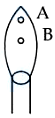
\(Fe ^{+3}\) will give green coloured bead when heated at point \(B\).
Number of unpaired \(e^{-}\)in \(Fe ^{+3}=5\)
\(\mu=5.92\)
Nearest integer = 6 -
- (A) \(\mathrm{IO}_4^{-}\)
- (B) \(\mathrm{IO}^{-}\)
- (C) \(\mathrm{I}_2\)
- (D) \(\mathrm{IO}_3^{-}\)
Show answer and solution
Correct Answer: (D)
\(2 \mathrm{MnO}_4^{-}+\mathrm{H}_2 \mathrm{O}+\mathrm{I}^{-} \xrightarrow{\text { allcaline medium }} 2 \mathrm{MnO}_2+2 \mathrm{OH}^{-}+\mathrm{IO}_3^{-}\) -
- (A) \(4\)
- (B) \(6\)
- (C) \(8\)
- (D) \(10\)
Show answer and solution
Correct Answer: (B)
\(\mathrm{K}_2 \mathrm{Cr}_2 \mathrm{O}_7(\mathrm{~s})+4 \mathrm{KCl}(\mathrm{s})+6 \mathrm{H}_2 \mathrm{SO}_4 \text { (conc.) }\)\(\rightarrow 2 \mathrm{CrO}_2 \mathrm{Cl}_2(\mathrm{~g})+6 \mathrm{KHSO}_4+3 \mathrm{H}_2 \mathrm{O}\)
This reaction is called chromyl chloride test. Here oxidation state of \(\mathrm{Cr}\) is +6 .
- 46. \(\mathrm{KMnO}_4\) decomposes on heating at \(513 \mathrm{~K}\) to form \(\mathrm{O}_2\) along with _______. 2024 Hard
- (A) \(\mathrm{MnO}_2 \& \mathrm{~K}_2 \mathrm{O}_2\)
- (B) \(\mathrm{K}_2 \mathrm{MnO}_4 \& \mathrm{Mn}\)
- (C) \(\mathrm{Mn} \& \mathrm{KO}_2\)
- (D) \(\mathrm{K}_2 \mathrm{MnO}_4 \& \mathrm{MnO}_2\)
Show answer and solution
Correct Answer: (D)
\(\mathrm{KMnO}_4 \xrightarrow{\Delta} \mathrm{K}_2 \mathrm{MnO}_4+\mathrm{MnO}_2+\mathrm{O}_2\) -
- (A) A-III, B-II, C-IV, D-I
- (B) A-III, B-IV, C-I, D-II
- (C) A-III, B-I, C-II, D-IV
- (D) A-III, B-I, C-IV, D-II
Show answer and solution
Correct Answer: (B)
(A-III, B-IV, C-I, D-II) -
- (A) \( (A)-I, (B)-II, (C)-III, (D)-IV\)
- (B) \( (A)-III, (B) - IV, (C) - I, (D)-II\)
- (C) \( (A)-IV, (B)-III, (C)-I, (D)-II\)
- (D) \((A)-II, (B)-I, (C)-IV, (D)-III\)
Show answer and solution
Correct Answer: (B)
\({24} \mathrm{Cr} \rightarrow[\mathrm{Ar}] 3 \mathrm{~d}^5 4 \mathrm{~s}^1 ; \mathrm{Cr}^{2+} \rightarrow[\mathrm{Ar}] 3 \mathrm{~d}^4\)\({25} \mathrm{Mn} \rightarrow\lfloor\mathrm{Ar}\rfloor 3 \mathrm{~d}^5 4 \mathrm{~s}^2 ; \mathrm{Mn}^{+} \rightarrow\lfloor\mathrm{Ar}\rfloor 3 \mathrm{~d}^5 4 \mathrm{~s}^1\)
\({28} \mathrm{Ni} \rightarrow[\mathrm{Ar}] 3 \mathrm{~d}^8 4 \mathrm{~s}^2 ; \mathrm{Ni}^{2+} \rightarrow[\mathrm{Ar}] 3 \mathrm{~d}^8\)
\({23} \mathrm{~V} \rightarrow[\mathrm{Ar}] 3 \mathrm{~d}^5 4 \mathrm{~s}^2 ; \mathrm{V}^{+} \rightarrow[\mathrm{Ar}] 3 \mathrm{~d}^3 4 \mathrm{~s}^1\)
-
- (A) \(\mathrm{CrO}_2 \mathrm{Cl}_2, \mathrm{Na}_2 \mathrm{CrO}_4\)
- (B) \(\mathrm{Na}_2 \mathrm{CrO}_4, \mathrm{CrO}_2 \mathrm{Cl}_2\)
- (C) \(\mathrm{CrO}_2 \mathrm{Cl}_2, \mathrm{KHSO}_4\)
- (D) \(\mathrm{CrO}_2 \mathrm{Cl}_2, \mathrm{Na}_2 \mathrm{Cr}_2 \mathrm{O}_7\)
Show answer and solution
Correct Answer: (A)
\( \mathrm{NaCl}+\text { conc. } \mathrm{H}_2 \mathrm{SO}_4+\mathrm{K}_2 \mathrm{Cr}_2 \mathrm{O}_7 \)
\( \rightarrow \mathrm{CrO}_2 \mathrm{Cl}_2 [(\text B)\text{ Reddish brown} ]+\mathrm{KHSO}_4+\mathrm{NaHSO}_4+\mathrm{H}_2 \mathrm{O}\)
\(\mathrm{CrO}_2 \mathrm{Cl}_2+\mathrm{NaOH} \rightarrow \mathrm{Na}_2 \mathrm{CrO}_4 [(\text C)\text{ Yellow colour}]+\mathrm{NaCl}+\mathrm{H}_2 \mathrm{O}\) -
- (A) \(1\)
- (B) \(2\)
- (C) \(5\)
- (D) \(8\)
Show answer and solution
Correct Answer: (B)
\(\mathrm{La}^{+3}-[\mathrm{Xe}] 4 \mathrm{f}^0\)\(\mathrm{Nd}^{+3}-[\mathrm{Xe}] 4 \mathrm{f}^3\)
\(\mathrm{Sm}^{+3}-[\mathrm{Xe}] 4 \mathrm{f}^5\)
\(\mathrm{Eu}^{+3}-[\mathrm{Xe}] 4 \mathrm{f}^6\)
\(\mathrm{Lu}^{+3}-[\mathrm{Xe}] 4 \mathrm{f}^{14}\)
\(\mathrm{La}^{+3}\) and \(\mathrm{Lu}^{+3}\) do not show any colour because no unpaired electron is present.
No questions on this page match these filters.
Other years
Frequently asked
How many JEE Mains 2024 Chemistry questions are on ExamBro?
490 questions, each with the correct answer and a full solution.
Which JEE Mains 2024 Chemistry chapter is asked the most?
D and f- block elements, with 42 questions, followed by Co-ordination chemistry with 40.
How difficult are JEE Mains 2024 Chemistry questions?
0% are easy, 53% medium and 46% hard.