


Questions
7 questionsShowing 1–7 of 7 questions
-
- (A) II, IV
- (B) III, II
- (C) I, IV
- (D) II, I
Show answer and solution
Correct Answer: (D)
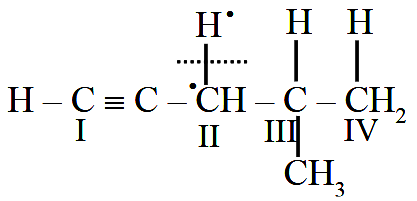
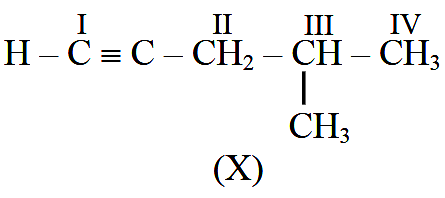
II most stable carbon radical due to resonance stablise
I least stable carbon radical due to no stabilising factor. -
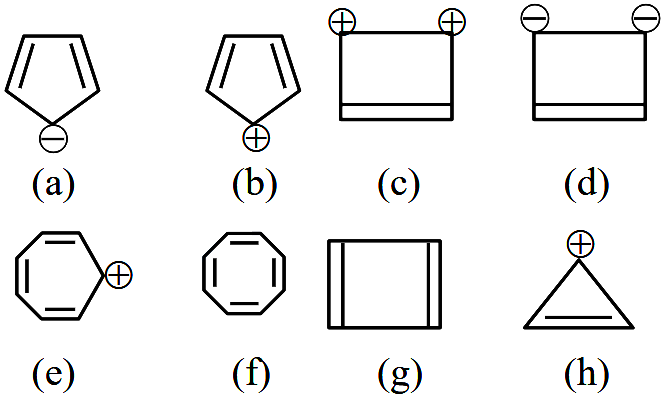
- (A) \(e, g\) aromatic and \(a, b, c, d, f, h\) not aromatic
- (B) \(b, e, f, g\) aromatic and \(a, c, d, h\) not aromatic
- (C) \(a, b, c, d\) aromatic and \(e, f, g, h\) not aromatic
- (D) \(a, c, d, e, h\) aromatic and \(b, f, g\) not aromatic
Show answer and solution
Correct Answer: (D)
Aromatic compounds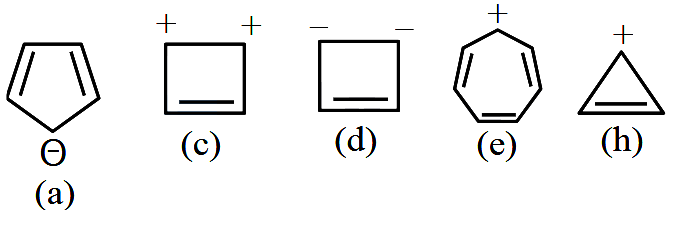
a, c, d, e, h follow Huckel's rule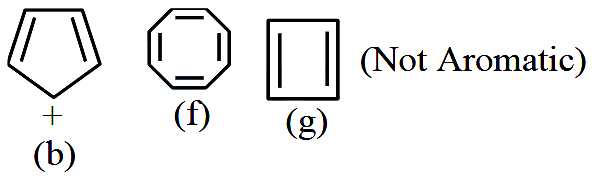
\(b, f, g\), are not aromatic, these compounds do not follow Huckel's rule. -
- (A) Statement I is true but Statement II is false
- (B) Both Statement I and Statement II are false
- (C) Statement I is false but Statement II is true
- (D) Both Statement I and Statement II are true
Show answer and solution
Correct Answer: (C)
Hyper conjugation is permanent effect because external reagent is not required, so Statement-I is false and Statement-II is true. because moore alkyl group, more \(\alpha-H\), so more hyperconjugation which results more stability of carbocation. -
- (A) Statement I is false but Statement II is true
- (B) Both Statement I and Statement II are false
- (C) Statement I is true but Statement II is false
- (D) Both Statement I and Statement II are true
Show answer and solution
Correct Answer: (C)
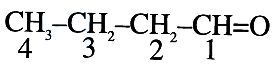
Statement-I :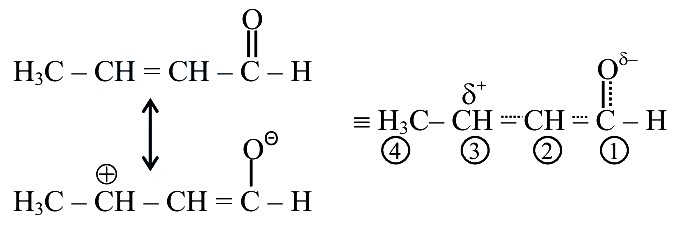
\(\mu=\mathrm{q} \times \mathrm{d}\)
More charges and more distance between charges than other compound so more dipole moment. Statement-I is true.
Statement-II :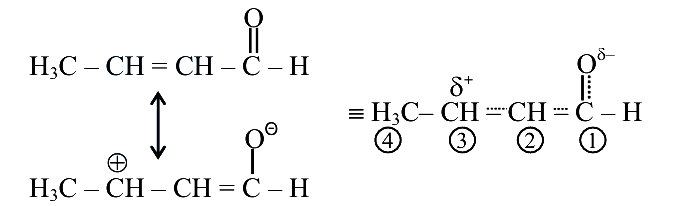
\(\mathrm{C}_1-\mathrm{C}_2\) bond has partial double bond character that means lesser bond length than \(\mathrm{C}_1-\mathrm{C}_2\) bond of other compound. Statement-II is false. -
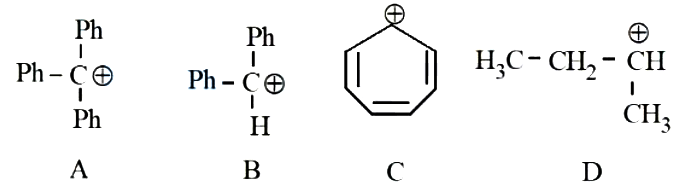
- (A) \(\mathrm{C}\gt\mathrm{B}\gt\mathrm{A}\gt\mathrm{D}\)
- (B) \(\mathrm{A}\gt\mathrm{B}\gt\mathrm{C}\gt\mathrm{D}\)
- (C) \(\mathrm{B}\gt\mathrm{C}\gt\mathrm{A}\gt\mathrm{D}\)
- (D) \(\mathrm{C}\gt\mathrm{A}\gt\mathrm{B}\gt\mathrm{D}\)
Show answer and solution
Correct Answer: (D)
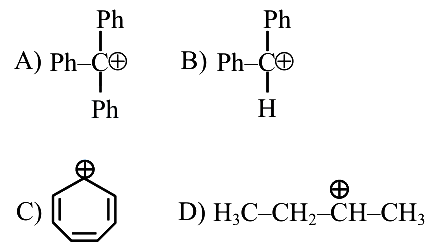
Solution :-
C is aromatic due to \(\oplus \mathrm{ve}\) charge hence it is most stable
A have more resonance structure
B have less resonance structure
D have only hyper conjugation
Consider First Aromaticity \(>\) Resonance \(>\) Hyper conjugation
Ans. D \( < \) B \( < \) A \( < \) C -
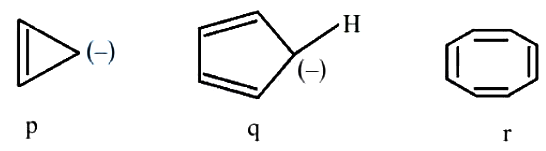
- (A) \(q\gt r\gt p\)
- (B) \(r\gt q\gt p\)
- (C) \(q\gt p\gt r\)
- (D) \(\mathrm{p}\gt\mathrm{q}\gt\mathrm{r}\)
Show answer and solution
Correct Answer: (A)
q is aromatic
r is non-aromatic
p is antiaromatic
\(\mathrm{q}>\mathrm{r}>\mathrm{p}\) (order of stability)
Aromatic > non-aromatic > antiaromatic -
- (A) 7
- (B) 4
- (C) 6
- (D) 5
Show answer and solution
Correct Answer: (D)
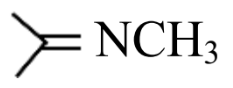
Total five nucleophiles are present
\(\mathrm{NH}_3, \mathrm{PhSH},\left(\mathrm{H}_3 \mathrm{C}\right)_2 \mathrm{~S}, \mathrm{CH}_2=\mathrm{CH}_2, \stackrel{\ominus}{\mathrm{O}} \mathrm{H}\)
No questions on this page match these filters.