


JEE Mains · Chemistry · STD 11 - 8.3. Organic chemistry purification and characterization
When a salt is treated with sodium hydroxide solution it gives gas \(\mathrm{X}\). On passing gas \(\mathrm{X}\) through reagent \(\mathrm{Y}\) a brown coloured precipitate is formed. \(\mathrm{X}\) and \(\mathrm{Y}\) respectively are _______.
- A \(\mathrm{X}=\mathrm{NH}_3\) and \(\mathrm{Y}=\mathrm{HgO}\)
- B \(\mathrm{X}=\mathrm{NH}_3\) and \(\mathrm{Y}=\mathrm{K}_2 \mathrm{HgI}_4+\mathrm{KOH}\)
- C \(\mathrm{X}=\mathrm{NH}_4 \mathrm{Cl}\) and \(\mathrm{Y}=\mathrm{KOH}\)
- D \(\mathrm{X}=\mathrm{HCl}\) and \(\mathrm{Y}=\mathrm{NH}_4 \mathrm{Cl}\)
Answer & Solution
Correct Answer
(B) \(\mathrm{X}=\mathrm{NH}_3\) and \(\mathrm{Y}=\mathrm{K}_2 \mathrm{HgI}_4+\mathrm{KOH}\)
Step-by-step Solution
Detailed explanation
\(\mathrm{NH}_4^{+}+\mathrm{NaOH} \longrightarrow \mathrm{H}_2 \mathrm{O}+\mathrm{NH}_3 \uparrow\) \(\mathrm{NH}_4^{+}+\mathrm{NaOH} \longrightarrow \mathrm{H}_2 \mathrm{O}+\mathrm{NH}_3 \uparrow\) \(\mathrm{NH}_3\) is identify by…
See the Complete Solution
Get step-by-step explanations for this and 2.5 Lakh+ more JEE, NEET & CET questions.
- Unlock all solutions
- Practice the full chapter
- Track accuracy across PYQs
4.8 rated on Google Play · 14,000+ reviews
More questions from Chemistry
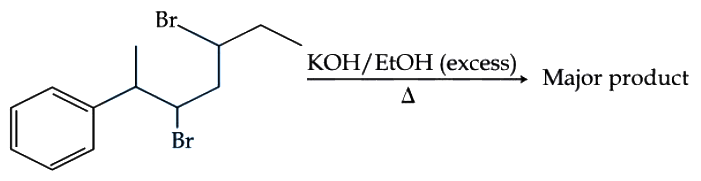
- The major product of the following reaction is _______.
 JEE Mains 2025 Medium
 - The \(INCORRECT\) match in the following isJEE Mains 2019 Medium
- The maximum number of lone pairs of electrons on the central atom from the following species is \(........\). \(ClO _3^{-}, XeF _4, SF _4\) and \(I _3^{-}\)JEE Mains 2023 Medium
- For emission line of atomic hydrogen from \(n_1= 8\) to \(n_f = n\), the plot of wave number \(\left( {\bar v} \right)\) against \(\left( {\frac{1}{{{n^2}}}} \right)\) will be(The Rydberg constant, \(R_H\) is in wave number unit)JEE Mains 2019 Hard
- An optically active alkyl bromide C\(_4\)H\(_9\)Br, reacts with ethanolic KOH to form major compound [A] which reacts with bromine to give compound [B]. Compound [B] reacts with ethanolic KOH and sodamide to give compound [C]. One molecule of water adds to compound [C] on warming with mercuric sulphate and dilute sulphuric acid at \(333\) K to form compound [D]. The functional group in compound D will be confirmed by :JEE Mains 2026 Hard
- Solute \(A\) associates in water. When \(0.7\, g\) of solute \(A\) is dissolved in \(42.0\, g\) of water, it depresses the freezing point by \(0.2^{\circ} C\). The percentage association of solute \(A\) in water, is \(.....\,\%\) [Given : Molar mass of \(A =93\, g\, mol ^{-1}\). Molal depression constant of water is \(1.86\, K \,kg\, mol ^{-1}\) ]JEE Mains 2022 Medium
More PYQs from JEE Mains
- The hybridization and magnetic behaviour of cobalt ion in \(\left[ Co \left( NH _3\right)_6\right]^{3+}\) complex, respectively isJEE Mains 2023 Medium
- There are \(15\) players in a cricket team, out of which \(6\) are bowlers, \(7\) are batsmen and \(2\) are wicketkeepers. The number of ways, a team of \(11\) players be selected from them so as to include at least \(4\) bowlers, \(5\) batsmen and \(1\) wicketkeeper, is \(.....\)JEE Mains 2021 Medium
- \(0.25\, g\) of an organic compound containing chlorine gave \(0.40\, g\) of silver chloride in Carius estimation. The percentage of chlorine present in the compound is \(.....\) [in nearest integer] (Given: Molar mass of \(Ag\) is \(108\, g \,mol ^{-1}\) and that of \(Cl\) is \(35.5 \,g\, mol ^{-1}\) )JEE Mains 2022 Medium
- Let the tangents at two points \(A\) and \(B\) on the circle \(x ^{2}+ y ^{2}-4 x +3=0\) meet at origin \(O (0,0)\). Then the area of the triangle of \(OAB\) is.JEE Mains 2022 Hard
- An object is taken to a height above the surface of earth at a distance \(\frac{5}{4} R\) from the centre of the earth. Where radius of earth, \(R=6400\,km\). The percentage decrease in the weight of the object will be \(....\%\)JEE Mains 2022 Medium
- For some \(n \neq 10\), let the coefficients of the 5 th, 6 th and 7 th terms in the binomial expansion of \((1+\mathrm{x})^{\mathrm{n}+4}\) be in A.P. Then the largest coefficient in the expansion of \((1+\mathrm{x})^{\mathrm{n}+4}\) is:JEE Mains 2025 Medium