


JEE Mains · Chemistry · STD 12 - 4. d and f- block elements
Lanthanoid ions with \(4 f^7\) configuration are :
(A) \(\mathrm{Eu}^{2+}\)
(B) \(\mathrm{Gd}^{3+}\)
(C) \(\mathrm{Eu}^{3+}\)
(D) \(\mathrm{Tb}^{3+}\)
(E) \(\mathrm{Sm}^{2+}\)
Choose the correct answer from the options given below :
- A (A) and (D) only
- B (B) and (C) only
- C (A) and (B) only
- D (B) and (E) only
Answer & Solution
Correct Answer
(C) (A) and (B) only
Step-by-step Solution
Detailed explanation
\begin{aligned} & { }_{63} \mathrm{Eu}^{2+}-[\mathrm{Xe}] 4 \mathrm{f}^7 6 \mathrm{~s}^0 \\ & { }_{64} \mathrm{Gd}^{3+}-[\mathrm{Xe}] 4 \mathrm{f}^7 5 \mathrm{~d}^0 6 \mathrm{~s}^0 \\ & { }_{63} \mathrm{Eu}^{3+}-[\mathrm{Xe}] 4 \mathrm{f}^6 6 \mathrm{~s}^0 \\ & { }_{65}…
See the Complete Solution
Get step-by-step explanations for this and 2.5 Lakh+ more JEE, NEET & CET questions.
- Unlock all solutions
- Practice the full chapter
- Track accuracy across PYQs
4.8 rated on Google Play · 14,000+ reviews
More questions from Chemistry
- On complete combustion \(0.30 \,g\) of an organic compound gave \(0.20\, g\) of carbon dioxide and \(0.10\, g\) of water. The percentage of carbon in the given organic compound is \(.....\) (Nearest Integer)JEE Mains 2022 Medium
- Consider the reaction \(N _{2} O _{4}( g ) \rightleftharpoons 2 NO _{2}( g )\) The temperature at which \(K _{ C }=20.4\) and \(K _{ P }=600.1,\) is ....... \(K\). (Round off to the Nearest Integer). [Assume all gases are ideal and \(R =0.0831\, L\,bar \, K ^{-1} mol ^{-1}]\)JEE Mains 2021 Medium
- The total number of anti bonding molecular orbitals, formed from \(2 \mathrm{s}\) and \(2 \mathrm{p}\) atomic orbitals in a diatomic molecule is _______.JEE Mains 2024 Hard
- Reduction potential of ions are given below:
The correct order of their oxidising power is _______.\(ClO_4^{-}\) \(IO_4^{-}\) \(BrO_4^{-}\) \(E^{\circ}=1.19 V\) \(E^{\circ}=1.65 V\) \(E^{\circ}=1.74 V\) JEE Mains 2024 Hard - Consider the following sequence of reactions.
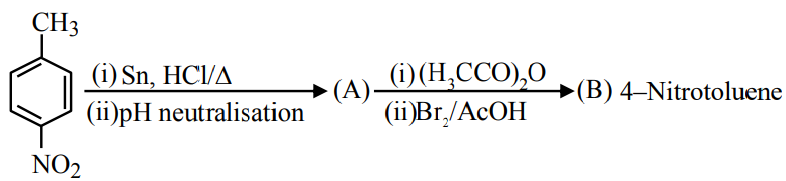
Assuming that the reaction proceeds to completion, then 137 mg of 4-nitrotoluene will produce _________ mg of B .
(Given molar mass in \(g~mol ^{-1} H : 1, C : 12, N: 14\), O : \(16, Br : 80\) )JEE Mains 2026 Easy - Arrange the following solutions in order of their increasing boiling points.
(i) \(10^{-4} \mathrm{M~} \mathrm{NaCl}\)
(ii) \(10^{-4} \mathrm{M~}\) Urea
(iii) \(10^{-3} \mathrm{M~} \mathrm{NaCl}\)
(iv) \(10^{-2} \mathrm{M~} \mathrm{NaCl}\)JEE Mains 2025 Easy
More PYQs from JEE Mains
- Ship \(A\) is sailing towards north -east with velocity \(\vec v = 30\,\hat i + 50\hat j\,km/hr\) where \(\hat i\) points east and \(\hat j\) , north. Ship \(B\) is at a distance of \(80\, km\) east and \(150\, km\) north of Ship \(A\) and is sailing towards west at \(10\, km/hr\). \(A\) will be at minimum distance from \(B\) is.........\(hrs\)JEE Mains 2019 Hard
- If the magnetic field of a plane electromagnetic wave is given by (The speed of light \( = 3 \times {10^8}\,m/s\) ) \(B = 100 \times {10^{ - 6}}\,\sin \,\left[ {2\pi \times 2 \times {{10}^{15}}\,\left( {t - \frac{x}{c}} \right)} \right]\) then the maximum electric field associated with it isJEE Mains 2019 Easy
- Let \(\vec{a}=-5 \hat{i}+\hat{j}-3 \hat{k}, \vec{b}=\hat{i}+2 \hat{j}-4 \hat{k}\) and \(\vec{c}=(((\vec{a} \times \vec{b}) \times \hat{i}) \times \hat{i}) \times \hat{i}\). Then \(\vec{c} \cdot(-\hat{i}+\hat{j}+\hat{k})\) is equal toJEE Mains 2024 Hard
- The element that shows greater ability to form \(p\pi - p\pi \) multiple bonds, isJEE Mains 2019 Medium
- A particle of mass \(\mathrm{m}\) is projected with a speed \(u\) from the ground at an angle \(\theta=\frac{\pi}{3}\) w.r.t. horizontal (\(x-\)axis). When it has reached its maximum height, it collides completely inelastically with another particle of the same mass and velocity \(u \hat i\). The horizontal distance covered by the combined mass before reaching the ground isJEE Mains 2020 Hard
- If \(\alpha\) and \(\beta\) are the roots of the equation \(x ^{2}+ px +2=0\) and \(\frac{1}{\alpha}\) and \(\frac{1}{\beta}\) are the roots of the equation \(2 x^{2}+2 q x+1=0,\) then \(\left(\alpha-\frac{1}{\alpha}\right)\left(\beta-\frac{1}{\beta}\right)\left(\alpha+\frac{1}{\beta}\right)\left(\beta+\frac{1}{\alpha}\right)\) is equal toJEE Mains 2020 Hard