


Questions
21 questionsShowing 1–21 of 21 questions
-
- (A) 68
- (B) 69
- (C) 70
- (D) 71
Show answer and solution
Correct Answer: (B)
\(\begin{aligned} & \mathrm{t}_{1 / 2}=\frac{0.693}{\mathrm{~K}} \\ & \mathrm{~K}=\mathrm{Ae}^{-\mathrm{Ea} / \mathrm{RT}} \\ & =10^{20} \times \mathrm{e}^{-\frac{191.48 \times 10^3}{8.314 \times 1000}} \\ & =10^{20} \times \mathrm{e}^{-23.031}=10^{20} \times-\mathrm{e}^{\ln 10 \times 10} \\ & =\frac{10^{20}}{10^{10}}=10^{10} \mathrm{sec} . \\ & \mathrm{t}_{1 / 2}=\frac{0.693}{10^{10}}=6.93 \times 10^{-11} \\ & \quad=69.3 \times 10^{-12} \mathrm{sec} .\end{aligned}\) -
- (A) \(\mathrm{k}=\frac{1}{\mathrm{t}} \ln \frac{2\left(\mathrm{p}_{\infty}-\mathrm{P}_{\mathrm{t}}\right)}{\mathrm{P}_{\mathrm{t}}}\)
- (B) \(\mathrm{k}=\frac{1}{\mathrm{t}} \ln \frac{\mathrm{p}_{\infty}}{\mathrm{P}_{\mathrm{t}}}\)
- (C) \(\mathrm{k}=\frac{1}{\mathrm{t}} \ln \frac{\mathrm{p}_{\infty}}{2\left(\mathrm{p}_{\infty}-\mathrm{P}_{\mathrm{t}}\right)}\)
- (D) \(\mathrm{k}=\frac{1}{\mathrm{t}} \ln \frac{\mathrm{p}_{\infty}}{\left(\mathrm{p}_{\infty}-\mathrm{P}_{\mathrm{t}}\right)}\)
Show answer and solution
Correct Answer: (C)
\(\begin{aligned}
& \begin{array}{lllll}
& A_{(g)} & \rightarrow & B_{(g)} & +
C_{(g)} \\
t=0 & P^o & & 0 & 0 \\
t=t & P^o-x & & x & x \\
t=\infty & 0 & & P^o & P^o
\end{array} \\
& \mathrm{P}_{\mathrm{t}}=\mathrm{P}^{\mathrm{o}}+\mathrm{x} \Rightarrow \mathrm{x}=\mathrm{P}_{\mathrm{t}}-\mathrm{P}^{\mathrm{o}}=\mathrm{P}_{\mathrm{t}}-\frac{\mathrm{P}_{\infty}}{2} \\
& \mathrm{P}_{\infty}=2 \mathrm{P}^{\mathrm{o}} \Rightarrow \mathrm{P}^0=\frac{\mathrm{P} \infty}{2} \\
& \mathrm{k}=\frac{1}{\mathrm{t}} \ell \ln \frac{\mathrm{P}^{\mathrm{o}}}{\mathrm{P}^{\mathrm{o}}-\mathrm{x}} \\
& k=\frac{1}{t} \ell n \frac{P_{\infty}}{2\left(P_{\infty}-P_t\right)}
\end{aligned}\) -
- (A) 10
- (B) 20
- (C) 30
- (D) 40
Show answer and solution
Correct Answer: (B)
\(\mathrm{k}_1, \mathrm{k}_2\) and \(\mathrm{k}_3\) are given as rate constants of three steps of a complex reaction. Rate constant (k) of the overall reaction is given as
\(k=\sqrt{\frac{k_1 k_3}{k_2}}\)
Activation energies of the three steps are given as
\(\begin{aligned}
& \mathrm{E}_{\mathrm{a}_1}=60 \mathrm{~kJ} \mathrm{~mol}^{-1}, \mathrm{E}_{\mathrm{a}_2}=30 \mathrm{~kJ} \mathrm{~mol}^{-1}, \\
& \mathrm{E}_{\mathrm{a}_3}=10 \mathrm{~kJ} \mathrm{~mol}^{-1}
\end{aligned}\)
From Arrhenius equation, we know that
\(\mathrm{k}=\mathrm{Ae}^{-\mathrm{Ea} / \mathrm{RT} T}\)
If \(E_a\) is the activation energy of the overall reaction, then
\(\begin{aligned}
& E_a=\frac{1}{2}\left[E_{a_1}+E_{a_3}-E_{a_2}\right] \\
& =\frac{1}{2}[60+10-30]=20 \mathrm{~kJ} \mathrm{~mol}^{-1}
\end{aligned}\) -
- (A) \(3\)
- (B) \(\frac{1}{9}\)
- (C) \(9\)
- (D) \(\frac{1}{3}\)
Show answer and solution
Correct Answer: (C)
Since, the reaction is elementary
\(\text { Rate }=k[A]^1[B]^1\)
When V is reduced to \(\frac{1}{3} \mathrm{~V}\), concentration will be tripled.
Hence, rate \(=9 \times(\text { rate })_{\text {initial }}\)
\(x=9\) -
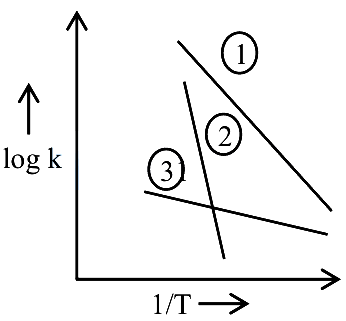
- (A) \(\mathrm{Ea}_2 \gt \mathrm{Ea}_1 \gt \mathrm{Ea}_3\)
- (B) \(\mathrm{Ea}_1 \gt \mathrm{Ea}_3 \gt \mathrm{Ea}_2\)
- (C) \(\mathrm{Ea}_1 \gt \mathrm{Ea}_2 \gt \mathrm{Ea}_3\)
- (D) \(\mathrm{Ea}_3 \gt \mathrm{Ea}_2 \gt \mathrm{Ea}_1\)
Show answer and solution
Correct Answer: (A)
\(\begin{aligned}
& \mathrm{K}=\mathrm{A} \mathrm{e}^{-\mathrm{E} a \mathrm{RT}} \\
& \operatorname{logk}=\log \mathrm{A}-\frac{\mathrm{Ea}}{2.303 \mathrm{RT}}
\end{aligned}\)
For graph between logk with \(\frac{1}{\mathrm{~T}}\)
\(\mid \text { Slope of curve } \left\lvert\,=\frac{\mathrm{Ea}}{2.303 \mathrm{R}}\right.\)
From given graph
Magnitude of slope \(\Rightarrow(2) \gt (1) \gt (3)\)
Hence \(\mathrm{Ea}_2 \gt \mathrm{Ea}_1 \gt \mathrm{Ea}_3\) -
- (A) A, C and D Only
- (B) B , D and E Only
- (C) B and C Only
- (D) A and B Only
Show answer and solution
Correct Answer: (C)
Arrhenious equation hold true for elementary as well as complex reactions.
Unit of A is same as unit of k. Rate of reaction is high if activation energy is low,
A and Ea are temperature independent. -
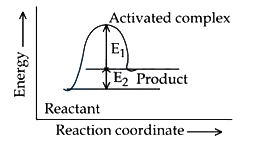
- (A) Activation energy of both forward and backward reaction is \(\mathrm{E}_1+\mathrm{E}_2\) and reactant is more stable than product.
- (B) Activation energy of forward reaction is \(\mathrm{E}_1+\mathrm{E}_2\) and product is less stable than reactant.
- (C) Activation energy of backward reaction is \(\mathrm{E}_1\) and product is more stable than reactant.
- (D) Activation energy of forward reaction is \(\mathrm{E}_1+\mathrm{E}_2\) and product is more stable than reactant.
Show answer and solution
Correct Answer: (B)
Activation energy of forward reaction \(=E_1+E_2\)
Energy of product \(>\) Energy of reactant
Stability
Reactant \(>\) Product -
- (A) 2
- (B) 6
- (C) 12
- (D) 3
Show answer and solution
Correct Answer: (B)
Drug \(\mathrm{X} \xrightarrow{\text { 1st order }}\) Product
Initial concentration of drug \(=16 \mathrm{mg} / \mathrm{mL}\)
Concentration of drug after 12 months \(=4 \mathrm{mg} / \mathrm{mL}\)
Half life of drug = 6 months
Drug become ineffective after 50\% decomposition. The expiry time of drug \(=6\) months -
- (A) Catalyst does not alter the Gibbs energy change of a reaction.
- (B) Catalyst can cause non-spontaneous reactions to occur.
- (C) The enthalpy change for the reaction is \(+20 \mathrm{~kJ} \mathrm{~mol}^{-1}\).
- (D) The enthalpy change for the catalysed reaction is different from that of uncatalysed reaction.
Show answer and solution
Correct Answer: (A)
\(\mathrm{A}_2+\mathrm{B}_2 \rightleftharpoons 2 \mathrm{AB}\)
\(\mathrm{E}_{\mathrm{f}}=180 \mathrm{~kJ} \mathrm{~mol}^{-1}\)
\(\mathrm{E}_{\mathrm{b}}=200 \mathrm{~kJ} \mathrm{~mol}^{-1}\)
\(\Delta \mathrm{H}=\mathrm{E}_{\mathrm{f}}-\mathrm{E}_{\mathrm{b}}=-20 \mathrm{~kJ} \mathrm{~mol}^{-1}\)
In presence of catalyst :
\(\begin{aligned}
& \mathrm{E}_{\mathrm{f}}=180-100=80 \mathrm{~kJ} \mathrm{~mol}^{-1} \\
& \mathrm{E}_{\mathrm{b}}=200-100=100 \mathrm{~kJ} \mathrm{~mol}^{-1}
\end{aligned}\)
Catalyst does not change \(\Delta \mathrm{H}\) or \(\Delta \mathrm{G}\) of a reaction. -
- (A) A and C Only
- (B) A, B and D Only
- (C) C and D Only
- (D) A and B Only
Show answer and solution
Correct Answer: (B)
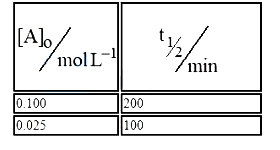
\(\frac{t_1}{2} \propto\left(C_0\right)^{1-\eta}\)
\(\frac{t_1}{t_2}=\left(\frac{C_1}{C_2}\right)^{1-\eta} \)
\( \Rightarrow \frac{200}{100}=\left(\frac{0.100}{0.025}\right)^{1-\eta} \)
\( \Rightarrow 2=(4)^{1-\eta} \)
\( (1-\eta)=\frac{1}{2} \)
\( \eta=\frac{1}{2} \)
\( \text { For } \eta=\frac{1}{2} \)
\( \frac{-d A}{d t}=k(A)^{\frac{1}{2}} \)
\( \int_{C_0}^C \frac{d A}{(A)^{\frac{1}{2}}}=-\int_0^t k d t \)
\( \Rightarrow 2 \mathrm{~A}^{\frac{1}{2}}=-\mathrm{kt} \)
\( \Rightarrow \sqrt{\mathrm{C}}-\sqrt{\mathrm{C}_0}=\frac{-\mathrm{kt}}{2} \)
\( \sqrt{\mathrm{C}}-\sqrt{\mathrm{C}_0}-\frac{\mathrm{kt}}{2} \)
\( \text { For } \mathrm{C}_0=0.1 \Rightarrow \mathrm{t}_{\frac{1}{2}}=200 \mathrm{~min} \)
\( \sqrt{\frac{c_0}{2}}=\sqrt{c_0}-\frac{k t}{2} \)
\( \frac{\mathrm{kt}}{2}=\sqrt{\mathrm{c}_0}-\sqrt{\frac{\mathrm{c}_0}{2}} \)
\( \frac{\mathrm{kt}}{2}=\sqrt{\mathrm{c}_0}\left(\frac{\sqrt{2}-1}{\sqrt{2}}\right) \)
\( t_{\frac{1}{2}}=\frac{2 \sqrt{c_0}}{k}\left(\frac{\sqrt{2}-1}{\sqrt{2}}\right) \)
\( 200=\frac{2 \sqrt{0.1}}{k}\left(\frac{\sqrt{2}-1}{\sqrt{2}}\right) \)
\(\mathrm{k}=\frac{\sqrt{0.1}}{100}\left(\frac{\sqrt{2}-1}{\sqrt{2}}\right)\)
For \(\mathrm{C}_0=1 \mathrm{M}\)
\(t_{\frac{1}{2}}=\frac{2 \times 100(\sqrt{2})}{\sqrt{0.1}(\sqrt{2}-1)} \times \frac{(\sqrt{2}-1)}{\sqrt{2}}\)
\(\Rightarrow 200 \sqrt{10} \mathrm{~min}\).
\(\Rightarrow B\) is correct
C is incorrect
For \(\mathrm{C}_0=1.6 \mathrm{M}\)
\(\mathrm{t}_{\frac{1}{2}}=\frac{2 \sqrt{1.6}(\sqrt{2})(\sqrt{2}-1) \times 100}{\sqrt{0.1}(\sqrt{2}-1)(\sqrt{2})} \)
\( \mathrm{t}_{\frac{1}{2}}=400 \times 2 \mathrm{~min} \)
\( \mathrm{t}_{\frac{1}{2}}=800 \mathrm{~min}\) -
- (A) 43
- (B) 46
- (C) 49
- (D) 50
Show answer and solution
Correct Answer: (A)
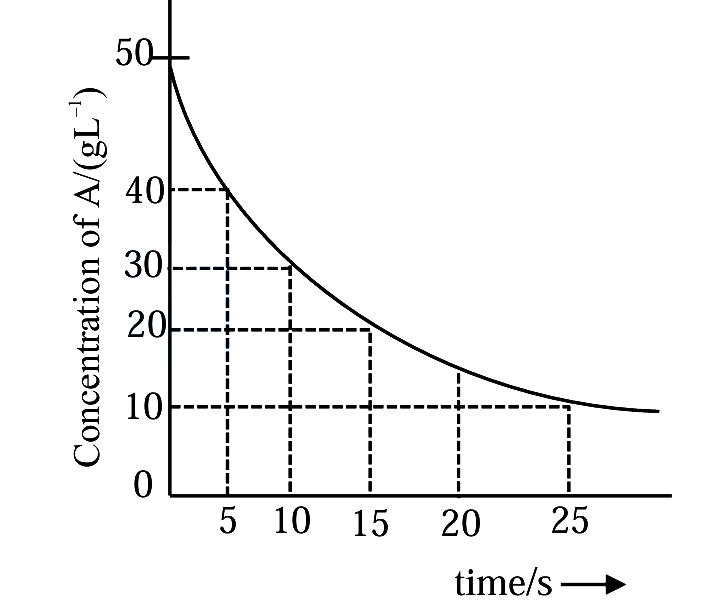
As it is difficult to predict order using data provided in graph.
For specific time interval \(0-5 \mathrm{sec}, 5-10 \mathrm{sec}\) and \(10-15 \mathrm{sec}\). order comes to be zero, but graph is not a straight line.
Assuming \(1^{\text {st }}\) order kinetics
\(\begin{aligned}
& \mathrm{K}=\frac{1}{\mathrm{t}} \ln \frac{\mathrm{~A}_0}{\mathrm{~A}_{\mathrm{t}}} \\
& \mathrm{~K}=\frac{1}{10} \ln \frac{40}{20}
\end{aligned}\)
Time required to reduce to \(2.5 \mathrm{~g} / \mathrm{L}\)
\(\begin{aligned}
& \mathrm{K}=\frac{1}{\mathrm{t}} \ln \frac{50}{2.5} \\
& \frac{1}{10} \ln 2=\frac{1}{\mathrm{t}} \ln 20 \\
& \mathrm{t}=\frac{1.3010 \times 10}{0.3010}=43.3 \mathrm{sec}
\end{aligned}\) -
- (A) 2435
- (B) 2400
- (C) 2541
- (D) 1254
Show answer and solution
Correct Answer: (A)
\(\begin{aligned}
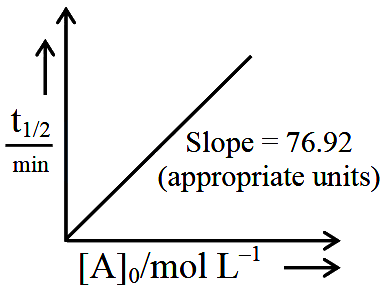
& \mathrm{t}_{1 / 2} \propto[\mathrm{A}]_0 \Rightarrow \text { Order }=\text { zero } \\
& \mathrm{t}_{1 / 2}=\frac{\mathrm{A}_0}{2 \mathrm{~K}} \Rightarrow \text { Slope }=\frac{1}{2 \mathrm{~K}}=76.92 \\
& \mathrm{~K}=\frac{1}{2 \times 76.92} \\
& {[\mathrm{A}]_{10}=-\mathrm{Kt}+\mathrm{A}_0=-\frac{1}{2 \times 76.92} \times 10+2.5=2.435} \\
& =2435 \times 10^{-3} \mathrm{~mol} / \mathrm{L}
\end{aligned}\) -
- (A) 800
- (B) 547
- (C) 897
- (D) 874
Show answer and solution
Correct Answer: (C)
\(2 \mathrm{~N}_2 \mathrm{O}_5(\mathrm{~g}) \rightarrow 2 \mathrm{~N}_2 \mathrm{O}_4(\mathrm{~g})+\mathrm{O}_2(\mathrm{~g})\)
\(\begin{aligned} & k=\frac{2.303}{t} \log \frac{0.9-0.6}{(0.9-x)} \\ & 2 \times 10^{-2} \times 100=\log \frac{0.3}{(0.9-x)} \\ & 100=\frac{0.3}{(0.9-x)} \\ & =\frac{0.9-x}{0.3}=0.01 \\ & 0.9-X=0.003 \\ & =897 \times 10^{-3}\end{aligned}\) - 14. Given below are two statements :
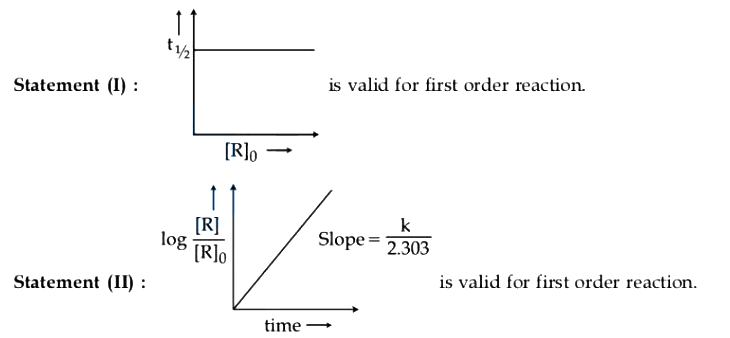
In the light of the above statements, choose the correct answer from the options given below : 2025 Medium- (A) Both Statement I and Statement II are true
- (B) Statement I is false but Statement II is true
- (C) Statement I is true but Statement II is false
- (D) Both Statement I and Statement II are false
Show answer and solution
Correct Answer: (C)
For first order reaction \(\mathrm{t}_{1 / 2}=\frac{\ell \mathrm{n} 2}{\mathrm{k}}\)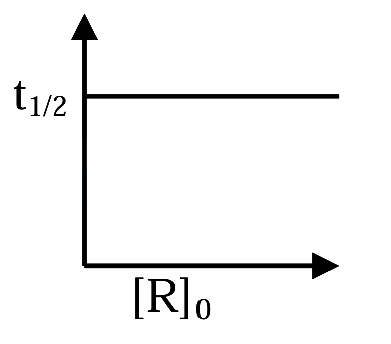
For first order reaction
\(\begin{aligned}
& \log \frac{[R]_0}{[R]}=\frac{1}{2.303} \mathrm{kt} \\
& \log \frac{[\mathrm{R}]_0}{[\mathrm{R}]}=\left(\frac{\mathrm{k}}{2.303}\right) \times \mathrm{t}
\end{aligned}\)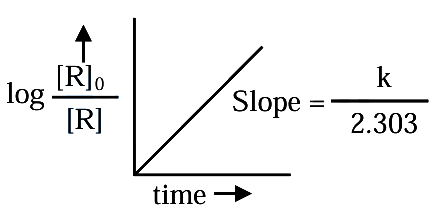
-
- (A) 0.5 hour
- (B) 4 hour
- (C) 15 min
- (D) 60 min
Show answer and solution
Correct Answer: (C)
For zero order reaction
\(\begin{aligned}
& \text { Half life }=\frac{A_o}{2 k} \\
& 60 \min =\frac{2}{2 k} \\
& k=\frac{1}{60} \mathrm{M} / \min
\end{aligned}\)
Now
\(\begin{aligned} & \mathrm{A}_{\mathrm{t}}=\mathrm{A}_{\mathrm{o}}-\mathrm{kt} \\ & \mathrm{t}=\frac{\mathrm{A}_{\mathrm{o}}-\mathrm{A}_{\mathrm{t}}}{\mathrm{k}} \\ & =\frac{0.5-0.25}{1 / 60} \\ & 0.25 \times 60\end{aligned}\)
\(\mathrm{t}=15 \mathrm{~min}\) -
- (A) \(\frac{4}{3}\)
- (B) \(\frac{3}{2}\)
- (C) \(\frac{3}{4}\)
- (D) \(\frac{2}{3}\)
Show answer and solution
Correct Answer: (D)
For \(\mathrm{I}^{\text {st }}\) order reaction
When \(\mathrm{C}_{\mathrm{t}}=\mathrm{Co} / 4\)
\(\begin{aligned}
& \mathrm{t}_1=2 \mathrm{t}_{50 \%}. \\
& \text { when } \mathrm{C}_{\mathrm{t}}=\mathrm{Co} / 8 \\
& \mathrm{t}_2=3 \mathrm{t}_{50 \%} \\
& \text { so } \frac{\mathrm{t}_1}{\mathrm{t}_2}=\frac{2}{3}
\end{aligned}\) -
- (A) 60 min
- (B) 80 min
- (C) 20 min
- (D) 40 min
Show answer and solution
Correct Answer: (D)
Given : \([\mathrm{A}]_0=8[\mathrm{~B}]_0\)
\(\left[\mathrm{t}_{1 / 2}\right]_{\mathrm{A}}=10 \mathrm{~min}\).
\(\left[\mathrm{t}_{1 / 2}\right]_{\mathrm{B}}=40 \mathrm{~min}\).
\(\mathrm{I}^{\text {st }}\) order kinetics
\(\mathrm{t}=\) ?
\([\mathrm{A}]_{\mathrm{t}}=[\mathrm{B}]_{\mathrm{t}}\)
\(-\mathrm{k}_{\mathrm{A}} \times \mathrm{t} \quad-\mathrm{k}_{\mathrm{B}} \times \mathrm{t}\)
\(\Rightarrow \quad[\mathrm{A}]_0 \mathrm{e}=[\mathrm{B}]_0 \mathrm{e}\)
\(\Rightarrow \quad \frac{[\mathrm{A}]_0}{[\mathrm{~B}]_0}=\mathrm{e}^{\left(\mathrm{k}_{\mathrm{A}}-\mathrm{k}_{\mathrm{B}}\right) \mathrm{t}}\)
\(\Rightarrow \quad 8=\mathrm{e}^{\left(\mathrm{k}_{\mathrm{A}}-\mathrm{k}_{\mathrm{B}}\right) \times \mathrm{t}}\)
\(\Rightarrow \quad \ell \mathrm{n} 8=\left(\mathrm{k}_{\mathrm{A}}-\mathrm{k}_{\mathrm{B}}\right) \times \mathrm{t}\)
\(\Rightarrow \quad \ln 8=\ln 2\left(\frac{1}{\left(\operatorname{ta}_2\right)_{\mathrm{A}}}-\frac{1}{\left(\operatorname{ta}_2\right)_{\mathrm{B}}}\right) \times \mathrm{t}\) -
- (A) \(2^{(n-m)}\)
- (B) \((n-m)\)
- (C) \((m+n)\)
- (D) \(\frac{1}{2^{m+n}}\)
Show answer and solution
Correct Answer: (A)
\(\mathrm{r}_1=\mathrm{k}[\mathrm{~A}]^{\mathrm{n}}[\mathrm{~B}]^{\mathrm{m}}\)
Now A is doubled \& B is halved in concentration
\(\Rightarrow \mathrm{r}_2=\mathrm{k} 2^{\mathrm{n}}[\mathrm{~A}]^{\mathrm{n}} \cdot \frac{[\mathrm{~B}]^{\mathrm{m}}}{2^{\mathrm{m}}}\)
Now \(\frac{r_2}{r_1}=2^{(n-m)}\) -
- (A) Initial pressure of A is 80 mm Hg
- (B) The reaction never goes to completion
- (C) Rate constant of the reaction is \(1.693 \mathrm{~min}^{-1}\)
- (D) Partial pressure of A after 10 minute is 40 mm Hg
Show answer and solution
Correct Answer: (C)
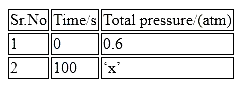
\(\mathrm{A}(\mathrm{g}) \longrightarrow 2 \mathrm{~B}(\mathrm{~g})+\mathrm{C}(\mathrm{g})\)
\(\begin{array}{llll}\mathrm{t}=0 & \mathrm{P}_0 & & \\ \mathrm{t} \rightarrow \infty & 0 & 2 \mathrm{P}_0 & \mathrm{P}_0\end{array}\)
\(\begin{aligned} \mathrm{P}_{\infty}=3 \mathrm{P}_0 & =240 \\ \mathrm{P}_0 & =80 \mathrm{~mm} \text { of } \mathrm{Hg}\end{aligned}\)
\(\mathrm{Kt}=\ln \left(\frac{\mathrm{P}_{\infty}-\mathrm{P}_0}{\mathrm{P}_{\infty}-\mathrm{Pt}}\right)\)
\(K \times 10=\ln \left(\frac{240-80}{240-160}\right)\)
\(\mathrm{K}=\frac{\ell \mathrm{n} 2}{10}=0.0693 \mathrm{~min}^{-1}\)
Option (3) is incorrect -
- (A) 2
- (B) 2.5
- (C) 3
- (D) 1.5
Show answer and solution
Correct Answer: (D)
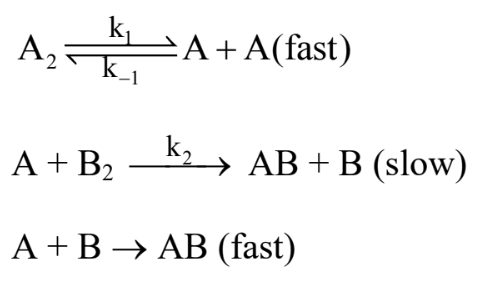
\(\begin{aligned}
& \text { rate }=\mathrm{k}_2[\mathrm{~A}]\left[\mathrm{B}_2\right] \ldots \ldots \\
& \left(\frac{\mathrm{k}_1}{\mathrm{k}_{-1}}\right)=\left(\frac{[\mathrm{A}]^2}{\left[\mathrm{~A}_2\right]}\right) \\
& \Rightarrow[\mathrm{A}]=\sqrt{\frac{\mathrm{k}_1}{\mathrm{k}_{-1}}} \cdot \sqrt{\left[\mathrm{~A}_2\right]}
\end{aligned}\)
Substituting in (1) ; we get
\(\begin{aligned} & \text { Rate }=\mathrm{k}_2 \sqrt{\frac{\mathrm{k}_1}{\mathrm{k}_{-1}}} \cdot\left[\mathrm{~A}_2\right]^{\frac{1}{2}} \cdot\left[\mathrm{~B}_2\right] \\ & \therefore \text { order }=\left(\frac{3}{2}\right)=1.5\end{aligned}\) -
- (A) Decay constant increases with increase in temperature.
- (B) Amount of radioactive substance remained after three half lives is \(\frac{1}{8}\) th of original amount.
- (C) Decay constant does not depend upon temperature.
- (D) Half life is ln 2 times of \(\frac{1}{\text { rate constant }}\).
Show answer and solution
Correct Answer: (A)
For radioactive decay, decay constant does not depend upon temperature because for radioactive decay activation energy is zero.
No questions on this page match these filters.