


Questions
22 questionsShowing 1–22 of 22 questions
-
- (A) 20
- (B) 40
- (C) 60
- (D) 80
Show answer and solution
Correct Answer: (D)
Organic Compound\(\rightarrow \mathrm{CO}_2\)
Applying POAC on ' C ' (mole) of ' C ' in compound \(=\mathrm{n}_{\mathrm{CO}_2} \times 1\)
So mass of ' C ' in compound \(=\frac{1.46}{44} \times 12\)
So, \(\%\) of ' C ' in compound \(=\frac{1.46}{44} \times \frac{12}{0.5} \times 100\)
\(=79.63\) -
- (A) 14
- (B) 16
- (C) 12
- (D) 10
Show answer and solution
Correct Answer: (C)
Organic compound \(\xrightarrow[\Delta]{\mathrm{CuO}} \mathrm{CO}_2+\mathrm{H}_2 \mathrm{O}\)
\(\begin{aligned} & \mathrm{n}_{\mathrm{CO}_2}=\frac{220 \times 10^{-3}}{44}=5 \times 10^{-3} \mathrm{moles} \\ & \mathrm{m}_{\mathrm{C}}=5 \times 10^{-3} \times 12\end{aligned}\)
\(\% \mathrm{~m}\) carbon \(=\frac{5 \times 10^{-3} \times 12}{500 \times 10^{-3}} \times 100=12 \%\)
Correct answer is \(12\) -
- (A) A, D and E only
- (B) B, D and E only
- (C) A, B and C only
- (D) C, D and E only
Show answer and solution
Correct Answer: (C)
\(2 \mathrm{CuSO}_4+\mathrm{K}_4\left[\mathrm{Fe}(\mathrm{CN})_6\right] \xrightarrow{\mathrm{CH}_3 \mathrm{COOH}}\underset{\text{(Chocolate brown ppt.)}}{\mathrm{Cu}_2\left[\mathrm{Fe}(\mathrm{CN})_6\right]+2 \mathrm{~K}_2 \mathrm{SO}_4}\)
\(4 \mathrm{FeCl}_3+3 \mathrm{~K}_4\left[\mathrm{Fe}(\mathrm{CN})_6\right] \longrightarrow \underset{\text { (Prussian Blue ppt.) }}{\mathrm{Fe}_4\left[\mathrm{Fe}(\mathrm{CN})_6\right]_3}+12 \mathrm{KCl}\)
\(3 \mathrm{ZnCl}_4+2 \mathrm{~K}_4\left[\mathrm{Fe}(\mathrm{CN})_6\right] \xrightarrow{\mathrm{NH}_4 \mathrm{OH}} \underset{\text { (White or bluish white ppt.) }}{\mathrm{K}_2 \mathrm{Zn}_3\left[\mathrm{Fe}(\mathrm{CN})_6\right]_2}+6 \mathrm{KCl}\) -
- (A) B and D Only
- (B) D and E Only
- (C) C, D and E Only
- (D) A, C and D Only
Show answer and solution
Correct Answer: (D)
The primary standard is a highly pure stable compound with a known exact composition that can be accurately weighed and dissolved to creat a solution of known concentration.
NaOH is hygroscopic and can't be used.
\(\mathrm{FeSO}_4 \cdot 6 \mathrm{H}_2 \mathrm{O}\) is unstable and can be easily oxidised.
\(\mathrm{Na}_2 \mathrm{Cr}_2 \mathrm{O}_7\) is hygroscopic and can't be used. -
- (A) 111
- (B) 222
- (C) 333
- (D) 444
Show answer and solution
Correct Answer: (A)
M.wt. of given compound \(=86\)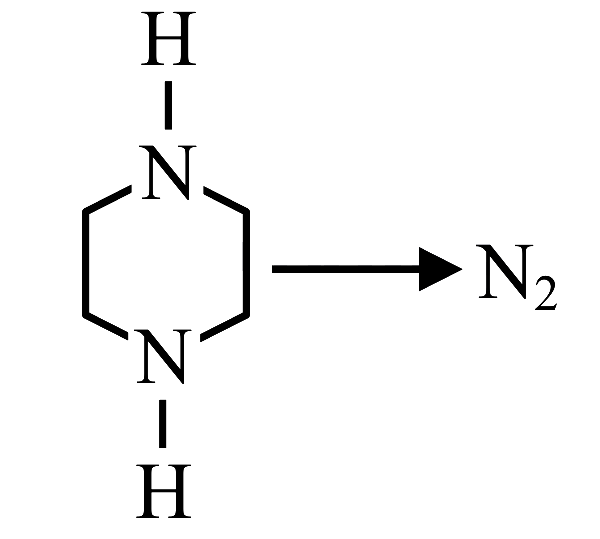
Applying POAC on ' N '
\(\begin{aligned}
& \mathrm{n}_{\mathrm{X}} \times 2=\mathrm{n}_{\mathrm{N}_2} \times 2 \\
& \frac{0.42}{86}=\mathrm{n}_{\mathrm{N}_2} \\
& \Rightarrow(\text { Volume })_{\mathrm{N}_2} \text { at } \mathrm{STP}=\frac{0.42}{86} \times 22.4 \mathrm{~L} \\
& =0.1108 \mathrm{~L}=110.8 \mathrm{~m} \ell
\end{aligned}\) -
- (A) 10
- (B) 20
- (C) 30
- (D) 40
Show answer and solution
Correct Answer: (D)
\(\begin{aligned} & \mathrm{m} \text { mole of } \mathrm{BaSO}_4=\text { mmoles of } \mathrm{S}=\frac{466}{233} \\ & \text { Mass of } \mathrm{S}=\frac{466}{233} \times 32 \mathrm{mg} \\ & =64 \mathrm{mg} \\ & \% \mathrm{~S}=\frac{64}{160} \times 100=40 \%\end{aligned}\) -
- (A) Statement I is true but Statement II is false
- (B) Both Statement I and Statement II are false
- (C) Statement I is false but Statement II is true
- (D) Both Statement I and Statement II are true
Show answer and solution
Correct Answer: (A)
In Dumas method nitrogen present in organic compound is converted into \(\mathrm{N}_2\) gas whose volumetric analysis gives the percentage of nitrogen atom in the organic compound. -
- (A) Statement I is true but Statement II is false
- (B) Statement I is false but Statement II is true
- (C) Both Statement I and Statement II are false
- (D) Both Statement I and Statement II are true
Show answer and solution
Correct Answer: (A)
Statement \(I\) is true.
In partition chromatography, stationary phase is thin liquid film present in the inert support.
Statement II is false.
Because stationary phase in paper chromatography is water. -
- (A) Statement I is true but Statement II is false
- (B) Both Statement I and Statement II are false
- (C) Both Statement I and Statement II are true
- (D) Statement I is false but Statement II is true
Show answer and solution
Correct Answer: (A)
Lassaigne's test is a general test for detection of halogen, nitrogen and sulphur in an organic compound. These elements covalently bonded to the organic compounds, In order to detect them, these have to converted into ionic forms.
-
- (A) Statement I is false but Statement II is true
- (B) Both Statement I and Statement II are true
- (C) Both Statement I and Statement II are false
- (D) Statement I is true but Statement II is false
Show answer and solution
Correct Answer: (D)
The elements present in the compound are converted from covalent form into ionic form by fusing the compound with sodium in Lassigne's test -
- (A) 20
- (B) 40
- (C) 60
- (D) 80
Show answer and solution
Correct Answer: (A)
\(\begin{aligned} & \mathrm{n}_{\mathrm{Cl}}=\mathrm{n}_{\mathrm{AgCl}}=\frac{143.5 \times 10^{-3}}{143.5}=10^{-3} \\ & \% \mathrm{Cl}=\frac{10^{-3} \times 35.5}{180 \times 10^{-3}} \times 100=19.72\end{aligned}\) -
- (A) 250
- (B) 255
- (C) 260
- (D) 665
Show answer and solution
Correct Answer: (B)
Mass of organic compound \(=0.25 \mathrm{~g}\)
Mass of \(\mathrm{AgBr}=0.15 \mathrm{~g}\)
No. of moles of \(\mathrm{Br}=\) No. of moles of \(\mathrm{AgBr}=\frac{0.15}{188}\)
\(\begin{aligned}
& \text { Mass of } \mathrm{Br}=\frac{0.15 \times 80}{188} \mathrm{~g} \\
& \% \text { of } \mathrm{Br}=\frac{0.15 \times 80 \times 100}{188 \times 0.25} \\
& =25.5 \% \\
& =255 \times 10^{-1} \%
\end{aligned}\) -
- (A) 20
- (B) 18
- (C) 16
- (D) 14
Show answer and solution
Correct Answer: (B)
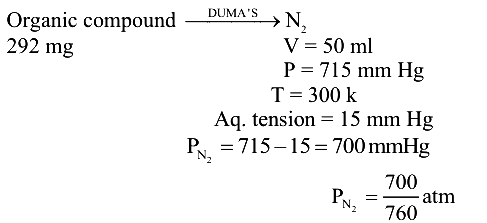
\(\begin{aligned} & \mathrm{n}_{\mathrm{N}_2}=\frac{\mathrm{P}_{\mathrm{N}_2} \cdot \mathrm{~V}}{\mathrm{RT}} \\ & \mathrm{n}_{\mathrm{N}_2}=\frac{700}{760} \times \frac{50}{1000} \times \frac{1}{0.0821 \times 300} \\ & \mathrm{n}_{\mathrm{N}}=2 \times \mathrm{n}_{\mathrm{N}_2} \\ & \text { Mass of } \mathrm{N}=2 \times \mathrm{n}_{\mathrm{N}} \times 14 \\ & \% \mathrm{~N}=\frac{\text { mass of } \mathrm{N}}{\text { mass of organic compound }} \times 100 \\ & \% \mathrm{~N}=\frac{700}{760} \times \frac{50}{1000} \times \frac{2 \times 14}{0.0821 \times 300} \times \frac{1000}{292} \times 100 \\ & \% \mathrm{~N}=18 \%\end{aligned}\) -
- (A) \(15.71 \%\)
- (B) \(20.95 \%\)
- (C) \(17.46 \%\)
- (D) \(7.85 \%\)
Show answer and solution
Correct Answer: (A)
\(\text { Pressure of }
\mathrm{N}_2 \text { gas evolved } =715-15 \\
=700 \mathrm{~mm} \mathrm{Hg} \\
=\frac{700}{760} \mathrm{~atm}.
\)
\(\begin{aligned}
\therefore \text { Mole of } \mathrm{N}_2 \text { evolved } & =\frac{\mathrm{PV}}{\mathrm{RT}} \\
& =\frac{700 \times 60 \times 10^{-3}}{760 \times 0.0821 \times 300} \\
& =0.0022 \mathrm{~mole}
\end{aligned}\)
\(\therefore \mathrm{wt}. \%\) of nitrogen in compound
\(\begin{aligned}
& =\frac{\text { wt. of nitrogen }}{\text { wt. of compound }} \times 100 \\
& =\frac{0.063}{0.4} \times 100 \\
& =15.71 \%
\end{aligned}\) -
- (A) 1.257
- (B) 20.87
- (C) 18.67
- (D) 12.57
Show answer and solution
Correct Answer: (D)
\(\begin{aligned} & \text { Pressure of } \mathrm{N}_2 \text { gas }=(715-15) \\ & \begin{array}{l}=700 \mathrm{mmHg} \\ \mathrm{n}_{\mathrm{N}_2}=\frac{\mathrm{PV}}{\mathrm{RT}} \\ \mathrm{n}_{\mathrm{N}_2}=\frac{700 \times 60 \times 10^{-3}}{760 \times 0.0821 \times 300} \\ \quad=2.24 \times 10^{-3} \mathrm{~mol}\end{array} \\ & \begin{array}{r}\text { Mass of } \mathrm{N}_2=2.24 \times 10^{-3} \times 28 \mathrm{~g} \\ \quad=0.06272 \mathrm{~g}\end{array} \\ & \begin{array}{r}\% \mathrm{~N}_2=\frac{0.06272}{0.5} \times 100 \simeq 12.57\end{array}\end{aligned}\) -
- (A) 22
- (B) 24
- (C) 20
- (D) 18
Show answer and solution
Correct Answer: (C)
Partial pressure of \(\mathrm{N}_2=(900-15)=885 \mathrm{~mm} \mathrm{Hg}\)
Mole of \(\mathrm{N}_2=\frac{\left(\frac{885}{760} \times 0.15\right)}{(0.0821 \times 300)}=0.0071\)
Moles \(\%\) of nitrogen in organic compound
\(\begin{aligned}
& =\frac{(0.0071 \times 28)}{1} \times 10 \\
& =19.85 \%
\end{aligned}\) -
- (A) 250
- (B) 275
- (C) 300
- (D) 325
Show answer and solution
Correct Answer: (B)
\(\begin{array}{ll}\text { Organic Compound } \longrightarrow & \mathrm{BaSO}_4 \\ 0.20 \mathrm{gm} & 0.40 \mathrm{gm} \\ & \frac{0.40}{233} \mathrm{~mol}\left(\mathrm{BaSO}_4\right) \\ & \frac{0.40}{233} \mathrm{~mol} \text { (Sulphur) } \\ & \frac{0.40}{233} \times 32 \mathrm{gm} \text { (sulphur) }\end{array}\)
\(\% \mathrm{~S}=\frac{\frac{0.40 \times 32}{233} \times 100}{0.20}=27.5 \%\) or \(275 \times 10^{-1} \%\) -
- (A) (A)-(II), (B)-(III), (C)-(IV), (D)-(I)
- (B) (A)-(II), (B)-(IV), (C)-(I), (D)-(III)
- (C) (A)-(III), (B)-(IV), (C)-(II), (D)-(I)
- (D) (A)-(III), (B)-(I), (C)-(IV), (D)-(II)
Show answer and solution
Correct Answer: (D)
List-I (Purification technique) List-II (Mixture of organic compounds) (A) Distillation (simple) (III) Chloroform + Aniline (B) Fractional distillation (I) Diesel + Petrol (C) Distillation under reduced pressure (IV) Glycerol + Spent-lye (D) Steam distillation (II) Aniline + Water -
- (A) (A)-(IV), (B)-(III), (C)-(II), (D)-(I)
- (B) (A)-(I), (B)-(II), (C)-(III), (D)-(IV)
- (C) (A)-(III), (B)-(IV), (C)-(I), (D)-(II)
- (D) (A)-(II), (B)-(I), (C)-(IV), (D)-(III)
Show answer and solution
Correct Answer: (A)
(A) Aniline \(-\mathrm{H}_2 \mathrm{O}\) : Steam Distillation
(B) Glycerol from spent-lye in soap industry - Distillation under reduced pressure
(C) Different fraction of crude oil in petroleum industry - Fractional distillation
(D) \(\mathrm{CHCl}_3-\) Aniline - Simple distillation -
- (A) A-II, B-III, C-IV, D-I
- (B) A-II, B-III, C-I, D-IV
- (C) A-III, B-II, C-IV, D-I
- (D) A-II, B-IV, C-III, D-I
Show answer and solution
Correct Answer: (A)
(1) Carboxylic acid gives efferve scence with sodium bicarbonate solution
(2) Phenolic-OH gives voilet coloured complex with Neutral \(\mathrm{FeCl}_3\).
(3) Alcoholic-OH gives Red colour with cerric ammonium Nitrate.
(4) When alkaline \(\mathrm{KMnO}_4\) reacts with an unsaturated compound (Alkene or alkyne) the purple colour of \(\mathrm{KMnO}_4\) solution disappears, indicating positive test for unsaturation. -
- (A) Distillation
- (B) Extraction
- (C) Sublimation
- (D) Crystallization
Show answer and solution
Correct Answer: (C)
Phase transfer from solid to vapour directly is known as sublimation. -
- (A) \(\mathrm{X}=\mathrm{NH}_3\) and \(\mathrm{Y}=\mathrm{HgO}\)
- (B) \(\mathrm{X}=\mathrm{NH}_3\) and \(\mathrm{Y}=\mathrm{K}_2 \mathrm{HgI}_4+\mathrm{KOH}\)
- (C) \(\mathrm{X}=\mathrm{NH}_4 \mathrm{Cl}\) and \(\mathrm{Y}=\mathrm{KOH}\)
- (D) \(\mathrm{X}=\mathrm{HCl}\) and \(\mathrm{Y}=\mathrm{NH}_4 \mathrm{Cl}\)
Show answer and solution
Correct Answer: (B)
\(\mathrm{NH}_4^{+}+\mathrm{NaOH} \longrightarrow \mathrm{H}_2 \mathrm{O}+\mathrm{NH}_3 \uparrow\)
\(\mathrm{NH}_4^{+}+\mathrm{NaOH} \longrightarrow \mathrm{H}_2 \mathrm{O}+\mathrm{NH}_3 \uparrow\)
\(\mathrm{NH}_3\) is identify by \(\mathrm{K}_2\left[\mathrm{HgI}_4\right]+\mathrm{KOH}\)

No questions on this page match these filters.