


JEE Mains · Chemistry · STD 12 - 4. d and f- block elements
The spin-only magnetic moment value of \(\mathrm{M}^{\mathrm{n+-}}\) ion formed among \(\mathrm{Ni}, \mathrm{Zn} \mathrm{Mn}\) and Cu that has the least enthalpy of atomisation is ________. (in nearest integer)
Here n is equal to the number of diamagnetic complexes among \(\mathrm{K}_2\left[\mathrm{NiCl}_4\right],\left[\mathrm{Zn}\left(\mathrm{H}_2 \mathrm{O}\right)_6\right] \mathrm{Cl}_2\),
\(\mathrm{K}_3\left[\mathrm{Mn}(\mathrm{CN})_6\right] \text { and }\left[\mathrm{Cu}\left(\mathrm{PPh}_3\right)_3 \mathrm{I}\right]\)
- A \(0\)
- B 1
- C 2
- D 3
Answer & Solution
Correct Answer
(A) \(0\)
Step-by-step Solution
Detailed explanation
\(\mathrm{K}_2\left[\mathrm{NiCl}_4\right] \Rightarrow \mathrm{sp}^3\), Paramagnetic \(\left[\mathrm{Zn}\left(\mathrm{H}_2 \mathrm{O}\right)_6\right] \mathrm{Cl}_2 \Rightarrow \mathrm{sp}^3 \mathrm{~d}^2\), Diamagnetic…
See the Complete Solution
Get step-by-step explanations for this and 2.5 Lakh+ more JEE, NEET & CET questions.
- Unlock all solutions
- Practice the full chapter
- Track accuracy across PYQs
4.8 rated on Google Play · 14,000+ reviews
More questions from Chemistry
- The correct stability order of the following resonance structures of \(\mathrm{CH}_3-\mathrm{CH}=\mathrm{CH}-\mathrm{CHO}\) is _______.
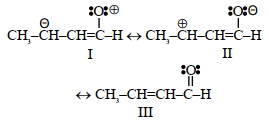 JEE Mains 2024 Medium
 - Match \(List-I\) with \(List-II\).
Choose the correct answer from the options given below.\(List-I\) (Compound) \(List-II\) (Shape) \((A)\) \(BrF _{5}\) \((I)\) bent \((B)\) \(\left[ CrF _{6}\right]^{3-}\) \((II)\) square pyramidal \((C)\) \(O _{3}\) \((III)\) trigonal bipyramidal \((D)\) \(PCl _{5}\) \((IV)\) octahedral JEE Mains 2022 Medium - The volume (in \(mL\) ) of \(0.1\, N\) \(NaOH\) required to neutralise \(10\, mL\) of \(0.1\, N\) phosphinic acid is........JEE Mains 2020 Hard
- The difference between \(\Delta H\) and \(\Delta U\) \((\Delta H - \Delta U),\) when the combustion of one mole of heptane \((I)\) is carried out a temperature \(T\) is equal toJEE Mains 2019 Hard
- The metal atom present in the complex MABXL (where A, B, X and L are unidentate ligands and M is metal) involves \(sp ^3\) hybridization. The number of geometrical isomers exhibited by the complex is _______.JEE Mains 2024 Medium
- Consider the following data:
\(\Delta_{f}H^{\Theta}(methane,g) = -X~kJ~mol^{-1}\)
Enthalpy of sublimation of graphite = \(Y~kJ~mol^{-1}\)
Dissociation enthalpy of \(H_{2} = Z~kJ~mol^{-1}\)
The bond enthalpy of C-H bond is given by:JEE Mains 2026 Medium
More PYQs from JEE Mains
- Let \(\Delta\) be the area of the region \(\left\{( x , y ) \in R ^2: x ^2+ y ^2 \leq 21, y ^2 \leq 4 x , x \geq 1\right\}\). Then \(\frac{1}{2}\left(\Delta-21 \sin ^{-1} \frac{2}{\sqrt{7}}\right)\) is equal toJEE Mains 2023 Hard
- Two identical conducting spheres \(\mathrm{P}\) and \(\mathrm{S}\) with charge \(Q\) on each, repel each other with a force \(16 \mathrm{~N}\). A third identical uncharged conducting sphere \(\mathrm{R}\) is successively brought in contact with the two spheres. The new force of repulsion between \(\mathrm{P}\) and \(\mathrm{S}\) is what?JEE Mains 2024 Hard
- If \(\int \frac{\sin ^{\frac{3}{2}} x+\cos ^{\frac{3}{2}} x}{\sqrt{\sin ^3 x \cos ^3 x \sin (x-\theta)}} d x=A \sqrt{\cos \theta \tan x-\sin \theta}+B \sqrt{\cos \theta-\sin \theta \operatorname{coc} x}+C,\) where \(C\) is the integration constant, then \(A B\) is equal toJEE Mains 2024 Hard
- The differential equation satisfied by the system of parabolas \(y ^{2}=4 a ( x + a )\) isJEE Mains 2021 Hard
- In the following reaction sequence The compound \(I\) is \(\mathop I\limits_{({C_3}{H_6}C{l_2})} \xrightarrow{{KOH(aq)}}II\xrightarrow[{(ii){H_2}O/{H^ + }}]{{(i)C{H_3}MgBr}}III\xrightarrow{{Anhy.ZnC{l_2} + Conc.HCl}}\) given turbidity immediatelyJEE Mains 2017 Hard
- Let A be a \(3\times3\) matrix such that \(A+A^{T}=O\). If \(A\begin{bmatrix}1\\ -1\\ 0\end{bmatrix}=\begin{bmatrix}3\\ 3\\ 2\end{bmatrix}\), \(A^{2}\begin{bmatrix}1\\ -1\\ 0\end{bmatrix}=\begin{bmatrix}-3\\ 19\\ -24\end{bmatrix}\) and \(\det(adj(2adj(A+I)))\) = \((2)^\alpha \cdot(3)^\beta \cdot(11)^\gamma\), then \(\alpha+\beta+\gamma\) is equal to ___ .JEE Mains 2026 Medium