


JEE Mains · Chemistry · STD 12 - 4. d and f- block elements
Consider the following reactions.
\(\mathrm{K}_2 \mathrm{Cr}_2 \mathrm{O}_7 \xrightarrow[-\mathrm{H}_2 \mathrm{O}]{\mathrm{KOH}}[\mathrm{A}] \xrightarrow[-\mathrm{H}_2 \mathrm{O}]{\mathrm{H}_2 \mathrm{SO}_4}[\mathrm{~B}]+\mathrm{K}_2 \mathrm{SO}_4\)
The products \([A]\) and \([B]\), respectively are :
- A \(\mathrm{K}_2 \mathrm{CrO}_4\) and CrO
- B \(\mathrm{K}_2 \mathrm{CrO}_4\) and \(\mathrm{Cr}_2 \mathrm{O}_3\)
- C \(\mathrm{K}_2 \mathrm{CrO}_4\) and \(\mathrm{K}_2 \mathrm{Cr}_2 \mathrm{O}_7\)
- D \(\mathrm{K}_2 \mathrm{Cr}(\mathrm{OH})_6\) and \(\mathrm{Cr}_2 \mathrm{O}_3\)
Answer & Solution
Correct Answer
(C) \(\mathrm{K}_2 \mathrm{CrO}_4\) and \(\mathrm{K}_2 \mathrm{Cr}_2 \mathrm{O}_7\)
Step-by-step Solution
Detailed explanation
\(\mathrm{K}_2 \mathrm{Cr}_2 \mathrm{O}_7 \xrightarrow[-\mathrm{H}_2 \mathrm{O}]{\mathrm{KOH}} \mathrm{K}_2 \mathrm{CrO}_4 \xrightarrow[-\mathrm{H}_2 \mathrm{O}]{\mathrm{H}_2 \mathrm{SO}_4} \mathrm{~K}_2 \mathrm{Cr}_2 \mathrm{O}_7+\mathrm{K}_2 \mathrm{SO}_4\) [A]…
See the Complete Solution
Get step-by-step explanations for this and 2.5 Lakh+ more JEE, NEET & CET questions.
- Unlock all solutions
- Practice the full chapter
- Track accuracy across PYQs
4.8 rated on Google Play · 14,000+ reviews
More questions from Chemistry
- When \(MnO _2\) and \(H _2 SO _4\) is added to a salt \(( A )\), the greenish yellow gas liberated as salt \(( A )\) is _______.JEE Mains 2024 Medium
- Sodium oxide reacts with water to produce sodium hydroxide. \(20.0\, \mathrm{~g}\) of sodium oxide is dissolved in \(500\, \mathrm{~mL}\) of water. Neglecting the change in volume, the concentration of the resulting \(\mathrm{NaOH}\) solution is \(........\times \quad 10^{-1} \quad\) \(M.\) (Nearest integer) [Atomic mass \(: \mathrm{Na}=23.0, \mathrm{O}=16.0, \mathrm{H}=1.0]\)JEE Mains 2021 Hard
- The standard entropy change for the reaction \(4 Fe ( s )+3 O _{2}( g ) \rightarrow 2 Fe _{2} O _{3}( s )\) is \(-550\, JK ^{-1}\) at \(298 \,K\). [Given : The standard enthalpy change for the reaction is \(-165\, kJ\, mol ^{-1}\). The temperature in \(K\) at which the reaction attains equilibrium is ... . (Nearest Integer)JEE Mains 2022 Medium
- \(\mathrm{A} \rightarrow \mathrm{~B}\)
The molecule A changes into its isomeric form B by following a first order kinetics at a temperature of 1000 K . If the energy barrier with respect to reactant energy for such isomeric transformation is \(191.48 \mathrm{~kJ} \mathrm{~mol}^{-1}\) and the frequency factor is \(10^{20}\), the time required for \(50 \%\) molecules of A to become \(B\) is _________ picoseconds (nearest integer). \(\left[\mathrm{R}=8.314 \mathrm{~J} \mathrm{~K}^{-1} \mathrm{~mol}^{-1}\right]\)JEE Mains 2025 Hard - In order to oxidize a mixture of one mole of each of \(Fe{C_2}{O_4},F{e_2}\,{\left( {{C_2}{O_4}} \right)_3},FeS{O_4}\) and \(F{e_2}{\left( {S{O_4}} \right)_3}\) in acidic medium, the number of moles of \(KMnO_4\) required isJEE Mains 2019 Hard
- For the given cell
\(\mathrm{Fe}^{2+}{ }_{(\mathrm{aq})}+\mathrm{Ag}^{+}{ }_{(\mathrm{aq})} \rightarrow \mathrm{Fe}_{(\mathrm{aq})}^{3+}+\mathrm{Ag}_{(\mathrm{s})}\)
The standard cell potential of the above reaction is Given:
\(\begin{array}{lr}
\mathrm{Ag}^{+}+\mathrm{e}^{-} \rightarrow \mathrm{Ag} & \mathrm{E}^\theta=\mathrm{xV} \\
\mathrm{Fe}^{2+}+2 \mathrm{e}^{-} \rightarrow \mathrm{Fe} & \mathrm{E}^\theta=\mathrm{yV} \\
\mathrm{Fe}^{3+}+3 \mathrm{e}^{-} \rightarrow \mathrm{Fe} & \mathrm{E}^\theta=\mathrm{zV}
\end{array}\)JEE Mains 2025 Medium
More PYQs from JEE Mains
- At \(298\,K\), the equilibrium constant is \(2 \times 10^{15}\) for the reaction. \(Cu ( s )+2 Ag ^{+}( aq ) \rightleftharpoons Cu ^{2+}( aq )+2 Ag ( s )\) The equilibrium constant for the reaction.\(\frac{1}{2} Cu ^{2+}( aq )+ Ag ( s ) \rightleftharpoons \frac{1}{2} Cu ( s )+ Ag ^{+}( aq )\) is \(x \times 10^{-8}\). The value of \(x\) is (Nearest Integer)JEE Mains 2022 Medium
- Let \(A =\left(\begin{array}{cc}2 & -1 \\ 0 & 2\end{array}\right)\). If \(B = I -{ }^{5} C _{1} (\operatorname{adj} A )+{ }^{5} C _{2}\) \((\operatorname{adjA})^{2}-\ldots-{ }^{5} C _{5} (\operatorname{adj} A )^{5}\), then the sum of all elements of the matrix \(B\) isJEE Mains 2022 Medium
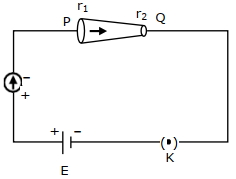
- In the given figure, a battery of emf \(E\) is connnected across a conductor \(P Q\) of length \('Y'\) and different area of cross-sections having radii \(r_{1}\) and \(r_{2}\left(r_{2}\,<\,r_{1}\right)\). Choose the correct option as one moves from \(P\) to \(Q\) :
 JEE Mains 2021 Hard
 - The correct statements among \(I\) to \(III\) are \(I\). Valence bond theory cannot explain the color exhibited by transition metal complexes \(II\). Valence bond theory can predict quantitatively the magnetic properties of transition metal complexes \(III\). Valence bond theory cannot distinguish ligands as weak and strong field onesJEE Mains 2019 Hard
- The volume (in \(mL\) ) of \(0.1\,M\,AgNO _3\) required for complete precipitation of chloride ions present in \(20\,mL\) of \(0.01\,M\) solution of \(\left[ Cr \left( H _2 O \right)_5 Cl \right] Cl _2\) as silver chloride is \(..........\).JEE Mains 2023 Hard
- If \(y=y(x)\) is the solution of the differential equation, \(\frac{ dy }{ dx }+2 y \tan x =\sin x , y \left(\frac{\pi}{3}\right)=0,\) then the maximum value of the function \(y ( x )\) over \(R\) is equal toJEE Mains 2021 Hard