


All JEE Mains 2025 Chemistry questions
26 chaptersShowing 101–150 of 381 questions
-
- (A) 800
- (B) 547
- (C) 897
- (D) 874
Show answer and solution
Correct Answer: (C)
\(2 \mathrm{~N}_2 \mathrm{O}_5(\mathrm{~g}) \rightarrow 2 \mathrm{~N}_2 \mathrm{O}_4(\mathrm{~g})+\mathrm{O}_2(\mathrm{~g})\)
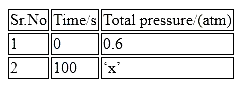
\(\begin{aligned} & k=\frac{2.303}{t} \log \frac{0.9-0.6}{(0.9-x)} \\ & 2 \times 10^{-2} \times 100=\log \frac{0.3}{(0.9-x)} \\ & 100=\frac{0.3}{(0.9-x)} \\ & =\frac{0.9-x}{0.3}=0.01 \\ & 0.9-X=0.003 \\ & =897 \times 10^{-3}\end{aligned}\) - 102. Given below are two statements :
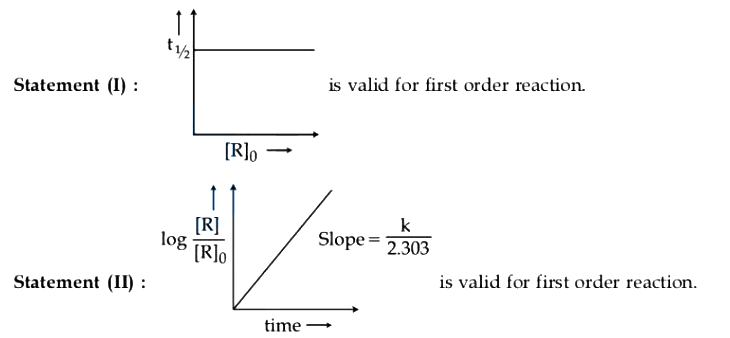
In the light of the above statements, choose the correct answer from the options given below : 2025 Medium- (A) Both Statement I and Statement II are true
- (B) Statement I is false but Statement II is true
- (C) Statement I is true but Statement II is false
- (D) Both Statement I and Statement II are false
Show answer and solution
Correct Answer: (C)
For first order reaction \(\mathrm{t}_{1 / 2}=\frac{\ell \mathrm{n} 2}{\mathrm{k}}\)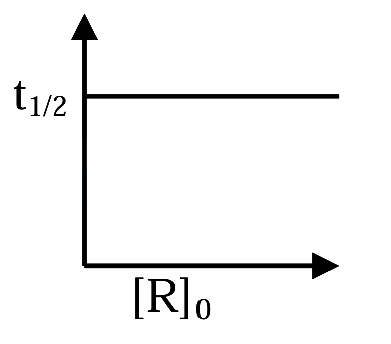
For first order reaction
\(\begin{aligned}
& \log \frac{[R]_0}{[R]}=\frac{1}{2.303} \mathrm{kt} \\
& \log \frac{[\mathrm{R}]_0}{[\mathrm{R}]}=\left(\frac{\mathrm{k}}{2.303}\right) \times \mathrm{t}
\end{aligned}\)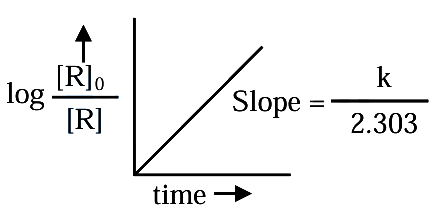
-
- (A) 0.5 hour
- (B) 4 hour
- (C) 15 min
- (D) 60 min
Show answer and solution
Correct Answer: (C)
For zero order reaction
\(\begin{aligned}
& \text { Half life }=\frac{A_o}{2 k} \\
& 60 \min =\frac{2}{2 k} \\
& k=\frac{1}{60} \mathrm{M} / \min
\end{aligned}\)
Now
\(\begin{aligned} & \mathrm{A}_{\mathrm{t}}=\mathrm{A}_{\mathrm{o}}-\mathrm{kt} \\ & \mathrm{t}=\frac{\mathrm{A}_{\mathrm{o}}-\mathrm{A}_{\mathrm{t}}}{\mathrm{k}} \\ & =\frac{0.5-0.25}{1 / 60} \\ & 0.25 \times 60\end{aligned}\)
\(\mathrm{t}=15 \mathrm{~min}\) -
- (A) \(\frac{4}{3}\)
- (B) \(\frac{3}{2}\)
- (C) \(\frac{3}{4}\)
- (D) \(\frac{2}{3}\)
Show answer and solution
Correct Answer: (D)
For \(\mathrm{I}^{\text {st }}\) order reaction
When \(\mathrm{C}_{\mathrm{t}}=\mathrm{Co} / 4\)
\(\begin{aligned}
& \mathrm{t}_1=2 \mathrm{t}_{50 \%}. \\
& \text { when } \mathrm{C}_{\mathrm{t}}=\mathrm{Co} / 8 \\
& \mathrm{t}_2=3 \mathrm{t}_{50 \%} \\
& \text { so } \frac{\mathrm{t}_1}{\mathrm{t}_2}=\frac{2}{3}
\end{aligned}\) -
- (A) 60 min
- (B) 80 min
- (C) 20 min
- (D) 40 min
Show answer and solution
Correct Answer: (D)
Given : \([\mathrm{A}]_0=8[\mathrm{~B}]_0\)
\(\left[\mathrm{t}_{1 / 2}\right]_{\mathrm{A}}=10 \mathrm{~min}\).
\(\left[\mathrm{t}_{1 / 2}\right]_{\mathrm{B}}=40 \mathrm{~min}\).
\(\mathrm{I}^{\text {st }}\) order kinetics
\(\mathrm{t}=\) ?
\([\mathrm{A}]_{\mathrm{t}}=[\mathrm{B}]_{\mathrm{t}}\)
\(-\mathrm{k}_{\mathrm{A}} \times \mathrm{t} \quad-\mathrm{k}_{\mathrm{B}} \times \mathrm{t}\)
\(\Rightarrow \quad[\mathrm{A}]_0 \mathrm{e}=[\mathrm{B}]_0 \mathrm{e}\)
\(\Rightarrow \quad \frac{[\mathrm{A}]_0}{[\mathrm{~B}]_0}=\mathrm{e}^{\left(\mathrm{k}_{\mathrm{A}}-\mathrm{k}_{\mathrm{B}}\right) \mathrm{t}}\)
\(\Rightarrow \quad 8=\mathrm{e}^{\left(\mathrm{k}_{\mathrm{A}}-\mathrm{k}_{\mathrm{B}}\right) \times \mathrm{t}}\)
\(\Rightarrow \quad \ell \mathrm{n} 8=\left(\mathrm{k}_{\mathrm{A}}-\mathrm{k}_{\mathrm{B}}\right) \times \mathrm{t}\)
\(\Rightarrow \quad \ln 8=\ln 2\left(\frac{1}{\left(\operatorname{ta}_2\right)_{\mathrm{A}}}-\frac{1}{\left(\operatorname{ta}_2\right)_{\mathrm{B}}}\right) \times \mathrm{t}\) -
- (A) \(2^{(n-m)}\)
- (B) \((n-m)\)
- (C) \((m+n)\)
- (D) \(\frac{1}{2^{m+n}}\)
Show answer and solution
Correct Answer: (A)
\(\mathrm{r}_1=\mathrm{k}[\mathrm{~A}]^{\mathrm{n}}[\mathrm{~B}]^{\mathrm{m}}\)
Now A is doubled \& B is halved in concentration
\(\Rightarrow \mathrm{r}_2=\mathrm{k} 2^{\mathrm{n}}[\mathrm{~A}]^{\mathrm{n}} \cdot \frac{[\mathrm{~B}]^{\mathrm{m}}}{2^{\mathrm{m}}}\)
Now \(\frac{r_2}{r_1}=2^{(n-m)}\) -
- (A) Initial pressure of A is 80 mm Hg
- (B) The reaction never goes to completion
- (C) Rate constant of the reaction is \(1.693 \mathrm{~min}^{-1}\)
- (D) Partial pressure of A after 10 minute is 40 mm Hg
Show answer and solution
Correct Answer: (C)
\(\mathrm{A}(\mathrm{g}) \longrightarrow 2 \mathrm{~B}(\mathrm{~g})+\mathrm{C}(\mathrm{g})\)
\(\begin{array}{llll}\mathrm{t}=0 & \mathrm{P}_0 & & \\ \mathrm{t} \rightarrow \infty & 0 & 2 \mathrm{P}_0 & \mathrm{P}_0\end{array}\)
\(\begin{aligned} \mathrm{P}_{\infty}=3 \mathrm{P}_0 & =240 \\ \mathrm{P}_0 & =80 \mathrm{~mm} \text { of } \mathrm{Hg}\end{aligned}\)
\(\mathrm{Kt}=\ln \left(\frac{\mathrm{P}_{\infty}-\mathrm{P}_0}{\mathrm{P}_{\infty}-\mathrm{Pt}}\right)\)
\(K \times 10=\ln \left(\frac{240-80}{240-160}\right)\)
\(\mathrm{K}=\frac{\ell \mathrm{n} 2}{10}=0.0693 \mathrm{~min}^{-1}\)
Option (3) is incorrect - 108. The reaction \(\mathrm{A}_2+\mathrm{B}_2 \rightarrow 2 \mathrm{AB}\) follows the mechanism
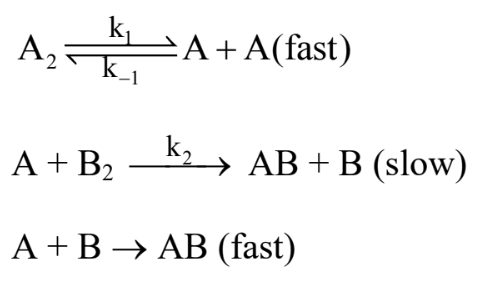
The overall order of the reaction is : 2025 Hard- (A) 2
- (B) 2.5
- (C) 3
- (D) 1.5
Show answer and solution
Correct Answer: (D)
\(\begin{aligned}
& \text { rate }=\mathrm{k}_2[\mathrm{~A}]\left[\mathrm{B}_2\right] \ldots \ldots \\
& \left(\frac{\mathrm{k}_1}{\mathrm{k}_{-1}}\right)=\left(\frac{[\mathrm{A}]^2}{\left[\mathrm{~A}_2\right]}\right) \\
& \Rightarrow[\mathrm{A}]=\sqrt{\frac{\mathrm{k}_1}{\mathrm{k}_{-1}}} \cdot \sqrt{\left[\mathrm{~A}_2\right]}
\end{aligned}\)
Substituting in (1) ; we get
\(\begin{aligned} & \text { Rate }=\mathrm{k}_2 \sqrt{\frac{\mathrm{k}_1}{\mathrm{k}_{-1}}} \cdot\left[\mathrm{~A}_2\right]^{\frac{1}{2}} \cdot\left[\mathrm{~B}_2\right] \\ & \therefore \text { order }=\left(\frac{3}{2}\right)=1.5\end{aligned}\) -
- (A) Decay constant increases with increase in temperature.
- (B) Amount of radioactive substance remained after three half lives is \(\frac{1}{8}\) th of original amount.
- (C) Decay constant does not depend upon temperature.
- (D) Half life is ln 2 times of \(\frac{1}{\text { rate constant }}\).
Show answer and solution
Correct Answer: (A)
For radioactive decay, decay constant does not depend upon temperature because for radioactive decay activation energy is zero. -
- (A) II, IV
- (B) III, II
- (C) I, IV
- (D) II, I
Show answer and solution
Correct Answer: (D)
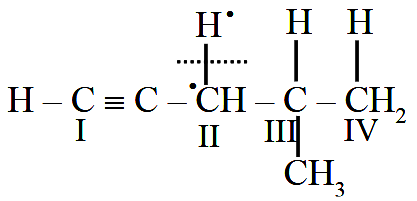
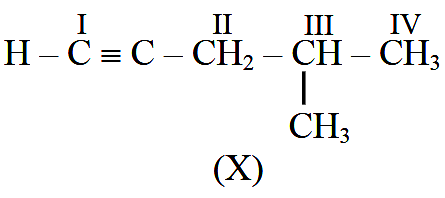
II most stable carbon radical due to resonance stablise
I least stable carbon radical due to no stabilising factor. -
- (A) \(e, g\) aromatic and \(a, b, c, d, f, h\) not aromatic
- (B) \(b, e, f, g\) aromatic and \(a, c, d, h\) not aromatic
- (C) \(a, b, c, d\) aromatic and \(e, f, g, h\) not aromatic
- (D) \(a, c, d, e, h\) aromatic and \(b, f, g\) not aromatic
Show answer and solution
Correct Answer: (D)
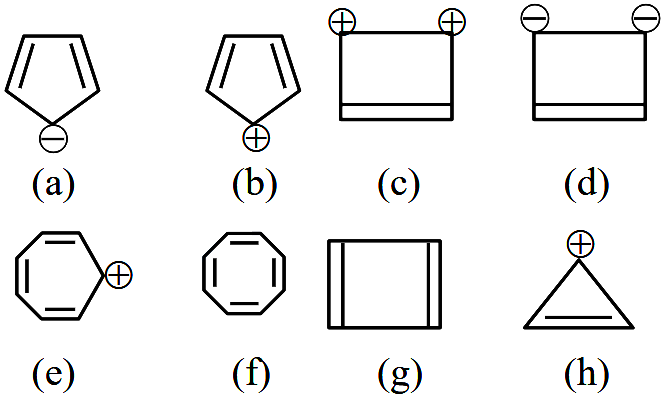
Aromatic compounds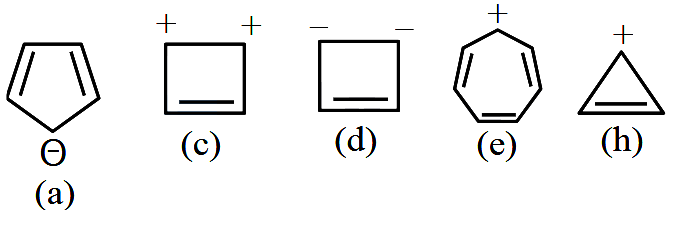
a, c, d, e, h follow Huckel's rule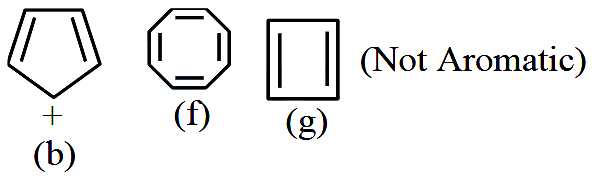
\(b, f, g\), are not aromatic, these compounds do not follow Huckel's rule. -
- (A) Statement I is true but Statement II is false
- (B) Both Statement I and Statement II are false
- (C) Statement I is false but Statement II is true
- (D) Both Statement I and Statement II are true
Show answer and solution
Correct Answer: (C)
Hyper conjugation is permanent effect because external reagent is not required, so Statement-I is false and Statement-II is true. because moore alkyl group, more \(\alpha-H\), so more hyperconjugation which results more stability of carbocation. -
- (A) Statement I is false but Statement II is true
- (B) Both Statement I and Statement II are false
- (C) Statement I is true but Statement II is false
- (D) Both Statement I and Statement II are true
Show answer and solution
Correct Answer: (C)
Statement-I :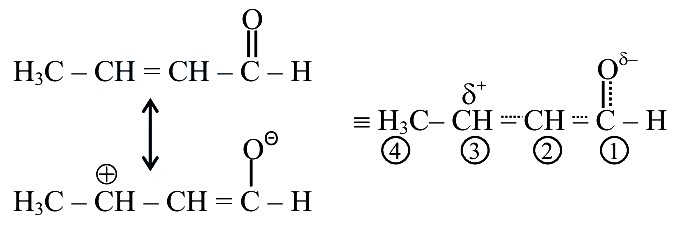
\(\mu=\mathrm{q} \times \mathrm{d}\)
More charges and more distance between charges than other compound so more dipole moment. Statement-I is true.
Statement-II :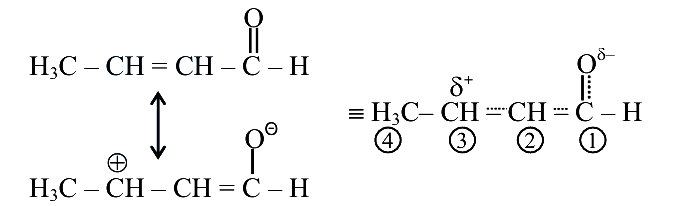
\(\mathrm{C}_1-\mathrm{C}_2\) bond has partial double bond character that means lesser bond length than \(\mathrm{C}_1-\mathrm{C}_2\) bond of other compound. Statement-II is false. -
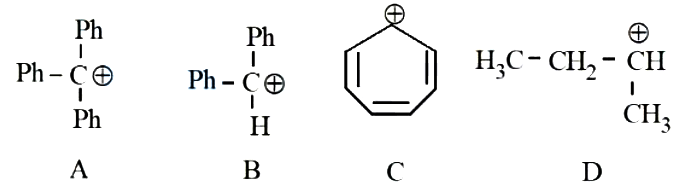
- (A) \(\mathrm{C}\gt\mathrm{B}\gt\mathrm{A}\gt\mathrm{D}\)
- (B) \(\mathrm{A}\gt\mathrm{B}\gt\mathrm{C}\gt\mathrm{D}\)
- (C) \(\mathrm{B}\gt\mathrm{C}\gt\mathrm{A}\gt\mathrm{D}\)
- (D) \(\mathrm{C}\gt\mathrm{A}\gt\mathrm{B}\gt\mathrm{D}\)
Show answer and solution
Correct Answer: (D)
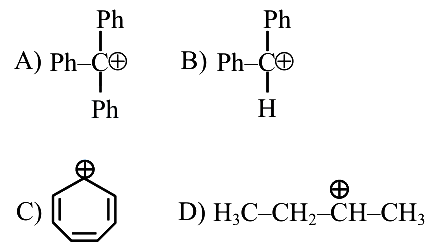
Solution :-
C is aromatic due to \(\oplus \mathrm{ve}\) charge hence it is most stable
A have more resonance structure
B have less resonance structure
D have only hyper conjugation
Consider First Aromaticity \(>\) Resonance \(>\) Hyper conjugation
Ans. D \( < \) B \( < \) A \( < \) C -
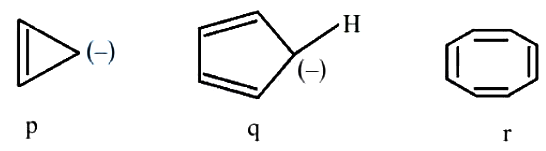
- (A) \(q\gt r\gt p\)
- (B) \(r\gt q\gt p\)
- (C) \(q\gt p\gt r\)
- (D) \(\mathrm{p}\gt\mathrm{q}\gt\mathrm{r}\)
Show answer and solution
Correct Answer: (A)
q is aromatic
r is non-aromatic
p is antiaromatic
\(\mathrm{q}>\mathrm{r}>\mathrm{p}\) (order of stability)
Aromatic > non-aromatic > antiaromatic -
- (A) 7
- (B) 4
- (C) 6
- (D) 5
Show answer and solution
Correct Answer: (D)
Total five nucleophiles are present
\(\mathrm{NH}_3, \mathrm{PhSH},\left(\mathrm{H}_3 \mathrm{C}\right)_2 \mathrm{~S}, \mathrm{CH}_2=\mathrm{CH}_2, \stackrel{\ominus}{\mathrm{O}} \mathrm{H}\) -
- (A) 90
- (B) 93
- (C) 96
- (D) 99
Show answer and solution
Correct Answer: (B)
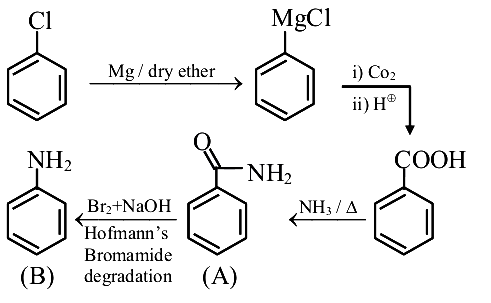
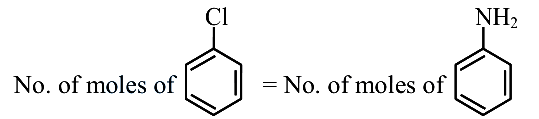
\(\begin{aligned} & \frac{11.25 \times 10^{-3}}{112.5}=\frac{x \times 10^{-1} \times 10^{-3}}{93} \\ & x \times 10^{-1}=93 \times 0.1 \\ & x=93 \mathrm{mg}\end{aligned}\) - 118. Consider the following sequence of reactions :
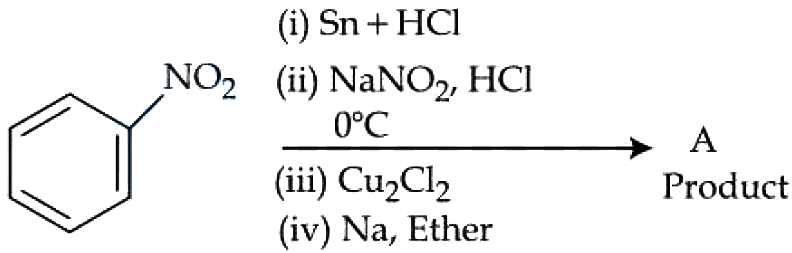
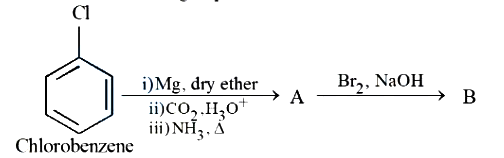
Molar mass of the product formed (A) is _______ \(\mathrm{g} \mathrm{mol}^{-1}\). 2025 Medium- (A) 151
- (B) 152
- (C) 153
- (D) 154
Show answer and solution
Correct Answer: (D)
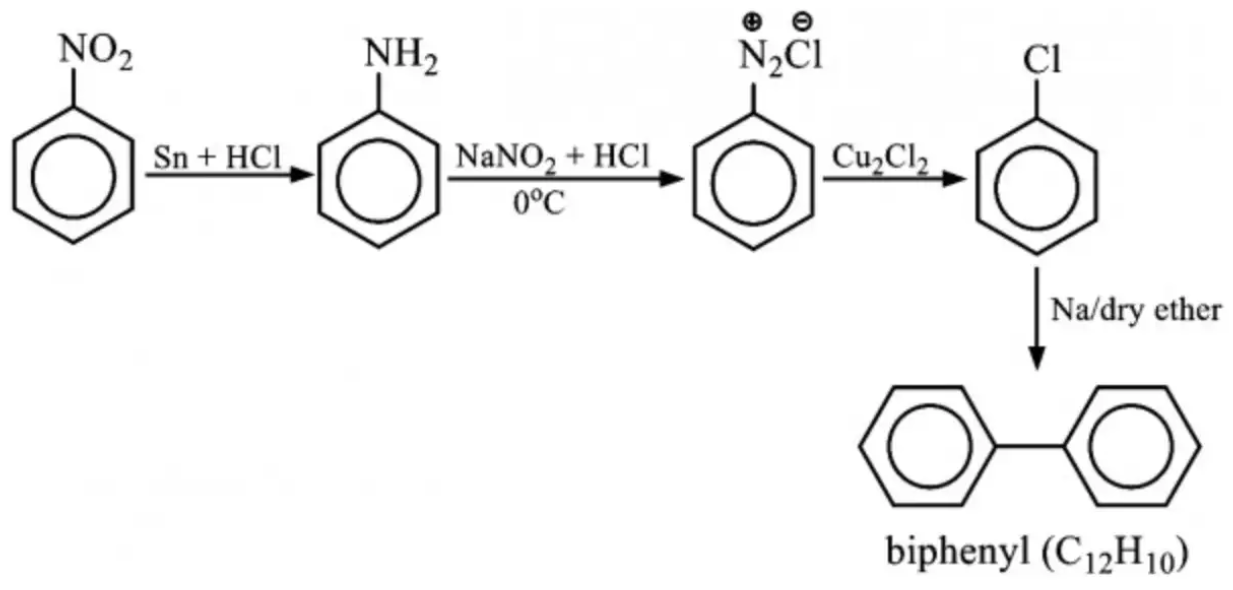
Molar mass \(=120 \times 12+10 \times 1=154\) -
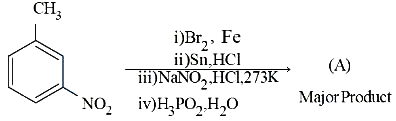
- (A) 141
- (B) 161
- (C) 171
- (D) 181
Show answer and solution
Correct Answer: (C)
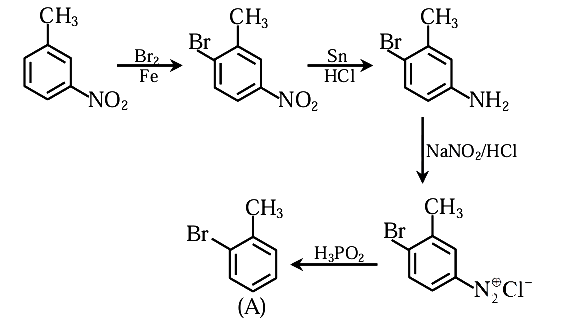
Molar mass of product \(\left(\mathrm{C}_7 \mathrm{H}_7 \mathrm{Br}\right)(\mathrm{A})\) is \(171 \mathrm{~g} \mathrm{~mol}^{-1}\) -
- (A) 340
- (B) 341
- (C) 342
- (D) 343
Show answer and solution
Correct Answer: (B)
Benzyl Amine is most basic due to localised lone pair.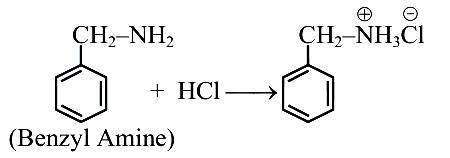
Mole of benzyl Amine \(\Rightarrow \frac{1}{107}=0.00934\) mole
1 Mole of Benzyl amine consumed 1 mole of HCl
So, Mole of HCl consumed \(\rightarrow 0.00934\) mole
Mass of HCl consumed \(\rightarrow 0.00934 \times\) molar mass
of HCl
\(\begin{aligned}
& =0.00934 \times 36.5 \\
& =0.341 \mathrm{gm} \\
& =341 \mathrm{mg}
\end{aligned}\) -
- (A) Statement I is incorrect but Statement II is correct
- (B) Both Statement I and Statement II are correct
- (C) Statement I is correct but Statement II is incorrect
- (D) Both Statement I and Statement II are incorrect
Show answer and solution
Correct Answer: (C)
\(\mathrm{CH}_3-\mathrm{C} \equiv \mathrm{CH}+\mathrm{Na} \rightarrow \mathrm{CH}_3-\mathrm{C} \equiv \mathrm{C}^{-} \mathrm{Na}^{+}+\frac{1}{2} \mathrm{H}_2\)
Statement-l is correct.
Moles of \(\mathrm{C}_3 \mathrm{H}_4=\frac{4}{40}=0.1\) mole
\(\mathrm{CH}_3-\mathrm{C} \equiv \mathrm{CH}+\mathrm{NaNH}_2 \rightarrow \mathrm{CH}_3-\mathrm{C} \equiv \mathrm{C}^{-} \mathrm{Na}^{+}+\mathrm{NH}_3\)
0.1 mole
0.1 mole
Volume of \(\mathrm{NH}_3=(0.1)(22.4)=2.24 \mathrm{~L}\)
Statement-II is incorrect. -
- (A) Statement I is incorrect but Statement II is correct
- (B) Statement I is correct but Statement II is incorrect
- (C) Both Statement I and Statement II are correct
- (D) Both Statement I and Statement II are incorrect
Show answer and solution
Correct Answer: (C)
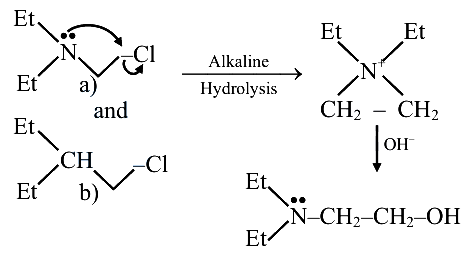
Rate of (a) is faster than rate of (b) because it is a intramolecular substitution. -
- (A) (A) and (B) only
- (B) (D) and (E) only
- (C) (B) and (D) only
- (D) (B) and (C) only
Show answer and solution
Correct Answer: (C)
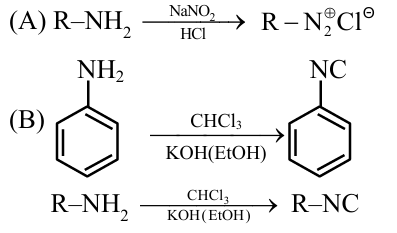
(C) Only primary amine gives carbyl amine test
(D) Benzene sulphonyl chloride
\(\mathrm{Ph}-\mathrm{SO}_2 \mathrm{Cl}\) \(\qquad\) Hinsberg reagent
(E) Tertiary amine do not react with \(\mathrm{Ph}-\mathrm{SO}_2 \mathrm{Cl}\)
So correct options are (B) and (D) only -
- (A) 20
- (B) 40
- (C) 60
- (D) 80
Show answer and solution
Correct Answer: (C)
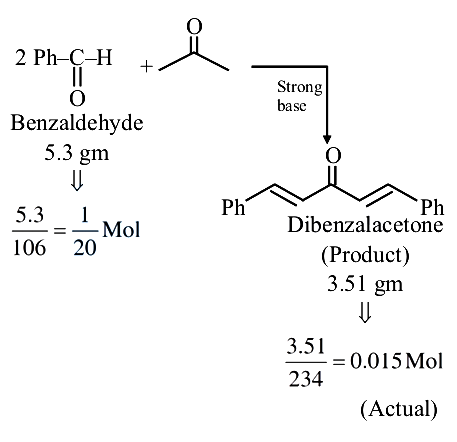
\(\begin{aligned} & \text { Theoretical }=\frac{1}{40} \mathrm{Mol} \\ & \% \text { yield }=\frac{0.015}{1 / 40} \times 100 \\ & \Rightarrow 60 \%\end{aligned}\) -
- (A) \(\mathrm{NH}_3 \lt \mathrm{H}_2 \mathrm{~N}-\mathrm{NH}_2 \lt \left(\mathrm{CH}_3 \mathrm{CH}_2\right)_3 \mathrm{~N} \lt \) \(\mathrm{CH}_3 \mathrm{CH}_2 \mathrm{NH}_2 \lt \left(\mathrm{CH}_3 \mathrm{CH}_2\right)_2 \mathrm{NH}\)
- (B) \(\mathrm{NH}_3 \lt \mathrm{H}_2 \mathrm{~N}-\mathrm{NH}_2 \lt \mathrm{CH}_3 \mathrm{CH}_2 \mathrm{NH}_2 \lt \) \(\left(\mathrm{CH}_3 \mathrm{CH}_2\right)_2 \mathrm{NH} \lt \left(\mathrm{CH}_3 \mathrm{CH}_2\right)_3 \mathrm{~N}\)
- (C) \(\mathrm{H}_2 \mathrm{~N}-\mathrm{NH}_2 \lt \mathrm{NH}_3 \lt \left(\mathrm{CH}_3 \mathrm{CH}_2\right)_3 \mathrm{~N} \lt \) \(\mathrm{CH}_3 \mathrm{CH}_2 \mathrm{NH}_2 \lt \left(\mathrm{CH}_3 \mathrm{CH}_2\right)_2 \mathrm{NH}\)
- (D) \(\mathrm{NH}_2-\mathrm{NH}_2 \lt \mathrm{NH}_3 \lt \mathrm{CH}_3 \mathrm{CH}_2 \mathrm{NH}_2 \lt \) \(\left(\mathrm{CH}_3 \mathrm{CH}_2\right)_3 \mathrm{~N} \lt \left(\mathrm{CH}_3 \mathrm{CH}_2\right)_2 \mathrm{NH}\)
Show answer and solution
Correct Answer: (D)
Basic strength of amine depends on hydrogen bonding and electronic inductive effect.
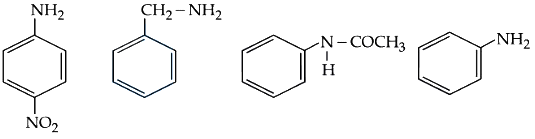
\(\mathrm{NH}(\mathrm{Et})_2 \gt \mathrm{N}(\mathrm{Et})_3 \gt \mathrm{NH}_2 \mathrm{Et} \gt \mathrm{\stackrel{\cdot \cdot}{N}H}_3 \gt \mathrm{NH}_2-\mathrm{NH}_2\) - 126. The descending order of basicity of following amines is _______.
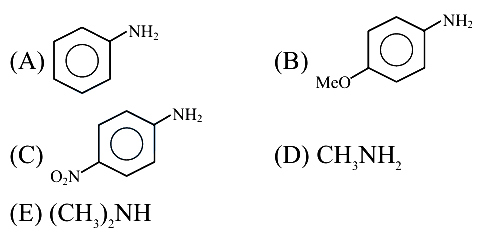
Choose the correct answer from the options given below : 2025 Hard- (A) \(\mathrm{B} \gt \mathrm{E} \gt \mathrm{D} \gt \mathrm{A} \gt \mathrm{C}\)
- (B) \(\mathrm{E} \gt \mathrm{D} \gt \mathrm{B} \gt \mathrm{A} \gt \mathrm{C}\)
- (C) \(\mathrm{E} \gt \mathrm{D} \gt \mathrm{A} \gt \mathrm{B} \gt \mathrm{C}\)
- (D) \(\mathrm{E} \gt \mathrm{A} \gt \mathrm{D} \gt \mathrm{C} \gt \mathrm{B}\)
Show answer and solution
Correct Answer: (B)
\(\mathrm{E} \gt \mathrm{D} \gt \mathrm{B} \gt \mathrm{A} \gt \mathrm{C}\)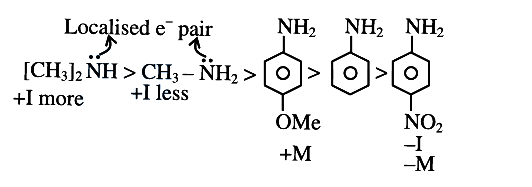
-
- (A) 343
- (B) 330
- (C) 33
- (D) 66
Show answer and solution
Correct Answer: (C)
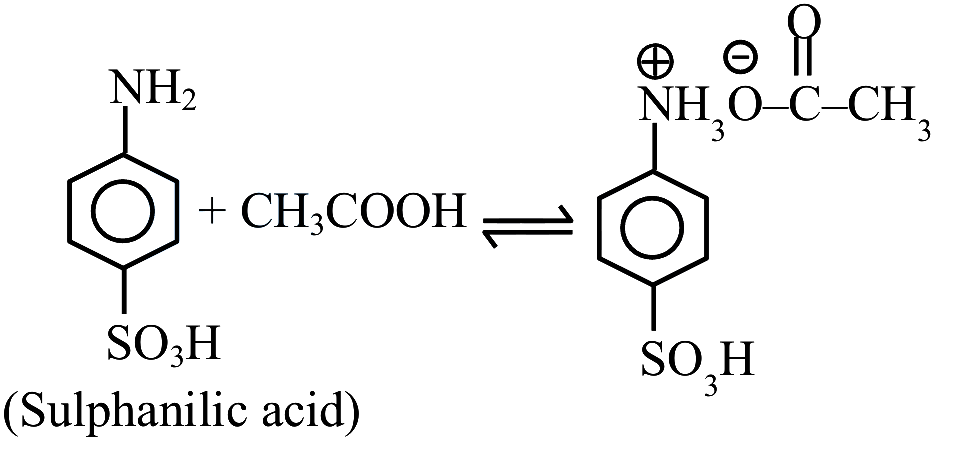
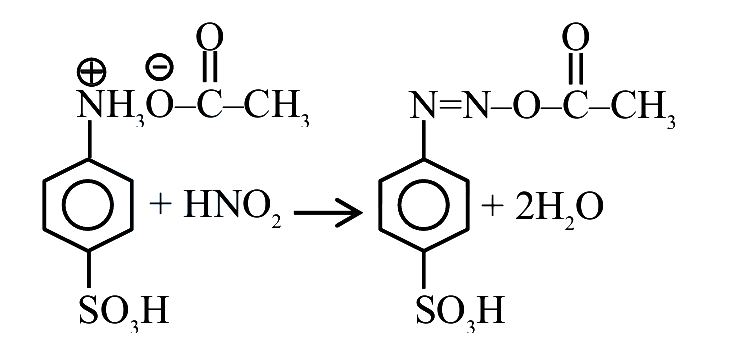
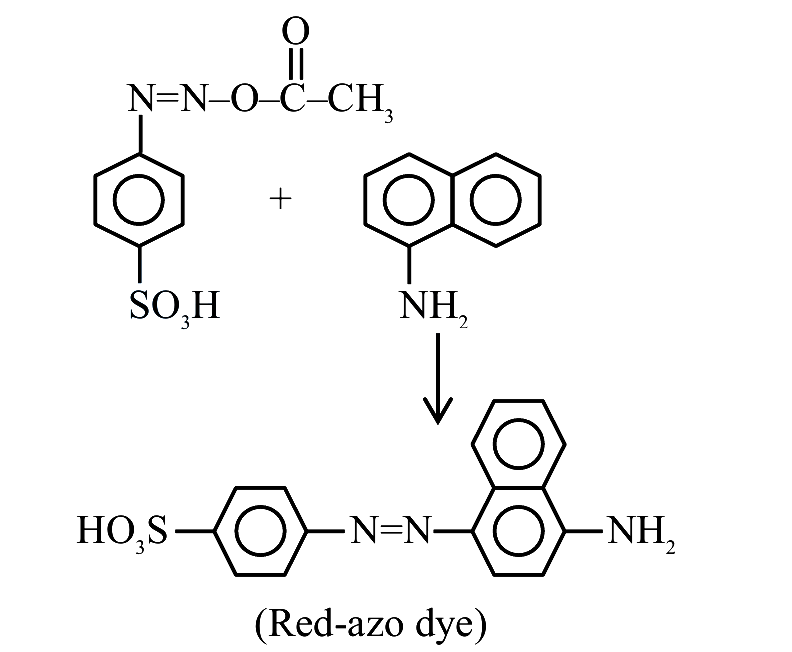
0.1 mole of red-azo dye \((\) Molar Mass \(=327 \mathrm{gm} / \mathrm{mol})\) will have 32.7 gm mass. Nearly 33 gm. - 128. Which among the following react with Hinsberg's reagent?
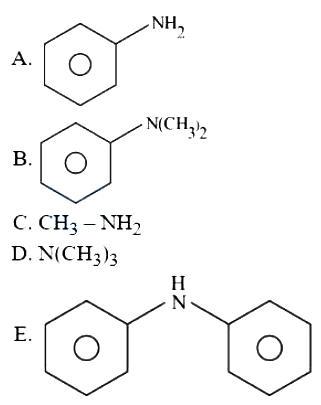
Choose the correct answer from the options given below: 2025 Easy- (A) A, B and E Only
- (B) A, C and E Only
- (C) C and D Only
- (D) B and D Only
Show answer and solution
Correct Answer: (B)
B and D are \(3^{\circ}\) amine which does not have replaceable H on N , So does not react. -
- (A) A and E Only
- (B) C Only
- (C) A and C Only
- (D) B, C and D Only
Show answer and solution
Correct Answer: (C)
Only \(1^{\circ}\) or primary amines gives positive carbylamines test.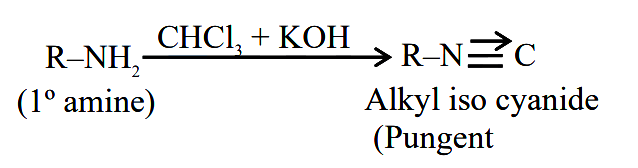
Option (A) and (C) are primary amine and given \(\oplus \mathrm{ve}\) carbyl amine test -
- (A) 1
- (B) 2
- (C) 3
- (D) 4
Show answer and solution
Correct Answer: (C)
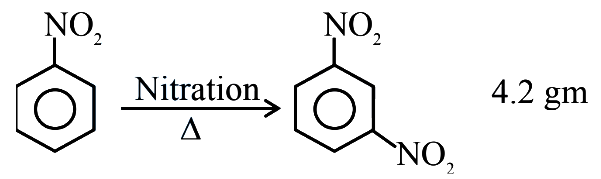
\(\begin{array}{ll}\mathrm{C}_6 \mathrm{H}_5 \mathrm{NO}_2 & \mathrm{MF}=\mathrm{C}_6 \mathrm{H}_4 \mathrm{~N}_2 \mathrm{O}_4 \\ \mathrm{MW}=123 & \mathrm{MW}=168 \\ & \therefore \frac{4.2}{168}=0.025 \mathrm{~mol}\end{array}\)
\(\because\) required gm of nitro benzene
\(\begin{aligned}
& =123 \times 0.025 \\
& =3.075
\end{aligned}\)
\(\therefore\) Nearest integer is 3 - 131. Consider the following molecules :
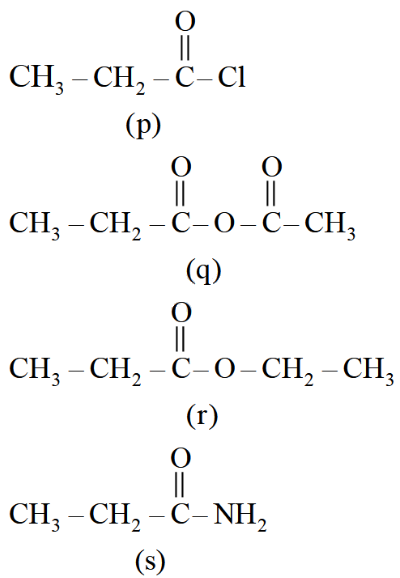
The correct order of rate of hydrolysis is _______. 2025 Medium- (A) \(r>q>p>s\)
- (B) \(q>p>r>s\)
- (C) \(p>r>q>s\)
- (D) \(p>q>r>s\)
Show answer and solution
Correct Answer: (D)
Rate of hydrolysis \(\propto\) Leaving group ability
-
- (A) A and D only
- (B) A,B and E only
- (C) B,C and E only
- (D) B and E only
Show answer and solution
Correct Answer: (D)
(A) \(\mathrm{R}-\mathrm{C} \equiv \mathrm{N} \xrightarrow[\text { mild condition }]{\text { (i) } \mathrm{H}^{+} / \mathrm{H}_2 \mathrm{O}} \mathrm{R}-\mathrm{CONH}_2\)
Under mild condition amide is formed because this reaction is typically slow if further more heat will supplied then it gets convert in to -COOH.
(B) \(\mathrm{R}-\mathrm{MgX} \xrightarrow[\text { (ii) } \mathrm{H}_3 \mathrm{O}^{+}]{\text {(i) } \mathrm{CO}_2} \mathrm{R}-\mathrm{COOH}\)
(C) \(\mathrm{R}-\mathrm{C} \equiv \mathrm{N} \xrightarrow[\text { (ii) } \mathrm{H}_3 \mathrm{O}^{+}]{\text {(i) } \mathrm{SnCl}_2 / \mathrm{HCl}} \mathrm{R}-\mathrm{CHO}\)
(D) \(\mathrm{R} \cdot \mathrm{CH}_2 \cdot \mathrm{OH} \xrightarrow{\mathrm{PCC}} \mathrm{R}-\mathrm{CHO}\)
(E)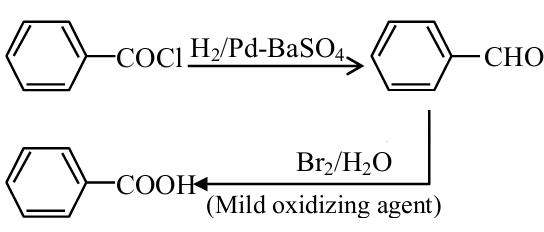
-
- (A) Both Statement I and Statement II are false
- (B) Statement I is false but Statement II is true
- (C) Statement I is true but Statement II is false
- (D) Both Statement I and Statement II are true
Show answer and solution
Correct Answer: (D)
Statement - I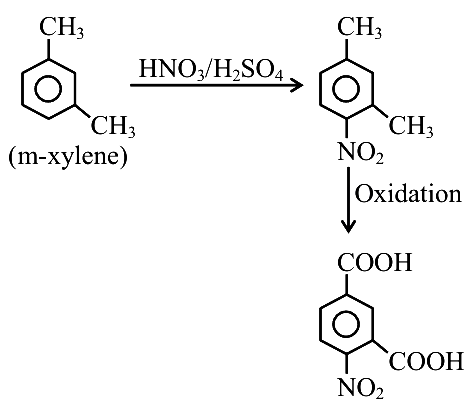
Statement-II \(-\mathrm{CH}_3\) group is o/p directing while \(-\mathrm{NO}_2\) group is meta directing. -
- (A) A, C and D Only
- (B) A, B and E Only
- (C) A and C Only
- (D) A and B Only
Show answer and solution
Correct Answer: (A)
\(A , C , D\) produce \(CO _2\) with aqueous \(NaHCO _3\) solution.
\(A , C , D\) acids are stronger acid than \(H _2 CO _3\) (Carbonic acid) -
- (A) D
- (B) A
- (C) B
- (D) C
Show answer and solution
Correct Answer: (A)
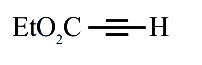
C.B. of terminal alkyne will be sp hybridisation and loculised. In other C.B. will be resonance stablised. - 136. The total number of compounds from below when treated with hot \(\text{KMnO} _4\) giving benzoic acid is _______.
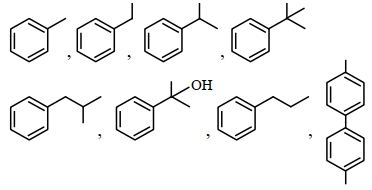 2025 Medium
- (A) 3
- (B) 4
- (C) 6
- (D) 5
Show answer and solution
Correct Answer: (D)
Compounds having at least \(1 \alpha- H\) will react with \(KMnO _4\) and give benzoic acid.
Total 5 compounds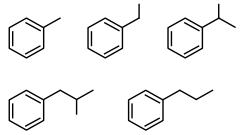
- 137. Xg of benzoic acid on reaction with aq \(\mathrm{NaHCO}_3\) released \(\mathrm{CO}_2\) that occupied 11.2 L volume at STP.
X is _____ g. 2025 Easy- (A) 60
- (B) 65
- (C) 61
- (D) 47
Show answer and solution
Correct Answer: (C)
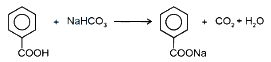
1 mole benzoic acid will release 1 mole \(\mathrm{CO}_2\)
11.2 \(\mathrm{L} \mathrm{CO}_2\) at STP is \(\frac{1}{2} \mathrm{~mole}_{\mathrm{CO}}^2\) which will be released by reaction with \(\frac{1}{2}\) mole benzoic acid
\(\begin{aligned} \text { Mass of benzoic acid } & =\frac{1}{2} \times 122 \\ & =61 \mathrm{gm}\end{aligned}\) -
- (A) A, B and D Only
- (B) C and E Only
- (C) A, C and E Only
- (D) B, C and D Only
Show answer and solution
Correct Answer: (C)
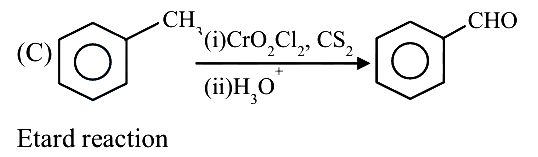
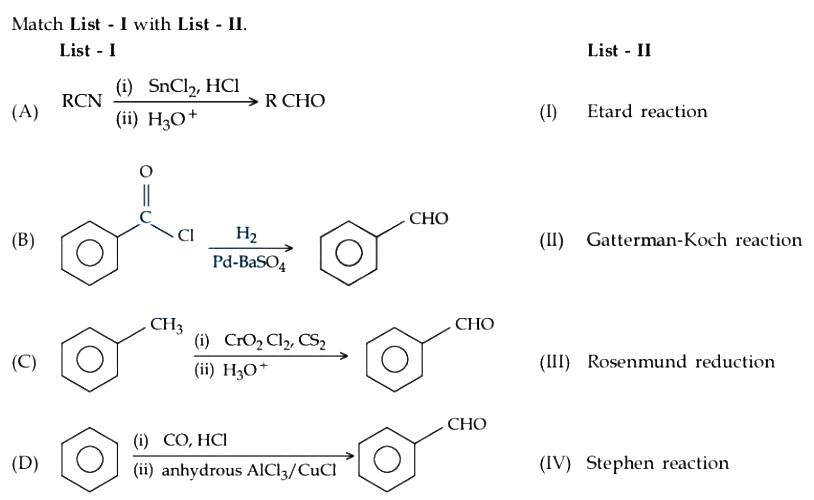
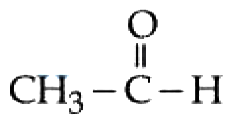
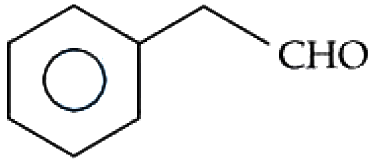
Name of Reaction Acetaldehyde Acetone A. Iodoform reaction ✓ ✓ B. Cannizaro reaction × × C. Aldol reaction ✓ ✓ D. Tollen's test ✓ × E. Clemmensen reduction ✓ ✓ -
- (A) (A)-(III), (B)-(IV), (C)-(II), (D)-(I)
- (B) (A)-(I), (B)-(III), (C)-(II), (D)-(IV)
- (C) (A)-(III), (B)-(IV), (C)-(I), (D)-(II)
- (D) (A)-(IV), (B)-(III), (C)-(I), (D)-(II)
Show answer and solution
Correct Answer: (D)
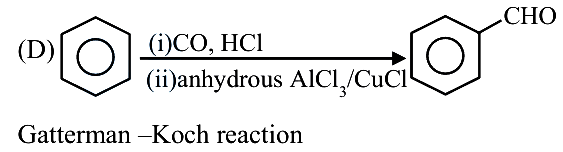
(A) \(\mathrm{RCN} \xrightarrow[\text { (i) } \mathrm{H}_3 \mathrm{O}^{+}]{\text {(i) } \mathrm{SnCl}_2, \mathrm{HCl}} \mathrm{RCHO}\)
Stephen reaction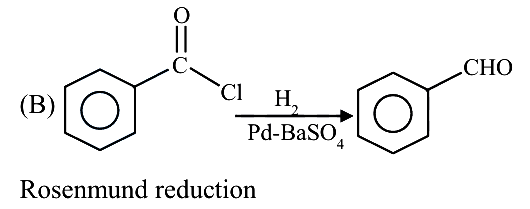
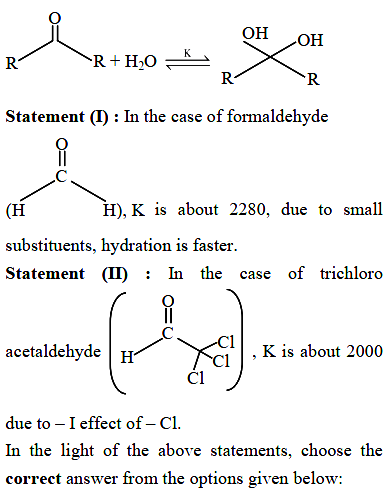
-
- (A) Both Statement I and Statement II are false
- (B) Statement I is true but Statement II is false
- (C) Statement I is false but Statement II is true
- (D) Both Statement I and Statement II are true
Show answer and solution
Correct Answer: (D)
\(\mathrm{k}_{\mathrm{eq}}=2280\) is for HCHO
\(\mathrm{k}_{\text {eq }}=2000\) is for chloral
Both data is given in clayden and warren book.
\(\mathrm{k}_{\mathrm{eq}}>1\) because HCHO and chloral are more electrophilic. -
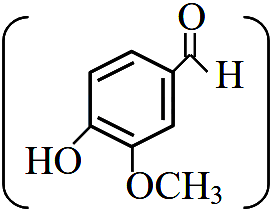
- (A) Statement I is incorrect but Statement II is correct
- (B) Statement I is correct but Statement II is incorrect
- (C) Both Statement I and Statement II are incorrect
- (D) Both Statement I and Statement II are correct
Show answer and solution
Correct Answer: (B)
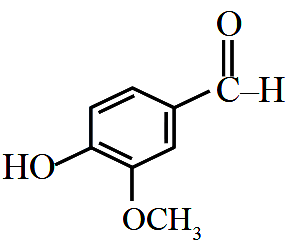
Phenolic group soluble in NaOH
Benzaldehyde derivative react with Tollen's reagent.
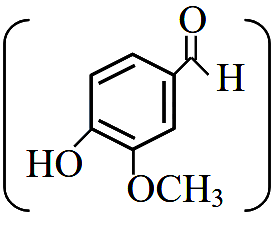
Vanillin does not give self-aldol reaction due to lack of acidic H for condensation. -
- (A) 5
- (B) 6
- (C) 7
- (D) 8
Show answer and solution
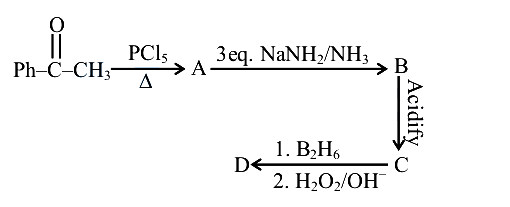
Correct Answer: (C)
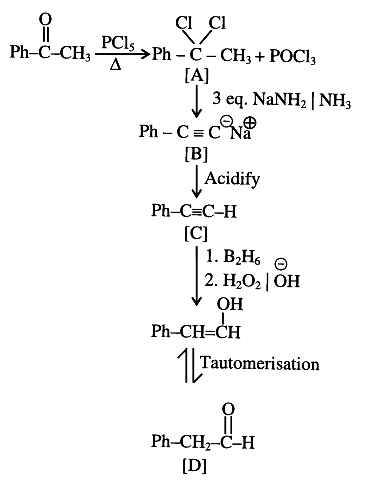
\(\Rightarrow\) Number of \(\mathrm{sp}^2 \mathrm{C}\)-atoms in product \(\mathrm{D}=7\)
NTA Ans. \(=7\)
ALLEN Ans. \(=7\) -
- (A) 5
- (B) 4
- (C) 3
- (D) 2
Show answer and solution
Correct Answer: (B)
Following will not give iodoform reaction/test.
(1) Butanal
(2) 3-Pentanone
(3) Pentanal
(4) 3-Pentanol -
- (A) (A), (D) and (E) Only
- (B) (C), (D) and (E) Only
- (C) (A), (C) and (D) Only
- (D) (A), (B) and (C) Only
Show answer and solution
Correct Answer: (B)
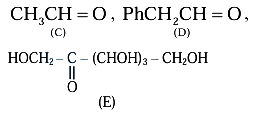
All gives positive Fehling test - 145. Which of the following arrangements with respect to their reactivity in nucleophilic addition reaction is correct? 2025 Easy
- (A) acetophenone \( \lt \) benzaldehyde \( \lt \) p-tolualdehyde \( \lt \) p- nitrobenzaldehyde
- (B) benzaldehyde \( \lt \) acetophenone \( \lt \) p- nitrobenzaldehyde \( \lt \) p-tolualdehyde
- (C) p- nitrobenzaldehyde \( \lt \) benzaldehyde \( \lt \) p-tolualdehyde \( \lt \) acetophenone
- (D) acetophenone \( \lt \) p-tolualdehyde \( \lt \) benzaldehyde \( \lt \) p- nitrobenzaldehyde
Show answer and solution
Correct Answer: (D)
Reactivity \(\propto+\mathrm{ve}\) charge on electrophilic carbon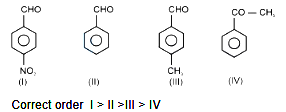
-
- (A) 11
- (B) 12
- (C) 13
- (D) 14
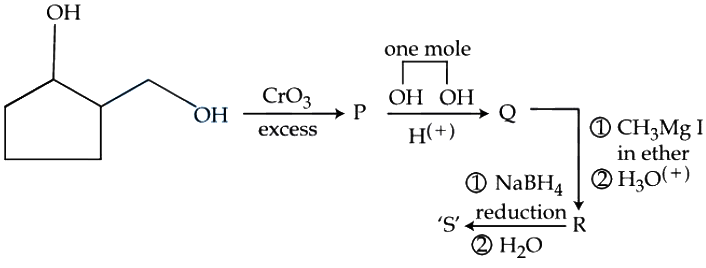
Show answer and solution
Correct Answer: (C)
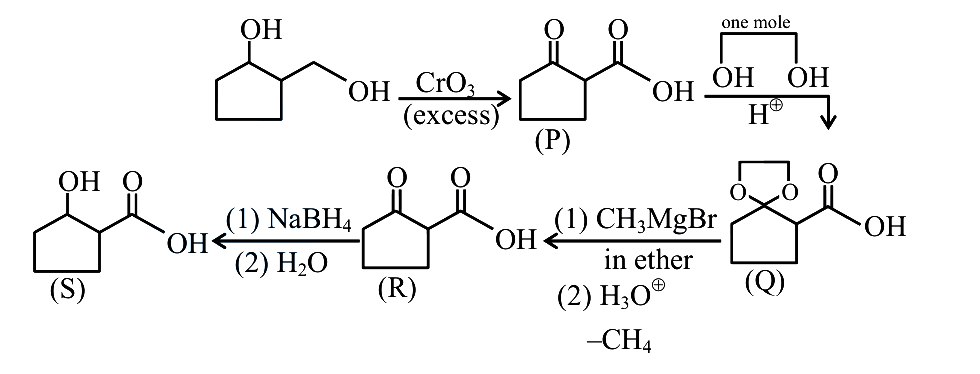
0.1 mole of compound ( S ) weight in gm
\(\begin{aligned}
& =0.1 \times \text { molar mass of compound }(\mathrm{S}) \\
& =0.1 \times 130=13 \mathrm{gm}
\end{aligned}\) -
- (A) Statement I is false but Statement II are true
- (B) Both Statement I and Statement II are false
- (C) Statement I is true but Statement II is false
- (D) Both Statement I and Statement II are true
Show answer and solution
Correct Answer: (D)
St-I : - St-I is correct because both given ether are soluble in water \(\rightarrow\) Di ethyl ether and butan-1-ol are miscible to almost same extent i.e., 7.5 and 9 gm per 100 ml water due to H -bonding St-II : - St. II is also correct because sodium metal is not used with ethyl alcohol as \(\mathrm{H}_2\) gas release with ethyl a below -
- (A) Both Statement I and Statement II are false
- (B) Both Statement I and Statement II are true
- (C) Statement I is false but Statement II is true
- (D) Statement I is true but Statement II is false
Show answer and solution
Correct Answer: (B)
Statement I is correct as boiling point of alcohol phenols increase with increase in the number of C -atoms due to increase in van der Waals forces.
Statement II is correct, since alcohols phenols have intermolecular H -bonding therefore their boiling points are higher in comparison to other class of compounds such as ethers, haloalkanes. -
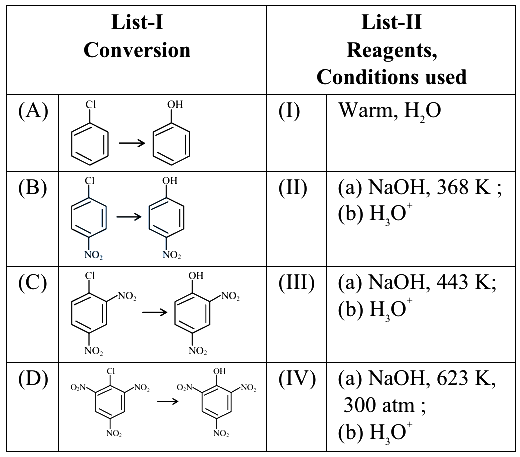
- (A) (A)-(II), (B)-(III), (C)-(I), (D)-(IV)
- (B) (A)-(III), (B)-(IV), (C)-(II), (D)-(I)
- (C) (A)-(IV), (B)-(III), (C)-(II), (D)-(I)
- (D) (A)-(IV), (B)-(III), (C)-(I), (D)-(II)
Show answer and solution
Correct Answer: (C)
Aromatic halide give nucleophilic substitution reaction at high temperature or in presence of \(-\mathrm{I} /-\) M group rate of reaction high even at low temperature.
A-IV
B-III
C-II
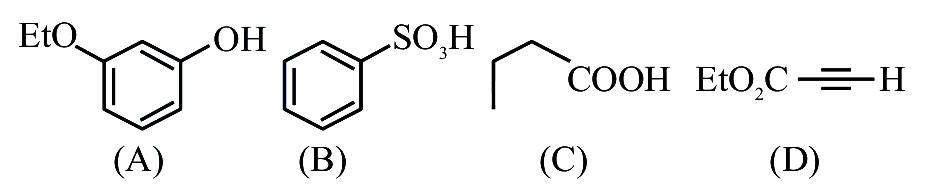
D-I - 150. The steam volatile compounds among the following are _______.
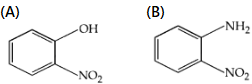
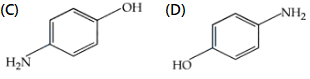
Choose the correct answer from the options given below : 2025 Medium- (A) (B) and (D) Only
- (B) (A) and (C) Only
- (C) (A), (B) and (C) Only
- (D) (A) and (B) Only
Show answer and solution
Correct Answer: (D)
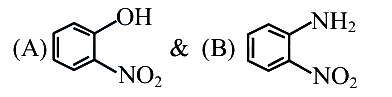
are steam volatile due to intramolecular hydrogen bonding.
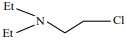 will undergo alkaline hydrolysis at a faster rate than
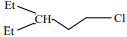
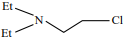 substitution takes place first by involving lone pair of electrons on nitrogen.
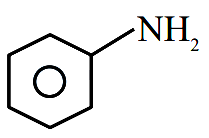
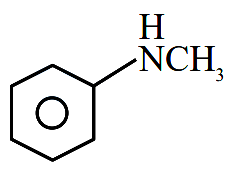
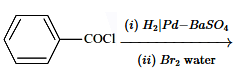
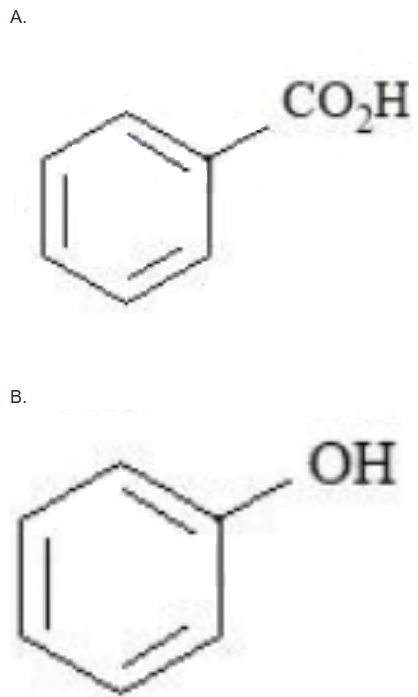 \(\qquad\)\(\qquad\)
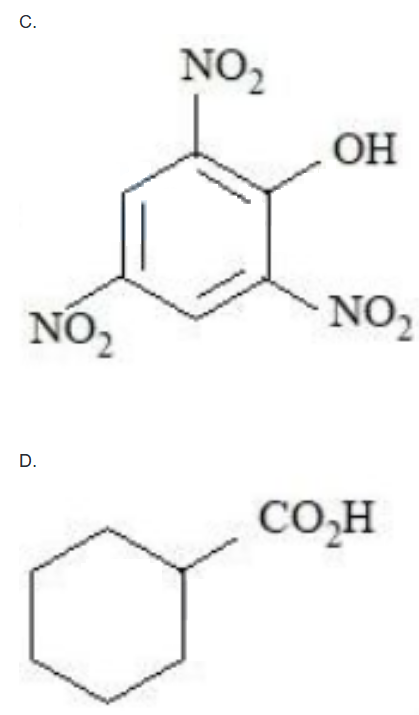
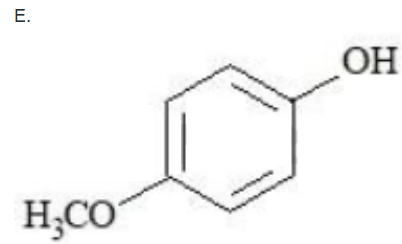
No questions on this page match these filters.