


Questions
17 questionsShowing 1–17 of 17 questions
-
- (A) 16
- (B) 32
- (C) 8
- (D) 24
Show answer and solution
Correct Answer: (D)
The number of tetrapeptides (sequences) possible involving each of these amino acids (glycine, alanine, valine, leucine) ; It has three (3) peptides linkage the number of permutations in which they can be arranged
\(\begin{aligned}
& =4 \times 3 \times 2 \times 1 \\
& =24
\end{aligned}\) -
- (A) C & D Only
- (B) A & B Only
- (C) B & C Only
- (D) C & E Only
Show answer and solution
Correct Answer: (D)
Vit D, E, K. A are fat soluble vitamins. -
- (A) Statement I is false but Statement II is true
- (B) Both Statement I and Statement II are false
- (C) Both Statement I and Statement II are true
- (D) Statement I is true but Statement II is false
Show answer and solution
Correct Answer: (A)
- D-glucose pentaacetate do not react with 2.4 DNP
- Starch \(\frac{\text { conc. } \mathrm{H}_2 \mathrm{SO}_4}{\Delta}\) Glucose
\(\begin{gathered}2-3 \mathrm{~atm} \\ 100^{\circ} \mathrm{C}\end{gathered}\) -
- (A) Both Statement I and Statement II are true.
- (B) Statement I is false but Statement II are true.
- (C) Statement I is true but Statement II is false.
- (D) Both Statement I and Statement II are false.
Show answer and solution
Correct Answer: (B)
On hydrolysis of sucrose gives D-(+)-glucose and D-(-)-fructose while in Statement (1) D-(+)-fructose is given evince Statement-(1) is incorrect.
Statement II - It is correct because sucrose on hydrolysis gives invert sugar -
- (A) Both statement I and statement II are correct
- (B) Statement I is incorrect but Statement II is correct
- (C) Both statement I and statement II are incorrect
- (D) Statement I is correct but Statement II is incorrect
Show answer and solution
Correct Answer: (C)
(i) Protein does not gives \(\beta\)-amino acid on hydrolysis
(ii) Fibrous protein are not water soluble
So both statement's are wrong -
- (A) Statement I is false but Statement II is true
- (B) Statement I is true but Statement II is false
- (C) Both Statement I and Statement II are true
- (D) Both Statement I and Statement II are false
Show answer and solution
Correct Answer: (B)
Cellulose derivcative has more number of hydroxy groups, so more H -bonding is present with water in cellulose derivatives cotton cloths. -
- (A) (A), (B) and (C) only
- (B) (B), (C) and (E) only
- (C) (C), (D) and (E) only
- (D) (B), (C) and (D) only
Show answer and solution
Correct Answer: (B)
\((\mathrm{A})\) Starch \(\xrightarrow{\mathrm{H}^{+} / \mathrm{H}_2 \mathrm{O}}\) Glucose
(B) Cane sugar \(\xrightarrow{\mathrm{H}^{+} / \mathrm{H}_2 \mathrm{O}}\) glucose + fructose (Sucrose) \(50 \% \quad 50 \%\)
(C) Milk sugar \(\xrightarrow{\mathrm{H}^{+} / \mathrm{H}_2 \mathrm{O}}\) glucose + galactose (Lactose)
(D) Amylopectin \(\xrightarrow{\mathrm{H}^{+} / \mathrm{H}_2 \mathrm{O}}\) Glucose
(E) Amylose \(\xrightarrow{\mathrm{H}^{+} / \mathrm{H}_2 \mathrm{O}}\) Glucose
So, correct options are B,C,and E only. -
- (A) All naturally occurring amino acids except glycine contain one chiral centre.
- (B) All naturally occurring amino acids are optically active.
- (C) Glutamic acid is the only amino acid that contains a-COOH group at the side chain.
- (D) Amino acid, cysteine easily undergo dimerization due to the presence of free SH group.
Show answer and solution
Correct Answer: (D)
* Isoleucine has 2 chiral centre
* Glycine is optically inactive
* Aspartic acid also contain COOH group at the side chain.
* Cysteine easily dimmerise due to free SH group -
- (A) (A), (C) and (E) only
- (B) (A), (C) and (D) only
- (C) (C), (D) and (E) only
- (D) (B), (C) and (E) only
Show answer and solution
Correct Answer: (B)
Valine, Lysine and Threonine are essential amino acids. - 10. Identify the number of structures from the following which can be correlated to D-glyceraldehyde.
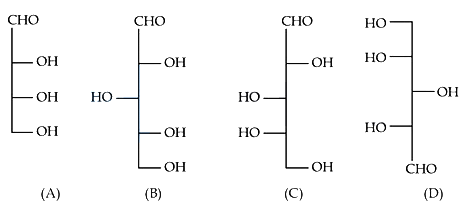 2025 Medium
- (A) four
- (B) one
- (C) two
- (D) three
Show answer and solution
Correct Answer: (D)
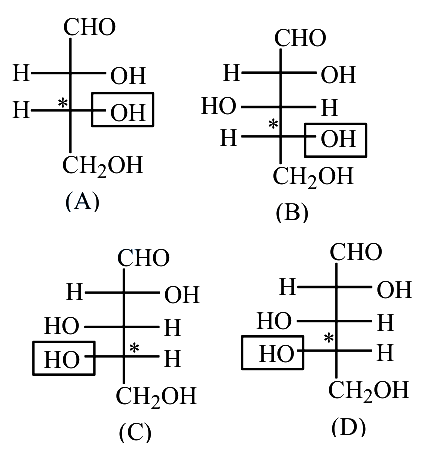
In \(\mathrm{A}, \mathrm{B}, \mathrm{D}^*-\mathrm{OH}\) group in right hand side then D-configuration is assign -
- (A) 4
- (B) 6
- (C) 8
- (D) 2
Show answer and solution
Correct Answer: (D)
\(\begin{aligned}
\text { Degree of unsaturation } & =\mathrm{C}+1-\frac{\mathrm{H}}{2} \\
& =9+1-6=4
\end{aligned}\)
Benzene shows negative Baeyer's test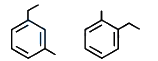
Both compounds have four different non-aliphatic substitution sites. -
- (A) (A)-(IV), (B)-(I), (C)-(III), (D)-(II)
- (B) (A)-(III), (B)-(II), (C)-(I), (D)-(IV)
- (C) (A)-(II), (B)-(III), (C)-(I), (D)-(IV)
- (D) (A)-(IV), (B)-(I), (C)-(II), (D)-(III)
Show answer and solution
Correct Answer: (D)
Amylose \(\Rightarrow \mathrm{It}\) is a plant based starch it has \(\alpha-\mathrm{C}_1-\mathrm{C}_4\) glycosidic linkage.
Cellulose \(\Rightarrow\) It has \(\beta-\mathrm{C}_1-\mathrm{C}_4\) glycosidic linkage
Glycogen \(\Rightarrow\) It has \(\alpha-\mathrm{C}_1-\mathrm{C}_4\) and glycosidic linkage (animal starch)
Amylopectin \(\Rightarrow\) It is a plant based with \(\alpha-\mathrm{C}_1-\mathrm{C}_4\) and \(\mathrm{C}_1-\mathrm{C}_6\) glycosidic linkage -
- (A) (A)-(IV), (B)-(II), (C)-(I), (D)-(III)
- (B) (A)-(I), (B)-(II), (C)-(III), (D)-(IV)
- (C) (A)-(III), (B)-(I), (C)-(IV), (D)-(II)
- (D) (A)-(II), (B)-(IV), (C)-(III), (D)-(I)
Show answer and solution
Correct Answer: (C)
(A) Sucrose \(\rightarrow \alpha_1-\beta_2\) Glycosidic linkage
(B) Maltose \(\rightarrow \alpha\) 1-4 Glycosidic linkage
(C) Lactose \(\rightarrow \beta\) 1-4 Glycosidic linkage
(D) Amylopectin \(\rightarrow \alpha 1-4\) and \(\alpha 1-6\)
Glycosidic linkage
A-III, B-I, C-IV, D-II -
- (A) A, D and E Only
- (B) A, C and D Only
- (C) A, B and E Only
- (D) B, D and E Only
Show answer and solution
Correct Answer: (B)
In Ribose carbohydrate present in DNA is \(\beta-2-\) Deoxy-D-Ribose whose structure is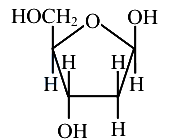
which is a reducing \(D\)-sugar in \(\beta\) anomeric form & it is a pentose sugar. - 15. The \(\alpha\)-Helix and \(\beta\) - Pleated sheet which structures of protein are associated with its? 2025 Easy
- (A) tertiary structure
- (B) quaternary structure
- (C) secondary structure
- (D) primary structure
Show answer and solution
Correct Answer: (C)
\(\alpha\)-helix and \(\beta\)-pleated sheet belongs to secondary structure of protein, which have hydrogen bonds. -
- (A) 11
- (B) 22
- (C) 33
- (D) 44
Show answer and solution
Correct Answer: (C)
Two nucleic acid chains are wound about each other and held together by H bonds between pair of bases.
Adenine from two hydrogen bonds with thymine and Guanine form three hydrogen bond with cytosine.
\(5^{\prime} \mathrm{G}-\mathrm{G}-\mathrm{C}-\mathrm{A}-\mathrm{A}-\mathrm{A}-\mathrm{T}-\mathrm{C}-\mathrm{G}-\mathrm{G}-\mathrm{C}-\mathrm{T}-\mathrm{A}-3^{\prime}\)
In given DNA strand total seven guanine and cytosine bases which form total 21 H -bonds and six adenine and thymine base which will form total 12 H-bonds with other DNA strand.
Total no. of H bonds \(=7 \times 3+6 \times 2=33\) -
- (A) Adipic acid
- (B) Ascorbic acid
- (C) Saccharic acid
- (D) Aspartic acid
Show answer and solution
Correct Answer: (B)
Vitamin-C is Ascorbic acid.
No questions on this page match these filters.