


Questions
31 questionsShowing 1–31 of 31 questions
-
- (A) 4
- (B) 6
- (C) 8
- (D) 2
Show answer and solution
Correct Answer: (D)
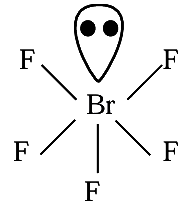
1 lone pair hence 1 mole AgCl.
Complex is \(\left[\mathrm{M}\left(\mathrm{NH}_3\right)_3 \mathrm{Cl}_3\right] \mathrm{Cl}\).
It shows 2 geometrical isomers \(\left(\mathrm{Ma}_3 \mathrm{~b}_3\right.\) type) facial (fac) & meridional (Mer) -
- (A) 2
- (B) 3
- (C) 4
- (D) 1
Show answer and solution
Correct Answer: (D)
Co has highest standard electrode potential \(\left(\mathrm{M}^{+3} / \mathrm{M}^{+2}\right)\) among \(\mathrm{Mn}, \mathrm{Cr}, \mathrm{Co}, \mathrm{Fe}\)
\(\therefore\) Complex is \(\left[\mathrm{Co}(\mathrm{CN})_6\right]^{4-}\) and its splitting is as follows.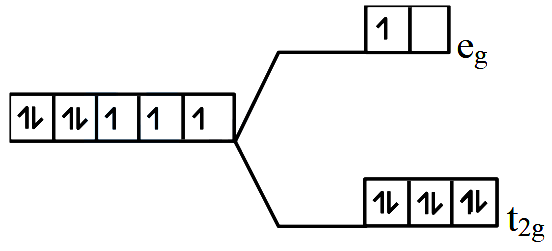
\(\therefore\) electron in \(\mathrm{e}_{\mathrm{g}}\) orbital is one. -
- (A) 3
- (B) 6
- (C) 9
- (D) 12
Show answer and solution
Correct Answer: (A)
\(\mathrm{Cu}^{2+}, \mathrm{Ca}^{2+} \& \mathrm{Zn}^{2+}\) will form precipitate with \(\mathrm{K}_4\left[\mathrm{Fe}(\mathrm{CN})_6\right] . \mathrm{Fe}^{3+}\) forms coloured solution -
- (A) Co-ordinate isomerism
- (B) Linkage isomerism
- (C) Ionisation isomerism
- (D) Geometrical isomerism
Show answer and solution
Correct Answer: (C)
(A) complex is \(\left[\mathrm{Co}\left(\mathrm{NH}_3\right)_5\left(\mathrm{SO}_4\right)\right] \mathrm{Cl}\)
(B) complex is \(\left[\mathrm{Co}\left(\mathrm{NH}_3\right)_5 \mathrm{Cl}\right] \mathrm{SO}_4\)
Both \((\mathrm{A})\) and \((\mathrm{B})\) are Ionisation isomers. -
- (A) \(0\)
- (B) 1
- (C) 2
- (D) 3
Show answer and solution
Correct Answer: (A)
\(\mathrm{K}_3\left[\mathrm{Co}\left(\mathrm{NO}_2\right)_6\right]=\) Yellow \(\Rightarrow \mathrm{Co}^{3+}=3 \mathrm{~d}^6 \Rightarrow \mathrm{t}_{2 \mathrm{~g}}^6 \mathrm{e}_{\mathrm{g}}^0\)
\(\begin{aligned}
& \mathrm{K}_4\left[\mathrm{Fe}(\mathrm{CN})_8\right]=\text { Yellow } \Rightarrow \mathrm{Fe}^{2+}=3 \mathrm{~d}^6 \Rightarrow \mathrm{t}_{2 \mathrm{~g}}^6 \mathrm{e}_{\mathrm{g}}^0 \\
& \mathrm{~K}_3\left[\mathrm{Fe}(\mathrm{CN})_8\right]=\text { Bright Red } \Rightarrow \mathrm{Fe}^{3+}=3 \mathrm{~d}^5 \Rightarrow \mathrm{t}_{2 \mathrm{~g}}^5 \mathrm{e}_{\mathrm{g}}^0 \\
& \mathrm{Cu}_2\left[\mathrm{Fe}(\mathrm{CN})_8\right]=\text { Chocolate brown } \\
& \mathrm{Zn}_2\left[\mathrm{Fe}(\mathrm{CN})_8\right]=\text { White }
\end{aligned}\)
Spin only magnetic moment of complex having Yellow colour is zero. -
- (A) \(\left[\mathrm{Cr}\left(\mathrm{NH}_3\right)_5 \mathrm{Cl}\right] \mathrm{Cl}_2\)
- (B) \(\left[\mathrm{Cr}\left(\mathrm{NH}_3\right)_6\right] \mathrm{Cl}_3\)
- (C) \(\left[\mathrm{Cr}\left(\mathrm{NH}_3\right)_3 \mathrm{Cl}_3\right]\)
- (D) \(\left[\mathrm{Cr}\left(\mathrm{NH}_3\right)_4 \mathrm{Cl}_2\right] \mathrm{Cl}\)
Show answer and solution
Correct Answer: (A)
\(\begin{aligned} & \Delta T_f=i K_f m \\ & 0.558=i \times 1.86 \times 0.1 \\ & i=\frac{0.558}{0.186}=3\end{aligned}\)
Number of ions when 100\% ionisation takes place \(=3\)
\(\left[\mathrm{Cr}\left(\mathrm{NH}_3\right)_5 \mathrm{Cl}\right] \mathrm{Cl}_2 \xrightarrow{\text { aqueous solution }}\left[\mathrm{Cr}\left(\mathrm{NH}_3\right)_5 \mathrm{Cl}^{2+}\right]^{2+}+2 \mathrm{Cl}^{-}\)
Number of ions \(=3\) -
- (A) \(\left[\mathrm{NiCl}_4\right]^{2-}: \mathrm{Ni}^{\mathrm{II}}\), tetrahedral
\(\left[\mathrm{Ni}(\mathrm{CO})_4\right]: \mathrm{Ni}^{\mathrm{II}}\), square planar - (B) \(\left[\mathrm{NiCl}_4\right]^{2-}\) : \(\mathrm{Ni}^{\mathrm{II}}\), square planar
\(\left[\mathrm{Ni}(\mathrm{CO})_4\right]: \mathrm{Ni}(0)\), square planar - (C) \(\left[\mathrm{NiCl}_4\right]^{2-}: \mathrm{Ni}^{\mathrm{II}}\), tetrahedral
\(\left[\mathrm{Ni}(\mathrm{CO})_4\right]: \mathrm{Ni}(0)\), tetrahedral - (D) \(\left[\mathrm{NiCl}_4\right]^{2-}: \mathrm{Ni}(0)\), tetrahedral
\(\left[\mathrm{Ni}(\mathrm{CO})_4\right]: \mathrm{Ni}(0)\), square planar
Show answer and solution
Correct Answer: (C)
\(\left[\mathrm{NiCl}_4\right]^{2-}\)
\(\mathrm{Ni}^{+2}-[\mathrm{Ar}] 3 \mathrm{~d}^8 4 \mathrm{~s}^0 \rightarrow \mathrm{sp}^3\), Tetrahedral
Number of unpaired electron \(=2\) paramagentic
\(\left[\mathrm{Ni}(\mathrm{CO})_4\right]\)
\(\mathrm{Ni}(0) \rightarrow[\mathrm{Ar}] 3 \mathrm{~d}^{10} 4 \mathrm{~s}^0\) (After rearrangement)
No unpaired electron
\(\mathrm{sp}^3\), Tetrahedral, Diamagnetic - (A) \(\left[\mathrm{NiCl}_4\right]^{2-}: \mathrm{Ni}^{\mathrm{II}}\), tetrahedral
-
- (A) Statement I is correct but Statement II is incorrect.
- (B) Both Statement I and Statement II are incorrect
- (C) Statement I is incorrect but Statement II is correct
- (D) Both Statement I and Statement II are correct
Show answer and solution
Correct Answer: (D)
In octahedral complex \((\mathrm{CN}=6)\)
If \(\Delta_0 \lt \) P.E., then high spin complexes are formed
If \(\Delta_0 \gt \) P.E., then low spin complexes are formed But in tetrahedral complex \((\mathrm{CN}=4)\)
\(\Delta_t \lt \) P.E., then mainly high spin complexes are formed and rarely low spin complexes are formed. -
- (A) Both statements I and Statement II are false
- (B) Statement I is false but Statement II is true
- (C) Statement I is true but Statement II are false
- (D) Both statements I and Statement II are true
Show answer and solution
Correct Answer: (C)
Mohr's salt : \(\mathrm{FeSO}_4 \cdot\left(\mathrm{NH}_4\right)_2 \mathrm{SO}_4 \cdot 6 \mathrm{H}_2 \mathrm{O}\)
Using Kohlrousch law
\(\lambda_{\mathrm{m}}^{\infty}(\text { Mohr's salt })=\mathrm{x}_1+2 \mathrm{x}_2+2 \mathrm{x}_3\) -
- (A) (B), (C) and (D) only
- (B) (C) and (E) only
- (C) (B) and (D) only
- (D) (A), (B) and (E) only
Show answer and solution
Correct Answer: (C)
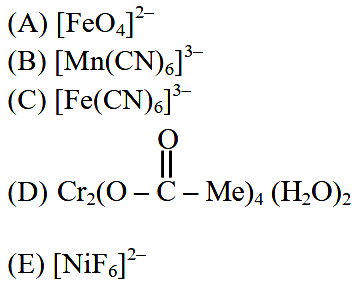
\(\begin{aligned} & \mathrm{Fe}^{+6}=[\mathrm{Ar}] 3 \mathrm{~d}^2 \\ & \mathrm{Mn}^{+3}=[\mathrm{Ar}] 3 \mathrm{~d}^4 \\ & \mathrm{Fe}^{+3}=[\mathrm{Ar}] 3 \mathrm{~d}^5 \\ & \mathrm{Cr}^{+2}=[\mathrm{Ar}] 3 \mathrm{~d}^4 \\ & \mathrm{Ni}^{+4}=[\mathrm{Ar}] 3 \mathrm{~d}^6\end{aligned}\) -
- (A) (C) only
- (B) (C) and (D) only
- (C) (A) and (C) only
- (D) (B) and (E) only
Show answer and solution
Correct Answer: (B)
(A) \(\left[\mathrm{Fe}(\mathrm{CN})_5 \mathrm{NO}\right]^{-2} \rightarrow\) Heteroleptic, \(\mathrm{Fe}^{+2}, 3 \mathrm{~d}^6\), \(\mathrm{t}_{2 \mathrm{~g}}{ }^6 \mathrm{e}_{\mathrm{g}}{ }^0, \mathrm{~d}^2 \mathrm{sp}^3\), Low spin ( 3 d series +SFL )
(B) \(\left[\mathrm{CoF}_6\right]^{-3} \rightarrow\) Homoleptic, \(\mathrm{sp}^3 \mathrm{~d}^2\), High spin, \(\mathrm{Co}^{+3}, 3 \mathrm{~d}^6(3 \mathrm{~d}\) series + WFL \()\)
(C) \(\left[\mathrm{Fe}(\mathrm{CN})_6\right]^{-4} \rightarrow\) Homoleptic
\(\mathrm{Fe}^{+2}, 3 \mathrm{~d}^6, \mathrm{~d}^2 \mathrm{sp}^3, \mathrm{t}_{2 \mathrm{~g}}{ }^6 \mathrm{eg}^0\) Low spin
\((3 \mathrm{~d}\) series +SFL\()\)
(D) \(\left[\mathrm{Co}\left(\mathrm{NH}_3\right)_6\right]^{+3} \rightarrow\) Homoleptic, \(\mathrm{Co}^{+3} 3 \mathrm{~d}^6, \mathrm{~d}^2 \mathrm{sp}^3\),
\(\mathrm{t}_{2 \mathrm{~g}}{ }^6 \mathrm{eg}^0\), Low spin (3d series + SFL)
(E) \(\left[\mathrm{Cr}\left(\mathrm{H}_2 \mathrm{O}\right)_6\right]^{+2} \rightarrow\) Homoleptic
\(\mathrm{Cr}^{+2} 3 \mathrm{~d}^4, \mathrm{~d}^2 \mathrm{sp}^3\), High spin \(\mathrm{t}_{2 \mathrm{~g}}{ }^3 \mathrm{e}_{\mathrm{g}}{ }^1\)
(3d series + WFL) -
- (A) (A), (B) and (D) only
- (B) (C) and (E) only
- (C) (B) and (D) only
- (D) (A), (C) and (E) only
Show answer and solution
Correct Answer: (C)
(A) \(\left[\mathrm{FeO}_4\right]^{2-} \Rightarrow \mathrm{Fe}^{6+}=3 \mathrm{~d}^2\)
(B) \(\left[\mathrm{Fe}(\mathrm{CN})_8\right]^{3-} \Rightarrow \mathrm{Fe}^{3+}=3 \mathrm{~d}^5\)
(C) \(\left[\mathrm{Fe}(\mathrm{CN})_5 \mathrm{NO}\right]^{2-} \Rightarrow \mathrm{Fe}^{2+}=3 \mathrm{~d}^6\)
(D) \([\mathrm{CoCl} 4]^{2-} \Rightarrow \mathrm{Co}^{2+}=3 \mathrm{~d}^7\)
(E) \(\left[\mathrm{Co}\left(\mathrm{H}_2 \mathrm{O}\right)_3 \mathrm{~F}_3\right] \Rightarrow \mathrm{Co}^{3+}=3 \mathrm{~d}^6\)
(B) and (D) are homoleptic complex having odd no. of d electrons. - 13. In which of the following complexes the CFSE, \(\Delta_{\mathrm{o}}\) will be equal to zero? 2025 Medium
- (A) \(\left[\mathrm{Fe}(\mathrm{en})_3\right] \mathrm{Cl}_3\)
- (B) \(\mathrm{K}_4\left[\mathrm{Fe}(\mathrm{CN})_6\right]\)
- (C) \(\left[\mathrm{Fe}\left(\mathrm{NH}_3\right)_6\right] \mathrm{Br}_2\)
- (D) \(\mathrm{K}_3\left[\mathrm{Fe}(\mathrm{SCN})_6\right]\)
Show answer and solution
Correct Answer: (D)
For complex \(\mathrm{K}_3\left[\mathrm{Fe}(\mathrm{SCN})_6\right]\)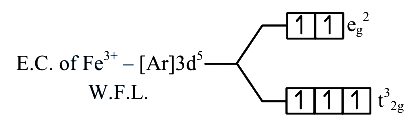
Calculation of CFSE
\(\begin{aligned}
& =(-0.4 \times 3+0.6 \times 2) \Delta_0 \\
& =0 \Delta_0
\end{aligned}\) -
- (A) (A)-(III), (B)-(I), (C)-(II), (D)-(IV)
- (B) (A)-(I), (B)-(IV), (C)-(II), (D)-(III)
- (C) (A)-(I), (B)-(III), (C)-(II), (D)-(IV)
- (D) (A)-(II), (B)-(III), (C)-(IV), (D)-(I)
Show answer and solution
Correct Answer: (B)
Primary valency \(=\) Oxidation state
Secondary valency \(=\) Co-ordination numberComplex Primary Valency Secondary Valency (A) [Co(en)2Cl2]Cl 3 6 (B) [Pt(NH3)2Cl(NO2)] 2 4 (C) Hg[Co(SCN)4] 3 4 (D) [Mg(EDTA)]2- 2 6 -
- (A) (A)-(IV), (B)-(II), (C)-(III), (D)-(I)
- (B) (A)-(IV), (B)-(III), (C)-(I), (D)-(II)
- (C) (A)-(III), (B)-(IV), (C)-(II), (D)-(I)
- (D) (A)-(III), (B)-(I), (C)-(IV), (D)-(II)
Show answer and solution
Correct Answer: (B)
- Bronze is an alloy of copper and Tin. (A-IV)
- Brass is an alloy of copper and Zinc. (B-III)
- UK Silver coin is an alloy of copper and Nickel. (C-I)
- Stainless steel is an alloy of \(\mathrm{Fe}, \mathrm{Cr}, \mathrm{Ni}, \mathrm{C}\). (D-II) -
- (A) A-II, B-III, C-IV, D-I
- (B) A-IV, B-I, C-II, D-III
- (C) A-I, B-II, C-III, D-IV
- (D) A-III, B-I, C-IV, D-II
Show answer and solution
Correct Answer: (A)
\(\begin{aligned}
& \mathrm{PF}_5: 5 \sigma+0 \ell \mathrm{p} \rightarrow \mathrm{sp}^3 \mathrm{~d} \\
& \mathrm{SF}_6: 6 \sigma+0 \ell \mathrm{p} \rightarrow \mathrm{sp}^3 \mathrm{~d}^2 \\
& \mathrm{Ni}(\mathrm{CO})_4: \mathrm{Ni} \rightarrow 0
\end{aligned}\)
In presence of ligand field :-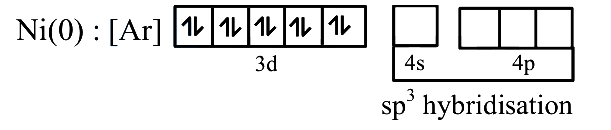
\(\left[\mathrm{PtCl}_4\right]^{2-}: \mathrm{Pt} \rightarrow+2\)
In presence of ligand field :-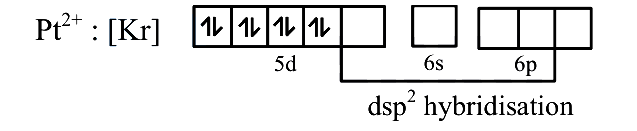
-
- (A) \(3 \& 3\)
- (B) \(2 \& 2\)
- (C) \(2 \& 3\)
- (D) \(1 \& 2\)
Show answer and solution
Correct Answer: (C)
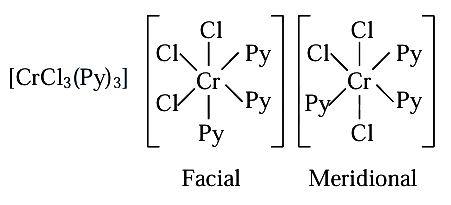
So total stereo isomer \(=2\)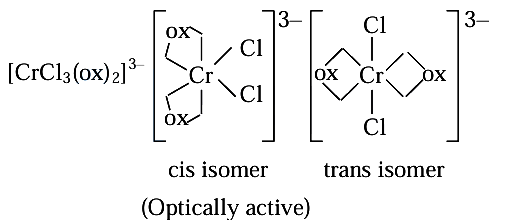
Geometrical isomer \(=2(1\) cis +1 trans \()\)
Optical isomer \(=3\) ( 2 optically active +1 optically inactive)
Stereoisomer \(=3\) -
- (A) \(\left[\mathrm{Co}\left(\mathrm{NH}_3\right)_4 \mathrm{Cl}_2\right] \cdot \mathrm{Cl} \cdot \mathrm{NH}_3\)
- (B) \(\left[\mathrm{Co}\left(\mathrm{NH}_3\right)_3 \mathrm{Cl}_3\right] \cdot 2 \mathrm{NH}_3\)
- (C) \(\left[\mathrm{Co}\left(\mathrm{NH}_3\right)_5 \mathrm{Cl}\right] \mathrm{Cl}_2\)
- (D) \(\left[\mathrm{Co}\left(\mathrm{NH}_3\right)_4 \mathrm{Cl}\right] \cdot \mathrm{Cl}_2 \cdot \mathrm{NH}_3\)
Show answer and solution
Correct Answer: (C)
\(\begin{array}{l}{\left[\mathrm{Co}\left(\mathrm{NH}_3\right)_5 \mathrm{Cl}\right] \mathrm{Cl}_2 \rightarrow \underbrace{\left[\mathrm{Co}\left(\mathrm{NH}_3\right)_5 \mathrm{Cl}\right]^{2+}(\text { aq. })+2 \mathrm{Cl}^{-}(\text {aq. })}_{3 \text { ions in water }}} \\ {\left[\mathrm{Co}\left(\mathrm{NH}_3\right)_5 \mathrm{Cl}\right] \mathrm{Cl}_2(\text { aq. })+2 \mathrm{AgNO}_3(\text { aq. }) \rightarrow} {\left[\mathrm{Co}\left(\mathrm{NH}_3\right)_5 \mathrm{Cl}\right]\left(\mathrm{NO}_3\right)_2(\text { aq. })+2 \mathrm{AgCl}(\mathrm{s})}\end{array}\) - 19. The complex of \(\mathrm{Ni}^{2+}\) ion and dimethyl glyoxime contains ________ number of Hydrogen \((\mathrm{H})\) atoms. 2025 Easy
- (A) 10
- (B) 14
- (C) 18
- (D) 22
Show answer and solution
Correct Answer: (B)
\(\mathrm{Ni}^{2+}\) with(dmg) forms \(\left[\mathrm{Ni}(\mathrm{dmg})_2\right]^{2+}\) having 2 H -Bonds as shown:
The no. of H atoms \(=14\)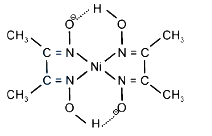
-
- (A) \({ }_{1 .}\left[\mathrm{Co}(\mathrm{en})_2 \mathrm{Cl}_2\right]^{+}\)
- (B) \(\left[\mathrm{Co}(\mathrm{en})_3\right]^{3+}\)
- (C) \(\left[\mathrm{Co}\left(\mathrm{NH}_3\right)_3 \mathrm{Cl}_3\right]\)
- (D) \(\left[\mathrm{Co}\left(\mathrm{NH}_3\right)_4 \mathrm{Cl}_2\right]^{+}\)
Show answer and solution
Correct Answer: (C)
\(\mathrm{Ma}_3 \mathrm{~b}_3\) type complexes show Facial - Meridional isomerism
(i) \(\left[\mathrm{Co}\left(\mathrm{NH}_3\right)_3 \mathrm{Cl}_3\right] \Rightarrow \mathrm{Ma}_3 \mathrm{~b}_3\)
(ii) \(\left[\mathrm{Co}\left(\mathrm{NH}_3\right)_4 \mathrm{Cl}_2\right]^{+} \Rightarrow \mathrm{Ma}_4 \mathrm{~b}_2\)
(iii) \(\left[\mathrm{Co}(\mathrm{en})_3\right]^{3+} \Rightarrow \mathrm{M}(\mathrm{AA})_3\)
(iv) \(\left[\mathrm{Co}(\mathrm{en})_2 \mathrm{Cl}_2\right]^{+} \Rightarrow \mathrm{M}(\mathrm{AA})_2 \mathrm{~b}_2\)
\(\mathrm{a}, \mathrm{b},=\mathrm{NH}_3, \mathrm{Cl}^{-}\)
\(\mathrm{AA}=\mathrm{en}\) - 21. The conditions and consequence that favours the \(t_{2 g}^3 e_g^1\) configuration in a metal complex are _______. 2025 Medium
- (A) weak field ligand, low spin complex
- (B) weak field ligand, high spin complex
- (C) strong field ligand, high spin complex
- (D) strong field ligand, low spin complex
Show answer and solution
Correct Answer: (B)
The conditions and consequence that favour \(t_{2 g}^3 e_g^1\) configuration in a metal complex are
(i) weak field ligand, and
(ii) high spin complex
For weak field ligands, splitting energy ( \(\Delta_0\) ) is lower than pairing energy \((P)\). As a result distribution of electrons for \(3 \mathrm{~d}^4\) will be \(t_{2 \mathrm{~g}}^3 \mathrm{e}_{\mathrm{g}}^1\). It results in high spin complex due to maximum number of unpaired electrons. -
- (A) \(\mathrm{IV} \lt \mathrm{III} \lt \mathrm{II} \lt \mathrm{I}\)
- (B) \(\mathrm{I} \lt \mathrm{II} \lt \mathrm{IV} \lt \) III
- (C) III \( \lt \) II \( \lt \) IV \( \lt \) I
- (D) II \( \lt \) III \( \lt \) I \( \lt \) IV
Show answer and solution
Correct Answer: (B)
Neglecting pairing energy
I. \([\mathrm{Mn}(\mathrm{CN}) \mathrm{B}]^{3-} \Rightarrow \mathrm{Mn}^{3+}, \mathrm{t}_2 \mathrm{~g}^4, \mathrm{CFSE}=-0.4 \times 4 \Delta \mathrm{o}\) \(=-1.6 \Delta\) 。
II. \([\mathrm{Co}(\mathrm{CN}) 8]^{4-} \Rightarrow \mathrm{Co}^{2+}, \mathrm{t}_2{ }^6 \mathrm{eg}^1, \mathrm{CFSE}=-0.4 \times 6+\) \(0.6 \times 1=-1.8 \Delta_{\circ}\)
III. \(\left[\mathrm{Fe}(\mathrm{CN})_8\right]^{4-} \Rightarrow \mathrm{Fe}^{2+}, \mathrm{t}_{2 g}{ }^6 \mathrm{e}^0, \mathrm{CFSE}=-0.4 \times 6=\) \(-2.4 \Delta_0\)
IV. \(\left[\mathrm{Fe}(\mathrm{CN})_8\right]^{3-} \Rightarrow \mathrm{Fe}^{3+}, \mathrm{t}_{2 g}{ }^5 \mathrm{e}^0, \mathrm{CFSE}=-0.4 \times 5=\) \(-2 \Delta_0\)
Order of stability III \(>\) IV \(>\) II \(>\) I -
- (A) D > A > B > C
- (B) C > B > D > A
- (C) D > C > B > A
- (D) C > B > A > D
Show answer and solution
Correct Answer: (A)
We know \(\mathrm{E}=\mathrm{h} v=\frac{\mathrm{hC}}{\lambda}\)
\(\mathrm{E} \propto \frac{1}{\lambda}\)
Here all Co in +3 oxidation state.
So, as the ligand field strength \(\uparrow, \operatorname{CFSE} \uparrow\)
Order of field strength of ligand :
\(\mathrm{CN} \gt \mathrm{NH}_3 \gt \mathrm{H}_2 \mathrm{O} \gt \mathrm{Cl}^{-}\)
CFSE order : \(\mathrm{C} \gt \mathrm{B} \gt \mathrm{A} \gt \mathrm{D}\)
Wavelength order: \(\mathrm{D} \gt \mathrm{A} \gt \mathrm{B} \gt \mathrm{C}\) - 24. The correct order of the following complexes in terms of their crystal field stabilization energies is _______. 2025 Hard
- (A) \(\left[\mathrm{Co}\left(\mathrm{NH}_3\right)_4\right]^{2+} \lt \left[\mathrm{Co}\left(\mathrm{NH}_3\right)_6\right]^{2+} \lt \left[\mathrm{Co}(\mathrm{en})_3\right]^{3+} \lt \left[\mathrm{Co}\left(\mathrm{NH}_3\right)_6\right]^{3+}\)
- (B) \(\left[\mathrm{Co}\left(\mathrm{NH}_3\right)_6\right]^{2+} \lt \left[\mathrm{Co}\left(\mathrm{NH}_3\right)_6\right]^{3+} \lt \left[\mathrm{Co}\left(\mathrm{NH}_3\right)_4\right]^{2+} \lt \left[\mathrm{Co}(\mathrm{en})_3\right]^{3+}\)
- (C) \(\left[\mathrm{Co}(\mathrm{en})_3\right]^{3+} \lt \left[\mathrm{Co}\left(\mathrm{NH}_3\right)_6\right]^{3+} \lt \left[\mathrm{Co}\left(\mathrm{NH}_3\right)_6\right]^{2+} \lt \left[\mathrm{Co}\left(\mathrm{NH}_3\right)_4\right]^{2+}\)
- (D) \(\left[\mathrm{Co}\left(\mathrm{NH}_3\right)_4\right]^{2+} \lt \left[\mathrm{Co}\left(\mathrm{NH}_3\right)_6\right]^{2+} \lt \left[\mathrm{Co}\left(\mathrm{NH}_3\right)_6\right]^{3+} \lt \left[\mathrm{Co}(\mathrm{en})_3\right]^{3+}\)
Show answer and solution
Correct Answer: (D)
Crystal field splitting energy \((\Delta) \propto\) charge or oxidation state of central metal atom.
Crystal field splitting energy \((\Delta) \propto\) Field strength of ligand (and chelation)
Crystal field stabilisation energy (CFSE) \(=\left[-0.4 \mathrm{t}_{\mathrm{g}_g}\right.\) +0.6 eg] \(\Delta_{\circ}\) (for octahedral)
For,
\(\begin{aligned} & {\left[\mathrm{Co}(\mathrm{en})_3\right]^{3+}: \mathrm{Co}^{3+}: \mathrm{t}_{2 \mathrm{~g}}^6 \mathrm{eg}^0 ; \mathrm{CFSE}=-2.4\left(\Delta_0\right)_1} \\ & {\left[\mathrm{Co}\left(\mathrm{NH}_3\right)_6\right]^{3+}: \mathrm{Co}^{3+}: \mathrm{t}_{2 \mathrm{~g}}^6 \mathrm{eg}^0 ; \mathrm{CFSE}=-2.4\left(\Delta_0\right)_2} \\ & {\left[\mathrm{Co}\left(\mathrm{NH}_3\right)_6\right]^{2+}: \mathrm{Co}^{2+}: \mathrm{t}_{2 g}^5 \mathrm{eg}^2 ; \mathrm{CFSE}=-0.8\left(\Delta_0\right)_3} \\ & {\left[\mathrm{Co}\left(\mathrm{NH}_3\right)_4\right]^{2+}: \mathrm{Co}^{2+}: \mathrm{e}^4 \mathrm{t}_2^3 ; \mathrm{CFSE}=-1.2 \Delta_{\mathrm{t}}} \\ & \left(\mathrm{as}:\left(\Delta_{\mathrm{t}}\right)=\frac{4}{9}\left(\Delta_0\right)_3\right) \\ & \because \Delta_{\mathrm{t}} < \left(\Delta_0\right)_3 < \left(\Delta_0\right)_2 < \left(\Delta_0\right)_1\end{aligned}\) - 25. The d- electronic configuration of an octahedral Co(II) complex having magnetic moment of 3.95 BM is _______. 2025 Medium
- (A) \(\mathrm{t}_{2 \mathrm{~g}}{ }^3 \mathrm{e}_{\mathrm{g}}{ }^0\)
- (B) \(\mathrm{t}_{2 \mathrm{~g}}{ }^6 \mathrm{e}_{\mathrm{g}}{ }^1\)
- (C) \(\mathrm{t}_{2 \mathrm{~g}}{ }^5 \mathrm{e}_{\mathrm{g}}{ }^2\)
- (D) \(\mathrm{e}^4 \mathrm{t}_2{ }^3\)
Show answer and solution
Correct Answer: (C)
\(\mathrm{Co}^{2+}\) complex having \(\mu=3.95 \mathrm{BM}\)
Hence number of unpaired electron \(=3\)
\(\mathrm{Co}^{2+} \Rightarrow 3 d^7=\mathrm{t}_{2 \mathrm{~g}}^5 \mathrm{e}_{\mathrm{g}}^2\) -
- (A) \(t_2^6 g_g^0\)
- (B) \(t_2^6 e_g^4\)
- (C) \(t_{2 g}^3 e_g^2\)
- (D) \(t_2^4 e_g^2\)
Show answer and solution
Correct Answer: (A)
In \(\left[\mathrm{Co}(\mathrm{en})_3\right]^{+3}\) S.F.L. is present and hence highest value of CFSE
In rest all complexes WFL is present hence CFSE will be low.
\(\left[\mathrm{Co}(\mathrm{en})_3\right]^{+3} \Rightarrow \mathrm{Co}^{+3}\) and en (SFL)
\(\mathrm{Co}^{+3} \Rightarrow[\mathrm{Ar}] 3 \mathrm{~d}^6\)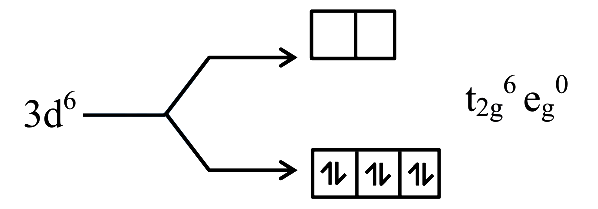
-
- (A) 2
- (B) 4
- (C) 6
- (D) 8
Show answer and solution
Correct Answer: (A)
\(\left[\mathrm{FeF}_6\right]^{3-} \quad\quad\) Paramagnetic \(\quad\quad \mathrm{sp}^3 \mathrm{~d}^2\)
\(\left[\mathrm{Fe}(\mathrm{CN})_6\right]^{3-} \quad\) Paramagnetic \(\quad\quad \mathrm{d}^2 \mathrm{sp}^3\)
\(\left[\mathrm{Mn}(\mathrm{CN})_6\right]^{3-} \quad\) Paramagnetic \(\quad\quad \mathrm{d}^2 \mathrm{sp}^3\)
\(\left[\mathrm{Co}\left(\mathrm{C}_2 \mathrm{O}_4\right)_3\right]^{3-} \quad\) Diamagnetic \(\quad\quad \mathrm{d}^2 \mathrm{sp}^3\)
\(\left[\mathrm{MnCl}_6\right]^{3-} \quad\) Paramagnetic \(\quad \mathrm{sp}^3 \mathrm{~d}^2\)
\(\left[\mathrm{CoF}_6\right]^{3-} \quad\) Paramagnetic \(\quad \mathrm{sp}^3 \mathrm{~d}^2\)
Only \(\quad\left[\mathrm{Fe}(\mathrm{CN})_6\right]^{3-}\) and \(\left[\mathrm{Mn}(\mathrm{CN})_6\right]^{3-}\) are paramagnetic and \(\mathrm{d}^2 \mathrm{sp}^3\) hybridisation of metal. -
- (A) \(5\)
- (B) \(6\)
- (C) \(4\)
- (D) \(3\)
Show answer and solution
Correct Answer: (D)
In \(\left[\mathrm{Co}\left(\mathrm{NH}_3\right]_6\right]^{3+}, \mathrm{Co}^{+3}:[\mathrm{Ar}] 3 \mathrm{~d}^6, \mathrm{NH}_3\) is S.F.L
Hybridisation state of \(\mathrm{Co}^{3+}\) is \(\mathrm{d}^2 \mathrm{sp}^3\)
In \(\mathrm{SF}_6\), Hybridisation state of sulphur is \(\mathrm{sp}^3 \mathrm{~d}^2\)
In \(\left[\mathrm{CrF}_6\right]^{3-}, \mathrm{Cr}^{+3}:[\mathrm{Ar}] 3 \mathrm{~d}^3\)
Hybridisation state of \(\mathrm{Cr}^{3+}\) is \(\mathrm{d}^2 \mathrm{sp}^3\)
\(\left[\mathrm{CoF}_6\right]^{3-}, \mathrm{Co}^{+3}:[\mathrm{Ar}] 3 \mathrm{~d}^6 \mathrm{~F}^{-}\)is W.F.L
Hybridisation state of \(\mathrm{Co}^{3+}\) is \(\mathrm{sp}^3 \mathrm{~d}^2\)
\(\left[\mathrm{Mn}(\mathrm{CN})_6\right]^{3-}, \mathrm{Mn}^{+3}:[\mathrm{Ar}] 3 \mathrm{~d}^4 \mathrm{CN}^{-}\)is S.F.L Hybridisation state of \(\mathrm{Mn}^{3+}\) is \(\mathrm{d}^2 \mathrm{sp}^3\)
\(\left[\mathrm{MnCl}_6\right]^{3-}, \mathrm{Mn}^{+3}:[\mathrm{Ar}] 3 \mathrm{~d}^4 \mathrm{Cl}^{-}\)is W.F.L
Hybridisation state of \(\mathrm{Cl}^{-}\)is \(\mathrm{sp}^3 \mathrm{~d}^2\)
Total number of \(\mathrm{sp}^3 \mathrm{~d}^2\) hybridized molecules is 3 - 29. The type of hybridization and the magnetic property of \(\left[\mathrm{MnCl}_6\right]^{3-}\) are _______. 2025 Medium
- (A) \(d^2 s p^3\), paramagnetic with four unpaired electrons
- (B) \(\mathrm{sp}^3 \mathrm{~d}^2\), paramagnetic with four unpaired electrons
- (C) \(\mathrm{d}^2 \mathrm{sp}^3\), paramagnetic with two unpaired electrons
- (D) \(\mathrm{sp}^3 \mathrm{~d}^2\), paramagnetic with two unpaired electrons
Show answer and solution
Correct Answer: (B)
\(\begin{aligned} & {\left[\mathrm{MnCl}_6\right]^{3-} \text { contains } \mathrm{Mn}^{+3}} \\ & \mathrm{Mn}^{+3}:-[\mathrm{Ar}] 3 \mathrm{~d}^4 \\ & \text { Ligand } \Rightarrow \mathrm{Cl}^{-}(\mathrm{WFL})\end{aligned}\)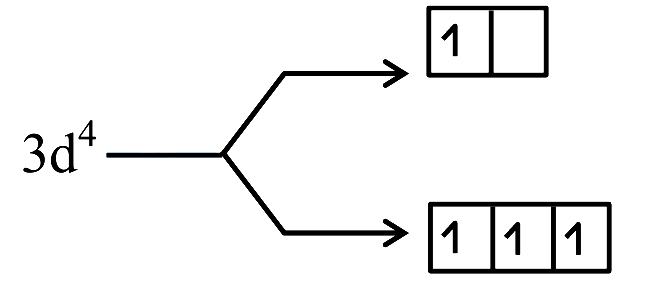
\(\text { Hybridisation }=\mathrm{sp}^3 \mathrm{~d}^2\)
4 unpaired electrons - 30. When Ethane-1,2-diamine is added progressively to an aqueous solution of Nickel (II) chloride, the sequence of colour change observed will be : 2025 Medium
- (A) Violet → Blue → Pale Blue → Green
- (B) Pale Blue → Blue → Green → Violet
- (C) Green → Pale Blue → Blue → Violet
- (D) Pale Blue → Blue → Violet → Green
Show answer and solution
Correct Answer: (C)
\(\left[ Ni \left( H _2 O \right)_6\right]_{( aq )}^{+2}+ en _{( aq )} \rightarrow\left[ Ni \left( H _2 O \right)_4( en )\right]_{( aq )}^{+2}+2 H _2 O\)
Green
\(\left[ Ni \left( H _2 O \right)_4( en )\right]_{( aq )}^{+2}+ en _{( aq )} \rightarrow\left[ Ni \left( H _2 O \right)_2( en )_2\right]_{( aq )}^{+2}+2 H _2 O\)
Pale Blue
\(\left[ Ni \left( H _2 O \right)_2( en )\right]_{( aq )}^{+2}+ en _{( aq )} \rightarrow\left[ Ni ( en )_3\right]_{( aq )}^{+2}+2 H _2 O\)
Blue / purple -
- (A) \(\left[\mathrm{Fe}(\mathrm{CN})_6\right]^4\)
- (B) \(\left[\mathrm{CO}\left(\mathrm{NH}_3\right)_6\right]^{3+}\)
- (C) \(\left[\mathrm{FeF}_6\right]^4\)
- (D) \(\left[\mathrm{Mn}(\mathrm{SCN})_6\right]^4\)
Show answer and solution
Correct Answer: (D)
(1) \(\left[\mathrm{Co}\left(\mathrm{NH}_3\right)_6\right]^{3+} \quad \mathrm{Co}^{3+} \Rightarrow 3 \mathrm{~d}^6 4 \mathrm{~s}^0\)
\(=[-0.4 \times 6+0.6 \times(0)] \Delta_0=-2.4 \Delta_0\)
(2)
\(\begin{aligned}
& {\left[\mathrm{Mn}(\mathrm{SCN})_6\right]^4} \\
& \mathrm{Mn}^{2+} \Rightarrow 3 \mathrm{~d}^5 4 \mathrm{~s}^0
\end{aligned}\)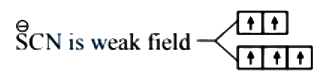
\(\begin{aligned}
& \mu=\sqrt{35} \text { B.M. }=5.96 \text { B.M. } \\
& \mathrm{CFSE}=(-0.4 \times 3+0.6 \times 2) \Delta_0
\end{aligned}\)
So \(\Delta_0=0\)
(3)
\(\begin{aligned}
& {\left[\mathrm{Fe}(\mathrm{CN})_6\right]^{-4} \quad \mathrm{Fe}^{2+} \Rightarrow 3 \mathrm{~d}^6 4 \mathrm{~s}^0}
\end{aligned}\)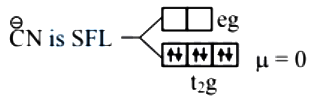
\(\mathrm{CFSE}=-2.4 \Delta_0\)
(4) \(\left[\mathrm{FeF}_6\right]^{4-}\)
\(\mathrm{Fe}^{2+} \Rightarrow 3 \mathrm{~d}^6 4 \mathrm{~s}^0\)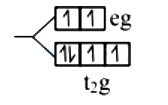
\(\begin{aligned}
& \mu=\sqrt{24} \text { B.M. }=4.89 \text { B.M. } \\
& \text { CFSE }=(-0.4 \times 4+0.6 \times 2) \Delta_0=-1.2 \Delta_0
\end{aligned}\)
No questions on this page match these filters.