


Chapters asked in 2014
25 chapters- 1Qs STD 11 Organic chemistry purification and characterization
- 3Qs STD 12 D and f- block elements
- 5Qs STD 11 Redox reactions
- 3Qs STD 12 Biomolecules
- 4Qs STD 11 Equilibrium - II (icon Equilibrium)
- 4Qs STD 12 Chemical kinetics
- 5Qs STD 12 Amines
- 4Qs STD 12 Carboxylic acids and their derivative
- 5Qs STD 12 Aldehydes and ketones
- 6Qs STD 12 Alcohol, phenol and ethers Most asked
- 4Qs STD 12 Haloalkanes and Haloarenes
- 1Qs STD 11 Organic chemistry isomerism
- 8Qs STD 12 Co-ordination chemistry Most asked
- 5Qs STD 12 P -Block elements - ll
- 7Qs STD 12 Electrochemistry Most asked
- 3Qs STD 12 Solution and colligative properties
- 3Qs STD 11 Some basic concept of chemistry
- 4Qs STD 11 Hydricarbon
- 2Qs STD 11 Organic chemistry Nomenclature of organic compounds
- 6Qs STD 11 Chemical bonding and molecular structure
- 5Qs STD 11 Classification of elements and periodicity in properties
- 4Qs STD 11 Equilibrium - 1 (chemical Equilibrium)
- 6Qs STD 11 Thermodynamics and thermochemistry
- 3Qs STD 11 P-Block elements - I
- 6Qs STD 11 Structure of atom
All JEE Mains 2014 Chemistry questions
25 chaptersShowing 1–50 of 107 questions
-
- (A) \(6\)
- (B) \(10\)
- (C) \(3\)
- (D) \(5\)
Show answer and solution
Correct Answer: (B)
\(\%\) of \(N=\frac{1.4 \times \text { meq.of acid }}{\text { mass of organic compound }}\)meq. of \(H_{2} S O_{4}=60 \times \frac{M}{10} \times 2=12\)
meq. of \(N a O H=20 \times \frac{M}{10}=2\)
meq. of acid consumed \(=12-2=10\)
\(\therefore \% \quad N=\frac{1.4 \times 10}{1.4}=10 \%\)
- 2. Chloro compound of Vanadium has only spin magnetic moment of \(1.73\, BM\). This Vanadium chloride has the formula 2014 Hard
- (A) \(VCl_2\)
- (B) \(VCl_4\)
- (C) \(VCl_3\)
- (D) \(VCl_5\)
Show answer and solution
Correct Answer: (B)
\(\mu = \sqrt {n(n + 2)} \)\(1.73 = \sqrt {n(n + 2)} \)
On calculating the value of \(n\) we find \(n=1\)
No. of unpaired electrons \(= 1\)
hence its consfiguration will be
\(V(23) = [Ar] 3d^3\,4s^2\)
\(V^{4+} = [Ar]3d^1\)
Its chloride has the formula \(VCl_4\)
- 3. Which of the following is not formed when \(H_2S\) reacts with acidic \(K_2Cr_2O_7\) solution ? 2014 Medium
- (A) \(CrSO_4\)
- (B) \(Cr_2(SO_4)_3\)
- (C) \(K_2SO_4\)
- (D) \(S\)
Show answer and solution
Correct Answer: (A)
\(K_2Cr_2O_7+ 4H_2SO_4+ 3H_2S\) \(\longrightarrow\) \(K_2SO_4 + Cr_2 (SO_4)_3 + 7H_2O + 3S\) -
- (A) \(Ti\,(22)\)
- (B) \(V\,(23)\)
- (C) \(Cr\,(24)\)
- (D) \(Mn\,(25)\)
Show answer and solution
Correct Answer: (D)
Maganese exhibits the large number of oxidation states. The most common oxidation states of \(Mn\) are \(+ 2 , + 3 ,+ 4, + 6\) and \(+7.\) -
- (A) \(Sn^{4+}\) is the oxidizing agent because it undergoes oxidation
- (B) \(Sn^{4+}\) is the reducing agent because it undergoes oxidatio
- (C) \(H_2SO_3\) is the reducing agent because it undergoes oxidation
- (D) \(H_2SO_3\) is the reducing agent because it undergoes reduction
Show answer and solution
Correct Answer: (C)
\(\mathop {{H_2}S{O_3}}\limits^{ + 4} (aq) + \mathop {Sn^{+4}} (aq) + {H_2}O(l) \to S{n^{2 + }}(aq) + \mathop {HS{O_4}^ - }\limits^{ + 6} (aq) + 3{H^ + }\) Hence \(H_2SO_3\) is the reducing agent because it undergoes oxidation -
- (A) \(3\)
- (B) \(4\)
- (C) \(6\)
- (D) \(5\)
Show answer and solution
Correct Answer: (C)
Oxidation state of Cr in \(C{r_2}O_7^{2-}\): \(+6\)
Oxidation state of Cr in \(C{r^{3+}}\): \(+3\)
Electrons gained by Cr per mole of \(C{r_2}O_7^{2-}\): \(2 \times (+6 - +3) = 6e^-\)
Oxidation state of Fe in \(F{e^{2+}}\): \(+2\)
Oxidation state of Fe in \(F{e^{3+}}\): \(+3\)
Electrons lost by Fe per mole of \(F{e^{2+}}\): \(+3 - +2 = 1e^-\)
Oxidation state of C in \({C_2}O_4^{2-}\): \(+3\)
Oxidation state of C in \(C{O_2}\): \(+4\)
Electrons lost by C per mole of \({C_2}O_4^{2-}\): \(2 \times (+4 - +3) = 2e^-\)
For the reaction to be balanced, total electrons gained = total electrons lost.
Let the coefficient for \(F{e^{2+}}\) be \(x\) and for \({C_2}O_4^{2-}\) be \(y\).
\(1 \times 6 = x \times 1 + y \times 2\)
\(6 = x + 2y\)
The smallest integer solution is \(x=4, y=1\).
Total electrons involved: \(6\)
-
- (A) \(MnO_4^-\)
- (B) \(Cr_2O_7^{2-}\)
- (C) \(SO_3^{2-}\)
- (D) \(KI\)
Show answer and solution
Correct Answer: (A)
\(H_2O_2\) acts as a reducing agent only in presence of strong oxidising agents (\(i.e.,MnO_4^-\) ) in acidic as well as alkaline medium. \(2KMnO_4 + 3H_2SO_4 + 5H_2O_2 \to K_2SO_4 + 2MnSO_4 + 8H_2O + 5O_2\) -
- (A) \(Li_2O + 2KCl \rightarrow 2LiCl + K_2O\)
- (B) \([ CoCl( NH_3 )_5]^+ +5H^+ \rightarrow Co^{2+} +5NH_4^+ +Cl^-\)
- (C) \([ Mg(H_2O)_6]^{2+} +(EDTA)^{4-} \xrightarrow{{excess\,NaOH}} \) \([Mg(EDTA)]^{2+} +6H_2O\)
- (D) \(CuSO_4 + 4KCN \rightarrow K_2[Cu(CN)_4]+K_2SO_4\)
Show answer and solution
Correct Answer: (B)
Equation \(-1\) is not balanced with respect to charge.Equation \(-2\) gives \(K _3\left[ Cu ( CN )_4\right]\) as product.
Equation \(-3\) reaction is unfavourable in the forward direction \(\left( K _2 O\right.\) is unstable, while \(LiO _2\) is stable).
Equation \(-4\) is correct and balanced.
-
- (A) It is diamagnetic in nature
- (B) It is derivative of \(H_2O_2\)
- (C) \(Na_2O_2\) oxidises \(Cr^{3+}\) to \(CrO_4^{2-}\) in acid medium
- (D) It is the super oxide of sodium
Show answer and solution
Correct Answer: (D)
Explanation:
Let us evaluate each statement regarding sodium peroxide (\( \text{Na}_2\text{O}_2 \)):
1. Diamagnetic Nature: The peroxide ion (\( \text{O}_2^{2-} \)) has a total of 18 electrons. According to Molecular Orbital Theory, all electrons are completely paired up in its molecular orbitals, which makes it diamagnetic in nature. This statement is correct.
2. Derivative of \( \text{H}_2\text{O}_2 \): Sodium peroxide reacts readily with water or dilute acids at low temperatures to produce hydrogen peroxide (\( \text{H}_2\text{O}_2 \)). Therefore, it behaves as a stable salt derivative of hydrogen peroxide. This statement is correct.
3. Oxidation of Chromium: In an alkaline (basic) medium, sodium peroxide acts as a strong oxidizing agent and converts trivalent chromium (\( \text{Cr}^{3+} \)) into yellow chromate ions (\( \text{CrO}_4^{2-} \)). Option C has been modified to reflect this correct chemical environment.
4. Peroxide vs Superoxide: \( \text{Na}_2\text{O}_2 \) is the peroxide of sodium where oxygen exists in a \( -1 \) oxidation state as the \( \text{O}_2^{2-} \) ion. On the other hand, sodium superoxide has the chemical formula \( \text{NaO}_2 \) containing the \( \text{O}_2^- \) ion. Thus, statement D is completely incorrect.
Since the question asks for the statement that is not correct, Option D is the correct choice. -
- (A) Electrostatic attractions
- (B) vander Waals forces
- (C) Dipole - Dipole interactions
- (D) Hydrogen bonding
Show answer and solution
Correct Answer: (D)
The two polynucleotide chains of \(DNA\) molecules are twisted around a common axis but run in opposite directions to form a right handed helix. The two chains are joined together by specific hydrogen bonds -
- (A) Maltose
- (B) Lactose
- (C) Glucose
- (D) Sucrose
Show answer and solution
Correct Answer: (D)
Sucrose does not contain a free aldehydic or ketonic group hence it does not show mutarotation. -
- (A) Quinoline
- (B) Adenine
- (C) Cytosine
- (D) Thymine
Show answer and solution
Correct Answer: (A)
Quinoline is an alkaloid, it is not present in \(DNA.\; DNA\) has four nitrogen bases in adenine, guanine, cytosine and thymine - 13. Assuming that the degree of hydrolysis is small, the \(pH\) of \(0.1\, M\) solution of sodium acetate \((K_a\, = 1.0\times10^{- 5})\) will be 2014 Medium
- (A) \(5\)
- (B) \(6\)
- (C) \(8\)
- (D) \(9\)
Show answer and solution
Correct Answer: (D)
sodium acetate is a salt of strong base and weak acid.\(\,pH = 7 + \frac{1}{2}p{K_a} + \frac{1}{2}\,\log \,c\) where
\(p{K_a} = - \log \,{K_a} = - \log \,{10^{ - 5}} = 5\)
\(\log \,c = \log \,{10^{ - 1}} = - 1\)
\(pH = 7 + \frac{5}{2} - \frac{1}{2} = 9.0\)
-
- (A) Ideal solutions
- (B) Colloidal solutions
- (C) True solutions
- (D) Buffer solutions
Show answer and solution
Correct Answer: (D)
Solutions which resist the change in the value of \(pH\) when small amount of acid or base is added to them are known as buffers . -
- (A) \(N^{-3}\)
- (B) \(N_3^ - \)
- (C) \(N_2^ - \)
- (D) \(HN_3^ - \)
Show answer and solution
Correct Answer: (B)
\(\mathop {{N_3}H}\limits_{{\text{Hydrazoic acid}}} \,\, \rightleftharpoons \,N_3^ - \, + \,{H^ + }\)\(i.e,\) conjugate base of hydrazoic acid is \(N_3^-\)
-
- (A) \(S = \{ {K_{sp}}/{\left( {6912} \right)^{1/7}}\}\)
- (B) \(S = {\{ {K_{sp}}/144\} ^{1/7}}\)
- (C) \(S = {\{ {K_{sp}}/6912\} ^{1/7}}\)
- (D) \(S = {\{ {K_{sp}}/6912\} ^7}\)
Show answer and solution
Correct Answer: (C)
\([Z{r_3}{(P{O_4})_4}] \rightleftharpoons \mathop {3Z{r^{4 + }}}\limits_{3S} + \mathop {4P{O_4}^{3 - }}\limits_{4S} \)\({K_{sp}} = {(3S)^3}{(4S)^4}\)
\( = 27{S^3} \times 256{S^4}\)
\( = 6912{S^7}\)
\(\therefore \,S = {\left( {\frac{{{K_{sp}}}}{{6912}}} \right)^{1/2}}\)
-
- (A) \(\frac{1}{3}\frac{{d\left[ A \right]}}{{dt}} = \frac{{d\left[ C \right]}}{{dt}} = k{\left[ A \right]^n}{\left[ B \right]^m}\)
- (B) \( - \frac{{d\left[ A \right]}}{{dt}} = \frac{{d\left[ C \right]}}{{dt}} = k{\left[ A \right]^n}{\left[ B \right]^m}\)
- (C) \( + \frac{1}{3}\frac{{d\left[ A \right]}}{{dt}} = - \frac{{d\left[ C \right]}}{{dt}} = k{\left[ A \right]^n}{\left[ B \right]^m}\)
- (D) \( - \frac{1}{3}\frac{{d\left[ A \right]}}{{dt}} = \frac{{d\left[ C \right]}}{{dt}} = k{\left[ A \right]^n}{\left[ B \right]^m}\)
Show answer and solution
Correct Answer: (D)
For the reaction\(3A+2B\to C+D\)
Rate of disappearance of \(A\,=\) Rate of appearance of \(C\) reation
\( = \, - \,\frac{1}{3}\,\frac{{d[A]}}{{dt}}\, = \,\frac{{d[C]}}{{dt}}\, = \,k\,{[A]^n}\,{[B]^m}\)
-
- (A) \(- 1.25\times10^{-4}\)
- (B) \(- 2.50\times10^{-4}\)
- (C) \(- 3.75\times10^{-4}\)
- (D) \(-5.00\times10^{-4}\)
Show answer and solution
Correct Answer: (D)
From rate law\( - \frac{1}{2}\frac{{dS{O_2}}}{{dt}}\, - \,\frac{{d{O_2}}}{{dt}} - \frac{1}{2}\frac{{dS{O_3}}}{{dt}}\)
\(\therefore \,\,\frac{{dS{O_2}}}{{dt}}\, = -\,2 \times \frac{{d{O_2}}}{{dt}}\)
\(=\,-\,2\times 2.5\times 10^{-4}\)
\(=\,-\,5\times 10^{-4}\,mol\,L^{-1}\,s^{-1}\)
- 19. The half-life period of a first order reaction is \(15\,minutes\). The amount of substance left after one hour will be 2014 Hard
- (A) \(\frac{1}{4}\) of the original amount
- (B) \(\frac{1}{8}\) of the original amount
- (C) \(\frac{1}{16}\) of the original amount
- (D) \(\frac{1}{32}\) of the original amount
Show answer and solution
Correct Answer: (C)
Given \(t_{1/2}\,=\,15\,minutes\)Total time \((T)\,=\,1\,hr\,=\,60\,min.\)
From \(T\,=\,n\times t_{1/2}\)
\(n\,=\,\frac {60}{15}\,=\,4\)
Now from the formula \(\frac{N}{{{N_0}}}\, = \,{\left( {\frac{1}{2}} \right)^n}\)
\( = \,{\left( {\frac{1}{2}} \right)^4}\, = \,\frac{1}{{16}}\)
Where \(N_0\,=\) initial amount
\(N\,=\) amount left after time \(t\)
hence the amount of substance left after \(1\,hour\) will be \(\frac {1}{16}\)
-
- (A) \(16\)
- (B) \(60\)
- (C) \(99\)
- (D) \(132\)
Show answer and solution
Correct Answer: (B)
According to arrhenius equation\(\log \,\frac{{{k_2}}}{{{k_1}}}\, = \,\frac{{{E_a}}}{{2.303\,\,R}}\,\left( {\frac{1}{{{T_1}}}\, - \,\frac{1}{{{T_2}}}} \right)\)
\(\log \,\frac{{1.3 \times {{10}^{ - 3}}}}{{1.3 \times {{10}^{ - 4}}}}\, = \,\frac{{{E_a}}}{{2.303 \times 8.314}}\,\left[ {\frac{1}{{373}} - \frac{1}{{423}}} \right]\)
\(1 = \frac{{{E_a}}}{{2.303 \times 8.314}}\,\left[ {\frac{1}{{373}} - \frac{1}{{423}}} \right]\)
\({E_a}\, = \,60\,\,kJ/mole\)
-
- (A) Aniline
- (B) Phenylhydrazine
- (C) Azobenzene
- (D) Hydrazobenzene
Show answer and solution
Correct Answer: (A)
On reduction with \(Zn\) and \(HCl\), \(C_6H_5N_2Cl\) forms aniline as the main product - 22. Considering the basic strength of amines in aqueous solution, which one has the smallest \(pK_b\) value ? 2014 Medium
- (A) \((CH_3)_2NH\)
- (B) \(CH_3NH_2\)
- (C) \((CH_3)_3N\)
- (D) \(C_6H_5NH_2\)
Show answer and solution
Correct Answer: (A)
Order of basic strength of aliphatic amine in aqueous solution is as follows (order of \(K_{b}\) )\(\left(\mathrm{CH}_{3}\right)_{2} \bar {N}H>\mathrm{CH}_{3} \bar {N}H_{2}>\)\(\left(CH_{3}\right)_{3} \bar {N}>\mathrm{C}_{6}\ mathrm{H}_{5} \bar {N} \mathrm{H}_{2}\)
As we know \(\mathrm{pk}_{\mathrm{b}}=-\log \mathrm{K}_{\mathrm{b}}\)
So \( (CH_3) _{2}\) \(NH\) will have smallest \(pK_{b}\) value. In the case of phenylamine, \(N\) is attached to \(s p^{2}\) hybridised carbon, hence it has highest \(p K_{b}\) and least basic strength.
- 23. Conversion of benzene diazonium chloride to chlorobenzene is an example of which of the following reactions? 2014 Hard
- (A) Claisen
- (B) Friedel-craft
- (C) Sandmeyer
- (D) Wurtz
Show answer and solution
Correct Answer: (C)
\(\underset{\begin{smallmatrix}
\,\text{Benzene} \\
\text{diazoniumchloride}
\end{smallmatrix}}{\mathop{{{C}_{6}}{{H}_{5}}{{N}_{2}}Cl}}\,\,\,\xrightarrow[or\,Cu+HCl]{CuCl/HCl}\,\underset{\text{Chloro benzene}}{\mathop{{{C}_{6}}{{H}_{5}}Cl}}\,\,\,+\,{{N}_{2}}\)The above reaction is known as Sandmayer 's reaction.
- 24. On heating an aliphatic primary amine with chloroform and ethanolic potassium hydroxide, the organic compound formed is : 2014 Medium
- (A) an alkanol
- (B) an alkanediol
- (C) an alkyl cyanide
- (D) an alkyl isocyanide
Show answer and solution
Correct Answer: (D)
This reaction is an example of carbylamine test which includes conversion of amine to isocyanide.\(R-\ddot{N}_{H_{2}}+C H C I_{3} \frac{C_{2} H_{5} O H}{K O H} R-_{N}^{+} \equiv \bar{c}^{:}\)
\(1^{\circ}\; amine \quad \quad \quad \quad \quad \;Alkyl \;isocyanide\)The mechanism of this reaction included rearrangement of nitrene in which migration of alkyl group from carbon to nitrogen takes place.
-
- (A) Diazomethane
- (B) Methylalcohol
- (C) Methylcyanide
- (D) Nitromethane
Show answer and solution
Correct Answer: (B)
\(CH_3NH_2 + HNO_2 \to CH_3OH + N_2 + H_2O\) -
- (A) Pyruvic acid
- (B) Lactic acid
- (C) Butyric acid
- (D) Acetic acid
Show answer and solution
Correct Answer: (C)
Butyric acid also known as butanoic acid is found in milk, and butter and is a product of anaerobic fermentation. It has an unpleasant smell and acrid taste - 27. In the reaction, \(C{H_3}COOH\xrightarrow{{LiAl{H_4}}}A\xrightarrow{{PC{l_5}}} \) \(B\xrightarrow{{Alc.\,KOH}}C,\) the product \(C\) is : 2014 Medium
- (A) Acetaldehyde
- (B) Acetylene
- (C) Ethylene
- (D) Acetyl chloride
Show answer and solution
Correct Answer: (C)
\(\begin{array}{*{20}{c}}
{\,\,\,O} \\
{\,\,\,||} \\
{C{H_3} - C - OH}
\end{array}\) \(\xrightarrow[{{\text{ Reduction }}}]{{LiAl{H_4}}}{\text{C}}{{\text{H}}_3} - {\text{C}}{{\text{H}}_2} - {\text{OH}}\) \(\xrightarrow{{{\text{PC}}{{\text{l}}_5}}}{\text{C}}{{\text{H}}_3} - {\text{C}}{{\text{H}}_2} - {\text{Cl}}\) \(\xrightarrow[{{\text{ Dehydrohalogenation }}}]{{{\text{Alc}}.{\text{KOH}}}}\) \(\mathrm{CH}_{2}=\mathrm{CH}_{2}\) (Ethylene) -
- (A) Ethane
- (B) Ethyne
- (C) Ethene
- (D) Propene
Show answer and solution
Correct Answer: (C)
Ethane is obtained by electrolysis of dipotassium succinate as follows\(\underset{Dipot.\,\,succinate}{\mathop{\begin{matrix}
C{{H}_{2}}COOK \\
|\,\,\,\,\,\,\,\,\,\,\,\,\,\,\,\,\,\,\,\,\,\,\,\,\,\, \\
C{{H}_{2}}COOK \\
\end{matrix}}}\,\) \(\xrightarrow{ionization}\) \(\begin{matrix}
C{{H}_{2}}CO{{O}^{-}} \\
|\,\,\,\,\,\,\,\,\,\,\,\,\,\,\,\,\,\,\,\,\,\,\,\,\,\,\, \\
C{{H}_{2}}CO{{O}^{-}} \\
\end{matrix}\) \(+2K^+\)\(2{{H}_{2}}O\,\overset{ionization}{\longleftrightarrow}2O{{H}^{-\,}}+\,2{{H}^{+}}\)
At anode :
\(\begin{matrix}
C{{H}_{2}}CO{{O}^{-}} \\
|\,\,\,\,\,\,\,\,\,\,\,\,\,\,\,\,\,\,\,\,\,\,\,\,\,\, \\
C{{H}_{2}}CO{{O}^{-}} \\
\end{matrix}\) \(\xrightarrow{2{{e}^{-}}}\) \(\underset{Unstable}{\mathop{\left[ \begin{matrix}
C{{H}_{2}}COO \\
|\,\,\,\,\,\,\,\,\,\,\,\,\,\,\,\,\,\,\,\,\,\,\, \\
C{{H}_{2}}COO \\
\end{matrix} \right]}}\,\) \(\to \) \(\begin{matrix}
C{{H}_{2}} \\
||\,\,\,\,\,\, \\
C{{H}_{2}} \\
\end{matrix}\) \(+\,2CO_2\)At cathode :
\(2H^+ + 2e^-\to [2H]\to H_2\)
- 29. The major product formed when \(1, 1, 1-\) trichloro propane is treated with aqueous potassium hydroxide is 2014 Hard
- (A) Propyne
- (B) \(1-\) Propanol
- (C) \(2-\) Propanol
- (D) Propionic acid
Show answer and solution
Correct Answer: (D)
\(C{l_3}C - C{H_2}C{H_3} + KOH\xrightarrow{{heat}}\) \({\left( {OH} \right)_3}C - C{H_2}C{H_3} + 3KCl \to \) \(\begin{array}{*{20}{c}}
{\,\,\,\,\,\,O} \\
{\,\,\,\,\,\,||} \\
{C{H_3}C{H_2}C - OH}
\end{array}\) - 30. An organic compound \(A\), \(C_5H_8O\); reacts with \(H_2O\), \(NH_3\) and \(CH_3COOH\) as described below \(A\) is
 2014 Hard
- (A) \(\begin{array}{*{20}{c}}
{C{H_3}CH = C - CHO} \\
{\,\,\,\,\,\,|} \\
{\,\,\,\,\,\,\,\,\,\,\,\,\,C{H_3}}
\end{array}\) - (B) \(\begin{array}{*{20}{c}}
{C{H_2} = CHCH - CHO} \\
{\,\,\,\,\,\,|\,\,\,} \\
{\,\,\,\,\,\,\,\,\,\,\,\,\,C{H_3}\,\,\,\,}
\end{array}\) - (C) \(\begin{array}{*{20}{c}}
{C{H_3} - C{H_2} - C = C = O} \\
{\,\,\,\,\,\,\,\,\,\,\,\,\,\,\,|\,\,\,} \\
{\,\,\,\,\,\,\,\,\,\,\,\,\,\,\,\,\,\,\,\,\,\,\,C{H_3}\,\,\,\,}
\end{array}\) - (D) \(\begin{array}{*{20}{c}}
{C{H_3} - C{H_2} - C - C = O} \\
{\,\,\,\,\,\,\,\,\,\,\,\,\,\,\,\,\,\,\,\,\,\,\,||\,\,\,\,\,\,\,\,\,|} \\
{\,\,\,\,\,\,\,\,\,\,\,\,\,\,\,\,\,\,\,\,\,\,\,\,\,\,\,\,\,\,C{H_2}\,H\,\,\,\,}
\end{array}\)
Show answer and solution
Correct Answer: (C)
Given compound \(A\) is\(\begin{matrix}
C{{H}_{3}}-C{{H}_{2}}-C=C=O \\
\,\,\,\,\,\,\,\,\,\,\,\,| \\
\,\,\,\,\,\,\,\,\,\,\,\,\,\,\,\,\,\,C{{H}_{3}} \\
\end{matrix}\)Reactions given are as following:
\(\begin{array}{*{20}{c}}
{C{H_3} - C{H_2} - C = C = O\xrightarrow{{N{H_3}}}} \\
{{\mkern 1mu} {\mkern 1mu} {\mkern 1mu} {\mkern 1mu} {\mkern 1mu} {\mkern 1mu} {\mkern 1mu} {\mkern 1mu} \,\,\,\,\,\,\,\,\,\,\,\,\,\,\,\,{\mkern 1mu} {\mkern 1mu} {\mkern 1mu} |{\mkern 1mu} \,\,{\mkern 1mu} \,\,\,\,\,\,\,\,\,\,\,\,\,\,\,\,\,{\mkern 1mu} } \\
{{\mkern 1mu} {\mkern 1mu} {\mkern 1mu} {\mkern 1mu} {\mkern 1mu} {\mkern 1mu} {\mkern 1mu} {\mkern 1mu} {\mkern 1mu} {\mkern 1mu} {\mkern 1mu} {\mkern 1mu} {\mkern 1mu} {\mkern 1mu} \,\,\,\,\,\,\,\,\,\,\,\,\,\,\,\,\,\,\,\,C{H_{3\,}}\,\,\,\,\,\,\,\,\,\,\,\,\,\,\,\,\,\,\,\,}
\end{array}\) \(\left[ \begin{matrix}
C{{H}_{3}}-C{{H}_{2}}-C=\overset{+}{\mathop{C}}\,-{{O}^{-}} \\
\,\,\,\,\,\,\,\,\,\,\,\,| \\
\,\,\,\,\,\,\,\,\,\,\,\,\,\,\,\,\,\,C{{H}_{3}} \\
\end{matrix} \right]\)\(\updownarrow \)
\(\left[ \begin{matrix}
C{{H}_{3}}-C{{H}_{2}}-C=C-OH \\
\,\,\,\,\,\,\,\,\,\,\,\,\,\,\,\,\,\,\,\,\,\,\,|\,\,\,\,\,\,\,\,\,\,| \\
\,\,\,\,\,\,\,\,\,\,\,\,\,\,\,\,\,\,\,\,\,\,\,\,\,\,\,\,\,\,\,C{{H}_{3}}\,\,N{{H}_{2}}\,\, \\
\end{matrix} \right]\)\(\downarrow \)
\(\begin{matrix}
\,\,\,\,\,\,\,\,\,\,\,\,\,\,\,\,\,\,\,\,\begin{matrix}
\,\,\,\,\,\,\,\,\,\,\,\,\,\,\,\,\,\,\,\,\,\,\,\,\,\,\,\,O\,\, \\
\,\,\,\,\,\,\,\,\,\,\,\,\,\,\,\,\,\,\,\,\,\,\,\,\,|| \\
\end{matrix}\,\,\,\,\,\,\,\,\, \\
C{{H}_{3}}-C{{H}_{2}}-CH-C-N{{H}_{2}} \\
| \\
\,\,\,\,\,\,\,\,C{{H}_{3}} \\
\end{matrix}\)\(\begin{matrix}
C{{H}_{3}}-C{{H}_{2}}-C=C=O\xrightarrow{{{H}_{2}}O} \\
\,\,\,\,\,\,\,\,\,\,\,|\,\,\,\,\, \,\,\,\, \\
\,\,\,\,\,\,\,\,\,\,\,\,\,\,C{{H}_{3}}\,\,\,\,\,\,\,\,\, \\
\end{matrix}\) \(\begin{matrix}
C{{H}_{3}}-C{{H}_{2}}-CH-COOH \\
\,\,\,\,\,\,\,\,\,\,\,\,\,\,\,\,\,\,\,\,\,\,\,\,\,\,\,|\,\,\,\,\,\,\,\,\,\,\,\,\,\,\,\,\,\,\,\, \\
\,\,\,\,\,\,\,\,\,\,\,\,\,\,\,\,\,\,\,\,\,\,\,\,\,\,\,\,\,\,\,\,C{{H}_{3}}\,\,\,\,\,\,\,\,\,\,\,\,\,\,\,\,\,\, \\
\end{matrix}\)\(\begin{matrix}
C{{H}_{3}}-C{{H}_{2}}-C=C=O\xrightarrow{C{{H}_{3}}COOH} \\
\,\,\,\,\,\,\,\,\,|\,\,\,\,\,\,\,\,\,\,\,\,\,\,\,\,\,\,\,\,\,\,\,\, \\
\,\,\,\,\,\,\,\,\,\,C{{H}_{3}}\,\,\,\,\,\,\,\,\,\,\,\,\,\,\,\,\,\,\,\,\, \\
\end{matrix}\) \(\begin{matrix}
\,\,\,\,\,\,\,\,\,\,\,\,\,\,\,\,\,\,\,\,\,\,\,\,\,\,\,\,\,\,\,\,\,\,\,\,\,\,\begin{matrix}
O\,\,\,\,\,\,\,\,\,\,\,\,\,\,\,\,O \\
||\,\,\,\,\,\,\,\,\,\,\,\,\,\,\,\,\,\,\,|| \\
\end{matrix} \\
C{{H}_{3}}-C{{H}_{2}}-CH-C-O-C-C{{H}_{3}} \\
|\,\,\,\,\,\,\,\,\,\,\,\,\,\,\,\,\,\,\,\,\, \\
C{{H}_{3}}\,\,\,\,\,\,\,\,\,\,\,\,\,\,\, \\
\end{matrix}\,\) - (A) \(\begin{array}{*{20}{c}}
-
- (A) Perkin reaction
- (B) Gatterman-Koch Formylation
- (C) Kolbe's reaction
- (D) Gattermann reaction
Show answer and solution
Correct Answer: (D)
The given reaction is known as Gattermann reaction.In this reaction, aromatic compound such as benzene or phenol is treated with a mixture of \(HCN\) and dry \(HCl\) gas under pressure and in the presence of anhydrous aluminum chloride or zinc chloride to introduce a formyl group in the aromatic nucleus. -
- (A) Aldol condensation
- (B) Claisen condensation
- (C) Cannizzaro reaction
- (D) Pinacol-pinacolon reaction
Show answer and solution
Correct Answer: (C)
Tishchenko reaction is a modification of canizzaro's reaction.This reaction involves disproportionation of an aldehyde lacking a hydrogen atom in the alpha position in the presence of an alkoxide. The reaction product is an ester. catalysts are aluminium alkoxide or sodium alkoxide.In cannizzaro's reaction the base is sodium hydroxide and the oxidation product is a carboxylic acid and the reduction product is an alcohol.

- 33. Which is major product formed when acetone is heated with iodine and potassium hydroxide? 2014 Hard
- (A) Iodoacetone
- (B) Acetic acid
- (C) Iodoform
- (D) Acetophenone
Show answer and solution
Correct Answer: (C)
\(CH_3COCH_3 + 3I_2 + 4KOH\) \( \longrightarrow\) \(CHI_3 + CH_3COOK + 3HI + 3H_2O\) - 34. Which one of the following reactions will not result in the formation of carbon-carbon bond? 2014 Hard
- (A) Reimer-Tieman reaction
- (B) Friedel Craft's acylation
- (C) Wurtz reaction
- (D) Cannizzaro reaction
Show answer and solution
Correct Answer: (D)
Canizzaro's reaction is a disproportionation reaction of aldehyde in which one molecule of aldehyde reduces to alcohol whereas other reduces to salt of carboxylic acid\(C_6H_5CHO+ KOH \longrightarrow C_6H_5CH_2OH + C_6H_5COOK\)
-
- (A) \(C_6H_5Br + CH_2 = CH - CH_2 - ONa\)
- (B) \(CH_2 = CH - CH_2 - Br - C_6H_5ONa\)
- (C) \(C_6H_5 - CH =CH - Br - CH_3 - ONa\)
- (D) \(CH_2 =CH - Br - C_6H_5 - CH_2 - ONa\)
Show answer and solution
Correct Answer: (A)
\(C_6H_5Br + NaO - CH_2 - CH = CH_2\) \(\longrightarrow\) \(\begin{array}{l}
{C_6}{H_5} - O - C{H_2} - CH = C{H_2} + NaBr\\
\,\,\,\,\,\,\,\,\,\,\,\,\,\,\,\,\,\,\,\,\,\,\,\,\,\,\,\,\,\,\,\,\,\,\,\,\,\,\,\,\,\,\,\,\,\,\,{\rm{Allyl\, phenyl\, ether}}
\end{array}\) - 36. In the hydrocarboration - oxidation reaction of propene with diborane, \(H_2O_2\) and \(NaOH\), the organic compound formed is 2014 Hard
- (A) \(CH_3CH_2OH\)
- (B) \(CH_3CHOHCH_3\)
- (C) \(CH_3CH_2CH_2OH\)
- (D) \((CH_3)_3COH\)
Show answer and solution
Correct Answer: (C)
\(CH_3CH = CH_2\) \(\xrightarrow[{{{\text{H}}_2}{{\text{O}}_2}{\text{, NaOH}}}]{{{{\text{B}}_2}{{\text{H}}_6}}}\) \(CH_3CH_2CH_2OH\) -
- (A) \(2, 4, 6 -\) Trinitrophenol
- (B) Benzoic acid
- (C) \(o -\) Nitrophenol
- (D) Benzene sulphonic acid
Show answer and solution
Correct Answer: (C)
Due to intramolecular hydrogen bonding this will not be soluble in sodium bicarbonate
-
- (A) Alcohols are weaker acids than water
- (B) Acid strength of alcohols decreases in the following \(RCH_2OH > R_2CHOH > R_3COH\)
- (C) Carbon-oxygen bond length in methanol, \(CH_3OH\) is shorter than that of \(C - O\) bond length in phenol
- (D) The bond angle \(image\) in methanol is \(108.9^o\).

Show answer and solution
Correct Answer: (C)
The \(C-O\) bond length in alcohol is \(142\,pm\) and in phenol it is \(136\,pm\). The \(C-O\) bond length in phenol is shorter than that in methanol due to the conjugation of unshared pair of electrons on oxygen with the ring, which imparts double bond character to the \(C-O\) bond.
- 39. Which one of the following substituents at para position is most effective in stabilizing the phenoxide ion ?
 2014 Hard
- (A) \(- CH_3\)
- (B) \(- OCH_3\)
- (C) \(- COCH_3\)
- (D) \(- CH_2OH\)
Show answer and solution
Correct Answer: (C)
Electron with drawing group stabilises the benzene ring due to delocalisation of charge. \(-CH_3\) and \(-CH_2OH\) are electron donating group and hence decrease the stability of benzene ring \(-OCH_3\) is weaker electron with drawing group than \(-COCH_3\) . Hence \(-COCH_3\) group more stabilize the phenoxide ion at \(p-\) position. -
- (A) Nucleophilic addition
- (B) Electrophilic addition
- (C) Electrophilic substitution
- (D) Nucleophilic substitution
Show answer and solution
Correct Answer: (D)
This method is suitable for the preparation of a wide variety of unsymmetrical ethers. The nucleophilic substitution of halides with alkoxide leads to desired product. - 41. For the compounds \(CH_3Cl, CH_3Br, CH_3I\) and \(CH_3F\), the correct order of increasing \(C-\) halogen bond length is 2014 Medium
- (A) \(CH_3F < CH_3Cl < CH_3Br < CH_3I\)
- (B) \(CH_3F < CH_3Br < CH_3Cl < CH_3I\)
- (C) \(CH_3F < CH_3I < CH_3Br < CH_3Cl\)
- (D) \(CH_3Cl< CH_3Br < CH_3F < CH_3I\)
Show answer and solution
Correct Answer: (A)
The correct order of increasing bond length is\(CH_3F < CH_3Cl < CH_3Br < CH_3I\)
-
- (A) \(C_6H_5CHC_6H_5Br\)
- (B) \(C_6H_5CH_2Br\)
- (C) \(C_6H_5CHCH_3Br\)
- (D) \(C_6H_5CCH_3C_6H_5Br\)
Show answer and solution
Correct Answer: (C)
\(C_6H_5CHCH_3Br\) being an optically active secondary alkyl bromide undergoes \(S_N2\) nucleophilic substitution reaction. Hence it undergoes complete inversion of configuration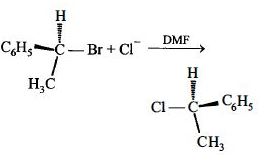
- 43. In \({S_{{N^2}}}\) reactions, the correct order of reactivity for the following compounds : 2014 Medium
- (A) \(CH_3Cl > (CH_3)_2CHCl > CH_3CH_2Cl > ( CH_3)_3CCl\)
- (B) \(CH_3Cl > CH_3CH_2 Cl > (CH_3)_2CHCl > (CH_3)_3CCl\)
- (C) \(CH_3CH_2 Cl > CH_3Cl > (CH_3)_2CHCl > (CH_3)_3CCl\)
- (D) \((CH_3 )_2CHCl > CH_3CH_2Cl > CH_3Cl > (CH_3)_3CCl\)
Show answer and solution
Correct Answer: (B)
Rate of \({S_{{N^2}}} \propto \frac{1}{\text { Steric crowding of }^{\prime} C^{\prime}}\)As steric hindrance (crowding) increases, the rate of \({S_{{N^2}}}\) reaction decreases.
The order of reactivity towards \({S_{{N^2}}}\) reaction for alkyl halides is
Primary halides \(>\) Secondary halides \(>\) Tertiary halides
- 44. The major organic compound formed by the reaction of \(1, 1, 1-\) trichloroethane with silver powder is : 2014 Hard
- (A) Acetylene
- (B) Ethene
- (C) \(2 -\) Butyne
- (D) \(2 -\) Butene
Show answer and solution
Correct Answer: (C)
\(2 \mathrm{CH}_{3}-\mathrm{CCl}_{3} \stackrel{6 \mathrm{Ag}}{\longrightarrow} \mathrm{CH}_{3}-\mathrm{C} \equiv \mathrm{C}-\mathrm{CH}_{3}+6 \mathrm{AgCl}\) -
- (A) Lactic acid
- (B) Tartaric acid
- (C) Maleic acid
- (D) \(\alpha -\) amino acids
Show answer and solution
Correct Answer: (C)
Optical isomers contain an asymmetric (chiral) carbon atom (a carbon atomattached to four different atoms or groups). Therefore all except maleic acid exhibit optical isomerism. - 46. Among the following species the one which causes the highest \(CFSE,\,\,\Delta _0\) as a ligand is 2014 Hard
- (A) \(CN^-\)
- (B) \(NH_3\)
- (C) \(F^-\)
- (D) \(CO\)
Show answer and solution
Correct Answer: (D)
Following is the order of increasing value of \(\Delta _0\) for the ligands.\(I^- < Br^- < Cl^- < F^- < H_2O < Py = NH_3 < en< NO_2^- << CN ^- < CO\)
-
- (A) \(CrO_2Cl_2\)
- (B) \([Cr(CN)_6]^{3-}\)
- (C) \(Cr_2O_3\)
- (D) \([MnO_4]^-\)
Show answer and solution
Correct Answer: (A)
\(CrO_2Cl_2\)
Let \(O\). No. of \(Cr\, = x\)
\(\therefore \) \(x +2 (-2) +2 (-1 )\,=0\)\(x - 4 - 2\,=0\)
\(\therefore \) \(x\, = +6\)
-
- (A) Linkage isomerism
- (B) Ionisation isomerism
- (C) Coodinate isomerism
- (D) Geomerical isomerism
Show answer and solution
Correct Answer: (B)
The two possible isomers for the given octahedral complex are \([M(NH_3)_5SO_4]Cl\) and \((M(NH_3)_5Cl]SO_4\). They respectively give chloride ion (indicated by precipitation with \(BaCl_2\) ) and \(SO_4\) ion (indicated by precipitation with \(AgNO_3\)). Hence the type of isomerism exhibited by the complex is ionization isomerism -
- (A) \([Co(NH_3)_6]^{3+}\)
- (B) \(Cl^-\)
- (C) \(Co^{3+}\)
- (D) \(NH_3\)
Show answer and solution
Correct Answer: (A)
\(\mathop {C{o^{3 + }}}\limits_{Lewis\,acid} + \,\mathop {6N{H_3}}\limits_{Lewis\,base} \to \mathop {{{\left[ {Co{{\left( {N{H_3}} \right)}_6}} \right]}^{3 + }}}\limits_{adduct} \) - 50. The correct statement about the magnetic properties of \([Fe(CN)_6]^{3-}\) and \([FeF_6]^{3-}\) is \((Z= 26)\) 2014 Hard
- (A) both are paramagnetic
- (B) both are diamagnetic
- (C) \([Fe(CN)_6]^{3-}\) is diamagnetic, \([FeF_6]^{3-}\) is paramagnetic
- (D) \([Fe(CN)_6]^{3-}\) is paramagnetic, \([FeF_6]^{3-}\) is diamagnetic
Show answer and solution
Correct Answer: (A)
Both are paramagnetic, the only difference is that \(CN^-\) is a strong field ligand where as \(F^-\) is a weak field ligand

No questions on this page match these filters.
Other years
Frequently asked
How many JEE Mains 2014 Chemistry questions are on ExamBro?
107 questions, each with the correct answer and a full solution.
Which JEE Mains 2014 Chemistry chapter is asked the most?
Co-ordination chemistry, with 8 questions, followed by Electrochemistry with 7.
How difficult are JEE Mains 2014 Chemistry questions?
5% are easy, 26% medium and 69% hard.