


All JEE Mains 2025 Chemistry questions
26 chaptersShowing 151–200 of 381 questions
-
- (A) 20.44 g
- (B) 4.0 g
- (C) 6.0 g
- (D) 10.22 g
Show answer and solution
Correct Answer: (D)
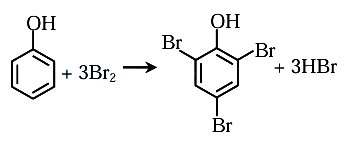
\(\begin{aligned} & \text { Moles of phenol }=\frac{2}{94}=0.021 \\ & \therefore \text { Moles of bromine }=0.021 \times 3=0.064 \\ & \therefore \text { Mass of bromine }=0.064 \times 160=10.22 \mathrm{~g}\end{aligned}\) -
- (A) 180
- (B) 184
- (C) 188
- (D) 192
Show answer and solution
Correct Answer: (B)
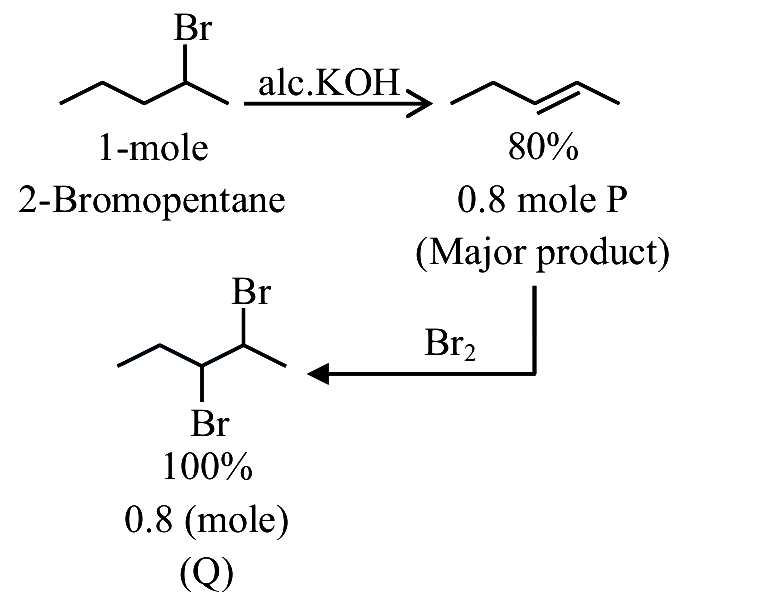
\(\begin{aligned} & \text { Molecular mass of } \mathrm{Q}=230 \mathrm{~g} \mathrm{~mol}^{-1} \\ & \begin{aligned} \text { Mass of } \mathrm{Q} & =0.8 \times 230 \\ & =184 \mathrm{~g}\end{aligned}\end{aligned}\) -
- (A) Both Statement I and Statement II are incorrect
- (B) Statement I is incorrect but Statement II is correct
- (C) Statement I is correct but Statement II is incorrect
- (D) Both Statement I and Statement II are correct
Show answer and solution
Correct Answer: (B)
Statement (I) :
\(\mathrm{R}-\mathrm{Cl} \xrightarrow{(\text { aq. } \mathrm{KOH})} \mathrm{R}-\mathrm{OH}\left(\mathrm{S}_{\mathrm{N}}\right.\) reaction \()\)
Statement (II) :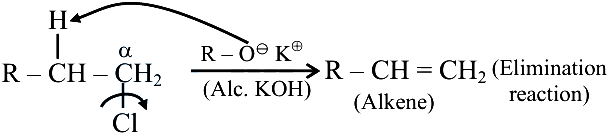
-
- (A) Both Statement I and Statement II are incorrect
- (B) Both Statement I and Statement II are correct
- (C) Statement I is incorrect but Statement II is correct
- (D) Statement I is correct but Statement II is incorrect
Show answer and solution
Correct Answer: (B)
1. Analysis of Statement I (True):
- Generally, primary alkyl halides do not undergo \( \text{S}_\text{N}1 \) reactions because primary carbocations are highly unstable.
- However, for \( \text{CH}_3-\text{O}-\text{CH}_2-\text{Cl} \), the loss of the chloride ion forms the carbocation \( \text{CH}_3-\ddot{\text{O}}-\overset{+}{\text{C}}\text{H}_2 \).
- This specific carbocation is exceptionally stabilized by resonance due to the lone pair of electrons on the adjacent oxygen atom:
\( \text{CH}_3-\ddot{\text{O}}-\overset{+}{\text{C}}\text{H}_2 \longleftrightarrow \text{CH}_3-\overset{+}{\text{O}}=\text{CH}_2 \)
- In the canonical structure on the right, every single atom (including both carbon and oxygen) satisfies the octet rule. This high resonance stabilization lowers the activation energy barrier for the \( \text{S}_\text{N}1 \) pathway remarkably, allowing it to proceed rapidly despite being a primary halide.
2. Analysis of Statement II (True):
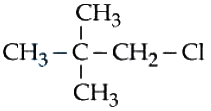
- Neopentyl chloride is a primary alkyl halide. For an \( \text{S}_\text{N}2 \) reaction to occur, a nucleophile must perform a backside attack on the electrophilic carbon carrying the leaving group.
- In neopentyl chloride, the \( \alpha \)-carbon bonded to chlorine is directly attached to a highly bulky tert-butyl group (\( -\text{C(CH}_3)_3 \)).
- This extreme steric hindrance completely shields the backside approach of the nucleophile. Consequently, neopentyl chloride is practically inert to \( \text{S}_\text{N}2 \) substitution reactions under standard laboratory conditions.
Since both Statement I and Statement II are factually correct, Option B is definitively the correct choice. -
- (A) A-II, B-I, C-III, D-IV
- (B) A-II, B-III, C-I, D-IV
- (C) A-IV, B-I, C-III, D-II
- (D) A-IV, B-III, C-I, D-II
Show answer and solution
Correct Answer: (D)
LIST-I
Name reactionLIST-II
Product obtainable(A) Swarts reaction (I) \(Et-I \xrightarrow{KF/DF} Et-F\) (B) Sandmeyer's reaction (II) \(\mathrm{PhN}_2^{\oplus} \mathrm{Cl}^{-} \xrightarrow[\mathrm{CuCN} / \mathrm{KCN}]{\mathrm{PhCN}+\mathrm{N}_2}\) (C) Wurtz Fittig reaction (III) \(Ph-Cl + EtCl \xrightarrow{Na/ether} Ph-Et + Ph-Ph + Et-Et\) (D) Finkelstein reaction (IV) \(Et-Cl \xrightarrow[acetone]{NaI} Et-I + NaCl\)
Explanation:
Let us evaluate each named organic reaction to determine its correct product:
1. Swarts reaction (A): This reaction involves the synthesis of alkyl fluorides by heating alkyl chlorides or bromides in the presence of metallic fluorides such as \( \text{AgF} \). For example, heating ethyl chloride with \( \text{AgF} \) gives Ethyl fluoride (IV).
2. Sandmeyer's reaction (B): This reaction is used to synthesize aryl nitriles or aryl halides from diazonium salts. Treating a benzene diazonium salt with \( \text{CuCN} \) yields Cyanobenzene (III).
3. Wurtz Fittig reaction (C): This reaction involves the coupling of an aryl halide and an alkyl halide when treated with sodium metal in the presence of dry ether to form an alkylbenzene. Reacting chlorobenzene and ethyl chloride with sodium yields Ethyl benzene (I).
4. Finkelstein reaction (D): This is a halogen exchange reaction where alkyl iodides are prepared by reacting alkyl chlorides or bromides with \( \text{NaI} \) in the presence of dry acetone. This gives Ethyl iodide (II).
Matching these correctly gives: A-IV, B-III, C-I, D-II.
Hence, Option D is the correct choice. -
- (A) benzoic acid
- (B) benzoic acid and aniline
- (C) benzoic acid and chlorobenzene
- (D) chlorobenzene and aniline
Show answer and solution
Correct Answer: (D)
Organic layer in funnel are mixture of chloro benzene and aniline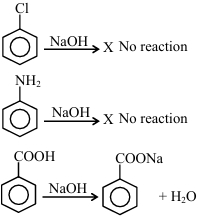
- 157. The ascending order of relative rate of solvolysis of following compounds is _______.
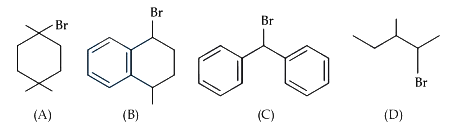
2025 Medium- (A) \((\mathrm{C}) \lt (\mathrm{B}) \lt (\mathrm{A}) \lt (\mathrm{D})\)
- (B) \((\mathrm{D}) \lt (\mathrm{A}) \lt (\mathrm{B}) \lt (\mathrm{C})\)
- (C) \((\mathrm{D}) \lt (\mathrm{B}) \lt (\mathrm{A}) \lt (\mathrm{C})\)
- (D) \((\mathrm{C}) \lt (\mathrm{D}) \lt (\mathrm{B}) \lt (\mathrm{A})\)
Show answer and solution
Correct Answer: (B)
Solvolysis or \(\mathrm{S}_{\mathrm{N}} 1 \propto\) stability of carboccation Stability order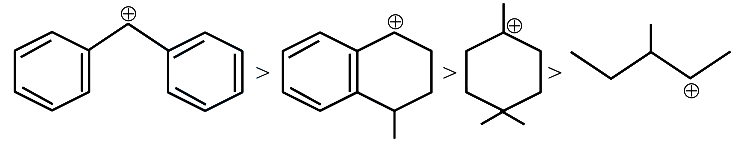
-
- (A) Both Statement (I) and Statement (II) are false.
- (B) Both Statement (I) and Statement (II) are true.
- (C) Statement (I) is false but Statement (II) is true.
- (D) Statement (I) is true but Statement (II) is false.
Show answer and solution
Correct Answer: (B)
Explanation:
Let us evaluate the truthfulness of both statements based on the principles of organic isomerism:
1. Analysis of Statement (I):
Methylcyclopentane is a cyclic alkane containing a total of 6 carbon atoms, giving it the molecular formula \( \text{C}_6\text{H}_{12} \). Hex-3-ene is an open-chain alkene with one double bond and 6 carbon atoms, which also gives it the molecular formula \( \text{C}_6\text{H}_{12} \). Since they share the same molecular formula but possess different skeletal connectivity (ring vs. open chain), they are valid ring-chain isomers. Thus, Statement (I) is true.
2. Analysis of Statement (II):
Pentan-1-amine \( (\text{CH}_3\text{CH}_2\text{CH}_2\text{CH}_2\text{CH}_2\text{NH}_2) \) is a primary \( (1^\circ) \) amine with the molecular formula \( \text{C}_5\text{H}_{13}\text{N} \). N-methylbutan-1-amine \( (\text{CH}_3\text{CH}_2\text{CH}_2\text{CH}_2\text{NHCH}_3) \) is a secondary \( (2^\circ) \) amine, which also shares the exact same molecular formula \( \text{C}_5\text{H}_{13}\text{N} \). In organic chemistry, primary, secondary, and tertiary amines containing the same molecular formula are classified as functional group isomers because they contain different functional environments. Thus, the corrected Statement (II) is true.
Hence, Option B is the correct choice. - 159. Identify the correct statements from the following
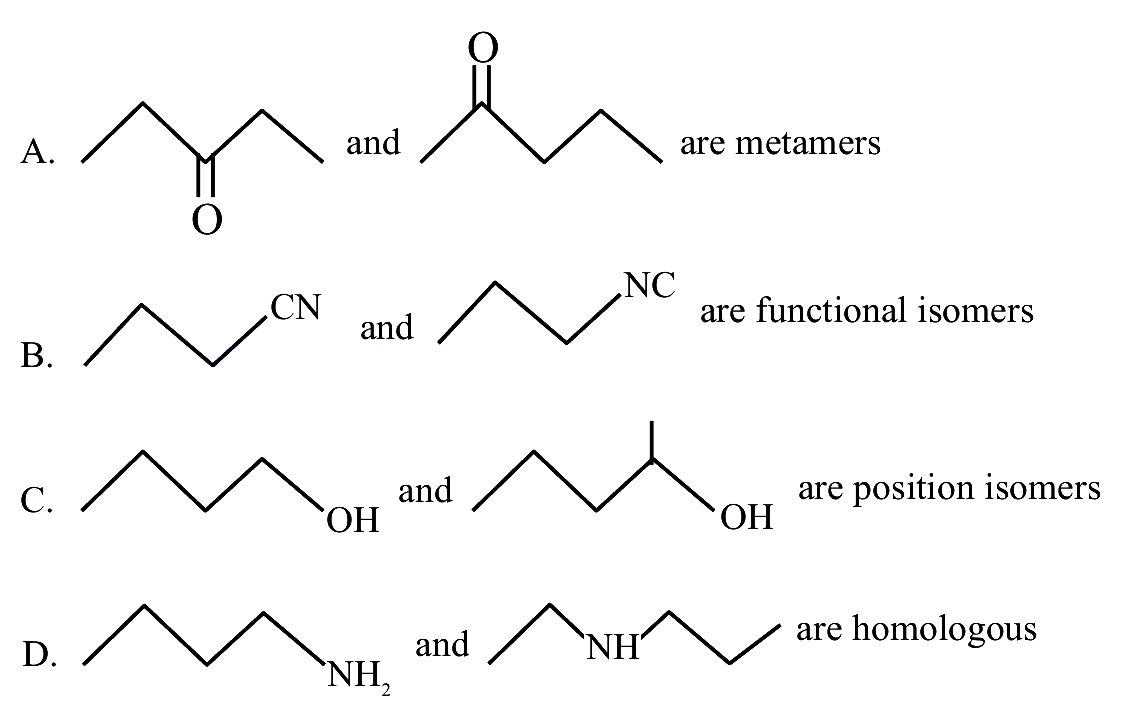
Choose the correct answer from the options given below. 2025 Medium- (A) C & D only
- (B) B & C only
- (C) A & B only
- (D) A,B & C only
Show answer and solution
Correct Answer: (C)
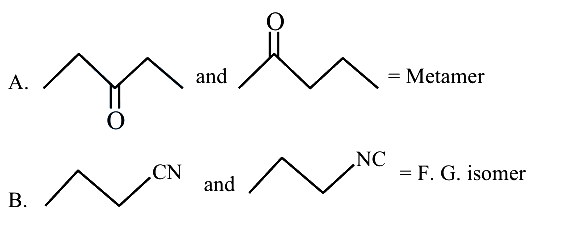
In option C are momologoes to each - other and option D are only organic molecule not isomers. -
- (A) 4
- (B) 6
- (C) 8
- (D) 10
Show answer and solution
Correct Answer: (C)
Since 4 moles of \(\mathrm{H}_2\) is being added for complete hydrogenation the degree of unsaturation \(=4\)
No. of \(\pi\) electrons in \(\mathrm{C}_6 \mathrm{H}_6=4 \times 2=8\) - 161. The hydrocarbon \((X)\) with molar mass \(80 \mathrm{~g} \mathrm{~mol}^{-1}\) and \(90 \%\) carbon has _______ degree of unsaturation. 2025 Easy
- (A) 9
- (B) 6
- (C) 3
- (D) 2
Show answer and solution
Correct Answer: (C)
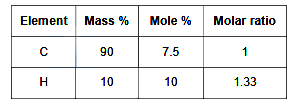
\(\therefore\) Empirical formula is \(\mathrm{C}_3 \mathrm{H}_4\)
Molecular mass \(=80 \mathrm{~g} \mathrm{~mol}^{-1}\).
Molecular formula \(=\left(\mathrm{C}_3 \mathrm{H}_4\right)_{\mathrm{n}}\)
\(\mathrm{n}=\frac{\text { Molecular mass }}{\mathrm{EF} \text { mass }}=\frac{80}{40}=2\)
\(\therefore\) Molecular formula is \(\mathrm{C}_6 \mathrm{H}_8\)
Degree of unsaturation \(=\frac{2 \times 6+2-8}{2}=3\) -
- (A) (A) and (E) Only
- (B) (A), (D) and (E) Only
- (C) (B) and (C) Only
- (D) (C), (D) and (E) Only
Show answer and solution
Correct Answer: (B)
(A) \(\mathrm{CH}_3-\mathrm{CH}=\mathrm{CH}_2\). GI is not possible
(B) Trans isomer has identical atoms/groups on the opposite side of double bond.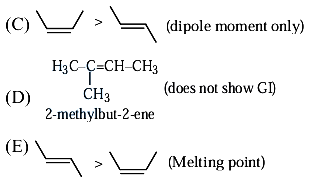
- 163.
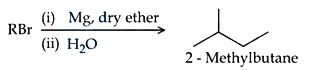
The maximum number of RBr producing 2-methylbutane by above sequence of reactions is ________ - (Consider the structural isomers only) 2025 Hard- (A) 5
- (B) 4
- (C) 3
- (D) 1
Show answer and solution
Correct Answer: (B)
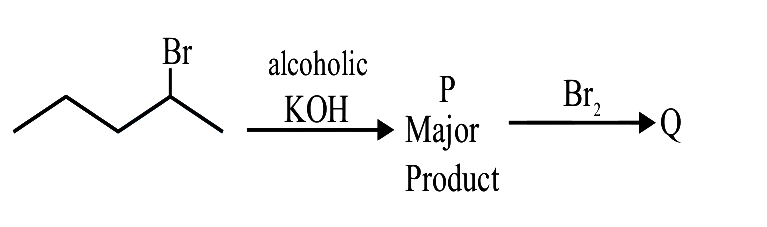
\(\mathrm{RBr} \xrightarrow[\text { dry Ether }]{\mathrm{Mg}} \mathrm{RMgBr} \xrightarrow{\mathrm{H}_2 \mathrm{O}} \mathrm{R}-\mathrm{H}\)
Hence, RBr Can be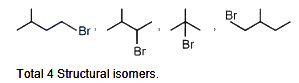
-
- (A) 2
- (B) 4
- (C) 6
- (D) 8
Show answer and solution
Correct Answer: (A)
\(\mathrm{FeCl}_3+\mathrm{KOH}+\mathrm{H}_2 \mathrm{SO}_4 \rightarrow \mathrm{~K}_3\left[\mathrm{Fe}\left(\mathrm{C}_2 \mathrm{O}_4\right)_3\right]\)
\(\Rightarrow\left[\mathrm{Fe}\left(\mathrm{C}_2 \mathrm{O}_4\right)_3\right]^{3-}\) is \(\left[\mathrm{M}(\mathrm{AA})_3\right]\) type complex.
So total optical isomers \(=2\) -
- (A) 6
- (B) 5
- (C) 4
- (D) 3
Show answer and solution
Correct Answer: (C)
The given compound is 5-phenylpent-4-en-2-ol. Possible stereoisomers are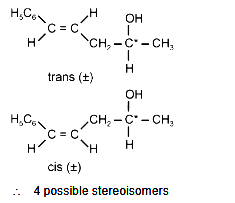
-
- (A) 8
- (B) 10
- (C) 12
- (D) 14
Show answer and solution
Correct Answer: (A)
\(\mathrm{MF}=\mathrm{C}_9 \mathrm{H}_{12}\)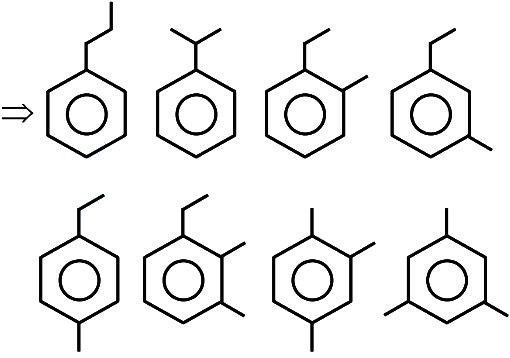
-
- (A) 4
- (B) 6
- (C) 8
- (D) 2
Show answer and solution
Correct Answer: (D)
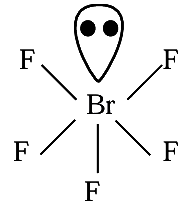
1 lone pair hence 1 mole AgCl.
Complex is \(\left[\mathrm{M}\left(\mathrm{NH}_3\right)_3 \mathrm{Cl}_3\right] \mathrm{Cl}\).
It shows 2 geometrical isomers \(\left(\mathrm{Ma}_3 \mathrm{~b}_3\right.\) type) facial (fac) & meridional (Mer) -
- (A) 2
- (B) 3
- (C) 4
- (D) 1
Show answer and solution
Correct Answer: (D)
Co has highest standard electrode potential \(\left(\mathrm{M}^{+3} / \mathrm{M}^{+2}\right)\) among \(\mathrm{Mn}, \mathrm{Cr}, \mathrm{Co}, \mathrm{Fe}\)
\(\therefore\) Complex is \(\left[\mathrm{Co}(\mathrm{CN})_6\right]^{4-}\) and its splitting is as follows.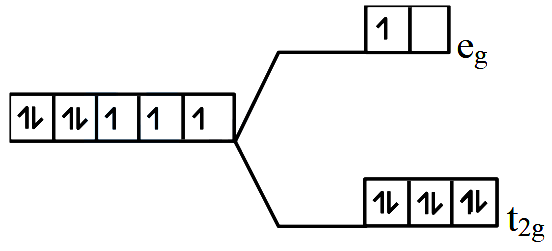
\(\therefore\) electron in \(\mathrm{e}_{\mathrm{g}}\) orbital is one. -
- (A) 3
- (B) 6
- (C) 9
- (D) 12
Show answer and solution
Correct Answer: (A)
\(\mathrm{Cu}^{2+}, \mathrm{Ca}^{2+} \& \mathrm{Zn}^{2+}\) will form precipitate with \(\mathrm{K}_4\left[\mathrm{Fe}(\mathrm{CN})_6\right] . \mathrm{Fe}^{3+}\) forms coloured solution -
- (A) Co-ordinate isomerism
- (B) Linkage isomerism
- (C) Ionisation isomerism
- (D) Geometrical isomerism
Show answer and solution
Correct Answer: (C)
(A) complex is \(\left[\mathrm{Co}\left(\mathrm{NH}_3\right)_5\left(\mathrm{SO}_4\right)\right] \mathrm{Cl}\)
(B) complex is \(\left[\mathrm{Co}\left(\mathrm{NH}_3\right)_5 \mathrm{Cl}\right] \mathrm{SO}_4\)
Both \((\mathrm{A})\) and \((\mathrm{B})\) are Ionisation isomers. -
- (A) \(0\)
- (B) 1
- (C) 2
- (D) 3
Show answer and solution
Correct Answer: (A)
\(\mathrm{K}_3\left[\mathrm{Co}\left(\mathrm{NO}_2\right)_6\right]=\) Yellow \(\Rightarrow \mathrm{Co}^{3+}=3 \mathrm{~d}^6 \Rightarrow \mathrm{t}_{2 \mathrm{~g}}^6 \mathrm{e}_{\mathrm{g}}^0\)
\(\begin{aligned}
& \mathrm{K}_4\left[\mathrm{Fe}(\mathrm{CN})_8\right]=\text { Yellow } \Rightarrow \mathrm{Fe}^{2+}=3 \mathrm{~d}^6 \Rightarrow \mathrm{t}_{2 \mathrm{~g}}^6 \mathrm{e}_{\mathrm{g}}^0 \\
& \mathrm{~K}_3\left[\mathrm{Fe}(\mathrm{CN})_8\right]=\text { Bright Red } \Rightarrow \mathrm{Fe}^{3+}=3 \mathrm{~d}^5 \Rightarrow \mathrm{t}_{2 \mathrm{~g}}^5 \mathrm{e}_{\mathrm{g}}^0 \\
& \mathrm{Cu}_2\left[\mathrm{Fe}(\mathrm{CN})_8\right]=\text { Chocolate brown } \\
& \mathrm{Zn}_2\left[\mathrm{Fe}(\mathrm{CN})_8\right]=\text { White }
\end{aligned}\)
Spin only magnetic moment of complex having Yellow colour is zero. -
- (A) \(\left[\mathrm{Cr}\left(\mathrm{NH}_3\right)_5 \mathrm{Cl}\right] \mathrm{Cl}_2\)
- (B) \(\left[\mathrm{Cr}\left(\mathrm{NH}_3\right)_6\right] \mathrm{Cl}_3\)
- (C) \(\left[\mathrm{Cr}\left(\mathrm{NH}_3\right)_3 \mathrm{Cl}_3\right]\)
- (D) \(\left[\mathrm{Cr}\left(\mathrm{NH}_3\right)_4 \mathrm{Cl}_2\right] \mathrm{Cl}\)
Show answer and solution
Correct Answer: (A)
\(\begin{aligned} & \Delta T_f=i K_f m \\ & 0.558=i \times 1.86 \times 0.1 \\ & i=\frac{0.558}{0.186}=3\end{aligned}\)
Number of ions when 100\% ionisation takes place \(=3\)
\(\left[\mathrm{Cr}\left(\mathrm{NH}_3\right)_5 \mathrm{Cl}\right] \mathrm{Cl}_2 \xrightarrow{\text { aqueous solution }}\left[\mathrm{Cr}\left(\mathrm{NH}_3\right)_5 \mathrm{Cl}^{2+}\right]^{2+}+2 \mathrm{Cl}^{-}\)
Number of ions \(=3\) -
- (A) \(\left[\mathrm{NiCl}_4\right]^{2-}: \mathrm{Ni}^{\mathrm{II}}\), tetrahedral
\(\left[\mathrm{Ni}(\mathrm{CO})_4\right]: \mathrm{Ni}^{\mathrm{II}}\), square planar - (B) \(\left[\mathrm{NiCl}_4\right]^{2-}\) : \(\mathrm{Ni}^{\mathrm{II}}\), square planar
\(\left[\mathrm{Ni}(\mathrm{CO})_4\right]: \mathrm{Ni}(0)\), square planar - (C) \(\left[\mathrm{NiCl}_4\right]^{2-}: \mathrm{Ni}^{\mathrm{II}}\), tetrahedral
\(\left[\mathrm{Ni}(\mathrm{CO})_4\right]: \mathrm{Ni}(0)\), tetrahedral - (D) \(\left[\mathrm{NiCl}_4\right]^{2-}: \mathrm{Ni}(0)\), tetrahedral
\(\left[\mathrm{Ni}(\mathrm{CO})_4\right]: \mathrm{Ni}(0)\), square planar
Show answer and solution
Correct Answer: (C)
\(\left[\mathrm{NiCl}_4\right]^{2-}\)
\(\mathrm{Ni}^{+2}-[\mathrm{Ar}] 3 \mathrm{~d}^8 4 \mathrm{~s}^0 \rightarrow \mathrm{sp}^3\), Tetrahedral
Number of unpaired electron \(=2\) paramagentic
\(\left[\mathrm{Ni}(\mathrm{CO})_4\right]\)
\(\mathrm{Ni}(0) \rightarrow[\mathrm{Ar}] 3 \mathrm{~d}^{10} 4 \mathrm{~s}^0\) (After rearrangement)
No unpaired electron
\(\mathrm{sp}^3\), Tetrahedral, Diamagnetic - (A) \(\left[\mathrm{NiCl}_4\right]^{2-}: \mathrm{Ni}^{\mathrm{II}}\), tetrahedral
-
- (A) Statement I is correct but Statement II is incorrect.
- (B) Both Statement I and Statement II are incorrect
- (C) Statement I is incorrect but Statement II is correct
- (D) Both Statement I and Statement II are correct
Show answer and solution
Correct Answer: (D)
In octahedral complex \((\mathrm{CN}=6)\)
If \(\Delta_0 \lt \) P.E., then high spin complexes are formed
If \(\Delta_0 \gt \) P.E., then low spin complexes are formed But in tetrahedral complex \((\mathrm{CN}=4)\)
\(\Delta_t \lt \) P.E., then mainly high spin complexes are formed and rarely low spin complexes are formed. -
- (A) Both statements I and Statement II are false
- (B) Statement I is false but Statement II is true
- (C) Statement I is true but Statement II are false
- (D) Both statements I and Statement II are true
Show answer and solution
Correct Answer: (C)
Mohr's salt : \(\mathrm{FeSO}_4 \cdot\left(\mathrm{NH}_4\right)_2 \mathrm{SO}_4 \cdot 6 \mathrm{H}_2 \mathrm{O}\)
Using Kohlrousch law
\(\lambda_{\mathrm{m}}^{\infty}(\text { Mohr's salt })=\mathrm{x}_1+2 \mathrm{x}_2+2 \mathrm{x}_3\) -
- (A) (B), (C) and (D) only
- (B) (C) and (E) only
- (C) (B) and (D) only
- (D) (A), (B) and (E) only
Show answer and solution
Correct Answer: (C)
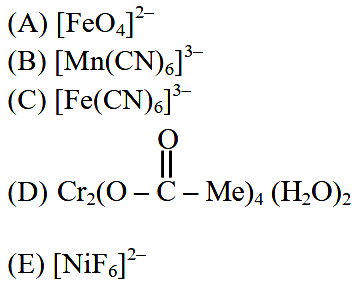
\(\begin{aligned} & \mathrm{Fe}^{+6}=[\mathrm{Ar}] 3 \mathrm{~d}^2 \\ & \mathrm{Mn}^{+3}=[\mathrm{Ar}] 3 \mathrm{~d}^4 \\ & \mathrm{Fe}^{+3}=[\mathrm{Ar}] 3 \mathrm{~d}^5 \\ & \mathrm{Cr}^{+2}=[\mathrm{Ar}] 3 \mathrm{~d}^4 \\ & \mathrm{Ni}^{+4}=[\mathrm{Ar}] 3 \mathrm{~d}^6\end{aligned}\) -
- (A) (C) only
- (B) (C) and (D) only
- (C) (A) and (C) only
- (D) (B) and (E) only
Show answer and solution
Correct Answer: (B)
(A) \(\left[\mathrm{Fe}(\mathrm{CN})_5 \mathrm{NO}\right]^{-2} \rightarrow\) Heteroleptic, \(\mathrm{Fe}^{+2}, 3 \mathrm{~d}^6\), \(\mathrm{t}_{2 \mathrm{~g}}{ }^6 \mathrm{e}_{\mathrm{g}}{ }^0, \mathrm{~d}^2 \mathrm{sp}^3\), Low spin ( 3 d series +SFL )
(B) \(\left[\mathrm{CoF}_6\right]^{-3} \rightarrow\) Homoleptic, \(\mathrm{sp}^3 \mathrm{~d}^2\), High spin, \(\mathrm{Co}^{+3}, 3 \mathrm{~d}^6(3 \mathrm{~d}\) series + WFL \()\)
(C) \(\left[\mathrm{Fe}(\mathrm{CN})_6\right]^{-4} \rightarrow\) Homoleptic
\(\mathrm{Fe}^{+2}, 3 \mathrm{~d}^6, \mathrm{~d}^2 \mathrm{sp}^3, \mathrm{t}_{2 \mathrm{~g}}{ }^6 \mathrm{eg}^0\) Low spin
\((3 \mathrm{~d}\) series +SFL\()\)
(D) \(\left[\mathrm{Co}\left(\mathrm{NH}_3\right)_6\right]^{+3} \rightarrow\) Homoleptic, \(\mathrm{Co}^{+3} 3 \mathrm{~d}^6, \mathrm{~d}^2 \mathrm{sp}^3\),
\(\mathrm{t}_{2 \mathrm{~g}}{ }^6 \mathrm{eg}^0\), Low spin (3d series + SFL)
(E) \(\left[\mathrm{Cr}\left(\mathrm{H}_2 \mathrm{O}\right)_6\right]^{+2} \rightarrow\) Homoleptic
\(\mathrm{Cr}^{+2} 3 \mathrm{~d}^4, \mathrm{~d}^2 \mathrm{sp}^3\), High spin \(\mathrm{t}_{2 \mathrm{~g}}{ }^3 \mathrm{e}_{\mathrm{g}}{ }^1\)
(3d series + WFL) -
- (A) (A), (B) and (D) only
- (B) (C) and (E) only
- (C) (B) and (D) only
- (D) (A), (C) and (E) only
Show answer and solution
Correct Answer: (C)
(A) \(\left[\mathrm{FeO}_4\right]^{2-} \Rightarrow \mathrm{Fe}^{6+}=3 \mathrm{~d}^2\)
(B) \(\left[\mathrm{Fe}(\mathrm{CN})_8\right]^{3-} \Rightarrow \mathrm{Fe}^{3+}=3 \mathrm{~d}^5\)
(C) \(\left[\mathrm{Fe}(\mathrm{CN})_5 \mathrm{NO}\right]^{2-} \Rightarrow \mathrm{Fe}^{2+}=3 \mathrm{~d}^6\)
(D) \([\mathrm{CoCl} 4]^{2-} \Rightarrow \mathrm{Co}^{2+}=3 \mathrm{~d}^7\)
(E) \(\left[\mathrm{Co}\left(\mathrm{H}_2 \mathrm{O}\right)_3 \mathrm{~F}_3\right] \Rightarrow \mathrm{Co}^{3+}=3 \mathrm{~d}^6\)
(B) and (D) are homoleptic complex having odd no. of d electrons. - 179. In which of the following complexes the CFSE, \(\Delta_{\mathrm{o}}\) will be equal to zero? 2025 Medium
- (A) \(\left[\mathrm{Fe}(\mathrm{en})_3\right] \mathrm{Cl}_3\)
- (B) \(\mathrm{K}_4\left[\mathrm{Fe}(\mathrm{CN})_6\right]\)
- (C) \(\left[\mathrm{Fe}\left(\mathrm{NH}_3\right)_6\right] \mathrm{Br}_2\)
- (D) \(\mathrm{K}_3\left[\mathrm{Fe}(\mathrm{SCN})_6\right]\)
Show answer and solution
Correct Answer: (D)
For complex \(\mathrm{K}_3\left[\mathrm{Fe}(\mathrm{SCN})_6\right]\)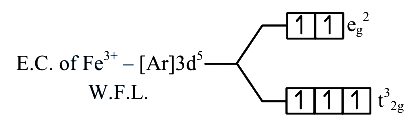
Calculation of CFSE
\(\begin{aligned}
& =(-0.4 \times 3+0.6 \times 2) \Delta_0 \\
& =0 \Delta_0
\end{aligned}\) -
- (A) (A)-(III), (B)-(I), (C)-(II), (D)-(IV)
- (B) (A)-(I), (B)-(IV), (C)-(II), (D)-(III)
- (C) (A)-(I), (B)-(III), (C)-(II), (D)-(IV)
- (D) (A)-(II), (B)-(III), (C)-(IV), (D)-(I)
Show answer and solution
Correct Answer: (B)
Primary valency \(=\) Oxidation state
Secondary valency \(=\) Co-ordination numberComplex Primary Valency Secondary Valency (A) [Co(en)2Cl2]Cl 3 6 (B) [Pt(NH3)2Cl(NO2)] 2 4 (C) Hg[Co(SCN)4] 3 4 (D) [Mg(EDTA)]2- 2 6 -
- (A) (A)-(IV), (B)-(II), (C)-(III), (D)-(I)
- (B) (A)-(IV), (B)-(III), (C)-(I), (D)-(II)
- (C) (A)-(III), (B)-(IV), (C)-(II), (D)-(I)
- (D) (A)-(III), (B)-(I), (C)-(IV), (D)-(II)
Show answer and solution
Correct Answer: (B)
- Bronze is an alloy of copper and Tin. (A-IV)
- Brass is an alloy of copper and Zinc. (B-III)
- UK Silver coin is an alloy of copper and Nickel. (C-I)
- Stainless steel is an alloy of \(\mathrm{Fe}, \mathrm{Cr}, \mathrm{Ni}, \mathrm{C}\). (D-II) -
- (A) A-II, B-III, C-IV, D-I
- (B) A-IV, B-I, C-II, D-III
- (C) A-I, B-II, C-III, D-IV
- (D) A-III, B-I, C-IV, D-II
Show answer and solution
Correct Answer: (A)
\(\begin{aligned}
& \mathrm{PF}_5: 5 \sigma+0 \ell \mathrm{p} \rightarrow \mathrm{sp}^3 \mathrm{~d} \\
& \mathrm{SF}_6: 6 \sigma+0 \ell \mathrm{p} \rightarrow \mathrm{sp}^3 \mathrm{~d}^2 \\
& \mathrm{Ni}(\mathrm{CO})_4: \mathrm{Ni} \rightarrow 0
\end{aligned}\)
In presence of ligand field :-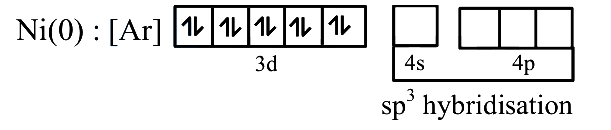
\(\left[\mathrm{PtCl}_4\right]^{2-}: \mathrm{Pt} \rightarrow+2\)
In presence of ligand field :-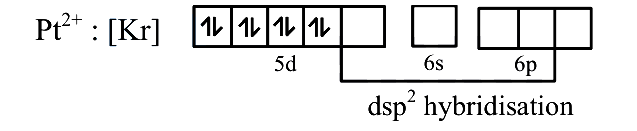
-
- (A) \(3 \& 3\)
- (B) \(2 \& 2\)
- (C) \(2 \& 3\)
- (D) \(1 \& 2\)
Show answer and solution
Correct Answer: (C)
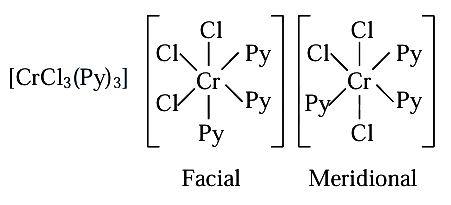
So total stereo isomer \(=2\)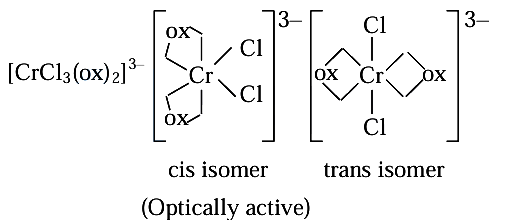
Geometrical isomer \(=2(1\) cis +1 trans \()\)
Optical isomer \(=3\) ( 2 optically active +1 optically inactive)
Stereoisomer \(=3\) -
- (A) \(\left[\mathrm{Co}\left(\mathrm{NH}_3\right)_4 \mathrm{Cl}_2\right] \cdot \mathrm{Cl} \cdot \mathrm{NH}_3\)
- (B) \(\left[\mathrm{Co}\left(\mathrm{NH}_3\right)_3 \mathrm{Cl}_3\right] \cdot 2 \mathrm{NH}_3\)
- (C) \(\left[\mathrm{Co}\left(\mathrm{NH}_3\right)_5 \mathrm{Cl}\right] \mathrm{Cl}_2\)
- (D) \(\left[\mathrm{Co}\left(\mathrm{NH}_3\right)_4 \mathrm{Cl}\right] \cdot \mathrm{Cl}_2 \cdot \mathrm{NH}_3\)
Show answer and solution
Correct Answer: (C)
\(\begin{array}{l}{\left[\mathrm{Co}\left(\mathrm{NH}_3\right)_5 \mathrm{Cl}\right] \mathrm{Cl}_2 \rightarrow \underbrace{\left[\mathrm{Co}\left(\mathrm{NH}_3\right)_5 \mathrm{Cl}\right]^{2+}(\text { aq. })+2 \mathrm{Cl}^{-}(\text {aq. })}_{3 \text { ions in water }}} \\ {\left[\mathrm{Co}\left(\mathrm{NH}_3\right)_5 \mathrm{Cl}\right] \mathrm{Cl}_2(\text { aq. })+2 \mathrm{AgNO}_3(\text { aq. }) \rightarrow} {\left[\mathrm{Co}\left(\mathrm{NH}_3\right)_5 \mathrm{Cl}\right]\left(\mathrm{NO}_3\right)_2(\text { aq. })+2 \mathrm{AgCl}(\mathrm{s})}\end{array}\) - 185. The complex of \(\mathrm{Ni}^{2+}\) ion and dimethyl glyoxime contains ________ number of Hydrogen \((\mathrm{H})\) atoms. 2025 Easy
- (A) 10
- (B) 14
- (C) 18
- (D) 22
Show answer and solution
Correct Answer: (B)
\(\mathrm{Ni}^{2+}\) with(dmg) forms \(\left[\mathrm{Ni}(\mathrm{dmg})_2\right]^{2+}\) having 2 H -Bonds as shown:
The no. of H atoms \(=14\)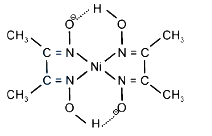
-
- (A) \({ }_{1 .}\left[\mathrm{Co}(\mathrm{en})_2 \mathrm{Cl}_2\right]^{+}\)
- (B) \(\left[\mathrm{Co}(\mathrm{en})_3\right]^{3+}\)
- (C) \(\left[\mathrm{Co}\left(\mathrm{NH}_3\right)_3 \mathrm{Cl}_3\right]\)
- (D) \(\left[\mathrm{Co}\left(\mathrm{NH}_3\right)_4 \mathrm{Cl}_2\right]^{+}\)
Show answer and solution
Correct Answer: (C)
\(\mathrm{Ma}_3 \mathrm{~b}_3\) type complexes show Facial - Meridional isomerism
(i) \(\left[\mathrm{Co}\left(\mathrm{NH}_3\right)_3 \mathrm{Cl}_3\right] \Rightarrow \mathrm{Ma}_3 \mathrm{~b}_3\)
(ii) \(\left[\mathrm{Co}\left(\mathrm{NH}_3\right)_4 \mathrm{Cl}_2\right]^{+} \Rightarrow \mathrm{Ma}_4 \mathrm{~b}_2\)
(iii) \(\left[\mathrm{Co}(\mathrm{en})_3\right]^{3+} \Rightarrow \mathrm{M}(\mathrm{AA})_3\)
(iv) \(\left[\mathrm{Co}(\mathrm{en})_2 \mathrm{Cl}_2\right]^{+} \Rightarrow \mathrm{M}(\mathrm{AA})_2 \mathrm{~b}_2\)
\(\mathrm{a}, \mathrm{b},=\mathrm{NH}_3, \mathrm{Cl}^{-}\)
\(\mathrm{AA}=\mathrm{en}\) - 187. The conditions and consequence that favours the \(t_{2 g}^3 e_g^1\) configuration in a metal complex are _______. 2025 Medium
- (A) weak field ligand, low spin complex
- (B) weak field ligand, high spin complex
- (C) strong field ligand, high spin complex
- (D) strong field ligand, low spin complex
Show answer and solution
Correct Answer: (B)
The conditions and consequence that favour \(t_{2 g}^3 e_g^1\) configuration in a metal complex are
(i) weak field ligand, and
(ii) high spin complex
For weak field ligands, splitting energy ( \(\Delta_0\) ) is lower than pairing energy \((P)\). As a result distribution of electrons for \(3 \mathrm{~d}^4\) will be \(t_{2 \mathrm{~g}}^3 \mathrm{e}_{\mathrm{g}}^1\). It results in high spin complex due to maximum number of unpaired electrons. -
- (A) \(\mathrm{IV} \lt \mathrm{III} \lt \mathrm{II} \lt \mathrm{I}\)
- (B) \(\mathrm{I} \lt \mathrm{II} \lt \mathrm{IV} \lt \) III
- (C) III \( \lt \) II \( \lt \) IV \( \lt \) I
- (D) II \( \lt \) III \( \lt \) I \( \lt \) IV
Show answer and solution
Correct Answer: (B)
Neglecting pairing energy
I. \([\mathrm{Mn}(\mathrm{CN}) \mathrm{B}]^{3-} \Rightarrow \mathrm{Mn}^{3+}, \mathrm{t}_2 \mathrm{~g}^4, \mathrm{CFSE}=-0.4 \times 4 \Delta \mathrm{o}\) \(=-1.6 \Delta\) 。
II. \([\mathrm{Co}(\mathrm{CN}) 8]^{4-} \Rightarrow \mathrm{Co}^{2+}, \mathrm{t}_2{ }^6 \mathrm{eg}^1, \mathrm{CFSE}=-0.4 \times 6+\) \(0.6 \times 1=-1.8 \Delta_{\circ}\)
III. \(\left[\mathrm{Fe}(\mathrm{CN})_8\right]^{4-} \Rightarrow \mathrm{Fe}^{2+}, \mathrm{t}_{2 g}{ }^6 \mathrm{e}^0, \mathrm{CFSE}=-0.4 \times 6=\) \(-2.4 \Delta_0\)
IV. \(\left[\mathrm{Fe}(\mathrm{CN})_8\right]^{3-} \Rightarrow \mathrm{Fe}^{3+}, \mathrm{t}_{2 g}{ }^5 \mathrm{e}^0, \mathrm{CFSE}=-0.4 \times 5=\) \(-2 \Delta_0\)
Order of stability III \(>\) IV \(>\) II \(>\) I -
- (A) D > A > B > C
- (B) C > B > D > A
- (C) D > C > B > A
- (D) C > B > A > D
Show answer and solution
Correct Answer: (A)
We know \(\mathrm{E}=\mathrm{h} v=\frac{\mathrm{hC}}{\lambda}\)
\(\mathrm{E} \propto \frac{1}{\lambda}\)
Here all Co in +3 oxidation state.
So, as the ligand field strength \(\uparrow, \operatorname{CFSE} \uparrow\)
Order of field strength of ligand :
\(\mathrm{CN} \gt \mathrm{NH}_3 \gt \mathrm{H}_2 \mathrm{O} \gt \mathrm{Cl}^{-}\)
CFSE order : \(\mathrm{C} \gt \mathrm{B} \gt \mathrm{A} \gt \mathrm{D}\)
Wavelength order: \(\mathrm{D} \gt \mathrm{A} \gt \mathrm{B} \gt \mathrm{C}\) - 190. The correct order of the following complexes in terms of their crystal field stabilization energies is _______. 2025 Hard
- (A) \(\left[\mathrm{Co}\left(\mathrm{NH}_3\right)_4\right]^{2+} \lt \left[\mathrm{Co}\left(\mathrm{NH}_3\right)_6\right]^{2+} \lt \left[\mathrm{Co}(\mathrm{en})_3\right]^{3+} \lt \left[\mathrm{Co}\left(\mathrm{NH}_3\right)_6\right]^{3+}\)
- (B) \(\left[\mathrm{Co}\left(\mathrm{NH}_3\right)_6\right]^{2+} \lt \left[\mathrm{Co}\left(\mathrm{NH}_3\right)_6\right]^{3+} \lt \left[\mathrm{Co}\left(\mathrm{NH}_3\right)_4\right]^{2+} \lt \left[\mathrm{Co}(\mathrm{en})_3\right]^{3+}\)
- (C) \(\left[\mathrm{Co}(\mathrm{en})_3\right]^{3+} \lt \left[\mathrm{Co}\left(\mathrm{NH}_3\right)_6\right]^{3+} \lt \left[\mathrm{Co}\left(\mathrm{NH}_3\right)_6\right]^{2+} \lt \left[\mathrm{Co}\left(\mathrm{NH}_3\right)_4\right]^{2+}\)
- (D) \(\left[\mathrm{Co}\left(\mathrm{NH}_3\right)_4\right]^{2+} \lt \left[\mathrm{Co}\left(\mathrm{NH}_3\right)_6\right]^{2+} \lt \left[\mathrm{Co}\left(\mathrm{NH}_3\right)_6\right]^{3+} \lt \left[\mathrm{Co}(\mathrm{en})_3\right]^{3+}\)
Show answer and solution
Correct Answer: (D)
Crystal field splitting energy \((\Delta) \propto\) charge or oxidation state of central metal atom.
Crystal field splitting energy \((\Delta) \propto\) Field strength of ligand (and chelation)
Crystal field stabilisation energy (CFSE) \(=\left[-0.4 \mathrm{t}_{\mathrm{g}_g}\right.\) +0.6 eg] \(\Delta_{\circ}\) (for octahedral)
For,
\(\begin{aligned} & {\left[\mathrm{Co}(\mathrm{en})_3\right]^{3+}: \mathrm{Co}^{3+}: \mathrm{t}_{2 \mathrm{~g}}^6 \mathrm{eg}^0 ; \mathrm{CFSE}=-2.4\left(\Delta_0\right)_1} \\ & {\left[\mathrm{Co}\left(\mathrm{NH}_3\right)_6\right]^{3+}: \mathrm{Co}^{3+}: \mathrm{t}_{2 \mathrm{~g}}^6 \mathrm{eg}^0 ; \mathrm{CFSE}=-2.4\left(\Delta_0\right)_2} \\ & {\left[\mathrm{Co}\left(\mathrm{NH}_3\right)_6\right]^{2+}: \mathrm{Co}^{2+}: \mathrm{t}_{2 g}^5 \mathrm{eg}^2 ; \mathrm{CFSE}=-0.8\left(\Delta_0\right)_3} \\ & {\left[\mathrm{Co}\left(\mathrm{NH}_3\right)_4\right]^{2+}: \mathrm{Co}^{2+}: \mathrm{e}^4 \mathrm{t}_2^3 ; \mathrm{CFSE}=-1.2 \Delta_{\mathrm{t}}} \\ & \left(\mathrm{as}:\left(\Delta_{\mathrm{t}}\right)=\frac{4}{9}\left(\Delta_0\right)_3\right) \\ & \because \Delta_{\mathrm{t}} < \left(\Delta_0\right)_3 < \left(\Delta_0\right)_2 < \left(\Delta_0\right)_1\end{aligned}\) - 191. The d- electronic configuration of an octahedral Co(II) complex having magnetic moment of 3.95 BM is _______. 2025 Medium
- (A) \(\mathrm{t}_{2 \mathrm{~g}}{ }^3 \mathrm{e}_{\mathrm{g}}{ }^0\)
- (B) \(\mathrm{t}_{2 \mathrm{~g}}{ }^6 \mathrm{e}_{\mathrm{g}}{ }^1\)
- (C) \(\mathrm{t}_{2 \mathrm{~g}}{ }^5 \mathrm{e}_{\mathrm{g}}{ }^2\)
- (D) \(\mathrm{e}^4 \mathrm{t}_2{ }^3\)
Show answer and solution
Correct Answer: (C)
\(\mathrm{Co}^{2+}\) complex having \(\mu=3.95 \mathrm{BM}\)
Hence number of unpaired electron \(=3\)
\(\mathrm{Co}^{2+} \Rightarrow 3 d^7=\mathrm{t}_{2 \mathrm{~g}}^5 \mathrm{e}_{\mathrm{g}}^2\) -
- (A) \(t_2^6 g_g^0\)
- (B) \(t_2^6 e_g^4\)
- (C) \(t_{2 g}^3 e_g^2\)
- (D) \(t_2^4 e_g^2\)
Show answer and solution
Correct Answer: (A)
In \(\left[\mathrm{Co}(\mathrm{en})_3\right]^{+3}\) S.F.L. is present and hence highest value of CFSE
In rest all complexes WFL is present hence CFSE will be low.
\(\left[\mathrm{Co}(\mathrm{en})_3\right]^{+3} \Rightarrow \mathrm{Co}^{+3}\) and en (SFL)
\(\mathrm{Co}^{+3} \Rightarrow[\mathrm{Ar}] 3 \mathrm{~d}^6\)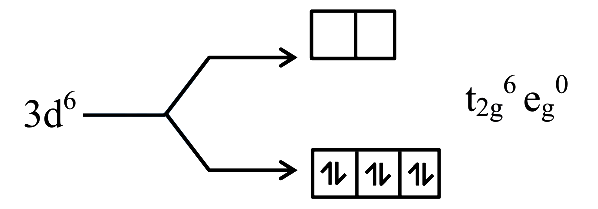
-
- (A) 2
- (B) 4
- (C) 6
- (D) 8
Show answer and solution
Correct Answer: (A)
\(\left[\mathrm{FeF}_6\right]^{3-} \quad\quad\) Paramagnetic \(\quad\quad \mathrm{sp}^3 \mathrm{~d}^2\)
\(\left[\mathrm{Fe}(\mathrm{CN})_6\right]^{3-} \quad\) Paramagnetic \(\quad\quad \mathrm{d}^2 \mathrm{sp}^3\)
\(\left[\mathrm{Mn}(\mathrm{CN})_6\right]^{3-} \quad\) Paramagnetic \(\quad\quad \mathrm{d}^2 \mathrm{sp}^3\)
\(\left[\mathrm{Co}\left(\mathrm{C}_2 \mathrm{O}_4\right)_3\right]^{3-} \quad\) Diamagnetic \(\quad\quad \mathrm{d}^2 \mathrm{sp}^3\)
\(\left[\mathrm{MnCl}_6\right]^{3-} \quad\) Paramagnetic \(\quad \mathrm{sp}^3 \mathrm{~d}^2\)
\(\left[\mathrm{CoF}_6\right]^{3-} \quad\) Paramagnetic \(\quad \mathrm{sp}^3 \mathrm{~d}^2\)
Only \(\quad\left[\mathrm{Fe}(\mathrm{CN})_6\right]^{3-}\) and \(\left[\mathrm{Mn}(\mathrm{CN})_6\right]^{3-}\) are paramagnetic and \(\mathrm{d}^2 \mathrm{sp}^3\) hybridisation of metal. -
- (A) \(5\)
- (B) \(6\)
- (C) \(4\)
- (D) \(3\)
Show answer and solution
Correct Answer: (D)
In \(\left[\mathrm{Co}\left(\mathrm{NH}_3\right]_6\right]^{3+}, \mathrm{Co}^{+3}:[\mathrm{Ar}] 3 \mathrm{~d}^6, \mathrm{NH}_3\) is S.F.L
Hybridisation state of \(\mathrm{Co}^{3+}\) is \(\mathrm{d}^2 \mathrm{sp}^3\)
In \(\mathrm{SF}_6\), Hybridisation state of sulphur is \(\mathrm{sp}^3 \mathrm{~d}^2\)
In \(\left[\mathrm{CrF}_6\right]^{3-}, \mathrm{Cr}^{+3}:[\mathrm{Ar}] 3 \mathrm{~d}^3\)
Hybridisation state of \(\mathrm{Cr}^{3+}\) is \(\mathrm{d}^2 \mathrm{sp}^3\)
\(\left[\mathrm{CoF}_6\right]^{3-}, \mathrm{Co}^{+3}:[\mathrm{Ar}] 3 \mathrm{~d}^6 \mathrm{~F}^{-}\)is W.F.L
Hybridisation state of \(\mathrm{Co}^{3+}\) is \(\mathrm{sp}^3 \mathrm{~d}^2\)
\(\left[\mathrm{Mn}(\mathrm{CN})_6\right]^{3-}, \mathrm{Mn}^{+3}:[\mathrm{Ar}] 3 \mathrm{~d}^4 \mathrm{CN}^{-}\)is S.F.L Hybridisation state of \(\mathrm{Mn}^{3+}\) is \(\mathrm{d}^2 \mathrm{sp}^3\)
\(\left[\mathrm{MnCl}_6\right]^{3-}, \mathrm{Mn}^{+3}:[\mathrm{Ar}] 3 \mathrm{~d}^4 \mathrm{Cl}^{-}\)is W.F.L
Hybridisation state of \(\mathrm{Cl}^{-}\)is \(\mathrm{sp}^3 \mathrm{~d}^2\)
Total number of \(\mathrm{sp}^3 \mathrm{~d}^2\) hybridized molecules is 3 - 195. The type of hybridization and the magnetic property of \(\left[\mathrm{MnCl}_6\right]^{3-}\) are _______. 2025 Medium
- (A) \(d^2 s p^3\), paramagnetic with four unpaired electrons
- (B) \(\mathrm{sp}^3 \mathrm{~d}^2\), paramagnetic with four unpaired electrons
- (C) \(\mathrm{d}^2 \mathrm{sp}^3\), paramagnetic with two unpaired electrons
- (D) \(\mathrm{sp}^3 \mathrm{~d}^2\), paramagnetic with two unpaired electrons
Show answer and solution
Correct Answer: (B)
\(\begin{aligned} & {\left[\mathrm{MnCl}_6\right]^{3-} \text { contains } \mathrm{Mn}^{+3}} \\ & \mathrm{Mn}^{+3}:-[\mathrm{Ar}] 3 \mathrm{~d}^4 \\ & \text { Ligand } \Rightarrow \mathrm{Cl}^{-}(\mathrm{WFL})\end{aligned}\)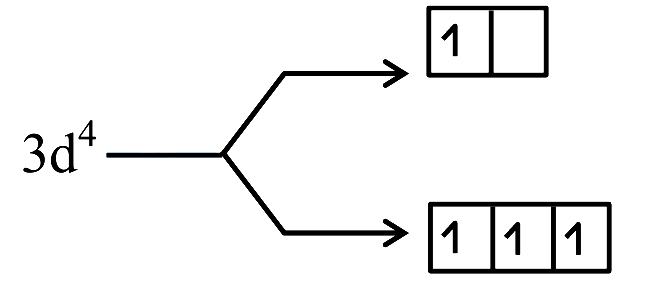
\(\text { Hybridisation }=\mathrm{sp}^3 \mathrm{~d}^2\)
4 unpaired electrons - 196. When Ethane-1,2-diamine is added progressively to an aqueous solution of Nickel (II) chloride, the sequence of colour change observed will be : 2025 Medium
- (A) Violet → Blue → Pale Blue → Green
- (B) Pale Blue → Blue → Green → Violet
- (C) Green → Pale Blue → Blue → Violet
- (D) Pale Blue → Blue → Violet → Green
Show answer and solution
Correct Answer: (C)
\(\left[ Ni \left( H _2 O \right)_6\right]_{( aq )}^{+2}+ en _{( aq )} \rightarrow\left[ Ni \left( H _2 O \right)_4( en )\right]_{( aq )}^{+2}+2 H _2 O\)
Green
\(\left[ Ni \left( H _2 O \right)_4( en )\right]_{( aq )}^{+2}+ en _{( aq )} \rightarrow\left[ Ni \left( H _2 O \right)_2( en )_2\right]_{( aq )}^{+2}+2 H _2 O\)
Pale Blue
\(\left[ Ni \left( H _2 O \right)_2( en )\right]_{( aq )}^{+2}+ en _{( aq )} \rightarrow\left[ Ni ( en )_3\right]_{( aq )}^{+2}+2 H _2 O\)
Blue / purple -
- (A) \(\left[\mathrm{Fe}(\mathrm{CN})_6\right]^4\)
- (B) \(\left[\mathrm{CO}\left(\mathrm{NH}_3\right)_6\right]^{3+}\)
- (C) \(\left[\mathrm{FeF}_6\right]^4\)
- (D) \(\left[\mathrm{Mn}(\mathrm{SCN})_6\right]^4\)
Show answer and solution
Correct Answer: (D)
(1) \(\left[\mathrm{Co}\left(\mathrm{NH}_3\right)_6\right]^{3+} \quad \mathrm{Co}^{3+} \Rightarrow 3 \mathrm{~d}^6 4 \mathrm{~s}^0\)
\(=[-0.4 \times 6+0.6 \times(0)] \Delta_0=-2.4 \Delta_0\)
(2)
\(\begin{aligned}
& {\left[\mathrm{Mn}(\mathrm{SCN})_6\right]^4} \\
& \mathrm{Mn}^{2+} \Rightarrow 3 \mathrm{~d}^5 4 \mathrm{~s}^0
\end{aligned}\)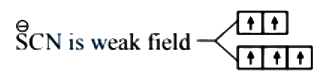
\(\begin{aligned}
& \mu=\sqrt{35} \text { B.M. }=5.96 \text { B.M. } \\
& \mathrm{CFSE}=(-0.4 \times 3+0.6 \times 2) \Delta_0
\end{aligned}\)
So \(\Delta_0=0\)
(3)
\(\begin{aligned}
& {\left[\mathrm{Fe}(\mathrm{CN})_6\right]^{-4} \quad \mathrm{Fe}^{2+} \Rightarrow 3 \mathrm{~d}^6 4 \mathrm{~s}^0}
\end{aligned}\)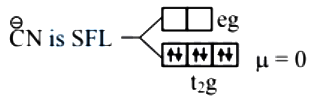
\(\mathrm{CFSE}=-2.4 \Delta_0\)
(4) \(\left[\mathrm{FeF}_6\right]^{4-}\)
\(\mathrm{Fe}^{2+} \Rightarrow 3 \mathrm{~d}^6 4 \mathrm{~s}^0\)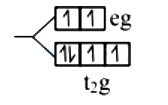
\(\begin{aligned}
& \mu=\sqrt{24} \text { B.M. }=4.89 \text { B.M. } \\
& \text { CFSE }=(-0.4 \times 4+0.6 \times 2) \Delta_0=-1.2 \Delta_0
\end{aligned}\) -
- (A) 10
- (B) 15
- (C) 20
- (D) 25
Show answer and solution
Correct Answer: (B)
Phosphorus belongs to \(15^{\text {th }}\) group and forms \(\mathrm{d} \pi-\mathrm{d} \pi\) bond with transition metal and \(\mathrm{PH}_3\) is strongest base among the other group members except \(\mathrm{NH}_3\). -
- (A) Statement I is true but Statement II is false
- (B) Both Statement I and Statement II are false
- (C) Statement I is false but Statement II is true
- (D) Both Statement I and Statement II are true
Show answer and solution
Correct Answer: (D)
In oxide of nitrogen it can achieve +5 oxidation state because it can form \(\mathrm{p} \pi-\mathrm{p} \pi\) bond with oxygen e.g. \(\mathrm{N}_2 \mathrm{O}_5\)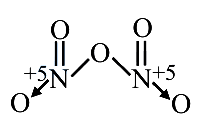
Nitrogen cannot form halide in +5 oxidation state because it does not contain d-orbital.
e.g. \(\mathrm{NX}_5\) does not exist
\(\mathrm{X}=\text { halide }\) -
- (A) Statement I is true but statement II is false
- (B) Both statement I and statement II are false
- (C) Statement I is false but statement II is true
- (D) Both statement I and statement II are true
Show answer and solution
Correct Answer: (B)
\(\ddot{\mathrm{N}}-\ddot{\mathrm{N}}\) single bond weaker than \(\ddot{\mathrm{P}}-\ddot{\mathrm{P}}\) due to more \(\ell \mathrm{p}-\ell \mathrm{p}\) repulsion.
Bond length \(\Rightarrow d_{p-p} \gt d_{N-N}(\operatorname{size} \uparrow\), B.L. \(\uparrow)\)
In group 15 elements only N & P show disproportionation in +3 oxidation state, As, Sb & Bi have almost inert for disproportionation in +3 oxidation state.
So both statements are false.
No questions on this page match these filters.