


All JEE Mains 2025 Chemistry questions
26 chaptersShowing 351–381 of 381 questions
-
- (A) 250
- (B) 100
- (C) 200
- (D) 105
Show answer and solution
Correct Answer: (C)
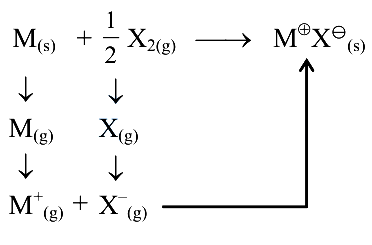
\(\therefore \Delta \mathrm{H}_{\mathrm{f}}(\mathrm{MX})= \)
\( \Delta \mathrm{H}_{\text {sub }}(\mathrm{M})+\text { I.E. }(\mathrm{M})+\frac{1}{2}[\text { B.E. }(\mathrm{X}-\mathrm{X})] +\mathrm{EG}(\mathrm{X})+\text { L.E. }(\mathrm{MX})\)
\( -400=(100)+(500)+\frac{1}{2}(\text { B.E. })+(-300)+(-800)\)
\(\therefore \text { B.E. }=200 \mathrm{~kJ} \mathrm{~mole}^{-1}\) -
- (A) The term 'standard state' implies that the temperature is \(0^{\circ} \mathrm{C}\)
- (B) The standard state of pure gas is the pure gas at a pressure of 1 bar and temperature 273 K
- (C) \(\Delta_{\mathrm{f}} \mathrm{H}_{298}^\theta\) is zero for \(\mathrm{O}(\mathrm{g})\)
- (D) \(\Delta_{\mathrm{f}} \mathrm{H}_{500}^\theta\) is zero for \(\mathrm{O}_2(\mathrm{~g})\)
Show answer and solution
Correct Answer: (D)
For standard state \(\Rightarrow\) pressure \(=1\) bar and temperature is specified only
\(\Rightarrow\left(\Delta \mathrm{H}_{\mathrm{f}}^{\mathrm{o}}\right)_{\mathrm{O}_{2,(\mathrm{~g})}}=0\) -
- (A) (B) and (C) only
- (B) (B) and (D) only
- (C) (A) and (D) only
- (D) (A) and (C) only
Show answer and solution
Correct Answer: (A)
\(\because \Delta \mathrm{G}=\Delta \mathrm{H}-\mathrm{T} \Delta \mathrm{~S}\)
For spontaneity of reaction: \(\Delta \mathrm{G}=-\mathrm{ve}\) -
- (A) 460
- (B) 466
- (C) 450
- (D) 444
Show answer and solution
Correct Answer: (B)
\(\begin{aligned} & \frac{1}{2} \mathrm{H}_{2(\mathrm{~g})} \rightarrow \mathrm{H}(\mathrm{g}) \quad ; \quad \Delta_{\mathrm{f}} \mathrm{H}\left(\mathrm{H}_{(\mathrm{g})}\right)=220 \mathrm{KJ} / \mathrm{mol} \\ & \frac{1}{2} \mathrm{O}_{2(\mathrm{~g})} \rightarrow \mathrm{O}(\mathrm{g}) \quad ; \quad \Delta_{\mathrm{f}} \mathrm{H}\left(\mathrm{O}_{(\mathrm{g})}\right)=250 \mathrm{KJ} / \mathrm{mol}\end{aligned}\)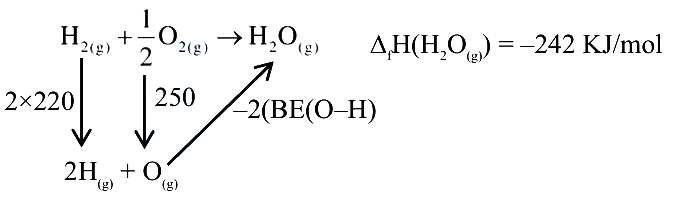
\(\begin{aligned} & \Delta \mathrm{H}_{\mathrm{f}}\left(\mathrm{H}_2 \mathrm{O}_{(\mathrm{l})}\right)=-242=440+250-2(\mathrm{~B} . \mathrm{E} .(\mathrm{O}-\mathrm{H})) \\ & \mathrm{BE}(\mathrm{O}-\mathrm{H})=466 \mathrm{KJ} / \mathrm{mol}\end{aligned}\) -
- (A) \(+x-y-z\)
- (B) \(x+y+z\)
- (C) \(z-(x+y)\)
- (D) \(-\mathrm{z}-(\mathrm{x}+\mathrm{y})\)
Show answer and solution
Correct Answer: (C)
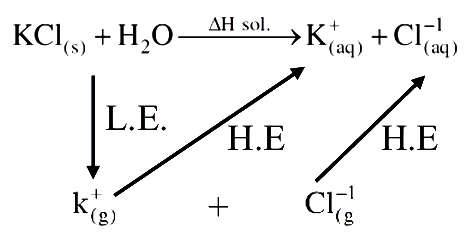
\(\begin{aligned} \Delta \mathrm{H}_{\text {Sol}^{\mathrm{n}}.} & =\mathrm{L} \cdot \mathrm{E} \cdot+(\mathrm{H} \cdot \mathrm{E})_{\mathrm{K}_{(\mathrm{g})}^{+}}+(\mathrm{HE})_{\mathrm{Cl}_{(\mathrm{g})}^{-1}} \\ & =\mathrm{Z}-\mathrm{x}-\mathrm{y} \\ & =\mathrm{z}-(\mathrm{x}+\mathrm{y})\end{aligned}\) -
- (A) 2850
- (B) 2750
- (C) 2950
- (D) 2650
Show answer and solution
Correct Answer: (A)
\(\begin{aligned} & \Delta \mathrm{H}_{\mathrm{rxn}}^{\mathrm{o}}=55 \mathrm{~kJ} / \mathrm{mol}, \quad \mathrm{T}=298 \mathrm{~K} \\ & \Delta \mathrm{~S}_{\mathrm{rxn}}^{\mathrm{o}}=175 \mathrm{~J} / \mathrm{mol} \\ & \Delta \mathrm{G}_{\mathrm{rxn}}^{\mathrm{o}}=\Delta \mathrm{H}_{\mathrm{rxn}}^{\mathrm{o}}-\mathrm{T} \Delta \mathrm{S}_{\mathrm{rxn}}^{\circ} \\ & \Rightarrow \Delta \mathrm{G}_{\mathrm{rxn}}^{\mathrm{o}}=55000 \mathrm{~J} / \mathrm{mol}-298 \times 175 \mathrm{~J} / \mathrm{mol} \\ & \Rightarrow \Delta \mathrm{G}_{\mathrm{rxn}}^{\mathrm{o}}=55000-52150 \\ & \Rightarrow \Delta \mathrm{G}_{\mathrm{rxn}}^{\mathrm{o}}=2850 \mathrm{~J} / \mathrm{mol}\end{aligned}\) -
- (A) \(-x-10 y-10 z\)
- (B) \(-10(100 x+y+z)\)
- (C) \(10(100 x+y+z)\)
- (D) \(x-10 y-10 z\)
Show answer and solution
Correct Answer: (B)
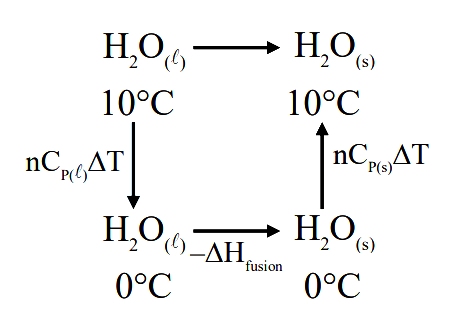
\(\begin{aligned} & \Delta H=1 \times y(0-10)-x \times 1000+1 \times z\left(-10^{\circ}-0^{\circ}\right) \\ & \Delta H=-10(100 x+y+z) \text { Joule. }\end{aligned}\) -
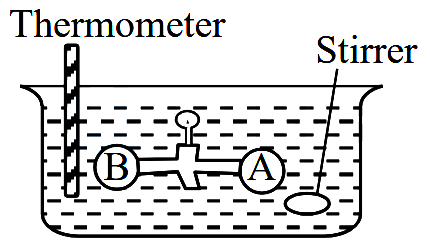
- (A) \(d w \neq 0\)
- (B) \(\mathrm{dq} \neq 0\)
- (C) \(\mathrm{dU} \neq 0\)
- (D) The pressure in the vessel \(B\) before opening the stopcock is zero.
Show answer and solution
Correct Answer: (D)
It is free expansion of gas \(\Rightarrow P_{\text {ext }}=0\)
Where \(\mathrm{w}=0, \mathrm{q}=0\) and \(\Delta \mathrm{U}=0\) - 359. Which of the following properties will change when system containing solution 1 will become solution 2?
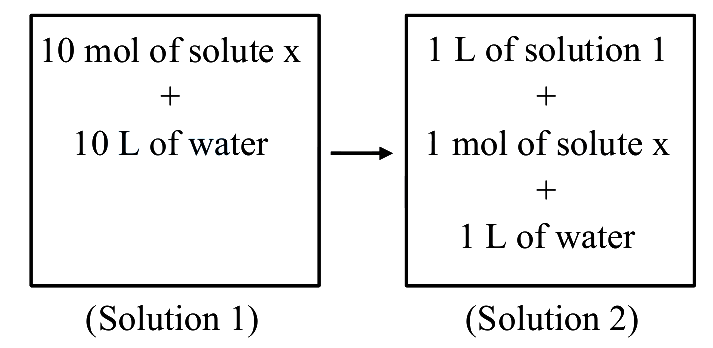
2025 Easy- (A) Molar heat capacity
- (B) Density
- (C) Concentration
- (D) Gibbs free energy
Show answer and solution
Correct Answer: (D)
Both solutions are having same composition, which is 1 mole of ' \(x\) ' in 1 ' \(\ell\) ' water, so all the intensive properties will remain same, but as total amount is greater in solution ' 1 ' compared to solution ' 2 '. So extensive properties will be different hence Gibbs free energy will be different. -
- (A) \(+4\) and +1
- (B) +1 and +4
- (C) +4 and +3
- (D) +2 and +3
Show answer and solution
Correct Answer: (C)
Among \(\mathrm{Al}, \mathrm{In}, \mathrm{Tl}, \mathrm{Ge}, \mathrm{Sn}, \mathrm{Pb}\), the metal having highest \(\mathrm{IE}_1\) is Ge and lowest \(\mathrm{IE}_1\) is In .
Most stable oxidation state of Ge is +4 and In is +3 . - 361. Given below are the atomic numbers of some group 14 elements. The atomic number of the element with lowest melting point is _______. 2025 Easy
- (A) 6
- (B) 82
- (C) 14
- (D) 50
Show answer and solution
Correct Answer: (D)
Order of M.P. of group 14: \(\mathrm{C}>\mathrm{Si}>\mathrm{Ge}>\mathrm{Pb}>\mathrm{Sn}\)
\(\begin{array}{ll}
\text { element } & \text { M.P. }\left({ }^{\circ} \mathrm{C}\right) \\
\mathrm{Z}=6=\mathrm{C} & 3730 \\
\mathrm{Z}=14=\mathrm{Si} & 1410 \\
\mathrm{Z}=32=\mathrm{Ge} & 937 \\
\mathrm{Z}=50=\mathrm{Sn} & 232 \\
\mathrm{Z}=82=\mathrm{Pb} & 327
\end{array}\) -
- (A) 31
- (B) 49
- (C) 13
- (D) 81
Show answer and solution
Correct Answer: (A)
Size order
\(\begin{aligned}
& \mathrm{Al} \gt \mathrm{Ga} \\
& \mathrm{Al}^{3+} \lt \mathrm{Ga}^{3+}
\end{aligned}\)
Atomic number of Ga is 31 -
- (A) Statement I is correct but Statement II is incorrect
- (B) Statement I is incorrect but Statement II is correct
- (C) Both Statement I and Statement II are incorrect
- (D) Both Statement I and Statement II are correct
Show answer and solution
Correct Answer: (A)
Statement 1 is correct since left to right \(1 E\) increases in general in periodic table.
Statement 2 is incorrect since M.P. of group 14 elements is more than group 13 elements. -
- (A) B and D Only
- (B) A and C Only
- (C) C and D Only
- (D) A and B Only
Show answer and solution
Correct Answer: (A)
Property B Al Ga In Tl Atomic radius (pm) 88 143 135 167 170 Electronegativity 2 1.5 1.6 1.7 1.8 Density (g/cm³) 2.35 2.7 5.9 7.31 11.85 Ionisation Energy (kJ/mol) 801 577 579 558 589
Radius Order \( \mathrm{T} \ell \gt \mathrm{In} \gt \mathrm{A} \ell \gt \mathrm{Ga} \gt \mathrm{B}\)
EN Order \(\mathrm{B} \gt \mathrm{T} \ell \gt \mathrm{In} \gt \mathrm{Ga} \gt \mathrm{Al}\)
Density Order \(\mathrm{T} \ell \gt \mathrm{In} \gt \mathrm{Ga} \gt \mathrm{A} \ell \gt \mathrm{B}\)
\(\mathrm{IE}_1\) Order \(\mathrm{B} \gt \mathrm{T} \ell \gt \mathrm{Ga} \gt \mathrm{A} \ell \gt \mathrm{In}\) - 365. According to Bohr's model of hydrogen atom, which of the following statement is incorrect? 2025 Easy
- (A) Radius of \(3^{\text {rd }}\) orbit is nine times larger than that of \(1^{\text {st }}\) orbit.
- (B) Radius of \(8^{\text {th }}\) orbit is four times larger than that of \(4^{\text {th }}\) orbit.
- (C) Radius of \(6^{\text {th }}\) orbit is three time larger than that of \(4^{\text {th }}\) orbit.
- (D) Radius of \(4^{\text {th }}\) orbit is four times larger than that of \(2^{\text {nd }}\) orbit.
Show answer and solution
Correct Answer: (C)
\(\mathrm{r} \propto \mathrm{n}^2\)
(1) \(\frac{\mathrm{r}_3}{\mathrm{r}_1}=\frac{9}{1}\)
(2) \(\frac{\mathrm{r}_8}{\mathrm{r}_4}=\frac{64}{16}=4\)
(3) \(\frac{\mathrm{r}_6}{\mathrm{r}_4}=\left(\frac{6}{4}\right)^2=\frac{9}{4}\)
(4) \(\frac{\mathrm{r}_4}{\mathrm{r}_2}=\left(\frac{4}{2}\right)^2=4\) -
- (A) 12 and 4
- (B) 16 and 4
- (C) 12 and 5
- (D) 16 and 5
Show answer and solution
Correct Answer: (C)
\(\begin{aligned} & \mathrm{Cr}: 1 \mathrm{~s}^2 2 \mathrm{~s}^2 2 \mathrm{p}^6 3 \mathrm{~s}^2 3 \mathrm{p}^6 3 \mathrm{~d}^5 4 \mathrm{~s}^1 \\ & \ell=1 \quad \ell=1 \quad \ell=2 \\ & \text { electrons having } \ell=1 \Rightarrow 12 \\ & \text { electrons having } \ell=2 \Rightarrow 5\end{aligned}\) -
- (A) C and D Only
- (B) A and C Only
- (C) A, C and D Only
- (D) A and B Only
Show answer and solution
Correct Answer: (B)
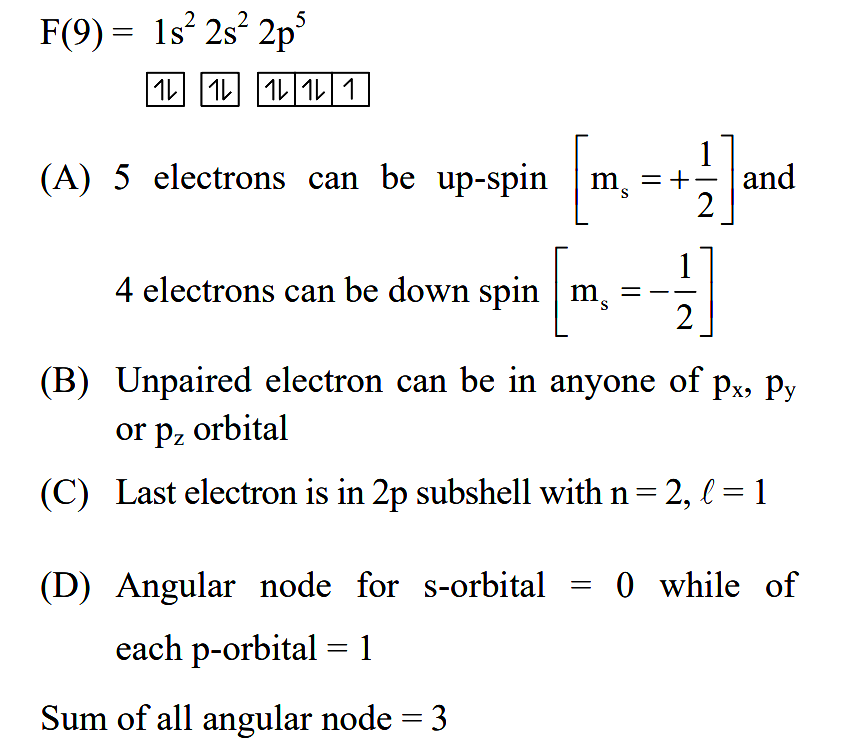
Explanation:
The element with atomic number 9 is Fluorine (\( \text{F} \)). Its ground-state electronic configuration is \( 1s^2 2s^2 2p^5 \). Let us analyze each statement:
1. Statement A is Correct: In the fully filled \( 1s^2 \) and \( 2s^2 \) subshells, there are 2 spin-up and 2 spin-down electrons. For the \( 2p^5 \) subshell, following Hund's rule, the distribution contains 3 spin-up and 2 spin-down electrons (or vice-versa). Therefore, a maximum of \( 2 + 3 = 5 \) electrons can have \( m_s = +\frac{1}{2} \) and \( 2 + 2 = 4 \) electrons can have \( m_s = -\frac{1}{2} \).
2. Statement B is Incorrect: The three \( 2p \) orbitals (\( 2p_x, 2p_y, 2p_z \)) are completely degenerate (equal in energy). The 5 valence electrons fill these orbitals such that two orbitals are completely paired and one remains unpaired. Because these orbitals are degenerate, the single unpaired electron can occupy any one of the three orbitals arbitrarily, not exclusively the \( p_z \) orbital.
3. Statement C is Correct: The last incoming electron enters the \( 2p \) subshell. For any electron occupying a \( 2p \) orbital, the principal quantum number is \( n = 2 \) and the azimuthal quantum number is \( l = 1 \).
4. Statement D is Incorrect: The number of angular nodes for any atomic orbital is given by its azimuthal quantum number (\( l \)). For Fluorine, the angular nodes for the occupied orbitals are: \( 1s \) has 0, \( 2s \) has 0, and each of the three active \( 2p \) orbitals (\( 2p_x, 2p_y, 2p_z \)) has 1 angular node. The total sum of angular nodes across all occupied atomic orbitals is \( 0 + 0 + 1 + 1 + 1 = 3 \).
Hence, Option B is the correct choice. - 368. For electron in ' 2 s ' and ' 2 p ' orbitals, the orbital angular momentum values, respectively are : 2025 Easy
- (A) \(\sqrt{2} \frac{\mathrm{~h}}{2 \pi}\) and 0
- (B) \(\frac{\mathrm{h}}{2 \pi}\) and \(\sqrt{2} \frac{\mathrm{~h}}{2 \pi}\)
- (C) 0 and \(\sqrt{6} \frac{\mathrm{~h}}{2 \pi}\)
- (D) 0 and \(\sqrt{2} \frac{\mathrm{~h}}{2 \pi}\)
Show answer and solution
Correct Answer: (D)
\(\begin{aligned} & \text { Orbital angular momentum }=\sqrt{\ell(\ell+1)} \frac{\mathrm{h}}{2 \pi} \\ & \therefore \quad \text { For } 2 \mathrm{~s} \text { orbital }: \ell=0 \\ & \text { Orbital angular momentum }=0 \\ & \therefore \quad \text { For } 2 \mathrm{p} \text { orbital }: \ell=1 \\ & \quad \begin{aligned} \text { Orbital angular momentum } & =\sqrt{1(1+2)} \frac{\mathrm{h}}{2 \pi} \\ & =\sqrt{2} \frac{\mathrm{~h}}{2 \pi}\end{aligned}\end{aligned}\) -
- (A) (B), (C) and (D) only
- (B) (A) and (E) only
- (C) (A) only
- (D) (B) only
Show answer and solution
Correct Answer: (A)
For hydrogen atom and one electron species, the energy of orbitals is decided by the value of principal quantum number. Higher the value of principal quantum number, higher will be the energy of orbital.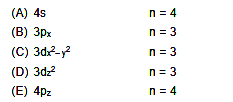
\(\therefore (B),(C)\) and (D) have orbitals with the lowest energy. -
- (A) Both Statement I and Statement II are true
- (B) Statement I is false but Statement II is true
- (C) Both Statement I and Statement II are false
- (D) Statement I is true but Statement II is false
Show answer and solution
Correct Answer: (B)
\(2 p_{\mathrm{x}}\) and \(2 \mathrm{p}_{\mathrm{y}}\) are degenerated orbitals hence having equal energy and therefore no spectral line will be observed for \(2 p_x \rightarrow 2 p_y\) transition. -
- (A) Both Statement I and Statement II are false
- (B) Statement I is true but Statement II is false
- (C) Both Statement I and Statement II are true
- (D) Statement I is false but Statement II is true
Show answer and solution
Correct Answer: (C)
For a shell total number of orbitals \(=n^2\)
Magnetic quantum number have values \((-\ell\) to \(+\ell)\) including 0 . -
- (A) Statement I is false but Statement II is true
- (B) Both Statement I and Statement II are false
- (C) Both Statement I and Statement II are true
- (D) Statement I is true but Statement II is false
Show answer and solution
Correct Answer: (C)
According to Heisenberg's uncertainty principle, it is impossible to determine simultaneously the exact position and momentum of particle like electron.
If
\(\begin{aligned} & \Delta p=\Delta x \\ & \Delta p \cdot \Delta x \geq \frac{h}{4 \pi} \\ &(\Delta p)^2 \geq \frac{h}{4 \pi} \\ & \Delta p \geq \sqrt{\frac{h}{\pi}} \times \frac{1}{2} \\ & m \Delta v \geq \sqrt{\frac{h}{\pi}} \times \frac{1}{2} \\ & \Delta v \geq \sqrt{\frac{h}{\pi}} \times \frac{1}{2 m}\end{aligned}\) -
- (A) Balmer series, \(\infty \rightarrow 2\)
- (B) Lyman series, \(\infty \rightarrow 1\)
- (C) Paschen series, \(\infty \rightarrow 3\)
- (D) Paschen series, \(5 \rightarrow 3\)
Show answer and solution
Correct Answer: (C)
\(\begin{aligned}
& \lambda=900 \mathrm{~nm} \quad \text { H-atom }(\mathrm{Z}=1) \\
& =9 \times 10^{-5} \mathrm{~cm} \\
& \mathrm{R}_{\mathrm{H}}=10^5 \mathrm{~cm}^{-1} \\
& \text { Ryderg eq. }=\frac{1}{\lambda}=\mathrm{R}_{\mathrm{H}} \mathrm{Z}^2 \times\left(\frac{1}{\mathrm{n}_1^2}-\frac{1}{\mathrm{n}_2^2}\right) \\
& \Rightarrow \frac{1}{\lambda \times \mathrm{R}_{\mathrm{H}}}=\frac{1}{\mathrm{n}_1^2}-\frac{1}{\mathrm{n}_2^2} \\
& \Rightarrow \frac{1}{9 \times 10^{-5} \mathrm{~cm} \times 10^5 \mathrm{~cm}^{-1}}=\left(\frac{1}{\mathrm{n}_1^2}-\frac{1}{\mathrm{n}_2^2}\right) \\
& \Rightarrow \frac{1}{\mathrm{n}_1^2}-\frac{1}{\mathrm{n}_2^2}=\frac{1}{9}
\end{aligned}\)
It is possible when \(\mathrm{n}_1=3, \mathrm{n}_2=\infty\)
Possible series : \(\infty \rightarrow 3\) -
- (A) \(\frac{8 \pi a_0}{n}\)
- (B) \(\frac{2 a_0}{n \pi}\)
- (C) \(\frac{4 \mathrm{n}}{\pi \mathrm{a}_0}\)
- (D) \(\frac{4 \pi a_0}{n}\)
Show answer and solution
Correct Answer: (A)
Explanation:
The radius of the \( n \)-th orbit of a hydrogen-like atom is given by the formula:
\( r_n = \frac{a_0 n^2}{Z} \)
1. Atomic Number of Hydrogen: For a hydrogen atom, the atomic number is \( Z = 1 \). Substituting this value into the equation yields the radius of the orbit:
\( r_n = a_0 n^2 \)
2. De-Broglie Relationship: According to the Bohr orbit quantization criteria, the total circumference of the stationary orbit must equal an integral multiple of the electron's de-Broglie wavelength:
\( 2\pi r_n = n\lambda \)
Substituting the value of \( r_n \) from our first step into this relationship gives:
\( 2\pi (a_0 n^2) = n\lambda \)
Simplifying the expression by canceling \( n \) from both sides results in:
\( \lambda = 2\pi a_0 n \)
3. Evaluating for Second Orbit: For the second orbit, the principal quantum number is \( n = 2 \). Substituting this directly gives the absolute wavelength value:
\( \lambda = 2\pi a_0 (2) = 4\pi a_0 \)
To match the general representation format used in the provided options, we can intentionally multiply and divide the expression by \( 2 \):
\( \lambda = \frac{8\pi a_0}{2} \)
Since \( n = 2 \), substituting \( n \) back into the denominator yields:
\( \lambda = \frac{8\pi a_0}{n} \)
Hence, Option A is the correct choice. -
- (A) B and C Only
- (B) A and B Only
- (C) C and D Only
- (D) D and E Only
Show answer and solution
Correct Answer: (D)
\(\begin{array}{lc} \mathrm{A}: \mathrm{n}=1, \ell=0, \mathrm{~m}_{\ell}=0 & 1 \mathrm{~s} \\ \mathrm{B}: \mathrm{n}=2, \ell=0, \mathrm{~m}_{\ell}=0 & 2 \mathrm{~s} \\ \mathrm{C}: \mathrm{n}=2, \ell=1, \mathrm{~m}_{\ell}=1 & 3 \mathrm{p} \\ \mathrm{D}: \mathrm{n}=3, \ell=2, \mathrm{~m}_{\ell}=1 & 3 \mathrm{~d} \\ \mathrm{E}: \mathrm{n}=3, \ell=2, \mathrm{~m}_{\ell}=0 & 3 \mathrm{~d} \\ \end{array}\)
In absence of electric and magnetic fields, all orbitals of 3d are degenerate. -
- (A) \(\mathrm{r}=4 \mathrm{a}_0\)
- (B) \(\mathrm{r}=2 \mathrm{a}_0\)
- (C) \(r=\frac{a_0}{2}\)
- (D) \(r=\frac{a_0}{4}\)
Show answer and solution
Correct Answer: (B)
\(\begin{aligned} & \mathrm{r}=\mathrm{a}_0\left(\frac{\mathrm{n}^2}{\mathrm{z}}\right) \\ & \mathrm{r}=\frac{\mathrm{a}_0(2)^2}{(2)} \\ & \mathrm{r}=2 \mathrm{a}_0\end{aligned}\) -
- (A) (A) and (C) only
- (B) (B) and (D) only
- (C) (C) and (D) only
- (D) (A) and (B) only
Show answer and solution
Correct Answer: (C)
For single electron species energy only depends on ' n ' (principal quantum number)
So energy of \(2 \mathrm{~s}=2 \mathrm{p}\)
and energy of \(3 \mathrm{~d} < 4 \mathrm{~s}\) - 378. Which of the following postulate of Bohr's model of hydrogen atom in not in agreement with quantum mechanical model of an atom ? 2025 Medium
- (A) An atom in a stationary state does not emit electromagnetic radiation as long as it stays in the same state
- (B) An atom can take only certain distinct energies \(\mathrm{E}_1, \mathrm{E}_2, \mathrm{E}_3\), etc. These allowed states of constant energy are called the stationary states of atom
- (C) When an electron makes a transition from a higher energy stationary state to a lower energy stationary state, then it emits a photon of light
- (D) The electron in a H atom's stationary state moves in a circle around the nucleus
Show answer and solution
Correct Answer: (D)
The electron in a H-atom's stationary state moves in a spherical path. -
- (A) A, D and E Only
- (B) B, C and D Only
- (C) A, C, D and E Only
- (D) A, B, D and E Only
Show answer and solution
Correct Answer: (D)
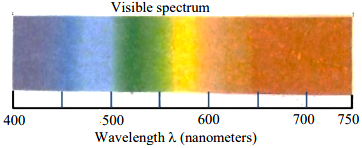
\(\begin{aligned} & \lambda=\frac{\mathrm{C}}{\mathrm{v}}=\frac{3 \times 10}{5.16 \times 10^{14}} \\ & \lambda=581.39 \mathrm{~nm}\end{aligned}\)
* \(\lambda_{\text {Photon }}\) is near \(\&\) below yellow light it can show photoelectric effect.
* If intensity of light decreases photocurrent decreases.
* Red light will not produce photoelectric effect.
* \(v_{\text {Blue }} \gt v_{\text {yellow }}\) so photoelectric current will be produced.
* White light contain all frequencies so it will show photo electric current.
Correct statements are \(\mathrm{~A~B~D~} \& \mathrm{~E}\). -
- (A) (B) and (D) only
- (B) (A), (B) and (C) only
- (C) (C) and (D) only
- (D) (A) and (B) only
Show answer and solution
Correct Answer: (D)
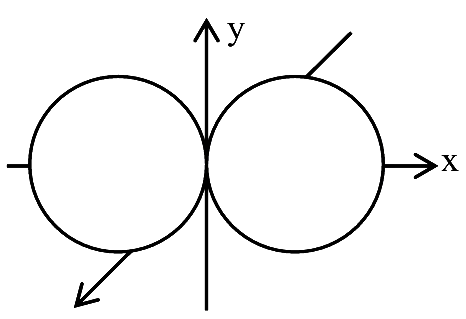
(A) Azimuthal quantum number \((\ell)\) indicates the shape of orbital occupied by the electron
(B)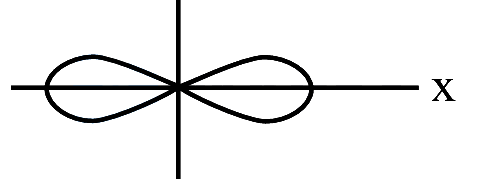
\(\mathrm{p}_{\mathrm{x}}\) orbital
(C) The + and - sign in the wave function of \(2 p_x\) orbital refer to the sign (Phase) of the wave function, not the charge
(D) The wave function of \(2 p_x\) orbital will be zero in yz plane (Nodal plane). -
- (A) The probability density of finding the electron is maximum at the nucleus
- (B) The electron can be found at a distance \(2 \mathrm{a}_0\) from the nucleus
- (C) The 1 s orbital is spherically symmetrical
- (D) The total energy of the electron is maximum when it is at a distance \(a_0\) from the nucleus
Show answer and solution
Correct Answer: (D)
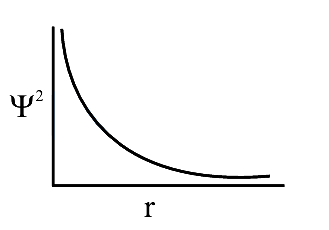
1. \(\Psi^2=\) Probability density is maximum at nucleus.
2. Electron can exist upto infinity from nucleus.
3. True
4. Energy of electron is maximum at infinite distance from nucleus.
No questions on this page match these filters.