


Questions
14 questionsShowing 1–14 of 14 questions
-
- (A) 200
- (B) 320
- (C) 100
- (D) 150
Show answer and solution
Correct Answer: (C)
Organic compound \(\xrightarrow{\text { combustion }} \underset{\substack{\mathrm{0.9} \mathrm{gm}}}{\mathrm{H}_2 \mathrm{O}}\)
\(\therefore\) mole of \(\mathrm{H}_2 \mathrm{O}=\frac{0.9}{18}=0.05 \mathrm{~mole}\)
\(\therefore\) mole of H in \(\mathrm{H}_2 \mathrm{O}=0.05 \times 2=0.1\) mole
\(=\) mole of H in 0.01 mole
Organic compound
\(\therefore\) wt of H atom in 0.01 mole compound \(=0.1 \times 1\) \(=0.1 \mathrm{gm}\)
\(\therefore\) wt of H atom in one mole compound
\(=\frac{0.1}{0.01}=10 \mathrm{gm}\)
\(\because \mathrm{wt} . \%\) of \(\mathrm{H}=\frac{\mathrm{wt} \text {. of } \mathrm{H} \text { in one mole compound }}{\text { Molar mass of compound }} \times 1\)
\(\begin{aligned}
& 10=\frac{10}{M} \times 100 \\
& \therefore M=100
\end{aligned}\) -
- (A) 375
- (B) 372
- (C) 370
- (D) 376
Show answer and solution
Correct Answer: (B)
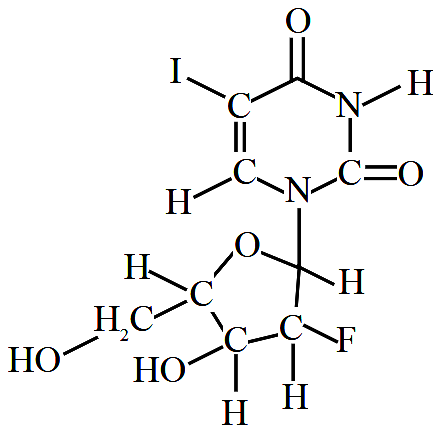
\(\begin{aligned} & \text {Molar mass }=372 \mathrm{gm} \\ & \therefore 0.1 \text { mole has }=372 \times 10^{-1} \mathrm{gm}\end{aligned}\) -
- (A) 98 .3 mg
- (B) 48.2 mg
- (C) 196 .2 mg
- (D) 150 .4 mg
Show answer and solution
Correct Answer: (C)
Moles of removed \(\mathrm{CO}_2=\frac{10^{21}}{6.02 \times 10^{23}} \mathrm{~mol}\)
\(=1.66 \times 10^{-3} \mathrm{~mol}\)
mole of \(\mathrm{CO}_2\) left \(=2.8 \times 10^{-3} \mathrm{moles}\) total moles of \(\mathrm{CO}_2\) taken initially
\(=(2.8+1.66) \times 10^{-3} \mathrm{~mol}\)
mass of \(\mathrm{CO}_2\) taken initially
\(\begin{aligned}
& =4.46 \times 10^{-3} \times 44 \\
& =196.24 \times 10^{-3} \mathrm{~g} \\
& =196.24 \mathrm{mg}
\end{aligned}\) -
- (A) Po
- (B) Pr
- (C) Pb
- (D) Pt
Show answer and solution
Correct Answer: (B)
\(\text { No. of atoms }=\frac{\text { Massin } g}{\operatorname{Molar} \operatorname{Mas}(\mathrm{~g} / \mathrm{mol})} \times \mathrm{N}_{\mathrm{A}}\)
Therefore for the same Mass element having the least Molar mass will have the higher no. of atoms.
- \(\mathrm{M}_{\mathrm{Po}}=209\)
- \(\mathrm{M}_{\mathrm{Pr}}=141\)
- \(\mathrm{M}_{\mathrm{Pb}}=207\)
- \(\mathrm{M}_{\mathrm{Pt}}=195\) -
- (A) 3.908 g
- (B) 2.636 g
- (C) 10.545 g
- (D) 5.272 g
Show answer and solution
Correct Answer: (C)
\(\begin{aligned}
& \mathrm{CaCO}_3+2 \mathrm{HCl} \rightarrow \mathrm{CaCl}_2+\mathrm{CO}_2+\mathrm{H}_2 \mathrm{O} \\
& \text { Moles of } \mathrm{CaCO}_3=\frac{1000}{100}=10
\end{aligned}\)
Moles of \(\mathrm{HCl}=0.76 \times \frac{250}{1000}=0.19\) (L.R.)
Moles of \(\mathrm{CaCl}_2\) formed \(=\frac{0.19}{2}\)
Mass of \(\mathrm{CaCl}_2=\frac{0.19}{2} \times 111=10.545 \mathrm{gm}\) -
- (A) (A), (D) and (E) Only
- (B) (C), (D) and (E) Only
- (C) (A), (B) and (C) Only
- (D) (B), (C) and (D) Only
Show answer and solution
Correct Answer: (B)
Mass of substance is amount of matter present in it. Weight is force exerted by gravity on object. -
- (A) 400
- (B) 420
- (C) 440
- (D) 460
Show answer and solution
Correct Answer: (B)
\(\begin{aligned}
& \text { moles of } \mathrm{Fe}_3 \mathrm{O}_4=\frac{2.32 \times 10^3 \times 10^3}{232}=10000 \mathrm{~mol} \\
& \text { moles of } \mathrm{CO}=\frac{2.8 \times 10^2 \times 10^3}{28}=10000 \mathrm{~mol} \\
& \mathrm{Fe}_3^3 \mathrm{O}_4+4 \mathrm{CO} \longrightarrow 3 \mathrm{Fe}+4 \mathrm{CO}_2 \\
& 10^4 \mathrm{~mol} \quad 10^4 \mathrm{~mol}
\end{aligned}\)
CO is L.R.
mole of \(\mathrm{Fe}=\frac{3}{4} \times 10^4\)
mass of \(\mathrm{Fe}=\frac{3}{4} \times \frac{10^4 \times 56}{1000} \mathrm{~kg}=420 \mathrm{~kg}\) -
- (A) 235.7 g
- (B) 0.24 mg
- (C) 236 mg
- (D) 2.444 g
Show answer and solution
Correct Answer: (C)
\(\mathrm{Mg}+2 \mathrm{HCl} \rightarrow \mathrm{MgCl}_2+\mathrm{H}_2\)
Volume \(\mathrm{H}_2\) evolved \(=220 \mathrm{ml}\)
Mole of \(\mathrm{H}_2=\frac{220 \times 10^{-3}}{22.4}=\) mole of Mg used
\(\begin{aligned}
\therefore \text { Mass of Mg used } & =\frac{220 \times 10^{-3}}{22.4} \times 24 \\
& =235.7 \times 10^{-3} \mathrm{gm} \\
& =235.7 \mathrm{mg}
\end{aligned}\) -
- (A) 30
- (B) 45
- (C) 60
- (D) 15
Show answer and solution
Correct Answer: (A)
Moles of ' C ' \(=\mathrm{n}_{\mathrm{CO}_2}=\frac{1.46}{44}=0.033\)
Moles of ' C ' \(=\mathrm{W}_{\mathrm{C}}=0.033 \times 12\)
Moles of 'H' \(=2 \times \mathrm{n}_{\mathrm{H}_2 \mathrm{O}}=2 \times \frac{0.567}{18}=0.063\)
Mass of ' H ' \(=0.0063\)
Mass of Oxygen \((\mathrm{O})=1-\left(\mathrm{W}_{\mathrm{c}}+\mathrm{W}_{\mathrm{H}}\right)\) \(=1-(0.033 \times 12+0.063 \times 1)=0.541 \mathrm{gm}\)
Moles of ' O ' \(=\frac{0.541}{16}=0.033\)
Empirical formula \(=\mathrm{CH}_2 \mathrm{O}\)
Empirical formula mass \(=30\). -
- (A) 1655
- (B) 1600
- (C) 1650
- (D) 1645
Show answer and solution
Correct Answer: (A)
\(\begin{array}{ll:cccl} & \mathrm{C} & \mathrm{Cl} & \mathrm{H} & \mathrm{O} & \\ \text { %mass } & 14.5 & 64.46 & 1.8 & 19.24\end{array}\)
Molar ratio \(\frac{14.5}{12} \quad \frac{64.46}{35.5} \quad \frac{1.8}{1} \quad \frac{19.24}{16}\)
\(\begin{aligned}
&\begin{array}{ccccc}
& 1.2 & 1.8 & 1.8 & 1.2 \\
\text { Minimum } & 2 & 3 & 3 & 2
\end{array}\\
&\text { integral ratio }
\end{aligned}\)
\(\begin{aligned} & \text { Empiricial formula }=\mathrm{C}_2 \mathrm{H}_3 \mathrm{Cl}_3 \mathrm{O}_2 \\ & \text { Mass }=165.5 \\ & \text { Mass }=1655 \times 10^{-1}\end{aligned}\) -
- (A) 60
- (B) 63
- (C) 66
- (D) 67
Show answer and solution
Correct Answer: (B)
\(\begin{aligned} & \mathrm{CaCO}_3 \rightarrow \mathrm{CaO}+\mathrm{CO}_2 \\ & \text { mass of } \mathrm{CaCO}_3=\frac{150 \times 75}{100}=112.5 \mathrm{~kg} \\ & =112500 \mathrm{~g} \\ & \mathrm{n}_{\mathrm{CaCO}_3}=1125 \\ & \mathrm{So} \text { moles of } \mathrm{CaO}=1125 \\ & \quad \text { mass of } \mathrm{CaO}=\frac{1125 \times 56}{1000}=63 \mathrm{~kg} \\ & \text { Correct answer } \Rightarrow 63\end{aligned}\) -
- (A) \(\mathrm{C}_4 \mathrm{H}_9 \mathrm{O}_3\)
- (B) \(\mathrm{C}_6 \mathrm{H}_{12} \mathrm{O}_6\)
- (C) \(\mathrm{C}_4 \mathrm{H}_8 \mathrm{O}_2\)
- (D) \(\mathrm{C}_6 \mathrm{H}_{12} \mathrm{O}_3\)
Show answer and solution
Correct Answer: (D)
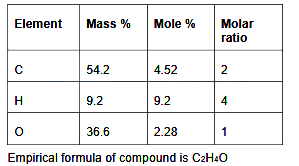
Molecular mass of compound \(=132 \mathrm{~g} \mathrm{~mol}^{-1}\) Molecular formula of compound is \(\left(\mathrm{C}_2 \mathrm{H}_4 \mathrm{O}\right)_n\)
\(\mathrm{n}=\frac{\text { Molecular mass }}{\mathrm{EF} \text { mass }}=\frac{132}{44}=3\)
\(\therefore\) Molecular formula of compound is \(\mathrm{C}_6 \mathrm{H}_{12} \mathrm{O}_3\) -
- (A) 60
- (B) 65
- (C) 70
- (D) 75
Show answer and solution
Correct Answer: (B)
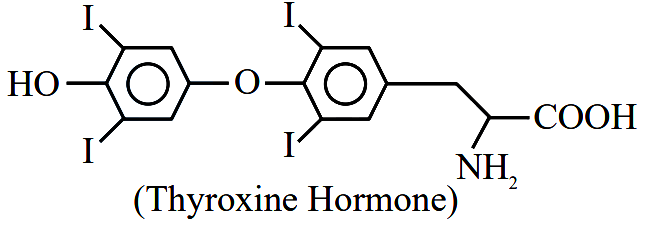
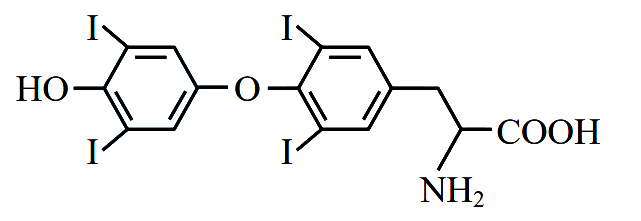
\(\rightarrow\) Molecular formula of Thyroxine \(\Rightarrow\) \(\mathrm{C}_{15} \mathrm{H}_{11} \mathrm{O}_4 \mathrm{NI}_4\)
\(\rightarrow\) Molecular mass of Thyroxine -
\(\begin{aligned} & \mathrm{C} \rightarrow 15 \times 12=180 \\ & \mathrm{H} \rightarrow 11 \times 1=11 \\ & \mathrm{O} \rightarrow 16 \times 4=64 \\ & \mathrm{~N} \rightarrow 14 \times 1=14 \\ & \mathrm{I} \rightarrow 127 \times 4=508\end{aligned}\)
\(\rightarrow\) Molecular mass of Thyroxine \(\Rightarrow 777\)
\(\begin{aligned}& \rightarrow \% \text { of Iodine }=\frac{508}{777} \times 100 \\& =65.38 \%\end{aligned}\)
Nearest integer \(=65\) -
- (A) 150
- (B) 153
- (C) 145
- (D) 140
Show answer and solution
Correct Answer: (B)
\(\begin{aligned} & 4 \mathrm{Al}+3 \mathrm{O}_2 \longrightarrow 2 \mathrm{Al}_2 \mathrm{O}_3 \\ & \frac{81}{27}=3 \text { mole } \frac{128}{32}=4 \mathrm{~mole}\end{aligned}\)
Limiting reagent
\(\begin{aligned}
& \therefore \text { mole of } \mathrm{Al}_2 \mathrm{O}_3 \text { formed }=\frac{1}{2} \times 3 \text { mole } \\
& \therefore \text { wt. of } \mathrm{Al}_2 \mathrm{O}_3 \text { formed }=\frac{3}{2} \times 102 \\
& \quad=153 \mathrm{gm}
\end{aligned}\)
No questions on this page match these filters.