


Questions
18 questionsShowing 1–18 of 18 questions
-
- (A) Square pyramidal
- (B) Octahedral
- (C) Pentagonal planar
- (D) Trigonal bipyramidal
Show answer and solution
Correct Answer: (A)
Given A is rarest, monoatomic, non-radioactive p-block element and form \(\mathrm{AX}_4 \mathrm{Y}\) type of molecule.
\(\therefore\) It is concluded that it is Xe
It is given the electronegativity of A is less than X & Y
It is given the electronegativity of \(\mathrm{X} ~\&~ \mathrm{Y}\) is highest and second highest respectively among all element.
\(\therefore \mathrm{X} ~\&~ \mathrm{Y}\) are \(\mathrm{F} ~\&~ \mathrm{O}\)
\(\therefore\) Compound is consider as \(\mathrm{XeOF}_4\) with square pyramidal shape.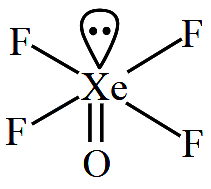
-
- (A) \(\mathrm{sp}^3\)
- (B) \(\mathrm{dsp}^2\)
- (C) \(\mathrm{sp}^3 \mathrm{~d}^2\)
- (D) \(\mathrm{sp}^3 \mathrm{~d}\)
Show answer and solution
Correct Answer: (D)
\(\begin{array}{|c|c|c|c|}
\hline \text { Molecule } & \text { Hybridisation } & \begin{array}{c}
\text { Dipole } \\
\text { Moment }
\end{array} & \begin{array}{c}
\text { Lone pair on the } \\
\text { central atom }
\end{array} \\
\hline \mathrm{SO}_2 & \mathrm{sp}^2 & \text { Non-zero } & \mathrm{1} \\
\hline \mathrm{NF}_3 & \mathrm{sp}^3 & \text { Non-zero } & \mathrm{1} \\
\hline \mathrm{NH}_3 & \mathrm{sp}^3 & \text { Non-zero } & \mathrm{1} \\
\hline \mathrm{XeF}_2 & \mathrm{sp}^3 \mathrm{~d} & \text { zero } & \mathrm{3} \\
\hline{\mathrm{C} \ell \mathrm{~F}_3}^{\mathrm{SF}_4} & \mathrm{sp}^3 \mathrm{~d} & \text { Non-zero } & \mathrm{2} \\
\hline \mathrm{sp}^3 \mathrm{~d} & \text { Non-zero } & \mathrm{1} \\
\hline
\end{array}\) -
- (A) \(\mathrm{H}_2 \mathrm{~S} \lt \mathrm{HBr} \lt \mathrm{NF}_3 \lt \mathrm{CHCl}_3\)
- (B) \(\mathrm{NF}_3 \lt \mathrm{HBr} \lt \mathrm{H}_2 \mathrm{~S} \lt \mathrm{CHCl}_3\)
- (C) \(\mathrm{HBr} \lt \mathrm{H}_2 \mathrm{~S} \lt \mathrm{NF}_3 \lt \mathrm{CHCl}_3\)
- (D) \(\mathrm{CHCl}_3 \lt \mathrm{NF}_3 \lt \mathrm{HBr} \lt \mathrm{H}_2 \mathrm{~S}\)
Show answer and solution
Correct Answer: (B)
\(\begin{aligned}
& \mu_{\mathrm{HBr}}=0.78 \mathrm{D} \\
& \mu_{\mathrm{H}_2 \mathrm{~S}}=0.95 \mathrm{D} \\
& \mu_{\mathrm{NF}_3}=0.24 \mathrm{D} \\
& \mu_{\mathrm{CHCl}_3}=1.01 \mathrm{D}
\end{aligned}\)
Hence dipole moment of
\(\mathrm{NF}_3 < \mathrm{HBr} < \mathrm{H}_2 \mathrm{~S} < \mathrm{CHCl}_3\) -
- (A) A and C Only
- (B) A, D and E Only
- (C) B and D Only
- (D) B and C Only
Show answer and solution
Correct Answer: (B)
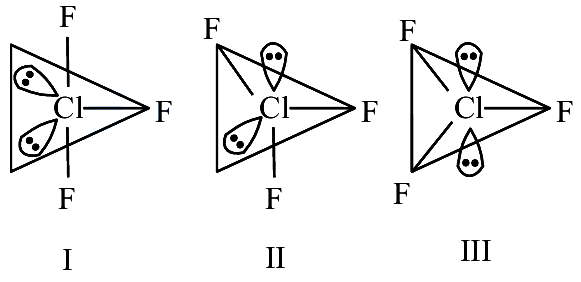
\(\mathrm{ClF}_3\)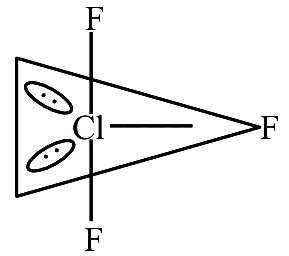
\(\mathrm{n}=2(\) No of lone pair present in equitorial plane \()\) (Unpaired \(\mathrm{e}^{-}\))
(A) \(\mathrm{V}^{+3}:[\mathrm{Ar}] 3 \mathrm{~d}^2 \quad 2\)
(B) \(\mathrm{Ti}^{3+}:[\mathrm{Ar}] 3 \mathrm{~d}^1 \quad 1\)
(C) \(\mathrm{Cu}^{+2}:[\mathrm{Ar}] 3 \mathrm{~d}^9 \quad 1\)
(D) \(\mathrm{Ni}^{+2}:[\mathrm{Ar}] 3 \mathrm{~d}^8 \quad 2\)
(E) \(\mathrm{Ti}^{+2}:[\mathrm{Ar}] 3 \mathrm{~d}^2 \quad 2\) -
- (A) Both Statement I and Statement II are false
- (B) Statement I is false but Statement II is true
- (C) Statement I is true but Statement II is false
- (D) Both Statement I and Statement II are true
Show answer and solution
Correct Answer: (C)
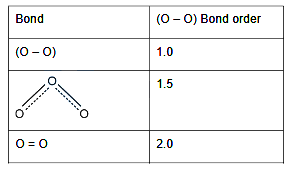
Bond length \(\propto \frac{1}{\text { Bond order }}\)
Order of \(\mathrm{O}-\mathrm{O}\) bond length
\(\mathrm{O}=\mathrm{O} < \mathrm{O}_3 < \mathrm{O}-\mathrm{O}\)
\(\therefore\) Statement \(I\) is true.
Lone pair-lone pair repulsion between O-atoms is not solely responsible for the correct order of O-O bond length. Bond order also should be considered.
\(\therefore \quad\) Statement II is false. -
- (A) Statement I is incorrect but statement II is correct.
- (B) Statement I is correct but statement II is incorrect.
- (C) Both Statement I and statement II are correct.
- (D) Both Statement I and statement II are incorrect.
Show answer and solution
Correct Answer: (B)
Statement 1 is correct.
Statement 2 is incorrect since in \(\mathrm{sp}^3 \mathrm{~d}\) hybridization; lone pair cannot occupy axial position. -
- (A) Both Statement I and Statement II are true
- (B) Statement I is true but Statement II is false
- (C) Statement I is false but Statement II is true
- (D) Both Statement I and Statement II are false
Show answer and solution
Correct Answer: (A)
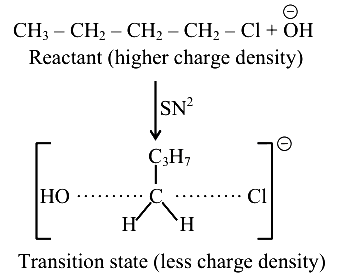
\(\Rightarrow\) This reaction will proceed faster in less polar medium which will not increase the activation energy value.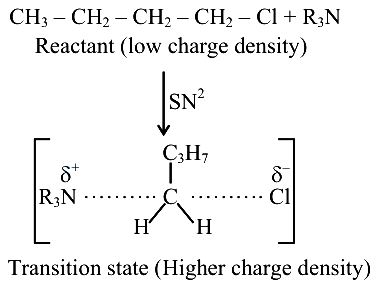
\(\Rightarrow\) This reaction will proceed faster in more polar medium which will decrease the activation energy value. - 8. In the given structure, number of sp and \(\mathrm{sp}^2\) hybridized carbon atoms present respectively are :
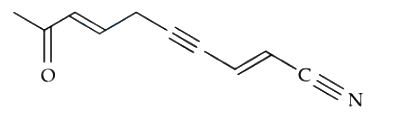
2025 Easy- (A) 4 and 5
- (B) 3 and 5
- (C) 3 and 6
- (D) 4 and 6
Show answer and solution
Correct Answer: (B)
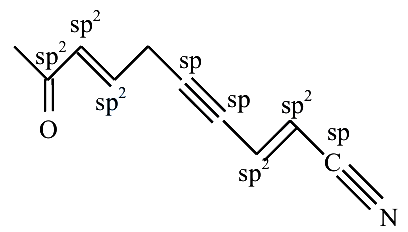
Number of sp and \(\mathrm{sp}^2\) hybridised carbon atom are 3 and 5. -
- (A) (A) \(-(\mathrm{IV}),(\mathrm{B})-(\mathrm{II}),(\mathrm{C})-(\mathrm{I}),(\mathrm{D})-(\mathrm{III})\)
- (B) \((\mathrm{A})-(\mathrm{III}),(\mathrm{B})-(\mathrm{I}),(\mathrm{C})-(\mathrm{II}),(\mathrm{D})-(\mathrm{IV})\)
- (C) (A) \(-(\mathrm{IV}),(\mathrm{B})-(\mathrm{I}),(\mathrm{C})-(\mathrm{II}),(\mathrm{D})-(\mathrm{III})\)
- (D) \((\mathrm{A})-(\mathrm{III}),(\mathrm{B})-(\mathrm{II}),(\mathrm{C})-(\mathrm{I}),(\mathrm{D})-(\mathrm{IV})\)
Show answer and solution
Correct Answer: (A)
\(\begin{aligned}
& \text { (A) }\left[\mathbf{M n B r}_4\right]^{2-} \\
& \mathrm{Mn}^{+2} \Rightarrow[\mathrm{Ar}] 3 \mathrm{~d}^5
\end{aligned}\)
In presence of ligand field
\(\Rightarrow \mathrm{sp}^3\) hybridization, paramagnetic in nature
(B) \(\left[\mathrm{FeF}_6\right]^{3-}\)
\(\mathrm{Fe}^{+3} \Rightarrow[\mathrm{Ar}] 3 \mathrm{~d}^5\)
In presence of ligand field
\(\Rightarrow \mathrm{sp}^3 \mathrm{~d}^2\) hybridization, paramagnetic in nature
(C) \(\left[\mathrm{Co}\left(\mathrm{C}_2 \mathrm{O}_4\right)_3\right]^{3-}\)
\(\mathrm{Co}^{+3} \Rightarrow[\mathrm{Ar}] 3 \mathrm{~d}^6\)
In presence of ligand field
\(\Rightarrow d^2 \mathrm{sp}^3\) hybridization, diamagnetic in nature
(D) \(\left[\mathrm{Ni}(\mathrm{CO})_4\right]\)
\(\mathrm{Ni}^0 \Rightarrow[\mathrm{Ar}] 3 \mathrm{~d}^8 4 \mathrm{~s}^2\)
In presence of ligand field
\(\Rightarrow \mathrm{sp}^3\) hybridization, diamagnetic in nature -
- (A) A-IV, B-I, C-III, D-II
- (B) A-IV, B-II, C-I, D-III
- (C) A-II, B-IV, C-III, D-I
- (D) A-III, B-II, C-I, D-IV
Show answer and solution
Correct Answer: (B)
\(\mathrm{NO}=7 \mathrm{e}^{-}\)Incomplete octet with
\(\mathrm{NO}_2=7 \mathrm{e}^{-} \int \quad\) odd electron
\(\left.\begin{array}{l}\mathrm{BCl}_3=6 \mathrm{e}^{-} \\ \mathrm{AlCl}_3=6 \mathrm{e}^{-}\end{array}\right\}\)Incomplete octet
\(\mathrm{H}_2 \mathrm{SO}_4=12 \mathrm{e}^{-}, \mathrm{PCl}_5=10 \mathrm{e}^{-} \Rightarrow\) molecules with expanded octet
\(\mathrm{CCl}_4=8 \mathrm{e}^{-}, \mathrm{CO}_2=8 \mathrm{e}^{-} \Rightarrow\) molecules obeying octet rule -
- (A) A-IV, B-III, C-II, D-I
- (B) A-III, B-IV, C-II, D-I
- (C) A-III, B-IV, C-I, D-II
- (D) A-II, B-I, C-IV, D-III
Show answer and solution
Correct Answer: (B)
(A)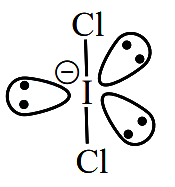
________ B.P : L.P = \(2: 3\)
(B)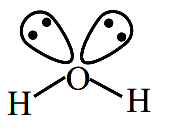
________ B.P : L.P = \(2: 2\)
(C)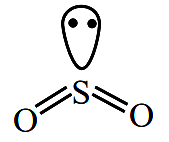
________ B.P : L.P = \(4: 1\)
(D)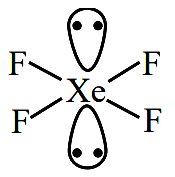
________ B.P : L.P = \(4: 2\) -
- (A) (B), (D) and (E) only
- (B) \((\mathrm{A}),(\mathrm{B}),(\mathrm{D})\) and (E) only
- (C) (B), (C) and (D) only
- (D) (A), (B) and (D) only
Show answer and solution
Correct Answer: (B)
Extra stability of half filled is due to :
(i) Symmetrical distribution of electrons
(ii) Large exchange energy
(iii) Smaller coulombic repulsion
(iv) Smaller shielding of electrons by one another -
- (A) \(\mathrm{BrF}_5 \& \mathrm{PCl}_5\)
- (B) \(\mathrm{SbF}_5 \& \mathrm{PCl}_5\)
- (C) \(\mathrm{SbF}_5 \& \mathrm{XeOF}_4\)
- (D) \(\mathrm{BrF}_5 \& \mathrm{XeOF}_4\)
Show answer and solution
Correct Answer: (D)
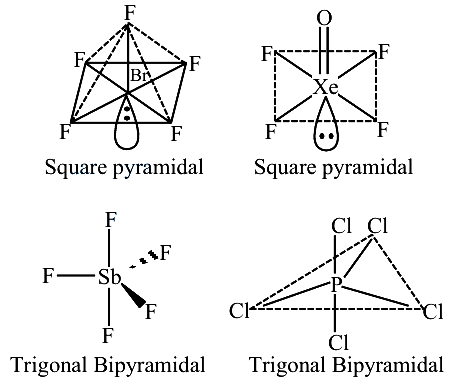
\(\mathrm{BrF}_5\) : Square pyramedal
\(\mathrm{XeOF}_4\) : Square pyramedal
\(\mathrm{SbF}_5\) : Trigonal bipyramidal
\(\mathrm{PCl}_5\) : Trigonal bipyramidal -
- (A) 4
- (B) 6
- (C) 8
- (D) 10
Show answer and solution
Correct Answer: (B)
Linear species are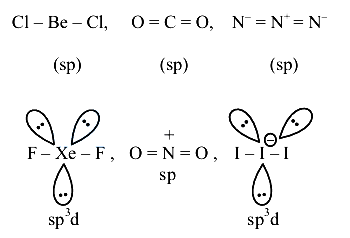
-
- (A) 10
- (B) 8
- (C) 6
- (D) 12
Show answer and solution
Correct Answer: (C)
\(\mathrm{O}_2 \rightarrow 2\) unpaired electrons according to MOT
\(\mathrm{O}_2^{+} \rightarrow 1\) unpaired electrons according to MOT
\(\mathrm{O}_2^{-} \rightarrow 1\) unpaired electrons according to MOT
\(\mathrm{NO} \rightarrow\) odd electron species
\(\mathrm{NO}_2 \rightarrow\) odd electron species
\(\mathrm{K}_2\left[\mathrm{NiCl}_4\right] \rightarrow \mathrm{Ni}^{2+} \Rightarrow 3 \mathrm{~d}^8\) weak Ligand, C.N. \(=4\)
\(\Rightarrow\) Tetrahedral, Paramagnetic with 2 unpaired electrons -
- (A) \(\mathrm{PF}_5\)
- (B) \(\mathrm{XeF}_4\)
- (C) \(\mathrm{SF}_4\)
- (D) \(\mathrm{XeF}_2\)
Show answer and solution
Correct Answer: (C)
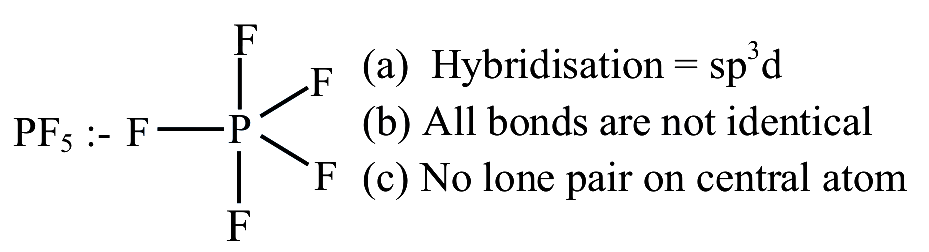
\(\mathrm{XeF}_4:-\mathrm{sp}^3 \mathrm{~d}^2\) Hybridisation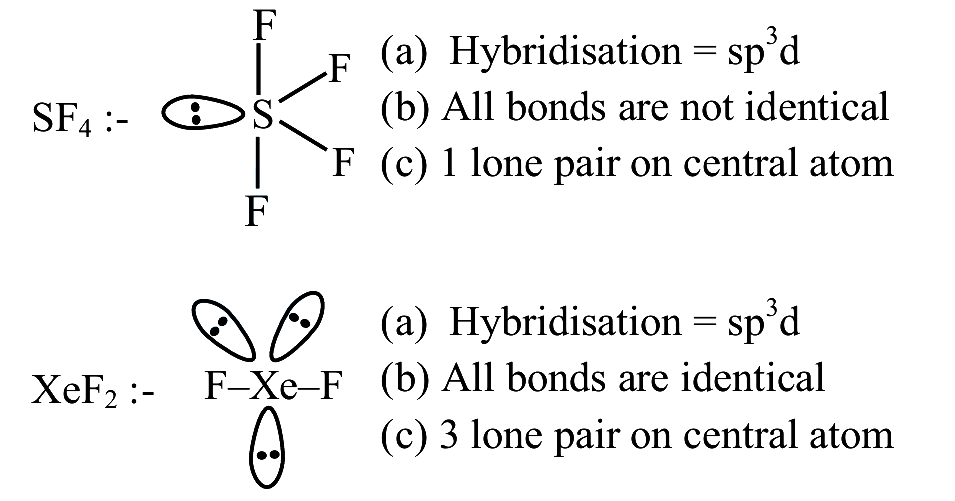
-
- (A) B only
- (B) A & C only
- (C) A & E only
- (D) A & D only
Show answer and solution
Correct Answer: (D)
\(\begin{array}{lcc}
& & \text { No. of unpaired } \mathrm{e}^{-} \\
\text {(A) } & \mathrm{O}_2 & 2 \\
\text { (B) } & \mathrm{N}_2 & 0 \\
\text { (C) } & \mathrm{F}_2 & 0 \\
\text { (D) } & \mathrm{S}_2 & 2 \\
\text { (E) } & \mathrm{Cl}_2 & 0
\end{array}\)
If species contain unpaired electron than it is paramagnetic.
So A \& D are paramagnetic. -
- (A) A, B and C Only
- (B) A, D and E Only
- (C) C, D and E Only
- (D) A, B, C and E Only
Show answer and solution
Correct Answer: (A)
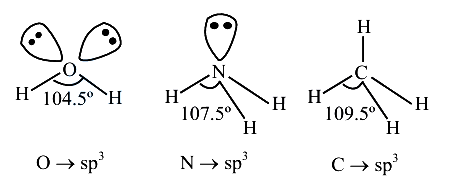
Dipole moment \(\quad \mathrm{H}_2 \mathrm{O}>\mathrm{NH}_3>\mathrm{CH}_4\)
\(\mathrm{H}_2 \mathrm{O} \& \mathrm{NH}_3\) are Lewis Bases
\(\mathrm{NH}_3\) act as Lowry- Bronsted base
Hence, A, B & C are correct

No questions on this page match these filters.