


Questions
6 questionsShowing 1–6 of 6 questions
-
- (A) 180
- (B) 184
- (C) 188
- (D) 192
Show answer and solution
Correct Answer: (B)
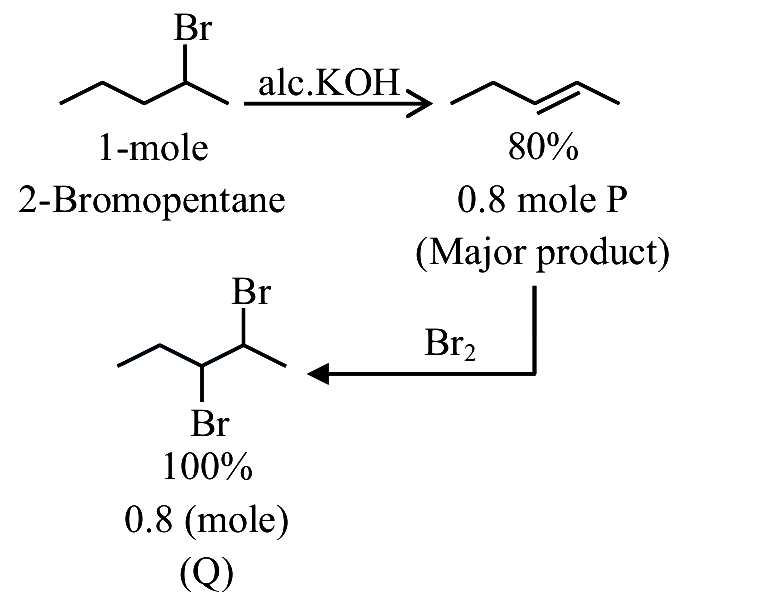
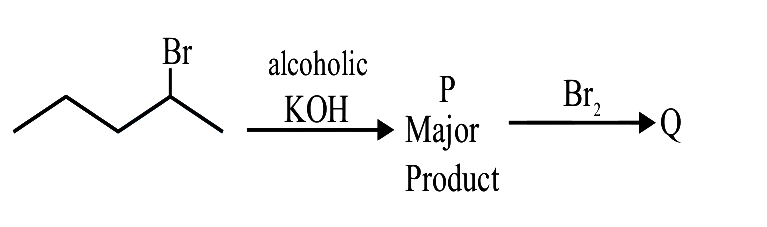
\(\begin{aligned} & \text { Molecular mass of } \mathrm{Q}=230 \mathrm{~g} \mathrm{~mol}^{-1} \\ & \begin{aligned} \text { Mass of } \mathrm{Q} & =0.8 \times 230 \\ & =184 \mathrm{~g}\end{aligned}\end{aligned}\) -
- (A) Both Statement I and Statement II are incorrect
- (B) Statement I is incorrect but Statement II is correct
- (C) Statement I is correct but Statement II is incorrect
- (D) Both Statement I and Statement II are correct
Show answer and solution
Correct Answer: (B)
Statement (I) :
\(\mathrm{R}-\mathrm{Cl} \xrightarrow{(\text { aq. } \mathrm{KOH})} \mathrm{R}-\mathrm{OH}\left(\mathrm{S}_{\mathrm{N}}\right.\) reaction \()\)
Statement (II) :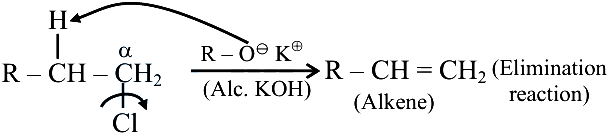
-
- (A) Both Statement I and Statement II are incorrect
- (B) Both Statement I and Statement II are correct
- (C) Statement I is incorrect but Statement II is correct
- (D) Statement I is correct but Statement II is incorrect
Show answer and solution
Correct Answer: (B)
1. Analysis of Statement I (True):
- Generally, primary alkyl halides do not undergo \( \text{S}_\text{N}1 \) reactions because primary carbocations are highly unstable.
- However, for \( \text{CH}_3-\text{O}-\text{CH}_2-\text{Cl} \), the loss of the chloride ion forms the carbocation \( \text{CH}_3-\ddot{\text{O}}-\overset{+}{\text{C}}\text{H}_2 \).
- This specific carbocation is exceptionally stabilized by resonance due to the lone pair of electrons on the adjacent oxygen atom:
\( \text{CH}_3-\ddot{\text{O}}-\overset{+}{\text{C}}\text{H}_2 \longleftrightarrow \text{CH}_3-\overset{+}{\text{O}}=\text{CH}_2 \)
- In the canonical structure on the right, every single atom (including both carbon and oxygen) satisfies the octet rule. This high resonance stabilization lowers the activation energy barrier for the \( \text{S}_\text{N}1 \) pathway remarkably, allowing it to proceed rapidly despite being a primary halide.
2. Analysis of Statement II (True):
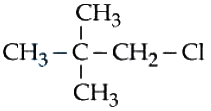
- Neopentyl chloride is a primary alkyl halide. For an \( \text{S}_\text{N}2 \) reaction to occur, a nucleophile must perform a backside attack on the electrophilic carbon carrying the leaving group.
- In neopentyl chloride, the \( \alpha \)-carbon bonded to chlorine is directly attached to a highly bulky tert-butyl group (\( -\text{C(CH}_3)_3 \)).
- This extreme steric hindrance completely shields the backside approach of the nucleophile. Consequently, neopentyl chloride is practically inert to \( \text{S}_\text{N}2 \) substitution reactions under standard laboratory conditions.
Since both Statement I and Statement II are factually correct, Option B is definitively the correct choice. -
- (A) A-II, B-I, C-III, D-IV
- (B) A-II, B-III, C-I, D-IV
- (C) A-IV, B-I, C-III, D-II
- (D) A-IV, B-III, C-I, D-II
Show answer and solution
Correct Answer: (D)
LIST-I
Name reactionLIST-II
Product obtainable(A) Swarts reaction (I) \(Et-I \xrightarrow{KF/DF} Et-F\) (B) Sandmeyer's reaction (II) \(\mathrm{PhN}_2^{\oplus} \mathrm{Cl}^{-} \xrightarrow[\mathrm{CuCN} / \mathrm{KCN}]{\mathrm{PhCN}+\mathrm{N}_2}\) (C) Wurtz Fittig reaction (III) \(Ph-Cl + EtCl \xrightarrow{Na/ether} Ph-Et + Ph-Ph + Et-Et\) (D) Finkelstein reaction (IV) \(Et-Cl \xrightarrow[acetone]{NaI} Et-I + NaCl\)
Explanation:
Let us evaluate each named organic reaction to determine its correct product:
1. Swarts reaction (A): This reaction involves the synthesis of alkyl fluorides by heating alkyl chlorides or bromides in the presence of metallic fluorides such as \( \text{AgF} \). For example, heating ethyl chloride with \( \text{AgF} \) gives Ethyl fluoride (IV).
2. Sandmeyer's reaction (B): This reaction is used to synthesize aryl nitriles or aryl halides from diazonium salts. Treating a benzene diazonium salt with \( \text{CuCN} \) yields Cyanobenzene (III).
3. Wurtz Fittig reaction (C): This reaction involves the coupling of an aryl halide and an alkyl halide when treated with sodium metal in the presence of dry ether to form an alkylbenzene. Reacting chlorobenzene and ethyl chloride with sodium yields Ethyl benzene (I).
4. Finkelstein reaction (D): This is a halogen exchange reaction where alkyl iodides are prepared by reacting alkyl chlorides or bromides with \( \text{NaI} \) in the presence of dry acetone. This gives Ethyl iodide (II).
Matching these correctly gives: A-IV, B-III, C-I, D-II.
Hence, Option D is the correct choice. -
- (A) benzoic acid
- (B) benzoic acid and aniline
- (C) benzoic acid and chlorobenzene
- (D) chlorobenzene and aniline
Show answer and solution
Correct Answer: (D)
Organic layer in funnel are mixture of chloro benzene and aniline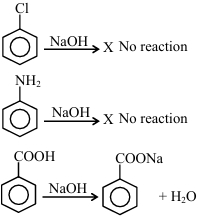
- 6. The ascending order of relative rate of solvolysis of following compounds is _______.
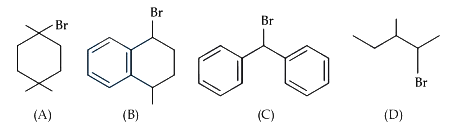
2025 Medium- (A) \((\mathrm{C}) \lt (\mathrm{B}) \lt (\mathrm{A}) \lt (\mathrm{D})\)
- (B) \((\mathrm{D}) \lt (\mathrm{A}) \lt (\mathrm{B}) \lt (\mathrm{C})\)
- (C) \((\mathrm{D}) \lt (\mathrm{B}) \lt (\mathrm{A}) \lt (\mathrm{C})\)
- (D) \((\mathrm{C}) \lt (\mathrm{D}) \lt (\mathrm{B}) \lt (\mathrm{A})\)
Show answer and solution
Correct Answer: (B)
Solvolysis or \(\mathrm{S}_{\mathrm{N}} 1 \propto\) stability of carboccation Stability order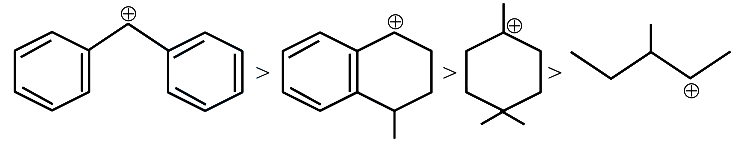
No questions on this page match these filters.