


Questions
7 questionsShowing 1–7 of 7 questions
- 1. Consider the following molecules :
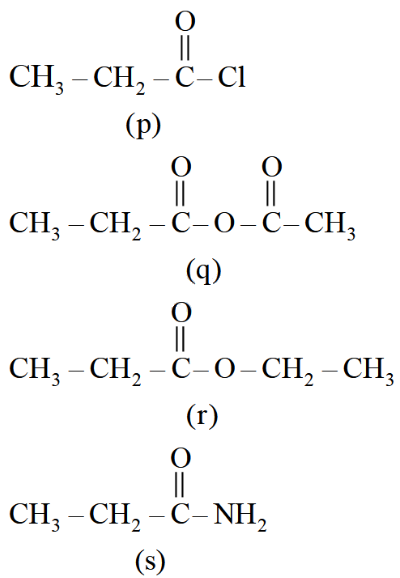
The correct order of rate of hydrolysis is _______. 2025 Medium- (A) \(r>q>p>s\)
- (B) \(q>p>r>s\)
- (C) \(p>r>q>s\)
- (D) \(p>q>r>s\)
Show answer and solution
Correct Answer: (D)
Rate of hydrolysis \(\propto\) Leaving group ability
-
- (A) A and D only
- (B) A,B and E only
- (C) B,C and E only
- (D) B and E only
Show answer and solution
Correct Answer: (D)
(A) \(\mathrm{R}-\mathrm{C} \equiv \mathrm{N} \xrightarrow[\text { mild condition }]{\text { (i) } \mathrm{H}^{+} / \mathrm{H}_2 \mathrm{O}} \mathrm{R}-\mathrm{CONH}_2\)
Under mild condition amide is formed because this reaction is typically slow if further more heat will supplied then it gets convert in to -COOH.
(B) \(\mathrm{R}-\mathrm{MgX} \xrightarrow[\text { (ii) } \mathrm{H}_3 \mathrm{O}^{+}]{\text {(i) } \mathrm{CO}_2} \mathrm{R}-\mathrm{COOH}\)
(C) \(\mathrm{R}-\mathrm{C} \equiv \mathrm{N} \xrightarrow[\text { (ii) } \mathrm{H}_3 \mathrm{O}^{+}]{\text {(i) } \mathrm{SnCl}_2 / \mathrm{HCl}} \mathrm{R}-\mathrm{CHO}\)
(D) \(\mathrm{R} \cdot \mathrm{CH}_2 \cdot \mathrm{OH} \xrightarrow{\mathrm{PCC}} \mathrm{R}-\mathrm{CHO}\)
(E)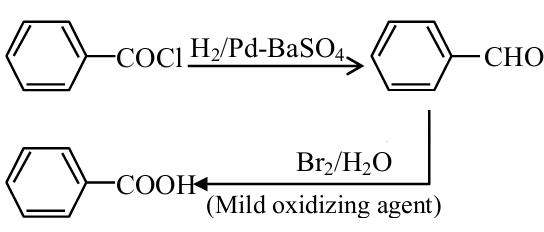
-
- (A) Both Statement I and Statement II are false
- (B) Statement I is false but Statement II is true
- (C) Statement I is true but Statement II is false
- (D) Both Statement I and Statement II are true
Show answer and solution
Correct Answer: (D)
Statement - I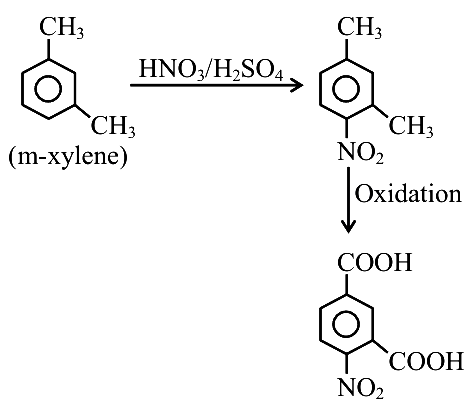
Statement-II \(-\mathrm{CH}_3\) group is o/p directing while \(-\mathrm{NO}_2\) group is meta directing. -
- (A) A, C and D Only
- (B) A, B and E Only
- (C) A and C Only
- (D) A and B Only
Show answer and solution
Correct Answer: (A)
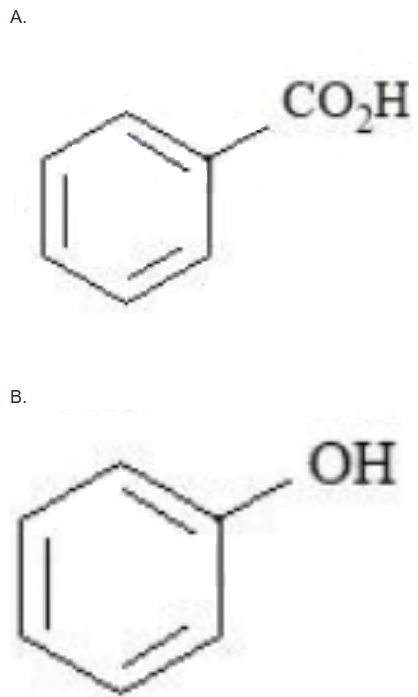
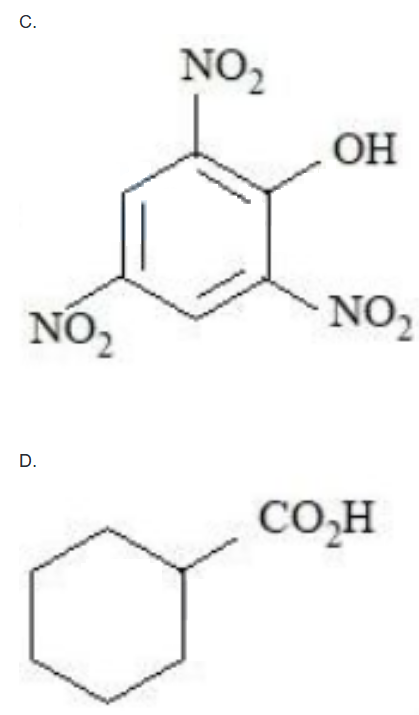
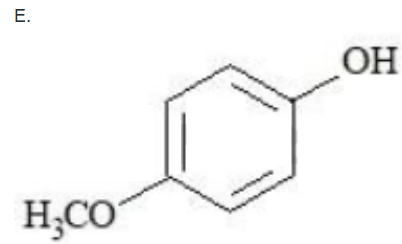
\(A , C , D\) produce \(CO _2\) with aqueous \(NaHCO _3\) solution.
\(A , C , D\) acids are stronger acid than \(H _2 CO _3\) (Carbonic acid) -
- (A) D
- (B) A
- (C) B
- (D) C
Show answer and solution
Correct Answer: (A)
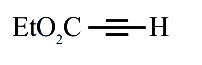
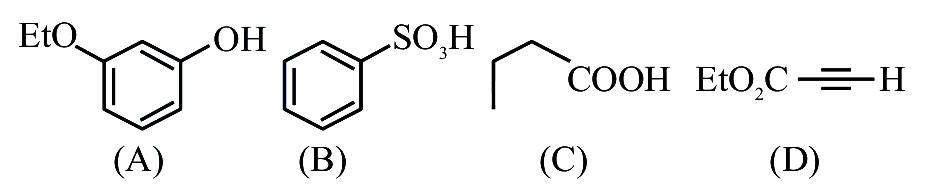
C.B. of terminal alkyne will be sp hybridisation and loculised. In other C.B. will be resonance stablised. - 6. The total number of compounds from below when treated with hot \(\text{KMnO} _4\) giving benzoic acid is _______.
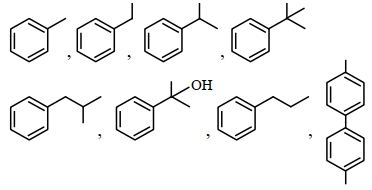 2025 Medium
- (A) 3
- (B) 4
- (C) 6
- (D) 5
Show answer and solution
Correct Answer: (D)
Compounds having at least \(1 \alpha- H\) will react with \(KMnO _4\) and give benzoic acid.
Total 5 compounds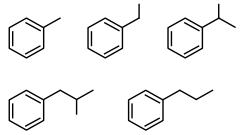
-
- (A) 60
- (B) 65
- (C) 61
- (D) 47
Show answer and solution
Correct Answer: (C)
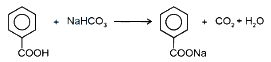
1 mole benzoic acid will release 1 mole \(\mathrm{CO}_2\)
11.2 \(\mathrm{L} \mathrm{CO}_2\) at STP is \(\frac{1}{2} \mathrm{~mole}_{\mathrm{CO}}^2\) which will be released by reaction with \(\frac{1}{2}\) mole benzoic acid
\(\begin{aligned} \text { Mass of benzoic acid } & =\frac{1}{2} \times 122 \\ & =61 \mathrm{gm}\end{aligned}\)
 \(\qquad\)\(\qquad\)
No questions on this page match these filters.