


Questions
23 questionsShowing 1–23 of 23 questions
-
- (A) 20
- (B) 23
- (C) 26
- (D) 29
Show answer and solution
Correct Answer: (B)
Given : Concentration of \(\mathrm{NaOH}=0.2 \%(\mathrm{w} / \mathrm{v})\)
\(\therefore 0.2 \mathrm{~g}\) of NaOH in 100 ml of solution.
Molarity of NaOH solution
\(\begin{array}{r}
=\frac{\text { moles of solute }}{\mathrm{V}_{\mathrm{ml}}} \times 1000 \\
=\frac{0.2 / 40}{100} \times 1000==\frac{0.2}{40 \times 100} \times 1000=\frac{2}{40} \mathrm{M}
\end{array}\)
Given resistivity of solution \(=870 \mathrm{~m}\) ohm m \(=870 \times 10^{-3} \mathrm{ohm} \mathrm{m}\)
\(=870 \times 10^{-3} \times 10 \mathrm{ohm} \mathrm{dm}\)
\(=870 \times 10^{-2}\) ohm dm
\(=8.7\) ohm dm
Now conductivity
\(\mathrm{K}=\frac{1}{\rho}=\frac{1}{8.7} \mathrm{ohm}^{-1} \mathrm{dm}^{-1}\)
Now molar conductivity of solution is
\(\begin{aligned}
& \lambda_{\mathrm{m}}=\frac{\mathrm{K}}{\mathrm{M}}=\frac{\frac{1}{8.7}}{\frac{2}{40}}=\frac{40}{2 \times 8.7}=2.29 \mathrm{~S} \mathrm{dm}^2 \mathrm{~mol}^{-1} \\
& 2.29 \times 10^3 \mathrm{~m} \mathrm{~S} \mathrm{dm}^2 \mathrm{~mol}^{-1} \\
& =22.9 \times 10^2 \mathrm{~m} \mathrm{~S} \mathrm{dm}^2 \mathrm{~mol}^{-1} \\
& =23 \times 10^2 \mathrm{~m} \mathrm{~S} \mathrm{dm}^2 \mathrm{~mol}^{-1}
\end{aligned}\) -
- (A) 100
- (B) 200
- (C) 300
- (D) 400
Show answer and solution
Correct Answer: (D)
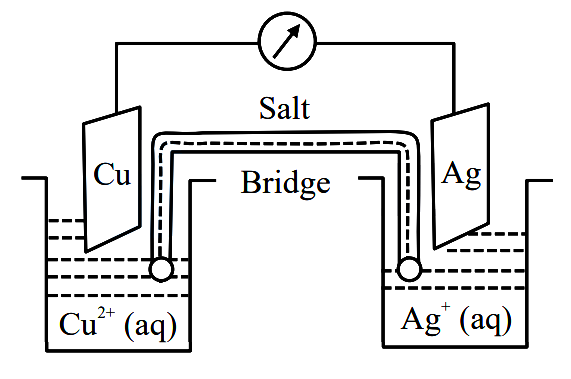
\(\mathrm{Cu}^{+2}+2 \mathrm{e}^{-} \longrightarrow \mathrm{Cu}\)
\(\begin{aligned}& (1 \text { faraday }=\text { charge on } 1 \text { mole electron }) \\& \mathrm{t}=0 \quad 1.5 \quad 1 \mathrm{~mole} \\& \mathrm{t}=\mathrm{t} \quad 1 \quad-\quad 0.5 \text { mole }\end{aligned}\)
\(\left[\mathrm{Cu}^{+2}\right]=1 \mathrm{M}\) after electrolysis
* \(\mathrm{Ag} \oplus+\mathrm{e}^{-} \quad \longrightarrow \mathrm{Ag}\)
\(\begin{array}{lll}\mathrm{t}=0 & 0.2 & 0.1 \text { mole } \\ \mathrm{t}=\mathrm{t} & 0.1 & - \qquad -\end{array}\)
\(\left[\mathrm{Ag}^{+}\right]=0.1 \mathrm{M}\) after electrolysis
Cell \(\quad \mathrm{Cu}_{(\mathrm{s})}+2 \mathrm{Ag}_{(\mathrm{aq})}^{+} \rightarrow \mathrm{Cu}_{(\mathrm{aq})}^{+2}+2 \mathrm{Ag}_{(\mathrm{s})}\)
reaction
\(\begin{aligned} & \mathrm{E}=\mathrm{E}^{\circ}-\frac{0.06}{\mathrm{n}} \log \frac{\left[\mathrm{Cu}^{+2}\right]}{\left[\mathrm{Ag}^{+}\right]^2} \\ & \mathrm{E}=(0.8-0.34)-\frac{0.06}{2} \log \frac{1}{(0.1)^2}=0.4 \mathrm{~V}\end{aligned}\)
Correct answer \(=400 \mathrm{mV}\) -
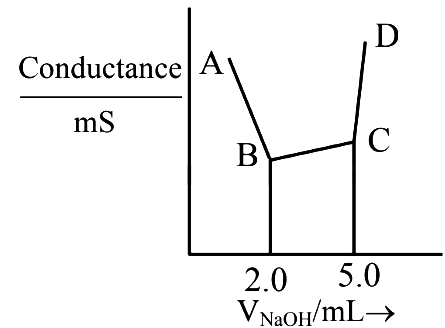
- (A) The concentration of \(\mathrm{CH}_3 \mathrm{COOH}\) in the original mixture is 0.005 M
- (B) The concentration of HCl in the original mixture is 0.005 M
- (C) \(\mathrm{CH}_3 \mathrm{COOH}\) is neutralised first followed by neutralisation of HCl
- (D) Point ' C ' indicates the complete neutralisation HCl
Show answer and solution
Correct Answer: (B)
From the given graph 2 ml NaOH solution is used for neutralisation of HCl and 3 ml NaOH solution is used for neutralisation of \(\mathrm{CH}_3 \mathrm{COOH}\).
\(\therefore\) Mole of \(\mathrm{HCl}=\) Mole of NaOH used
\(\begin{aligned}
& \mathrm{M} \times 40=0.1 \times 2 \\
& \mathrm{M}=0.005
\end{aligned}\)
\(\therefore\) Mole of \(\mathrm{CH}_3 \mathrm{COOH}=\) Mole of NaOaH used
\(\begin{aligned}
& \mathrm{M} \times 40=0.1 \times 3 \\
& \mathrm{M}=0.0075
\end{aligned}\)
HCl is strong acid and will be neutralised first. -
- (A) 1.660 g
- (B) 0.336 g
- (C) 0.441 g
- (D) 1.007 g
Show answer and solution
Correct Answer: (B)
\(\mathrm{Al}^{1++}+3 \mathrm{e}^{-} \longrightarrow \mathrm{Al}\)
\(\begin{aligned}
\text { Moles of electron } & =\frac{2 \times 30 \times 60}{96500} \\
& =\frac{36}{965}
\end{aligned}\)
\(\begin{aligned}
\text { Moles of } \mathrm{Al} & =\frac{36}{3 \times 965} \\
& =\frac{12}{965}
\end{aligned}\)
\(\text { Mass of } \mathrm{Al}=\frac{12}{965} \times 27\)
\(=0.336 \mathrm{gm}\) -
- (A) Cr
- (B) \(\mathrm{Cl}^{-}\)
- (C) \(\mathrm{MnO}_4^{-}\)
- (D) \(\mathrm{Mn}^{2+}\)
Show answer and solution
Correct Answer: (A)
\(\begin{aligned}
& \mathrm{E}_{\mathrm{Cr}_2 \mathrm{Of}_4^{\circ} / \mathrm{ca}^8}^0=1.33 \mathrm{~V}_{\mathrm{C}_2 / \mathrm{Cr}}^{\circ}=1.36 \mathrm{~V} \\
& \mathrm{E}_{\mathrm{MnO}_4 / \mathrm{Mm}^2}^{\circ}=1.51 \mathrm{~V} \mathrm{E}_{\mathrm{Cr}^2 / \mathrm{Cr}}^0=-0.74 \mathrm{~V}
\end{aligned}\)
The species which has the most negative value of standard reduction potential will be the strongest reducing agent. Since \(\mathrm{Cr}^{3+} / \mathrm{Cr}\) has SRP value of \(-0.74 \mathrm{~V}, \mathrm{Cr}\) is the strongest reducing agent. -
- (A) 2
- (B) 4
- (C) 6
- (D) 8
Show answer and solution
Correct Answer: (C)
\(\begin{aligned}
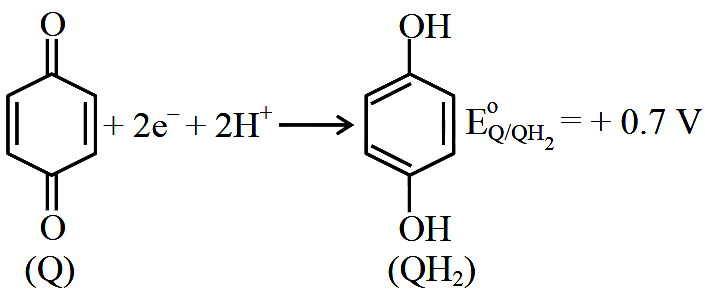
& \mathrm{QH}_2+2 \mathrm{Ag}^{+} \rightarrow 2 \mathrm{Ag}+\mathrm{Q}+2 \mathrm{H}^{+} \\
& \mathrm{E}=\mathrm{E}^{\circ}-\frac{0.06}{2} \log \left[\mathrm{H}^{+}\right]^2 \\
& \mathrm{E}=\mathrm{E}^{\circ}-0.06 \times \log \left[\mathrm{H}^{+}\right] \\
& \mathrm{pH}=-\log \left(\mathrm{H}^{+}\right)=\frac{\mathrm{E}-\mathrm{E}^{\mathrm{o}}}{0.06}=\frac{0.4-0.1}{0.06} \\
& =\frac{0.3}{0.06}=5
\end{aligned}\)
\(\begin{aligned} & \mathrm{pH}+\mathrm{NH}_4 \mathrm{X}=7-\frac{1}{2} \mathrm{pK}_{\mathrm{b}}-\frac{1}{2} \log \mathrm{C} \\ & 5=7-\frac{1}{2} \times \mathrm{pK}_{\mathrm{b}}-\frac{1}{2} \log \left(10^{-2}\right) \\ & \mathrm{pK}_{\mathrm{b}}=6\end{aligned}\) -
- (A) 10
- (B) 20
- (C) 30
- (D) 40
Show answer and solution
Correct Answer: (A)
\(\begin{aligned} & \mathrm{Cr}_2 \mathrm{O}_{7 \text { (aq) }}^{-2}+14 \mathrm{H}_{(\mathrm{aq})}^{+}+6 \mathrm{e}^{-} \rightarrow 2 \mathrm{Cr}_{(\mathrm{aq})}^{+3}+7 \mathrm{H}_2 \mathrm{O}_{(\ell)} \\ & \mathrm{E}_{\mathrm{R}}=\mathrm{E}_{\mathrm{R}}^0-\frac{0.059}{6} \log \frac{\left[\mathrm{Cr}^{+3}\right]^2}{\left[\mathrm{Cr}_2 \mathrm{O}_7^{-2}\right]\left[\mathrm{H}^{+}\right]^{14}} \\ & 0=1.33-\frac{0.059}{6} \log \frac{10^{-6}}{\left[\mathrm{H}^{+}\right]^{14}} \\ & \frac{1.33 \times 6}{0.059}=\log \frac{10^{-6}}{[\mathrm{H}]^{14}} \\ & 135.254=-6-14 \log \left[\mathrm{H}^{+}\right] \\ & 141.254=14 \mathrm{pH} \\ & \mathrm{pH}=\frac{141.254}{14}=10.08\end{aligned}\) -
- (A) \(\mathrm{H}^{+} \gt \mathrm{Na}^{+} \gt \mathrm{K}^{+} \gt \mathrm{Ca}^{2+} \gt \mathrm{Mg}^{2+}\)
- (B) \(\mathrm{H}^{+} \gt \mathrm{Ca}^{2+} \gt \mathrm{Mg}^{2+} \gt \mathrm{K}^{+} \gt \mathrm{Na}^{+}\)
- (C) \(\mathrm{Mg}^{2+} \gt \mathrm{H}^{+} \gt \mathrm{Ca}^{2+} \gt \mathrm{K}^{+} \gt \mathrm{Na}^{+}\)
- (D) \(\mathrm{H}^{+} \gt \mathrm{Na}^{+} \gt \mathrm{Ca}^{2+} \gt \mathrm{Mg}^{2+} \gt \mathrm{K}^{+}\)
Show answer and solution
Correct Answer: (B)
Limiting Molar Conductivities of Ions:
- \(\stackrel{\oplus}{\mathrm{H}}: 349.8 \mathrm{Scm}^2 \mathrm{~mol}^{-1}\)
- \(\mathrm{Na}^{+}: 50.11 \mathrm{Scm}^2 \mathrm{~mol}^{-1}\)
- \(\mathrm{K}^{+}: 73.52 \mathrm{Scm}^2 \mathrm{~mol}^{-1}\)
- \(\mathrm{Ca}^{+2}: 119 \mathrm{Scm}^2 \mathrm{~mol}^{-1}\)
- \(\mathrm{Mg}^{+2}: 106.12 \mathrm{Scm}^2 \mathrm{~mol}^{-1}\)
Therefore correct order of limiting molar conductivity of cations will be -
\(\stackrel{\oplus}{\mathrm{H}} \gt \mathrm{Ca}^{+2} \gt \mathrm{Mg}^{+2} \gt \mathrm{K}^{+} \gt \mathrm{Na}^{+}\) -
- (A) 2
- (B) 4
- (C) 6
- (D) 8
Show answer and solution
Correct Answer: (A)
Electrolysis of NaCl is
\(\mathrm{NaCl}+\mathrm{H}_2 \mathrm{O}(\mathrm{aq}) \rightarrow \mathrm{NaOH}(\mathrm{aq})+\frac{1}{2} \mathrm{Cl}_2(\mathrm{~g})+\frac{1}{2} \mathrm{H}_2(\mathrm{~g})\)
Since during electrolysis pH changes to 12
So \(\left[\mathrm{OH}^{\ominus}\right]=10^{-2}\) and \(\left[\mathrm{H}^{+}\right]=10^{-12}\)
So by Faraday law
Gram amount of substance deposited \(=\) Amount of electricity passed
\(\begin{aligned} & 10^{-2} \times \frac{600}{1000} \times 96500=\mathrm{I} \times \mathrm{t} \\ & \frac{10^{-2} \times 600}{1000} \times 96500=\mathrm{I} \times 5 \times 60 \\ & \mathrm{I}=\frac{10^{-2} \times 600 \times 96500}{1000 \times 5 \times 60} \\ & \mathrm{I}=1.93 \text { ampere } \\ & \text { So }, I=2 \text { ampere (nearest integer) }\end{aligned}\) -
- (A) 2.1 V
- (B) 1 .7 V
- (C) 1 .4 V
- (D) 1 .2 V
Show answer and solution
Correct Answer: (B)
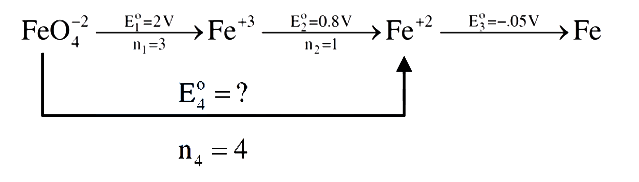
\(\begin{aligned} & \Delta \mathrm{G}_4^{\mathrm{o}}=\Delta \mathrm{G}_1^{\mathrm{o}}+\Delta \mathrm{G}_2^{\mathrm{o}} \\ \Rightarrow & -\mathrm{n}_4 \mathrm{FE}_4^{\mathrm{o}}=-\mathrm{n}_1 \mathrm{FE}_1^0-\mathrm{n}_2 \mathrm{FE}_2^{\mathrm{o}} \\ \Rightarrow & +4 \mathrm{E}_4^{\mathrm{o}}=3 \times 2+(1 \times 0.8) \\ \Rightarrow & \mathrm{E}_4^{\mathrm{o}}=\frac{6.8}{4} \mathrm{~V} \\ \Rightarrow & \mathrm{E}_4^{\mathrm{o}}=1.7 \mathrm{~V}\end{aligned}\) -
- (A) \(\mathrm{E}_{\text {cell }}=\mathrm{E}_{\text {cell }}^{\mathrm{o}}-\frac{\mathrm{RT}}{2 \mathrm{~F}} \ln \frac{\left[\mathrm{Ag}^{+}\right]}{\left[\mathrm{Mg}^{2+}\right]}\)
- (B) \(\mathrm{E}_{\text {cell }}=\mathrm{E}_{\text {cell }}^{\mathrm{o}}+\frac{\mathrm{RT}}{2 \mathrm{~F}} \ln \frac{\left[\mathrm{Ag}^{+}\right]^2}{\left[\mathrm{Mg}^{2+}\right]}\)
- (C) \(\mathrm{E}_{\text {cell }}=\mathrm{E}_{\text {cell }}^{\mathrm{o}}-\frac{\mathrm{RT}}{2 \mathrm{~F}} \ln \frac{\left[\mathrm{Ag}^{+}\right]^2}{\left[\mathrm{Mg}^{2+}\right]}\)
- (D) \(\mathrm{E}_{\text {cell }}=\mathrm{E}_{\text {cell }}^{\mathrm{o}}-\frac{\mathrm{RT}}{2 \mathrm{~F}} \ln \frac{\left[\mathrm{Mg}^{2+}\right]}{\left[\mathrm{Ag}^{+}\right]}\)
Show answer and solution
Correct Answer: (B)
\(\begin{array}{lll}\text { Cathode } & \left(\mathrm{Ag}+(\mathrm{aq})+\mathrm{e}^{-}\right. & \rightarrow \mathrm{Ag}) \times 2 \\ \text { Anode } & \mathrm{Mg} & \rightarrow \mathrm{Mg}^{2+}(\mathrm{aq})+2 \mathrm{e}^{-}\end{array}\)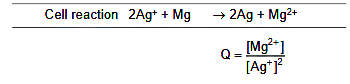
By Nernst equation
\(\begin{aligned}
& \mathrm{E}_{\text {cell }}=\mathrm{E}_{\mathrm{cell}}^{\circ}-\frac{\mathrm{RT}}{\mathrm{nF}} \ln \mathrm{Q} \\
& \mathrm{E}_{\text {cell }}=\mathrm{E}_{\mathrm{cell}}^{\circ}-\frac{\mathrm{RT}}{\mathrm{nF}} \ln \frac{\left[\mathrm{Mg}^{2+}\right]}{\left[\mathrm{Ag}^{+}\right]^2} \\
& =\mathrm{E}_{\text {cell }}^{\circ}+\frac{\mathrm{RT}}{2 \mathrm{~F}} \ln \frac{\left[\mathrm{Ag}^{+}\right]^2}{\left[\mathrm{Mg}^{2+}\right]}
\end{aligned}\) -
- (A) \(x+y-z\)
- (B) \(x+2 y\)
- (C) \(x+2 y-3 z\)
- (D) \(y-2 x\)
Show answer and solution
Correct Answer: (C)
\(\mathrm{Fe}^{2+}(\mathrm{aq})+\mathrm{Ag}^{+}(\mathrm{aq}) \rightarrow \mathrm{Fe}^{3+}(\mathrm{aq})+\mathrm{Ag}(\mathrm{s})\)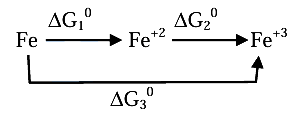
\(\begin{aligned}
& \Delta \mathrm{G}_3^0=\Delta \mathrm{G}_1^0+\Delta \mathrm{G}_2^0 \\
& -3 \mathrm{~F}(-\mathrm{z})=-2 \mathrm{~F}(-\mathrm{y})+\Delta \mathrm{G}_2{ }^0 \\
& \Delta \mathrm{G}_2^0=3 \mathrm{Fz}-2 \mathrm{Fy}
\end{aligned}\)
Also \(\Delta \mathrm{G}_2^0=-\mathrm{nFE}_{\mathrm{Fe}^{+2} / \mathrm{Fe}^{t^{43}}}^0\)
\(\begin{aligned}
& 3 \mathrm{Fz}-2 \mathrm{Fy}=-1 \mathrm{~F}\left(\mathrm{E}_{\mathrm{Fe}^{t^2} / \mathrm{Fe}^{43}}^0\right) \\
& \mathrm{E}_{\mathrm{Fe}^{2+2} / \mathrm{Fe}^{t^3}}^0=2 \mathrm{y}-3 \mathrm{z}
\end{aligned}\)
\(\mathrm{E}_{\text {Cell }}^0\) for reaction will be
\(\begin{aligned}
& \mathrm{E}_{\mathrm{Ag}^{+} / \mathrm{Ag}}^0+\mathrm{E}_{\mathrm{Fe}^{t^2 / \mathrm{Fe}}}^{03} \\
& =\mathrm{x}+2 \mathrm{y}-3 \mathrm{z}
\end{aligned}\) -
- (A) Both statement I and statement II are incorrect
- (B) Statement I is correct but statement II is incorrect
- (C) Both statement I and statement II are correct
- (D) Statement I is incorrect but statement II is correct
Show answer and solution
Correct Answer: (B)
Statement-II \(\Rightarrow\) At cathode, instead of \(\mathrm{Mg}, \mathrm{H}_2 \mathrm{O}_{(\ell)}\) will reduce & evolve \(\mathrm{H}_2\) gas. -
- (A) Both Statement I and Statement II are true
- (B) Statement I is false but Statement II is true
- (C) Statement I is true but Statement II is false
- (D) Both Statement I and Statement II are false
Show answer and solution
Correct Answer: (C)
Statement I :
Corrosion is an example of electrochemical phenomenon
In which pure metal act as anode and impure metal (rusted metal) act as cathode.
Statement II :
Corrosion is more favourable in acid medium than alkaline so rate of corrosion is high is acid medium then alkaline. -
- (A) 100
- (B) 150
- (C) 200
- (D) 250
Show answer and solution
Correct Answer: (B)
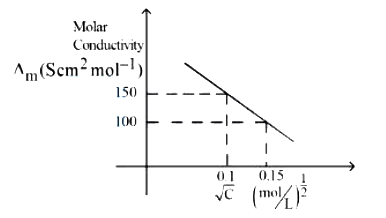
\(\begin{aligned} & \mathrm{R}=\rho \frac{\ell}{\mathrm{A}} \\ & \kappa=\mathrm{G} \cdot \mathrm{G}^* \quad \mathrm{G}=\frac{1}{\mathrm{R}} ; \kappa=\frac{1}{\rho}\end{aligned}\)
\(\begin{aligned} \mathrm{G}^*= & \frac{\ell}{\mathrm{A}} \\ \mathrm{R} & =\text { Resistance } \\ \rho & =\text { Resistivity } \\ \frac{\ell}{\mathrm{A}} & =\text { cell constant }\left(\mathrm{G}^*\right)\end{aligned}\)
\(\begin{aligned} & \frac{\kappa_{\mathrm{c}}}{\kappa_{\mathrm{d}}}=\frac{\mathrm{R}_{\mathrm{d}}}{\mathrm{R}_{\mathrm{c}}} ; \lambda_{\mathrm{m}}=\frac{\kappa \times 1000}{\mathrm{C}} \\ & \frac{\kappa_{\mathrm{c}}}{\kappa_{\mathrm{d}}}=\frac{\left(\lambda_{\mathrm{m}} \cdot \mathrm{C}\right)}{\left(\lambda_{\mathrm{m}} \cdot C\right)_{\mathrm{d}}}=\frac{\mathrm{R}_{\mathrm{d}}}{R_{\mathrm{c}}} \quad \\ & \mathrm{c}=\text { concentrated sol. } \quad \mathrm{d} \text { = diluted solution } \\ & \frac{100 \cdot(0.15)^2}{150 .(0.1)^2}=\frac{R_{\mathrm{d}}}{100} \\ & \mathrm{R}_{\mathrm{d}}=150 \Omega\end{aligned}\) -
- (A) (A)-(III), (B)-(II), (C)-(IV), (D)-(I)
- (B) (A)-(II), (B)-(III), (C)-(IV), (D)-(I)
- (C) (A)-(III), (B)-(I), (C)-(IV), (D)-(II)
- (D) (A)-(IV), (B)-(III), (C)-(II), (D)-(I)
Show answer and solution
Correct Answer: (C)
In transistor, anode is Zn and cathode is carbon.
In hearing, aids mercury battery are used.
In invertors, lead storage battery is used.
In apollo space ship, hydrogen fuel cell was used. -
- (A) (A) and (C) only
- (B) (B) and (C) only
- (C) (A) and (D) only
- (D) (B) and (D) only
Show answer and solution
Correct Answer: (B)
When an aqueous solution of \(\mathrm{AgNO}_3\) is electrolysed using Pt electrodes
Cathode: \(\mathrm{Ag}^{+}(\mathrm{aq})+\mathrm{e}^{-} \rightarrow \mathrm{Ag}(\mathrm{s})\)
Anode : \(2 \mathrm{H}_2 \mathrm{O}(\mathrm{l}) \rightleftharpoons 4 \mathrm{H}^{+}(\mathrm{aq})+\mathrm{O}_2(\mathrm{~g})+4 \mathrm{e}^{-}\)
\(\Rightarrow\) When dilute \(\mathrm{H}_2 \mathrm{SO}_4\) is electrolysed using Pt electrodes
\(\Rightarrow\) When dilute \(\mathrm{H}_2 \mathrm{SO}_4\) is electrolysed using Pt electrodes
Anode : \(2 \mathrm{H}_2 \mathrm{O}(\mathrm{l}) \rightarrow \mathrm{O}_2(\mathrm{~g})+4 \mathrm{H}^{+}(\mathrm{aq})+4 \mathrm{e}^{-}\)
Cathode: \(2 \mathrm{H}^{+}(\mathrm{aq})+2 \mathrm{e}^{-} \rightarrow \mathrm{H}_2(\mathrm{~g})\) -
- (A) \(\mathrm{Zn}\left|\mathrm{Zn}^{2+}(1 \mathrm{M})\right|\left|\mathrm{Ag}^{+}(1 \mathrm{M})\right| \mathrm{Ag}\)
- (B) \(\mathrm{Zn}\left|\mathrm{Zn}^{2+}(1 \mathrm{M})\right|\left|\mathrm{Mg}^{2+}(1 \mathrm{M})\right| \mathrm{Mg}\)
- (C) \(\mathrm{Ag}\left|\mathrm{Ag}^{+}(1 \mathrm{M})\right|\left|\mathrm{Mg}^{2+}(1 \mathrm{M})\right| \mathrm{Mg}\)
- (D) \(\mathrm{Cu}\left|\mathrm{Cu}^{2+}(1 \mathrm{M}) \| \mathrm{Ag}^{+}(1 \mathrm{M})\right| \mathrm{Ag}\)
Show answer and solution
Correct Answer: (A)
\(\begin{gathered}\because \Delta \mathrm{G}^{\circ}=-\mathrm{nFE}^{\circ} \\ \text { Option }(1) \mathrm{E}^{\circ}=0.8+0.76 \\ =1.56 \mathrm{~V} \\ \therefore \Delta \mathrm{G}^{\circ}=-2 \times \mathrm{F} \times 1.56 \\ =-3.12 \mathrm{~V} \\ \text { Option (2) } \mathrm{E}^{\circ}=-2.37+0.76 \\ =-1.61 \mathrm{~V} \\ \therefore \Delta \mathrm{G}^{\circ}=-2 \times \mathrm{F} \times(-1.61) \\ =+3.22 \mathrm{~V} \\ \text { Option (3) } \mathrm{E}^{\circ}=-2.37-0.8 \\ =-3.17 \mathrm{~V} \\ \left.\begin{array}{c}\Delta \mathrm{G}^{\circ}=-2\end{array}\right) \times \mathrm{F} \times(-3.17) \\ =+6.34 \\ \text { Option }(4) \mathrm{E}^{\circ}=0.8-0.34 \\ =0.46 \mathrm{~V} \\ \Delta \mathrm{G}^{\circ}=-2 \times \mathrm{F} \times 0.46 \\ =-0.92 \mathrm{~V}\end{gathered}\) -
- (A) 3
- (B) 6
- (C) 9
- (D) 12
Show answer and solution
Correct Answer: (A)
\(\begin{aligned} & \lambda_{\mathrm{m}}^{\circ} \text { of } \mathrm{NH}_4 \mathrm{Cl}=185 \\ & \left(\lambda_{\mathrm{m}}^{\circ}\right)_{\mathrm{NH}_4^{+}}+\left(\lambda_{\mathrm{m}}^{\circ}\right)_{\mathrm{Cl}^{-}}=185 \\ & \left(\lambda_{\mathrm{m}}^{\circ}\right)_{\mathrm{NH}_4^{+}}=185-70=115 \mathrm{Scm}^2 \mathrm{~mol}^{-1} \\ & \left(\lambda_{\mathrm{m}}^{\circ}\right)_{\mathrm{NH}_4 \mathrm{OH}}=\left(\lambda_{\mathrm{m}}^{\circ}\right)_{\mathrm{NH}_4^{+}}+\left(\lambda_{\mathrm{m}}^{\circ}\right)_{\mathrm{OH}^{-}} \\ & =115+170 \\ & \left(\lambda_{\mathrm{m}}^{\circ}\right)_{\mathrm{NH}_4 \mathrm{OH}}=285 \mathrm{Scm}^2 \mathrm{~mol}^{-1}\end{aligned}\)
\(\begin{aligned} \text { degree of dissociation } & =\frac{\left(\lambda_{\mathrm{m}}\right)_{\mathrm{NH}_4 \mathrm{OH}}}{\left(\lambda_{\mathrm{m}}^{\circ}\right)_{\mathrm{NH}_4 \mathrm{OH}}} \\ & =\frac{85.5}{285} \\ & =0.3 \\ & =3 \times 10^{-1}\end{aligned}\) -
- (A) A small decrease in molar conductivity is observed at infinite dilution.
- (B) Molar conductivity decreases sharply with increase in concentration.
- (C) A small increase in molar conductivity is observed at infinite dilution.
- (D) Molar conductivity increases sharply with increase in concentration.
Show answer and solution
Correct Answer: (B)
For weak electrolyte, variation of \(\wedge_m\) with \(\sqrt{\mathrm{c}}\) is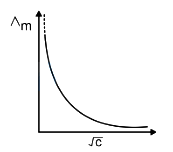
-
- (A) The standard half cell reduction potential for the reduction of \(\mathrm{CO}_2\left(\mathrm{E}_{\mathrm{CO}_2 / \mathrm{CH}_3 \mathrm{OH}}^0\right)\) is 19 mV
- (B) Oxygen is formed at the anode.
- (C) Reactants are fed at one go to each electrode.
- (D) Reduction of methanol takes place at the cathode.
Show answer and solution
Correct Answer: (A)
\(\begin{aligned}
\because \mathrm{E}_{\text {cell }}^{\mathrm{o}} & =\mathrm{E}_{\text {cathode }}^{\mathrm{o}}-\mathrm{E}_{\text {Anode }}^{\mathrm{o}} \\
1.21 & =1.229-\mathrm{E}_{\text {Anode }}^{\mathrm{o}}
\end{aligned}\)
\(\because\) Fuel cell involves oxidation of methanol which will occur at anode and reduction of \(\mathrm{O}_2\) will occur at cathode. - 22. The standard reduction potential values of some of the p-block ions are given below. Predict the one with the strongest oxidising capacity. 2025 Medium
- (A) \(\mathrm{E}_{\mathrm{Pb}^{4+} / \mathrm{Pb}^{2+}}^{\ominus}=+1.67 \mathrm{~V}\)
- (B) \(\mathrm{E}_{\mathrm{Sn}^{4+} / \mathrm{Sn}^{2+}}^{\ominus}=+1.15 \mathrm{~V}\)
- (C) \(\mathrm{E}_{\mathrm{Al}^{3+} / \mathrm{Al}}^{\ominus}=-1.66 \mathrm{~V}\)
- (D) \(\mathrm{E}_{\mathrm{Tl}^{3+}\mathrm{/Tl}}^{\ominus}=1.26 \mathrm{~V}\)
Show answer and solution
Correct Answer: (A)
The element having strongest oxidising capacity will have highest value of standard reduction potential. -
- (A) Dilute solution of sodium sulphate.
- (B) Acidified dilute solution of sodium sulphate.
- (C) Dilute solution of sulphuric acid
- (D) Concentrated solution of sulphuric acid
Show answer and solution
Correct Answer: (D)
Theory based.
At anode :
\(2 \mathrm{HSO}_4^{-} \rightarrow \mathrm{H}_2 \mathrm{~S}_2 \mathrm{O}_8+2 \mathrm{e}^{-}\)
No questions on this page match these filters.