


Questions
15 questionsShowing 1–15 of 15 questions
- 1. A weak acid HA has degree of dissociation x . Which option gives the correct expression of ( pH - \(\mathrm{pK}_{\mathrm{a}}\) )? 2025 Medium
- (A) 0
- (B) \(\log (1+2 \mathrm{x})\)
- (C) \(\log \left(\frac{1-x}{x}\right)\)
- (D) \(\log \left(\frac{x}{1-x}\right)\)
Show answer and solution
Correct Answer: (D)
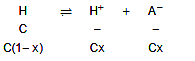
\(\begin{aligned} & \mathrm{K}_{\mathrm{a}}=\frac{\left[\mathrm{H}^{+}\right](\mathrm{x})}{\mathrm{C}(1-\mathrm{x})} \\ & {\left[\mathrm{H}^{+}\right]=\mathrm{K}_{\mathrm{a}} \frac{(1-\mathrm{x})}{\mathrm{x}}} \\ & \log \mathrm{H}^{+}=\log \mathrm{K}_{\mathrm{a}}+\log \left(\frac{1-\mathrm{x}}{\mathrm{x}}\right) \\ & -\log \mathrm{H}^{+}=-\log \mathrm{K}_{\mathrm{a}}-\log \frac{1-\mathrm{x}}{\mathrm{x}} \\ & \mathrm{pH}=\mathrm{pK}_{\mathrm{a}}-\log \frac{1-\mathrm{x}}{\mathrm{x}} \\ & \mathrm{pH}-\mathrm{pK}_{\mathrm{a}}=\log \frac{\mathrm{x}}{1-\mathrm{x}}\end{aligned}\) -
- (A) reduce to \(0.5\)
- (B) increase to \(1.3\)
- (C) remain same
- (D) increase to \(2\)
Show answer and solution
Correct Answer: (B)
\(\mathrm{HCl}_{(\mathrm{aq})} \mathrm{pH}=1 ;\left[\mathrm{H}^{+}\right]=10^{-1}\)
If equal volume of water is added concentration will become half
\(\begin{aligned}& {\left[\mathrm{H}^{+}\right]_{\mathrm{sol}}=\frac{10^{-1}}{2}} \\& \mathrm{pH}=1.3\end{aligned}\) -
- (A) \(\mathrm{HgS} \lt \mathrm{AgBr} \lt \mathrm{PbS} \lt \mathrm{Ca}(\mathrm{OH})_2\)
- (B) \(\mathrm{Ca}(\mathrm{OH})_2 \lt \mathrm{AgBr} \lt \mathrm{HgS} \lt \mathrm{PbS}\)
- (C) \(\mathrm{PbS} \lt \mathrm{HgS} \lt \mathrm{Ca}(\mathrm{OH})_2 \lt \mathrm{AgBr}\)
- (D) \(\mathrm{HgS} \lt \mathrm{PbS} \lt \mathrm{AgBr} \lt \mathrm{Ca}(\mathrm{OH})_2\)
Show answer and solution
Correct Answer: (D)
Based on the Ksp values and salt analysis cation identification, we can say that order of Ksp value is:
\(\mathrm{HgS} < \mathrm{PbS} < \mathrm{AgBr} < \mathrm{Ca}(\mathrm{OH})_2\)
K sp values
\(\begin{aligned}
& \mathrm{HgS} \rightarrow 4 \times 10^{-53} \\
& \mathrm{PbS} \rightarrow 8 \times 10^{-28} \\
& \mathrm{AgBr} \rightarrow 5 \times 10^{-13} \\
& \mathrm{Ca}(\mathrm{OH})_2 \rightarrow 5.5 \times 10^{-6}
\end{aligned}\) -
- (A) CoS
- (B) ZnS
- (C) NiS
- (D) MnS
Show answer and solution
Correct Answer: (A)
Compound \((A)\) in the given reaction sequence is likely to be CoS.
\(\begin{aligned} \mathrm{CoS}+\mathrm{HNO}_3+3 \mathrm{HCl} \rightarrow \mathrm{Co}^{2+} & +\mathrm{S} \downarrow+\mathrm{NOCl} \uparrow \\ & +2 \mathrm{Cl}^{-}+2 \mathrm{H}_2 \mathrm{O}\end{aligned}\)
The above solution is neutralised with \(\mathrm{NH}_4 \mathrm{OH}\).
To a neutral solution of \(\mathrm{Co}^{2+}\), acetic acid and saturated solution of \(\mathrm{KNO}_2\) are added which results in the formation of yellow precipitate of \(\mathrm{K}_3\left[\mathrm{Co}\left(\mathrm{NO}_2\right)_6\right]\)
\(\mathrm{Co}^{2+}+7 \mathrm{NO}_2^{-}+2 \mathrm{H}^{+}+3 \mathrm{~K}^{+} \rightarrow \mathrm{K}_3\left[\mathrm{Co}\left(\mathrm{NO}_2\right)_6\right]+\mathrm{NO} \uparrow+\mathrm{H}_2 \mathrm{O}\) -
- (A) Statement I is true but Statement II is false
- (B) Both Statement I and Statement II are false
- (C) Both Statement I and Statement II are true
- (D) Statement I is false but Statement II is true
Show answer and solution
Correct Answer: (C)
At melting point when ice melts, supplied heat is utilised to overcome intermolecular attraction within the molecules so temperature remain constant. -
- (A) (A), (D) and (E) only
- (B) (D) and (E) only
- (C) (A) and (B) only
- (D) (A) and (C) only
Show answer and solution
Correct Answer: (B)
\(\mathrm{As}_2 \mathrm{~S}_3\) and \(\mathrm{As}_2 \mathrm{~S}_5\) are yellow colour sulphides, \(\left(\mathrm{NH}_4\right)_2 \mathrm{~S}\) is colourless, PbS is black, CuS is black in colour -
- (A) 10
- (B) 17
- (C) 7
- (D) 5
Show answer and solution
Correct Answer: (C)
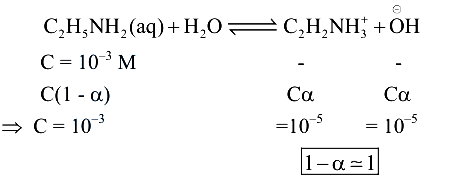
Given, \(\mathrm{P}^{\mathrm{H}}=9 \Rightarrow \mathrm{P}^{\mathrm{OH}}=5 \Rightarrow[\stackrel{\ominus}{\mathrm{OH}}]=10^{-5} \mathrm{M}\)
Now, \(\mathrm{K}_{\mathrm{b}}=\frac{\left[\mathrm{C}_2 \mathrm{H}_5 \mathrm{NH}_3^{+}\right][\stackrel{\ominus}{\mathrm{O}} \mathrm{H}]}{\left[\mathrm{C}_2 \mathrm{H}_5 \mathrm{NH}_2\right]}\)
\(\Rightarrow K_{\mathrm{b}}=\frac{10^{-5} \times 10^{-5}}{10^{-3}}=10^{-7}\) -
- (A) \(3.6 \times 10^{-3} \mathrm{M}~ \mathrm{AB}_2, 5.0 \times 10^{-4} \mathrm{M}~ \mathrm{XY}\)
- (B) \(2.0 \times 10^{-4} \mathrm{M}~ \mathrm{AB}_2, 0.8 \times 10^{-3} \mathrm{M}~ \mathrm{XY}\)
- (C) \(2.0 \times 10^{-2} \mathrm{M}~ \mathrm{AB}_2, 2.0 \times 10^{-2} \mathrm{M}~ \mathrm{XY}\)
- (D) \(1.5 \times 10^{-4} \mathrm{M}~ \mathrm{AB}_2, 1.5 \times 10^{-3} \mathrm{M}~ \mathrm{XY}\)
Show answer and solution
Correct Answer: (C)
When equal volumes are mixed molarity reduce to half.
For precipitation \(\mathrm{Q}_{\mathrm{SP}}=\left[\mathrm{A}^{+2}\right]\left[\mathrm{Y}^{-}\right]^2 \gt \mathrm{K}_{\mathrm{SP}}\)
(1) \(\mathrm{Q}_{\mathrm{SP}}=\left(1.8 \times 10^{-3}\right)\left(\frac{5}{2} \times 10^{-4}\right)^2 \lt \mathrm{K}_{\mathrm{sP}}\)
(2) \(\mathrm{Q}_{\mathrm{SP}}=\left(10^{-4}\right)\left(0.4 \times 10^{-3}\right)^2 \lt \mathrm{K}_{\mathrm{sp}}\)
(3) \(\mathrm{Q}_{\mathrm{SP}}=\left(10^{-2}\right)\left(10^{-2}\right)^2 \gt \mathrm{K}_{\mathrm{sP}}\)
(4) \(\mathrm{Q}_{\mathrm{SP}}=\left(\frac{1.5}{2} \times 10^{-4}\right)\left(\frac{1.5}{2} \times 10^{-3}\right)^2 \lt \mathrm{K}_{\mathrm{sP}}\) -
- (A) \(\frac{1.8 \times 10^{-30}}{27}\)
- (B) \(\sqrt[5]{1.8 \times 10^{-30}}\)
- (C) \(\sqrt[4]{\frac{1.6 \times 10^{-30}}{27}}\)
- (D) \(\sqrt[2]{1.6 \times 10^{-30}}\)
Show answer and solution
Correct Answer: (C)
\(\begin{aligned} & \mathrm{Cr}(\mathrm{OH})_3 \rightleftharpoons \underset{ \mathrm{s}}{\mathrm{Cr}^{3+}}(\mathrm{aq})+\underset{3 \mathrm{~s}}{3 \mathrm{OH}^{-}(\mathrm{aq})} \\ & \mathrm{K}_{\mathrm{sp}}=\mathrm{s}(3 \mathrm{~s})^3 \\ & 1.6 \times 10^{-30}=27 \mathrm{~s}^4 \\ & \sqrt[4]{\frac{1.6 \times 10^{-30}}{27}}=\mathrm{s}\end{aligned}\) -
- (A) 40
- (B) 48
- (C) 50
- (D) 52
Show answer and solution
Correct Answer: (B)
\(\begin{aligned}
& \mathrm{pOH}=\mathrm{pK}_{\mathrm{b}}+\log \frac{\left[\mathrm{NH}_4^{+}\right]}{\left[\mathrm{NH}_3\right]} \\
& \mathbf{p O H}=4.745
\end{aligned}\)
on adding 0.05 mole HCl
\(\begin{aligned}
& \begin{array}{llll}
\mathrm{NH}_3+ & \mathrm{H}^{\oplus} & \rightarrow & \mathrm{NH}_4^{\oplus} \\
0.1 & 0.05 & & 0.1 \\
0.05 & 0 & & 0.15
\end{array} \\
& \mathrm{pOH}^{\prime}=4.745+\log 3 \\
& \mathrm{pOH}^{\prime}-\mathrm{pOH}=0.477 \\
& 14-\mathrm{pH}^{\prime}-14+\mathrm{pH}=0.477 \\
& \Delta \mathrm{pH}=0.477 \\
& =47.7 \times 10^{-2} \approx 48 \times 10^{-2}
\end{aligned}\) - 11. pH of water is 7 at \(25^{\circ} \mathrm{C}\). If water is heated to \(80^{\circ} \mathrm{C}\)., it's pH will : 2025 Easy
- (A) Decrease
- (B) \(\mathrm{H}^{+}\)concentration increases, \(\mathrm{OH}^{-}\)concentration decreases
- (C) Remains the same
- (D) Increase
Show answer and solution
Correct Answer: (A)
At \(25^{\circ} \mathrm{C}\), pure water has \(\mathrm{pH}=7\)
As temperature increased, water molecules dissociate more into hydrogen ions ( \(\mathrm{H}^{+}\)) and hydroxide ions \(\left(\mathrm{OH}^{-}\right)\).
This increased dissociation leads to slightly decrease in pH .
At \(80^{\circ} \mathrm{C}, \mathrm{pH} \approx 6.93\) -
- (A) \(\left(\frac{\mathrm{K}_{\mathrm{sp}}}{9612}\right)^{\frac{1}{3}}\)
- (B) \(\left(\frac{\mathrm{K}_{\mathrm{sp}}}{6912}\right)^{\frac{1}{7}}\)
- (C) \(\left(\frac{\mathrm{K}_{\mathrm{sp}}}{8435}\right)^{\frac{1}{7}}\)
- (D) \(\left(\frac{\mathrm{K}_{\mathrm{sp}}}{5348}\right)^{\frac{1}{6}}\)
Show answer and solution
Correct Answer: (B)
\(\begin{array}{cc}\mathrm{Zr}_3\left(\mathrm{PO}_4\right)_4(\mathrm{~s}) \rightleftharpoons & 3 \mathrm{Zr}^{+4}(\mathrm{aq})+4 \mathrm{PO}_4^{-3}(\mathrm{aq}) \\ - & 3 \mathrm{~s} \quad 4 \mathrm{~s}\end{array}\)
\(\begin{aligned} & \mathrm{K}_{\text {sp }}=(3 \mathrm{~s})^3(4 \mathrm{~s})^4=6912 \mathrm{~s}^7 \\ & \mathrm{~s}=\left(\frac{\mathrm{K}_{\mathrm{sp}}}{6912}\right)^{1 / 7}\end{aligned}\) -
- (A) Both \(\mathrm{A}(\mathrm{OH})_2\) and \(\mathrm{B}(\mathrm{OH})_3\) do not show precipitation with \(\mathrm{NH}_4 \mathrm{OH}\)
- (B) \(\mathrm{A}(\mathrm{OH})_2\) will precipitate before \(\mathrm{B}(\mathrm{OH})_3\)
- (C) \(\mathrm{B}(\mathrm{OH})_3\) will precipitate before \(\mathrm{A}(\mathrm{OH})_2\)
- (D) \(\mathrm{A}(\mathrm{OH})_2\) and \(\mathrm{B}(\mathrm{OH})_3\) will precipitate together
Show answer and solution
Correct Answer: (C)
Condition for precipitation \(\mathrm{Q}_{\text {ip }}>\mathrm{K}_{\text {sp }}\)
For \(\left[\mathrm{A}(\mathrm{OH})_2\right]\)
\(\begin{aligned}
& {\left[\mathrm{A}^{2+}\right][\mathrm{OH}]^2>9 \times 10^{-10}} \\
& {\left[\mathrm{~A}^{+2}\right]=1 \mathrm{M}} \\
& \Rightarrow\left[\mathrm{OH}^{-}\right]>3 \times 10^{-5} \mathrm{M}
\end{aligned}\)
For \(\left[\mathrm{B}(\mathrm{OH})_3\right]\)
\(\begin{aligned}
& {\left[\mathrm{B}^{3+}\right]\left[\mathrm{OH}^{-}\right]^3>27 \times 10^{-18}} \\
& {\left[\mathrm{~B}^{3+}\right]=1 \mathrm{M}} \\
& \Rightarrow\left[\mathrm{OH}^{-}\right]>3 \times 10^{-6} \mathrm{M}
\end{aligned}\)
So, \(\mathrm{B}(\mathrm{OH})_3\) will precipitate before \(\mathrm{A}(\mathrm{OH})_2\) - 14. Which of the following mixing of 1 M base and 1 M acid leads to the largest increase in temperature? 2025 Hard
- (A) \(30 \mathrm{~mL} \mathrm{CH}_3 \mathrm{COOH}\) and 30 mL NaOH
- (B) 45 mL \(\mathrm{CH}_3\) COOH and 25 mL NaOH
- (C) 30 mL HCl and 30 mL NaOH
- (D) 50 mL HCl and 20 mL NaOH
Show answer and solution
Correct Answer: (C)
The rise in temperature of neutralization reaction will be maximum for maximum number of moles of strong acid and strong base neutralized and lower volume of final solution.
(3) \(\mathrm{HCl}+\mathrm{NaOH} \rightarrow \mathrm{NaCl}+\mathrm{H}_2 \mathrm{O}\)
mmol \(30 \quad 30\)
Final volume of solution \(=60 \mathrm{~mL}\)
Option (1) and (2) have weak acids and in option (4) only 20 mmol of HCl will be neutralized with 70 mL final volume. -
- (A) 3
- (B) 4
- (C) 5
- (D) 6
Show answer and solution
Correct Answer: (A)
\(\begin{aligned}
& \mathrm{pH}=10 \\
& \mathrm{pOH}=4 \\
& {\left[\mathrm{OH}^{-}\right]=10^{-4}}
\end{aligned}\)
no. of moles of \(\mathrm{OH}^{-}=10^{-4}\)
no. of moles of \(\operatorname{Mg}(\mathrm{OH})_2=\frac{10^{-4}}{2}=5 \times 10^{-5}\)
\(\text { mass of } \begin{aligned}
\mathrm{Mg}(\mathrm{OH})_2 & =5 \times 10^{-5} \times 58 \times 10^3 \mathrm{mg} \\
& =2.9
\end{aligned}\)
No questions on this page match these filters.