


Questions
3 questionsShowing 1–3 of 3 questions
-
- (A) 4,2,2
- (B) 3,3,2
- (C) 2,4,2
- (D) 2,2,4
Show answer and solution
Correct Answer: (A)
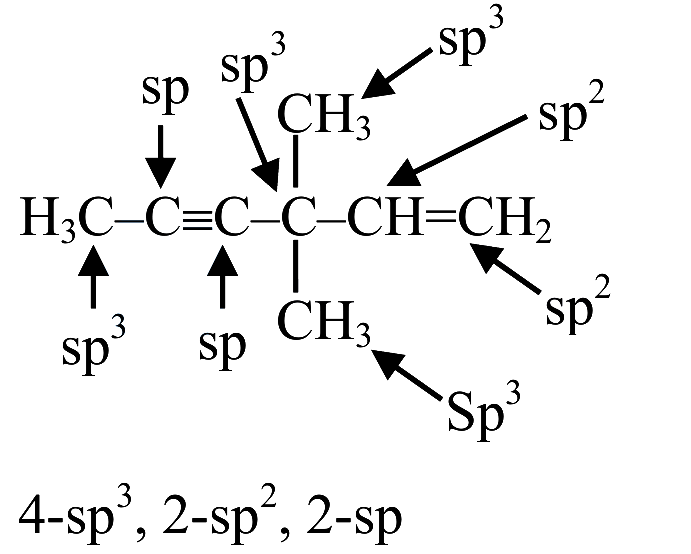
1. Priority Rule in IUPAC: Your assumption about priority is slightly reversed for this case. When numbering the parent carbon chain, multiple bonds (double and triple bonds) are actually given higher priority than alkyl substituents (like methyl groups) to get the lowest possible numbers (locants). While principal functional groups (like -OH, -COOH) have the highest priority, simple substituents like alkyl groups or halogens have lower priority than multiple bonds.
2. Numbering the Chain:
- Numbering from left to right: The multiple bonds get positions 2 and 5.
- Numbering from right to left: The multiple bonds get positions 1 and 4.
Since the locant set (1, 4) is lower than (2, 5), the correct numbering must start from the right (alkene side). Thus, the given IUPAC name "3,3-dimethylhex-1-ene-4-yne" is absolutely correct.
3. Structure & Hybridization Count:
Based on the correct name, the structure is: \( \text{CH}_3-\text{C}\equiv\text{C}-\text{C}(\text{CH}_3)_2-\text{CH}=\text{CH}_2 \)
Let's break down the hybridization of each carbon atom in this molecule:
- \( \text{C}_1 \) (\( =\text{CH}_2 \)): \( \text{sp}^2 \) hybridized (due to double bond)
- \( \text{C}_2 \) (\( -\text{CH}= \)): \( \text{sp}^2 \) hybridized (due to double bond)
- \( \text{C}_3 \) (\( -\text{C}- \)): \( \text{sp}^3 \) hybridized (attached to 4 single bonds)
- Two \( -\text{CH}_3 \) groups attached to \( \text{C}_3 \): Both are \( \text{sp}^3 \) hybridized
- \( \text{C}_4 \) (\( -\text{C}\equiv \)): \( \text{sp} \) hybridized (due to triple bond)
- \( \text{C}_5 \) (\( \equiv\text{C}- \)): \( \text{sp} \) hybridized (due to triple bond)
- \( \text{C}_6 \) (\( -\text{CH}_3 \)): \( \text{sp}^3 \) hybridized (attached to 4 single bonds)
Total Count:
- \( \text{sp}^3 \) carbons: \( 1 \) (at C3) + \( 2 \) (methyls) + \( 1 \) (at C6) = 4
- \( \text{sp}^2 \) carbons: \( 2 \) (C1 and C2) = 2
- \( \text{sp} \) carbons: \( 2 \) (C4 and C5) = 2
Hence, the sequence is 4, 2, 2. Option A is indeed the correct choice. -
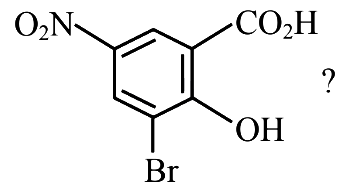
- (A) 3-Bromo-2-hydroxy-5-nitrobenzoic acid
- (B) 3-Bromo-4-hydroxy-1-nitrobenzoic acid
- (C) 2-Hydroxy-3-bromo-5-nitrobenzoic acid
- (D) 5-Nitro-3-bromo-2-hydroxybenzoic acid
Show answer and solution
Correct Answer: (A)
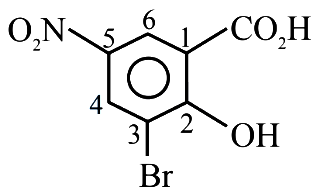
IUPAC 3-Bromo-2-hydroxy-5-nitro-Benzoic acid - 3. Which of the following is the correct IUPAC name of given organic compound \((\mathrm{X})\) ?
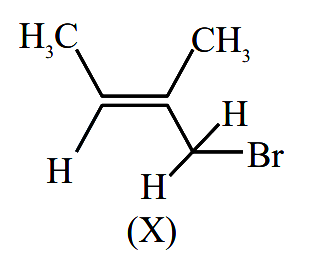
2025 Medium- (A) 2-Bromo-2-methylbut-2-ene
- (B) 3-Bromo-3-methylprop-2-ene
- (C) 1-Bromo-2-methylbut-2-ene
- (D) 4-Bromo-3-methylbut-2-ene
Show answer and solution
Correct Answer: (C)
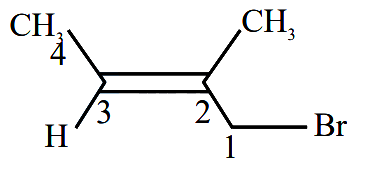
1-Bromo-2-methyl but-2-ene
No questions on this page match these filters.