


JEE Mains · Chemistry · STD 12 - D and f- block elements
- JEE Mains 2025
- Medium
- MCQ
The correct decreasing order of spin only magnetic moment values \((\mathrm{BM})\) of \(\mathrm{Cu}^{+}, \mathrm{Cu}^{2+}, \mathrm{Cr}^{2+}\) and \(\mathrm{Cr}^{3+}\) ions is which?
Pick an option to check your answer.
Answer & Solution
Correct Answer
(C) \(\mathrm{Cr}^{2+} \gt \mathrm{Cr}^{3+} \gt \mathrm{Cu}^{2+} \gt \mathrm{Cu}^{+}\)
Step-by-step Solution
Detailed explanation
\(\mathrm{Cu}^{+}:[\mathrm{Ar}] 3 \mathrm{~d}^{10}\), Spin only magnetic moment \(=0\)
B.M.
\(\mathrm{Cu}^{+2}:[\mathrm{Ar}] 3 \mathrm{~d}^9\), Spin only magnetic moment \(=\sqrt{3}\)
B.M.
\(\mathrm{Cr}^{+2}:[\mathrm{Ar}] 3 \mathrm{~d}^4\), Spin only magnetic moment \(=\sqrt{24}\)
B.M.
\(\mathrm{Cr}^{+3}:[\mathrm{Ar}] 3 \mathrm{~d}^3\), Spin only magnetic moment \(=\sqrt{15}\)
B.M.
Order of \(\mu\) : \(\mathrm{Cr}^{+2} \gt \mathrm{Cr}^{+3} \gt \mathrm{Cu}^{+2} \gt \mathrm{Cu}^{+}\)
More questions from Chemistry
- Coagulation of egg, on heating is because of _______.JEE Mains 2024 Medium
- What is the correct sequence of reagents used for converting nitrobenzene into \(m\) -dibromobenzene?
 JEE Mains 2021 Easy
- \(A.\) Phenyl methanamine \(B.\) \(N , N\) -Dimethylaniline \(C.\) N-Methyl aniline \(D.\) Benzenamine Choose the correct order of basic nature of the above amines.JEE Mains 2021 Easy
- Following four solutions are prepared by mixing different volumes of \(NaOH\) and \(HCl\) of different concentrations, \(pH\) of which one of them will be equal to \(1\)?JEE Mains 2018 Medium
- For the given cell
\(\mathrm{Fe}^{2+}{ }_{(\mathrm{aq})}+\mathrm{Ag}^{+}{ }_{(\mathrm{aq})} \rightarrow \mathrm{Fe}_{(\mathrm{aq})}^{3+}+\mathrm{Ag}_{(\mathrm{s})}\)
The standard cell potential of the above reaction is Given:
\(\begin{array}{lr}
\mathrm{Ag}^{+}+\mathrm{e}^{-} \rightarrow \mathrm{Ag} & \mathrm{E}^\theta=\mathrm{xV} \\
\mathrm{Fe}^{2+}+2 \mathrm{e}^{-} \rightarrow \mathrm{Fe} & \mathrm{E}^\theta=\mathrm{yV} \\
\mathrm{Fe}^{3+}+3 \mathrm{e}^{-} \rightarrow \mathrm{Fe} & \mathrm{E}^\theta=\mathrm{zV}
\end{array}\)JEE Mains 2025 Medium - Which one of the following reagents is not suitable for the elimination reaction ?
 JEE Mains 2016 Hard
More PYQs from JEE Mains
- The decay of a proton to neutron is :JEE Mains 2021 Medium
- The total number of acidic oxides from the following list is: \(NO , N _{2} O , B _{2} O _{3}, N _{2} O _{5}, CO\), \(SO _{3}, P _{4} O _{10}\)JEE Mains 2022 Medium
- Three conductors of same length having thermal conductivity \(\mathrm{k}_1, \mathrm{k}_2\) and \(\mathrm{k}_3\) are connected as shown in figure.
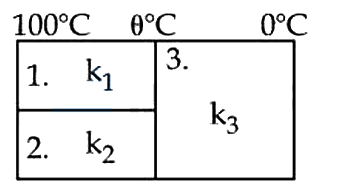
Area of cross sections of \(1^{\text {st }}\) and \(2^{\text {nd }}\) conductor are same and for \(3^{\text {rd }}\) conductor it is double of the \(1^{\text {st }}\) conductor. The temperatures are given in the figure. In steady state condition, the value of \(\theta\) is _______ \({ }^{\circ} \mathrm{C}\).
(Given : \(\mathrm{k}_1=60 \mathrm{Js}^{-1} \mathrm{~m}^{-1} \mathrm{~K}^{-1}, \mathrm{k}_2=120 \mathrm{Js}^{-1}\mathrm{~m}^{-1}\) \( \mathrm{~K}^{-1}, \mathrm{k}_3=135 \mathrm{Js}^{-1} \mathrm{~m}^{-1} \mathrm{~K}^{-1}\) )JEE Mains 2025 Medium - In the circuit shown below, maximum zener diode current will be \(.....mA\)
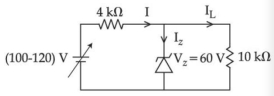 JEE Mains 2022 Medium
- A metal wire of resistance \(3\,\Omega \) is elongated to make a uniform wire of double its previous length. The new wire is now bent and the ends joined to make a circle. If two points on this circle make an angle \(60^o\) at the centre, the equivalent resistance between these two points will beJEE Mains 2019 Medium
- Which is the most suitable reagent for the following transformation ? \(\begin{array}{*{20}{c}}
{\,\,\,\,\,\,\,\,\,\,\,\,\,\,\,\,\,\,\,\,\,\,\,\,\,\,\,\,\,\,\,\,\,\,\,\,\,\,\,\,\,\,\,\,\,\,\,\,\,\,\,\,OH} \\
{\,\,\,\,\,\,\,\,\,\,\,\,\,\,\,\,\,\,\,\,\,\,\,\,\,\,\,\,\,\,\,\,\,\,\,\,\,\,\,\,\,\,\,\,\,\,\,\,\,\,|\,\,} \\
{C{H_3} - CH = CH - C{H_2} - CH - C{H_3}}
\end{array}\) \(\longrightarrow \) \(C{H_3} - CH = CH - C{H_2}C{O_2}H\)JEE Mains 2019 Hard